

OTA Testing Market Summary:
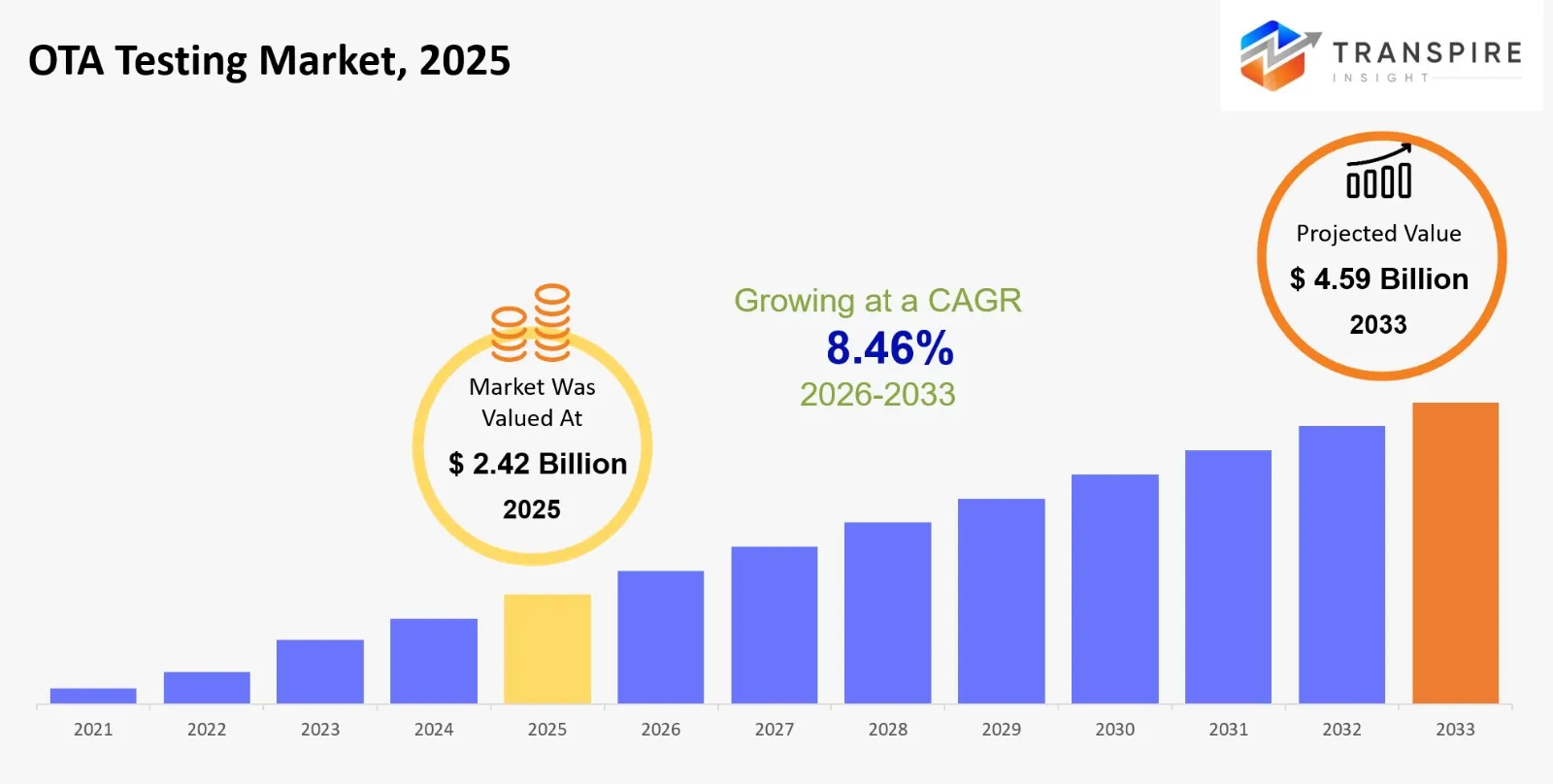
As per the Transpire Insight Analysis, The OTA Testing Market size is estimated at USD 2.42 billion in 2025 and is anticipated to reach USD 4.59 billion by 2033, growing at a CAGR of 8.46% from 2026 to 2033.
Over-the-air (OTA) testing evaluates the performance of a wireless device in a true radio environment, testing connectivity, antenna efficiency and performance, performance in handovers, resistance to interference, and ability to maintain software and firmware updates over the air, all without requiring physical connections. Historically, OTA testing was the final certification step, but it has evolved into an early design-control point as antenna concentration in densely-packaged hardware like 5G/ Wi-Fi 6/7/ IoT and connected vehicles has shifted toward product designs that are software-defined, antenna-integrated, and losing line-of-sight RF test points on test benches. Largely accelerated by automotive adoption of UN R155/R156, integrating cybersecurity and OTA software-update assurance into the type approval process; connected fleets, EV platforms, and telematics require OTAs for OTA assurance to prevent field failures, recalls, and certification delays-turning validation costs into value that guides the product to market.
OTA Testing Market Size & Forecast:
- Market Size 2025: USD 2.42 Billion
- Expected Market Value (2033): USD 4.59 Billion
- Forecast CAGR (2026–2033): 8.46%
- Leading Region in 2025: Asia Pacific
- Fastest Growing Region: North America
- Key Company Profiles: Keysight Technologies, Rohde & Schwarz, Anritsu, ETS-Lindgren, Bluetest, MVG, SGS, Intertek, UL Solutions, Spirent Communications, National Instruments, Cetecom, Bureau Veritas, TÜV Rheinland, TÜV SÜD.
Key OTA Testing Market Insights:
Competitive advantage is moving toward automated, standards-ready test ecosystems, and OTA testing is becoming the test point for 5G, mmWave, and satellite-connected device launches.
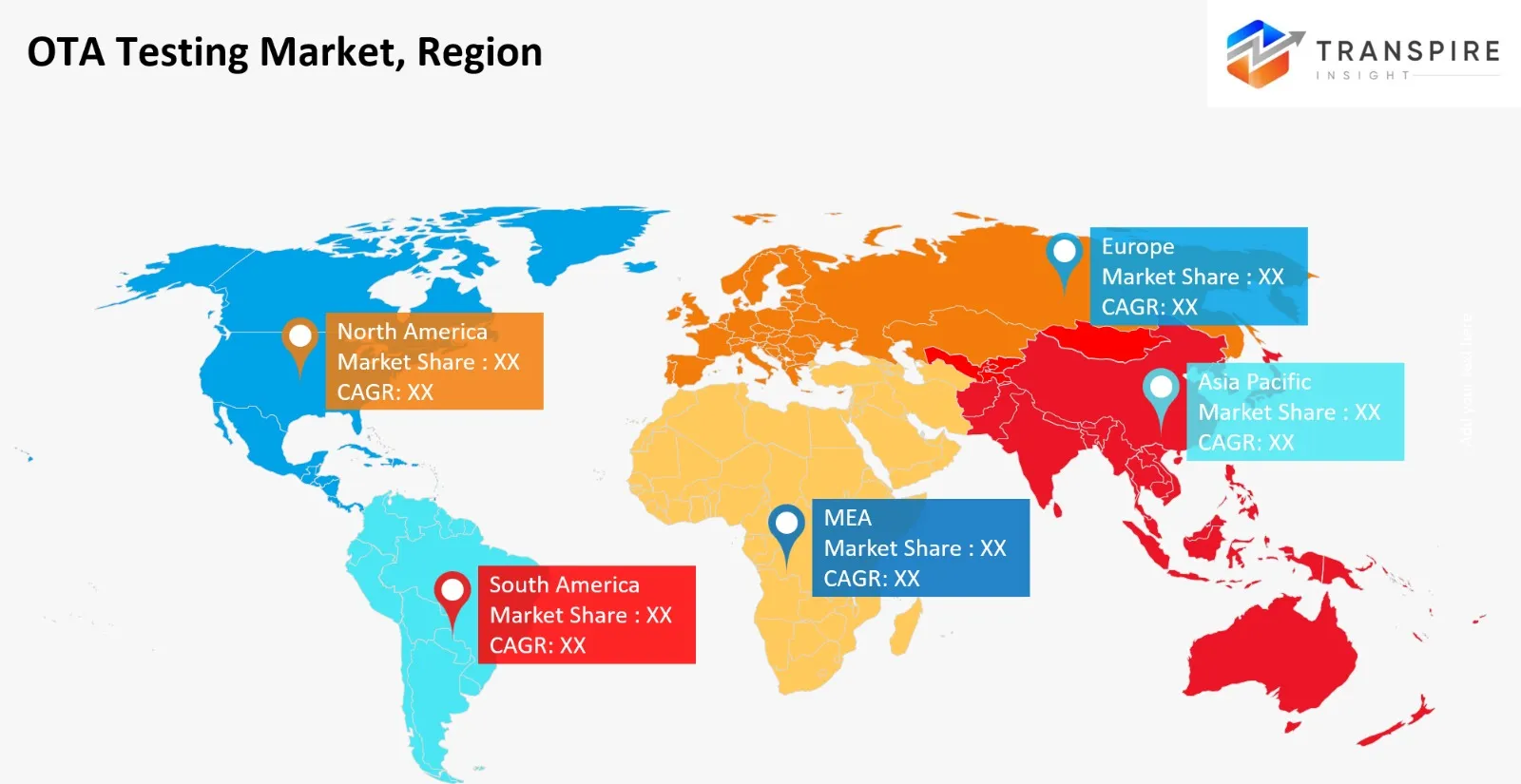
- Asia Pacific is the largest market, accounting for 32.4% of the current market, due to the high volume of 5G device manufacturing and growing capacity in the local certification market.
- North America accounts for 30.0% of the market; North Carolina-based Keysight took a step forward with Korea Testing Laboratory for satellite 5G acceptance testing
- Europe accounts for 23.5%, and Rohde & Schwarz showcased its ATS1800C CATR system for phased-array antenna testing at European Microwave Week 2026.
- For Latin America, the percentage is 8.0%, with increased use of pre-certified devices from abroad and a greater need for local acceptance testing.
- Middle East & Africa is a sub-segment of 6.1%, as satellite connectivity is driving demand for NTN-ready validation services.
- North America is expected to see a 6.0% CAGR, supported by 5G FR2, automotive connectivity and defence-use RF programs.
- ETS-Lindgren has designed approximately 80% of all CTIA OTA facilities around the world, solidifying its role in chamber design and certification infrastructure.
- The compact chamber offered by Anritsu can be deployed in less than 5 days, signalling a trend toward space-saving, quick-deployment test capacity.
- In July 2026, SGS further enhanced its AI-based assurance infrastructure by introducing CertX, marking the automation of evidence of certification and audit traceability.
What are the Key Drivers, Restraints, and Opportunities in the OTA Testing Market?
Driver:
The transition toward antenna-integrated 5G devices, massive MIMO, and connected automotive systems is increasing the complexity of wireless validation. Manufacturers must verify radiated performance rather than rely exclusively on conducted measurements. The expansion of 5G frequency bands and advanced beamforming capabilities requires more sophisticated test configurations, increasing demand for specialized chambers, instrumentation, and testing software. This directly supports equipment purchases and laboratory service revenue.
Restraint:
Test complexity and capital intensity remain the main constraints. A single 5G device may need validation across sub-6 GHz and mmWave bands, multiple antenna orientations, operator profiles, thermal conditions, and security-update scenarios. The constraint persists because chamber capacity, probe calibration, and skilled RF engineering do not scale as quickly as device variants; smaller IoT and wearable makers therefore face certification bottlenecks and longer time-to-market.
Opportunity:
Satellite-based connectivity offers a significant expansion opportunity. 3GPP-standardized NTN technologies are enabling communication beyond terrestrial network coverage. Testing providers can develop satellite channel emulation, Doppler simulation, and integrated cellular-satellite validation capabilities. Investment in modular OTA laboratories and remote-access testing services could help manufacturers reduce validation costs while supporting emerging satellite-connected smartphones, IoT sensors, and automotive communication systems.
Driver Impact Analysis – OTA Testing Market
|
Driver |
Relative Impact on Growth (%) |
Geographic Relevance |
Impact Timeline |
Demand Strength |
Growth Mechanism |
Key Beneficiaries |
Major Constraint |
|
5G-Advanced, mmWave and Massive MIMO Deployment |
30% |
North America, Asia Pacific, Europe |
Medium-term (2–4 years) |
High |
Expanding 5G frequencies increase radiated testing complexity. |
OTA equipment manufacturers, RF test providers, telecom OEMs |
High equipment costs and specialized engineering requirements. |
|
Increasing Wireless Device Complexity and IoT Proliferation |
24% |
Asia Pacific, North America |
Long-term (≥4 years) |
High |
Connected devices require extensive multi-band validation. |
Consumer electronics manufacturers, IoT vendors, testing laboratories |
Fragmented standards and diverse device architectures. |
|
Stringent Wireless Certification and Regulatory Compliance Requirements |
18% |
North America, Europe, Asia Pacific |
Short-term (≤2 years) |
High |
Mandatory certification increases demand for accredited testing. |
Certification laboratories, compliance specialists, wireless manufacturers |
Regulatory variations increase testing costs and delays. |
|
Automotive Connectivity, V2X and Software-Defined Vehicle Adoption |
16% |
North America, Europe, Asia Pacific |
Medium-term (2–4 years) |
High |
Connected vehicles require comprehensive antenna performance validation. |
Automotive OEMs, automotive test laboratories, RF equipment suppliers |
Complex vehicle testing environments and lengthy validation cycles. |
|
Advanced OTA Automation, AI Analytics and Emerging Wireless Technologies |
12% |
North America, Europe, Asia Pacific |
Long-term (≥4 years) |
Medium |
Automated measurements improve throughput and testing efficiency. |
Test equipment vendors, software developers, research laboratories |
Integration complexity and limited specialized technical expertise. |
|
Total |
100% |
— |
— |
— |
— |
— |
— |
What Has the Impact of Artificial Intelligence Been on the OTA Testing Market?
AI is evolving OTA testing from a tool to extract data with defined, repetitive measurements into a risk-based release confirmation system. For automation, machine-learning algorithms will optimise regression cases, plan chamber time, and correlate radio frequency results with fielded data, all of which should enable minimization of repeat tests in 5G NR, Wi-Fi, and vehicle connectivity programs. AI's ability to predict beamforming loss, handover failure, receiver sensitivity drift, and post-compromise update failures before the vehicle is deployed can be invaluable for mitigations that impact latency variance, cell handoff, packet break-up, and Doppler on real vehicle radio. From the manufacturing perspective, AI enables cloud orchestration of physical test benches, virtual ECUs, and the vehicle telemetry stream to allow more model year/multiple network validation without building more chambers. The main barrier to adoption is the requirement for a calibrated, labelled multi-domain signal base, and lopsided test configurations can undermine the efficacy of AI predictions. Furthermore, high deployment costs and a shortage of RF/cybersecurity/automotive software engineers inhibit broad adoption.
In March 2026, Anritsu announced that it had jointly verified AI-based antenna optimisation technologies alongside SK Telecom, Pohang University of Science and Technology (POSTECH), and Bluetest. https://www.anritsu.com/en-us/test-measurement/news/news-releases/2026/2026-03-25-us01
Key OTA Testing Market Trends:
The market is shifting from individual radio validation to full system validation of connected devices, networks and user experiences. The testing provider is increasingly deploying specialist software, hardware and automation to handle complex connectivity needs.
- Testing is moving earlier into R&D as integrated antennas and mmWave arrays eliminate traditional conducted access points.
- 5G stand-alone deployment is driving validation to go beyond simple RF, to slicing, to mobility, and to edge computing behaviour.
- The increase of CATR systems, multi-probe anechoic chambers and near far field software are all stimulated by mmWave adoption.
- Doppler, orbital-motion, and low-elevation beam-tracking test requirements are being introduced by satellite direct-to-device services.
- AI-based test selection is replacing wide-ranging regression suites with risk-based, adaptive validation.
- Cloud orchestration is helping to enable parallel remote testing in geographically dispersed labs.
- Digital twins are complementing real-world chambers by modelling the behaviour of antennas and network conditions before testing.
- The need for cybersecurity and secure firmware-update validation is now the expected standard for OTA, rather than an option.
- Operators and certification bodies are asking for more operator-specific acceptance evidence before commercial launch.
- The complexity of the OTA validation process is being outsourced to specialised labs so that makers of IoT and wearables can manage the certification process.
OTA Testing Market Segmentation
Offering:
Hardware provides essential chambers, antennas, and RF measurement instruments, while software enables signal analysis and test execution. Services support outsourced validation and certification, whereas test automation improves measurement consistency and throughput. Test management coordinates complex testing workflows, analytics identifies performance anomalies, and consulting helps manufacturers navigate technical and regulatory requirements. Future growth will favour integrated solutions combining physical infrastructure with software-based validation.
Technology:
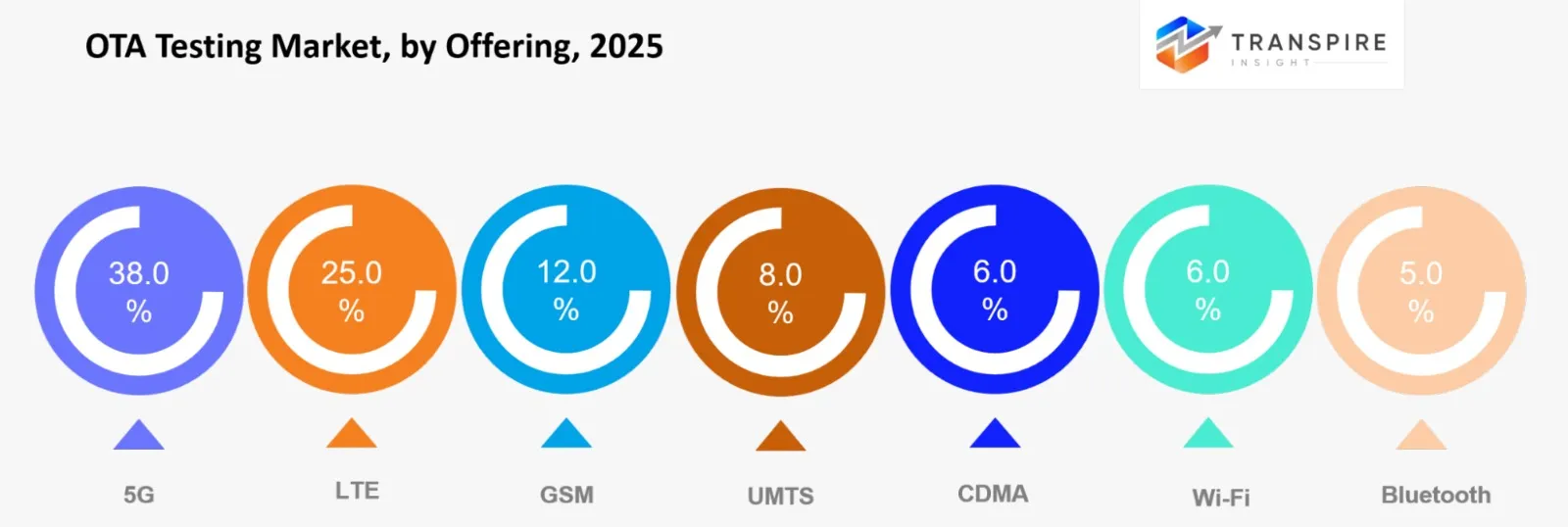
5G remains the largest segment at 38.0%, with LTE at 25.0%, GSM at 12.0%, UMTS at 8.0%, CDMA at 6.0%, Wi-Fi at 6.0%, and Bluetooth at 5.0%, thus summing to 100%. 5G is the leading segment, reflecting the MIMO, beamforming, and mmWave validation requirements. LTE is still significant in terms of compatibility testing, with support for GSM, UMTS and CDMA to maintain backward compatibility. Connected devices demand more testing of Wi-Fi and Bluetooth. There is also a new opportunity for satellite non-terrestrial networks, with an expected compound annual growth rate of 6.21% due to satellite-enabled communications and validation testing needs.
Test Type:
Conformance and certification testing ensure compliance with wireless standards and regulatory requirements, while interoperability testing verifies compatibility across devices and networks. Performance and functional testing evaluate connectivity and device behaviour, whereas security and reliability testing address vulnerabilities and operational resilience. Telecom remains a core application, supported by consumer electronics, automotive, IoT, healthcare wearables, aerospace and defence, and smart homes. Connected vehicles and industrial IoT increasingly require specialised validation to maintain reliable communication across complex wireless environments.
Application:
Telecom is supported by consumer electronics, automotive, IoT, healthcare wearables, aerospace and defence, and smart homes. Automotive manufacturers require reliable wireless communication across integrated vehicle systems, while industrial IoT applications prioritise connectivity stability and operational continuity. Wearables demand compact-device validation, whereas aerospace and defence applications emphasise communication reliability under demanding conditions. These diverse requirements will encourage specialised OTA testing services, advanced validation capabilities, and comprehensive testing workflows, supporting increasingly complex wireless product development and deployment.
Test Environment:
Far-field chambers enable controlled radiated measurements, while near-field systems and compact antenna test ranges support specialised antenna evaluation. Reverberation chambers simulate multipath propagation, helping assess wireless performance under complex conditions, whereas anechoic chambers minimise electromagnetic reflections for accurate measurements. OTA laboratories provide dedicated validation infrastructure, while field testing evaluates real-world connectivity. Increasing antenna integration, advanced beamforming, and diverse wireless standards are encouraging laboratories to adopt flexible testing environments, improve measurement accuracy, and accommodate evolving device architectures and connectivity requirements.
Device Type:
OTA laboratories provide controlled validation, while field testing captures real-world connectivity performance. Smartphones remain key testing targets, alongside connected vehicles, IoT devices, wearables, routers, tablets, and industrial equipment. Each category presents distinct antenna configurations, signal requirements, and operating conditions. Increasing antenna integration and wireless complexity are encouraging laboratories to invest in flexible, upgradeable infrastructure. Such systems will support diverse device architectures, simplify testing across emerging connectivity standards, and improve adaptability as manufacturers introduce increasingly sophisticated wireless products across consumer, automotive, and industrial applications.
What are the Key Use Cases Driving the OTA Testing Market?
The core use case is 5G smartphone and telecom equipment validation, directly linked to the dominant 5G technology segment. Manufacturers use OTA testing to verify antenna efficiency, signal reception, MIMO performance, and radiated transmission quality before certification. These measurements help prevent connectivity issues that could affect commercial launches and customer experience.
Expanding applications include connected vehicles, industrial IoT, Wi-Fi-enabled consumer electronics, and healthcare wearables. Automotive manufacturers validate wireless connectivity across vehicle-integrated systems, while industrial users prioritise reliable communication in demanding environments.
Emerging use cases include satellite-connected smartphones, NTN-enabled IoT devices, and direct-to-device communication. These applications require testing under simulated satellite motion, Doppler shifts, and changing signal conditions.
|
Report Metrics |
Details |
|
Market size value in 2025 |
USD 2.42 Billion |
|
Market size value in 2026 |
USD 2.62 Billion |
|
Revenue forecast in 2033 |
USD 4.59 Billion |
|
Growth rate |
CAGR of 8.46% from 2026 to 2033 |
|
Base year |
2025 |
|
Historical data |
2021 - 2024 |
|
Forecast period |
2026 - 2033 |
|
Report coverage |
Revenue forecast, competitive landscape, growth factors, and trends |
|
Regional scope |
United States; Canada; Mexico; United Kingdom; Germany; France; Italy; Spain; Denmark; Sweden; Norway; China; Japan; India; Australia; South Korea; Thailand; Brazil; Argentina; South Africa; Saudi Arabia; United Arab Emirates |
|
Key companies profiled |
Keysight Technologies, Rohde & Schwarz, Anritsu, ETS-Lindgren, Bluetest, MVG, SGS, Intertek, UL Solutions, Spirent Communications, National Instruments, Cetecom, Bureau Veritas, TÜV Rheinland, TÜV SÜD. |
|
Customization scope |
Free report customization (country, regional & segment scope). Available customized purchase options to meet your exact research needs. |
|
Report Segmentation |
Offering (Hardware, Software, Services, Test Automation, Test Management, Analytics, Consulting); Technology (5G, LTE, GSM, UMTS, CDMA, Wi-Fi, Bluetooth); Test Type (Conformance Testing, Certification Testing, Interoperability Testing, Performance Testing, Functional Testing, Security Testing, Reliability Testing); Application (Telecom, Consumer Electronics, Automotive, IoT, Healthcare Wearables, Aerospace & Defense, Smart Home); Test Environment (Far-Field Chambers, Near-Field Systems, Compact Antenna Test Range, Reverberation Chambers, Anechoic Chambers, OTA Labs, Field Testing); Device Type (Smartphones, Connected Vehicles, IoT Devices, Wearables, Routers, Tablets, Industrial Devices). |
Which Regions are Driving the OTA Testing Market Growth?
Asia Pacific dominates with 32.4% of the OTA testing market, which has both large-volume smartphones, IoT and automotive electronics production and a rapidly growing installer base of both 5G networks and certification labs. APAC has the benefit of not just volume manufacturing capacity, but the smaller distances between chipset suppliers, device OEMs, network operators and test-equipment vendors help shorten design-validation cycles. Digital-infrastructure investments, with an emphasis on 5G spectrum policies and new local content requirements, also influence in-region testing and certification, while APAC is an early adopter of NTN-capable test solutions for satellite direct-to-device and industrial IoT deployments.
In June 2026, Rohde & Schwarz supplied the independent test house BTL Laboratory in Taiwan with an R&S TS8991 OTA test system compliant with CTIA certification requirements. This installation expanded accredited OTA testing capacity in the Asia-Pacific region, enabling local device manufacturers to complete rapid, certification-grade radiated testing for advanced wireless features. https://www.rohde-schwarz.com/in/about-us/news-press/all-news/btl-laboratory-becomes-taiwan-s-first-test-house-with-a-ctia-certification-compliant-ota-test-system-by-rohde-schwarz_229356-1626219.html
Europe represents 23.5% of the market and is able to compete on engineering competency, regulatory leverage and focus on the automotive industry rather than on volumes of consumer devices. Europe's resilient position will be underpinned by strong automotive connectivity campaigns, 3GPP & ETSI participation and a broad tradition of test-equipment and certification providers, while Europe could be poised for growth with Asia Pacific's throwaway demand driven by manufacturing, vehicle-to-anything validation, cyber security and industrial wireless. This will insulate Europe from the boom & bust smartphone cycles, but increase its dependency on automotive & industrial cycles.
In July 2026, Hyundai and Kia partnered with energy service platform AllDayEnergy to integrate advanced bidirectional vehicle-to-everything (V2X) charging capabilities through the Kia App in the United Kingdom. https://www.hyundai.com/worldwide/en/newsroom/detail/0000001237
North America, with a 30.0% market share and an estimated CAGR of around 6.0% for the year, is the fastest-growing major region driven by recent developments in 5G Frequency Range 2 (FR2), private networks, defence communications and satellite connectivity. The need to extend New Radio Non-Terrestrial Networks (NR-NTN) from terrestrial-only 5G to cover orbital mobility, Doppler compensation and low-elevation beam steering has prompted new validation requirements. Keysight's satellite-to-mobile testing with Samsung and Keysight's work on NR-NTN with KTL represent North American test-platform innovation impacting certification workflows around the world. Upcoming areas for growth include 6G research, artificial-intelligence-enabled test automation, and resilient communications for defence markets.
In October 2026, Keysight Technologies, Inc. introduced agentic artificial intelligence capabilities into its Advanced Design System (ADS) 2027 software. This product launch enables radio frequency (RF) engineers to connect large language models (LLMs) to specialised simulation environments using Model Context Protocol (MCP) servers, automating complex design generation, layout verification, and circuit optimisation workflows. https://www.hpcwire.com/aiwire/2026/10/06/keysight-advances-its-design-software-with-agentic-ai/
Who are the Key Players in the OTA Testing Market, and how do they compete?
The competition is now becoming separated between instrumentation and measurement physics specialists and market access control certification companies. Hardware vendors are competing in the size of the chamber, coverage of the frequency, automation, and so on, whereas testing and certification companies compete with their worldwide laboratory networks, regulatory knowledge, and speed of acceptance. There's a blurring of the line between equipment vendors integrating software, emulation, and analytics, and certification vendors investing in digital evidence management and artificial-intelligence-based assurance.
Keysight Technologies adopts an innovation-led approach to differentiate itself with end-to-end 5G/NTN emulation, GCF-validated test cases, and partnership with Samsung and KTL. Its growth path is connected instruments, chambers, and certification workflows. Rohde & Schwarz's compact engineering and phased-array capability, and a chamber and ZNA analyser that is designed for labs with minimal floor space, help to distinguish it from its competitors. Anritsu can compete by bringing quick turnaround times for field-ready testing, such as with its chamber that takes fewer than five days to install, while ETS-Lindgren's low- to mid-range infrastructure niche is defined by its role in 80% of CTIA Over-The-Air (OTA) facilities, with chamber design, installation, and compliance-focused services. Bluetest, MVG, Spirent Communications, and National Instruments differentiate via expertise in measurement, channel emulation, and software-defined automation, respectively. SGS, Intertek, UL Solutions, Cetecom, Bureau Veritas, TÜV Rheinland and TÜV SÜD differentiate on accredited capacity, industry expertise, and regulatory acceptance; SGS's AI-augmented assurance work with CertX due in 2026 exemplifies certification firms' transition to traceable, automated workflows.
Key Players are:
- Bluetest
- MVG
- SGS, Intertek
- UL Solutions
- Spirent Communications
- National Instruments
- Cetecom
- Bureau Veritas
- TÜV Rheinland
- TÜV SÜD
OTA Testing Market — Enhanced Competitive Benchmarking
|
Company |
Est. Revenue Share Range |
Key Offerings |
Strategic Positioning |
Geographic Strength |
Technology Focus |
|
Keysight Technologies |
14–18% |
5G/6G OTA test systems, RF measurement instruments, wireless test software, CATR solutions |
Integrated wireless testing leader with broad instrumentation portfolio |
North America, Asia Pacific, Europe |
RF measurement, 5G/6G, MIMO, automated test software |
|
Rohde & Schwarz |
9–12% |
ATS800R/ATS1000 OTA chambers, CMX500, wireless communication testers, RF measurement systems |
Premium end-to-end testing systems for advanced wireless development |
Europe, North America, Asia Pacific |
5G NR, FR2/mmWave, RF measurement, chamber-based testing |
|
VIAVI Solutions |
6–9% |
Wireless network testing, 5G validation systems, Open RAN testing, network emulation |
Network-focused testing specialist serving telecom operators and equipment vendors |
North America, Europe, Asia Pacific |
5G network validation, Open RAN, network emulation |
|
Emerson (NI) |
4–7% |
PXI-based RF testing, vector signal transceivers, LabVIEW, TestStand |
Modular automation platform for customised wireless test environments |
North America, Europe, Asia Pacific |
PXI instrumentation, RF automation, software-defined testing |
|
Anritsu Corporation |
4–6% |
MT8000A, MT8821C, WLAN testers, cellular communication test platforms |
Wireless protocol and RF measurement specialist with strong OEM relationships |
Asia Pacific, North America, Europe |
5G NR, Wi-Fi 7, cellular protocol testing |
|
ETS-Lindgren |
2–4% |
OTA test chambers, AMS-5703 CATR, reverberation chambers, antenna measurement systems |
Specialized chamber supplier emphasising measurement environments |
North America, Europe, Asia Pacific |
Anechoic chambers, CATR, antenna characterisation |
|
Microwave Vision Group (MVG) |
2–4% |
Multi-probe OTA systems, StarMIMO, antenna measurement systems, automotive OTA solutions |
Chamber and antenna measurement specialist with advanced system integration |
Europe, North America, Asia Pacific |
Multi-probe measurement, spherical near-field, automotive OTA |
|
SGS |
3–5% |
Wireless device certification, 5G OTA testing, RF performance validation, regulatory testing |
certification provider leveraging accredited laboratory networks |
Europe, Asia Pacific, North America |
RF compliance, 5G validation, accredited OTA testing |
|
Intertek Group plc |
3–5% |
Wireless device testing, OTA performance evaluation, regulatory certification, telecommunications testing |
Compliance-led testing partner supporting product launches |
Europe, North America, Asia Pacific |
Wireless compliance, RF validation, certification testing |
|
UL Solutions |
2–4% |
Wireless device testing, OTA performance assessment, RF certification, connectivity testing |
Safety and compliance specialist integrating wireless validation services |
North America, Europe, Asia Pacific |
RF performance, wireless certification, compliance validation |
Recent Development News
- In January 2026, Keysight Technologies launched a Wireless Coexistence Test Solution designed to automate validation of wireless devices operating in congested RF environments. The solution helps manufacturers assess multi-radio interference and improve testing efficiency as connected devices incorporate increasingly complex wireless technologies. https://www.businesswire.com/news/home/20260127649425/en/Keysight-Launches-Wireless-Coexistence-Test-Solution-to-Accelerate-Compliance-and-Innovation
- In October 2026, Valeo and Anritsu announced an expanded digital twin validation solution for software-defined vehicles at the 5G Automotive Association meeting in New Delhi. The collaboration combines virtual ECU simulation with cellular network testing to validate connectivity scenarios, including OTA updates and network handoffs, reducing dependence on physical testing and supporting faster automotive connectivity validation. https://www.valeo.com/en/valeo-and-anritsu-to-showcase-digital-twin-validation-solution-for-software-defined-vehicles-at-the-5gaa-meeting/
What Strategic Insights Define the Future of the OTA Testing Market?
The industry is moving towards continuous cloud-orchestrated validation that incorporates physical test chambers, virtual network twins, and field telemetry into unified release-assurance systems. This evolution will support more flexible testing, remove validation bottlenecks, and speed up wireless launches.
A looming risk is that this may lead to an over-dependence on artificial intelligence-based test prioritisation. Without calibrated multi-vendor test datasets, algorithms might not detect rare but impactful failures of NTN handovers or mmWave beams and could impact device certification success. The emerging opportunity is NTN and device direct testing. Early investment in satellite connectivity validation will establish a technically differentiated offering ahead of the required certification standards becoming established. From a vendor strategy perspective, vendors should consider moving from individual equipment sales to subscription-based validation platforms that combine chamber hardware, automated test software, analytics, and certification services. Modular infrastructure, the ability to connect and upgrade pieces of test systems, and online software upgrades will enable customers to manage future wireless standards and testing performance and value.
Key Segmentations are:
Offering
- Hardware
- Software
- Services
- Test Automation
- Test Management
- Analytics
- Consulting
Technology
- 5G
- LTE
- GSM
- UMTS
- CDMA
- Wi-Fi
- Bluetooth
Test Type
- Conformance Testing
- Certification Testing
- Interoperability Testing
- Performance Testing
- Functional Testing
- Security Testing
- Reliability Testing
Application
- Telecom
- Consumer Electronics
- Automotive
- IoT
- Healthcare Wearables
- Aerospace & Defense
- Smart Home
Test Environment
- Far-Field Chambers
- Near-Field Systems
- Compact Antenna Test Range
- Reverberation Chambers
- Anechoic Chambers
- OTA Labs
- Field Testing
Device Type
- Smartphones
- Connected Vehicles
- IoT Devices
- Wearables
- Routers
- Tablets
- Industrial Devices
By Regional Analysis
North America
- US
- Canada
- Mexico
Europe
- Germany
- UK
- France
- Italy
- Spain
- Russia
- Rest of Europe
Asia Pacific
- China
- Japan
- India
- South Korea
- Australia
- Rest of Asia Pacific
South America
- Brazil
- Argentina
- Rest of South America
Middle East & Africa
- UAE
- Saudi Arabia
- Qatar
- South Africa
- Rest of the Middle East & Africa
Frequently Asked Questions
Find quick answers to common questions.
The OTA testing market size was valued at USD 2.42 billion in 2025 and is poised to reach USD 4.59 billion by 2033, expanding at an 8.46% CAGR.
Key segments for the OTA testing market are Offering (Hardware, Software, Services, Test Automation, Test Management, Analytics, Consulting); Technology (5G, LTE, GSM, UMTS, CDMA, Wi-Fi, Bluetooth); Test Type (Conformance Testing, Certification Testing, Interoperability Testing, Performance Testing, Functional Testing, Security Testing, Reliability Testing); Application (Telecom, Consumer Electronics, Automotive, IoT, Healthcare Wearables, Aerospace & Defense, Smart Home); Test Environment (Far-Field Chambers, Near-Field Systems, Compact Antenna Test Range, Reverberation Chambers, Anechoic Chambers, OTA Labs, Field Testing); Device Type (Smartphones, Connected Vehicles, IoT Devices, Wearables, Routers, Tablets, Industrial Devices).
Growth is primarily driven by 5G deployment, advanced MIMO and beamforming technologies, connected vehicle development, increasing wireless device complexity, and emerging satellite connectivity, which collectively increase demand for reliable radiated performance validation.
The OTA testing market is led by major manufacturers including Keysight Technologies, Rohde & Schwarz, Anritsu, ETS-Lindgren, Bluetest, MVG, SGS, Intertek, UL Solutions, Spirent Communications, National Instruments, Cetecom, Bureau Veritas, TÜV Rheinland, TÜV SÜD
Asia Pacific accounts for 32.4% of the OTA testing market, supported by its electronics manufacturing concentration, 5G infrastructure expansion, smartphone production, and growing automotive and IoT testing requirements.
Commercial opportunities include satellite NTN validation, AI-enabled test automation, cloud-based testing platforms, modular OTA laboratories, and connected vehicle connectivity testing.
- Keysight Technologies
- Rohde & Schwarz
- Anritsu
- ETS-Lindgren
- Bluetest
- MVG
- SGS, Intertek
- UL Solutions
- Spirent Communications
- National Instruments
- Cetecom
- Bureau Veritas
- TÜV Rheinland
- TÜV SÜD
About the Authors

Mayur Shinde
I am Mayur Shinde, a Senior Research Analyst at Transpire Insight, specializing in the Automotive & Transportation and Information & Communication Technology (ICT) Industry. My work focuses on analyzing emerging market trends, technological advancements, competitive landscapes, and industry developments to deliver accurate, data-driven insights. I am passionate about transforming complex market information into clear, actionable content that helps businesses, professionals, and decision-makers stay informed and make confident strategic decisions.

Chakradhar Khansole
Chakradhar serves as the Research Director at Transpire Insight, bringing over 8 years of experience in technology, innovation, and strategic market intelligence. He specializes in transforming complex market data into actionable business insights that enable organizations to make informed, growth-oriented decisions. Recognized for his strategic vision and analytical expertise, Chakradhar leads high-impact research initiatives, delivering comprehensive market assessments, competitive intelligence, and forward-looking industry analysis.
Recently Published Reports
-
Apr 2026
3D Optical Profiler Market
3D Optical Profiler Market Size, Share & Analysis Report By Type (Desktop 3D Optical Profiler, and Portable 3D Optical Profiler), By Technology (Confocal Technology, and White Light Interference), By End-Use Industry (Manufacturing, Research Institutions, Automotive, Aerospace and Defense, Medical Devices, and Other), and Geography (North America, Europe, Asia-Pacific, Middle East and Africa, South and Central America), 2021 - 2031
-
Apr 2026
Depth Sensor Market
Depth Sensor Market Size, Share & Analysis Report By Type (Infrared Depth Sensors, Time-of-Flight (ToF) Sensors, Stereo Vision Sensors, Structured Light Sensors, Ultrasonic Depth Sensors), By Application (Automotive, Robotics, Gaming, Consumer Electronics, Industrial Automation, Healthcare, Security & Surveillance, Others), By End Users (Automotive Manufacturers, Consumer Electronics Companies, Healthcare Providers, Industrial Companies, Security Agencies, Gaming Companies, Robotics Companies, Others), and Geography (North America, Europe, Asia-Pacific, Middle East and Africa, South and Central America), 2021 – 2031
-
Apr 2026
Digital Manufacturing Market
Digital Manufacturing Market Size, Share & Analysis Report By Component (Hardware, Software, and Services), By Technology (Robotics, 3D Printing, Internet of Things (IoT), and Others), By Application (Automotive and Transportation, Aerospace and Defense, Consumer Electronics, Industrial Machinery, and Others), By Process Type (Computer-Based Designing, Computer-Based Simulation, Computer 3D Visualization, Analytics, and Others), and Geography (North America, Europe, Asia-Pacific, Middle East and Africa, South and Central America), 2021 – 2031
-
Apr 2026
Digital Visa Services Market
Digital Visa Services Market Size, Share & Analysis Report By Type (Individual Travelers, Group Travelers), By Application (Tourism, Business Travel, Others), and Geography (North America, Europe, Asia-Pacific, Middle East and Africa, South and Central America), 2021 – 2031