

Online Tutoring Market Summary:
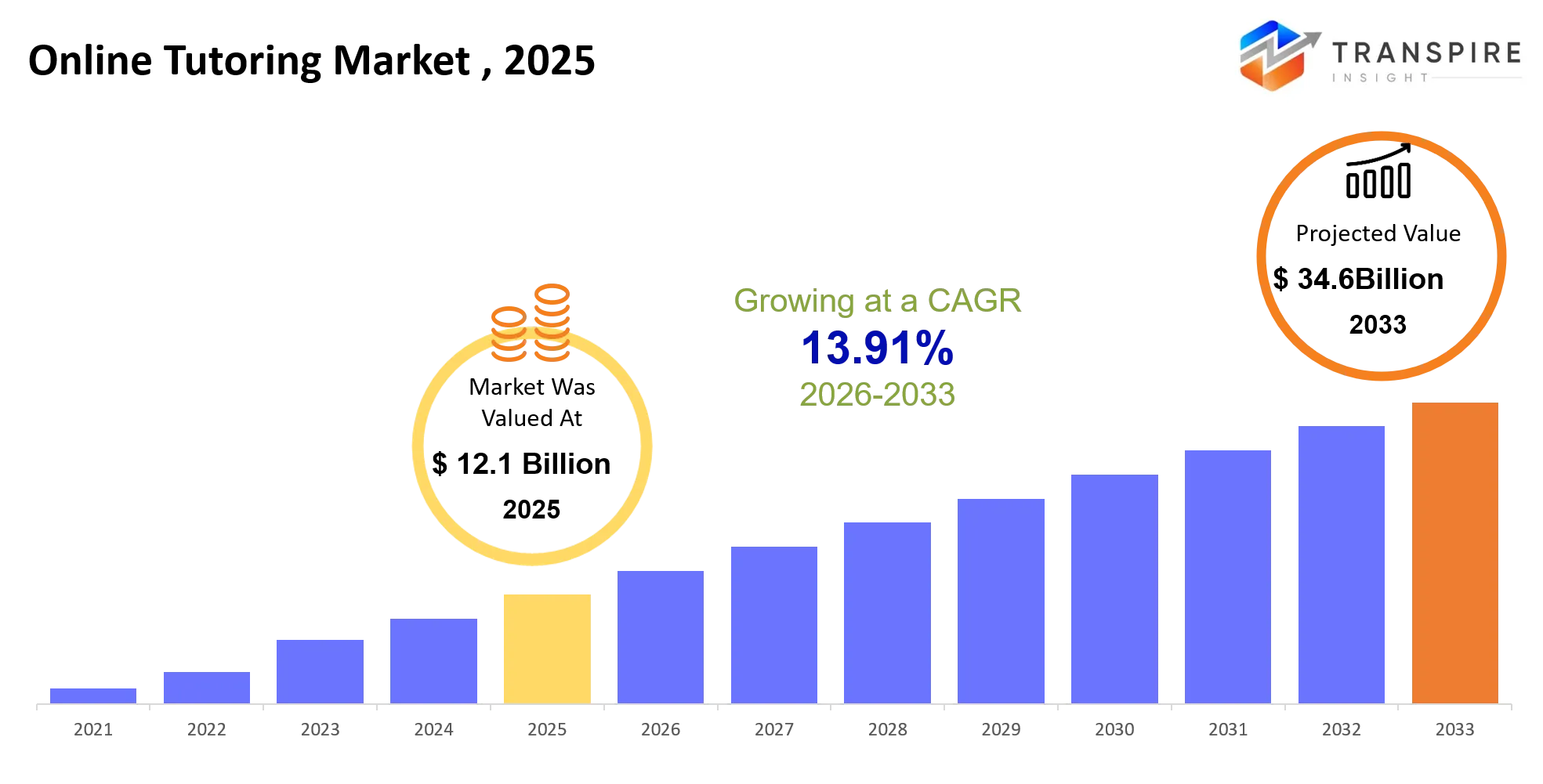
As per Transpire Insight Analysis, the Online Tutoring Market size is estimated at USD 12.1 billion in 2025 and is anticipated to reach USD 34.6 billion by 2033, growing at a CAGR of 13.91% from 2026 to 2033.
The online tutoring market around the world has changed a lot as students, parents and schools use tools more and more for help with schoolwork. In the past three to five years, tutoring has gone past simple video classes. Now it includes classes that students can join in real-time recordings of sessions, plans made just for each student and tools that use artificial intelligence to help with studying. . When schools closed, millions of students had to learn from home. Families found out about online tutoring services. Since that time, more students want to use these services because they offer timely help with specific subjects and support for tough exams. Better internet, more people having phones, and easier ways to pay online have made these services easier to use in parts of the world. At the same time tools that track learning and adjust to the needs of each student help teachers find where students need more help and change lessons to fit. These changes are making companies want to offer more and reach students.
Online Tutoring Market Size & Forecast:
- Market Size 2025: USD 12.1 Billion
- Expected Market Value (2033): USD 34.6 Billion
- Forecast CAGR (2026–2033): 13.91%
- Leading Region in 2025: Asia Pacific
- Fastest Growing Region: Latin America
- Key Company Profiles: Chegg, Pearson, BYJU'S, VIPKid, Preply, Varsity Tutors, Tutor.com, Cambly, Udemy, Outschool, K12, Brainly, Vedantu, Unacademy, Khan Academy
Key Market Insights:
The market is moving towards school-age learners, and AI-enabled services are transforming the way tutoring is offered.
- The K-12 group represents 48.7% of the target segment as a result of the constant necessity for assistance in completing their homework, preparation for examinations, and getting assistance in challenging academic fields.
- AI tutoring is declared to grow the quickest by having 18.5% of CAGR, where platforms offer adaptive practice, automated feedback, and 24/7 learning services.
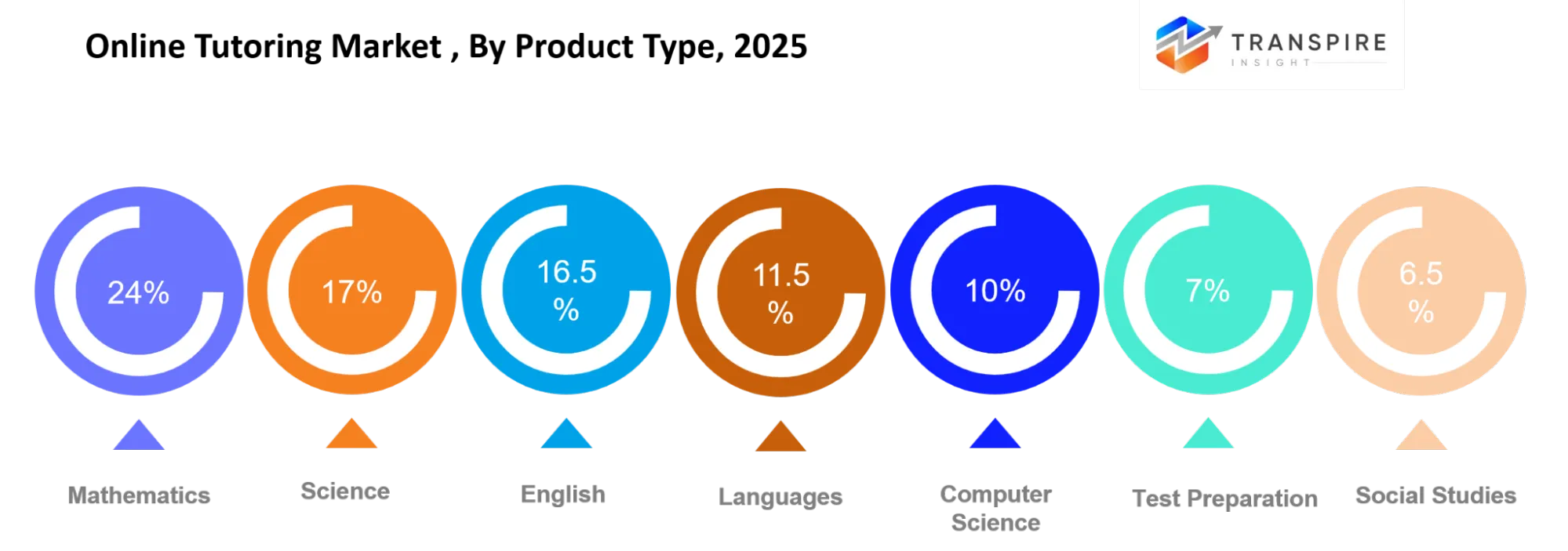
- Mathematics represents 24.0% of the demand and is the largest one of all listed fields as a result of numerous chances for explaining issues in detail and practice.
- The science field is responsible for 17.5% of the subject segment and is highly sought after due to the necessity to solve complicated problems and visual explanations of solutions.
- English comprises 16.5%, while languages represent 11.5% of the subject demand, and both require classes to complete writing, reading, speaking, and practising languages.
- Computer Science field represents 10.0% of the subject demand, and enables providers to offer project-based lessons as a result of code teaching and digital skills.
- Test Preparation is a 9.0% segment that enables learners to organise sessions online for school, college, and entrance tests.
What are the Key Drivers, Restraints, and Opportunities in the Online Tutoring Market?
Drivers
All times and locations have become more manageable for the modern-day student, employee and parent to organise. Increasing experience with live video and more flexible access on mobile devices and payment platforms has reduced the logistical barrier to booking an online lesson. It is easier to earn customers and keep them if they can choose a tutor by class, language, time and price.
Restraints
Unequal availability of the internet, devices and digital skills limit engagement in some households and locations. Quality is a further structural barrier: variation in tutor experience and expertise, tutor effectiveness and learner achievement are often experienced across marketplaces, posing a challenge for parents when choosing a provider. Concerns about privacy may be more prevalent where digital platforms interact with a child's data, lessons are recorded or a learner profile is digital.
Opportunities
AI coupled with high-quality teachers to provide practice, monitoring, and content in multiple languages. Education companies can work with schools, colleges, and businesses to reach students in need of support outside school hours. In emerging markets, low-bandwidth mobile learning and locally relevant curricula will allow access without huge fixed costs. And operators that can deliver educational outcomes, transparency around pricing, and responsible data use will differentiate themselves from the pack - and win customers - with more than just discounts.
|
Driver |
Relative Impact on Growth (%) |
Geographic Relevance |
Impact Timeline |
Demand Strength |
Growth Mechanism |
Key Beneficiaries |
Major Constraint |
|
Rising demand for personalized and flexible learning |
28% |
North America, Asia Pacific |
Short-term (≤2 years) |
High |
Enables customized lessons, flexible scheduling, and targeted academic support |
Online tutoring platforms, private tutors, students, parents |
Affordability concerns and inconsistent tutoring quality |
|
Increasing adoption of AI and adaptive learning technologies |
23% |
North America, Asia Pacific |
Medium-term (2–4 years) |
High |
Personalizes exercises, automates feedback, and tracks learner progress |
EdTech companies, AI developers, tutors, learners |
Data privacy risks and inaccurate AI-generated explanations |
|
Growing internet penetration and smartphone accessibility |
21% |
Asia Pacific, Latin America, Africa |
Medium-term (2–4 years) |
High |
Expands affordable tutoring access across underserved communities |
Mobile learning platforms, telecom providers, tutors, students |
Connectivity gaps, device costs, and unreliable internet |
|
Rising demand for examination preparation and skill development |
17% |
Asia Pacific, North America, Europe |
Short-term (≤2 years) |
High |
Drives paid tutoring for competitive exams, certifications, and career skills |
Test preparation providers, subject experts, learners, employers |
Strong competition and uncertain learning outcomes |
|
Government initiatives and institutional investment in digital education |
11% |
Asia Pacific, Europe, North America |
Long-term (≥4 years) |
Medium |
Supports digital learning infrastructure and institutional tutoring partnerships |
Education platforms, schools, technology vendors, students |
Funding limitations and student data compliance requirements |
|
Total |
100% |
— |
— |
— |
— |
— |
— |
What Has the Impact of Artificial Intelligence Been on the Online Tutoring Market?
AI is revolutionising the online tutoring market, making the practice far more tailored to each student. Adaptive online platforms can modify the difficulty level of questions, suggest revision topics and answer a student's question instantly when they get it wrong. For tutors, AI systems can assist with structuring lessons, create quizzes, analyse progress and highlight top-priority needs. Predictive analytics can identify students who show patterns of struggle or have fallen behind on tasks, giving tutors a chance to step in early before a small gap turns into a big one. The emerging trend was clear in Khan Academy's 2026 announcement of the Khanmigo project: In partnership with Google, it will launch Gemini-powered interactive diagrams and classroom learning tools beyond the text chat.AI can provide an aid to help platforms micro-personalise content at scale, and provide rudimentary practice offline. But accuracy is not guaranteed. An AI system may fail to grasp the nuances of a student's reasoning, offer a confident but wrong theory or miss out on emotional or contextual signals that a human teacher would pick up on. Additional costs, privacy protections and the importance of teacher supervision are factors to weigh; the best model will likely be one that uses AI to support rather than replace high-quality tutors.
Instance
In January 2026, Wiingy has launched CoTutor, an AI learning tutor that helps students in their revision through personalised summaries, quizzes, podcasts, and flashcards.
Key Market Trends:
Online tutoring is shifting its focus from just video conferences to integrated learning solutions, which will benefit students in terms of an improved learning experience.
- Learning solutions, which were previously providing only video lectures, now have incorporated digital worksheets, recordings, quizzes, and progress tracking mechanisms.
- AI-enabled features like question generation, adaptive learning, etc. are being included in routine learning practices, as well as features that will ease the job of tutors.
- The parents have preference for learning platforms that offer flexibility in scheduling lessons, along with recording option, thus making their learning solutions easily accessible via mobile phones and designed for short learning sessions.
- A hybrid approach becomes more important as students start to mix lessons provided by a human teacher with revision sessions and an automatic learning process.
- Progress of the students becomes more valuable to parents, thus making providers integrate tools that will measure learners' skills gap, completed exercises, attendance rates, and lesson feedback.
Online Tutoring Market Segmentation
By subject
Mathematics is the largest category, accounting for 24.0%, due to the requirement for process-based problem solving and repetition. Science covers 17.5%, English 16.5% and Languages 11.5%, with all these subjects requiring live explanations, feedback and repetition. Computer Science constitutes 10.0%, providing an opportunity for programming and digital skills training, whereas Test Preparation makes up 9.0%. Social Studies constitutes 6.5% and Other Subjects 5.0%.
By learning mode
There are One-to-One, Group Classes, Self-Paced, Live Classes, recorded, Hybrid, Peer Tutoring, and many more available in the market. One-to-one will work great for those users who want to have personalised guidance, and group classes will make it cheaper for the students. Self-paced and recorded methods give users flexibility in terms of time, and the hybrid method gives users both flexibility and live tutoring.
By age group
K-12 comes with the largest share of 48.7%, which implies that there is a greater demand for the curriculum-based class. In addition to K-12, Primary, Secondary, Higher Education, Adult Learners, Professional Learners, Preschool and others come under the larger category. Higher education and Professional learners might require help with tough subjects or certification or skills for the workplace, while younger ones might need guided classes.
By platform
Web-Based, Mobile Apps, Video Conferencing, LMS-Based Products, Marketplaces, Dedicated Tutoring Platforms, Social Learning Platforms and Others. Learners can easily find and book sessions via web and mobile access and can use the same devices to access learning content. LMS-integrated learning management systems can even synchronise lessons with homework and progress reports; marketplaces may also focus on allowing users to choose and connect with a specific tutor.
By provider type
Individual Tutors, Tutoring Firms, Schools, Educational Technology Companies, Freelance Tutors, Non-Profit and Government Programs, and many more are all serving different purposes. Individual and freelance tutors will compete with personalized attention and specialized areas; the bigger companies might be able to distinguish themselves with their process of screening, efficient lesson system, and the number of locations they operate in.
By pricing model
Each service may be priced with Subscription, Pay-Per-Class, Package-Based, Freemium, Commission-Based, Institutional Licensing, Membership and Other. Subscriptions are a good fit for those learners who want to buy services on a regular basis with consistent payments, while pay-per-class schemes may appeal to those with irregular needs seeking occasional help.
What are the Key Use Cases Driving the Online Tutoring Market?
The use case is that of K-12 educational tutoring as detailed in the accompanying data. The students use online tutors to revise classroom materials, complete homework assignments, prepare for tests and one-to-one explanation when class time is insufficient. Math is very appropriate for problem-solving and practice. Other use cases include tutoring in science, English and languages, teaching of computer science and test preparations. Real-time tutoring allows the students to ask questions, while pre-recorded and self-guided material provides room for revision by the students between tutoring sessions. Adults and college students might use tutoring to develop subject knowledge or digital literacy. Innovative uses include the merging of human tutoring and artificial intelligence tutoring, notifications of the students' progress and customized learning programs. Online tutoring can be used by schools and employers for supplemental tutoring at other locations, as long as the quality of the tutoring, privacy and learning results are guaranteed.
|
Report Metrics |
Details |
|
Market size value in 2025 |
USD 12.1 Billion |
|
Market size value in 2026 |
USD 13.9 Billion |
|
Revenue forecast in 2033 |
USD 34.6 Billion |
|
Growth rate |
CAGR of 13.91% from 2026 to 2033 |
|
Base year |
2025 |
|
Historical data |
2021 - 2024 |
|
Forecast period |
2026 - 2033 |
|
Report coverage |
Revenue forecast, competitive landscape, growth factors, and trends |
|
Regional scope |
United States; Canada; Mexico; United Kingdom; Germany; France; Italy; Spain; Denmark; Sweden; Norway; China; Japan; India; Australia; South Korea; Thailand; Brazil; Argentina; South Africa; Saudi Arabia; United Arab Emirates |
|
Key company profiled |
Chegg, Pearson, BYJU'S, VIPKid, Preply, Varsity Tutors, Tutor.com, Cambly, Udemy, Outschool, K12, Brainly, Vedantu, Unacademy, Khan Academy |
|
Customization scope |
Free report customization (country, regional & segment scope). Avail customized purchase options to meet your exact research needs. |
|
Report Segmentation |
Subject (Mathematics, Science, English, Languages, Social Studies, Computer Science, Test Preparation, Others)Learning Mode (One-to-One, Group Classes, Self-Paced, Live Classes, Recorded Lessons, Hybrid, Peer Tutoring, Others)Age Group (K-12, Primary, Secondary, Higher Education, Adult Learners, Professional Learners, Preschool, Others)Platform (Web-Based, Mobile App, Video Conferencing, LMS-Based, Marketplace, Dedicated Tutoring Platforms, Social Learning Platforms, Others)Provider Type (Individual Tutors, Tutoring Companies, Educational Institutions, EdTech Companies, Freelance Tutors, Non-Profit Organizations, Government Programs, Others)Pricing Model (Subscription, Pay-Per-Class, Package-Based, Freemium, Commission-Based, Institutional Licensing, Membership, Others) |
Which Regions are Driving the Online Tutoring Market Growth?
North America
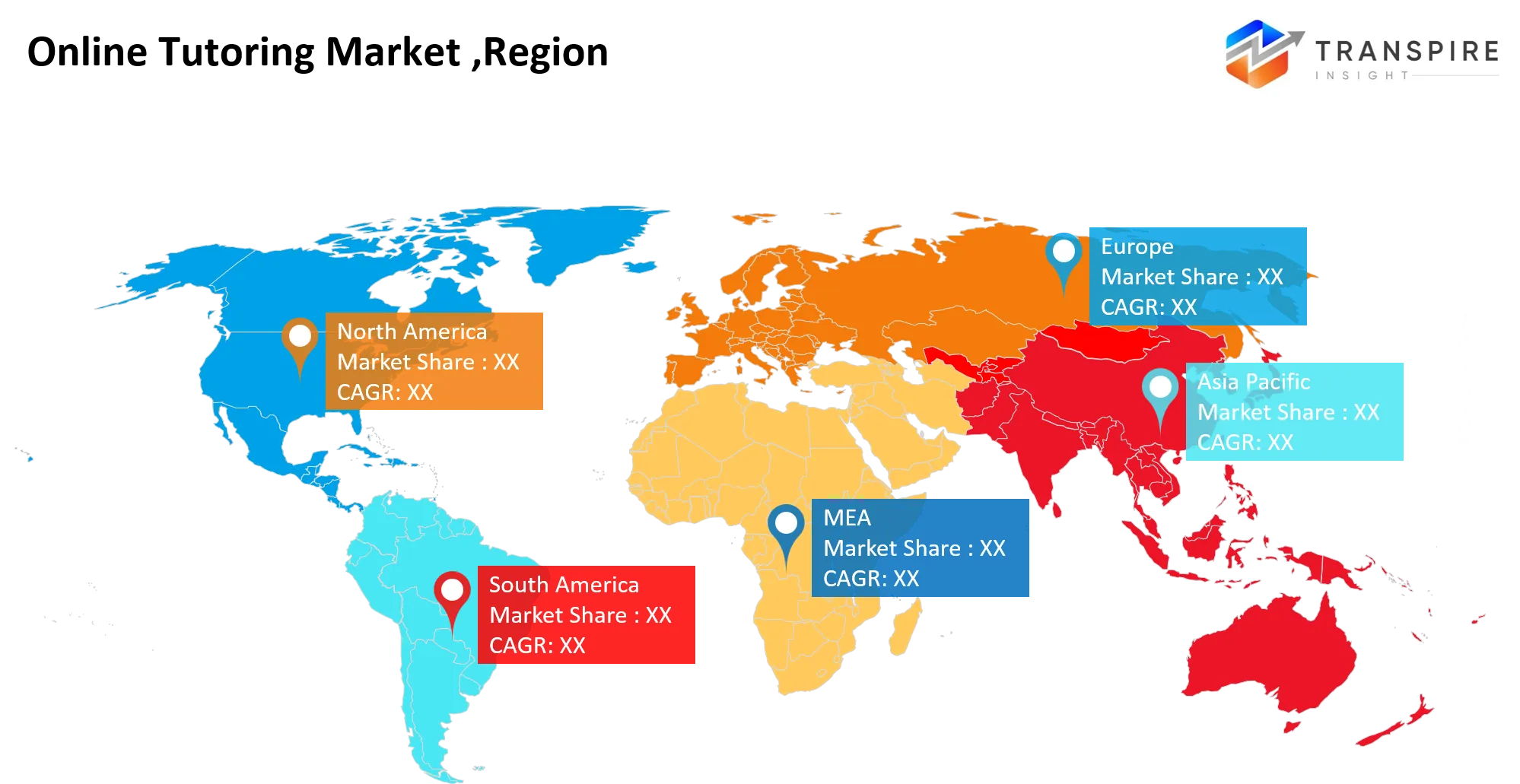
North America constitutes 30.4% of the market, with digital infrastructure, familiarity with remote learning, and education technology providers. Families have the choice of independent tutors, specialists, as well as online learning platforms. The demand comes from school support, test preparation, as well as the desire for flexible schedules. The competition will be driven by personalisation, results, and the quality of the learning experience.
In February 2026, the College Board has collaborated with Schoolhouse. to enhance the provision of free tutoring sessions of the SAT through an online portal, helping students receive personal attention during SAT preparation.
https://newsroom.collegeboard.org/free-peer-to-peer-sat-tutoring-schoolhouse-world
Europe
Europe holds 23.1% of the market, with demand being influenced by differing national curricula, multi-language learning and established broadband availability in most markets. As compared to North America, service providers find it necessary to adjust their services to accommodate varying languages, educational systems, as well as data protection needs. This opens up the way for local tutors and platforms to have region-specific content.
February 2026, Sofatutor acquired SchoolMouv (France), which is a learning platform offering educational services and solutions in curriculum-based learning
https://www.sofatutor.co.uk/about/press/sofatutor-acquires-french-learning-platform-schoolmouv
Asia-Pacific
The Asia-Pacific region dominates the regional distribution, holding 36.8%, due to the region's huge population of learners, exam-oriented learning requirements, increasing connectivity, and the presence of education technology service providers. Mobile-first delivery will help the providers to reach out to learners in urban as well as rural areas, even though there may be disparity in affordability and connectivity.
In January 2026, Infinity Learn launched Infinity One, providing personalised online tutoring in one-to-one mode for Grades 4-12, including for JEE and NEET Preparation.
Who are the Key Players in the Online Tutoring Market and how do they compete?
There is competition between tutors, tutoring companies, specialised study services and non-profit educational services. Companies are different in how they target tutors, how they set prices, how they use technology and how they approach potential new students. Each platform has its own competitive advantage based on quality of tutor, breadth of offering, ease of booking, learner trust and demonstration of results rather than its scale. The main focus of Preply and Cambly is language training, and they have differentiated themselves in tutor selection, conversation training and the ability to book classes flexibly. Their marketplace business model allows growing the number of lessons offered geographically, and tutor profiles together with learner reviews help match a tutor to a student. Varsity Tutors and Tutor.com have a broader education offering and business model that may appeal to schools, families and other organisations requiring a dedicated service. Wyzant emphasises availability of individual tutors and subject choice, giving students different options of tutors and prices.
Online Tutoring Market companies
- Chegg
- Pearson
- BYJU'S
- VIPKid
- Preply
- Varsity Tutors
- Tutor.com
- Cambly
- Udemy
- Outschool
- K12
- Brainly
- Vedantu
- Unacademy
- Khan Academy
|
Company |
Est. Revenue Share Range |
Key Offerings |
Strategic Positioning |
Geographic Strength |
Technology Focus |
|
Pearson plc |
Estimated: 0.5–1.5% |
Digital tutoring support, study preparation, learning resources |
Integrated digital education and academic support |
North America, Europe, Asia Pacific |
AI-assisted learning, adaptive study tools |
|
Chegg, Inc. |
Estimated: 0.2–0.8% |
Expert Q&A, homework assistance, subject learning support |
Student-focused academic support and digital learning |
North America, English-speaking markets |
Generative AI, personalized study assistance |
|
Nerdy, Inc. (Varsity Tutors) |
Estimated: 0.2–0.8% |
One-to-one tutoring, group classes, school tutoring programs |
Flexible tutoring marketplace and institutional contracts |
North America, United States |
Virtual classrooms, AI tutoring tools |
|
Tutor.com |
Estimated: 0.1–0.5% |
On-demand tutoring, writing assistance, institutional tutoring |
Institutional partnerships and on-demand academic support |
North America, selected international markets |
Live digital classrooms, tutor matching |
|
Preply |
Estimated: 0.1–0.5% |
Language lessons, private tutoring, business language training |
Personalized language tutoring marketplace |
Europe, North America, Asia Pacific |
AI tutor matching, personalized practice |
|
Cambly |
Estimated: 0.1–0.4% |
English conversation lessons, private tutoring, group classes |
Convenient on-demand English language instruction |
North America, Asia Pacific, Middle East |
Live video tutoring, mobile learning |
|
Outschool |
Estimated: 0.1–0.4% |
Small-group classes, academic enrichment, subject tutoring |
Flexible instructor-led learning for children |
North America, English-speaking markets |
Interactive classrooms, online learning marketplace |
|
Vedantu |
Estimated: 0.1–0.5% |
Live classes, school tutoring, competitive exam preparation |
Affordable curriculum-focused tutoring and exam preparation |
Asia Pacific, particularly India |
Digital whiteboards, interactive live teaching |
|
VIPKid |
Estimated: 0.1–0.4% |
Online English lessons, individualized language instruction |
Specialized teacher-led English language learning |
Asia Pacific, North America |
Live video lessons, digital teaching materials |
|
GoStudent |
Estimated: 0.1–0.5% |
One-to-one tutoring, school-subject support, exam preparation |
Structured private tutoring with technology-enabled delivery |
Europe, selected international markets |
Tutor matching, online lesson management |
Recent Development News
In August 2026, Google introduced classroom tools built by integrating Gemini models and working with Khan Academy. Among these are interactive diagrams for Khanmigo and a revamped practice experience. The partnership has the potential to improve visual explanations and introduce AI-assisted learning into more classroom workflows.
https://blog.google/products-and-platforms/products/education/khan-academy-back-to-school
In April 2025, Chegg announced its Create feature, which creates personalised practice tests and flashcards from the students' class material. This is indicative of the move towards study tools that take into account the learner's ongoing coursework instead of just generic revision material.
What Strategic Insights Define the Future of the Online Tutoring Market?
The future is headed in the direction of it being possible to offer a single learner journey that combines live delivery, adaptive practice and clear progress. Providers will need to show how their technology improves understanding, rather than makes more content. An immediate risk is that terrible feedback from a bad AI system, or poor data security for young learners, will spoil the trust more quickly than a new offering can begin to build it. The other challenge is that one metric may not be enough to demonstrate the effectiveness of the technology in a variety of different curricula, age ranges and languages. The opportunity is for blended tutoring for disadvantaged learners - once again thanks to mobile connectivity, more content in the learner's local language and an AI system that frees up teachers time working on learners' work. Providers will need to focus on mentoring the quality of tutors, transparent pricing model, privacy by design, and ongoing evaluation of AI outputs. Schools and institutions can become partners but only if that implementation prioritises and empowers the teachers and makes a difference to children's learning.
Subject
- Mathematics
- Science
- English
- Languages
- Social Studies
- Computer Science
- Test Preparation
- Others
Learning Mode
- One-to-One
- Group Classes
- Self-Paced
- Live Classes
- Recorded Lessons
- Hybrid
- Peer Tutoring
- Others
Age Group
- K-12
- Primary
- Secondary
- Higher Education
- Adult Learners
- Professional Learners
- Preschool
- Others
Platform
- Web-Based
- Mobile App
- Video Conferencing
- LMS-Based
- Marketplace
- Dedicated Tutoring Platforms
- Social Learning Platforms
- Others
Provider Type
- Individual Tutors
- Tutoring Companies
- Educational Institutions
- EdTech Companies
- Freelance Tutors
- Non-Profit Organizations
- Government Programs
- Others
Pricing Model
- Subscription
- Pay-Per-Class
- Package-Based
- Freemium
- Commission-Based
- Institutional Licensing
- Membership
- Others
Frequently Asked Questions
Find quick answers to common questions.
The online tutoring market size was valued at USD 12.1 Billion in 2025 and is poised to reach USD 34.6 Billion by 2033, expanding at a 13.91% CAGR.
Key segments for the online tutoring market are Subject (Mathematics, Science, English, Languages, Social Studies, Computer Science, Test Preparation, Others)Learning Mode (One-to-One, Group Classes, Self-Paced, Live Classes, Recorded Lessons, Hybrid, Peer Tutoring, Others)Age Group (K-12, Primary, Secondary, Higher Education, Adult Learners, Professional Learners, Preschool, Others)Platform (Web-Based, Mobile App, Video Conferencing, LMS-Based, Marketplace, Dedicated Tutoring Platforms, Social Learning Platforms, Others)Provider Type (Individual Tutors, Tutoring Companies, Educational Institutions, EdTech Companies, Freelance Tutors, Non-Profit Organizations, Government Programs, Others)Pricing Model (Subscription, Pay-Per-Class, Package-Based, Freemium, Commission-Based, Institutional Licensing, Membership, Others)
Growth is primarily driven by increasing internet penetration, rising demand for flexible and personalized learning, growing smartphone adoption, the use of AI-powered educational tools, and increasing demand for affordable test preparation and academic support services.
The market is led by major manufacturers including Chegg, Pearson, BYJU'S, VIPKid, Preply, Varsity Tutors, Tutor.com, Cambly, Udemy, Outschool, K12, Brainly, Vedantu, Unacademy, Khan Academy
Pacific constitutes 36.8% of the world’s online tutoring market, due to increased internet penetration, the need for affordable education, an increase in smartphone users, and the use of digital learning platforms in countries like India and China.
Commercial opportunities in the online tutoring market can be observed in rising personalisation needs, development of AI-based tutors, the rise of mobile learning apps, growing need for test preparation programs, and development in emerging markets where physical tutoring is hard to find.
- Chegg
- Pearson
- BYJU'S
- VIPKid
- Preply
- Varsity Tutors
- Tutor.com
- Cambly
- Udemy
- Outschool
- K12
- Brainly
- Vedantu
- Unacademy
- Khan Academy
About the Authors

Mayur Shinde
I am Mayur Shinde, a Senior Research Analyst at Transpire Insight, specializing in the Automotive & Transportation and Information & Communication Technology (ICT) Industry. My work focuses on analyzing emerging market trends, technological advancements, competitive landscapes, and industry developments to deliver accurate, data-driven insights. I am passionate about transforming complex market information into clear, actionable content that helps businesses, professionals, and decision-makers stay informed and make confident strategic decisions.

Chakradhar Khansole
Chakradhar serves as the Research Director at Transpire Insight, bringing over 8 years of experience in technology, innovation, and strategic market intelligence. He specializes in transforming complex market data into actionable business insights that enable organizations to make informed, growth-oriented decisions. Recognized for his strategic vision and analytical expertise, Chakradhar leads high-impact research initiatives, delivering comprehensive market assessments, competitive intelligence, and forward-looking industry analysis.
Recently Published Reports
-
Apr 2026
3D Optical Profiler Market
3D Optical Profiler Market Size, Share & Analysis Report By Type (Desktop 3D Optical Profiler, and Portable 3D Optical Profiler), By Technology (Confocal Technology, and White Light Interference), By End-Use Industry (Manufacturing, Research Institutions, Automotive, Aerospace and Defense, Medical Devices, and Other), and Geography (North America, Europe, Asia-Pacific, Middle East and Africa, South and Central America), 2021 - 2031
-
Apr 2026
Depth Sensor Market
Depth Sensor Market Size, Share & Analysis Report By Type (Infrared Depth Sensors, Time-of-Flight (ToF) Sensors, Stereo Vision Sensors, Structured Light Sensors, Ultrasonic Depth Sensors), By Application (Automotive, Robotics, Gaming, Consumer Electronics, Industrial Automation, Healthcare, Security & Surveillance, Others), By End Users (Automotive Manufacturers, Consumer Electronics Companies, Healthcare Providers, Industrial Companies, Security Agencies, Gaming Companies, Robotics Companies, Others), and Geography (North America, Europe, Asia-Pacific, Middle East and Africa, South and Central America), 2021 – 2031
-
Apr 2026
Digital Manufacturing Market
Digital Manufacturing Market Size, Share & Analysis Report By Component (Hardware, Software, and Services), By Technology (Robotics, 3D Printing, Internet of Things (IoT), and Others), By Application (Automotive and Transportation, Aerospace and Defense, Consumer Electronics, Industrial Machinery, and Others), By Process Type (Computer-Based Designing, Computer-Based Simulation, Computer 3D Visualization, Analytics, and Others), and Geography (North America, Europe, Asia-Pacific, Middle East and Africa, South and Central America), 2021 – 2031
-
Apr 2026
Digital Visa Services Market
Digital Visa Services Market Size, Share & Analysis Report By Type (Individual Travelers, Group Travelers), By Application (Tourism, Business Travel, Others), and Geography (North America, Europe, Asia-Pacific, Middle East and Africa, South and Central America), 2021 – 2031