

Online Travel Agency Market Summary:
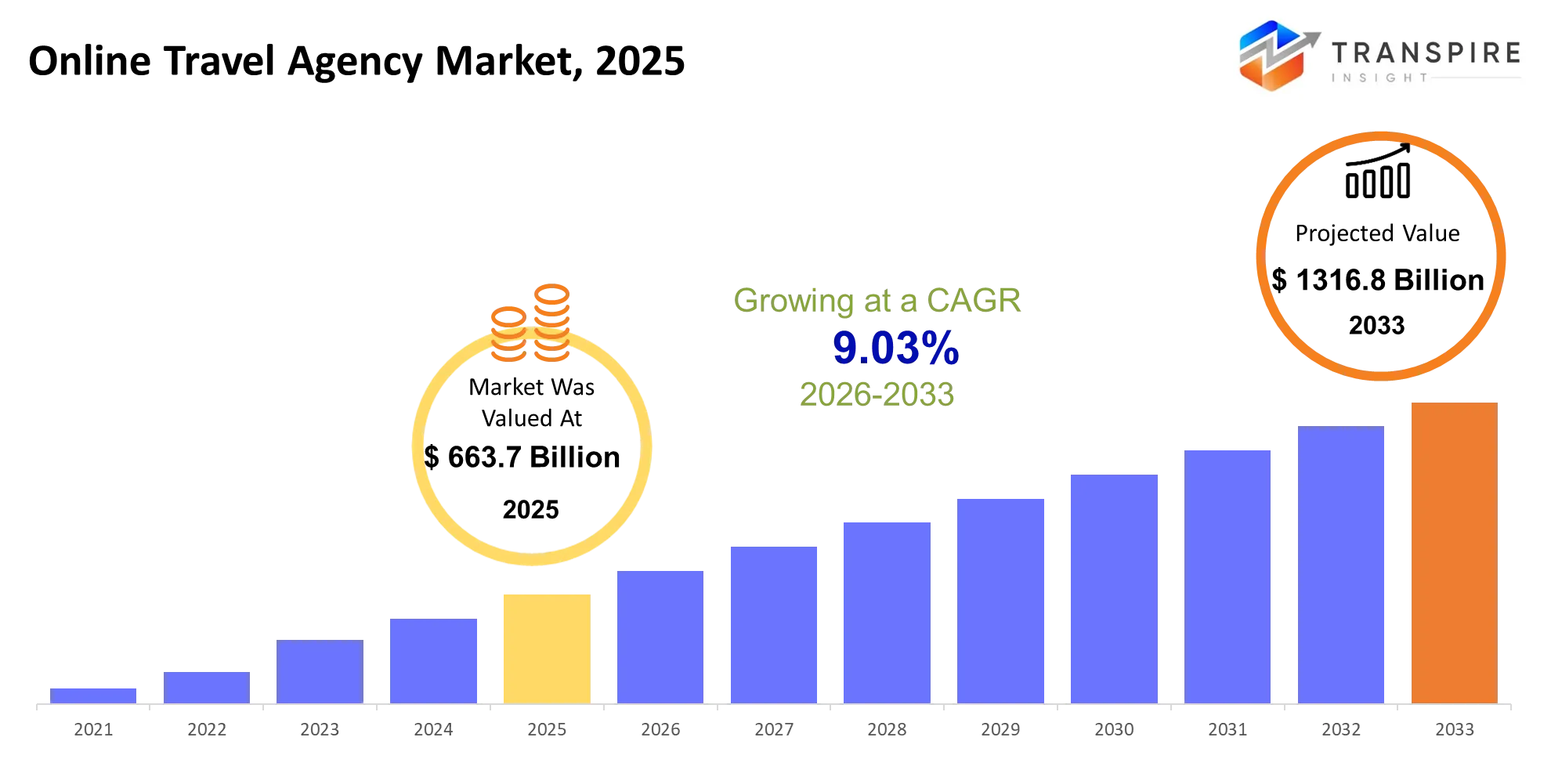
As per Transpire Insight, The Online Travel Agency Market size is estimated at USD 663.7 billion in 2025 and is anticipated to reach USD 1316.8 billion by 2033, growing at a CAGR of 9.03% from 2026 to 2033.
Online travel agencies (OTAs) help travellers compare prices, book accommodations and transportation, purchase trip packages, and adjust trips through a single online channel. Over the last three to five years, the market has shifted away from transaction-oriented, booking website architectures towards mobile-first, personalised, multi-service travel platforms with loyalty offerings. A key industry structure shift has been the introduction of artificial intelligence, dynamic pricing and real-time inventory systems into travel discovery and booking. Advances in generative AI and conversational search, for example, are changing how travellers explore locations, browse itineraries and get tailored advice, which has led OTAs to better align trip planning with booking and customer service. Similarly, integrations of mobile payments, online reviews and clear cancellation policies have reduced booking friction, while bundled reservations have helped agencies monetise additional transactions. At the same time, increasing data privacy obligations and consumer protection standards are prompting platforms to improve transparency of pricing, ensure payment security, and support customer service.
Online Travel Agency Market Size & Forecast:
- Market Size 2025: USD 663.7 Billion
- Expected Market Value (2033): USD 1316.8 Billion
- Forecast CAGR (2026–2033): 9.03%
- Leading Region in 2025: North America
- Fastest Growing Region: Asia-Pacific
- Key Company Profiles: Booking Holdings, Expedia Group, Trip.com Group, Airbnb, MakeMyTrip, Traveloka, eDreams ODIGEO, Despegar, Hopper, Agoda, Skyscanner, Lastminute.com Group, CheapOair, Cleartrip, KAYAK.
Key Online Travel Agency Market Insights:
The market is moving away from booking aggregation and towards intelligent travel ecosystems that integrate discovery, payment, and post-booking service. Ownership, differences in inventory, and a consistent execution of the journey are becoming key to competitive advantage.
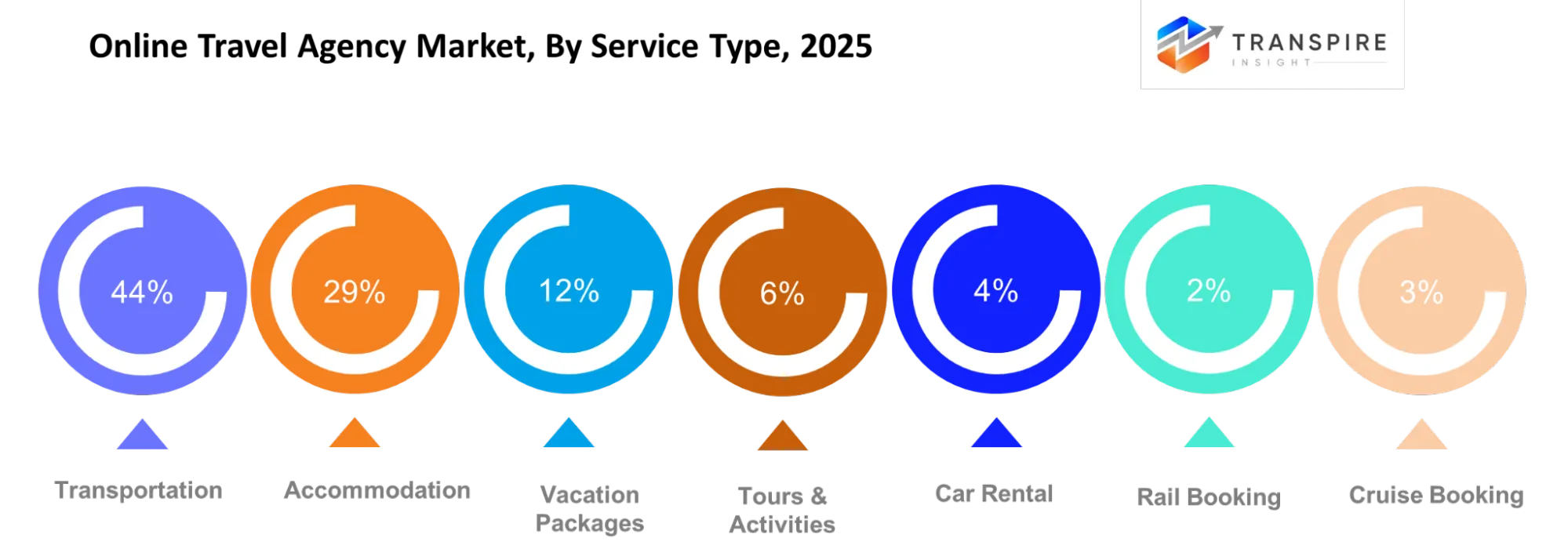
- Transportation continues to be the biggest service category at 43.80%, as Booking Holdings continues to grow its “connected trip” business on flights, stays, cars and attractions.
- Accommodation accounted for 29.50% of the accommodation category, and Airbnb's AI tools handled nearly 45% of customer problems without any human interaction, reducing the cost of support per booking by approximately 16% year-over-year.
- Vacation packages accounted for 12.00%, and Booking's multi-product transactions are expanding at a quicker rate than its business as a whole, further cementing the bundle-led retention.
- Mobile apps are the dominant application type in the OTA market (63.5%), forcing providers to increasingly shift to app-native payments, alerts, and itinerary management.
- Trip.com Group accounted for 26.0% of the market share and is emerging as a trusted third-party AI travel agent infrastructure.
- Expedia Group's stake was 15.9%, and it is an early ChatGPT apps partner, making an AI-powered transactable discovery channel.
- Airbnb accounted for 11.7% of the total market, offering a more exclusive alternative accommodation inventory, and it is estimated that 70% of its nine million listings are exclusive to the platform.
- The AI tools from Booking's Penny assistant and Agoda's AI service tools are providing measurable cost and conversion benefits, and AI is still a low single-digit per cent of technology budgets.
- Asia-Pacific will grow at 10.30% CAGR with mobile-first behaviour, growing middle-class travel demand and super-app distribution.
What are the Key Drivers, Restraints, and Opportunities in the Online Travel Agency Market?
Driver:
Mobile booking adoption and fragmented travel inventory are encouraging travellers to use OTAs as comparison and transaction hubs. The post-pandemic rebound in international travel exposed the inconvenience of checking airline, hotel, and activity providers separately. OTAs respond by combining availability, reviews, payment options, and itinerary management, helping convert browsing into completed bookings and generating additional revenue through cross-selling. IATA’s 2025 passenger survey confirms that mobile devices are increasingly central to booking and managing travel.
Restraint:
Supplier disintermediation remains a structural challenge because airlines and hotel chains promote direct bookings through loyalty points, exclusive discounts, and customer-specific benefits. OTAs must spend heavily on advertising and search visibility to attract traffic, while cancellations, refunds, inconsistent supplier data, and customer-service disputes increase operating costs. Regulatory scrutiny of misleading offers and undisclosed fees adds further compliance pressure.
Opportunity:
AI-led trip planning, connected payments, and dynamic packaging can expand revenue beyond individual reservations. For example, platforms can combine flights, accommodation, transfers, and local experiences into personalised itineraries, then recommend relevant upgrades using traveller preferences. Asia-Pacific offers scope for mobile-led expansion as digital payments and app-based travel services mature. In Europe, the revised Package Travel Directive creates an additional incentive to improve refund processes, booking disclosures, and package-management systems.
What Has the Impact of Artificial Intelligence Been on the Online Travel Agency Market?
AI has turned online travel agencies (OTAs) into prediction-driven travel-commerce solutions rather than simple catalogues. Machine-learning engines based on search history, location, travel spend, dates, and browsing habits deliver relevant flights, hotels, and attractions. The personalisation drives faster discovery of suitable products and closes the sale.
Generative AI chatbots and conversational search allow automation of pre-trip questions, changing or cancelling bookings, and multi-language care, easing a repetitive burden on service teams. Predictive algorithms allow accurate forecasting of demand, improved room and fare pricing, cancellation risk, and travel package models. Operational use cases include inventory allocation, fraud detection, payments, and disruption alerts – all of which support operational efficiency, cost control and retention. Due to legacy booking engines, standalone supplier integrations, inefficient data for availability, and privacy constraints, the implementation costs can be high, and recommendations less than perfect. AI models can be prone to inaccuracies and become the cause of inaccurate itineraries, pricing, or outdated information. Human judgement, clean data and transparency are still important, especially for high-value trips, complex itineraries and disruptions. The OTAs that get the mix right of automation and people-enabled service will turn these investments into a resilient competitive edge.
In May 2026, HBX Group completed the acquisition of Bridgify for an upfront consideration of €3 million. This operational move accelerates HBX Group’s broader AI capabilities by deploying Bridgify’s specialised AI matching technology across its entire travel technology infrastructure.
Key Online Travel Agency Market Trends:
OTAs are now competing more on trip orchestration, service reliability and customer retention than just price comparison. The strategic move is towards connected journeys, which include personalised discovery, flexible booking and post-booking support.
- Mobile apps have become the main booking tool, with biometric logins, saved payments and offline travel plans helping to make it easier.
- Generative-AI travel planning is moving travellers from keyword search to conversational, intent-based discovery.
- Dynamic packaging is growing in popularity as platforms start to combine flights, hotels, transfers and activities to boost basket value.
- Social commerce is evolving as a discovery platform, with younger travellers engaging in short-form video and creator content before booking.
- Personalisation is no longer just about destination suggestions but about real-time price, route and stay recommendations.
- Pressure from direct booking is driving OTAs to offer exclusive bundles, flexible cancellation and value-added services.
- Mobile alerts, as well as flexible corporate-travel tools, are helping to drive last-minute and bleisure travel.
- Sustainability filters, carbon information, and responsible-stay labels are becoming procurement and marketing differentiators.
- The boundaries between travel, payments, loyalty, and local commerce are becoming more indistinct with super-apps and embedded travel services.
Online Travel Agency Market Segmentation
Service Type:
Transportation dominates the service-type categories with a 43.80% share, reflecting low-fare/high-frequency/high-centrality products and the need to book these across products. The growth logic here is fare comparison, real-time prices, disruption handling, and mobility through mobile self-service and expected AI fare prediction and multi-modal journeys. Accommodation accounts for 29.50% share, reflecting an expanding plethora of hotel, resort, vacation home, hotel alternative, boutique hotel, villa, apartment, non-branded hotel, and other accommodation options. Vacation packages represent the fastest-growing value generation segment with 12.00% share, tying all of the other product types together through bundled flight/Hotel/Activities. Tours and activities constitute 6.00%, car rental 3.50%, rail ticketing 2.00%, cruise ticketing 1.20%, travel insurance and other 2.00%; these categories, while relatively small, have now become important for portfolio profit-sharing opportunities across the entire trip.
Platform:
Mobile apps benefit from saved traveller details, real-time alerts, integrated loyalty programs, and convenient payment options, encouraging repeat bookings. Mobile websites support quick reservations without app installation, while desktop websites remain useful for comparing complex itineraries and managing business travel. Super apps combine travel with payments and other services, creating convenient booking ecosystems. Voice assistants and conversational interfaces simplify travel searches, while social media inspires destination discovery. Metasearch platforms help travellers compare prices across providers. Future competition will depend on seamless experiences, personalisation, and consistent information across digital channels.
Traveler Type:
Leisure travellers generate bookings through destination discovery, seasonal promotions, and flexible itineraries, while business travelers prioritize schedule reliability, policy compliance, and expense management. Families and groups need coordinated reservations, suitable room configurations, and shared transport arrangements. Solo travellers value flexibility, personalised recommendations, and straightforward changes. Luxury travellers seek premium accommodation and curated experiences, whereas budget-conscious customers prioritise transparent pricing and affordable alternatives. Bleisure travellers combine business commitments with leisure extensions, creating opportunities for additional hotel nights and activities. Platforms that tailor services to these distinct requirements can improve conversion and retention.
Booking Type:
Direct OTA bookings enable platforms to maintain customer relationships, deliver personalised offers, and manage post-booking support. Third-party bookings expand access to distributed travel inventory, while package bookings simplify reservations involving multiple services. Independent bookings appeal to travellers who prefer arranging individual trip components. Last-minute reservations address urgent travel needs, whereas bookings support price planning and inventory management. Subscription models encourage repeat purchases through membership benefits and preferential pricing. Corporate arrangements streamline employee reservations and expense tracking. Future growth will depend on balancing attractive offers with cancellation flexibility, supplier reliability, and profitable customer acquisition.
Accommodation:
Hotels remain central to OTA accommodation listings because standardised facilities, recognisable service levels, and broad availability simplify comparison. Resorts attract holidaymakers seeking integrated leisure experiences, while vacation rentals, villas, and apartments appeal to families, larger groups, and extended-stay travellers. Hostels serve price-sensitive visitors, particularly younger and solo travellers, whereas boutique hotels differentiate themselves through local character and personalised service. Alternative stays broaden destination choices beyond conventional properties. Future growth will depend on verified listings, accurate availability, transparent property fees, and flexible cancellation policies. Better matching of amenities, location, and traveller preferences can improve booking confidence and reduce disputes.
What are the Key Use Cases Driving the Online Travel Agency Market?
The core use case is mobile flight and accommodation booking, linked to transportation’s 43.80% share and accommodation’s 29.50% share. Travellers use OTAs to compare fares, filter stays, manage changes, and receive disruption alerts in one interface.
Expanding applications include dynamic vacation packages, tours and activities, car rentals, rail tickets, cruises, and travel insurance. These services allow platforms to convert a single flight search into a complete itinerary, supporting the 12.00% vacation-package segment and higher transaction value.
Emerging use cases include AI conversational trip planning, predictive price alerts, carbon-aware travel choices, subscription-based travel benefits, and corporate bleisure management. These applications connect leisure, business, and mobile-first travellers while differentiating OTAs from direct supplier channels.
|
Report Metrics |
Details |
|
Market size value in 2025 |
USD 663.7 Billion |
|
Market size value in 2026 |
USD 718.9 Billion |
|
Revenue forecast in 2033 |
USD 1316.3 Billion |
|
Growth rate |
CAGR of 9.03% from 2026 to 2033 |
|
Base year |
2025 |
|
Historical data |
2021 - 2024 |
|
Forecast period |
2026 - 2033 |
|
Report coverage |
Revenue forecast, competitive landscape, growth factors, and trends |
|
Regional scope |
United States; Canada; Mexico; United Kingdom; Germany; France; Italy; Spain; Denmark; Sweden; Norway; China; Japan; India; Australia; South Korea; Thailand; Brazil; Argentina; South Africa; Saudi Arabia; United Arab Emirates |
|
Key companies profiled |
Booking Holdings, Expedia Group, Trip.com Group, Airbnb, MakeMyTrip, Traveloka, eDreams ODIGEO, Despegar, Hopper, Agoda, Skyscanner, Lastminute.com Group, CheapOair, Cleartrip, KAYAK. |
|
Customization scope |
Free report customization (country, regional & segment scope). Avail customized purchase options to meet your exact research needs. |
|
Report Segmentation |
Service Type (Transportation, Accommodation, Vacation Packages, Tour & Activities, Car Rental, Rail Booking, Cruise Booking, Travel Insurance); Platform (Mobile App, Mobile Web, Desktop Website, Super App, Voice/Conversational, Social Media, Metasearch, Others); Traveler Type (Leisure, Business, Family, Solo, Group, Luxury, Budget, Bleisure); Booking Type (Direct OTA, Third-Party, Package, Independent, Last-Minute, Advance Booking, Subscription, Corporate); Accommodation (Hotels, Resorts, Vacation Rentals, Hostels, Boutique Hotels, Villas, Apartments, Alternative Stays). |
Which Regions are Driving the Online Travel Agency Market Growth?
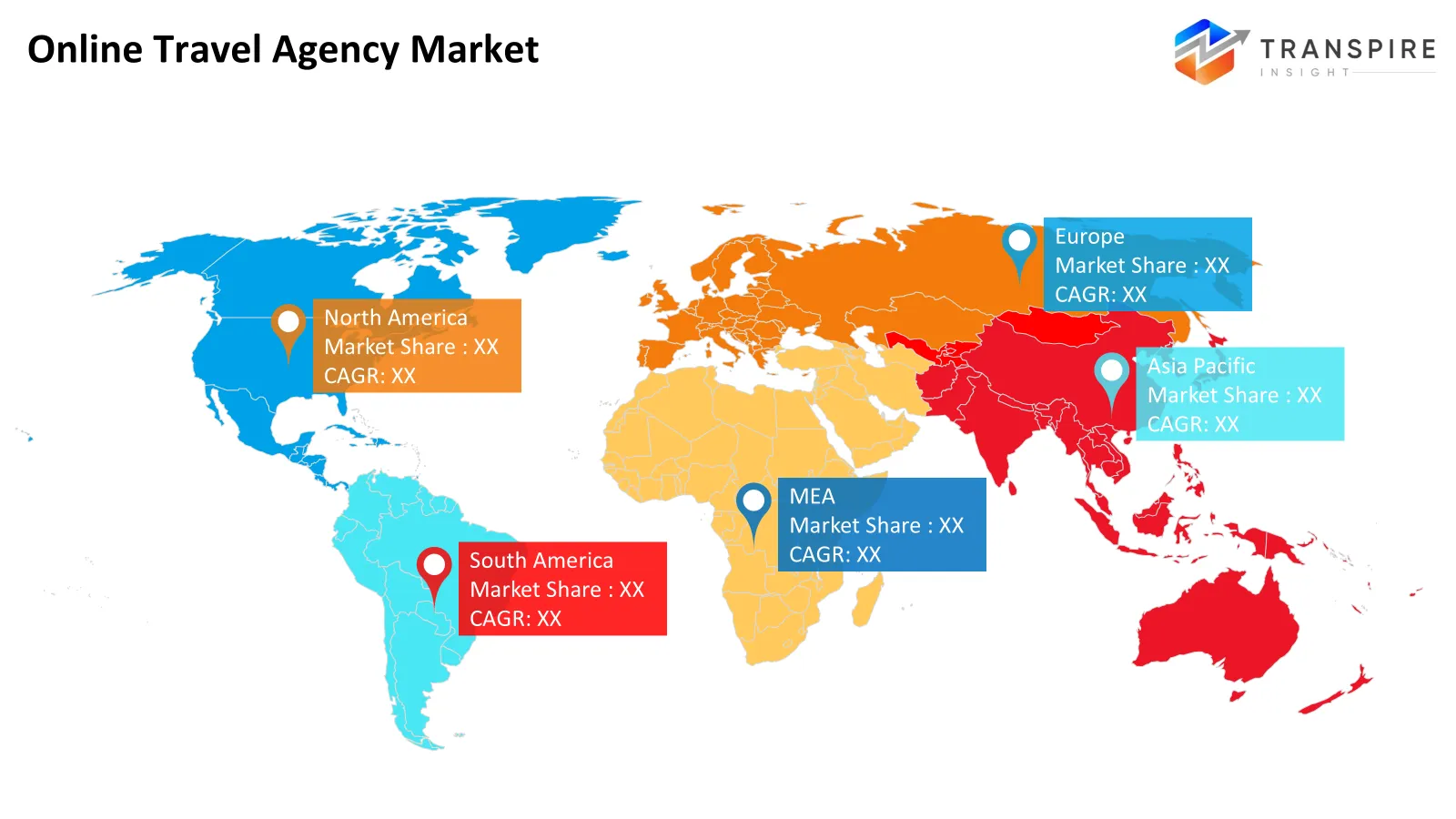
North America accounts for 29.85% of the market share because it combines high digital-payment penetration, sophisticated online-travel activity, and a high concentration of each online-travel agency HQ. North America benefits from a strong inventory of airlines, hotels and alternative accommodations, and existing loyalty programs and corporate-travel demand, owing to stable policies, broadband, cloud, AI infrastructure and strong product experimentation speed. These make monetisation of personalisation, dynamic packaging and additional-priced service layers much more profitable in the North American market than in lower-penetration markets.
In July 2026, Booking Holdings announced the formation of a newly consolidated business unit overseen by the CEO of Agoda to aggressively expand its B2B travel operations.
Europe, with a share of 29.09%, has slightly fractured but still reasonably resilient demand for short-haul, cross-border, rail, and city-break travel. It has a richer palette of multi-country inventory, a greater need for regulatory compliance and customer service in local languages relative to North America. Europe's relative stability derives from its high repeat leisure travel, busy rail network, and heavy regulation of the rail industry and consumer protection standards, which engenders trust in digital booking. Europe is therefore vital for Online Travel Agencies that offer simple prices, cancellation flexibility, and multi-modal itineraries.
In July 2026, Omio Group entered into an agreement to acquire Rail Europe. This acquisition expands the company's ground transportation distribution by uniting Omio’s tech stack with Rail Europe's B2B and B2C channels.
Asia-Pacific accounts for 27.05% of the market and is the fastest growing, with a compound annual growth rate of 10.30%. Driven by rising middle-class populations, passport, and a mobile-first travel discovery landscape, growth has been spearheaded by the advent of super-apps, digital wallets, and low-cost carriers, with domestic travel in markets such as China and India also rebounding. Opportunities still present themselves for Asia-Pacific via the amalgamation of transportation, accommodation, activities, and payments into one app. This regional model can build existing first-time online travelers into a loyal base through less cumbersome and more local-focused service offerings.
In May 2026, Visa and Trip.com Group entered into a strategic collaboration. By naming Trip.com Group—which boasts an expansive regional network of over 1.4 million hotels and flights from 600 airlines—as the Anchor Partner for Visa Destinations, Visa deeply embedded its digital transaction rails directly into the primary booking workflow of Asia-Pacific's highest-volume consumers.
Who are the Key Players in the Online Travel Agency Market, and how do they compete?
Travel industry rivalry spans scale in travel inventory, acquisition cost efficiency, differentiated accommodation assets, and regional market adaptation. Competition between Booking Holdings and Expedia Group is based on scale of supplier relationships, customer loyalty ecosystem, and connected trip solutions, while Trip.com Group is centred on international growth, local user booking, and artificial intelligence planning.
Personalization and loyalty-based Genius program in booking holdings, airline and hotel loyalty partner base in Expedia group, unique consumer brands in Expedia group, content partner B2B channel, home sharing concept with differentiated accommodations in Airbnb, solutions for Asian market travel services in MakeMyTrip, Traveloka, local transportation, accommodation, and alternative online payment offerings, wide inventory, variety of accommodation options and low prices in Agoda, transparency for comparison on flights and hotels by metasearch engine in Skyscanner and KAYAK, affordable alternative online booking services in Cheap Oair, focused Latin American market localization in Despegar, predictive pricing and fintech style mobility in Hopper, leisure vacation concept focused on package sales in Lastminute.com, beginner-friendly online booking platform and local customers in Cleartrip, travel inventory connection with online planning in Trip.com, other companies grow through supplier network market leaders, local pricing, cheap online searchings with marketing spend, smaller firms and niche aggregators must find positioning beyond discounts.
Key Players are:
- Booking Holdings
- Expedia Group
- Trip.com Group
- Airbnb
- MakeMyTrip
- Traveloka
- eDreams ODIGEO
- Despegar
- Hopper
- Agoda
- Skyscanner
- Lastminute.com Group
- CheapOair
- Cleartrip
- KAYAK
Recent Development News
- In June 2026, Air India partnered with Booking.com to introduce an integrated accommodation-booking platform on Air India’s website and mobile app. The partnership provides access to a broad accommodation inventory and introduces Maharaja Club loyalty points and promotional discounts, supporting cross-selling opportunities and a more connected flight-and-stay booking experience. https://www.airindia.com/in/en/newsroom/press-release/Air-India-and-Booking-com-partner-to-offer-integrated-booking-experiences-and-exclusive-rewards-to-travellers.html
- In July 2026, Expedia Group partnered with Allegiant Travel Company to become the airline’s first authorised online travel agency partner. The 12-month exclusive agreement covers 566 routes across 124 U.S. cities, expanding flight availability on Expedia Group’s platforms and improving access to domestic leisure travel options. https://ir.expediagroup.com/news-and-events/news/news-details/2026/Expedia-Group-becomes-Allegiants-first-ever-authorized-OTA-partner-/default.aspx
- In May 2026, Booking Holdings launched BKNG Ads, a unified advertising network connecting its major consumer properties including Booking.com, Priceline, and Agoda. The new advertising solution enables marketing partners to execute targeted, cross-brand native and display campaigns backed by centralised, proprietary traveller insights. https://www.bookingholdings.com/press-releases/booking-holdings-unifies-global-advertising-solutions-with-introduction-of-bkng-ads/
What Strategic Insights Define the Future of the Online Travel Agency Market?
The industry is moving toward a unified platform where discovery, booking, payments, and disruption will all be part of one integrated experience. Going forward, differentiation will be based on recommending what matters most, well-executed fulfilment, and the ability to measure price savings. The opportunity for artificial intelligence assistants lies in automating itinerary planning, solving for complex multi-hotel, multi-car and non-optional packages, especially in mobile-centric Asia-Pacific markets. An erosion of relationships occurs when a third-party AI assistant controls discovery and leads the user toward a competing channel for booking. Disruption erodes confidence when targeted ads lie in wait, hidden fees appear, or an AI incorrectly provides wrong information. Platforms should move toward authenticated inventories, total and clear pricing, secure checkout, and immediate channel switching and escalations in case of disruption. Partnerships with airlines, hospitality and hotel booking companies, payment networks and artificial intelligence developers will increase channel depth without paid promotion. A long-term leader will be a travel management company that incorporates personalisation with safe reservations, continually engages with customers after booking, and demonstrates additional value.
Key Segmentations are:
Service Type
- Transportation
- Accommodation
- Vacation Packages
- Tour & Activities
- Car Rental
- Rail Booking
- Cruise Booking
- Travel Insurance
Platform
- Mobile App
- Mobile Web
- Desktop Website
- Super App
- Voice/Conversational
- Social Media
- Metasearch
- Others
Traveler Type
- Leisure
- Business
- Family
- Solo
- Group
- Luxury
- Budget
- Bleisure
Booking Type
- Direct OTA
- Third-Party
- Package
- Independent
- Last-Minute
- Advance Booking
- Subscription
- Corporate
Accommodation
- Hotels
- Resorts
- Vacation Rentals
- Hostels
- Boutique Hotels
- Villas
- Apartments
- Alternative Stays
By Regional Analysis
North America
- US
- Canada
- Mexico
Europe
- Germany
- UK
- France
- Italy
- Spain
- Russia
- Rest of Europe
Asia Pacific
- China
- Japan
- India
- South Korea
- Australia
- Rest of Asia Pacific
South America
- Brazil
- Argentina
- Rest of South America
Middle East & Africa
- UAE
- Saudi Arabia
- Qatar
- South Africa
- Rest of the Middle East & Africa
Frequently Asked Questions
Find quick answers to common questions.
The online travel agency market size was valued at USD 663.7 billion in 2025 and is poised to reach USD 1316.8 billion by 2033, expanding at a 9.03% CAGR.
Key segments for the online travel agency market are Service Type (Transportation, Accommodation, Vacation Packages, Tour & Activities, Car Rental, Rail Booking, Cruise Booking, Travel Insurance); Platform (Mobile App, Mobile Web, Desktop Website, Super App, Voice/Conversational, Social Media, Metasearch, Others); Traveler Type (Leisure, Business, Family, Solo, Group, Luxury, Budget, Bleisure); Booking Type (Direct OTA, Third-Party, Package, Independent, Last-Minute, Advance Booking, Subscription, Corporate); Accommodation (Hotels, Resorts, Vacation Rentals, Hostels, Boutique Hotels, Villas, Apartments, Alternative Stays).
Growth is primarily driven by mobile-first booking platforms, AI-powered travel recommendations, digital payment adoption, integrated travel packages, loyalty programs, and increasing preference for convenient price comparisons and flexible reservations.
The online travel agency market is led by major manufacturers, including Booking Holdings, Expedia Group, Trip.com Group, Airbnb, MakeMyTrip, Traveloka, eDreams ODIGEO, Despegar, Hopper, Agoda, Skyscanner, Lastminute.com Group, CheapOair, Cleartrip, KAYAK.
North America accounts for 29.85% of the market, supported by mature digital infrastructure, extensive airline connectivity, established online booking platforms, strong payment systems, and widespread adoption of loyalty programs.
Key opportunities include AI-driven itinerary planning, dynamic travel packaging, subscription-based loyalty programs, localised mobile booking services, and integrated flight, accommodation, and activity reservations.
- Booking Holdings
- Expedia Group
- Trip.com Group
- Airbnb
- MakeMyTrip
- Traveloka
- eDreams ODIGEO
- Despegar
- Hopper
- Agoda
- Skyscanner
- Lastminute.com Group
- CheapOair
- Cleartrip
- KAYAK
About the Authors

Mayur Shinde
I am Mayur Shinde, a Senior Research Analyst at Transpire Insight, specializing in the Automotive & Transportation and Information & Communication Technology (ICT) Industry. My work focuses on analyzing emerging market trends, technological advancements, competitive landscapes, and industry developments to deliver accurate, data-driven insights. I am passionate about transforming complex market information into clear, actionable content that helps businesses, professionals, and decision-makers stay informed and make confident strategic decisions.

Chakradhar Khansole
Chakradhar serves as the Research Director at Transpire Insight, bringing over 8 years of experience in technology, innovation, and strategic market intelligence. He specializes in transforming complex market data into actionable business insights that enable organizations to make informed, growth-oriented decisions. Recognized for his strategic vision and analytical expertise, Chakradhar leads high-impact research initiatives, delivering comprehensive market assessments, competitive intelligence, and forward-looking industry analysis.
Recently Published Reports
-
Apr 2026
3D Optical Profiler Market
3D Optical Profiler Market Size, Share & Analysis Report By Type (Desktop 3D Optical Profiler, and Portable 3D Optical Profiler), By Technology (Confocal Technology, and White Light Interference), By End-Use Industry (Manufacturing, Research Institutions, Automotive, Aerospace and Defense, Medical Devices, and Other), and Geography (North America, Europe, Asia-Pacific, Middle East and Africa, South and Central America), 2021 - 2031
-
Apr 2026
Depth Sensor Market
Depth Sensor Market Size, Share & Analysis Report By Type (Infrared Depth Sensors, Time-of-Flight (ToF) Sensors, Stereo Vision Sensors, Structured Light Sensors, Ultrasonic Depth Sensors), By Application (Automotive, Robotics, Gaming, Consumer Electronics, Industrial Automation, Healthcare, Security & Surveillance, Others), By End Users (Automotive Manufacturers, Consumer Electronics Companies, Healthcare Providers, Industrial Companies, Security Agencies, Gaming Companies, Robotics Companies, Others), and Geography (North America, Europe, Asia-Pacific, Middle East and Africa, South and Central America), 2021 – 2031
-
Apr 2026
Digital Manufacturing Market
Digital Manufacturing Market Size, Share & Analysis Report By Component (Hardware, Software, and Services), By Technology (Robotics, 3D Printing, Internet of Things (IoT), and Others), By Application (Automotive and Transportation, Aerospace and Defense, Consumer Electronics, Industrial Machinery, and Others), By Process Type (Computer-Based Designing, Computer-Based Simulation, Computer 3D Visualization, Analytics, and Others), and Geography (North America, Europe, Asia-Pacific, Middle East and Africa, South and Central America), 2021 – 2031
-
Apr 2026
Digital Visa Services Market
Digital Visa Services Market Size, Share & Analysis Report By Type (Individual Travelers, Group Travelers), By Application (Tourism, Business Travel, Others), and Geography (North America, Europe, Asia-Pacific, Middle East and Africa, South and Central America), 2021 – 2031