

On-Demand Warehousing Platforms Market Summary:
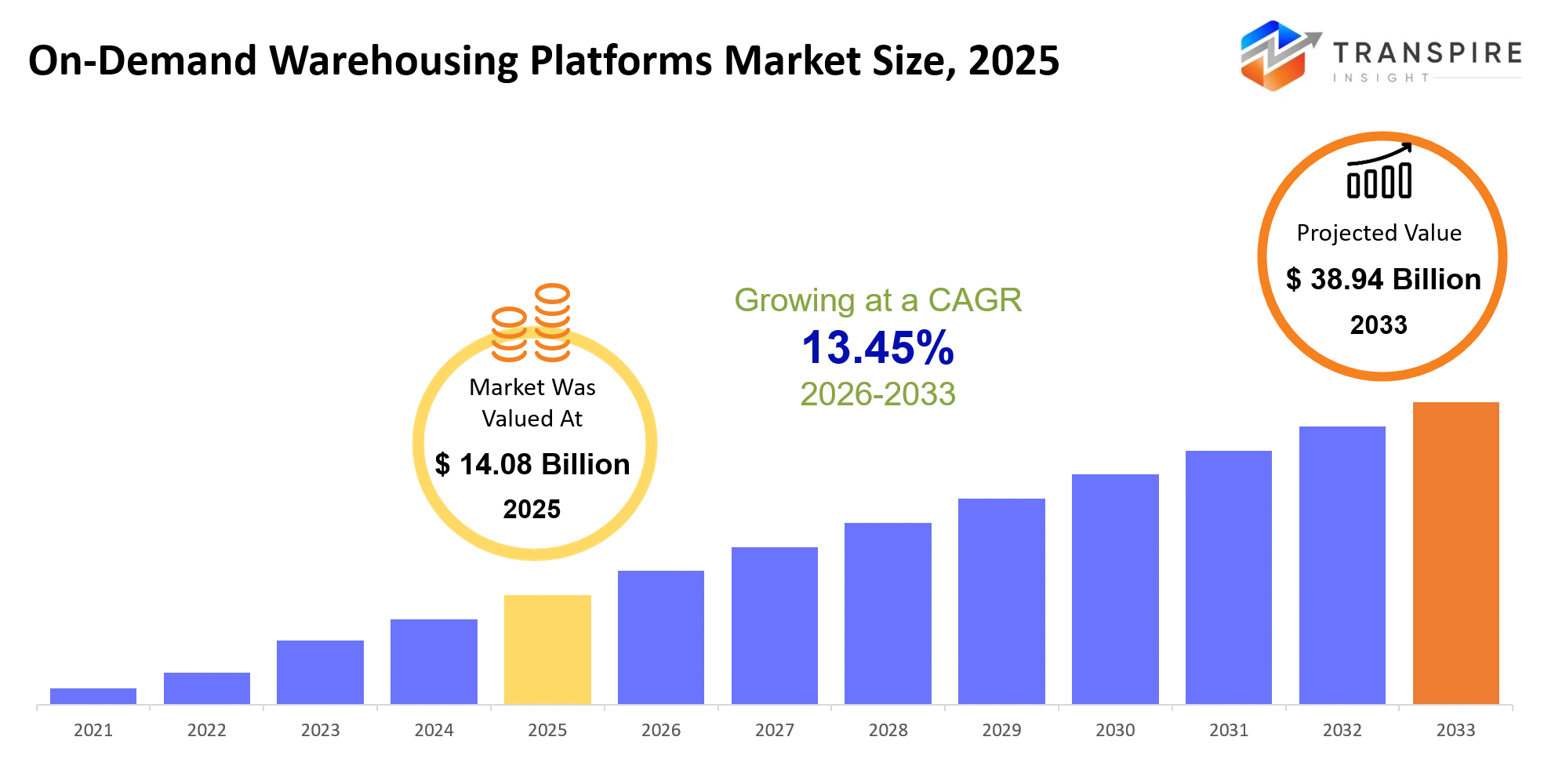
As per Transpire Insight Analysis, the On-Demand Warehousing Platforms Market size is estimated at USD 14.08 Billion in 2025 and is anticipated to reach USD 38.94 Billion by 2033, growing at a CAGR of 13.45% from 2026 to 2033. Growth is fueled by growing e-commerce activities, increased flexibility needs from warehouses, and logistics platforms using digital technology to enhance efficiency in managing inventory.
The on-demand warehousing platforms market is really important for businesses these days. It helps them get warehouse space when they need it. Companies do not have to build their own warehouses. They can use warehouses that are available for short-term use. This is good because companies do not always need the amount of space. Sometimes they need space, and sometimes they need less space.
The way companies store their goods has changed a lot in the past few years. This is because more people are buying things online and they want their purchases to arrive quickly. Also, companies are now selling their products to people in other countries. This means they need to be able to store their goods in places.
Nowadays there are online platforms that connect people who own warehouses with companies that need space to store their goods. These platforms are like websites that show which warehouses are available and how much space they have. Many companies are using these platforms because they want to be able to see where all their goods are and make sure they are being delivered quickly. They also want to save money on storage costs. On-demand warehousing platforms are becoming more popular because they help companies do all these things. The on-demand warehousing platforms market is. It will continue to grow as more companies start using these platforms to store and deliver their goods.
On-Demand Warehousing Platforms Market Size & Forecast:
- Market Size 2025: USD 14.08 Billion
- Expected Market Value (2033): USD 38.94 Billion
- Forecast CAGR (2026–2033): 13.45%
- Leading Region in 2025: North America
- Fastest Growing Region: Asia Pacific
- Key Company Profiles: Flexe, Ware2Go, Flowspace, Stord, DHL Supply Chain, GXO Logistics, ShipBob, Amazon Warehousing & Distribution, Prologis, Blue Yonder, Manhattan Associates, Oracle, SAP, e2open, ShipHero.
Key Market Insights:
The market is changing not only through the simple process of warehousing but through allowing companies to better use their storage capacity, gain greater visibility over their inventory and be responsive to changes in the supply chain needs.
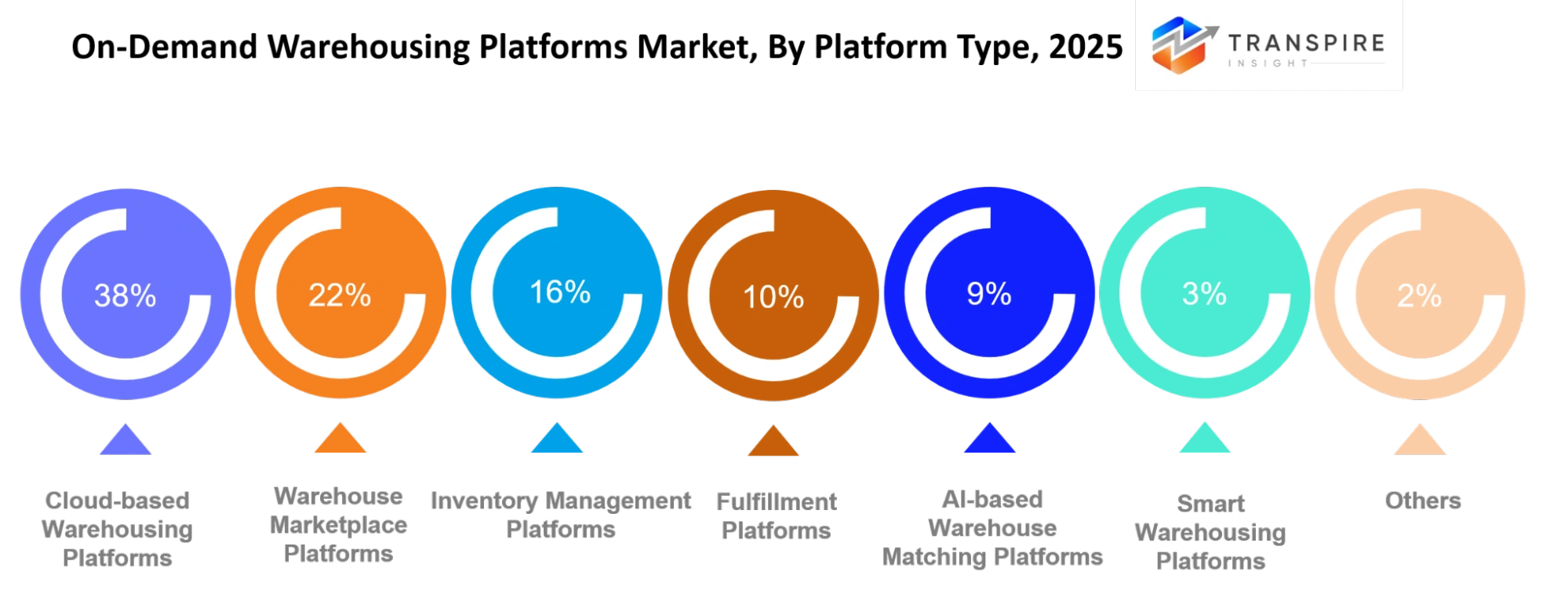
- Cloud-based Warehousing Platforms constitute 38% of the market due to the high need for scalable storage and as providers continue to roll out innovative cloud technologies in warehouse management.
- Warehouse Marketplace Platforms make up 22% of the market due to the rising preference for digital warehousing solutions that ease warehouse discovery, pricing, and booking.
- Inventory Management Platforms make up 16% of the market as firms adopt advanced inventory management solutions to help in real-time tracking and analysis of inventories.
- Fulfilment Platforms make up 10% of the total market share, aided by growing investments in advanced order processing and last-mile deliveries in the e-commerce industry.
- AI-based Warehouse Matching Platforms will have a CAGR of 19.2% as providers leverage AI and predictive analytics to automate warehouse matching processes.
- Smart Warehousing Platforms constitute 3% of the market as firms increasingly embrace IoT technology for monitoring warehouses and automation of logistics operations.
- Other Platforms make up 2% of the market share, providing customised digital solutions for storing special types of inventories.
What are the Key Drivers, Restraints, and Opportunities in the On-Demand Warehousing Platforms Market?
Drivers
The driving factor behind the growth of the on-demand warehousing platforms market is an increase in the demand for flexible and scalable storage capacity from the e-commerce industry, retail, manufacturing, and third-party logistics sectors. Higher order volumes, seasonal variations in inventory, and increased customer demands for expedited shipping services have prompted companies to rely on online warehousing platforms rather than building their own physical storage facilities. An increase in the digital transformation of the supply chain management process has also contributed to the use of these platforms.
Restraints
The market is facing some issues related to integration difficulties and a scattered warehouse ecosystem. Small and medium-sized warehouses still utilise outdated management software systems, which makes them incompatible with digital platforms. The lack of unified operational standards, high-quality data, and technology adoption in certain regions makes it difficult for companies to connect with platforms seamlessly, thus slowing down the process for some companies.
Opportunities
The opportunities would be a rise in AI-based warehouse matching, inventory forecasting, and automated systems. Further investments in intelligent logistics infrastructures and connected fulfilment networks are forecasted to provide new growth channels. Fast modernisation of warehouses in emerging economies in Asia-Pacific and Latin America would allow the platform provider to enlarge its customer base and increase efficiency in storage and fulfilment.
What Has the Impact of Artificial Intelligence Been on the On-Demand Warehousing Platforms Market?
AI has become an emerging technological solution in the on-demand warehousing platforms market by enabling effective identification and allocation of warehouse space. The algorithms developed using artificial intelligence analyse several aspects such as availability of storage space, inventory level, cost of transportation, customers' location and delivery periods in order to offer the most suitable warehouse options. Consequently, businesses will be able to save storage costs, shorten delivery distances, and use warehouse space more effectively. Predictive analytics also helps to foresee seasonal demand, estimate inventory needs, and to avoid shortages of stock and empty storage facilities. AI can automate order handling, planning delivery routes, and tracking inventories.
Logistics companies are actively applying AI solutions to their warehouse management platforms in order to automate warehouse selection and optimise the fulfilment process for customers who operate online. In addition, it allows responding to changing circumstances of the market in the most efficient way possible. Nevertheless, the integration of AI solutions in the industry is still facing some difficulties, which are associated with expensive implementation, integration with existing warehouse management systems, and reliability of operational data. In June 2025, Amazon unveiled several developments in the realm of AI within its warehouse and logistics systems, which include the launch of warehouse robots with agentic AI technology that can do many tasks like unloading trucks and picking inventory in warehouses. Another innovation in AI technology that Amazon has come up with is AI-powered demand forecasting and logistics optimisation for better inventory management.
Key Market Trends:
The on-demand warehousing platforms market globally is currently experiencing significant changes as companies are embracing digitised and flexible logistics networks. The technology-oriented approach to running warehousing operations, automation, and data-driven decision-making is a critical element of optimising supply chain performance.
- Cloud warehousing services have become not only an additional feature of the business but the preferred way of running the company due to the ability to manage increased storage without the need to build long-term infrastructure.
- Artificial intelligence is gradually incorporated into the warehouse platforms, allowing for the automation of warehouse selection, demand forecasts, and the optimisation of storage in several warehouses.
- Inventory visibility is now implemented by many companies for the sake of increasing supply chain responsiveness and avoiding imbalance of stock.
- Integration with transportation management system (TMS), ERP, and e-commerce platforms through API becomes more popular, resulting in optimised logistics operations.
- Flexible warehousing becomes popular not only for seasonal management of inventory but also for omnichannel selling, fast order deliveries, and international shipping.
- IoT-based solutions and automated monitoring increase the efficiency of smart warehouses.
On-Demand Warehousing Platforms Market Segmentation
By Platform Type
Cloud-based Warehousing Platforms dominate the worldwide on-demand warehousing platforms market share, contributing to 38% of the total market share because of the popularity of scalable, subscription-based inventory management solutions that provide businesses with real-time visibility and smooth collaboration across supply chains. The growing potential of cloud-based warehousing platforms to facilitate fast deployments, reduced costs of infrastructure, and integration with the logistics systems of enterprises is driving their adoption. Warehouse Marketplace Platforms capture 22% of the market share; meanwhile, Inventory Management Platforms and Fulfilment Platforms each have a market share of 16% and 10%, respectively. The use of advanced warehouse selection and logistics technology is anticipated to boost the growth of AI-based Warehouse Matching Platforms, which currently holds 9% of the market and has a CAGR of 19.2%.
By Deployment
The cloud-based deployment strategy still remains the most popular one, since it provides more flexibility, cheaper maintenance and easy integration with transportation systems, inventory management systems and ERP. The hybrid deployment strategy, which is also gaining popularity among companies that need a combination of scalability of cloud services and control of on-premises data. In turn, SaaS-based deployment, API integrated and AI-powered deployment strategies become increasingly popular, while companies update their supply chain and enhance connectivity of systems within warehouses.
By End User
The largest segment is represented by e-commerce companies due to growing online shopping and demand for flexible fulfilment solutions. Moreover, retailers, logistics companies, manufacturers, FMCGs and pharmaceutical companies are implementing on-demand warehousing platforms in order to better manage inventories, decrease storage expenses and address the problem of volatility of demand. The growing importance of outsourcing logistics services is continuously driving platform usage across multiple industries.
By Application
Inventory storage will continue to hold the dominant position since companies need scalable warehouse infrastructure in order to handle varying amounts of inventory without creating any permanent infrastructure. Applications such as order fulfilment, overflow storage, seasonal warehousing, last-mile logistics and cold storage will be witnessing a high rate of adoption as the companies become more concerned about faster deliveries, supply chain efficiency and better customer service. Omnichannel retailing will help drive growth in the mentioned application areas.
By Enterprise Size
The large enterprises are going to exhibit the highest rates of adoption since they have vast logistics operations, distributed infrastructure and constant investments in digital logistics solutions. However, the medium-sized and small enterprises are likely to adopt on-demand warehousing platforms since they will offer a cost-effective solution for using modern warehouses without making large investments. This trend will help promote adoption of digital logistics in the near future.
What are the Key Use Cases Driving the On-Demand Warehousing Platforms Market?
Use cases of the On-Demand Warehousing Platform include inventory storage, whereby organisations employ cloud-based warehousing platforms, which form the largest segment accounting for 38% market share. With inventory storage, companies are able to gain flexibility in their storage capacity without committing themselves to leasing warehouses. Apart from inventory storage, on-demand warehousing platforms can be employed in fulfilling orders, managing overflow of inventory, and last-mile logistics. With these features, retailers, ecommerce companies, and third-party logistics providers will be able to offer faster delivery times and enhance their customer experience. The digital warehouses will provide an opportunity to plan for inventories at multiple locations. Some of the new use cases include cold storage management, artificial intelligence-driven allocation of warehouses, and prediction of inventories for industries including pharmaceuticals, fast-moving consumer goods, and manufacturing.
|
Report Metrics |
Details |
|
Market size value in 2025 |
USD 14.08 Billion |
|
Market size value in 2026 |
USD 16.10 Billion |
|
Revenue forecast in 2033 |
USD 38.94 Billion |
|
Growth rate |
CAGR of 13.45% from 2026 to 2033 |
|
Base year |
2025 |
|
Historical data |
2021 - 2024 |
|
Forecast period |
2026 - 2033 |
|
Report coverage |
Revenue forecast, competitive landscape, growth factors, and trends |
|
Regional scope |
United States; Canada; Mexico; United Kingdom; Germany; France; Italy; Spain; Denmark; Sweden; Norway; China; Japan; India; Australia; South Korea; Thailand; Brazil; Argentina; South Africa; Saudi Arabia; United Arab Emirates |
|
Key company profiled |
Flexe, Ware2Go, Flowspace, Stord, DHL Supply Chain, GXO Logistics, ShipBob, Amazon Warehousing & Distribution, Prologis, Blue Yonder, Manhattan Associates, Oracle, SAP, e2open, ShipHero. |
|
Customization scope |
Free report customization (country, regional & segment scope). Avail customized purchase options to meet your exact research needs. |
|
Report Segmentation |
By Platform Type (Cloud-based Warehousing Platforms, Warehouse Marketplace Platforms, AI-based Warehouse Matching Platforms, Inventory Management Platforms, Fulfillment Platforms, Digital Warehouse Networks, Smart Warehousing Platforms, Others); By Deployment (Cloud-based, On-premise, Hybrid, SaaS Platforms, API-integrated Platforms, AI-enabled Platforms, Others); By End User (E-commerce Companies, Retailers, Logistics Providers, Manufacturers, FMCG Companies, Pharmaceutical Companies, Others); By Application (Inventory Storage, Order Fulfillment, Overflow Storage, Seasonal Warehousing, Last-mile Logistics, Cold Storage Management, Others); By Enterprise Size (Large Enterprises, Medium Enterprises, Small Enterprises, Others). |
Which Regions are Driving the On-Demand Warehousing Platforms Market Growth?
North America
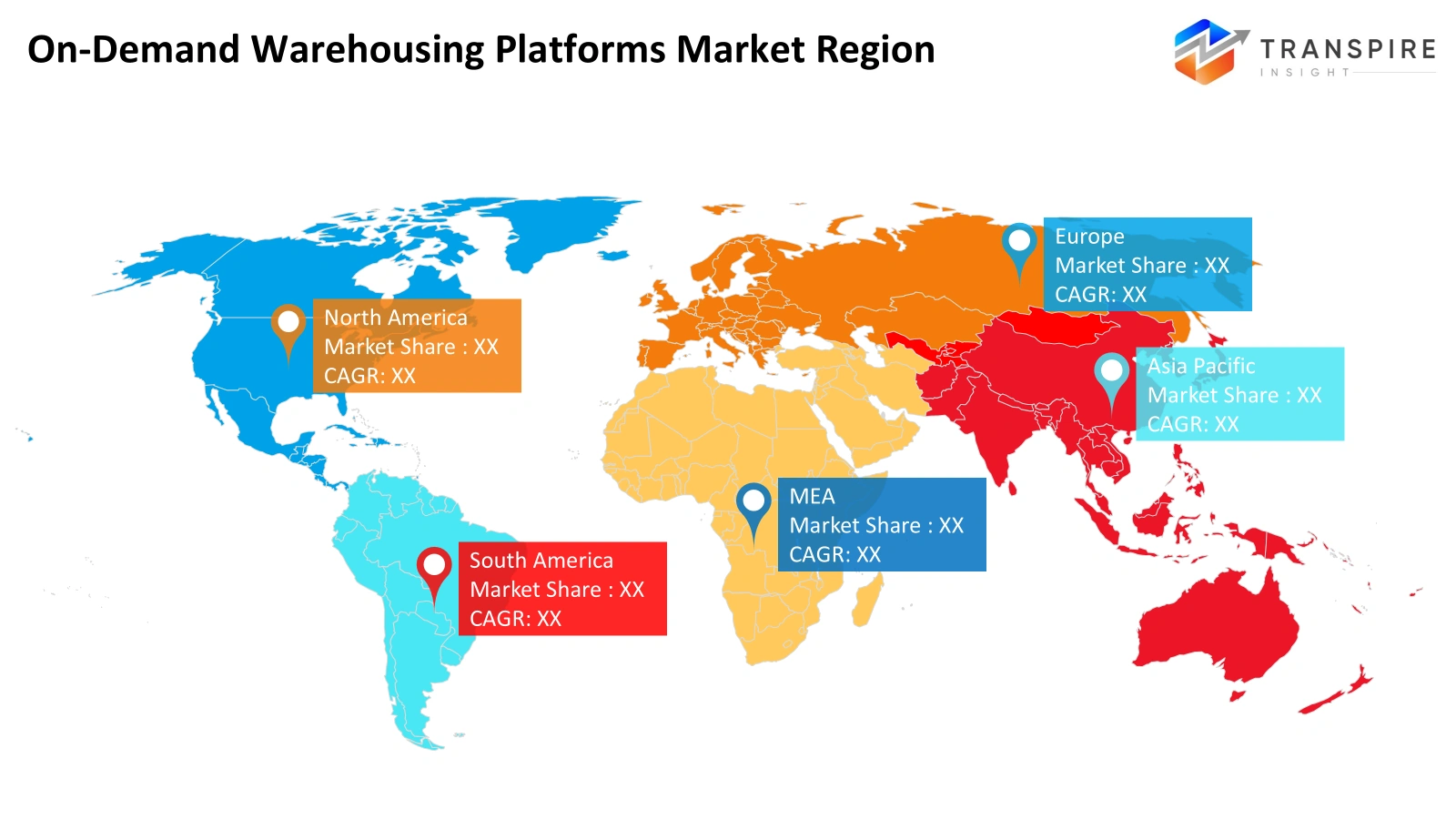
North America dominates the market for on-demand warehousing platforms globally, accounting for 41% of it due to the advanced infrastructure for logistics, development of digital supply chain technologies, as well as the presence of many leading e-commerce companies and third-party logistics providers in the region. Enterprises there quickly implement cloud warehousing technologies for better inventory tracking and order fulfilment. Continuous investments in the automation of warehouses, logistics platforms using AI technology, and transportation networks ensure the leadership of the region. The high need for flexible warehouse capacities and efficient delivery keeps driving market development.
Europe
The market share of Europe is 27%. The reason for that is the developed infrastructure for transport logistics, growing cross-border business, and more attention to sustainable logistics operations. Unlike North America, the region pays more attention to the efficiency of warehouses, efforts to reduce emissions of carbon dioxide, and compliance with regulations in the supply chains. Enterprises are increasingly implementing digital warehouse solutions for inventory management and fulfilment optimisation. In April 2025, PROXITY is the name of the innovative logistics platform introduced in Europe by Blackstone. The platform includes over 500 logistics properties spread across Europe and is meant to give the possibility of flexible warehousing services to companies that need scalable logistics space. Digital warehousing services were developed rapidly in the region.
Asia Pacific
The Asia Pacific region, which holds 25% market share, will witness the fastest growth at a CAGR of 20.1%. The growth in e-commerce, industrialisation, and investment in advanced warehouses has greatly driven the demand for digital warehouse solutions in the region. Cloud-based logistics solutions have been embraced to boost efficiency in domestic and international business activities. The ongoing modernisation of supply chain management in developing countries will provide long-term opportunities in Asia Pacific. In October 2025, the expansion of the warehousing network of Mahindra Logistics was realised due to the launch of over 400,000 sq. ft. of Grade A warehousing capacities in Guwahati and Agartala. These warehouses will help in the development of on-demand warehousing and distribution capacities in Eastern and North-Eastern India.
Who are the Key Players in the On-Demand Warehousing Platforms Marketand how do they Compete?
Competition among on-demand warehousing platforms in the market is influenced by innovations, technological connectivity, and provision of flexible warehousing services in different regions. In a bid to solidify their positions in the market, firms have been working towards increasing the number of warehouses, improving cloud-based platforms, AI integration, and visibility of the inventories in real time. This demand has increased due to the high need for fulfilment and scalable storage services.
Some of the top firms like Flexe, Ware2Go, Flowspace, and Stord have been working on expanding the capabilities of their digital warehousing systems using technology-based approaches. Flexe stands out in that it has a wide network of on-demand warehouse partners and provides flexible fulfilment services, whereas Ware2Go improves its platform through data-driven inventory positioning and national logistics coverage. Flowspace increases the value of customers using cloud-based warehouse management along with real-time inventory monitoring. Warehousing1, Spacefill, Stockarea, and CubicFM are growing in regions through partnerships, platform integrations, and customisation of their warehousing offerings. Some companies are focusing on leveraging AI to match warehouses, predictive analytics, and API integrations to improve the efficiency of operations and customers' experience. These approaches are geared toward building efficient logistics networks and geographical coverage.
On-Demand Warehousing Platforms Market companies
- Flexe
- Ware2Go
- Flowspace
- Stord
- DHL Supply Chain
- GXO Logistics
- ShipBob
- Amazon Warehousing & Distribution
- Prologis
- Blue Yonder
- Manhattan Associates
- Oracle
- SAP
- e2open
- ShipHero
Recent Development News
In May 2026, Stord secured a Series F funding round worth $250 million at a $3 billion valuation and started a subsidiary named Stord Labs that will fast-track the development of artificial intelligence, robotics, and physical intelligence in commerce operations. The funds will further consolidate Stord's technology platform for fulfilment services and extend AI-based warehousing operations in its worldwide network.
Source: https://www.stord.com
What Strategic Insights Define the Future of the On-Demand Warehousing Platforms Market?
In the on-demand warehousing platforms industry, a trend towards the development of highly interconnected logistics ecosystems with an emphasis on flexibility, real-time data, and quick delivery rather than physical warehouse management is evolving. It is expected that ongoing investments in cloud infrastructure, artificial intelligence technologies for warehouse matching, and platforms for integrating supply chains will transform the approach to storage space management across industries. The second problem, which is not widely known, relates to the absence of standard digital infrastructure at warehouse operators that might affect the efficiency of platform integration. However, the growing number of e-commerce transactions, international trade, and warehouse modernisation initiatives in developing countries bring many opportunities for platform providers to expand their business. Investing in intelligent automation, API capabilities, and partnerships with logistics providers will allow firms to gain a competitive advantage in terms of improved customer experience, robust supply chain performance, and sustainability.
Key Segmentations are:
By Platform Type
- Cloud-based Warehousing Platforms
- Warehouse Marketplace Platforms
- AI-based Warehouse Matching Platforms
- Inventory Management Platforms
- Fulfillment Platforms
- Digital Warehouse Networks
- Smart Warehousing Platforms,
By Deployment
- Cloud-based
- On-premise
- Hybrid
- SaaS Platforms
- API-integrated Platforms
- AI-enabled Platforms
By End User
- E-commerce Companies,
- Retailer
- Logistics Providers
- Manufacturers
- FMCG Companies
- Pharmaceutical Companies
By Application
- Inventory Storage
- Order Fulfillment
- Overflow Storage
- Seasonal Warehousing
- Last-mile Logistics
- Cold Storage Management
By Enterprise Size
- Large Enterprises
- Medium Enterprises
- Small Enterprises
Regional Outlook
North America
- United States
- Canada
- Mexico
Europe
- Germany
- United Kingdom
- France
- Spain
- Italy
- Rest of Europe
Asia Pacific
- Japan
- China
- Australia & New Zealand
- South Korea
- India
- Rest of Asia Pacific
South America
- Brazil
- Argentina
- Rest of South America
Middle East & Africa
- Saudi Arabia
- United Arab Emirates
- South Africa
- Rest of the Middle East & Africa
Frequently Asked Questions
Find quick answers to common questions.
The on-demand warehousing platforms market size was valued at USD 14.08 billion in 2025 and is poised to reach USD 38.94 billion by 2033, expanding at a 13.45% CAGR.
Key segments for the on-demand warehousing platforms market are By Platform Type (Cloud-based Warehousing Platforms, Warehouse Marketplace Platforms, AI-based Warehouse Matching Platforms, Inventory Management Platforms, Fulfillment Platforms, Digital Warehouse Networks, Smart Warehousing Platforms, Others); By Deployment (Cloud-based, On-premise, Hybrid, SaaS Platforms, API-integrated Platforms, AI-enabled Platforms, Others); By End User (E-commerce Companies, Retailers, Logistics Providers, Manufacturers, FMCG Companies, Pharmaceutical Companies, Others); By Application (Inventory Storage, Order Fulfillment, Overflow Storage, Seasonal Warehousing, Last-mile Logistics, Cold Storage Management, Others); By Enterprise Size (Large Enterprises, Medium Enterprises, Small Enterprises, Others).
Growth is primarily driven by the rapid growth of e-commerce, high demand for scalable and flexible warehouses, widespread use of digital logistics tools, the requirement for quicker order fulfilment, and innovations in artificial intelligence (AI) enabled warehouse management and supply chain management systems.
The market is led by major manufacturers including Flexe, Ware2Go, Flowspace, Stord, DHL Supply Chain, GXO Logistics, ShipBob, Amazon Warehousing & Distribution, Prologis, Blue Yonder, Manhattan Associates, Oracle, SAP, e2open, ShipHero.
The North American region accounts for 41% of the total market share for on-demand warehousing platforms, due to the superior logistics infrastructure, rapid development of e-commerce, extensive adoption of cloud-based supply chain technologies, and the availability of warehousing services companies.
Opportunities in the on-demand warehousing platforms market comprise tapping into new e-commerce markets, adoption of technologies such as AI and IoT to optimise warehouses, provision of flexible micro-fulfilment solutions, development of cross-border logistics capabilities, and collaborating with third-party logistics (3PL) service providers.
- Flexe
- Ware2Go
- Flowspace,
- Stord
- DHL Supply Chain
- GXO Logistics
- ShipBob
- Amazon Warehousing & Distribution
- Prologis
- Blue Yonder
- Manhattan Associates
- Oracle
- SAP
- e2open
- ShipHero
About the Authors

Mayur Shinde
I am Mayur Shinde, a Senior Research Analyst at Transpire Insight, specializing in the Automotive & Transportation and Information & Communication Technology (ICT) Industry. My work focuses on analyzing emerging market trends, technological advancements, competitive landscapes, and industry developments to deliver accurate, data-driven insights. I am passionate about transforming complex market information into clear, actionable content that helps businesses, professionals, and decision-makers stay informed and make confident strategic decisions.

Chakradhar Khansole
Chakradhar serves as the Research Director at Transpire Insight, bringing over 8 years of experience in technology, innovation, and strategic market intelligence. He specializes in transforming complex market data into actionable business insights that enable organizations to make informed, growth-oriented decisions. Recognized for his strategic vision and analytical expertise, Chakradhar leads high-impact research initiatives, delivering comprehensive market assessments, competitive intelligence, and forward-looking industry analysis.
Recently Published Reports
-
Apr 2026
3D Optical Profiler Market
3D Optical Profiler Market Size, Share & Analysis Report By Type (Desktop 3D Optical Profiler, and Portable 3D Optical Profiler), By Technology (Confocal Technology, and White Light Interference), By End-Use Industry (Manufacturing, Research Institutions, Automotive, Aerospace and Defense, Medical Devices, and Other), and Geography (North America, Europe, Asia-Pacific, Middle East and Africa, South and Central America), 2021 - 2031
-
Apr 2026
Depth Sensor Market
Depth Sensor Market Size, Share & Analysis Report By Type (Infrared Depth Sensors, Time-of-Flight (ToF) Sensors, Stereo Vision Sensors, Structured Light Sensors, Ultrasonic Depth Sensors), By Application (Automotive, Robotics, Gaming, Consumer Electronics, Industrial Automation, Healthcare, Security & Surveillance, Others), By End Users (Automotive Manufacturers, Consumer Electronics Companies, Healthcare Providers, Industrial Companies, Security Agencies, Gaming Companies, Robotics Companies, Others), and Geography (North America, Europe, Asia-Pacific, Middle East and Africa, South and Central America), 2021 – 2031
-
Apr 2026
Digital Manufacturing Market
Digital Manufacturing Market Size, Share & Analysis Report By Component (Hardware, Software, and Services), By Technology (Robotics, 3D Printing, Internet of Things (IoT), and Others), By Application (Automotive and Transportation, Aerospace and Defense, Consumer Electronics, Industrial Machinery, and Others), By Process Type (Computer-Based Designing, Computer-Based Simulation, Computer 3D Visualization, Analytics, and Others), and Geography (North America, Europe, Asia-Pacific, Middle East and Africa, South and Central America), 2021 – 2031
-
Apr 2026
Digital Visa Services Market
Digital Visa Services Market Size, Share & Analysis Report By Type (Individual Travelers, Group Travelers), By Application (Tourism, Business Travel, Others), and Geography (North America, Europe, Asia-Pacific, Middle East and Africa, South and Central America), 2021 – 2031