

Offshore Decommissioning Market Summary:
According to Transpire Insights, a detailed research report on the market reflects that the offshore oil & gas platform decommissioning application segment dominates the Offshore Decommissioning Market, accounting for approximately 71% of the total share worldwide. TechnipFMC leads the market with approximately (around USD 8.9 billion) in annual revenue and an estimated 13-17% market influence/share, making it a leading contributor to market development, innovation, manufacturing expansion, and industry growth.
Market Snapshot
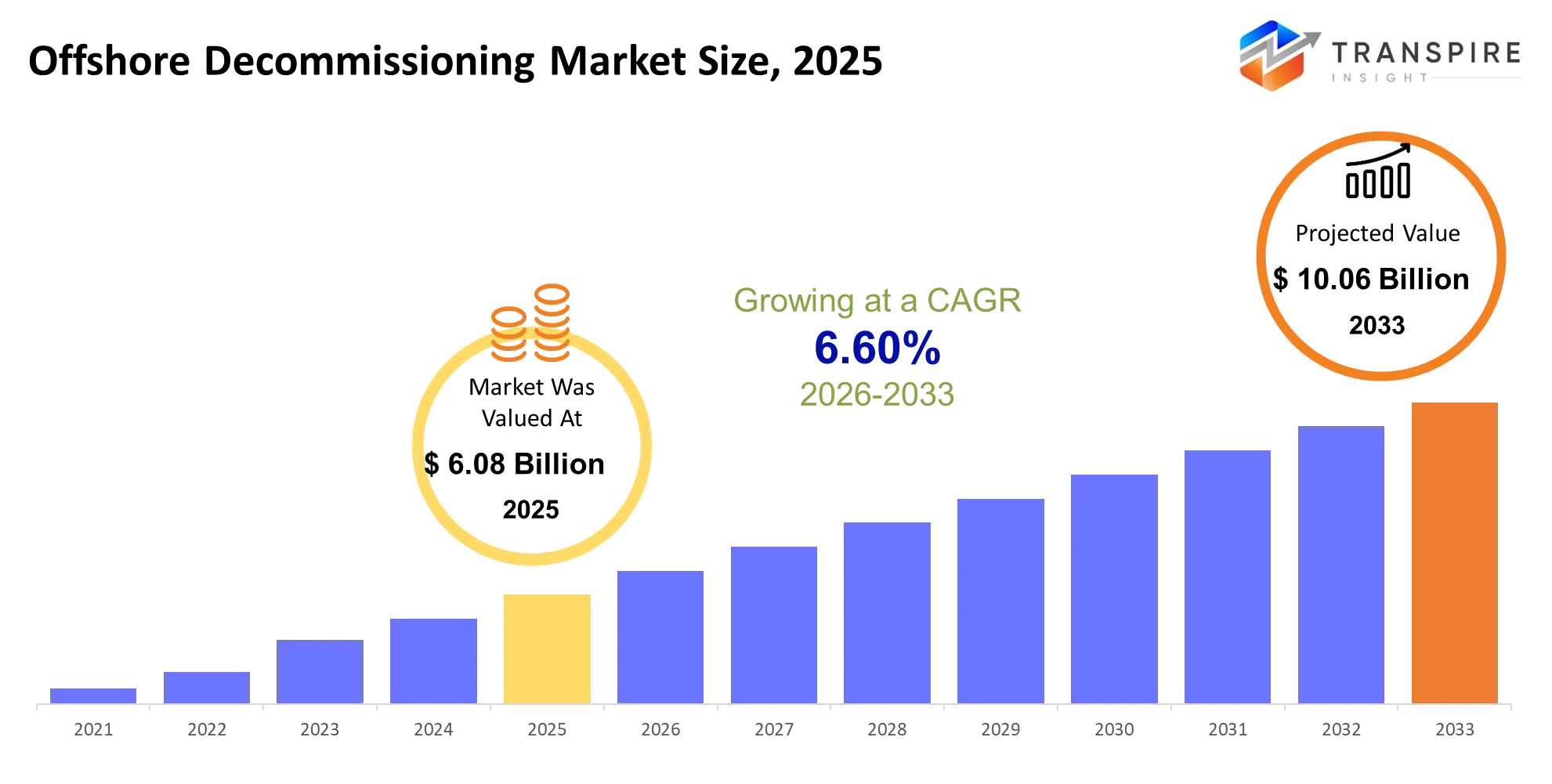
- Market Value (2025): USD 6.08 Billion.
- Expected Market Value (2026): USD 6.42 Billion.
- Estimated Market Value (2033): USD 10.06 Billion.
- Forecast CAGR (2026-2033): 6.60%
- Leading Region in 2025: Asia Pacific
- Second-largest Region: Europe
- Fastest Growing Region: North America
Introduction
Modern food delivery technologies and digital restaurant management solutions that facilitate efficient meal preparation, optimized kitchen operations, enhanced order accuracy, cost-effective food production, and improved operational performance across quick-service restaurants, food delivery platforms, virtual restaurant brands, catering providers, franchise operators, and independent food businesses comprise the market for cloud kitchens. Advanced kitchen management systems, virtual kitchen platforms, AI-powered order management solutions, smart food preparation technologies, automated inventory management systems, delivery optimization software, and next-generation cloud kitchen infrastructure are examples of cloud kitchen solutions that address the changing needs of restaurant operators, food delivery companies, hospitality providers, franchise networks, catering businesses, and digital food service enterprises.
Advanced kitchen management systems, virtual restaurant platforms, AI-powered order processing solutions, automated food preparation technologies, smart inventory management systems, delivery optimization software, cloud-based restaurant management solutions, and scalable digital kitchen technologies are examples of product innovations that improve functionality and performance. Cloud Kitchen innovation improves operational efficiency, order accuracy, food quality, kitchen productivity, delivery speed, customer satisfaction, and long-term business scalability through the use of artificial intelligence, cloud computing, automation technologies, real-time analytics, optimized kitchen workflows, and advanced digital food service infrastructure. Improved operational performance, reduced food preparation costs, enhanced delivery efficiency, greater resource utilization, and consistent service quality across interconnected food delivery ecosystems are all made possible by product innovation. Food safety standards, hygiene regulations, digital payment compliance, consumer protection requirements, quality management systems, and industry-specific regulatory standards are all adhered to.
Market Highlights: -
- Asia Pacific is expected to grow at a rapid CAGR in the Offshore Decommissioning Market by holding nearly 42% of the share during the forecast period.
- North America is the fastest-growing region in the Offshore Decommissioning Market during the period, holding around 31% share.
- Europe is anticipated to hold approximately 24% share of the Offshore Decommissioning Market over the predicted timeframe.
- By Service Type, the Well Plugging & Abandonment segment dominated the market and holds nearly 47.3% share in 2025 and is projected to grow at a substantial CAGR during the forecast period.
- By Structure Type, the Fixed Platform segment dominated the market and holds almost 48.6% share in 2025 and is projected to grow at a substantial CAGR during the forecast period.
- By Water Depth, the Shallow Water segment dominated the market and holds approximately 36.8% share in 2025 and is projected to grow at a substantial CAGR during the forecast period.
- By End User, the Oil & Gas Operators segment dominated the market and holds roughly 41.4% share in 2025 and is projected to grow at a substantial CAGR during the forecast period.
- By Removal Method, the Full Removal segment dominated the market and holds around 44.1% share in 2025 and is projected to grow at a substantial CAGR during the forecast period.
- Growing Adoption of Offshore Decommissioning Services, Advanced Subsea Engineering Technologies, and Sustainable Asset Retirement Solutions: Oil & gas operators, offshore engineering companies, energy service providers, subsea contractors, environmental management organizations, regulatory authorities, and decommissioning specialists across Asia Pacific, North America, and Europe are increasing investments in well plugging and abandonment, platform removal, subsea infrastructure decommissioning, pipeline decommissioning, heavy-lift vessel operations, remotely operated vehicle (ROV) technologies.
How is the Offshore Decommissioning Market Growing Due to Technology?
The market for offshore decommissioning is growing as a result of ongoing developments in subsea engineering technologies, well plugging and abandonment systems, remotely operated vehicle (ROV) technologies, autonomous underwater inspection solutions, digital asset management platforms, heavy-lift removal equipment, and advanced offshore decommissioning processes. Superior operational safety, optimized project execution, enhanced environmental protection, improved structural assessment, efficient asset retirement, regulatory compliance, and long-term offshore infrastructure management are provided by contemporary solutions such as advanced well plugging and abandonment technologies, subsea infrastructure removal systems, pipeline decommissioning solutions, platform dismantling technologies, digital inspection platforms, AI-powered monitoring systems, and high-performance offshore engineering equipment. Innovations in robotic subsea intervention, digital twin technology, predictive analytics, automated inspection systems, environmentally sustainable dismantling techniques, marine waste management solutions, advanced lifting technologies, smart offshore monitoring platforms, and integrated project management systems enable operators to execute offshore decommissioning projects that are safer, more efficient, scalable, environmentally responsible, and cost-effective while meeting stringent international environmental regulations, offshore safety standards, marine protection requirements, ISO quality management systems, and industry-specific compliance frameworks. In addition to improving operational efficiency, project safety, environmental sustainability, regulatory compliance, cost optimization, asset lifecycle management, and engineering innovation across the market.
Market Drivers
The Offshore Decommissioning Market is being driven by the growing number of aging offshore oil and gas assets, increasingly stringent environmental regulations, and the rising adoption of advanced offshore decommissioning solutions by oil & gas operators, offshore engineering companies, energy service providers, subsea contractors, marine infrastructure owners, and government authorities. The increasing use of well plugging and abandonment services, platform removal solutions, subsea infrastructure decommissioning, pipeline decommissioning, heavy-lift vessel operations, remotely operated vehicle (ROV) technologies, digital asset management systems, AI-powered inspection technologies, and environmentally sustainable offshore engineering solutions is driving up demand for services that improve operational safety, optimize project execution, reduce environmental risks, ensure regulatory compliance, and support responsible offshore asset retirement while addressing the growing need for safe, efficient, and cost-effective offshore decommissioning operations. These advancements are encouraging industry participants to invest in next-generation offshore engineering technologies, innovative decommissioning services, and expanded offshore asset retirement portfolios. Companies in the worldwide Offshore Decommissioning Market are expanding their service portfolios, improving operational capabilities, increasing research and development investments, and creating new growth opportunities.
For example, SLB (Schlumberger Limited) continues to advance offshore decommissioning innovation by developing advanced well plugging and abandonment technologies, digital offshore asset management solutions, subsea engineering services, AI-powered inspection platforms, integrated decommissioning workflows, and environmentally sustainable offshore engineering solutions that improve operational efficiency, enhance regulatory compliance, reduce environmental impact, and expand applications across offshore oil and gas fields, subsea infrastructure, offshore energy assets, and the Offshore Decommissioning Market.
Restrain
The primary challenges facing the Offshore Decommissioning Market are increasing project and operational costs, complex offshore engineering requirements, and stringent regulations related to environmental protection, marine ecosystem preservation, offshore worker safety, waste disposal, and regulatory compliance standards. The use of advanced well plugging and abandonment systems, subsea engineering technologies, heavy-lift vessels, remotely operated vehicle (ROV) systems, offshore inspection technologies, marine waste management solutions, digital monitoring platforms, and continuous research and development initiatives significantly increases project execution and operational costs.
Analysis of Prices and Consumer Behaviour
The Offshore Decommissioning Market is experiencing increasing demand for safe, environmentally responsible, technologically advanced, and cost-efficient offshore decommissioning solutions as oil & gas operators, offshore engineering companies, subsea contractors, energy service providers, offshore wind developers, and marine infrastructure owners increasingly prioritize regulatory compliance, operational efficiency, and sustainable asset retirement. Pricing is influenced by factors such as offshore asset size, water depth, project complexity, engineering requirements, decommissioning scope, vessel availability, equipment utilization, environmental compliance costs, labor expenses, regulatory approvals, and investments in advanced offshore technologies. Customers are increasingly evaluating offshore decommissioning services based on total lifecycle value, operational safety, environmental performance, regulatory compliance, project execution efficiency, engineering expertise, digital monitoring capabilities, and long-term cost optimization rather than initial project costs. Customer behaviour is also shifting toward well plugging and abandonment services, platform removal solutions, subsea infrastructure decommissioning, pipeline decommissioning, ROV-assisted inspection technologies, AI-powered asset monitoring, digital project management platforms, and sustainable offshore engineering solutions that improve operational efficiency, reduce environmental impact, streamline offshore asset retirement, enhance regulatory compliance, and support responsible marine infrastructure management. As organizations increasingly demand reliable, scalable, and technologically advanced offshore decommissioning services, companies are focusing on competitive pricing strategies, integrated engineering solutions, digital offshore technologies, sustainable decommissioning practices, and advanced project execution capabilities to address evolving customer requirements and strengthen their position in the Offshore Decommissioning Market.
Top Companies in the Offshore Decommissioning Market
- TechnipFMC
- Saipem
- Subsea7
- Halliburton
- Baker Hughes
- Oceaneering International
- Aker Solutions
- Heerema Marine Contractors
- Allseas
- Wood plc
- Petrofac
- Boskalis
- Fugro
- Schlumberger
- McDermott International
Market Segmentation
The Offshore Decommissioning Market share is divided into five categories: Service Type, Water Depth, Structure Type, End User, Technology.
The Well Plugging & Abandonment dominated the market, accounting for nearly 47.3% in 2025, and is expected to rise at a significant CAGR during the forecast period.
The Offshore Decommissioning Marketis segmented. By Service Type Well Plugging & Abandonment, Platform Removal, Pipeline Decommissioning, Subsea Infrastructure Removal, Waste Disposal & Recycling, Site Remediation, Engineering Services, Others Among these, the Well Plugging & Abandonment dominated the market, accounting for nearly 47.3% in 2025 and expected to increase at a significant CAGR during the forecast period.because aging offshore oil and gas wells require permanent sealing to ensure environmental protection, regulatory compliance, prevent hydrocarbon leakage, minimize long-term liabilities, and enable safe offshore asset retirement.
The Shallow Water segmentheld the greatest share of approximately 49.1% in 2025 and is expected to increase at a substantial CAGR over the forecast period.
The Offshore Decommissioning Market is segmented By Water Depth Shallow Water, Deepwater, Ultra-deepwater, Continental Shelf, Shelf Edge, Marginal Fields, Offshore Islands, Others Among these, the Shallow Water segment held the greatest share of approximately 49.1% in 2025 and is expected to increase at a substantial CAGR over the forecast period.because it contains the highest concentration of aging offshore oil and gas platforms, offers easier access, lower operational costs, established infrastructure, and faster decommissioning execution than deepwater projects.
The Fixed Platform segmentheld the greatest share of approximately 45.4% in 2025 and is expected to increase at a high CAGR over the forecast period.
The Offshore Decommissioning Market is segmentedBy Structure Type Fixed Platforms, Floating Platforms, FPSOs, Subsea Wells, Pipelines, Jackets, Topsides, Others. Among these theFixed Platform segment held the greatest share of approximately 44.9% in 2025 and is expected to increase at a considerable CAGR over the projected period.because most aging offshore oil and gas installations are fixed platforms, requiring extensive removal, well abandonment, and environmental restoration to comply with evolving regulatory requirements.
Regional Segment Analysis of the Offshore Decommissioning Market
- North America (U.S., Canada, Mexico)
- Europe (Germany, France, U.K., Italy, Spain, Rest of Europe)
- Asia-Pacific (China, Japan, India, Rest of APAC)
- South America (Brazil and the Rest of South America)
- The Middle East and Africa (UAE, South Africa, Rest of MEA)
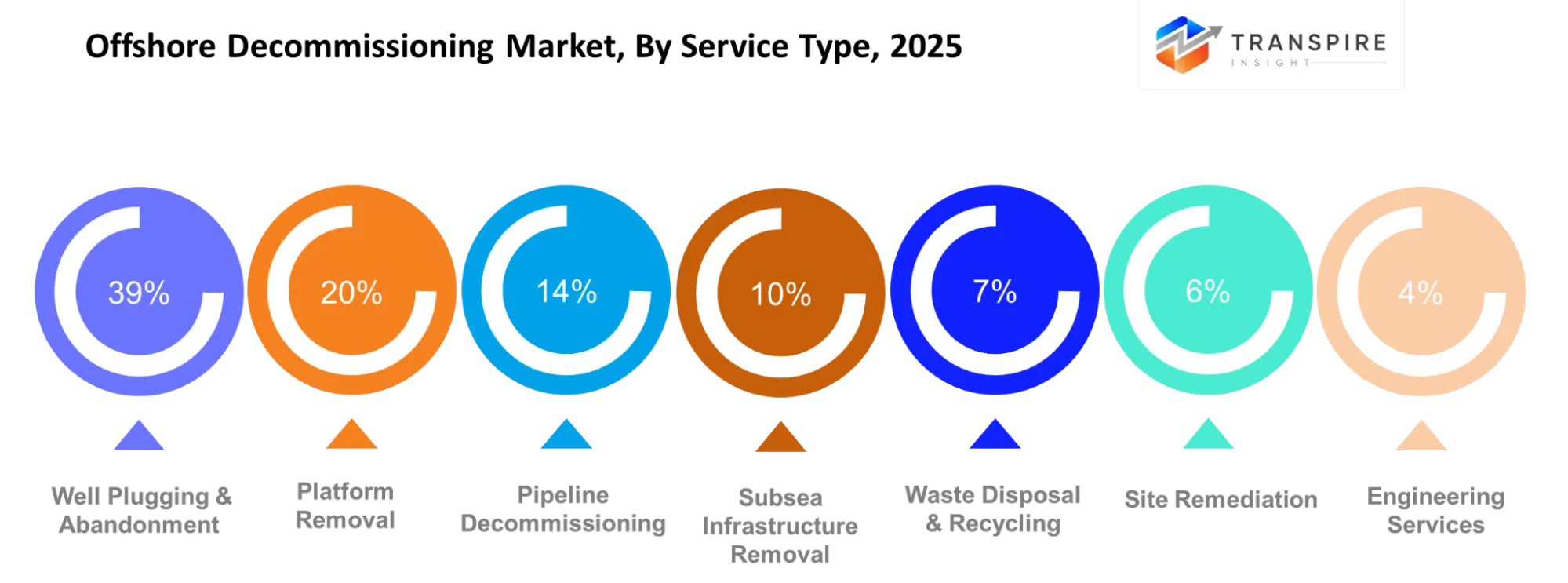
Asia Pacific is expected to grow at a rapid CAGR in the Offshore Decommissioning Market by holding nearly 42% of the share during the forecast period.
Over the forecast period, the Offshore Decommissioning Market is anticipated to expand rapidly in Asia Pacific. It makes up about 42% of the market. The region dominates this market due to a number of factors, including increasing numbers of aging offshore oil and gas assets, rising investments in offshore energy infrastructure, growing regulatory emphasis on safe asset retirement, expanding offshore exploration activities, and rapid development of offshore engineering capabilities in countries such as China, India, Australia, Malaysia, Indonesia, South Korea, and Japan. The demand is driven by advancements in well plugging and abandonment services, platform removal technologies, subsea infrastructure decommissioning, pipeline decommissioning, remotely operated vehicle (ROV) systems, heavy-lift vessel operations, digital offshore asset management, and environmentally sustainable decommissioning solutions, along with increasing investments by offshore oil and gas operators, engineering contractors, energy service providers, and marine infrastructure companies. Expanding deployment across fixed platforms, floating production systems, subsea facilities, offshore pipelines, offshore wind infrastructure, and other offshore energy assets, together with supportive government regulations promoting environmental protection, offshore safety, responsible asset retirement, and sustainable marine ecosystem management, further accelerates market growth. The increasing adoption of advanced offshore engineering technologies, digital inspection systems, AI-powered monitoring solutions, improved access to specialized decommissioning equipment, and growing public and private investments in offshore infrastructure lifecycle management continue to strengthen the regional Offshore Decommissioning Market.
Europe is anticipated to hold approximately 24% share of the Offshore Decommissioning Market over the predicted timeframe.
Over the course of the projected period, Europe is expected to hold a 24% market share of the Offshore Decommissioning Market. The region's growth is primarily driven by the large number of aging offshore oil and gas assets in the North Sea, stringent environmental regulations, expanding offshore engineering capabilities, and increasing investments in sustainable offshore asset retirement. Countries including the United Kingdom, Norway, Germany, the Netherlands, Denmark, and Italy are prioritizing well plugging and abandonment, platform removal, subsea infrastructure decommissioning, pipeline decommissioning, digital offshore asset management, remotely operated vehicle (ROV) technologies, and environmentally responsible offshore engineering solutions. Partnerships among offshore operators, engineering contractors, energy service providers, subsea technology companies, government agencies, regulatory authorities, research institutions, and technology providers are accelerating the development, deployment, and adoption of advanced offshore decommissioning solutions to support long-term market growth across Europe.
North America is anticipated to hold approximately 31% share of the Offshore Decommissioning Market over the predicted timeframe.
North America is anticipated to hold around 31% of the worldwide Offshore Decommissioning Market throughout the forecast period. A mature offshore oil and gas industry, increasing investments in offshore asset retirement, growing regulatory requirements for environmental compliance, and widespread adoption of advanced offshore engineering technologies are expected to drive regional growth. Rising investments by offshore oil and gas operators, engineering service providers, subsea contractors, marine infrastructure companies, and offshore energy developers, along with increasing demand for well plugging and abandonment, platform removal, subsea infrastructure decommissioning, pipeline decommissioning, heavy-lift vessel operations, and remotely operated vehicle (ROV) technologies, continue to strengthen the market. Continuous advancements in digital asset management, AI-powered offshore inspection systems, robotic subsea intervention, predictive maintenance, and environmentally sustainable decommissioning technologies are further supporting innovation, operational efficiency, and commercialization across North America.
Strategies for Market Growth in Non-Leading Regions
By developing scalable and cost-effective offshore decommissioning infrastructure utilizing advanced well plugging and abandonment technologies, platform removal systems, subsea engineering solutions, remotely operated vehicle (ROV) technologies, heavy-lift vessel operations, digital offshore asset management platforms, and integrated decommissioning project management systems, non-leading regions can accelerate market growth. Strengthening regional offshore engineering capabilities, expanding specialized decommissioning services, and establishing value-added offshore asset retirement ecosystems can reduce dependence on international service providers while improving operational efficiency. Strategic partnerships among offshore oil and gas operators, engineering contractors, subsea technology providers, marine infrastructure companies, environmental organizations, government agencies, academic institutions, and technology developers will accelerate commercialization and market penetration. Investments in workforce development, research and development, robotic subsea technologies, AI-powered inspection systems, offshore engineering infrastructure, environmental monitoring solutions, and compliance with offshore safety and environmental standards are essential to improve project execution and operational performance. Government support through offshore energy transition programs, marine environmental protection initiatives, regulatory modernization, infrastructure investments, and sustainable offshore asset retirement policies can further increase technology adoption, attract investment, and accelerate the long-term growth of the Offshore Decommissioning Market in emerging economies.
Recent Development
- February 2026: SLB (Schlumberger Limited) (U.S.) announced advancements in its offshore decommissioning portfolio with enhanced well plugging and abandonment technologies, advanced subsea engineering solutions, and expanded integrated offshore asset retirement capabilities. The innovation supports next-generation offshore decommissioning operations, improves project efficiency, promotes environmentally responsible asset retirement, and enhances operational safety, regulatory compliance, and overall decommissioning performance.
- May 2026: Baker Hughes (U.S.) expanded its offshore decommissioning portfolio with advanced well abandonment solutions, subsea intervention technologies, digital offshore asset management platforms, AI-powered inspection systems, and enhanced engineering capabilities for offshore oil and gas operators, energy service providers, subsea contractors, offshore wind developers, and marine infrastructure companies. The development supports advanced offshore decommissioning applications, improves operationalefficiency, enhances environmental sustainability, and increases project execution performance.
Future Market Trends for the Offshore Decommissioning Market:
- Growing Adoption of Offshore Decommissioning Services and Advanced Offshore Engineering Solutions: As offshore operators prioritize operational safety, environmental sustainability, regulatory compliance, project efficiency, and cost optimization, service providers are expanding their offshore decommissioning portfolios, including well plugging and abandonment, platform removal, subsea infrastructure decommissioning, pipeline decommissioning, digital asset management, remotely operated vehicle (ROV) technologies, and integrated offshore engineering solutions.
- Growing Need for Advanced Offshore Decommissioning Technologies: To improve project execution, enhance offshore safety, optimize asset retirement, minimize environmental impact, and support offshore oil & gas, offshore wind, subsea infrastructure, and marine energy applications, organizations are increasingly adopting AI-powered inspection systems, robotic subsea intervention technologies, digital twin platforms, predictive analytics, heavy-lift engineering solutions, advanced well abandonment systems, and comprehensive offshore decommissioning technologies.
- Increasing Investments in Digital and Sustainable Offshore Asset Retirement Solutions: In order to improve operational efficiency, engineering performance, project reliability, environmental sustainability, regulatory compliance, and support next-generation offshore energy ecosystems, companies are investing in advanced subsea engineering technologies, intelligent offshore monitoring systems, automated inspection platforms, sustainable decommissioning practices, digital asset lifecycle management, marine environmental protection technologies, integrated project management systems, and innovative offshore engineering solutions.
Market Segment
This study forecasts revenue at global, regional, and country levels from 2020 to 2033. Transpire Insights has segmented the Offshore Decommissioning Market based on the below-mentioned segments.
Offshore Decommissioning Market, By Service Type
- Well Plugging & Abandonment
- Platform Removal
- Subsea Infrastructure Decommissioning
- Pipeline Decommissioning
- Site Clearance & Remediation
- Engineering & Project Management
- Others
Offshore Decommissioning Market, By Structure Type
- Fixed Platform
- Floating Platform
- Subsea Systems
- Pipelines
- Offshore Wind Structures
- Others
Offshore Decommissioning Market, By Water Depth
- Shallow Water
- Deepwater
- Ultra-Deepwater
- Others
Offshore Decommissioning Market, By End User
- Oil & Gas Operators
- Offshore Wind Developers
- Engineering & Procurement Contractors (EPC)
- Energy Service Providers
- Government & Regulatory Authorities
- Others
Offshore Decommissioning Market, By Removal Method
- Full Removal
- Partial Removal
- Leave-in-Place
- Reefing
- Others
Offshore Decommissioning Market, By Regional Analysis
North America
- US
- Canada
- Mexico
- US
- Canada
Europe
- Germany
- UK
- France
- Italy
- Spain
- Rest of Europe
Asia Pacific
- China
- Japan
- India
- South Korea
- Australia
- Rest of Asia Pacific
South America
- Brazil
- Argentina
- Rest of South America
Middle East & Africa
- UAE
- Saudi Arabia
- Qatar
- South Africa
- Rest of the Middle East & Africa
Frequently Asked Questions
Find quick answers to common questions.
The Offshore Decommissioning Market is primarily driven by the increasing number of aging offshore oil and gas assets, stringent environmental regulations, and rising investments in well plugging & abandonment, platform removal, subsea infrastructure decommissioning, and digital offshore engineering technologies. Growing adoption of AI-powered inspection systems, ROVs, and sustainable decommissioning solutions is further accelerating market expansion.
The Well Plugging & Abandonment segment dominates the market, accounting for nearly 47.3% of the market in 2025. Its leadership is attributed to the increasing need to permanently seal aging offshore wells, prevent hydrocarbon leakage, comply with environmental regulations, minimize long-term liabilities, and ensure safe offshore asset retirement.
Asia Pacific is expected to hold nearly 42% of the market during the forecast period due to increasing numbers of aging offshore oil & gas assets, expanding offshore engineering capabilities, rising investments in offshore infrastructure, and supportive government regulations promoting environmentally responsible offshore decommissioning across countries such as China, India, Australia, Japan, and South Korea.
Technological advancements such as AI-powered monitoring systems, digital twin technology, robotic subsea intervention, remotely operated vehicles (ROVs), autonomous underwater inspection systems, predictive analytics, and integrated digital asset management platforms are improving project safety, operational efficiency, environmental compliance, and cost-effective offshore asset retirement.
SLB (Schlumberger Limited) is the leading company in the Offshore Decommissioning Market, holding approximately 18-22% of the market. The company maintains its leadership through advanced well plugging & abandonment technologies, integrated subsea engineering solutions, digital offshore asset management capabilities, and continuous innovation in sustainable offshore decommissioning services.
- TechnipFMC
- Saipem
- Subsea7
- Halliburton
- Baker Hughes
- Oceaneering International
- Aker Solutions
- Heerema Marine Contractors
- Allseas
- Wood plc
- Petrofac
- Boskalis
- Fugro
- Schlumberger
- McDermott International
About the Authors

Avinash Kumar
I’m Avinash Kumar, a Senior Research Analyst at Transpire Insight, with expertise in the Electronics and Semiconductor and Energy & Power industry. My work focuses on analyzing emerging technologies, market trends, industry developments, and innovation across these sectors. I specialize in transforming complex technical and market insights into clear, research-backed content that helps professionals, businesses, and decision-makers stay informed. Through continuous industry research and data-driven analysis, I strive to deliver accurate, reliable, and practical perspectives on the latest advancements shaping the semiconductor and energy landscape.

Chakradhar Khansole
Chakradhar serves as the Research Director at Transpire Insight, bringing over 8 years of experience in technology, innovation, and strategic market intelligence. He specializes in transforming complex market data into actionable business insights that enable organizations to make informed, growth-oriented decisions. Recognized for his strategic vision and analytical expertise, Chakradhar leads high-impact research initiatives, delivering comprehensive market assessments, competitive intelligence, and forward-looking industry analysis.
Recently Published Reports
-
Apr 2026
Active Power Filter Market
Active Power Filter Market Size, Share & Analysis Report By Type (Shunt Active Power Filters, Series Active Power Filter, Hybrid Active Power Filter), By Application (Harmonics Mitigation, Reactive Power Compensation, Voltage Regulation, Power Factor Correction), By Phase (Single Phase, Three Phase), By End-User Industry (Manufacturing, Healthcare, Commercial, Automotive, Oil and Gas, Others), and Geography (North America, Europe, Asia-Pacific, Middle East and Africa, South and Central America), 2021 - 2031
-
Apr 2026
Electrical Transformer Market
Electrical Transformer Market Size, Share & Analysis Report By Core (Closed, Shell, and Berry), By Insulation (Gas, Oil, Solid, Air, and Other), By Phase (Single, and Three), By Rating (100 MVA to 500 MVA, 501 MVA to 800 MVA, and 801 MVA to 1200 MVA), and Geography (North America, Europe, Asia-Pacific, Middle East and Africa, South and Central America), 2021 – 2031
-
Apr 2026
Hydraulic Piston Pumps Market
Hydraulic Piston Pumps Market Size, Share & Analysis Report By Type (Axial Piston Pumps, Radial Piston Pumps), By Operating Pressure (Low Pressure, Medium Pressure, High Pressure), By Application (Construction, Mining, Agriculture, Automotive, Oil & Gas, Industrial Machinery, Others), By End-User (OEMs, Aftermarket), and Geography (North America, Europe, Asia-Pacific, Middle East and Africa, South and Central America), 2021 – 2031
-
Apr 2026
Laboratory Gas Generators Market
Laboratory Gas Generators Market Size, Share & Analysis Report By Product (Nitrogen Gas Generator, Hydrogen Gas Generator, Zero Air Gas Generator, Purge Gas Generator, TOC Gas Generators, Others), By Application (Gas Chromatography, Liquid Chromatography-mass Spectrometry (LC-MS), Gas Analyzers, Others), By End-user (Life Science, Chemical & Petrochemical, Food & Beverage, Others), and Geography (North America, Europe, Asia-Pacific, Middle East and Africa, South and Central America), 2021 – 2031