

Off-road Vehicle Market Summary:
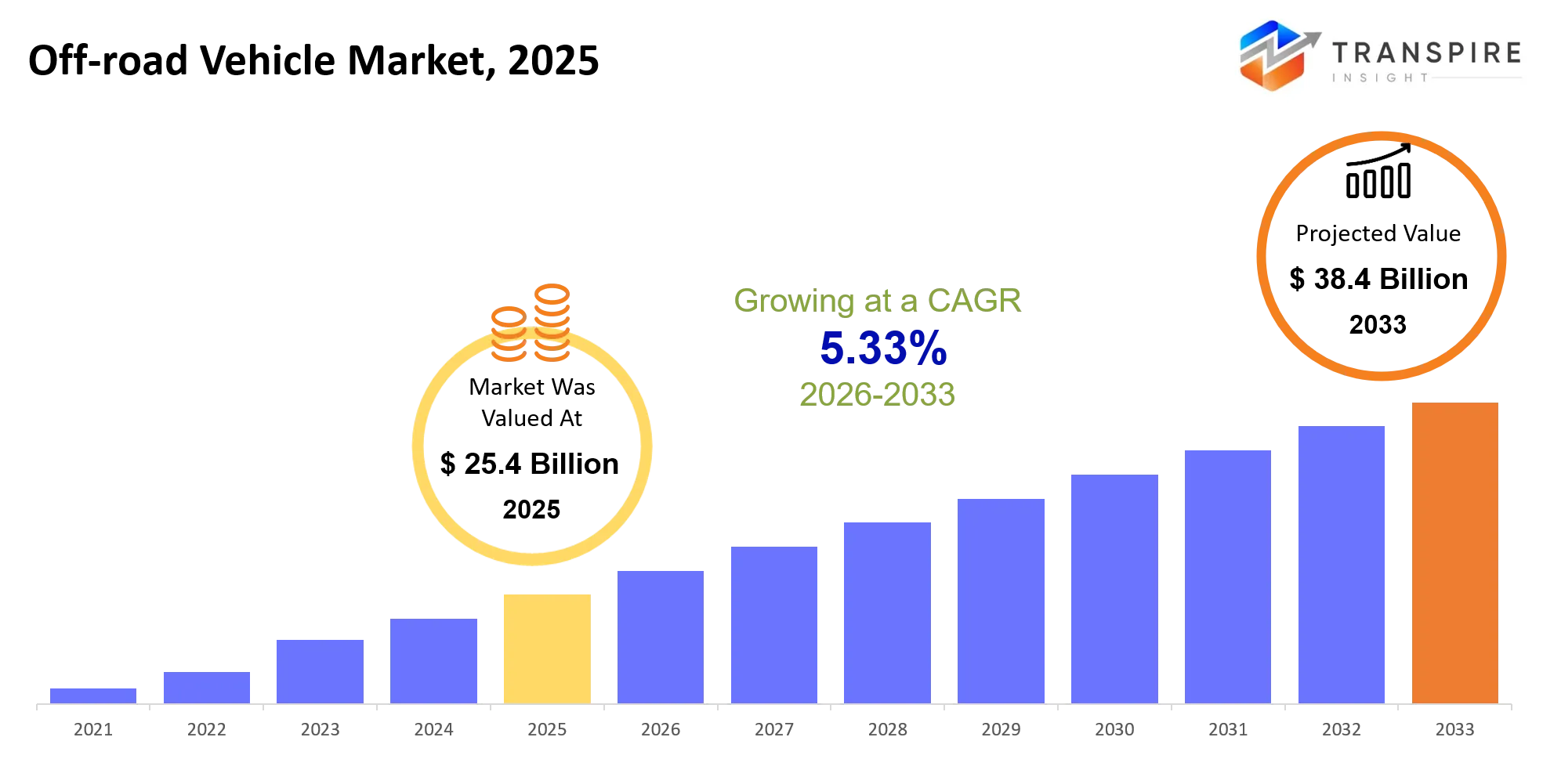
As per Transpire Insight Analysis, the Off-road Vehicle Market size is estimated at USD 25.4 billion in 2025 and is anticipated to reach USD 38.4 billion by 2033, growing at a CAGR of 5.33% from 2026 to 2033.
The international off-road vehicle industry is growing, not just in recreational applications but also in agricultural, construction, and other strenuous applications. Over the years, demand for off‑road vehicles has changed. Buyers want off‑road vehicles that are more versatile, safer, have suspension and cost less to run. A big shift in the off‑road vehicle world is the rise of electric off‑road vehicles. This shift is backed by battery technology and more focus on cutting emissions and noise. A clear real‑world reason for this change is the growth of agriculture and infrastructure work. Off‑road vehicles that can carry equipment and drive over uneven ground help farmers and builders in the field and at construction sites. At the same time, more people enjoy outdoor tourism and recreational riding, which adds to the demand for off‑road vehicles. Because of all these factors, manufacturers are pushing to make off‑road vehicles that're more capable, connected and efficient. They want models that suit both jobs and personal adventures.
Off-road Vehicle Market Size & Forecast:
- Market Size 2025: USD 25.4 Billion
- Expected Market Value (2033): USD 38.4 Billion
- Forecast CAGR (2026–2033): 5.33%
- Leading Region in 2025: North America
- Fastest Growing Region: Asia Pacific
- Key Company Profiles: Polaris, Honda, Yamaha, BRP, Kawasaki, Suzuki, Textron, Can-Am, CFMOTO, Arctic Cat, John Deere, Kubota, Segway Powersports, Kayo, Hisun Motors
Key Market Insights:
There has been a shift from the market being recreation-based to the mobility and utility market. There is an emphasis on product development that emphasises flexibility, electric power, digitisation, and vehicles meant for particular work environments.
- Three-wheelers constitute more than 45% of the market share owing to wide recreational and adventurous uses of this category of vehicles.
- ATVs constitute about 25%, with manufacturers striving to enhance suspension, cargo capacity, comfort, and off-road handling capabilities.
- UTVs make up about 15% owing to use in agriculture, construction, property management, and recreation.
- The market share for snowmobiles stands at about 7%, with manufacturers focusing on developing high-performance products that offer high comfort and better controls.
- Side-by-sides constitute about 4%, with consumers seeking all-terrain platforms for both utility and recreation purposes.
- Recreational vehicles make up almost 2% owing to the increasing desire of consumers for outdoor activities.
What are the Key Drivers, Restraints, and Opportunities in the Off-road Vehicle Market?
Drivers
The growth in the industry is driven by the adoption of off-road vehicles in the agricultural, construction, maintenance, hunting, and utility sectors. The main driving force is the requirement for small-sized vehicles capable of transporting and towing load while moving around in areas lacking any road infrastructure.
Restraints
High costs are still an impediment, especially where high-end, electric, and high-performance cars are concerned. The problem is mainly associated with the fact that tough drive systems, batteries, suspension, and safety equipment lead to high manufacturing and maintenance expenses.
Opportunities
Electrification is an opportunity that is present in this market, where fleet management and semi-autonomous technology can bring in a lot of revenue as users search for machines that are quiet, clean, and more efficient. Manufacturers should develop machinery that will serve farm, mining, construction and governmental operations specifically.
What Has the Impact of Artificial Intelligence Been on the Off-road Vehicle Market?
The use of AI for the of off-road vehicles can be achieved using computer vision, sensor fusion, route planning, and predictive monitoring. In difficult situations, AI can combine camera inputs, radar, GPS, and information from other sensors to identify obstacles, analyze the condition of the ground, and assist in navigating. This technology will be useful for choosing a suitable path, reducing unnecessary halts, and ensuring proper positioning in various situations within the agricultural, mining, construction, and military industries.of AI in action is the U.S. Army Artificial Intelligence of Manoeuvre and Mobility program aimed at developing autonomous off-road navigation and scene understanding. Off-highway technology vendors are also utilising machine learning for autonomous farming, construction, and mining machines. the development of such systems is limited by high costs associated with sensors, hardware, and software development, as well as by low accuracy due to unfamiliarity with terrain, difficult weather conditions, or insufficient training data.
Instance
In March 2026, The Polaris Government & Defence used their off-road vehicles in conjunction with AI-based autonomous capabilities from Overland AI, Forterra, and Dataspeed for the U.S. Army's xTech|Edge Strike. Ground challenge, highlighting how AI-based autonomous systems can be applied to off-road vehicles.
Key Market Trends:
Market Trend for Off-Road Vehicles as they become increasingly applicable to both recreation and business use. Recent innovations reveal an evident trend toward connectivity, electrification, increased comfort, and applicability.
- Consumers have shifted their preference from pure recreational machines to machines that have both recreational and utility functionality.
- Manufacturers are integrating larger screens and navigation features in their products as the use of digital technologies is becoming more prominent in off-road vehicles.
- The use of electric power is becoming more mainstream and not just a novel idea, as it is being integrated into ATVs and utility vehicles.
- Product development is now focusing more on the comfort of the user, such as ergonomic seating and enclosed cabs with heating and cooling.
- Utility vehicle performance is improving due to increased towing capacity, greater cargo space and more specific working setups.
- Better suspension and traction systems are becoming relevant for individuals who work with rocks, mud, hills and rough working sites.
Off-road Vehicle Market Segmentation
By product type
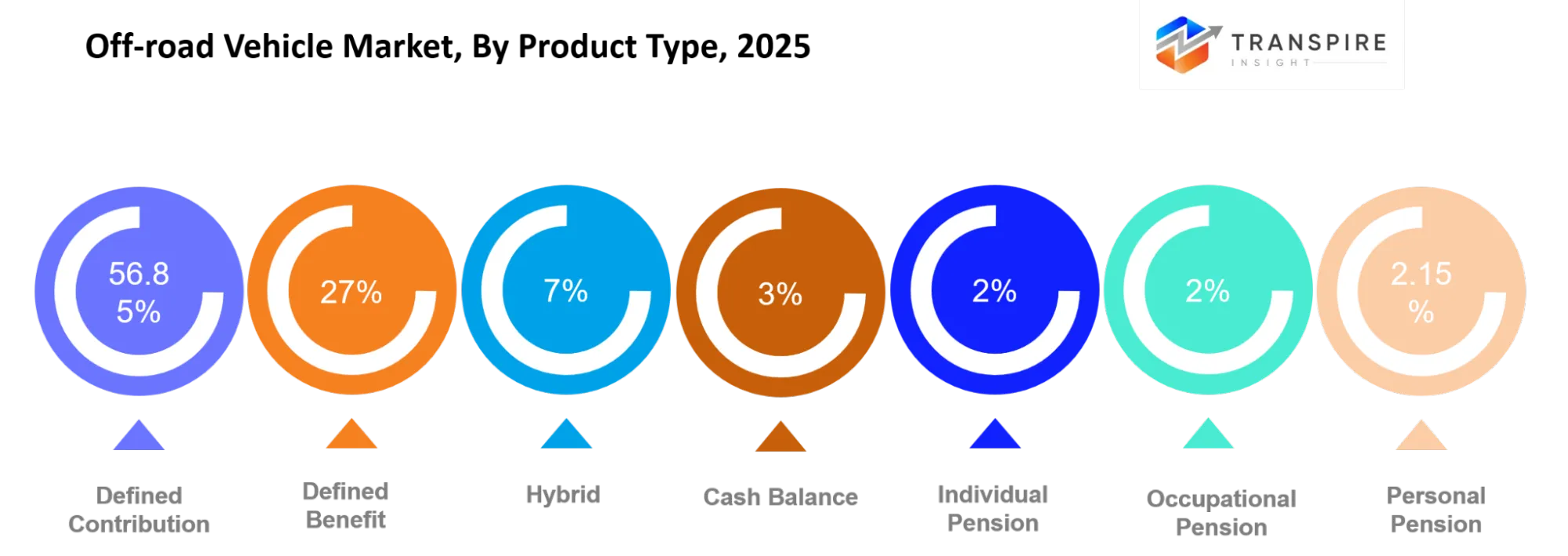
Three-wheelers constitute the largest market share of 45%, while ATVs and UTVs are second and third in terms of market share, constituting 25% and 15%. Snowmobiles hold a 7% market share, Side-by-side vehicles have 4%, Recreational Vehicles have 2%, Work Vehicles have 1%, and others have 1%. This can be attributed to the utility and recreational uses of three-wheelers and the work-related uses of ATVs and UTVs.
By propulsion
gasoline- and diesel-powered vehicles will continue to serve existing applications where longer range of travel, faster refuelling times and existing infrastructure are essential. However, the most rapid expansion in the supplied classification belongs to electric off-road vehicles, whose 10% CAGR of growth is due to technological advances in batteries, quietness and stricter requirements concerning emissions levels. It is clear that manufacturers try to develop more models powered by electricity, with the launch of Can-Am’s Outlander Electric being an example of penetration of electric motors into mainline ATVs.
By application
Recreation still plays the key role among the sources of demand, while agriculture, construction, military, mining, sports and hunting add to the variety of revenue sources. Applications that require work are especially valuable because the vehicle can be utilised for transportation and loading of cargo or for inspection purposes instead of mere leisure activities. Buyers become more interested in productivity, along with performance, and this trend results in the development of heavier models that can haul cargo or use special equipment.
By engine displacement
The range of machines ranges from less than 250cc to more than 1200cc to cater to various terrains, workloads, and customer budgets. Engines with smaller displacements are suitable for entry-level, utility, and youth uses, while large displacements cater to tough recreation, hauling, and performance demands. The mix of products in future will tend to become diversified as the customer will opt for a certain engine configuration depending on the need and not just the engine power output. This could be affected by electric bikes as torque delivery and battery efficiency become relevant.
By Drive types
2WD, 4WD, AWD, selectable drive, differential lock, electric drive, and hybrid drive that cater to diverse terrains and operational needs. Four-wheel drives and AWD continue to play an important role in mud, on slopes, on rocky surfaces, and on construction sites where traction plays a vital role, while selectable drive gives more options to consumers. Future products will tend to integrate more traction management through electronic controls.
By end-user
Recreational and individual buyers represent the consumer segment, while farmers, defence institutions, construction firms, mining firms, rental firms and governmental institutions make up the institutional demand. As opposed to individuals who use recreational vehicles for leisure purposes, commercial users usually pay attention to payload capacity, uptime, reliability, servicing and operating costs when choosing vehicles. In such cases, manufacturers have an opportunity to design their vehicles according to special industries’ needs, thus increasing their market share.
By distribution channel
dealers play a significant role in the sales process because potential buyers need demonstration, financing and assistance before making their purchases. Besides OEM stores, speciality retailers and distributors, as well as direct sales are used by manufacturers in order to increase their presence on the market, while online sales become more and more popular due to the possibility to compare and buy some accessories online. Rental channels help potential buyers try their future purchases, while the commercial and tourism sectors benefit greatly from them.
What are the Key Use Cases Driving the Off-road Vehicle Market?
Recreational use cases involve the existing three-wheeler segment along with continued interest in adventure biking, off-roading, hunting, and ecotourism. Such vehicles provide movement over terrains that are not covered by ordinary passenger vehicles. Increasing commercial use cases are emerging in the agricultural, construction, mining, real estate maintenance, and utility operations segments. UTVs, ATVs, and purpose-built side-by-sides aid the movement of personnel, tools, equipment, and supplies over extensive distances. Future use cases for Polaris Vehicles include autonomous movement, military logistics, conservation, and other outdoor applications. The use of Polaris Vehicles with autonomous companies in the U.S. Army’s competition exemplifies the potential of existing off-road platforms in developing new technology-based use cases.
|
Report Metrics |
Details |
|
Market size value in 2025 |
USD 25.4 Billion |
|
Market size value in 2026 |
USD 26.7 Billion |
|
Revenue forecast in 2033 |
USD 38.4 Billion |
|
Growth rate |
CAGR of 5.33% from 2026 to 2033 |
|
Base year |
2025 |
|
Historical data |
2021 - 2024 |
|
Forecast period |
2026 - 2033 |
|
Report coverage |
Revenue forecast, competitive landscape, growth factors, and trends |
|
Regional scope |
United States; Canada; Mexico; United Kingdom; Germany; France; Italy; Spain; Denmark; Sweden; Norway; China; Japan; India; Australia; South Korea; Thailand; Brazil; Argentina; South Africa; Saudi Arabia; United Arab Emirates |
|
Key company profiled |
Polaris, Honda, Yamaha, BRP, Kawasaki, Suzuki, Textron, Can-Am, CFMOTO, Arctic Cat, John Deere, Kubota, Segway Powersports, Kayo, Hisun Motors |
|
Customization scope |
Free report customization (country, regional & segment scope). Avail customized purchase options to meet your exact research needs. |
|
Report Segmentation |
By Product Type (All-Terrain Vehicles, Utility Terrain Vehicles, Snowmobiles, Three-wheelers, Side-by-side Vehicles, Recreational Vehicles, Work Vehicles, Others); By Propulsion (Gasoline, Diesel, Electric, Hybrid, Battery-electric, Hydrogen, Alternative Fuel, Others); By Application (Recreation, Agriculture, Construction, Military, Mining, Sports, Hunting, Others); By Engine Capacity (Below 250cc, 250–400cc, 400–600cc, 600–800cc, 800–1000cc, 1000–1200cc, Above 1200cc, Others); By Drive Type (2WD, 4WD, AWD, Selectable Drive, Differential Lock, Electric Drive, Hybrid Drive, Others); By End User (Individual Consumers, Farmers, Defense, Construction Companies, Mining Companies, Rental Companies, Government, Others); By Distribution Channel (Dealers, OEM Stores, Specialty Retailers, Online Sales, Direct Sales, Distributors, Rental, Others) |
Which Regions are Driving the Off-road Vehicle Market Growth?
North America
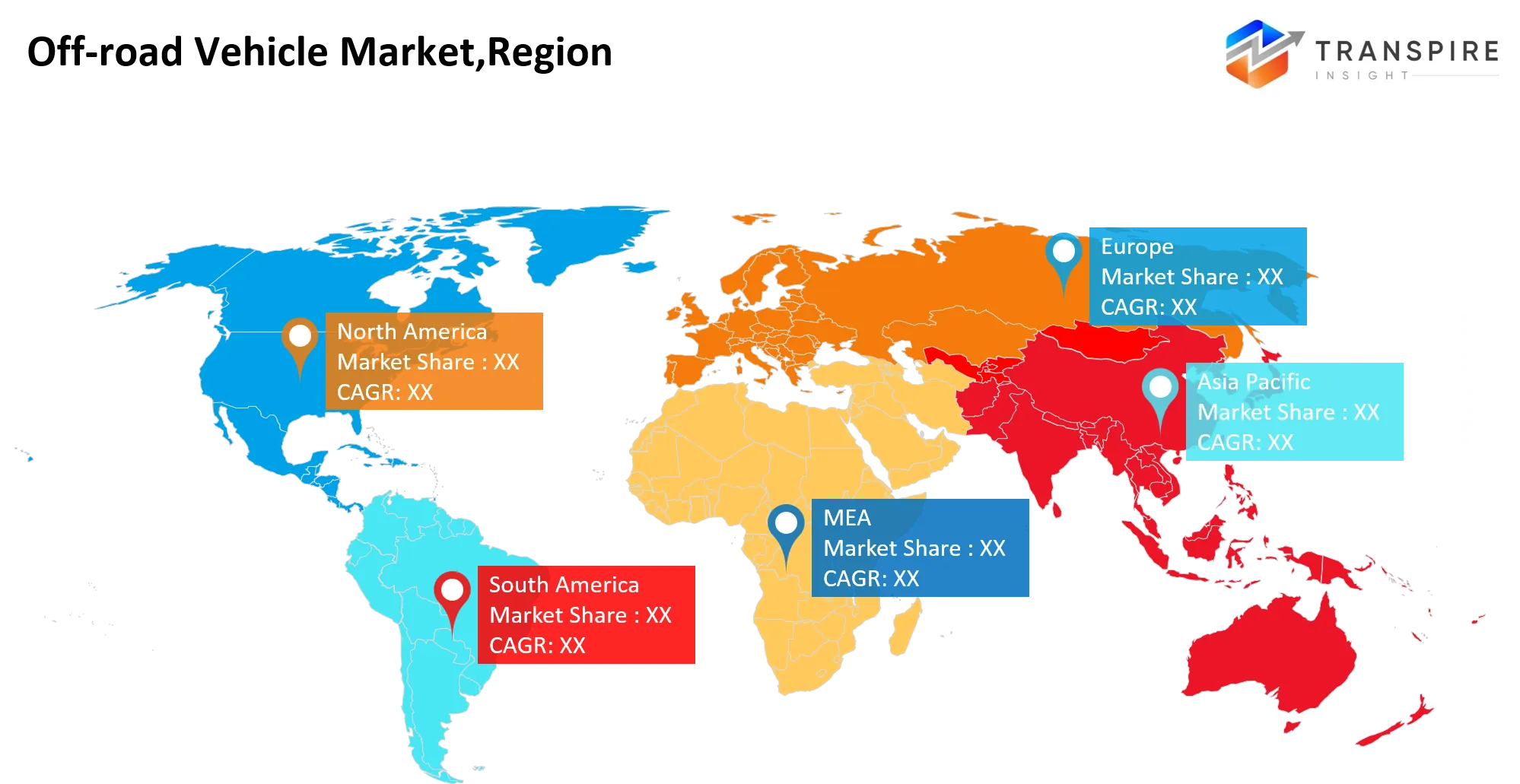
North America dominates the off-road vehicles market, with a 39.17% share of the regional share in the market. There is a strong recreational culture, established distribution channels for power sports, and wide application in agriculture, hunting, and property management, in favor of demand growth. The region is also favoured by the developed infrastructure of dealers and service centres, making it easier to buy, service, and customise such vehicles. Product launches in ATV, UTV, and side-by-side segments are continually growing.
In July 2025, Polaris Off Road unveiled the 2026 off-road vehicle models, featuring the new RANGER 500 utility side-by-side. The model was positioned for everyday property work and outdoor activities, demonstrating further product growth in the North American off-road vehicle market.
https://www.polaris.com/en-us/news/product/polaris-off-road-expands-2026-family-lineup
Europe
The European market accounts for 25% of the market share a diversified demand structure compared to North America. Off-road vehicles are used for leisure, farming, forestry, land management, and other specialised uses in the region. The focus on emissions and efficiency has led to manufacturers developing better electric and less invasive powertrain systems. Thus, Europe provides a relatively stable platform while driving innovation towards cleaner, connected, and efficient vehicle systems.
In September 2025, Yamaha Motor Europe presented its 2026 ATV and Side-by-Side model line-up, with the release of new Wolverine RMAX and XT-R models alongside existing Kodiak utility ATVs for farms, forests, and worksites. It is another example of product development in Europe's off-road market sectors of leisure and utility.
Asia Pacific
The Asia Pacific constitutes 26% of the market and is considered to be the fastest-growing segment at around 9.22% CAGR. The increasing industrialisation, along with the increasing use of agricultural machinery and infrastructure construction, is driving demand for small vehicles capable of functioning outside the roads. Increasing interest towards electric mobility, along with local production, can help enhance the availability and lower the costs of the products in the region.
In November 2025, CFMOTO featured several off-road vehicle models at the EICMA 2025 show, including the CFORCE ATV model line-up, UFORCE utility models, UFORCE U6 EV and ZFORCE Z10-4. The growing presence of the GOES brand on the European market showed the ongoing off-road product development by an Asian manufacturer.
Who are the Key Players in the off-road vehicle market, and how do they compete?
Competition in the international off-road vehicle market is driven by the wide product range, product performance engineering, practical vehicles, sales network, and new vehicle models. Besides competing on engine power, manufacturers compete on the basis of durability, comfort, suspension, electronics, equipment, electrification and the capacity to operate in specialised working environments. Polaris relies on the portfolio approach, including the lines of RANGER utility vehicles, RZR sports side-by-sides, Sportsman ATVs and XPEDITION adventure vehicles. The recently introduced vehicles demonstrate Polaris' attention to the riders' requests, connectivity, comfort and ability to perform certain tasks, which enables the company to appeal both to recreationists and utilitarians. BRP competes via the Can-Am line of Mavericks, Defenders and Outlanders, where high-performance products are combined with practical ones and even electric vehicles are added. The expansion of the Defender line and the introduction of the Outlander Electric line demonstrate its reliance on product differentiation and more options in powertrain.
Off-road Vehicle Market companies
- Polaris
- Honda
- Yamaha
- BRP
- Kawasaki
- Suzuki
- Textro
- Can-Am
- CFMOTO
- Arctic Ca
- John Deere
- Kubota
- Segway Powersports
- Kayo
- Hisun Motors
Recent Development News
In August 2026, Yamaha Motor announced structural changes in its Outdoor Land Vehicle operation. The firm claimed that it would stop manufacturing recreational off-highway vehicles internally in Georgia, opting for an OEM partnership approach while concentrating on ATVs and golf cars
https://global.yamaha-motor.com/news/2026/0804/olv.html
In October 2025, Polaris launched additional 2026 models of off-road vehicles. The firm launched the RZR XP S, updated the RZR XP, and provided technology upgrades along with some special edition models among its RZR and RANGER lineups.
What Strategic Insights Define the Future of the Off-road Vehicle Market?
The future of the off-road vehicle market globally will shift to a model of greater versatility, where vehicles not only perform agricultural functions but also provide recreation in conjunction with construction, land management, mining, and mobility. The innovation will likely centre on electricity-powered vehicles, connectivity solutions, sophisticated traction and selective autonomy. One hidden challenge could be that technology will make off-road vehicles more expensive and repair-dependent, as well as making them dependent on batteries, digital services, and specific maintenance networks, which may negatively impact their acceptance among price-sensitive customers. Another challenge could be the limited functionality of electric vehicles in remote areas due to a lack of charging infrastructure. One upcoming trend is the creation of custom-designed and digitally managed fleets of electric vehicles for agricultural operations, construction sites, rentals, and governmental entities. In order to capitalise on the trend, manufacturers need to integrate vehicles into the system of telematics, predictive maintenance, accessories, and service offerings.
By Product Type
- All-Terrain Vehicles
- Utility Terrain Vehicles
- Snowmobiles
- Three-wheelers
- Side-by-side Vehicle
- Recreational Vehicles
- Work Vehicles
By Propulsion
- Gasoline
- Diesel
- Electric
- Hybrid
- Battery-electric
- Hydrogen
- Alternative Fuel
By Application
- Recreation
- Agriculture
- Construction
- Military
- Mining
- Sports
- Hunting
By Engine Capacity
- Below 250cc
- 250–400cc
- 400–600cc
- 600–800cc
- 800–1000cc
- 1000–1200cc
- Above 1200cc
By Drive Type
- 2WD
- 4WD
- AWD
- Selectable Drive
- Differential Lock
- Electric Drive
- Hybrid Drive
By End User
- Individual Consumers
- Farmers
- Defense
- Construction Companies
- Mining Companies
- Rental Companies
- Government
By Distribution Channel
- Dealers
- OEM Stores
- Specialty Retailers
- Online Sales
- Direct Sales
- Distributors
- Rental
Frequently Asked Questions
Find quick answers to common questions.
The off-road vehicle market size was valued at USD 25.4 billion in 2025 and is poised to reach USD 38.4 billion by 2033, expanding at a 5.33% CAGR.
Key segments for the off-road vehicle market are By Product Type (All-Terrain Vehicles, Utility Terrain Vehicles, Snowmobiles, Three-wheelers, Side-by-side Vehicles, Recreational Vehicles, Work Vehicles, Others); By Propulsion (Gasoline, Diesel, Electric, Hybrid, Battery-electric, Hydrogen, Alternative Fuel, Others); By Application (Recreation, Agriculture, Construction, Military, Mining, Sports, Hunting, Others); By Engine Capacity (Below 250cc, 250–400cc, 400–600cc, 600–800cc, 800–1000cc, 1000–1200cc, Above 1200cc, Others); By Drive Type (2WD, 4WD, AWD, Selectable Drive, Differential Lock, Electric Drive, Hybrid Drive, Others); By End User (Individual Consumers, Farmers, Defense, Construction Companies, Mining Companies, Rental Companies, Government, Others); By Distribution Channel (Dealers, OEM Stores, Specialty Retailers, Online Sales, Direct Sales, Distributors, Rental, Others)
Growth is primarily driven by increased use of all-terrain vehicles for agricultural, construction, mining, and recreational purposes, coupled with increased need for electric vehicles
The market is led by major manufacturers including Polaris, Honda, Yamaha, BRP, Kawasaki, Suzuki, Textron, Can-Am, CFMOTO, Arctic Cat, John Deere, Kubota, Segway Powersports, Kayo, Hisun Motors
North America, which holds 39.17% of the world off-road vehicle market, is backed by high demand for construction, agricultural, mining, and recreational purposes. Improved vehicle technology, the presence of established players, and high usage of utility and recreational vehicles further aid the regional market.
Business opportunities in the off-road vehicle industry include increasing demand for electric off-road vehicles, growth of agriculture and construction uses, development of autonomous vehicle technologies, and increasing demand for high-performance utility and recreation vehicles.
- Polaris
- Honda
- Yamaha
- BRP
- Kawasaki
- Suzuki
- Textro
- Can-Am
- CFMOTO
- Arctic Ca
- John Deere
- Kubota
- Segway Powersports
- Kayo
- Hisun Motors
About the Authors

Mayur Shinde
I am Mayur Shinde, a Senior Research Analyst at Transpire Insight, specializing in the Automotive & Transportation and Information & Communication Technology (ICT) Industry. My work focuses on analyzing emerging market trends, technological advancements, competitive landscapes, and industry developments to deliver accurate, data-driven insights. I am passionate about transforming complex market information into clear, actionable content that helps businesses, professionals, and decision-makers stay informed and make confident strategic decisions.

Chakradhar Khansole
Chakradhar serves as the Research Director at Transpire Insight, bringing over 8 years of experience in technology, innovation, and strategic market intelligence. He specializes in transforming complex market data into actionable business insights that enable organizations to make informed, growth-oriented decisions. Recognized for his strategic vision and analytical expertise, Chakradhar leads high-impact research initiatives, delivering comprehensive market assessments, competitive intelligence, and forward-looking industry analysis.
Recently Published Reports
-
Apr 2026
ATV & UTV Market
ATV & UTV Market Size, Share & Analysis Report By Type (ATV, and UTV), By Variants (Less Than 400 CC, 400 CC To 800 CC, and More Than 800 CC), and Geography (North America, Europe, Asia-Pacific, Middle East and Africa, South and Central America), 2021 - 2031
-
Apr 2026
Automotive Central Gateway Module Market
Automotive Central Gateway Module Market Size, Share & Analysis Report By Type (Ethernet Central Gateway Module, CAN Central Gateway Module, LIN Central Gateway Module, and FlexRay), By Application (Powertrain Control, Body Control, Infotainment System, Advanced Driver Assistance Systems (ADAS), and Others), By End User (Passenger Vehicles, and Commercial Vehicles), and Geography (North America, Europe, Asia-Pacific, Middle East and Africa, South and Central America), 2021 - 2031
-
Apr 2026
Automotive Engine Oil Filter Market
Automotive Engine Oil Filter Market Size, Share & Analysis Report By Filter Type (Fuel Filter, Engine Oil Filter, Hydraulic Oil Filter, and Others), By Filter Media (Cellulose, Synthetic, and Micro), By Sales Channel (OEMs, and Aftermarket), By Vehicle Type (Passenger Cars, Light Commercial Vehicles, Heavy Duty Trucks, Buses and Coaches, and Off-road Vehicles), and Geography (North America, Europe, Asia-Pacific, Middle East and Africa, South and Central America), 2021 - 2031
-
Apr 2026
Automotive Parts Aluminium Die Casting Market
Automotive Parts Aluminium Die Casting Market Size, Share & Analysis Report By Production Process (Pressure Die Casting, Vacuum Die Casting, Squeeze Die Casting, Gravity Die Casting), By Application (Body Parts, Engine Parts, Transmission Parts, Battery And Related Components, Other Application Types), and Geography (North America, Europe, Asia-Pacific, Middle East and Africa, South and Central America), 2021 - 2031
Our Clients



