

North America Varicose Veins Treatment Market Size & Forecast:
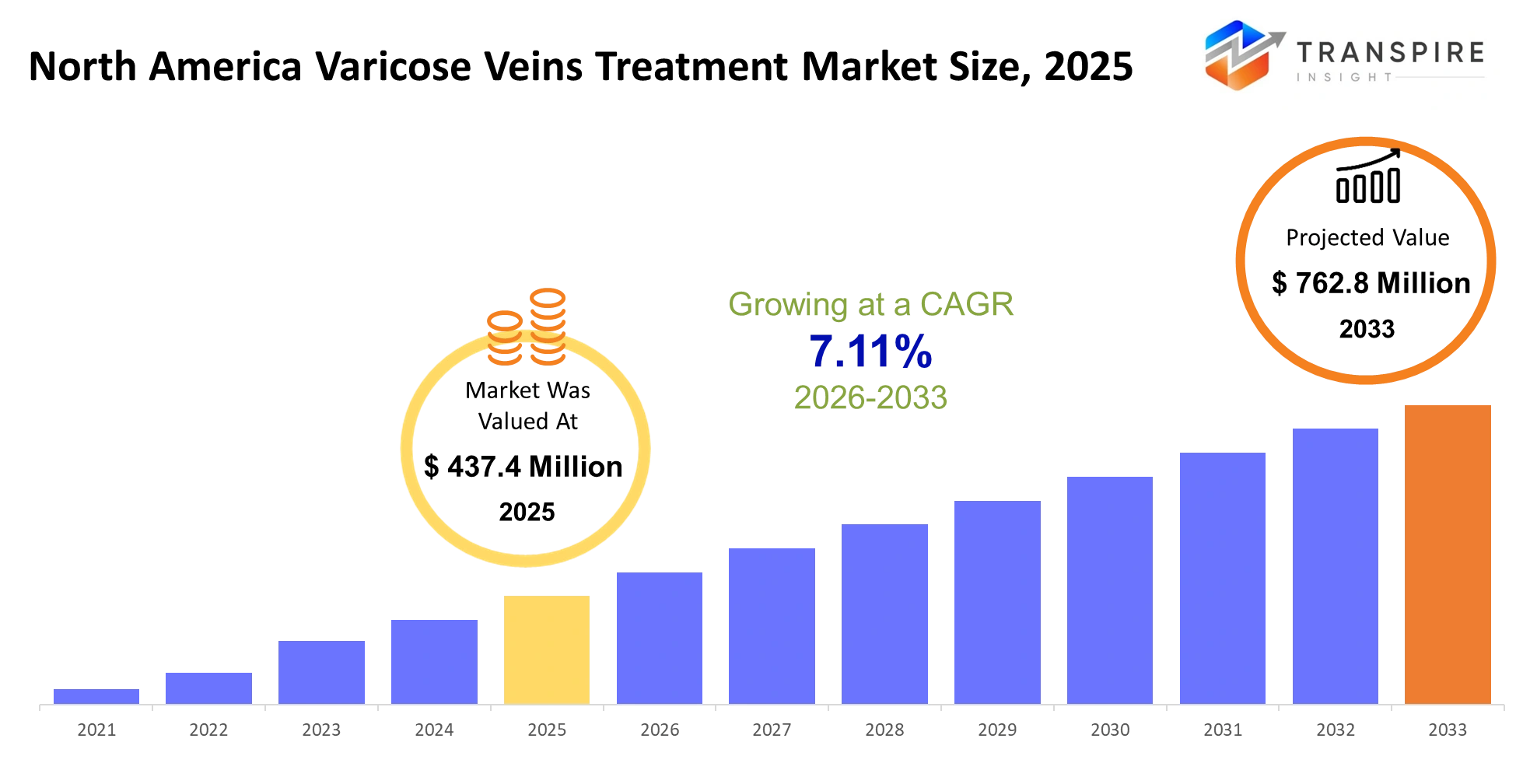
- North America Varicose Veins Treatment Market Size 2025: USD 437.4 Million
- North America Varicose Veins Treatment Market Size 2033: USD 762.8 Million
- North America Varicose Veins Treatment Market CAGR: 7.11%
- North America Varicose Veins Treatment Market Segments: By Treatment Type (Endovenous Ablation, Sclerotherapy, Vein Stripping, Laser Therapy, Compression Therapy, Others), By Product Type (Ablation Devices, Compression Stockings, Laser Devices, Sclerotherapy Injection Devices, Others), By End User (Hospitals, Specialty Clinics, Ambulatory Surgical Centers, Others), By Application (Spider Veins, Chronic Venous Insufficiency, Venous Ulcers, Others).
To learn more about this report,  Download Free Sample Report
North America Varicose Veins Treatment Market Summary:
The North America Varicose Veins Treatment Market size is estimated at USD 437.4 Million in 2025 and is anticipated to reach USD 762.8 Million by 2033, growing at a CAGR of 7.11% from 2026 to 2033. North America's Varicose Veins Treatment Market tackles a real healthcare headache , basically how to get venous blood moving the right way again while also lowering pain , swelling , skin problems, and those annoying cosmetic worries that come with long term venous issues. Providers are leaning more and more on minimally invasive steps , so patients can get back to everyday life quicker . In other words , vein care feels more available, especially in outpatient locations, not only bigger hospitals .
In the last five years, the market has kinda shifted its structure away from older vein stripping operations , and it is moving toward endovenous laser , radiofrequency ablation , and ultrasound guided methods. That change has helped outcomes, cut down recovery time , and encouraged more physicians to adopt these options . One clear on the ground trigger was the healthcare system emphasis on ambulatory and office based procedures after the COVID-19 period, it made demand climb for treatments that keep patients out of hospital, and also help lower procedural expenses .
Right now the main growth drivers show up as the aging population , higher rates of obesity, and stronger reimbursement backing for interventions that are clinically necessary. As clinicians switch to less invasive technologies , treatment numbers are rising too. That boosts procedure revenues and keeps the market investing in newer vein-care platforms.
Key Market Insights
- The United States dominates the North America Varicose Veins Treatment Market , taking in about 82% of the regional market share in 2025.
- A strong healthcare infrastructure and a high level of procedure adoption rates keep the United States at the top, both in overall industry size ,and in revenue generation.
- Canada looks like the fastest-growing regional market during the forecast window, mostly because access to specialized vascular care keeps expanding.
- Regional demand is climbing too, since many healthcare providers move procedures from hospitals to ambulatory surgical centers and office-based settings , kind of as a routine shift.
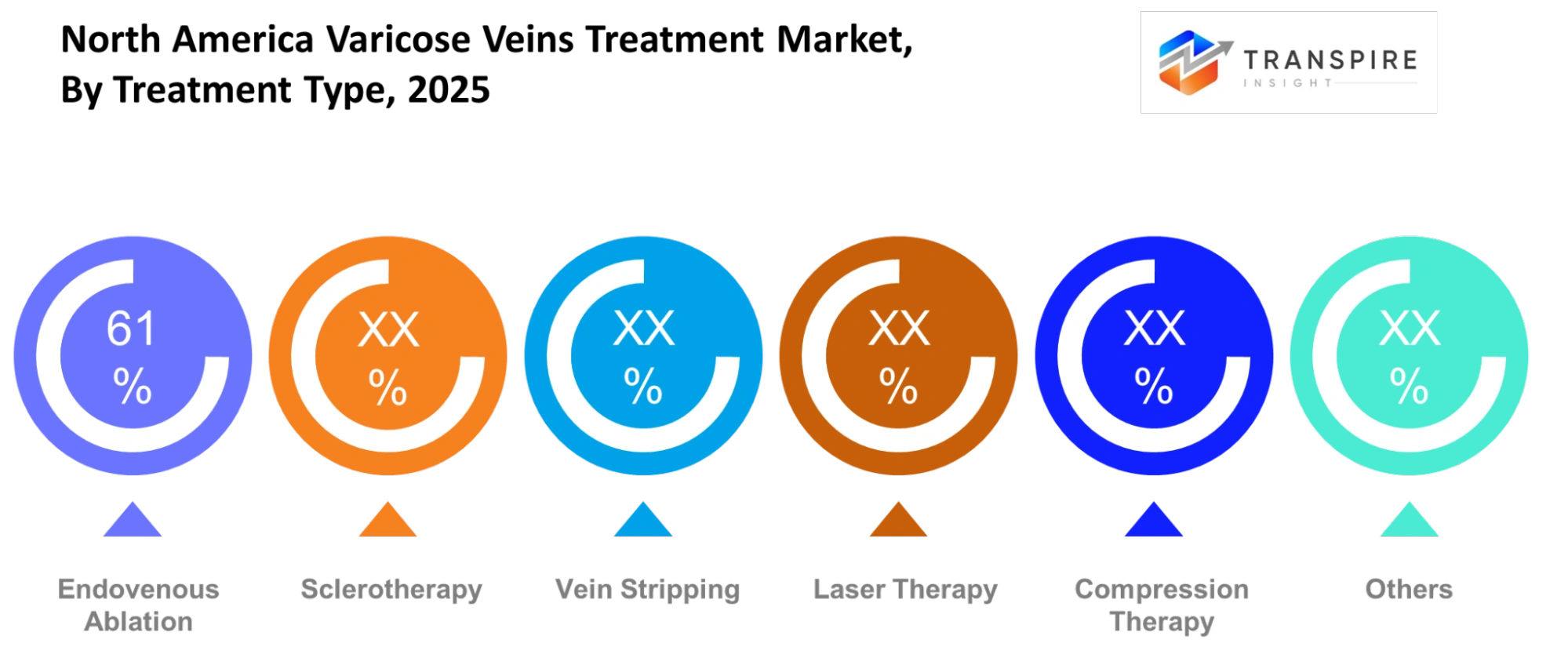
- Endovenous ablation ends up leading the market , holding nearly 45% of total revenue share in 2025.
- Sclerotherapy still ranks as the second-largest treatment segment, largely because it’s cost-effective and works well for early-stage varicose veins.
- Mechanochemical ablation is the fastest-growing segment from 2025 to 2032 , aided by shorter recovery times and smoother procedural efficiency.
- Ultrasound-guided treatment technologies continue to gain traction across advanced vein treatment centers.
- Chronic venous insufficiency treatment alone accounts for over 60% of North America Varicose Veins Treatment Market demand.
- For clinical use, symptomatic varicose vein management remains the biggest application, largely tied to the long-term burden of the condition.
- Cosmetic vein treatment is the fastest-growing application space, supported by patient preference for minimally invasive options.
- Early diagnosis initiatives are also expanding the treatment runway for both therapeutic and aesthetic use , at the same time.
- When it comes to end users, hospitals and specialty vascular clinics hold roughly 55% market share, so they sit at the front of the pack.
What are the Key Drivers, Restraints, and Opportunities in the North America Varicose Veins Treatment Market?
The strongest force driving the North America Varicose Veins Treatment Market is basically the swift move away from the older vein stripping ways, and over to more minimally invasive endovenous options. In particular, progress with laser ablation , radiofrequency ablation, and ultrasound-guided procedures has made patients bounce back faster, reduced procedural hazards, and also cut healthcare expenses. Because of that, many physicians have started scheduling treatment in outpatient or office-based environments, not so much hospitals. So providers end up seeing and managing more cases each day, and also lowering day-to-day operating costs, which in turn boosts procedure counts and supports revenue growth throughout the whole vein care network.
The biggest obstacle though, is still inconsistent insurance coverage for varicose vein procedures, especially if payers label the treatment as cosmetic instead of medically necessary. This is sort of a structural problem , because reimbursement rules differ from one payer to another, and quite often they demand extra paperwork and long clinical documentation trails before they even approve anything. Fixing the frameworks isn’t quick, it usually means regulatory review, insurer policy updates, and more clinical proof, so rapid resolution just doesn’t seem realistic. The downstream effect is that adoption slows down, patients wait longer for treatment, and there’s a real, measurable revenue downside for both healthcare providers and the device manufacturers involved.
A really big growth chance sits in growing ambulatory surgical centers and specialized vein clinics, kind of across the underserved areas of Canada plus some of the secondary U.S. metro markets. When people invest in portable imaging systems, and also next generation mechanochemical ablation technologies , it becomes possible to deliver advanced treatment in a way that feels economically viable even beyond big hospital networks. Then, as these facilities scale up their capacity, access to vein care gets noticeably better , and that can open the door to stronger treatment penetration and a more steady market expansion through the next ten years.
What Has the Impact of Artificial Intelligence Been on the North America Varicose Veins Treatment Market?
Artificial intelligence , and advanced digital technologies are starting to mess a bit with the North America Varicose Veins Treatment Market , mostly because clinical decision-making is getting better , patient workflow management feels smoother, and procedural planning is becoming less chaotic. AI enabled ultrasound analysis tools let physicians spot venous reflux patterns, vessel diameter variations, and potential treatment candidates faster than the usual manual assessment. In practice these tools handle parts of image interpretation and documentation , so there’s less admin load. That usually means clinics can move more patients through day to day without quite as much friction.
On top of that, machine learning models are being used to forecast treatment results, and also recurrence risk. They look at patient traits , vein anatomy , medical history, and procedural data. When this works well, providers can choose the intervention that fits best, like endovenous laser ablation, radiofrequency ablation, or sclerotherapy. The idea is not just higher procedural success but also fewer follow-up sessions, which is where patients often get stuck waiting.
Then there are digital vein care platforms, which fine-tune operations in a more operational way. They automate appointment scheduling, ongoing patient monitoring, and even reimbursement documentation. With these systems specialty clinics can take in more patients , while pushing down administrative costs and cutting delays. In bigger vascular networks, data driven workflow management is helping with stronger resource utilization, and more predictable clinical outcomes across different sites.
Still, AI adoption is sort of limited by fragmented healthcare data, and also by not having wide access to large, standardized venous disease datasets. Because of those gaps, algorithm accuracy can drop and deployment can slow down in community based vein treatment centers.
Key Market Trends
- From 2020 onward, endovenous laser and radiofrequency ablation procedures have been slowly, kind of steadily replacing surgical vein stripping across major U.S. healthcare networks, like it’s just the way things are going now.
- Ambulatory surgical centers saw their share of vein procedures rise from 2021 to 2025 , as providers looked for lower overhead and smoother operations.
- Over the last five years insurers also tightened what counts as medical necessity, and that pushed many clinics to build stronger diagnostic documentation systems , more or less.
- After 2020, ultrasound-guided treatment planning became the norm , helping make procedures more exact and cutting down on surplus or unneeded interventions.
- Since 2022, many vein-care providers started using AI-assisted imaging tools more often, to speed up diagnosis and refine patient matching, essentially.
- Specialty vein clinics didn’t just grow , consolidation really accelerated, with larger healthcare groups chasing regional expansion and scale related efficiencies.
- Manufacturers like Medtronic and Boston Scientific have increased spending on minimally invasive vascular treatment technologies since 2021 , and you can see the trend there.
- Meanwhile patient preference shifted toward procedures done in the office, and recovery times were often cut from weeks to just a few days, which sounds small but it’s noticeable.
- Digital patient engagement platforms gained momentum after the pandemic, improving appointment adherence and follow up care management , even for people who might otherwise slip.
- In Canada, healthcare systems expanded access to specialized venous treatment services after 2022, creating one of the fastest-evolving treatment landscapes in the region, so far.
North America Varicose Veins Treatment Market Segmentation
By Treatment Type
Treatment type segmentation is getting sort of driven more and more by what people like, minimal invasive actions. In that space, endovenous ablation still leads the market, mainly because it has strong clinical success levels, quicker recovery windows, and fewer adverse events versus older surgical routes. Sclerotherapy stays pretty relevant too, especially for smaller varicose veins, and spider veins, since it’s convenient and also cost effective. Vein stripping is still sliding in share, as many providers move toward outpatient options that cut down on hospital utilization.
Laser therapy also keeps moving forward, thanks to ongoing tech improvements and better physician buy-in, while compression therapy works as a key add on, for long-term symptom control and comfort. Going ahead, growth should cluster around image guided plus catheter based procedures, which help refine where and how the work is done during treatment. Overall, this direction opens room for device manufacturers to broaden their advanced offerings, and at the same time it pushes healthcare providers to build more specialized vein care capabilities.
To learn more about this report, Download Free Sample Report
By Product Type
Product type trends kinda track the shift toward less invasive care pathways. Ablation devices are still the big one, since endovenous procedures keep taking up a larger piece of treatment volumes across North America. Laser devices hold a strong place too, because many facilities are looking for solutions that enable quicker procedures and more predictable results. Compression stockings are still widely chosen for symptom management and post-procedure recovery, yet the growth is only moderate, mainly because they don’t deliver a definitive treatment.
Sclerotherapy injection devices keep a pretty steady niche, especially in office-based care where efficiency and cost stay front and center. Other supporting items, like imaging add-ons and procedural consumables, help smooth out the overall clinical workflow. Going forward, innovation will more and more center on device precision, treatment individualization, and tight integration with digital imaging systems. That should generate real value for suppliers, healthcare organizations, and investors who are after tech-driven growth.
By End-User
End-user dynamics show more and more why specialized care delivery models matter, like the whole picture is getting bigger. Hospitals are still holding the largest share , mainly because they have broad patient access, established vascular departments, and they can handle complicated venous disorders without too much trouble. Specialty clinics have also picked up steam pretty fast, mostly by concentrating on vein care only, which helps them set up streamlined treatment pathways and get people in sooner, with less waiting around. Ambulatory surgical centers seem to be the fastest-growing part too, since reimbursement structures are changing and, frankly, patient preferences are leaning toward outpatient procedures. These places often keep operating costs lower while still keeping procedural efficiency high. Other care settings continue to support local demand especially in underserved regions, where options can be limited.
Overall, the competitive landscape is starting to move toward decentralized treatment networks that stress convenience and cost effectiveness, not just “bigger is better.” This shift is likely to push even more investment into outpatient infrastructure, and it may open doors for providers that can blend clinical expertise with operational efficiency, in a practical way.
By Application
Demand that’s based on applications stays mostly clustered around chronic venous insufficiency, and it takes the biggest portion mainly because it’s common, keeps coming back, and it’s tied to longer-term vascular issues, in a way that really matters clinically. Treatment for spider veins, too, forms a big slice, supported by both medical needs and the more aesthetic kind of motivations , that patients mention when they want a minimally invasive option. Venous ulcers bring a lot of clinical focus, since waiting for treatment can push healthcare costs up and extend the time patients spend in ongoing care.
Beyond that, other venous problems add extra procedure numbers especially for older groups, and for people dealing with obesity-related vascular disorders. Across the applications there are clear demand drivers , where medical urgency tends to steer chronic disease management, while looks-driven concerns weigh more in spider vein care. Going forward, market growth will probably lean toward integrated treatment pathways, blending therapeutic results with a better overall patient experience. That shift could nudge manufacturers and providers to tune their solutions to specific disease patterns and the kinds of outcomes people actually expect.
What are the Key Use Cases Driving the North America Varicose Veins Treatment Market?
Honestly the primary use case is still the treatment of chronic venous insufficiency, which pretty much drives the highest procedure volume overall. Hospitals and specialty vein centers depend on endovenous ablation and the related interventions, to reduce pain, swelling skin damage and those longer-term vascular complications that tend to build up over time.
Then there are the expanding applications, like cosmetic treatment of spider veins and a more preventive management of symptomatic venous disease. In general specialty clinics and ambulatory surgical centers are seeing more patient interest in minimally invasive procedures that promise fast recovery, plus limited disruption to day to day routines.
Looking ahead, the emerging use cases start to sound a bit more futuristic, for example AI assisted treatment planning plus early intervention programs for higher-risk groups. This includes older adults and patients with obesity. Also advanced imaging guided therapies and customized vein care pathways could help outcomes, and widen treatment access across the forecast period, depending on adoption rates.
|
Report Metrics |
Details |
|
Market size value in 2025 |
USD 437.4 Million |
|
Market size value in 2026 |
USD 471.5 Million |
|
Revenue forecast in 2033 |
USD 762.8 Million |
|
Growth rate |
CAGR of 7.11% from 2026 to 2033 |
|
Base year |
2025 |
|
Historical data |
2021 - 2024 |
|
Forecast period |
2026 - 2033 |
|
Report coverage |
Revenue forecast, competitive landscape, growth factors, and trends |
|
Country scope |
North America (Canada, The United States, and Mexico) |
|
Key company profiled |
Medtronic, Boston Scientific, AngioDynamics, Teleflex, biolitec AG, Syneron Medical, Lumenis, Sciton, Merz Pharma, Candela Medical, VVT Medical, Cook Medical, Dornier MedTech, Becton Dickinson, Eufoton. |
|
Customization scope |
Free report customization (country, regional & segment scope). Avail customized purchase options to meet your exact research needs. |
|
Report Segmentation |
By Treatment Type (Endovenous Ablation, Sclerotherapy, Vein Stripping, Laser Therapy, Compression Therapy, Others), By Product Type (Ablation Devices, Compression Stockings, Laser Devices, Sclerotherapy Injection Devices, Others), By End User (Hospitals, Specialty Clinics, Ambulatory Surgical Centers, Others), By Application (Spider Veins, Chronic Venous Insufficiency, Venous Ulcers, Others). |
Which Regions are Driving the North America Varicose Veins Treatment Market Growth?
The United States kind of shows up as the leading region in the North America Varicose Veins Treatment Market , mainly because it has a pretty advanced healthcare infrastructure, and also broad reimbursement coverage for medically necessary procedures, plus a high concentration of vascular specialists. You can see how the strong adoption of minimally invasive technologies really sped up procedure volumes across hospitals , specialty vein centers, and ambulatory facilities. There’s also this fairly mature ecosystem involving device manufacturers, diagnostic imaging providers, and outpatient care networks, which basically keeps the momentum for market leadership. On top of that, steady investment in clinical innovation and physician training makes the country’s dominant position even more solid.
Canada comes in as the second-largest regional market, but the growth path looks different than the United States. Since public healthcare funding is in place and care is guided through structured pathways , the environment stays stable for long-term uptake of vein treatment technologies. Provincial health systems keep broadening access to specialized vascular services while still keeping spending patterns fairly predictable. So overall , this blend of healthcare steadiness and slow, careful technology integration makes Canada a dependable contributor to regional revenue.
Mexico is kind of emerging as the quickest-growing market, because healthcare modernization is continuing and access to private specialty care keeps expanding, as well. There have been recent investments in outpatient treatment facilities and in more robust diagnostic capabilities, which has made it much easier to find minimally invasive vein procedures. Also the participation of private healthcare providers seems to be growing, and that has pushed competition forward, so patients actually get more treatment options to choose from. Over the 2026–2033 period, that same momentum should translate into interesting opportunities for device manufacturers , clinic operators, and investors who are hunting for those underserved growth markets.
Who are the Key Players in the North America Varicose Veins Treatment Market and How Do They Compete?
Competition in the North America Varicose Veins Treatment Market is kinda moderately consolidated, with a rather small set of medical technology firms controlling a big part of the advanced treatment device area, yet lots of specialty clinics still chase patient volume and repeat appointments. In most cases, innovation in technology is the real competitive lever , not price, or at least not in the loud way you might expect. Healthcare providers also keep comparing options around procedural speed and treatment results, plus recovery time, and whether the workflow fits outpatient care models. Larger, established manufacturers tend to hold their ground by rolling out product upgrades and building clinical proof over time. Meanwhile, newer or more specialized entrants often go after a narrower set of treatment categories, and they market more physician-centric solutions.
Medtronic competes using a wide vascular technology portfolio, combined with long-standing relationships with hospitals and outpatient centers. They try to stand apart by pairing advanced catheter based technologies with physician training and clinical assistance programs , so providers can standardize the treatment path and not improvise too much case by case. Boston Scientific leans hard into procedural efficiency and minimally invasive vascular interventions. Their continuing investments in device innovation and physician education, help drive wider use across specialty vein clinics and ambulatory surgical centers, which in turn strengthens their market position.
AngioDynamics really pushes a niche style of specialization for venous disease treatment and image guided therapies, you know. Their whole focus on targeted vascular solutions helps set them apart in procedures where precision matters a lot, and where workflow optimization is basically the point. Teleflex leans on its know how in interventional access and catheter technologies so clinicians can get better procedural control , and hopefully better patient outcomes too. Merit Medical Systems then expands by widening its product portfolio and forming strategic partnerships with healthcare systems. Together this seems to help cover more clinical needs, while also boosting access for outpatient treatment settings. Which is, honestly, a competitive advantage as the market keeps shifting toward decentralized care delivery .
Company List
- Medtronic
- Boston Scientific
- AngioDynamics
- Teleflex
- biolitec AG
- Syneron Medical
- Lumenis
- Sciton
- Merz Pharma
- Candela Medical
- VVT Medical
- Cook Medical
- Dornier MedTech
- Becton Dickinson
- Eufoton
Recent Development News
In April 2026, VVT Medical announced Positive Clinical Data for ScleroSafe® Technology: VVT Medical announced positive clinical findings for its ScleroSafe® system, published in a peer-reviewed vascular surgery journal. The company highlighted growing clinical validation of its FDA-cleared non-thermal, non-tumescent technology designed for office-based varicose vein treatment procedures with minimal discomfort and recovery time.
Source: https://www.biospace.com
In April 2026, VVT Medical Signs Major Distribution Agreement and Strategic Investment Deal: VVT Medical signed its largest distribution agreement to date, expanding commercialization opportunities for its varicose vein treatment portfolio. The five-year deal also included an investment component from the distributor, providing additional financial support as the company expands adoption of its FDA-cleared vein treatment technologies.
Source: https://www.biospace.com
What Strategic Insights Define the Future of the North America Varicose Veins Treatment Market?
North America Varicose Veins Treatment Market is kinda heading toward a more decentralized, tech enabled care model where specialized outpatient centers take on a bigger chunk of the procedures. The main driver, in practice, is basically the economic edge of minimally invasive therapies; they tend to bring faster recovery, reduced facility expenses, and a higher patient throughput than the older surgical pathway. Over the next five to seven years competitive advantage will hinge more and more on how efficient procedures are, who gets selected using data, and how well advanced imaging tech gets integrated into day to day workflows.
There is also a risk that is a bit less visible but still real, reimbursement concentration. If the big players start tightening eligibility for venous interventions or they start adding more pre authorization layers, then treatment volumes could dip even if the underlying disease prevalence keeps climbing. This matters a lot for providers who rely heavily on only a few reimbursement routes, because if those routes change, it can hit volume quickly and not in a gradual way.
On the opportunity side, AI enabled venous imaging and predictive treatment planning platforms are starting to show up more often. The early adopters can improve clinical results while also stretching resources a little better, less waste and more right sized utilization. Market players should therefore focus on partnerships that blend device innovation, digital diagnostics, and outpatient care delivery , so they can keep a kind of sustainable differentiation as the market keeps maturing.
North America Varicose Veins Treatment Market Report Segmentation
By Treatment Type
- Endovenous Ablation
- Sclerotherapy
- Vein Stripping
- Laser Therapy
- Compression Therapy
- Others
By Product Type
- Ablation Devices
- Compression Stockings
- Laser Devices
- Sclerotherapy Injection Devices
- Others
By End User
- Hospitals
- Specialty Clinics
- Ambulatory Surgical Centers
- Others
By Application
- Spider Veins
- Chronic Venous Insufficiency
- Venous Ulcers
- Others
Frequently Asked Questions
Find quick answers to common questions.
The approximate North America Varicose Veins Treatment Market size for the market will be USD 762.8 Million in 2033.
The key segments of the North America Varicose Veins Treatment Market are By Treatment Type (Endovenous Ablation, Sclerotherapy, Vein Stripping, Laser Therapy, Compression Therapy, Others), By Product Type (Ablation Devices, Compression Stockings, Laser Devices, Sclerotherapy Injection Devices, Others), By End User (Hospitals, Specialty Clinics, Ambulatory Surgical Centers, Others), By Application (Spider Veins, Chronic Venous Insufficiency, Venous Ulcers, Others).
Major players in the North America Varicose Veins Treatment Market are Medtronic, Boston Scientific, AngioDynamics, Teleflex, biolitec AG, Syneron Medical, Lumenis, Sciton, Merz Pharma, Candela Medical, VVT Medical, Cook Medical, Dornier MedTech, Becton Dickinson, Eufoton.
The current market size of the North America Varicose Veins Treatment Market is USD 437.4 Million in 2025.
The North America Varicose Veins Treatment Market CAGR is 7.11%.
- Medtronic
- Boston Scientific
- AngioDynamics
- Teleflex
- biolitec AG
- Syneron Medical
- Lumenis
- Sciton
- Merz Pharma
- Candela Medical
- VVT Medical
- Cook Medical
- Dornier MedTech
- Becton Dickinson
- Eufoton
About the Authors

Pankaj Ghogare Patil
I am Pankaj Ghogare Patil, a Senior Research Analyst at Transpire Insight, specializing in the Pharmaceutical, Chemicals & Materials, Healthcare IT, and Biotechnology industry. My expertise lies in conducting comprehensive market research, analyzing industry trends, evaluating competitive landscapes, and translating complex data into actionable insights. At Transpire Insight, I closely follow emerging technologies, regulatory developments, and market innovations to create accurate, well-researched, and informative content that helps businesses and professionals make informed decisions. I am committed to producing credible, evidence-based articles that reflect industry best practices while making technical topics accessible and valuable for a broad audience.

Chakradhar Khansole
Chakradhar serves as the Research Director at Transpire Insight, bringing over 8 years of experience in technology, innovation, and strategic market intelligence. He specializes in transforming complex market data into actionable business insights that enable organizations to make informed, growth-oriented decisions. Recognized for his strategic vision and analytical expertise, Chakradhar leads high-impact research initiatives, delivering comprehensive market assessments, competitive intelligence, and forward-looking industry analysis.
Recently Published Reports
-
Apr 2026
AI in Diabetic Retinopathy Market
AI in Diabetic Retinopathy Market Size, Share & Analysis Report By Type (Screening AI Systems, Diagnostic AI Systems, and Predictive AI Models), By Application Segment (Hospitals, Ophthalmology Clinics, Diagnostic Centers, and Research and Development), and Geography (North America, Europe, Asia-Pacific, Middle East and Africa, South and Central America), 2021 - 2031
-
Apr 2026
Psychometric Tests Market
Psychometric Tests Market Size, Share & Analysis Report By Type (Personality Tests, Ability/Aptitude Tests, Skill/Knowledge Tests, and Others), By Application (Talent Acquisition and Talent Management), and Geography (North America, Europe, Asia-Pacific, Middle East and Africa, South and Central America), 2021 – 2031
-
Apr 2026
Rare Biological Sample Collection Market
Rare Biological Sample Collection Market Size, Share & Analysis Report By Type (Isolation Kits & Reagent, Blood Collection Tubes, and Others), By Application (Oncology, Transcriptomics, Pharmacogenomics, and Others), and Geography (North America, Europe, Asia-Pacific, Middle East and Africa, South and Central America), 2021 – 2031
-
Jul 2026
Diabetic Retinopathy Market
Diabetic Retinopathy Market Size, Share & Analysis Report By Type (Proliferative Diabetic Retinopathy, and Diabetic Macular Edema (DME)), By Treatment Type (Anti VEGF Drug, Steroid Implants, Laser Surgeries, and Vitrectomy), and Geography (North America, Europe, Asia-Pacific, Middle East and Africa, South and Central America), 2021 – 2031
Our Clients







