
United States Varicose Veins Treatment Devices Market Size & Forecast:
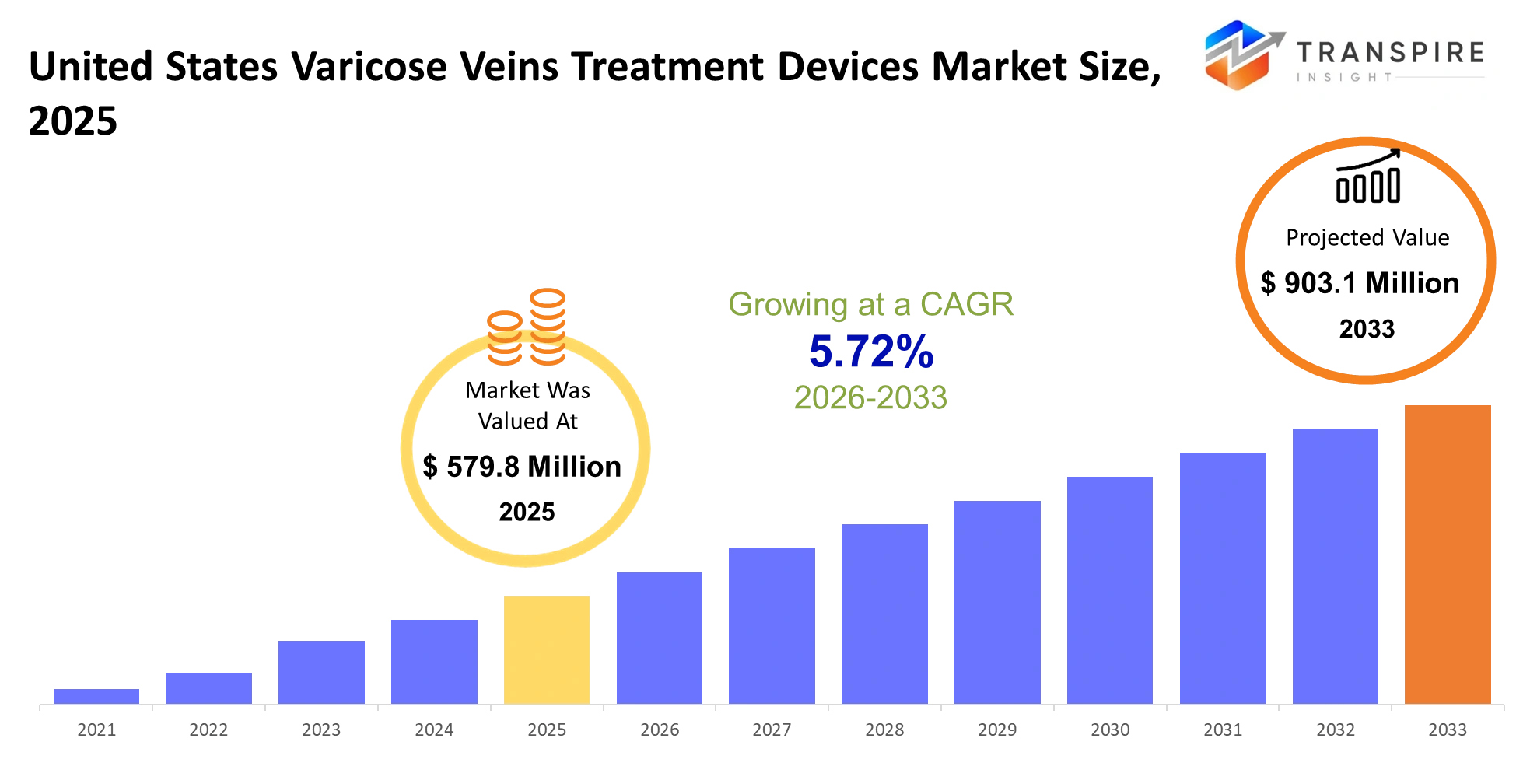
- United States Varicose Veins Treatment Devices Market Size 2025: USD 579.8 Million
- United States Varicose Veins Treatment Devices Market Size 2033: USD 903.1 Million
- United States Varicose Veins Treatment Devices Market CAGR: 5.72%
- United States Varicose Veins Treatment Devices Market Segments: By Product Type (Ablation Devices, Sclerotherapy Injection Devices, Surgical Devices, Compression Therapy Devices, Laser Devices, Radiofrequency Devices, Others); By Treatment Type (Endovenous Ablation, Sclerotherapy, Surgical Ligation, Vein Stripping, Laser Therapy, Others); By End User (Hospitals, Specialty Clinics, Ambulatory Surgical Centers, Dermatology Clinics, Others); By Application (Spider Veins, Varicose Veins, Chronic Venous Insufficiency, Venous Ulcers, Others).
To learn more about this report,  Download Free Sample Report
United States Varicose Veins Treatment Devices Market Summary
The United States Varicose Veins Treatment Devices Market was valued at USD 579.8 Million in 2025. It is forecast to reach USD 903.1 Million by 2033. That is a CAGR of 5.72% over the period.
The United States varicose veins treatment devices market kind of centers on technologies that help physicians manage venous insufficiency , which is a condition that can bring pain, swelling, skin problems, and reduced mobility for millions of adults. In real practice these devices let outpatient clinics, and also vascular specialists, close up damaged veins using minimally invasive methods, so patients usually get shorter hospital stays and a quicker recovery when compared with the more traditional vein stripping surgery. Over the past five years the market has had this noticeable structural turn away from thermal ablation systems toward non-thermal, and also non-tumescent options like mechanochemical ablation and cyanoacrylate closure. That shift mostly happened because providers are chasing shorter procedure times, and fewer anesthesia-related complications.
And it got more momentum in the post-pandemic period, when the backlog of elective vascular procedures made clinics push for faster patient throughput. Meanwhile reimbursement rules for office-based vein procedures became clearer, which strengthened investment into dedicated treatment platforms. So, in the end, device adoption looks stronger , since providers are expanding service capacity to handle an aging population, obesity-linked venous disorders, and a growing preference for ambulatory vascular care. This combo improves both operational efficiency and that procedural revenue side of things, pretty directly.
Key Market Insights
- The Northeast basically dominates the United States Varicose Veins Treatment Devices Market, and in 2025 it holds around 34% market share because there are so many specialty vascular centers there.
- Meanwhile the Southern United States is moving the quickest, with projections saying it will keep expanding through 2026–2032 , mainly because ambulatory vein clinics are boosting capacity quite fast.
- On the product side, endovenous laser ablation devices lead the pack, and they are responsible for roughly 38% of the market revenue in 2025, mostly thanks to well established physician preferences. Radiofrequency ablation systems then take the next spot, grabbing the second-largest market share, since they tend to deliver steadier procedures, and also usually result in less post-treatment discomfort.
- Non-thermal non-tumescent closure systems are the fastest-growing segment, expected to expand at more than 9% each year up to 2032, mostly because the treatment cycles can be shorter and the workflow is simpler.
- Chronic venous insufficiency treatment ends up being the driver, it represents almost 56% of the whole procedure volume during 2025 across the United States, Varicose Veins Treatment Devices Market.
- Cosmetic vein correction is also kind of popping off as the fastest-growing use case, mostly because patients are leaning toward minimally invasive outpatient steps, rather than the longer stuff.
- Specialty vein clinics pretty much take the lead with about 48% of the market share in 2025, and that seems tied to focused procedural know-how, plus smoother day-to-day outpatient operations.
- Hospitals still sit as the second-largest end-user segment, mostly from integrated vascular surgery resources and more advanced imaging infrastructure.
- Ambulatory surgical centers are the quicker risers here, they gain from lower procedural costs and higher patient throughput , which keeps the pace moving along.
What are the Key Drivers, Restraints, and Opportunities in the United States Varicose Veins Treatment Devices Market?
The strongest force pushing the United States varicose veins treatment devices market forward is basically the quick move of venous procedures out of hospitals and into office based vascular clinics. That change really picked up when reimbursement rules turned more friendly for outpatient endovenous work, and when providers were under pressure to reduce the procedural backlogs that piled up during the pandemic stretch. At the same time , newer non thermal ablation systems made the steps a lot less complicated by cutting out the need for tumescent anesthesia. Together, these things lower day to day operational costs for clinics while they can also handle more patients each day. So device use goes up, and manufacturers see steadier recurring revenue that tends to be stronger.
Even so, the biggest “block” in the structure is still inconsistent insurance reimbursement for venous procedures that get labeled as cosmetic adjacent, plus very strict paperwork expectations from payers about medical necessity. It’s not something that disappears quickly , because coverage determinations follow multi-year policy reviews and the standards vary a lot across private insurers from state to state. As a result, many patients postpone treatment when their out of pocket spending becomes hard to predict, and smaller clinics often hold back on investing in advanced platforms unless reimbursement looks stable. That, in turn, slows the replacement cycles for older equipment and ends up putting a brake on wider market revenue growth.
The next big growth thing kind of sits in ultrasound integrated treatment platforms and AI assisted vein mapping tech. These systems help procedural precision a lot, and they also lower how much the operator depends, so advanced care becomes more available beyond those big metropolitan vascular centers. Also, putting money into ambulatory care expansion in high growth Sun Belt places like Texas and Florida, well that creates good circumstances for adoption, you know, and it places these technologies to unlock the market’s next phase of scale.
What Has the Impact of Artificial Intelligence Been on the United States Varicose Veins Treatment Devices Market?
Artificial intelligence and advanced digital imaging platforms are kind of reshaping the United States market for varicose veins treatment devices, mostly by making procedural planning easier , automating parts of workflow and improving treatment precision. AI enabled ultrasound systems are now doing more of the vein mapping and vessel segmentation, so physicians can spot reflux pathways faster, and also cut down the manual interpretation time during the pre-procedure assessment. This kind of automation helps streamline clinic operations, because diagnostic sessions get shorter and clinics can handle higher daily patient throughput, especially in those high volume outpatient vein centers.
On top of that , machine learning models are being added into procedural guidance platforms to forecast catheter positioning results and fine tune energy delivery during endovenous laser and radiofrequency ablation. These predictive features assist in reducing incomplete vein closure rates and also lowering the chance of retreatment. Some clinics using digitally guided treatment platforms report more directional efficiency , with treatment times often coming down by around 15% to 20% compared with older conventional ultrasound guided workflows.
Then there are digital monitoring tools , which support post procedure follow up by watching recovery metrics and flagging complications earlier through remote patient engagement platforms. That helps improve follow up care compliance, while also reducing avoidable readmissions, which is not small.
Still, one big limitation is the integration cost for AI enabled imaging infrastructure. A lot of independent vein clinics simply do not have the budget to upgrade legacy systems, and limited longitudinal treatment datasets keep the algorithm accuracy restricted across different patient anatomies.
Key Market Trends
- Since 2020, non-thermal closure systems have gained almost 18% more procedural share ,with clinics really pushing for faster treatment times and less anesthesia.
- Between 2021 and 2025, specialty vein clinics boosted device procurement by more than 20%, and procedure volumes kind of moved away from hospital-based vascular surgery departments, bit by bit.
- Boston Scientific and Medtronic ramped up catheter innovation after 2022, putting out systems meant to improve precision and also shorten post-procedure recovery ,for many patients.
- After 2023, payer scrutiny got tighter, with tougher medical necessity paperwork slowing approvals and dragging out scheduling timelines across several private insurance networks, sort of.
- AI-assisted ultrasound mapping adoption kept rising after 2022 ,it helped providers shrink diagnostic interpretation time by about 15% to 20% in practical terms.
- Radiofrequency ablation has slipped a little in procedural share since 2021, while adhesive closure technologies gained traction among physicians looking for simpler workflows and less hassle.
- Supply chain volatility during 2021–2022 forced manufacturers to regionalize catheter assembly and split up component sourcing so they wouldn’t run into inventory shortages midstream.
- By 2024, ambulatory surgical centers expanded vein treatment capabilities by roughly 12%, mainly due to lower operating costs and more favorable outpatient reimbursement structures.
- Multi-site clinic consolidations sped up after 2023, and private equity-backed vascular platforms increased purchasing leverage while standardizing device choice across treatment networks.
- Since 2022, physician preference has shifted toward integrated digital guidance platforms—these help improve consistency during treatment and reduce retreatment rates, especially in complex venous insufficiency cases.
United States Varicose Veins Treatment Devices Market Segmentation
By Product Type:
The United States Varicose Veins Treatment Devices Market is broken down by product type into ablation devices , sclerotherapy injection devices , surgical devices , compression therapy devices , laser devices , radiofrequency devices , and others. Ablation devices seem to hold a strong position because people are leaning more and more toward procedures that are less invasive , with faster recovery and less discomfort , so it kind of makes sense. Laser and radiofrequency devices are also heavily used since they can deliver accurate treatment and they help with a cleaner closure of damaged veins.
Meanwhile, sclerotherapy injection devices keep getting attention too , especially when the target is smaller visible veins, because quick outpatient care is often preferred. Compression therapy devices remain an essential add-on as supportive treatment before and after the main procedure, and surgical devices are still relevant when the vein situation is more severe. Having a mix of product options means healthcare providers can choose a suitable path based on the patient’s condition and the desired treatment outcome, which supports steady market growth.
By Treatment Type:
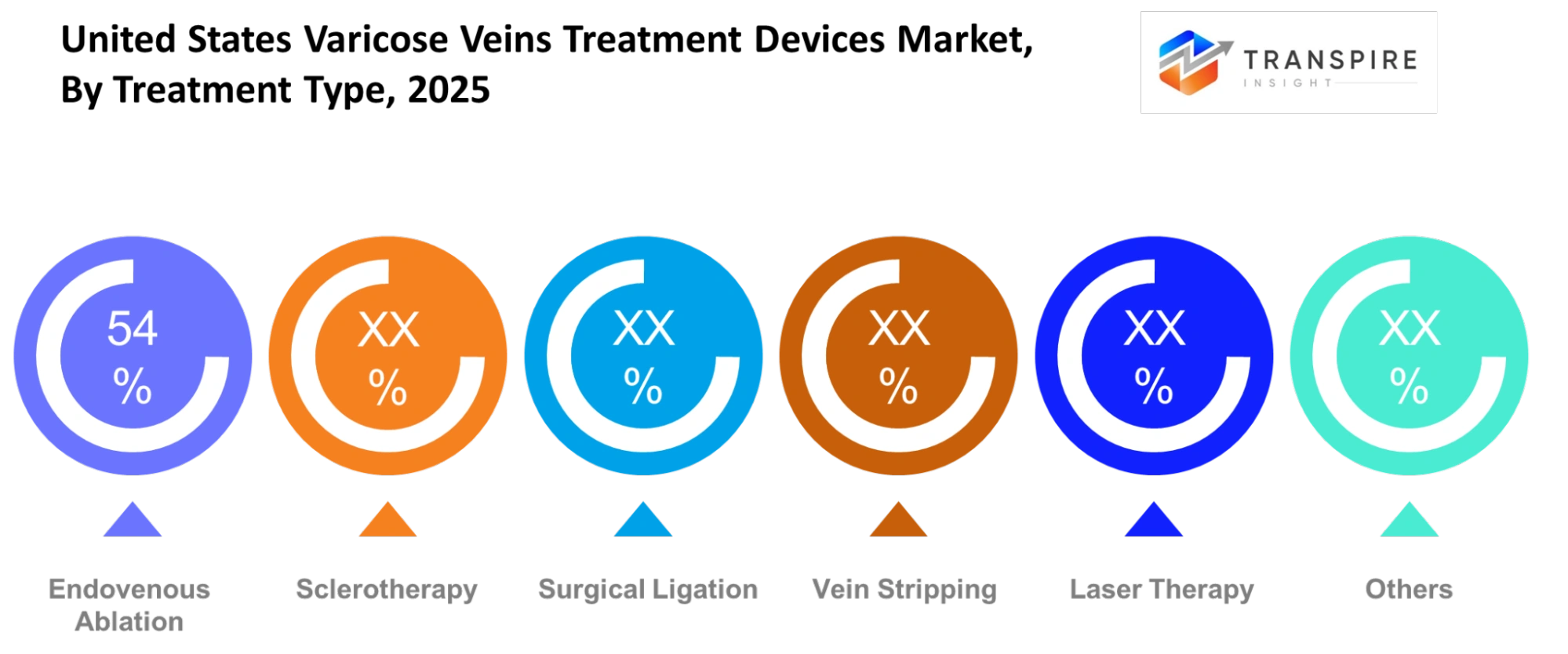
Depending on the treatment type, the United States Varicose Veins Treatment Devices Market is usually split into endovenous ablation, sclerotherapy, surgical ligation, vein stripping, laser therapy, and others. Endovenous ablation, if you look at it honestly, has been welcomed a lot lately because it delivers good outcomes with less downtime. Both patients and physicians seem to keep leaning toward this method, since it can reduce hospital stays, and supports a quick return to everyday routines within a shorter span of time, too.
Meanwhile sclerotherapy still feels like a solid choice for spider veins and for milder presentations. Laser therapy is getting used more and more, mainly because technology keeps improving and clinicians can apply treatment with more careful accuracy. As for surgical ligation and vein stripping, those are generally reserved for advanced vein disease, where less invasive options might not deliver full relief. This overall way of segmenting the treatments shows a bigger trend toward more tailored attention for different degrees of venous disorders.
To learn more about this report, Download Free Sample Report
By End User:
The market gets segmented by end user, into hospitals, specialty clinics, ambulatory surgical centers, dermatology clinics, and others. Hospitals take a noticeable share because they provide access to advanced imaging systems, experienced vascular specialists, and full treatment support for people needing complex care. There is also a big patient inflow, and that helps keep procedure volume steady across hospital environments.
Specialty clinics and ambulatory surgical centers are moving ahead faster. This is mostly tied to convenience, shorter appointment cycles, and lower treatment costs. Dermatology clinics meanwhile play an important role, especially for cosmetic vein correction procedures, where patient interest keeps climbing. More and more care is shifting toward outpatient settings, which is improving access and at the same time pushing broader adoption of modern vein treatment devices throughout the country.
By Application:
By application , the United States Varicose Veins Treatment Devices Market is sorted into spider veins , varicose veins , chronic venous insufficiency , venous ulcers , and other related categories. Varicose veins take up the biggest slice, mostly because incidence is climbing with aging , obesity, long hours of sitting and less physical movement. At the same time growing awareness about treatment alternatives is pushing many patients to look for medical care earlier, instead of waiting.
Spider veins also bring meaningful momentum to demand, especially when cosmetic concerns are involved, and people want procedures that improve what they see day to day. Chronic venous insufficiency and venous ulcers typically call for more focused care, so they often depend on advanced treatment devices to help circulation along and lower the chances of complications. Overall, this mixed application landscape shows how treatment technologies are getting used more widely for both medical necessity, and for aesthetic enhancement—kind of a dual track, really.
What are the Key Use Cases Driving the United States Varicose Veins Treatment Devices Market?
The main use for varicose vein treatment devices in the United States still feels like it’s mostly about minimally invasive care for chronic venous insufficiency, done in outpatient vascular clinics. That scenario is where you see the biggest procedural counts, because endovenous ablation comes with quicker recovery, fewer complications, and reimbursement friendly support for symptomatic patients.
More options are showing up too, like cosmetic vein correction and repeat treatment for recurring cases, especially in dermatology-led aesthetic centers and ambulatory surgical facilities. In those places they’re using more advanced closure systems to manage spider veins and post-surgical recurrence issues, and since many patients really want same-day discharge the device adoption keeps moving.
Other emerging use cases are popping up, for example AI guided vein mapping to deal with tricky vascular anatomies, and integrated treatment planning tied to obesity-related venous disease management. At the academic medical centers, teams are also testing combined therapy protocols, like adhesive closure paired with digital monitoring tools, and this sort of approach could start shifting the procedural norms during the forecast period as precision focused vascular care keeps gaining traction.
|
Report Metrics |
Details |
|
Market size value in 2025 |
USD 579.8 Million |
|
Market size value in 2026 |
USD 611.7 Million |
|
Revenue forecast in 2033 |
USD 903.1 Million |
|
Growth rate |
CAGR of 5.72% from 2026 to 2033 |
|
Base year |
2025 |
|
Historical data |
2021 - 2024 |
|
Forecast period |
2026 - 2033 |
|
Report coverage |
Revenue forecast, competitive landscape, growth factors, and trends |
|
Geographic scope |
United States of America |
|
Key company profiled |
Medtronic, Boston Scientific, AngioDynamics, Teleflex, biolitec AG, Syneron Medical, Lumenis, VVT Medical, Dornier MedTech, Eufoton, Merz Pharma, Sciton, Candela Medical, BTG International, Cook Medical. |
|
Customization scope |
Free report customization (country, regional & segment scope). Avail customized purchase options to meet your exact research needs. |
|
Report Segmentation |
By Product Type (Ablation Devices, Sclerotherapy Injection Devices, Surgical Devices, Compression Therapy Devices, Laser Devices, Radiofrequency Devices, Others); By Treatment Type (Endovenous Ablation, Sclerotherapy, Surgical Ligation, Vein Stripping, Laser Therapy, Others); By End User (Hospitals, Specialty Clinics, Ambulatory Surgical Centers, Dermatology Clinics, Others); By Application (Spider Veins, Varicose Veins, Chronic Venous Insufficiency, Venous Ulcers, Others). |
Which Regions are Driving the United States Varicose Veins Treatment Devices Market Growth?
The Northeastern United States is still kind of the most important regional market for varicose veins treatment devices, mostly because it blends a dense healthcare setup with solid commercial payer coverage for what’s considered medically necessary venous procedures. You can see it in states like New York, Massachusetts, and Pennsylvania, where theres a lot of vascular specialists, plus academic medical centers, and already established outpatient vein clinics. That combination really helps keep procedural volumes steady. On top of that, the region tends to adopt advanced closure technologies early, and a lot of physicians actually take part in clinical evaluations and technology rollouts that are often guided by major device manufacturers. So this mature ecosystem basically keeps things moving, it speeds up product uptake and it reinforces those referral pathways between primary care providers and vascular specialists , too.
The Midwest is the second-largest regional contributor, but the reason is a little different. It is more about procedural stability, not so much aggressive technology adoption. In comparison to the Northeast, Midwestern markets feel more cost-sensitive, and there’s more focus on reimbursement predictability, along with long-term provider investment discipline. Big integrated health systems across Illinois, Ohio, and Minnesota keep expanding outpatient vascular services, but at a measured pace, which then creates dependable device purchasing cycles. This kind of consistency makes the region a steady revenue foundation for manufacturers that want to lean on established ablation and imaging platforms, rather than constantly pushing newer approaches.
The Southern United States is showing the strongest growth momentum, kinda pushed along by fast ambulatory care expansion and demographic shifts that have bumped up venous disease treatment volumes . Population growth in states like Texas, Florida and Georgia has, in the last three years, increased investment in specialty vein clinics and also ambulatory surgical centers. At the same time private equity-backed healthcare platforms have funded pretty aggressive clinic rollouts, and they standardized device purchasing across multiple site networks, which sounds small but it really stacks up. For market entrants and investors , this regional acceleration makes a solid chance to capture procedural growth and set up distribution partnerships, through 2026 to 2033.
Who are the Key Players in the United States Varicose Veins Treatment Devices Market and How Do They Compete?
The competitive landscape of the United States varicose veins treatment devices market is sorta moderately consolidated, with most rivals clustered among diversified medical device manufacturers ,and then a smaller set of vascular-focused specialists too. Incumbents keep defending their share via procedural ecosystem integration while newer, technology-driven entrants are coming in and challenging the usual ablation platforms using simpler adhesive and non-thermal closure systems, kind of “streamlined” if you will. For sure competition is less about raw price and more about procedural efficiency, physician training support, and the practical ability to reduce the whole treatment complexity in outpatient settings. The companies that can shorten procedure time and make closure consistency feel more repeatable are getting extra traction with multi-site vein clinic operators
Medtronic holds its ground through technology refinement and a procedural reliability angle , with its radiofrequency ablation platforms staying familiar to many physicians across large vascular networks. The good side is more broad clinical validation and the way it slots into established vascular care pathways , so providers kind of deal with less switching friction, you know. Boston Scientific is really leaning into precision catheter engineering and physician focused training programs, which helps get people up to speed faster for advanced endovenous procedures. They’re also continuing to stretch outward via targeted outpatient partnerships and ongoing investment in minimally invasive vascular technologies.
AngioDynamics is kind of into niche specialization, especially with laser based treatment systems that are built to be adaptable during procedures across different venous anatomies. This flexibility keeps them still relevant in specialist led treatment centers, even when practices change. Merit Medical Systems, on the other hand, is really pushing ahead using imaging guided procedural accessories, which basically plug into and support ablation workflows, so it gives them cross selling leverage. Meanwhile Teleflex is growing via focused portfolio enhancements and they are going harder into ambulatory surgical centers, where streamlined procedural solutions are becoming a real decisive edge for competition.
Company List
- Medtronic
- Boston Scientific
- AngioDynamics
- Teleflex
- biolitec AG
- Syneron Medical
- Lumenis
- VVT Medical
- Dornier MedTech
- Eufoton
- Merz Pharma
- Sciton
- Candela Medical
- BTG International
- Cook Medical
Recent Development News
In April 2026, InVera Medical secured FDA clearance for its InVera Infusion Device. The clearance of this novel non-thermal catheter expands minimally invasive treatment options for chronic venous disease and strengthens innovation in the U.S. varicose veins treatment devices market.
Source: https://www.prnewswire.com/
In December 2025, Theraclion announced submission of its SONOVEIN® De Novo application to the U.S. FDA. This regulatory milestone positions the company for potential U.S. commercialization in 2026, potentially introducing non-invasive robotic HIFU technology into the American varicose vein treatment market.
Source: https://www.businesswire.com/
What Strategic Insights Define the Future of the United States Varicose Veins Treatment Devices Market?
In the next five to seven years, the United States varicose veins treatment devices market is gradually, kind of quietly, moving toward digitally connected office-based vascular intervention platforms that blend imaging intelligence, procedural automation, and minimally invasive closure technologies. That shift is getting pushed by payer pressure, to move more treatment into lower-cost outpatient settings while providers, at the same time, want higher throughput and procedural results that feel more repeatable. The market’s main hidden risk is reimbursement compression. If private insurers tighten medical necessity rules, or start cutting payment rates for advanced closure procedures, then the adoption of premium technologies could wobble, even if the clinical performance looks strong.
Another noticeable opportunity is the creation of AI-enabled ultrasound guidance and treatment planning systems made for independent specialty vein clinics, especially across the fast expanding Southern markets. These tools could widen access to advanced procedural accuracy, beyond just large hospital-affiliated vascular centers.
For market players, the strongest approach is investing in integrated procedural ecosystems, not only standalone devices. Firms that connect their treatment platforms with physician training programs, digital workflow software, and data-driven follow up monitoring should be more prepared to win durable contracts, and hold market share as purchasing decisions become more and more outcomes-focused.
United States Varicose Veins Treatment Devices Market Report Segmentation
By Product Type
- Ablation Devices
- Sclerotherapy Injection Devices
- Surgical Devices
- Compression Therapy Devices
- Laser Devices
- Radiofrequency Devices
By Treatment Type
- Endovenous Ablation
- Sclerotherapy
- Surgical Ligation
- Vein Stripping
- Laser Therapy
By End User
- Hospitals
- Specialty Clinics
- Ambulatory Surgical Centers
- Dermatology Clinics
By Application
- Spider Veins
- Varicose Veins
- Chronic Venous Insufficiency
- Venous Ulcers
Frequently Asked Questions
Find quick answers to common questions.
The United States Varicose Veins Treatment Devices Market size is USD 903.1 Million in 2033.
Key segments for the United States Varicose Veins Treatment Devices Market are By Product Type (Ablation Devices, Sclerotherapy Injection Devices, Surgical Devices, Compression Therapy Devices, Laser Devices, Radiofrequency Devices, Others); By Treatment Type (Endovenous Ablation, Sclerotherapy, Surgical Ligation, Vein Stripping, Laser Therapy, Others); By End User (Hospitals, Specialty Clinics, Ambulatory Surgical Centers, Dermatology Clinics, Others); By Application (Spider Veins, Varicose Veins, Chronic Venous Insufficiency, Venous Ulcers, Others).
Major United States Varicose Veins Treatment Devices Market players are Medtronic, Boston Scientific, AngioDynamics, Teleflex, biolitec AG, Syneron Medical, Lumenis, VVT Medical, Dornier MedTech, Eufoton, Merz Pharma, Sciton, Candela Medical, BTG International, Cook Medical.
The United States Varicose Veins Treatment Devices Market size is USD 579.8 Million in 2025.
The United States Varicose Veins Treatment Devices Market CAGR is 5.72% from 2026 to 2033.
- Medtronic
- Boston Scientific
- AngioDynamics
- Teleflex
- biolitec AG
- Syneron Medical
- Lumenis
- VVT Medical
- Dornier MedTech
- Eufoton
- Merz Pharma
- Sciton
- Candela Medical
- BTG International
- Cook Medical
Recently Published Reports
-
Apr 2026
AI in Diabetic Retinopathy Market
AI in Diabetic Retinopathy Market Size, Share & Analysis Report By Type (Screening AI Systems, Diagnostic AI Systems, and Predictive AI Models), By Application Segment (Hospitals, Ophthalmology Clinics, Diagnostic Centers, and Research and Development), and Geography (North America, Europe, Asia-Pacific, Middle East and Africa, South and Central America), 2021 - 2031
-
Apr 2026
Psychometric Tests Market
Psychometric Tests Market Size, Share & Analysis Report By Type (Personality Tests, Ability/Aptitude Tests, Skill/Knowledge Tests, and Others), By Application (Talent Acquisition and Talent Management), and Geography (North America, Europe, Asia-Pacific, Middle East and Africa, South and Central America), 2021 – 2031
-
Apr 2026
Rare Biological Sample Collection Market
Rare Biological Sample Collection Market Size, Share & Analysis Report By Type (Isolation Kits & Reagent, Blood Collection Tubes, and Others), By Application (Oncology, Transcriptomics, Pharmacogenomics, and Others), and Geography (North America, Europe, Asia-Pacific, Middle East and Africa, South and Central America), 2021 – 2031
-
Apr 2026
Patient Lift Pendant Market
Patient Lift Pendant Market By Product Type (Wired Pendants, Wireless, Programmable), By Operation Type(Manual, Electric), By End-Users (Healthcare Professionals, Patients), By Application (Hospitals, Homecare, Rehabilitation Centers, Others), By Industry Analysis, Size, Share, Growth, Trends, and Forecasts 2021-2033
Our Clients
.jpg)