
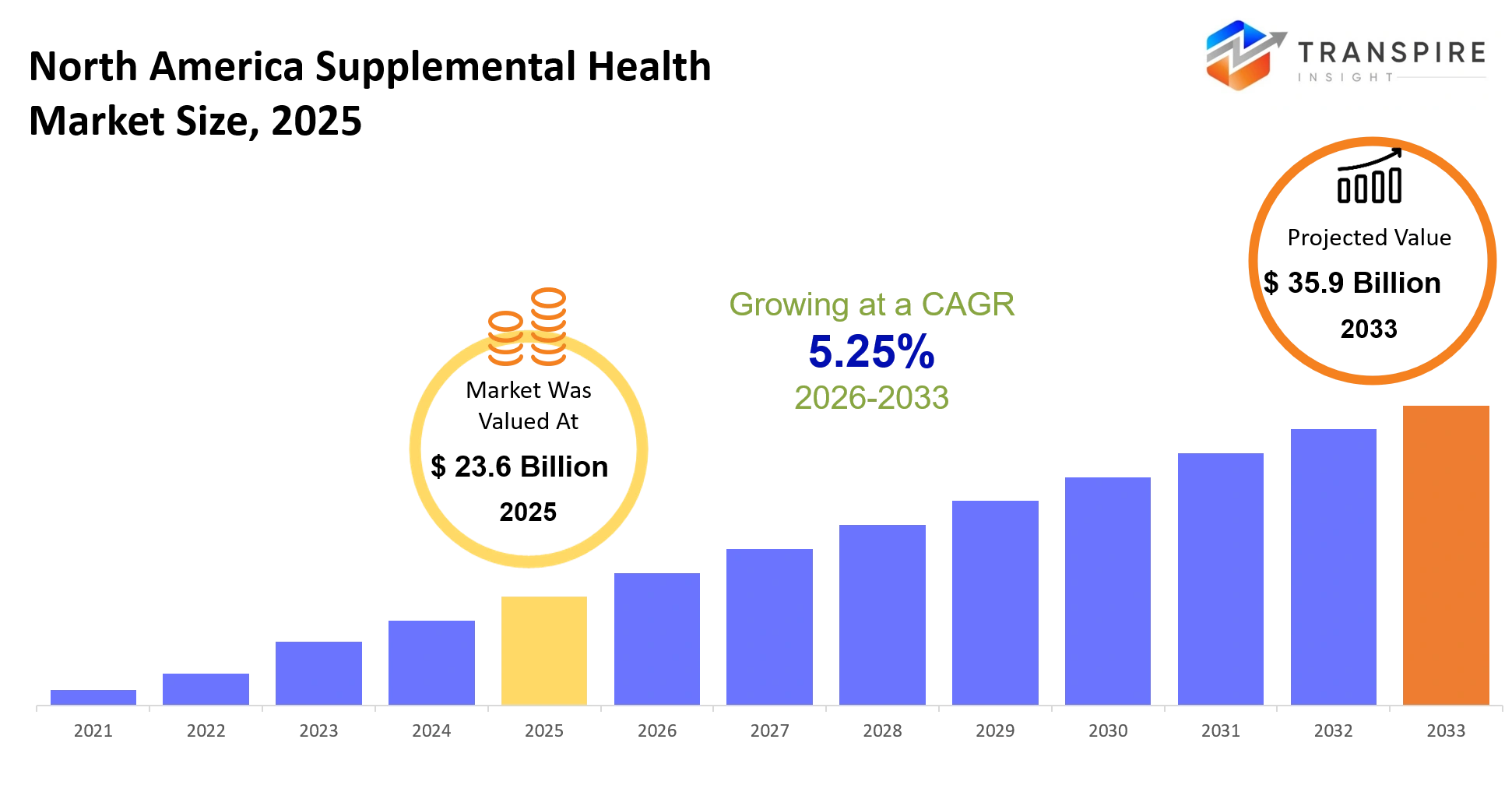
North America Supplemental Health Market Size & Forecast:
- North America Supplemental Health Market Size 2025: USD 23.6 Billion
- North America Supplemental Health Market Size 2033: USD 35.9 Billion
- North America Supplemental Health Market CAGR: 5.25%
- North America Supplemental Health Market Segments: By Insurance Type (Critical Illness Insurance, Accident Insurance, Hospital Indemnity Insurance, Dental Insurance, Others); By Coverage Type (Individual Coverage, Family Coverage, Employer-sponsored Coverage, Others); By End User (Individuals, Employers, Senior Citizens, Students, Others); By Distribution Channel (Direct Sales, Insurance Brokers, Online Platforms, Others)
To learn more about this report,  Download Free Sample Report
North America Supplemental Health Market Summary
The North America Supplemental Health Market was valued at USD 23.6 Billion in 2025. It is forecast to reach USD 35.9 Billion by 2033. That is a CAGR of 5.25% over the period.
In North America, supplemental health coverage kind of fills in the gaps left by primary medical insurance, but not always in the cleanest way, because it usually pays for out-of-pocket expenses like deductibles, copays, dental, vision, accident, and critical illness costs. In practice, it works like a financial cushion that households and employees lean on when standard insurance plans quietly move more risk to the individual. Over the past few years the market has shifted in a more structural way toward employer-sponsored voluntary benefits, delivered through digital enrollment platforms, and yeah this makes it simpler for workers to layer in targeted protection during onboarding, especially when things feel time constrained. A lot of that change also connects to the widespread adoption of high-deductible health plans, which was accelerated by post-pandemic healthcare cost pressure and COVID-19 claim volatility. So consumers have started looking for more predictable coverage layers, not just cheaper premiums. This also lets insurers bundle and cross-sell products with more effectiveness, which supports retention and increases revenue streams, while protection gaps widen and people actively manage their rising out-of-pocket exposure.
Key Market Insights
- United States pretty much dominates the North America Supplemental Health Market , with around 85% share, mainly because employer sponsored insurance penetration stays strong in 2025.
- Canada feels like the fastest grower through 2030 , mostly from more voluntary benefits being chosen and private insurance expanding.
- Mexico also looks promising, with emerging demand because informal workforce coverage gaps keep nudging supplemental protection uptake higher.
- Accident insurance is currently leading the market, taking about 30–35% share , largely tied to workplace injury protection needs.
- Dental and vision plans still sit as the second biggest piece , driven by routine care costs shifting toward employees.
- Critical illness coverage is the fastest-growing segment through 2030 as medical inflation ramps up financial risk exposure .
- Employer sponsored voluntary benefits are the dominant application , holding over 60% share in 2025.
- Individual-purchased supplemental policies are also moving fastest , helped by digital enrollment tools and the gig economy growing.
- Corporate employees make up the leading end-user segment , supported by big group benefit procurement.
- Self employed and gig workers are the fastest-growing category, due to flexible work models , and the need for portability in insurance coverage.
What are the Key Drivers, Restraints, and Opportunities in the North America Supplemental Health Market?
The North America Supplemental Health Market is mostly powered by a fast shift toward high deductible health plans, where more of the medical cost basically got pushed to employees over the last decade. After insurer redesigns in the early 2020s, deductibles and copay ceilings went up, and households started grabbing supplemental options like accident coverage, hospital indemnity, and critical illness plans, simply to quiet down unpredictable expenses. It also looks like this kind of build in change has directly lifted policy enrollment numbers, especially via employer sponsored voluntary benefit platforms that make cross selling easier during onboarding.
One important restraint is uneven affordability, mainly for lower income people and gig workers, and the income ups and downs make it hard to keep steady premium participation. This is not really a short term pricing problem, more of a structural snag tied to labor market fragmentation. So even if insurers try hard, there can be long lasting coverage gaps in the real world. Because of that, adoption still clusters around formal employment, which ends up holding back broader revenue growth even though companies are taking it up at a strong pace.
A big opportunity sits in digital first distribution ecosystems, the ones that plug into HR technology and payroll tools. For example, MetLife is already piloting API based enrollment features that slot supplemental coverage right into payroll systems in real time. When you combine that with AI driven personalization, it should help reach underserved SME and gig worker groups faster, and that may kick off the next growth phase for the North America Supplemental Health Market.
What Has the Impact of Artificial Intelligence Been on the North America Supplemental Health Market?
Artificial intelligence and advanced analytics are getting more and more slipped into scrubber performance systems and marine emission control tech, so vessels can monitor and steer compliance in a different way. On the automation side, AI enabled control systems keep fine tuning exhaust gas cleaning settings, like washwater flow and alkaline dosing, so regulatory sulfur limits stay met even when engine loads are shifting. That tends to cut down on manual meddling and makes compliance reporting steadier across fleets, especially for vessels running under IMO 2020 requirements.
At the same time predictive models are being used to anticipate scrubber fouling, corrosion risk, and overall performance decay, all based on sensor traces such as temperature, pressure, and pH values. These machine learning setups let operators line up maintenance earlier, before efficiency actually sags, which in turn supports better vessel uptime and fewer surprise dry-dock situations. Parallel to that, AI driven emissions forecasting tools can help shipping operators plan fuel choices and scrubber usage, giving tangible reductions in fuel penalties and operational drag, and in many cases nudging system efficiency up by mid single digit percentages, depending on the route and voyage conditions.
Still, adoption is not fully smooth because connectivity at sea can be limited in real time, which means data streams don’t always flow consistently to shore based analytics platforms. As a result, model refreshes arrive later than they should, and predictive accuracy can drop during fast changing maritime conditions. Even so, spending is moving into edge computing and mixed onboard AI architectures, and that is slowly reducing the gaps, allowing more intelligent exhaust gas cleaning technology to roll out across global fleets.
Key Market Trends
- After 2021, employer voluntary benefit platforms seemed to expand more, sort of moving supplemental health enrollment away from manual HR routines and into automated digital onboarding systems with fewer steps, and sometimes it felt a bit smoother even if the handoffs were less “human”.
- High deductible health plan penetration went up quite a bit post 2020, so employees leaned toward accident plus hospital indemnity coverage adoption, really across the North America Supplemental Health Market and not just a few areas.
- Insurers, for example Aflac, also pushed more API based partnerships with HR tech vendors after 2022, which helped make real time benefit enrollment line up better with payroll integration.
- Between 2021 and 2025, critical illness products gained more traction. A lot of that tracks with medical inflation, which increased household exposure to bigger out-of-pocket healthcare shocks, even for people who thought they were “fine” before.
- Meanwhile, the older broker led distribution model kept slipping steadily, and it got replaced by embedded digital marketplaces inside employer benefit portals, plus fintech enabled insurance ecosystems that sort of just, keep running in the background.
- AI driven underwriting tools rolled out after 2023 and they cut approval times by nearly 40 percent, and that improved conversion rates during supplemental coverage onboarding, which matters when people are deciding fast.
- Also since 2020, the gig economy kept growing, reshaping demand patterns. It increased individual purchased supplemental coverage among non-traditional workers, especially self employed segments, where the usual HR pathway doesn’t really exist.
- Insurers, at the same time, got more aggressive with cross selling across dental vision and accident plans, boosting retention rates, and raising policy bundling penetration across North America.
North America Supplemental Health Market Segmentation
By Insurance Type
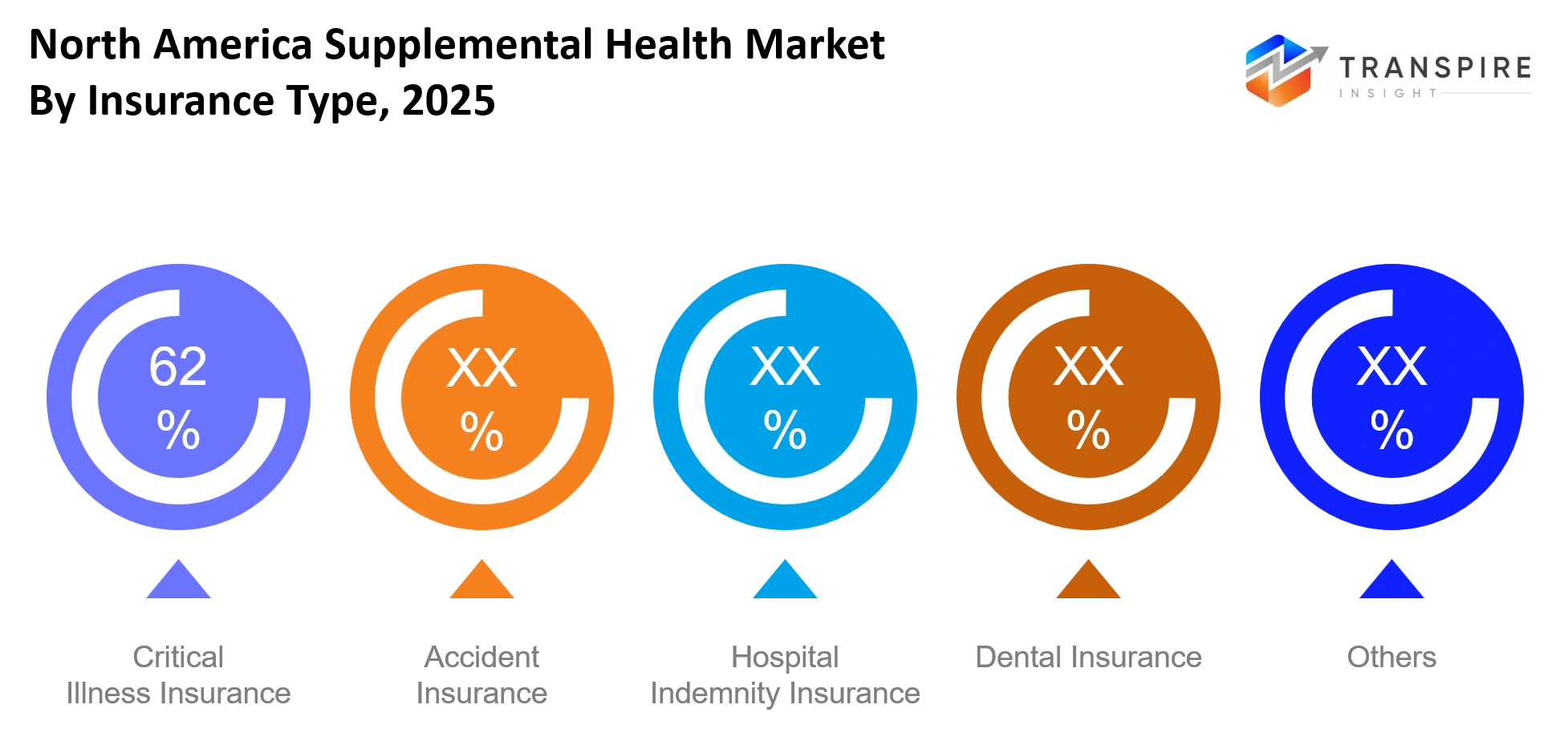
Accident insurance takes the strongest position in the North America Supplemental Health market, supported by pretty broad workplace injury coverage needs and also by lower premium thresholds that help adoption move fast, almost everywhere. Dental insurance also stays close behind, because routine care still gets used a lot and employers often bundle it in ways that help retention. Critical illness insurance is a smaller piece, but it matters in a focused way due to the bigger payout structure and its growing relevance as medical cost pressures keep climbing.
The rise in accident and hospital indemnity products is being pushed by the spread of high-deductible health plans, these kinds of plans shifted a lot more of the early healthcare costs onto employees. Insurers are designing modular offerings more often, so employers can mix and match coverage types, and that improves flexibility inside benefit design. Dental and vision coverage keep steady demand, since usage is pretty predictable, while critical illness products get more attention during stretches of economic uncertainty, you can see it in uptake patterns.
Over the forecast period, critical illness and hospital indemnity segments are expected to grow faster than the more traditional categories. Product developers will probably prioritize bundled protection packages that combine income replacement plus medical expense coverage, rather than staying single-line. Investors will likely lean toward high-margin, low-frequency payout products, because these can help underwriting profitability remain stronger even when claims timing is uneven.
To learn more about this report, Download Free Sample Report
By Coverage Type
Employer-sponsored coverage pretty much leads the North America Supplemental Health Market, mainly because big group purchasing arrangements and tax-advantaged benefit setups do the heavy lifting. Individual coverage is still more of a secondary player, but it keeps climbing, especially with gig workers and self-employed pros who want portable, always-on protection. Family coverage stays relatively stable, and that makes sense since households tend to pool risk at the household level, rather than treating each person like a standalone case.
This employer-heavy situation is reinforced through HR-driven enrollment systems, which plug benefits straight into payroll and onboarding tasks. At the same time, changes in workforce composition have nudged up demand for more flexible voluntary add-ons inside corporate benefit packages. Growth in individual coverage is also being pulled along by digital insurance marketplaces, they lower distribution friction and make enrollment way less annoying, or at least more streamlined.
Looking ahead, expansion will lean into hybrid models, mixing employer-sponsored base coverage with individual top-ups. Insurers will likely keep building modular policies that actually move with people from job to job. In the end, buyers will care more about portability and tailored options, especially across non-traditional employment segments where “standard” often doesnt fit.
By End User
Corporate employees are basically the leading end user chunk, because access is structured and the premium contributions are funded by the employer, so yeah it works out. Senior citizens are smaller, but still a very high value segment, mostly tied to higher healthcare use rates. Students, and people in younger age groups are more like emerging contributors, lower penetration for now but the interest in cheaper coverage keeps growing.
The distribution channels that are linked to the employer, really sway how employees adopt, especially in bigger organizations where benefits are standardized. Demographic aging plus the climb in out-of-pocket healthcare costs keep the demand fairly steady for seniors. Younger users are getting pulled in by digital-first insurance platforms, and also those financial wellness apps.
In the future, growth is expected to speed up among self-employed individuals and gig workers, since labor markets keep shifting toward flexible work. Insurers will likely have to offer simpler onboarding and more micro-insurance structures to reach the younger crowd. Investors, meanwhile will concentrate on scalable digital distribution methods aimed at fragmented end-user groups.
By Distribution Channel
In the North America Supplemental Health Market, Insurance brokers still hold a pretty strong position, mostly because they’ve got established employer ties and advisory-led sales models that feel more familiar. Meanwhile, direct sales channels are not gone, they stay important—especially for bigger insurers who manage enterprise clients. And then there are online platforms, these are the fastest emerging channel lately, kind of powered by digital transformation in benefits administration, more or less.
Broker dominance keeps going because many employers lean on advisory expertise for intricate benefit structuring and compliance alignment, it’s not just paperwork it’s also interpretation. Even so, digital platforms picked up pace since 2020, as companies connected their HR technology ecosystems with insurance enrollment tools, like the workflows actually talk to each other now. Direct insurer sales also do well when brand recognition is high and long-term corporate contracts already exist.
Looking ahead, future distribution will probably move toward embedded insurance models sitting inside payroll and HR software systems. Online platforms should grow quickly as AI-driven recommendation engines keep improving conversion rates. Finally, insurers that invest in API based integration will likely secure a stronger market share and also lower acquisition costs, which sounds good on both margins and resources.
What are the Key Use Cases Driving the North America Supplemental Health Market?
Employer-sponsored voluntary benefits are basically driving the main use case in North America Supplemental Health Market, where accident plus hospital indemnity coverage kinda fill those pesky cost gaps left by the high-deductible health plans. Big employers roll these offerings out, to help keep workforce financial volatility more stable and also to lower absenteeism that’s often tied to that unexpected medical spend, you know.
On the side, use cases are steadily widening among gig workers and self-employed people, mainly through digital insurance platforms that make it easier to keep portable dental and critical illness protection in motion. Meanwhile, senior care linked supplemental policies are starting to pick up steam too, because as the population ages, there’s more need for predictable out-of-pocket defense across retirement healthcare spending.
What’s next, includes embedded insurance inside payroll fintech systems, that can automatically switch on the coverage during employment transitions and similar moments. And then, AI-driven personalized benefit engines are also being tested, to line up coverage levels with individual health risk profiles, which signals a shift toward dynamic, data-based supplemental protection models.
|
Report Metrics |
Details |
|
Market size value in 2025 |
USD 23.6 Billion |
|
Market size value in 2026 |
USD 25.1 Billion |
|
Revenue forecast in 2033 |
USD 35.9 Billion |
|
Growth rate |
CAGR of 5.25% from 2026 to 2033 |
|
Base year |
2025 |
|
Historical data |
2021 - 2024 |
|
Forecast period |
2026 - 2033 |
|
Report coverage |
Revenue forecast, competitive landscape, growth factors, and trends |
|
Regional scope |
North America (Canada, The United States, and Mexico) |
|
Key company profiled |
Aflac, UnitedHealth Group, Cigna, Humana, MetLife, Allianz, Aetna, Anthem, Colonial Life, ManhattanLife, Guardian Life, Mutual of Omaha, Chubb, Prudential Financial, Sun Life Financial |
|
Customization scope |
Free report customization (country, regional & segment scope). Avail customized purchase options to meet your exact research needs. |
|
Report Segmentation |
By Insurance Type (Critical Illness Insurance, Accident Insurance, Hospital Indemnity Insurance, Dental Insurance, Others); By Coverage Type (Individual Coverage, Family Coverage, Employer-sponsored Coverage, Others); By End User (Individuals, Employers, Senior Citizens, Students, Others); By Distribution Channel (Direct Sales, Insurance Brokers, Online Platforms, Others) |
Which Regions are Driving the North America Supplemental Health Market Growth?
North America is leading the market, and the United States is really the one driving most of it, mainly because it has this huge employer based insurance set up and lots of private health coverage infrastructure. The regulatory frameworks are pretty strong for voluntary benefits integration,so insurers can more easily tuck supplemental plans into those corporate healthcare packages, without too much friction. Then you have a mature HR technology ecosystem,plus broad adoption of high-deductible health plans, and that basically keeps demand steady across both urban pockets and industrial workforce clusters. Because of that mix, the whole thing helps with scale distribution and it also supports strong, recurring premium flows.
Canada is steadier but it’s structured a bit differently. It leans on a more regulated public healthcare baseline, so people end up depending more on supplemental private coverage. Unlike the United States, the growth story is less employer driven and more shaped by unionized benefit arrangements and those provincial insurance gaps that still pop up. Still, when you look across provinces, the policy alignment stays fairly consistent, and that makes uptake pretty predictable especially for dental and vision coverage. So the result is stable, lower volatility revenue streams for insurers that operate there.
Mexico is the fastest growing region, and it’s getting help from rising formal employment and a gradual increase in private insurance penetration into workers that were historically underserved. More recently, investments in healthcare infrastructure,and more employers picking up supplemental benefit adoption, have pushed up demand in urban manufacturing and services. Also multinational companies are playing a part by rolling out standardized benefits packages across their supply chains. For investors and insurers, this means there’s a high opportunity entry point, and if you build early distribution partnerships, you can lock in long term market positioning through 2026–2033.
Who are the Key Players in the North America Supplemental Health Market and How Do They Compete?
The competitive landscape of the North America Supplemental Health Market is pretty moderately consolidated, with a small bunch of large insurers controlling a lot of employer channels while lots of regional carriers still compete in fairly niche areas. Most incumbents defend share via old, long-standing corporate relationships and embedded payroll distribution, and then disruption basically comes from digital-first insurtech platforms that make voluntary benefit enrollment simpler, kind of faster, and less annoying. In practice, competition is shaped less by pure pricing and more by distribution efficiency, product bundling skill, and the ability to integrate with HR technology systems in a smooth way.
Aflac leans into cost-efficient voluntary benefit specialization, building its edge using streamlined accident and critical illness offerings that are designed for rapid claims payout. The differentiated approach depends on strong workplace penetration plus payroll deduction partnerships, which lowers acquisition friction. MetLife instead leans hard on multi-product bundling across dental, vision, and life coverage, and it uses employer partnerships along with API-enabled enrollment tools to boost cross-selling efficiency across large enterprise clients. The Guardian Life Insurance Company of America holds position through niche specialization in dental and disability coverage, and it leans on provider networks plus claims service quality to keep employer groups from drifting away.
Cigna and UnitedHealth Group go at it through vertically integrated healthcare ecosystems, where insurance, provider networks, and analytics platforms all tie together. Their playbook centers on data-driven underwriting and integrated care delivery models, aiming to improve risk selection and keep cost control tighter. Growth tends to be driven by partnerships with employers and digital health platforms, which lets both firms embed supplemental products directly into broader healthcare benefit ecosystems.
Company List
- Aflac
- UnitedHealth Group
- Cigna
- Humana
- MetLife
- Allianz
- Aetna
- Anthem
- Colonial Life
- ManhattanLife
- Guardian Life
- Mutual of Omaha
- Chubb
- Prudential Financial
- Sun Life Financial
Recent Development News
“In January 2026, Aflac Incorporated joined the Workday Wellness Partner Program. The partnership enables Aflac to integrate supplemental insurance offerings into employer digital benefits platforms, improving distribution efficiency and expanding employer-sponsored supplemental coverage adoption in North America.https://newsroom.aflac.com
“In May 2026, UnitedHealth Group announced Optum Rx introduced the industry’s first transparent pharmacy care model. The launch strengthens integrated supplemental health and pharmacy benefits transparency in employer and Medicare-linked plans, enhancing competitive pressure in supplemental health benefit design across North America.https://www.unitedhealthgroup.com
What Strategic Insights Define the Future of the North America Supplemental Health Market?
The North America Supplemental Health Market is slowly moving toward this structurally embedded distribution model , where coverage becomes kind of a default feature inside employment and payroll ecosystems, rather than something people buy on their own like, separately. That change is being powered by deeper integration between insurers and HR technology platforms , it makes enrollment feel way less annoying and it can also lift lifetime policy attachment across those job-to-job transitions. And since benefits are getting more digitized by the month, the competition will shift to data integration capability , not just the old story of traditional underwriting strength.
But there’s a hidden risk, from this whole thing where distribution is consolidating into a few dominant employer platforms and digital benefits aggregators. So the dependency risk for insurers grows , because if an algorithm gets tweaked or a platform consolidates, access to end users could change fast, with no real heads up. On top of that, it makes the market more fragile for pricing too, since platform owners may push standardized benefit packages and that can squeeze premiums.
Still, there’s an emerging opportunity in embedded financial wellness ecosystems. These mix supplemental coverage with savings programs, payroll advances, and even preventive care incentives. You can already see this showing up in some large enterprise pilots and in fintech-HR partnerships, but it’s not mainstream yet. The firms that build API-first, modular product architectures will likely be the ones who catch the wave first. The core strategic recommendation, honestly, is to invest early in platform-native distribution instead of doubling down on the traditional broker-heavy channels, since those are probably going to lose relevance over time.
North America Supplemental Health Market Report Segmentation
By Insurance Type
- Critical Illness Insurance
- Accident Insurance
- Hospital Indemnity Insurance
- Dental Insurance
- Others
By Coverage Type
- Individual Coverage
- Family Coverage
- Employer-sponsored Coverage
- Others
By End User
- Individuals
- Employers
- Senior Citizens
- Students
- Others
By Distribution Channel
- Direct Sales
- Insurance Brokers
- Online Platforms
- Others
Frequently Asked Questions
Find quick answers to common questions.
The expected North America Supplemental Health Market size is USD 35.9 billion in 2033.
Key segments for the North America Supplemental Health Market are By Insurance Type (Critical Illness Insurance, Accident Insurance, Hospital Indemnity Insurance, Dental Insurance, Others); By Coverage Type (Individual Coverage, Family Coverage, Employer-sponsored Coverage, Others); By End User (Individuals, Employers, Senior Citizens, Students, Others); By Distribution Channel (Direct Sales, Insurance Brokers, Online Platforms, Others)
Major North America Supplemental Health Market players are Aflac, UnitedHealth Group, Cigna, Humana, MetLife, Allianz, Aetna, Anthem, Colonial Life, ManhattanLife, Guardian Life, Mutual of Omaha, Chubb, Prudential Financial, Sun Life Financial
The North America Supplemental Health Market size is USD 23.6 Billion in 2025.
The North America Supplemental Health Market CAGR is 5.25% from 2026 to 2033.
- Aflac
- UnitedHealth Group
- Cigna
- Humana
- MetLife
- Allianz
- Aetna
- Anthem
- Colonial Life
- ManhattanLife
- Guardian Life
- Mutual of Omaha
- Chubb
- Prudential Financial
- Sun Life Financial
About the Authors

Pankaj Ghogare Patil
I am Pankaj Ghogare Patil, a Senior Research Analyst at Transpire Insight, specializing in the Pharmaceutical, Chemicals & Materials, Healthcare IT, and Biotechnology industry. My expertise lies in conducting comprehensive market research, analyzing industry trends, evaluating competitive landscapes, and translating complex data into actionable insights. At Transpire Insight, I closely follow emerging technologies, regulatory developments, and market innovations to create accurate, well-researched, and informative content that helps businesses and professionals make informed decisions. I am committed to producing credible, evidence-based articles that reflect industry best practices while making technical topics accessible and valuable for a broad audience.

Chakradhar Khansole
Chakradhar serves as the Research Director at Transpire Insight, bringing over 8 years of experience in technology, innovation, and strategic market intelligence. He specializes in transforming complex market data into actionable business insights that enable organizations to make informed, growth-oriented decisions. Recognized for his strategic vision and analytical expertise, Chakradhar leads high-impact research initiatives, delivering comprehensive market assessments, competitive intelligence, and forward-looking industry analysis.
Recently Published Reports
-
Apr 2026
AI in Diabetic Retinopathy Market
AI in Diabetic Retinopathy Market Size, Share & Analysis Report By Type (Screening AI Systems, Diagnostic AI Systems, and Predictive AI Models), By Application Segment (Hospitals, Ophthalmology Clinics, Diagnostic Centers, and Research and Development), and Geography (North America, Europe, Asia-Pacific, Middle East and Africa, South and Central America), 2021 - 2031
-
Apr 2026
Psychometric Tests Market
Psychometric Tests Market Size, Share & Analysis Report By Type (Personality Tests, Ability/Aptitude Tests, Skill/Knowledge Tests, and Others), By Application (Talent Acquisition and Talent Management), and Geography (North America, Europe, Asia-Pacific, Middle East and Africa, South and Central America), 2021 – 2031
-
Apr 2026
Rare Biological Sample Collection Market
Rare Biological Sample Collection Market Size, Share & Analysis Report By Type (Isolation Kits & Reagent, Blood Collection Tubes, and Others), By Application (Oncology, Transcriptomics, Pharmacogenomics, and Others), and Geography (North America, Europe, Asia-Pacific, Middle East and Africa, South and Central America), 2021 – 2031
-
Jul 2026
Diabetic Retinopathy Market
Diabetic Retinopathy Market Size, Share & Analysis Report By Type (Proliferative Diabetic Retinopathy, and Diabetic Macular Edema (DME)), By Treatment Type (Anti VEGF Drug, Steroid Implants, Laser Surgeries, and Vitrectomy), and Geography (North America, Europe, Asia-Pacific, Middle East and Africa, South and Central America), 2021 – 2031
Our Clients







