North America Specimen Retrieval Market Size & Forecast:
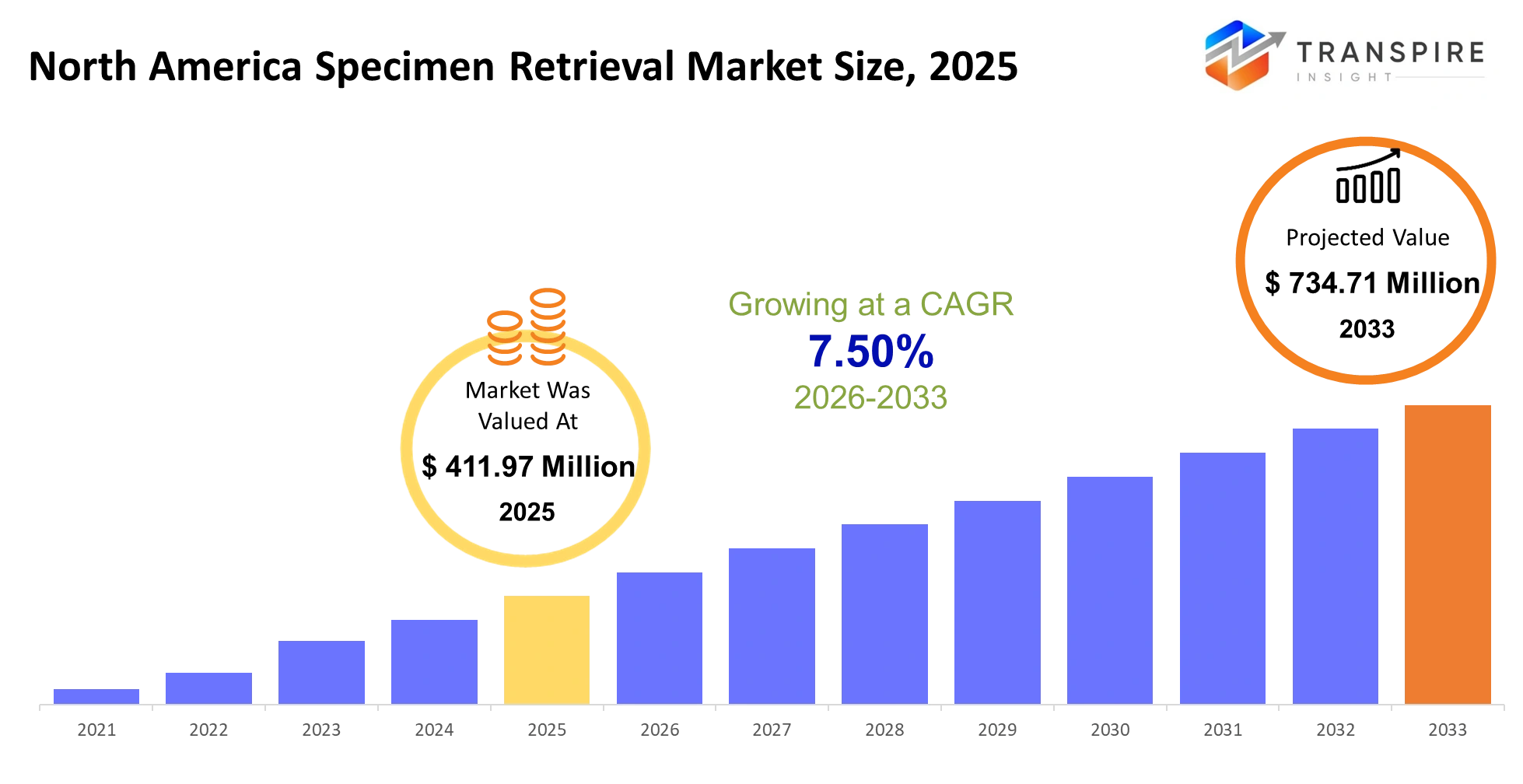
- North America Specimen Retrieval Market Size 2025: USD 411.97 Million
- North America Specimen Retrieval Market Size 2033: USD 734.71 Million
- North America Specimen Retrieval Market CAGR: 7.50%
- North America Specimen Retrieval Market Segments: By Type (Retrieval Bags, Forceps, Baskets, Snares, Others), By Application (Laparoscopy, Endoscopy, Urology, Gynecology, Others), By End-User (Hospitals, Clinics, Ambulatory Centers, Others), By Material (Polymer, Nylon, Silicone, Others).
To learn more about this report,  Download Free Sample Report
North America Specimen Retrieval Market Summary:
The North America Specimen Retrieval Market size is estimated at USD 411.97 Million in 2025 and is anticipated to reach USD 734.71 Million by 2033, growing at a CAGR of 7.50% from 2026 to 2033.The North America specimen retrieval market, kinda sits somewhere between minimally invasive surgery and pathology workflow efficiency, you know it really has to make both sides happy at the same time, sort of. In day to day practice, specimen retrieval devices assist surgeons in removing tissue samples, tumors, organs and even surgical debris, with a more careful touch during laparoscopic and robotic procedures. They also try to cut down contamination risk and keep the specimen integrity intact for diagnosis so pathology can do its work without extra back-and-forth or hassle. More and more hospitals are adopting these systems, to trim operating room turnover, lessen post-operative complications, and support precision focused surgical outcomes that are being asked for recently.
Over the last five years, the market has been shifting in a more obvious direction, toward robotic assisted approaches and single incision surgeries. Those methods tend to rely on specialized retrieval tools that can work through smaller, compact access points and that’s where the demand starts to get kinda narrow and specific. The COVID-19 backlog, tied to elective procedures acted like a noticeable catalyst, basically pushing hospitals to invest in minimally invasive platforms that can improve throughput and shorten inpatient stays. That same momentum helped drive demand for advanced retrieval bags and containment systems. And plus, since outpatient surgery volumes keep climbing across North America, manufacturers are also seeing steadier buying patterns. Ambulatory surgical centers often lean toward disposable products, with an infection control focus, because they align better with tighter operational efficiency targets.
Key Market Insights
- The United States pretty much dominates the North America Specimen Retrieval Market, taking around 78% of the market share in 2025, mostly because of advanced surgical infrastructure and how quickly robotic surgery adoption keeps going.
- Canada, meanwhile is showing the fastest expansion path all the way through 2032, helped by more outpatient surgical networks and those ongoing healthcare modernization investments which feel like they never stop.
- Also, cross-border medical device procurement agreements are easing access to products across North America. this helps the regional industry size, and it supports a stronger competitive position for many suppliers.
- In 2025 specimen retrieval bags are holding the leading chunk, above 52% market share, mainly because hospitals really prioritize contamination prevention during laparoscopic procedures, even when case volume is high.
- Detachable specimen pouches are still the second-largest segment , since they’re used widely across gynecological, bariatric, and urological surgeries, and people tend to stick with what is familiar.
- When it comes to pace, robotic-compatible retrieval systems are the fastest-growing segment through 2032. that’s tied to the procedural volume increase for robotic-assisted surgeries across North America, which is kind of a snowball effect.
- Laparoscopic surgery is leading the North America Specimen Retrieval Market overall with more than 61% revenue share, largely because it usually means shorter hospitalization and less surgical trauma compared with older approaches.
- Gynecological surgery applications are starting to pick up momentum too, driven by more minimally invasive hysterectomy procedures and ovarian cyst removal work, so demand keeps rising.
- Bariatric surgery applications are seeing solid forecast growth, as obesity treatment volumes continue climbing in both the United States and Canada, and clinics keep expanding capacity.
- Hospitals account for nearly 68% market share in 2025 , because high-volume surgical departments need reliable disposable specimen retrieval products that don’t cause headaches mid-procedure.
- Finally, ambulatory surgical centers are the fastest-growing end-user category, due to the continued expansion of cost-efficient outpatient surgical procedures which, honestly, is becoming the norm.
What are the Key Drivers, Restraints, and Opportunities in the North America Specimen Retrieval Market?
The strongest pull that is moving the North America specimen retrieval market is this fast, kind of obvious shift toward less traumatic and robotic supported surgery. In the hospitals across the United States and Canada , they expanded investment in robotic platforms after the elective surgery backlogs showed operating room capacity limits during the pandemic period. Surgeons increasingly lean toward specimen retrieval systems that cut down contamination risk and help shorten procedure times, especially for laparoscopic oncology, gynecology and bariatric surgeries . This shift keeps recurring revenue, because most retrieval bags and containment systems are disposable and that means continuous ordering cycles for hospitals and ambulatory surgical centers.
The biggest structural hitch in the market is the expensive procedural cost tied to advanced minimally invasive surgical infrastructure. Robotic surgery systems, compatible retrieval devices, plus surgeon training programs, all demand major capital outlay that smaller hospitals cannot take in quickly. It’s hard to fix because it really hinges on reimbursement reform, workforce specialization , and long procurement cycles, not simple short term pricing changes. So, a lot of secondary care facilities still rely on conventional surgical methods , which slows adoption and delays market penetration beyond the major metropolitan healthcare networks.
One large future opening is linking specimen retrieval systems with next generation robotic tools and single-incision surgical platforms. Firms building compact retrieval devices for outpatient robotic workflows, are set up to gain as ambulatory surgical centers continue expanding across North America.
What Has the Impact of Artificial Intelligence Been on the North America Specimen Retrieval Market?
Artificial intelligence and advanced digital technologies are kinda, more and more transforming specimen retrieval workflows across North American surgical settings, especially in robotic-assisted and minimally invasive procedures. Hospitals are taking AI-powered imaging platforms and pairing them with surgical navigation systems, so localization gets better tissue recognition improves, and intraoperative decisions happen faster. In practice, machine learning is now helping surgeons by looking over real time laparoscopic video streams, it flags tissue boundaries and lowers the risk of incomplete specimen removal during oncology and gynecological surgeries.
At the same time, advanced digital tracking is making operating room operations feel a bit smoother, like everything is slightly more coordinated. RFID-enabled specimen retrieval devices, when used together with cloud-based surgical workflow platforms, let hospitals automate instrument monitoring, cut down retrieval mistakes, and strengthen pathology chain-of-custody adherence. A number of major healthcare networks have already shared data showing measurable drops in surgical turnaround times, plus less procedural waste, after they rolled out digitally connected surgical inventory systems.
Predictive analytics is also showing up as a growing area. Many hospitals are using AI-driven maintenance solutions to watch robotic surgical systems continuously and anticipate component failures before they can interrupt a procedure. That tends to boost equipment uptime and limit expensive operating room downtime. Still, there are constraints with current AI adoption, because getting imaging software, robotic platforms, and hospital data infrastructure to work together takes high upfront capital and a lot of interoperability tuning, across older healthcare IT environments that were built before these kinds of integrations.
Key Market Trends
- Since 2021, robotic-assisted operations have expanded a lot across North America, which kind of pushed manufacturers to work on compact retrieval setups that fit with single-incision procedures .
- Hospitals also shifted procurement strategies after COVID-19 surgical backlogs highlighted operating room inefficiencies ,and at the same time increased demand for disposable contamination-control devices, which I guess everyone suddenly cared about.
- By 2025, ambulatory surgical centers captured more procurement volumes as outpatient laparoscopic procedures replaced a few selected inpatient surgical interventions.
- Manufacturers such as Medtronic and Johnson & Johnson put more money into reinforced specimen bags aimed at complicated oncological tissue extraction, not just basic retrieval.
- Surgeons have also increasingly adopted retrieval systems featuring improved sealing mechanisms, after contamination-related litigation and stricter pathology chain-of-custody protocols got more intense in 2022.
- Between 2020 and 2022, supply chain disruptions made hospitals diversify their surgical device sourcing, instead of depending on single-vendor procurement agreements, full stop.
- AI-enabled surgical imaging systems started gaining traction after major healthcare networks stated they saw fewer tissue handling errors during minimally invasive oncology procedures.
- Starting in 2023, purchasing teams increasingly preferred retrieval devices integrated with robotic surgical platforms, to reduce procedure time ,and cut down instrument exchanges too.
- Canadian healthcare systems moved faster on minimally invasive surgery investments after provincial infrastructure funding programs expanded outpatient surgical capacity beginning in 2022.
- Competitive behavior has shifted as well, toward strategic partnerships with ambulatory surgical centers, because recurring disposable device usage creates more predictable long-term revenue.
North America Specimen Retrieval Market Segmentation
By Type
By type, retrieval bags seem to keep the dominant market position, because minimally invasive surgeries need secure tissue containment and contamination prevention, especially during extraction procedures. Hospitals and ambulatory surgical centers are leaning more and more toward disposable retrieval bags due to infection control standards and the way pathology specimens must be handled. Forceps and baskets keep a steady demand in endoscopic and urological procedures where precise tissue manipulation stays pretty critical. Snares are still gaining relevance in gastrointestinal settings and for polyp removal, mainly because physicians want a quicker excision workflow with less procedural complication.
Demand patterns also shifted after robotic-assisted surgeries expanded throughout North America, which made the demand stronger for compact, and reinforced retrieval systems that can work alongside robotic instrumentation. Manufacturers are now concentrating on product distinction through better sealing mechanisms, improved puncture resistance, and ergonomic deployment setups. Going forward, competition inside this segment will probably depend on compatibility with robotic surgical platforms and on whether products can handle high-volume outpatient environments, where efficiency and disposable usage really steer purchasing decisions.

To learn more about this report, Download Free Sample Report
By Application
With application level, laparoscopy seems to be the most leading segment, because surgeons are more and more betting on minimally invasive pathways that reduce recovery time and also make hospital stays a bit shorter. In parallel, gynecological plus bariatric procedures add a big chunk of the procedural volume especially in city healthcare environments that already have advanced robotic surgery infrastructure. Even with delays, endoscopy still holds a solid market position, because colorectal screening and digestive tract interventions keep expanding, mostly within older patient groups.
On the urology side though, usage is rising in a steady kind of way, pushed by more frequent management of kidney stones and less invasive prostate procedures.
Demand really looks different across these application areas, depending on procedural complexity, reimbursement frameworks, and just how available physician training is in a given region. For oncology, more surgeries are now expecting high integrity specimen retrieval systems, systems that can preserve tissue condition for later diagnostic review. Looking ahead, the market direction points toward tighter integration between retrieval devices and robotic visualization tools, particularly for advanced laparoscopic oncology and single incision procedures. Investors and manufacturers also keep homing in on these specialized applications, where premium retrieval systems can justify stronger pricing and then still support repeat purchases over time.
By End-User
By end-user level, hospitals keep leading, mostly because big surgical departments run the bulk of minimally invasive and robotic assisted procedure volumes. Their buying clout is high, and long term procurement pacts let hospital groups standardize retrieval devices across several surgical specialties, which sort of makes it feel easier and repeatable. Ambulatory surgical centers are showing up as the fastest growing segment, partly from healthcare cost control and also because elective work keeps moving into outpatient settings. Clinics stay at a more modest demand level, especially when it comes to endoscopic, diagnostic interventions, where smaller scale retrieval systems are actually enough and faster to manage.
Operational efficiency is increasingly what guides purchasing everywhere, in all these end user categories. This is more noticeable now, since staffing shortages and operating room limitations keep pushing facilities to shave down procedure times. On top of that, larger healthcare systems tend to favor disposable retrieval products, tied to infection prevention rules and also to simplify sterilization workflows, or at least reduce the hassle. Looking ahead, the future growth in this slice will probably lean toward manufacturers who can provide cost effective, procedure specific devices that fit the expansion of outpatient surgery. Buyers also seem to care more about vendor partnerships that come with training help, inventory management, and clear compatibility with robotic surgical systems, even when the setup is slightly different from site to site
By Material
By material, polymer based retrieval systems kinda dominate ,mostly because lightweight build, flexibility and cost efficiency seems to match up with disposable surgical device needs. Advanced polymers also bring strong puncture resistance plus fluid containment during those more complex tissue extraction tasks. Nylon still keeps steady demand when the application calls for boosted tensile strength and durability, especially in the higher load laparoscopic procedures. Silicone based products keep picking up steam in specialized surgeries, since flexible handling and atraumatic touch help surgical precision a bit more, you know.
Material selection is getting more and more tied to procedural complexity , contamination risk and compatibility with robotic assisted surgical instruments. Manufacturers are now putting serious investment into multilayer polymer engineering and reinforced composite structures, to improve durability while not really sacrificing maneuverability inside tight surgical spaces. Sustainability worries also nudge the development path, as healthcare systems aim for less waste from surgical materials and recyclable packaging solutions.
Looking ahead, innovation in this slice will probably revolve around high performance polymers that can support advanced robotic workflows while still staying affordable for the high volume outpatient surgical environment.
What are the Key Use Cases Driving the North America Specimen Retrieval Market?
Laparoscopic surgery still looks like the main use case that’s pushing adoption of specimen retrieval devices across North America, and it sort of makes sense when you think about it. Once the bariatric , colorectal , and gynecological cases keep running at high procedural volumes, the demand stays steady because surgeons really do want contamination-controlled tissue extraction while they’re working through minimally invasive steps.
Meanwhile, endoscopic and urological procedures are getting more momentum, especially in ambulatory surgical centers and those specialty clinics. You can see it in the way gastrointestinal polyp removal, kidney stone extraction, and minimally invasive prostate interventions are starting to lean on compact retrieval systems, sort of like these practical little setups that fit in smaller workflows.These systems help with procedural efficiency, and they also cut down the operating room turnaround time, not just a little, but consistently.
Looking ahead, newer use cases are popping up too, like robotic-assisted oncology surgeries and single-incision procedures happening in more advanced hospital networks. Those scenarios call for reinforced retrieval devices that can handle delicate tissue samples, but also still support precision-minded robotic workflows and next generation minimally invasive surgical techniques.
|
Report Metrics |
Details |
|
Market size value in 2025 |
USD 411.97 Million |
|
Market size value in 2026 |
USD 442.87 Million |
|
Revenue forecast in 2033 |
USD 734.71 Million |
|
Growth rate |
CAGR of 7.50% from 2026 to 2033 |
|
Base year |
2025 |
|
Historical data |
2021 - 2024 |
|
Forecast period |
2026 - 2033 |
|
Report coverage |
Revenue forecast, competitive landscape, growth factors, and trends |
|
Country scope |
North America (Canada, The United States, and Mexico) |
|
Key company profiled |
Medtronic, Boston Scientific, Olympus, Cook Medical, B. Braun, Stryker, Conmed, Smith & Nephew, Cardinal Health, BD, Terumo, Karl Storz, Merit Medical, AngioDynamics, Fujifilm. |
|
Customization scope |
Free report customization (country, regional & segment scope). Avail customized purchase options to meet your exact research needs. |
|
Report Segmentation |
By Type (Retrieval Bags, Forceps, Baskets, Snares, Others), By Application (Laparoscopy, Endoscopy, Urology, Gynecology, Others), By End-User (Hospitals, Clinics, Ambulatory Centers, Others), By Material (Polymer, Nylon, Silicone, Others). |
Which Regions are Driving the North America Specimen Retrieval Market Growth?
North America remains the most important regional market for specimen retrieval devices, because healthcare systems across the United States and Canada keep having high uptake for minimally invasive and robotic-assisted surgeries. Good reimbursement structures and solid hospital infrastructure, plus early integration of robotic surgical platforms, keep pushing procedural volumes upward, even across big healthcare networks. At the same time large academic medical centers and specialty surgical institutions sustain demand through continuous investments in laparoscopic oncology, bariatric, and gynecological procedures. The region really benefits from a mature medical device ecosystem where manufacturers, distributors, and surgical training centers work inside tightly connected procurement and clinical support networks.
Europe is still the second-largest regional market, though the growth story looks different, because healthcare adoption leans more on standardized public healthcare systems and consistent long-term regulatory rules. In places like Germany, France, and the United Kingdom, procurement patterns remain steady, largely through centralized hospital buying , and a gradual modernization of minimally invasive surgical programs. Here, demand growth is more steady than aggressive because hospitals focus on cost efficiency and evidence-driven device adoption before they expand procurement at a bigger scale. Strong clinical governance standards and well-established surgeon training programs keep making Europe a dependable contributor for long-term global market revenue.
Asia-Pacific seems to be emerging as the fastest-growing regional market, after big healthcare infrastructure investments kicked in and accelerated surgical modernization programs across China, India, and Southeast Asia. In a way, governments along with private hospital operators expanded minimally invasive surgery capacity quite a bit, mainly once pandemic pressure worsened surgical backlogs , and when healthcare accessibility needed a quicker fix. On top of that, rising funding for robotic surgery systems and ambulatory surgical centers is opening fresh doors for advanced specimen retrieval technologies in high-volume, urban health facilities. If this keeps going, then it should pull in pretty aggressive expansion plans from global manufacturers and regional distributors from 2026 through 2033, as competitive intensity increases across developing healthcare markets.
Who are the Key Players in the North America Specimen Retrieval Market and How Do They Compete?
The North America specimen retrieval market looks like it has some moderate consolidation, not total lock-in, but a smaller set of multinational medical device manufacturers kind of controls a big slice of hospital procurement contracts. Instead of only focusing on pure pricing, the contest is drifting more toward how well the tech integrates, whether the devices are compatible with robotic surgery, and how surgeon oriented the product design feels. The well-known companies still try to hold their positions by maintaining long-term hospital relationships and offering bundled surgical product portfolios, you know , the whole set approach. Meanwhile smaller firms tend to chase niche chances in minimally invasive and outpatient procedures, more like targeted plays than broad coverage. Across the whole space, product dependability, contamination control performance, and robotic-assisted surgical system compatibility are still the main competitive points.
Medtronic seems to push hard on technology based differentiation using advanced laparoscopic retrieval systems made for intricate minimally invasive cases. Their wide integration across related surgical lines helps them win procurement agreements with major hospital networks that want standardized surgical platforms. Johnson & Johnson, via its Ethicon surgical segment, is using robotic assisted surgery as a strong angle , especially with devices engineered for precise tissue handling and better operating room efficiency. On top of that, their extensive surgeon training programs and clinical education collaborations act like extra leverage, because they raise physician familiarity with specific proprietary surgical systems.
Applied Medical kind of competes by betting on procedure centered innovation and cost efficient disposable retrieval products, that are aimed at ambulatory surgical centers plus outpatient facilities. They use flexible manufacturing and they keep a close, direct kind of engagement with hospitals so they can react faster to shifting preferences from surgeons. CONMED Corporation sets itself apart with specialized minimally invasive surgical products, focusing on ergonomic deployment and a more straightforward specimen handling approach during laparoscopic cases. B. Braun keeps pushing its regional presence forward via hospital partnerships, and bundled surgical supply solutions that back infection prevention protocols as well as operating room workflow standardization .
Company List
- Medtronic
- Boston Scientific
- Olympus
- Cook Medical
- B. Braun
- Stryker
- Conmed
- Smith & Nephew
- Cardinal Health
- BD
- Terumo
- Karl Storz
- Merit Medical
- AngioDynamics
- Fujifilm
Recent Development News
In May 2026, Teleflex Reports Q1 2026 Financial Results for Medical Technologies Business: Teleflex Incorporated reported first-quarter 2026 financial results highlighting continued activity in its medical technologies portfolio. Teleflex remains a recognized supplier in minimally invasive surgical products, including specimen retrieval solutions used in laparoscopic procedures throughout North America.
Source: https://www.businesswire.com
In February 2026, Medtronic Expands Surgical Robotics Portfolio in the U.S.: Medtronic announced the first U.S. commercial surgery performed with its Hugo™ robotic-assisted surgery system at Cleveland Clinic in February 2026. The development is significant for the North American specimen retrieval market because robotic-assisted minimally invasive procedures directly increase demand for specimen retrieval devices and retrieval bags used during surgeries.
Source: https://www.prnewswire.com
What Strategic Insights Define the Future of the North America Specimen Retrieval Market?
North America specimen retrieval market is kind of moving, in a structural way, toward very specialized robotic-compatible retrieval systems meant for outpatient setups and precision oriented surgical environments. The main push behind that shift is basically the coming together of robotic surgery growth, operating room efficiency pressures, and also the rising need for contamination controlled tissue handling, especially in oncology and in those minimally invasive procedures. Over the next five to seven years, buying choices will more and more lean toward integrated surgical ecosystems rather than just standalone retrieval products, and that’s the general direction.
There is also a less obvious risk here, like the concentration of demand inside big hospital procurement networks and group purchasing organizations. Smaller manufacturers may find it harder to lock in long term contracts even if they keep innovating because large healthcare systems are starting to standardize purchasing across bundled surgical platforms. If that continues, it could reduce pricing flexibility and, in practice, slow down wider competitive diversification.
Still, there is an emerging opportunity, and it looks like this: building AI integrated retrieval systems that can help with intraoperative tissue identification and digital pathology workflows during robotic assisted oncology surgeries. Firms that want in should really emphasize partnerships with robotic surgery platform providers, and with ambulatory surgical center networks. Procedural volume and technology adoption rates are expected to rise faster, especially through 2033.
North America Specimen Retrieval Market Report Segmentation
By Type
- Retrieval Bags
- Forceps
- Baskets
- Snares
- Others
By Application
- Laparoscopy
- Endoscopy
- Urology
- Gynecology
- Others
By End-User
- Hospitals
- Clinics
- Ambulatory Centers
- Others
By Material
- Polymer
- Nylo
- Silicone
- Others
Frequently Asked Questions
Find quick answers to common questions.
The approximate North America Specimen Retrieval Market size for the market will be USD 734.71 Million in 2033.
The key segments of the North America Specimen Retrieval Market are By Type (Retrieval Bags, Forceps, Baskets, Snares, Others), By Application (Laparoscopy, Endoscopy, Urology, Gynecology, Others), By End-User (Hospitals, Clinics, Ambulatory Centers, Others), By Material (Polymer, Nylon, Silicone, Others).
Major players in the North America Specimen Retrieval Market are Medtronic, Boston Scientific, Olympus, Cook Medical, B. Braun, Stryker, Conmed, Smith & Nephew, Cardinal Health, BD, Terumo, Karl Storz, Merit Medical, AngioDynamics, Fujifilm.
The current market size of the North America Specimen Retrieval Market is USD 411.97 Million in 2025.
The North America Specimen Retrieval Market CAGR is 7.50%.
- Medtronic
- Boston Scientific
- Olympus
- Cook Medical
- B. Braun
- Stryker
- Conmed
- Smith & Nephew
- Cardinal Health
- BD
- Terumo
- Karl Storz
- Merit Medical
- AngioDynamics
- Fujifilm
Recently Published Reports
-
Apr 2026
AI in Diabetic Retinopathy Market
AI in Diabetic Retinopathy Market Size, Share & Analysis Report By Type (Screening AI Systems, Diagnostic AI Systems, and Predictive AI Models), By Application Segment (Hospitals, Ophthalmology Clinics, Diagnostic Centers, and Research and Development), and Geography (North America, Europe, Asia-Pacific, Middle East and Africa, South and Central America), 2021 - 2031
-
Apr 2026
Psychometric Tests Market
Psychometric Tests Market Size, Share & Analysis Report By Type (Personality Tests, Ability/Aptitude Tests, Skill/Knowledge Tests, and Others), By Application (Talent Acquisition and Talent Management), and Geography (North America, Europe, Asia-Pacific, Middle East and Africa, South and Central America), 2021 – 2031
-
Apr 2026
Rare Biological Sample Collection Market
Rare Biological Sample Collection Market Size, Share & Analysis Report By Type (Isolation Kits & Reagent, Blood Collection Tubes, and Others), By Application (Oncology, Transcriptomics, Pharmacogenomics, and Others), and Geography (North America, Europe, Asia-Pacific, Middle East and Africa, South and Central America), 2021 – 2031
-
May 2026
Patient Lift Pendant Market
Patient Lift Pendant Market By Product Type (Wired Pendants, Wireless, Programmable), By Operation Type(Manual, Electric), By End-Users (Healthcare Professionals, Patients), By Application (Hospitals, Homecare, Rehabilitation Centers, Others), By Industry Analysis, Size, Share, Growth, Trends, and Forecasts 2021-2033
Our Clients
.jpg)