

North America Specimen Collection Cards Market Summary
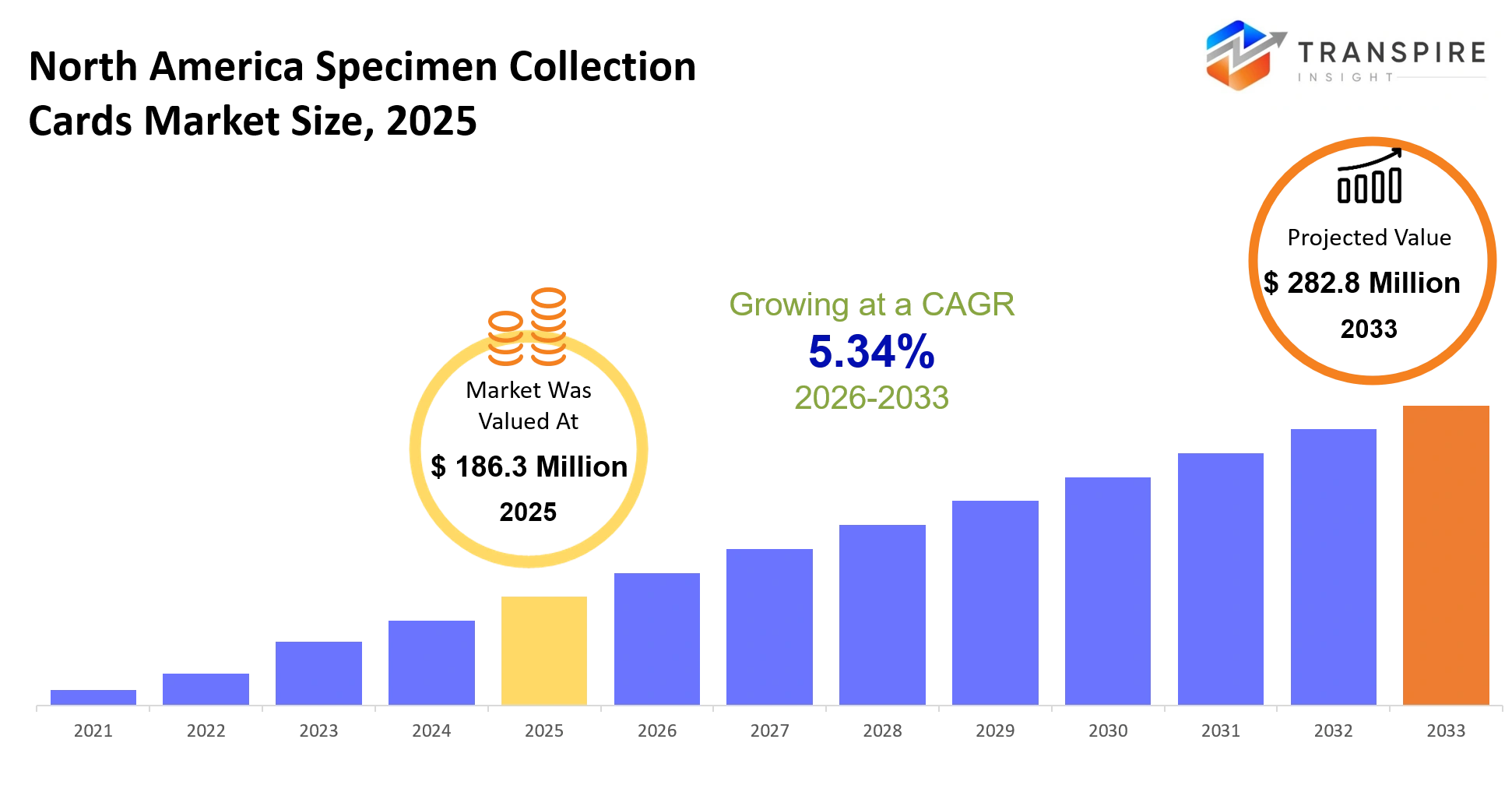
As per Transpire Insight Analysis the North America Specimen Collection Cards Market size is estimated at USD 186.3 Million in 2025 and is anticipated to reach USD 282.8 Million by 2033, growing at a CAGR of 5.34% from 2026 to 2033.
In North America, the specimen collection cards market is basically built around the secure gathering, transit, and long run retention of biological samples like blood, saliva, and various clinical specimens without, you know, ruining the sample quality. These kinds of cards assist laboratories, hospitals, forensic offices, and public health groups to streamline specimen manipulation, while also lowering the expense of storage and keeping contamination risks pretty low. Over the last five years, the whole market has moved toward more standardized collection layouts, the ones that actually work well with molecular diagnostics and genomic testing, plus that decentralized healthcare angle as well.
During the COVID-19 pandemic, the fast growth in infectious disease monitoring pushed adoption hard, because it made it clear how helpful it is to have stable and easy-to-ship samples for huge testing efforts. As a result, clinicians and research entities have started folding collection cards into everyday diagnostic routines, which then drives demand for advanced performance materials, automation-friendly designs, and offerings that satisfy stricter quality norms and regulatory expectations.
North America Specimen Collection Cards Market Size & Forecast:
- North America Specimen Collection Cards Market Size 2025: USD 186.3 Million
- Expected Market Value 2033: USD 282.8 Million
- Forecast CAGR: 5.34%
- Leading region in 2025: United States
- Fastest Growing region: Canada
- Key Profile: AbbVie, Johnson & Johnson, Pfizer, Amgen, Bristol Myers Squibb, Eli Lilly, Novartis, UCB Pharma, Roche, Sanofi, GSK, Biogen, Sandoz, Celltrion, Viatris
Key Market Insights
- North America still seems to be steered by the United States, making up roughly 82% of the market share in 2025, backed by advanced lab infrastructure and big-scale diagnostic initiatives.
- Canada becomes the quickest moving regional market over the 2025–2032 window, pushed by precision medicine outlays and broader provincial genomics testing moves.
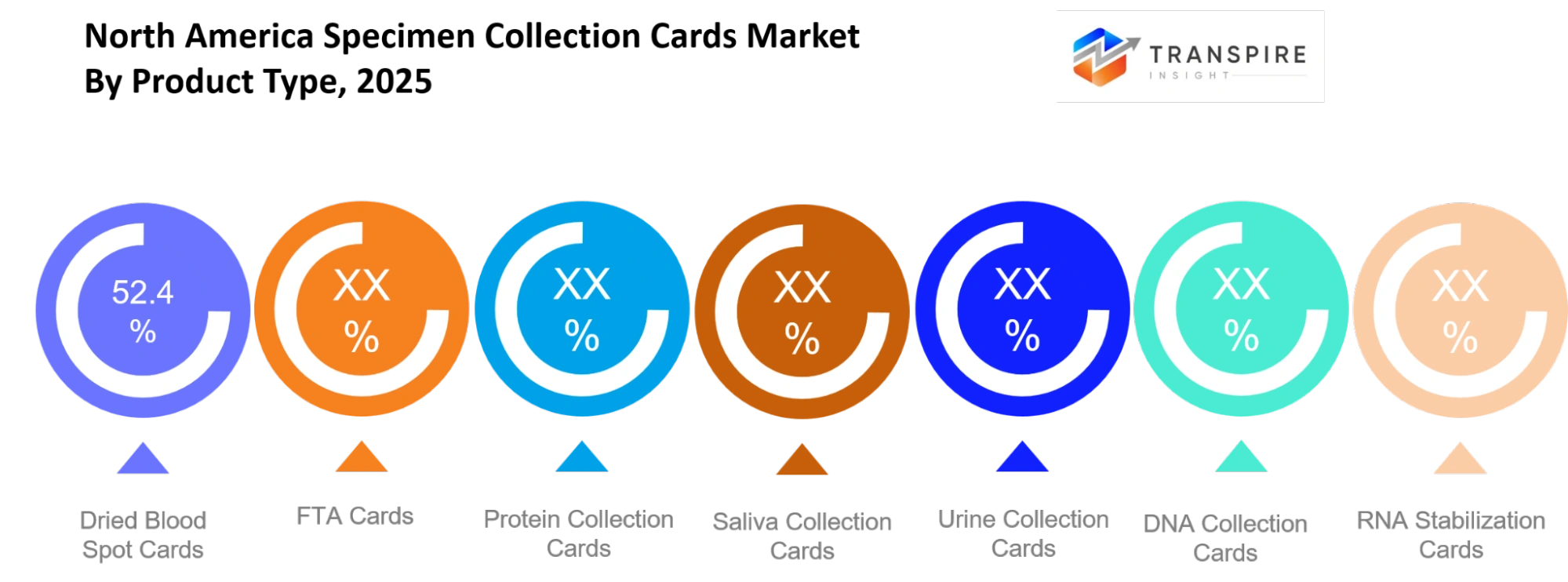
- For product types, dried blood spot (DBS) specimen collection cards feel like they dominate, with about 58% market share in 2025, mostly due to wide clinical use, plus newborn screening routines.
- DNA sample collection cards sit as the second-largest segment, since forensic laboratories, and population genomics efforts keep spreading across North America.
- RNA stabilization collection cards are set to show the fastest increase from 2025 to 2032, because molecular diagnostics keeps expanding, and infectious disease surveillance programs keep gaining momentum.
- On the application side, clinical diagnostics leads demand, with nearly 46% market share in 2025, showing the wider rollout of molecular testing across hospitals , and reference labs.
- Looking ahead, genomics and precision medicine research is expected to grow the fastest through 2032, supported by sequencing programs , and biomarker discovery investments.
- As for end users, hospitals and diagnostic laboratories contribute close to 54% of revenue in 2025, largely tied to routine diagnostic screening and more standardized sample handling processes.
- Finally, biopharmaceutical companies along with contract research organizations are expected to be the fastest-growing end-user group through 2032, riding on increased clinical trial workload and translational research.
What are the Key Drivers, Restraints, and Opportunities in the North America Specimen Collection Cards Market?
The strongest growth driver is the fast merging of molecular diagnostics into everyday care, not just specialized settings. With broader reimbursement for genomic testing, plus precision medicine programs and newborn screening, specimen collection has gotten pushed beyond centralized labs. Now, clinicians are looking for collection formats that keep nucleic acids stable during transport, without paying for pricey cold chain logistics. This change trims processing expenses, speeds up turnaround times a bit , and makes it easier to run more testing volume at the same time. And as lab networks keep standardizing their collection work instructions, suppliers usually see steady revenue from repeat replacement demand, along with longer procurement arrangements.
The main restraint is the way specialized raw materials and manufacturing know how are grouped in only a few places. High performance collection media depend on validated inputs, strict quality systems, and regulatory adherence that cannot be stood up overnight. Qualification cycles can easily stretch past 12 months, which delays commercialization and also makes supplier diversification harder. Based on a Transpire Insight read of regional procurement notices and product launch pacing , the concentration of the supply chain is still the leading execution risk. So what happens is slower launches, procurement pauses, and more limited revenue upside during times of supply disruption.
The biggest opportunity seems to be in gluing specimen collection cards into digital lab ecosystems and decentralized diagnostics, kind of like a seamless loop or something. AI supported laboratory information systems, automated sample tracking, and programs for collecting at home are expanding across North America, pretty fast. Money is going into population genomics, infectious disease monitoring, and remote clinical trials, so the conditions are pretty favorable for more advanced collection technologies. Firms that blend specimen preservation with digital traceability, plus automation compatibility will likely improve their competitive position and also win higher value procurement contracts in the coming years.
What Has the Impact of Artificial Intelligence Been on the North America Specimen Collection Cards Market?
Artificial intelligence and digital lab technologies are steadily improving how specimen collection cards kind of flow through diagnostic , and research workflows. With AI-enabled laboratory information management systems, sample identifiers get checked on their own, documentation inconsistencies are spotted, and chain-of-custody compliance gets monitored too , so that manual processing mistakes go down a lot. There is also automated image analysis that looks at specimen quality before lab handling , which means technicians can flag unsuitable samples earlier and avoid unnecessary steps.
Machine learning is getting used more and more to forecast how many specimens will show up, to tune inventory planning, and to anticipate lab capacity needs by using historical testing patterns. These forecasting models let manufacturers and healthcare providers line up production with expected diagnostic activity while still minimizing inventory gaps or shortages. At the same time, digital workflow optimization has boosted laboratory throughput, cut administrative effort, reinforced regulatory compliance, and lowered operating expenses. This happens largely because rejection rates drop and repeat collections become less common.
On the regional specimen collection cards side, cloud-based data integration is also helping , because it links collection sites with centralized laboratories and gives better visibility across distribution routes. Still, AI rollouts are somewhat held back by steep implementation costs and by fragmented healthcare data systems. A lot of labs rely on older information platforms, and those older systems make interoperability harder , which then reduces the reliability of predictive algorithms. Smaller healthcare facilities are limited by budget constraints as well , so widespread deployment moves slower even though the operational benefits are measurable.
Key Market Trends
- From 2021 thru 2025, molecular diagnostics kinda became the leading demand driver, and it started to swap out a lot of the more conventional specimen handling ways used for genomic testing.
- Programs for home-based specimen collection grew noticeably after 2020, so manufacturers started rolling out simpler collection card designs and more contamination-resistant materials, just to fit that new routine.
- Then during 2023–2025 the idea of automated lab processing compatibility really picked up, cutting down on manual touch time and also making test results more consistent, across different runs.
- In healthcare purchasing , buyers are leaning more toward products that have validated long-term nucleic acid stability, which basically pushes premium adoption higher in many large laboratories.
- Thermo Fisher Scientific kept expanding its integrated genomic workflow offerings, helping labs move faster through processing steps and manage digital sample information more smoothly.
- QIAGEN also put more money into molecular workflow solutions that work alongside standardized specimen collection, then connect into downstream nucleic acid analysis with fewer friction points.
- After 2022, clinical trial decentralization accelerated, and that increased the use of remote biological sample collection for multicenter research programs.
- At the same time, manufacturers are investing in sustainable specialty paper technologies , plus lower-plastic packaging options, because institutional procurement preferences have been changing.
- More regulatory focus on traceability , and on keeping samples intact, has encouraged broader use of barcode-enabled collection systems since 2023.
- And finally, strategic partnerships between diagnostics companies and healthcare providers keep getting stronger, which supports regional supply networks and speeds up commercialization for these more advanced collection technologies.
North America Specimen Collection Cards Market Segmentation
By Product Type :
You know dried blood spot cards do end up holding a leading position, mostly because labs really want dependable sample preservation, and then the whole thing stays easy for transportation, plus storage costs are usually lower, it just fits. FTA cards also stay pretty widely used for secure DNA preservation in forensic investigations and genetic studies where long-term sample stability matters quite a lot. Protein collection cards keep showing up in biomarker research too, especially as healthcare organizations start to expand disease surveillance and clinical studies, kind of steadily. Saliva collection cards are gaining broader acceptance because non-invasive sampling boosts patient comfort, and it can back large population screening programs without making people too stressed.
Urine collection cards support toxicology testing and infectious disease analysis, while also reducing transportation hassles that come with liquid specimens. DNA collection cards still maintain strong demand from precision medicine work, ancestry research, and molecular diagnostics, even when workflows get crowded. RNA stabilization cards are recording the fastest expansion, since advanced molecular testing really needs high quality RNA preservation for accurate results. And then other specialized products continue to cover more niche lab needs, with application specific collection and preservation features, so each setup has something more tailored.
By Material :
Cellulose card s are still the go-to choice, mainly because steady absorption, cost efficiency, and the fact labs are already used to them help keep routine diagnostic workflows moving. Filter paper card s keep showing up in newborn screening and public health testing , since having standardized collection methods is still kind of a big deal there. Chemically treated cards do a good job of improving sample stability, mostly by shielding nucleic acids, and also by lowering contamination during shipping and storage . Polymer cards are getting more attention for specialized diagnostic use, where better durability and stronger resistance to environmental factors matter more.
Synthetic fiber cards are rolling out bit by bit, as advanced lab procedures start asking for better material performance. Hybrid cards mix more than one material attribute, so specimen preservation stays steadier under different testing circumstances. Specialty cards are meant for very specific clinical and research needs, where ordinary materials just can’t meet the required performance. And other materials keep entering the market through product innovation , plus development that focuses more on specific applications.
By Application :
Clinical diagnostics are currently taking the biggest slice, mostly because healthcare providers keep extending molecular testing and routine disease spotting, over and over. Newborn screening is still a core use case, held up by long standing public health efforts and also uniform laboratory workflows. Genetic testing is climbing in a steady way as precision medicine programs broaden through hospitals and dedicated diagnostic centers. Forensic analysis also stays about the same in adoption, pushed by investigations from law enforcement, and by the gathering of judicial evidence for court work.
Infectious disease testing is helped a lot by quick sample transport, and by reliable specimen preservation so labs can confirm results. Biobanking backs longer term storage of biological specimens for later clinical work and for research use. Research applications are seeing solid expansion, since pharmaceutical development and academic programs both depend on dependable specimen collection. Other applications keep showing up, because lab technologies keep opening up extra testing pathways.
By End User :
Hospitals are a big end-user group, because routine patient testing really depends on steady specimen collection, and standardized handling workflows that don’t drift. Diagnostic labs keep a lot of market motion going via very high testing volumes, plus the growth of molecular diagnostic services. Academic research institutes help products get adopted by doing genomic research, biomarker examinations, and clinical investigations, kind of in parallel. Government labs add value through public health surveillance, disease tracking, and regulatory testing initiatives that stay consistent across regions.
Forensic laboratories rely on secure sample preservation for criminal investigations, and also for managing legal evidence. Contract research organizations can push adoption faster as decentralized clinical trials spread throughout North America. Biobanks keep long-term demand alive by storing biological samples for later scientific work, and even therapeutic development down the road. Other end users continue picking up specialized collection products based on changing lab needs.
By Distribution Channel :
Direct sales still feel like the leading distribution channel, mainly because manufacturers build long-term relationships with healthcare organizations and big laboratory networks. Lab distributors help expand the market by reaching out to regional labs and research institutions, plus they bring efficient logistics support with them, sort of in a predictable way. In hospitals, procurement departments go for standardized collection products through long-term agreements , so the availability stays consistent most of the time. And then government procurement backs public health goals , national screening programs, and also the needs of forensic laboratory operations.
At the same time online scientific suppliers are gaining more weight because they give quicker product access, a wider assortment to browse, and a simpler buying experience overall. Specialty dealers keep serving labs that want technical guidance, and they help with product choices that are more application-driven. There are also other distribution paths that support local supply needs , especially when conventional procurement models don’t offer enough adaptability. Competitive distribution strategies will likely keep getting better, which improves product accessibility across a mix of healthcare and research settings.
What are the Key Use Cases Driving the North America Specimen Collection Cards Market?
Clinical diagnostics are still the main use case, because hospitals and diagnostic laboratories really need dependable biological sample collection for molecular testing, and routine disease detection. Standardized specimen collection cards make transportation easier, help keep the sample integrity stable, and keep laboratory workflows kind of consistent, so bulk procurement stays economically practical.
Genetic testing, forensic analysis—these areas are still expanding across academic research institutes, contract research organizations, and also government labs. Precision medicine programs need dependable DNA preservation, while law enforcement agencies lean on secure sample storage that meets tight evidence handling rules and regulatory requirements.
Remote clinical trials and population-scale genomic surveillance look like the newer applications, with good long-term upside. Healthcare organizations and biobanks are now looking at more advanced collection formats that enable decentralized sample collection, broaden access for participants in far away locations, and simplify logistics for big research programs, even while regulations keep shifting over time.
|
Report Metrics |
Details |
|
Market size value in 2025 |
USD 186.3 Million |
|
Market size value in 2026 |
USD 196.5 Million |
|
Revenue forecast in 2033 |
USD 282.8 Million |
|
Growth rate |
CAGR of 5.34% from 2026 to 2033 |
|
Base year |
2025 |
|
Historical data |
2021 - 2024 |
|
Forecast period |
2026 - 2033 |
|
Report coverage |
Revenue forecast, competitive landscape, growth factors, and trends |
|
Regional scope |
North America (Canada, The United States, and Mexico) |
|
Key company profiled |
AbbVie, Johnson & Johnson, Pfizer, Amgen, Bristol Myers Squibb, Eli Lilly, Novartis, UCB Pharma, Roche, Sanofi, GSK, Biogen, Sandoz, Celltrion, Viatris . |
|
Customization scope |
Free report customization (country, regional & segment scope). Avail customized purchase options to meet your exact research needs. |
|
Report Segmentation |
By Product Type (Dried Blood Spot Cards, FTA Cards, Protein Collection Cards, Saliva Collection Cards, Urine Collection Cards, DNA Collection Cards, RNA Stabilization Cards, Others); By Material (Cellulose Cards, Filter Paper Cards, Chemically Treated Cards, Polymer Cards, Synthetic Fiber Cards, Hybrid Cards, Specialty Cards, Others); By Application (Newborn Screening, Genetic Testing, Forensic Analysis, Infectious Disease Testing, Biobanking, Clinical Diagnostics, Research Applications, Others); By End User (Hospitals, Diagnostic Laboratories, Academic Research Institutes, Government Laboratories, Forensic Laboratories, CROs, Biobanks, Others); By Distribution Channel (Direct Sales, Laboratory Distributors, Hospital Procurement, Government Procurement, Online Scientific Suppliers, Specialty Dealers, Others) |
Which Regions are Driving the North America Specimen Collection Cards Market Growth?
The United States roughly makes up 82% of regional revenue and stays the top, dominant market across North America, mostly because the regulatory picture is strong. For newborn screening, advanced molecular diagnostics, and broader public health testing there are solid frameworks that keep product adoption high across healthcare systems. There are also lots of lab networks, plus biotechnology companies, academic research centers, and specialist manufacturing sites, which helps the supply chain stay sturdy and makes products show up sooner. And there’s constant investment in precision medicine, genomic research, and diagnostic infrastructure, so the market leadership should keep going through the forecast period.
Canada is the next biggest region and it grows in a steady way, supported by ongoing healthcare funding and coordinated provincial lab networks. Since it is a public healthcare system, hospitals tend to follow standardized specimen collection routines, which improves testing quality and also operational efficiency at diagnostic facilities. Research funding stays fairly stable, and collaborations are expanding between universities, hospitals, and biotechnology organizations, so buying behavior remains dependable across the country. With long range planning and predictable procurement schedules, Canada becomes a reliable source for recurring revenue for manufacturers.
Mexico is set to show the quickest upturn between 2026 and 2033 , as investments in healthcare infrastructure and lab modernization programs keep ramping up . At the same time, wider access to molecular diagnostics, better infectious disease monitoring, and the ongoing expansion of clinical studies have boosted demand for consistent specimen collection solutions. On top of that, regulatory upgrades plus more funding directed toward healthcare services are still easing market entry for international manufacturers. Taken together, these shifts should open appealing opportunities for new entrants and investors , looking for durable growth across the broader regional healthcare space.
Who are the Key Players in the North America Specimen Collection Cards Market and How Do They Compete?
Competition is still kinda moderately consolidated, since only a limited group of specialized life science companies deliver advanced specimen collection technologies across North America. In practice, buyers seem to care about technology performance, regulatory compliance, product reliability, and how well everything fits lab workflow compatibility, more than price alone. The big established manufacturers keep pushing their product portfolios forward via research investment, while those more specialized suppliers lean into differentiated collection media and use-case focused solutions to snag new business opportunities.
Ahlstrom keeps improving its market position thanks to specialty fiber technologies that help with specimen preservation, and also help manufacturing consistency for diagnostic use. Cytiva keeps its focus on sample collection and preservation technologies, with the goal that they integrate smoothly with lab workflows, and also mesh well with molecular testing processes. QIAGEN, meanwhile, differentiates by using molecular biology expertise and solutions that back reliable downstream DNA and RNA analysis, and the ongoing product development keeps expanding laboratory adoption.
Thermo Fisher Scientific builds its competitive advantage by tying specimen collection products into wider genomic and diagnostic workflows, so labs can source multiple solutions from one supplier and not deal with too many different vendors. PerkinElmer expands newborn screening capabilities through product innovation, plus a close alignment with public health laboratory requirements. Merck KGaA puts money into life science manufacturing capacity and advanced research materials, which supports supply reliability, and in turn helps expand clinical and research applications across North America.
Company List
- AbbVie
- Johnson & Johnson
- Pfizer
- Amgen
- Bristol Myers Squibb
- Eli Lilly
- Novartis
- UCB Pharma
- Roche
- Sanofi
- GSK
- Biogen
- Sandoz
- Celltrion
- Viatris
Recent Development News
In April 2026, Ahlstrom announced that its material was selected to support a breakthrough dried urine test for chlamydia and gonorrhea. The development expands the use of advanced specimen collection materials in molecular diagnostics and strengthens opportunities for decentralized testing. Source https://www.ahlstrom.com/
In October 2025, Ahlstrom acquired EBF (Eastern Business Forms) to expand its life science capabilities in specimen collection cards. The acquisition added expertise in newborn screening diagnostic cards and strengthened manufacturing, converting, and customized packaging capabilities for biological sample collection products.
Sourcehttps://www.ahlstrom.com/
What Strategic Insights Define the Future of the North America Specimen Collection Cards Market?
In the next five to seven years , the market is likely to drift toward integrated specimen collection platforms, meant to back decentralized diagnostics, precision medicine, and those digitally connected lab networks. This trend will be pulled forward by more widespread use of molecular testing and by the constant need for standardized sample collection that behaves the same across clinical environments , research workflows, and public health programs. There’s also a quieter risk, kind of indirect , tied to relying on only a handful of highly specialized material suppliers, because that sort of dependence can trigger supply disruptions and pricing pressure , even if testing volumes stay strong.
At the same time an emerging opening should show up via home based genomic testing and remote clinical research efforts, both of which depend on validated collection formats for direct to laboratory processing. Firms that move early toward automation-friendly products, diversified sourcing for key materials, and manufacturing that’s ready for regulatory scrutiny will likely improve long-term competitiveness. They’ll also get better resilience when it comes to future supply issues and compliance headaches.
North America Specimen Collection Cards Market Report Segmentation
By Product Type
- Dried Blood Spot Cards
- FTA Cards
- Protein Collection Cards
- Saliva Collection Cards
- Urine Collection Cards
- DNA Collection Cards
- RNA Stabilization Cards
By Material
- Cellulose Cards
- Filter Paper Cards
- Chemically Treated Cards
- Polymer Cards
- Synthetic Fiber Cards
- Hybrid Cards
- Specialty Cards
By Application
- Newborn Screening
- Genetic Testing
- Forensic Analysis
- Infectious Disease Testing
- Biobanking
- Clinical Diagnostics
- Research Applications
By End User
- Hospitals
- Diagnostic Laboratories
- Academic Research Institutes
- Government Laboratories
- Forensic Laboratories
- CROs
- Biobanks
By Distribution Channel
- Direct Sales
- Laboratory Distributors
- Hospital Procurement
- Government Procurement
- Online Scientific Suppliers
- Specialty Dealers
Frequently Asked Questions
Find quick answers to common questions.
The expected North America Specimen Collection Cards Market size for the market will be USD 282.8 Million in 2033.
Key segments for the North America Specimen Collection Cards Market are By Product Type (Dried Blood Spot Cards, FTA Cards, Protein Collection Cards, Saliva Collection Cards, Urine Collection Cards, DNA Collection Cards, RNA Stabilization Cards, Others); By Material (Cellulose Cards, Filter Paper Cards, Chemically Treated Cards, Polymer Cards, Synthetic Fiber Cards, Hybrid Cards, Specialty Cards, Others); By Application (Newborn Screening, Genetic Testing, Forensic Analysis, Infectious Disease Testing, Biobanking, Clinical Diagnostics, Research Applications, Others); By End User (Hospitals, Diagnostic Laboratories, Academic Research Institutes, Government Laboratories, Forensic Laboratories, CROs, Biobanks, Others); By Distribution Channel (Direct Sales, Laboratory Distributors, Hospital Procurement, Government Procurement, Online Scientific Suppliers, Specialty Dealers, Others).
Major North America Specimen Collection Cards Market players are AbbVie, Johnson & Johnson, Pfizer, Amgen, Bristol Myers Squibb, Eli Lilly, Novartis, UCB Pharma, Roche, Sanofi, GSK, Biogen, Sandoz, Celltrion, Viatris.
The North America Specimen Collection Cards Market size is USD 186.3 Million in 2025.
The North America Specimen Collection Cards Market CAGR is 5.34% from 2026 to 2033.
- AbbVie
- Johnson & Johnson
- Pfizer
- Amgen
- Bristol Myers Squibb
- Eli Lilly
- Novartis
- UCB Pharma
- Roche
- Sanofi
- GSK
- Biogen
- Sandoz
- Celltrion
- Viatris
About the Authors

Pankaj Ghogare Patil
I am Pankaj Ghogare Patil, a Senior Research Analyst at Transpire Insight, specializing in the Pharmaceutical, Chemicals & Materials, Healthcare IT, and Biotechnology industry. My expertise lies in conducting comprehensive market research, analyzing industry trends, evaluating competitive landscapes, and translating complex data into actionable insights. At Transpire Insight, I closely follow emerging technologies, regulatory developments, and market innovations to create accurate, well-researched, and informative content that helps businesses and professionals make informed decisions. I am committed to producing credible, evidence-based articles that reflect industry best practices while making technical topics accessible and valuable for a broad audience.

Chakradhar Khansole
Chakradhar serves as the Research Director at Transpire Insight, bringing over 8 years of experience in technology, innovation, and strategic market intelligence. He specializes in transforming complex market data into actionable business insights that enable organizations to make informed, growth-oriented decisions. Recognized for his strategic vision and analytical expertise, Chakradhar leads high-impact research initiatives, delivering comprehensive market assessments, competitive intelligence, and forward-looking industry analysis.
Recently Published Reports
-
Apr 2026
AI in Diabetic Retinopathy Market
AI in Diabetic Retinopathy Market Size, Share & Analysis Report By Type (Screening AI Systems, Diagnostic AI Systems, and Predictive AI Models), By Application Segment (Hospitals, Ophthalmology Clinics, Diagnostic Centers, and Research and Development), and Geography (North America, Europe, Asia-Pacific, Middle East and Africa, South and Central America), 2021 - 2031
-
Apr 2026
Psychometric Tests Market
Psychometric Tests Market Size, Share & Analysis Report By Type (Personality Tests, Ability/Aptitude Tests, Skill/Knowledge Tests, and Others), By Application (Talent Acquisition and Talent Management), and Geography (North America, Europe, Asia-Pacific, Middle East and Africa, South and Central America), 2021 – 2031
-
Apr 2026
Rare Biological Sample Collection Market
Rare Biological Sample Collection Market Size, Share & Analysis Report By Type (Isolation Kits & Reagent, Blood Collection Tubes, and Others), By Application (Oncology, Transcriptomics, Pharmacogenomics, and Others), and Geography (North America, Europe, Asia-Pacific, Middle East and Africa, South and Central America), 2021 – 2031
-
Jul 2026
Diabetic Retinopathy Market
Diabetic Retinopathy Market Size, Share & Analysis Report By Type (Proliferative Diabetic Retinopathy, and Diabetic Macular Edema (DME)), By Treatment Type (Anti VEGF Drug, Steroid Implants, Laser Surgeries, and Vitrectomy), and Geography (North America, Europe, Asia-Pacific, Middle East and Africa, South and Central America), 2021 – 2031
Our Clients







