
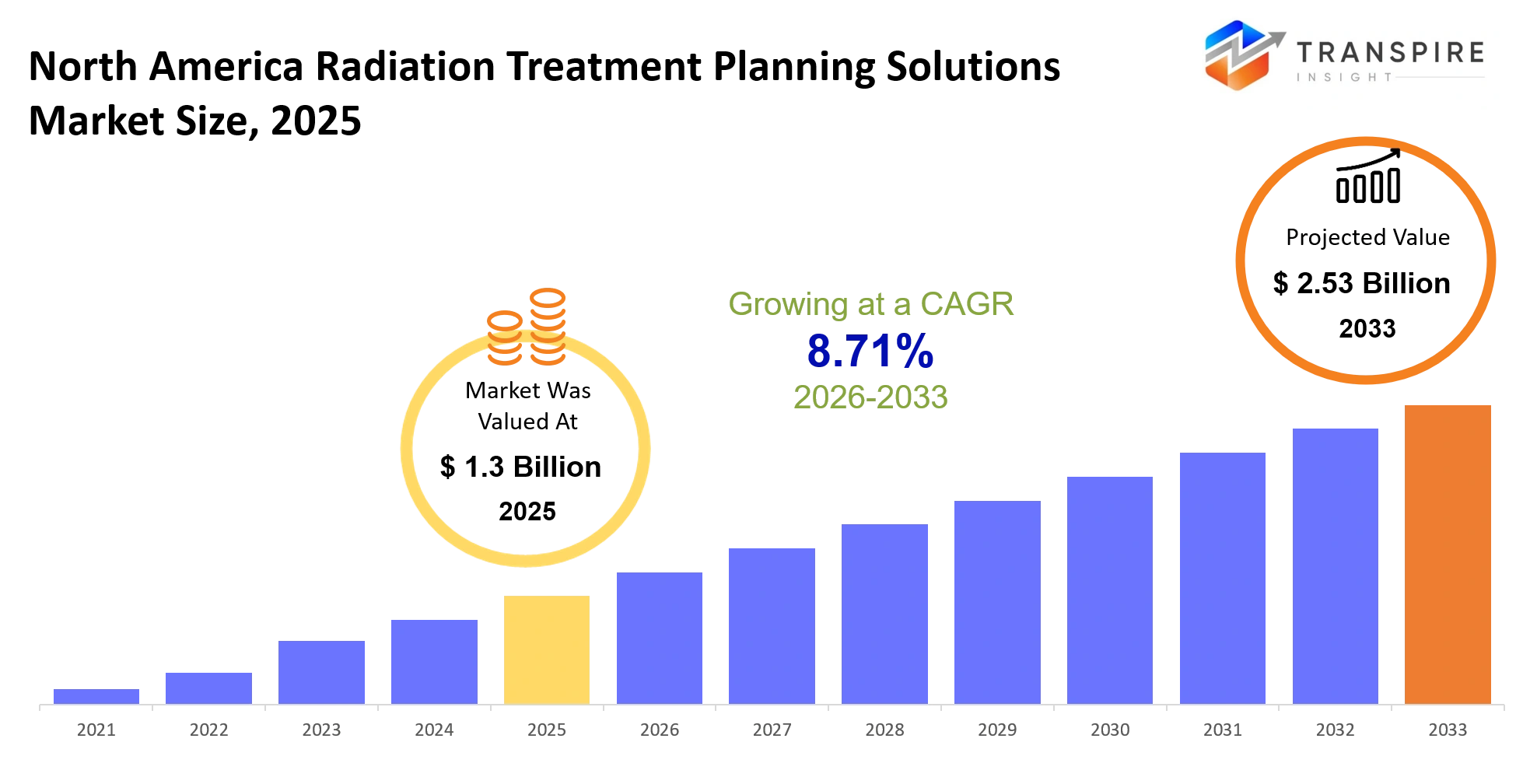
North America Radiation Treatment Planning Solutions Market Size & Forecast:
- North America Radiation Treatment Planning Solutions Market Size 2025: USD 1.3 Billion
- North America Radiation Treatment Planning Solutions Market Size 2033: USD 2.53 Billion
- North America Radiation Treatment Planning Solutions Market CAGR: 8.71%
- North America Radiation Treatment Planning Solutions Market Segments: By Product Type (Treatment Planning Software, Imaging Systems, Dose Calculation Systems, AI-based Planning Solutions, Others); By Application (External Beam Radiation Therapy, Brachytherapy, Proton Therapy, Stereotactic Radiotherapy, Others); By End User (Hospitals, Cancer Treatment Centers, Research Institutes, Others); By Technology (Cloud-based Solutions, AI-enabled Systems, On-premise Solutions, Others).
To learn more about this report,  Download Free Sample Report
North America Radiation Treatment Planning Solutions Market Summary
The North America Radiation Treatment Planning Solutions Market was valued at USD 1.3 Billion in 2025. It is forecast to reach USD 2.53 Billion by 2033. That is a CAGR of 8.71% over the period.
In North America, radiation treatment planning solutions are sort of the digital backbone, of radiotherapy workflows, where oncology teams can designand then revise radiation dose plans meant for tumors while also sparing nearby normal tissue. Over the past three to five years, the market has moved away from mostly manual planning that lived on stand-alone workstations, and it has leaned more toward AI-assisted, cloud-enabled platforms. these platforms tie imaging together with oncology records, and they add adaptive treatment capabilities that can respond during the care journey. A real world nudge showed up after the pandemic with the screening backlog, lots of missed appointments and delayed diagnoses. that, in turn, lifted the portion of complicated late-stage cases coming into treatment centers. In parallel, there have been shortages of medical physicists, and patient volumes kept climbing, so hospitals started automating the planning steps and trying to compress turnaround times. so providers are now putting money into software aimed at better planning efficiency and more consistent outputs. that operational pressure, ends up feeding steady demand, and it tends to raise the overall value per treatment cycle.
Key Market Insights
- United States kind of dominates the North America Radiation Treatment Planning Solutions Market, with around 70–75% share, mostly because of strong oncology infrastructure and huge treatment volumes.
- Meanwhile, Canada is showing a steady climb, mainly from higher cancer care investments and public healthcare modernization, running out through 2030.
- In the US, the urban oncology hubs are pushing faster uptake of cloud-based planning, and that helps the regional market stay heavily concentrated.
- Software solutions are leading this North America market, taking more than 55% share, and that’s tied to AI-enabled dose optimization tools.
- The services side sits in the second spot, with a meaningful share, because hospitals rely on implementation, training, and clinical workflow integration support.
- Also, cloud-based and AI-powered planning platforms are moving the quickest, they’re expected to expand a lot during the 2024–2030 forecast window.
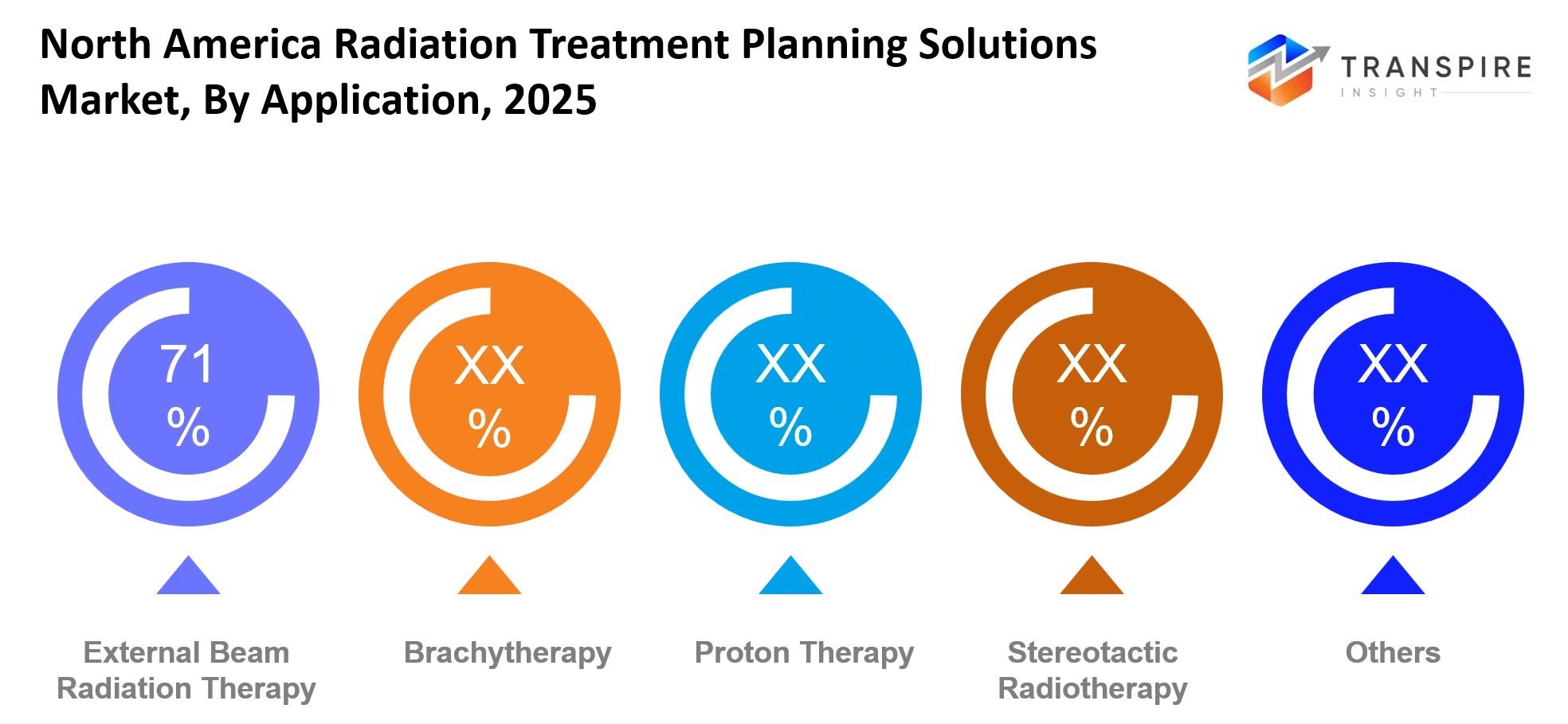
- External beam radiation therapy keeps the top position, about nearly 60% share across North America.
- Proton therapy planning is the fastest-growing application, helped along by the rising need for precision oncology and new facility setups.
- Adaptive radiotherapy planning is slowly gaining interest too, as clinicians start leaning more toward real-time treatment adjustments, for tighter targeting.
- Hospitals lead end-user adoption with roughly 65% share, largely due to integrated oncology departments and consistent patient inflow.
What are the Key Drivers, Restraints, and Opportunities in the North America Radiation Treatment Planning Solutions Market?
The main driver is that AI-enabled and image-driven treatment planning systems are being integrated pretty fast, across oncology departments. You can kind of trace it to rising patient complexity plus staffing constraints in radiation oncology, where fewer medical physicists are now handling greater case loads. So naturally, hospitals start putting money into automated contouring, dose optimization, and adaptive planning tools that cut down planning time a lot, and also help treatment precision. All of this pushes software licensing revenue up, and it makes upgrade cycles happen sooner, especially in bigger hospital networks and major cancer centers.
The most persistent restraint is the complicated implementation effort, and also the interoperability burden tied to older hospital IT infrastructure. A lot of oncology systems still lean on fragmented imaging EHR, and treatment platforms that do not really connect smoothly with newer planning software. This gap in the structure ends up meaning expensive customization and long deployment timelines, which then delays adoption, and slows down near-term revenue capture for vendors across the North America Radiation Treatment Planning Solutions Market.
A strong opportunity sits in cloud-based oncology ecosystems that also support real-time adaptive radiotherapy. For instance, integrated cloud platforms that are being piloted in big US cancer centers allow remote planning collaboration and ongoing model updates. That opens up scalability, extends access for mid-sized hospitals, and helps position vendors toward recurring subscription revenue growth.
What Has the Impact of Artificial Intelligence Been on the North America Radiation Treatment Planning Solutions Market?
Artificial intelligence is, kinda reshaping radiation treatment planning across North America, by taking what used to be pretty manual oncology workflows and turning them into automated, data-driven decision systems. In current planning platforms, AI helps with image segmentation, contouring of tumors and organs at-risk, plus dose optimization. As a result clinicians spend less time on repeated manual fiddling and more on meaningful review. These automation layers also support steadier outcomes between different scrubber performance systems in oncology planning environments, in particular at high volume cancer centers, where turnaround time really steers treatment scheduling.
On top of that, machine learning adds predictive features that keep refining treatment accuracy over time. Models trained using historical patient datasets can forecast dose distribution outcomes, flag likely plan rework, and even help tune machine calibration schedules so system downtime stays lower. In top hospitals, predictive tools have been associated with clear decreases in planning cycle time, frequently lowering manual review iterations by double digit percentages, and boosting operational throughput across radiation therapy units.
Still, adoption is held back by a recurring snag: data standardization and integration are complicated, especially across multi vendor hospital ecosystems. A lot of AI approaches need harmonized imaging and treatment datasets, but older oncology infrastructure often lacks interoperability and consistent labeling, so model accuracy can drop in real clinical practice. Even so, ongoing spending in cloud-enabled platforms and federated learning models is slowly improving scalability and overall performance across the North America Radiation Treatment Planning Solutions Market.
Key Market Trends
- Radiation planning workflows kinda shifted after 2022, from stand alone systems to more integrated oncology platforms, bringing imaging together with EHR and those treatment optimization tools too, you know.
- AI auto-contouring adoption jumped a lot post 2021, cutting manual segmentation time in major US cancer centers by close to 40%.
- Cloud deployment rose sharply after the pandemic era remote care expansion, and hospitals started prioritizing scalable multi site access models for radiation planning.
- Vendor competition heated up, as Varian Medical Systems and Elekta expanded their AI enabled planning ecosystems across North American oncology networks.
- Proton therapy planning demand has been climbing since around 2020, pushed by precision oncology investments and new facility approvals in the United States.
- Interoperability standards improved slowly after 2023, because hospitals kept pushing vendors to connect radiation planning with unified digital health records.
- Subscription based licensing models replaced the older perpetual software sales style in many institutions, so vendor revenue recognition also changed in response.
- Federated learning approaches showed up more recently, aiming to handle data privacy concerns while still improving model training across distributed hospital datasets.
North America Radiation Treatment Planning Solutions Market Segmentation
By Product Type
Treatment planning software, i guess holds the strongest position in the North America Radiation Treatment Planning Solutions Market, taking the biggest slice because it sits right in the middle of dose optimization and workflow coordination across oncology departments. Hospitals, in practice really favor it because it impacts treatment accuracy, plus scheduling efficiency. This matters a lot in high volume cancer centers where planning has to happen fast, and any delay can be a serious issue. Imaging systems come next, and their momentum is being nudged by deeper integration with MRI, CT and PET modalities, which support sharper tumor visualization and planning precision.
Dose calculation systems, along with AI based planning solutions, are starting to pick up speed as clinical teams move closer to automation plus predictive modeling. AI based tools are growing faster than more traditional groupings, mostly because they lower the manual contouring workload and help keep treatment plans more uniform from case to case. This part is getting traction from the need for briefer planning cycles, and also for less clinician burden. Over the forecast window, AI driven platforms are expected to nudge procurement decisions, so vendors feel pressure to bake machine learning abilities into the main planning architecture.
By Application
External beam radiation therapy stays in front in terms of application demand, since it is used widely across most cancer types, and it also has well established reimbursement arrangements. This segment keeps the leading share because hospitals lean on external beam systems for scalable and standardized delivery. Stereotactic radiotherapy is also rising, because precision oncology is gaining momentum, especially for difficult or complex tumor cases where targeting accuracy is critical.
Proton therapy and brachytherapy are kinda faster-growing uses, you know, pushed along by more and more investment into very precisely targeted radiation approaches. Proton therapy in US cancer centers seems to be rising because there’s a stronger preference for less collateral tissue injury in pediatric and neurological cases. Over time, the application pull should move toward even higher-precision modalities, and that will nudge vendors to build adaptive planning systems that can handle multiple therapy types, all inside one unified platform, or at least that’s the idea.
To learn more about this report, Download Free Sample Report
By End User
Hospitals are still the main end user group in the North America Radiation Treatment Planning Solutions Market, mostly because they handle big patient numbers and they also have oncology departments already in place. Centralized buying processes and existing radiotherapy infrastructure make hospitals the first adopters of these advanced planning tools. Cancer treatment centers are right behind them, helped by their oncology specialization and the quicker uptake of the newer planning technologies.
Research institutes are smaller, but kind of strategically essential, because they’re tied to clinical trials and the building of new treatment models. These organizations also tend to adopt AI-enabled planning sooner, along with experimental radiotherapy methods. During the forecast period, cancer treatment centers should grow the fastest, particularly as outpatient oncology programs expand. That growth pressure is likely to push vendors toward offering scalable, cloud-based planning platforms, designed for clinical networks that are distributed across locations.
By Technology
On-premise solutions are still holding a strong place mainly because of the legacy hospital IT environment and very strict data governance expectations across healthcare networks. A lot of oncology departments keep leaning on localized systems too mostly due to regulatory compliance and the usual worry about patient data security. Still, cloud-based solutions are picking up speed, because providers want a more scalable planning environment that’s also easy to access remotely, without the usual friction.
Meanwhile, AI-enabled systems are becoming the fastest-growing tech category, largely pulled by the need for automation in contouring, dose calculation, and even adaptive radiotherapy planning. In practice, these tools boost planning efficiency and lighten clinician workload, which really matters in understaffed oncology units. Through the forecast period, hybrid architectures that blend cloud deployment with AI integration, are likely to reshape adoption behavior. As a result, vendors may move toward subscription-based models plus continuous software updates, rather than relying only on traditional release cycles.
What are the Key Use Cases Driving the North America Radiation Treatment Planning Solutions Market?
External beam radiation therapy planning keeps being the main, dominant use case in the North America Radiation Treatment Planning Solutions Market, it really supports most of the cancer treatments that get delivered across hospitals and big oncology networks . This use case keeps pushing demand, mainly because clinicians need super precise dose mapping for all kinds of tumor types, and the planning software itself ends up affecting treatment accuracy directly and also patient throughput when radiation departments are running nonstop
At the same time, stereotactic radiotherapy planning and proton therapy planning are growing fast, especially inside specialized cancer treatment centers and upgraded hospital oncology units. In these settings the use cases demand even higher precision and better adaptive imaging integration, so providers are more and more leaning on advanced software that can handle multi-modality treatment workflows plus real-time dose recalibration, which sounds fancy but is basically the day to day need when things have to stay on track
On the emerging side adaptive radiotherapy planning and AI-guided re-planning during treatment cycles are starting to get more attention . They’re being tested often in research institutes and in some leading US cancer centers. These applications depend on ongoing imaging refreshes and predictive modeling, and the early signs look promising because it could improve response-based treatment customization across the forecast period.
|
Report Metrics |
Details |
|
Market size value in 2025 |
USD 1.3 Billion |
|
Market size value in 2026 |
USD 1.41 Billion |
|
Revenue forecast in 2033 |
USD 2.53 Billion |
|
Growth rate |
CAGR of 8.71% from 2026 to 2033 |
|
Base year |
2025 |
|
Historical data |
2021 - 2024 |
|
Forecast period |
2026 - 2033 |
|
Report coverage |
Revenue forecast, competitive landscape, growth factors, and trends |
|
Regional scope |
North America (Canada, The United States, and Mexico) |
|
Key company profiled |
Varian Medical Systems, Elekta, RaySearch Laboratories, Accuray, Brainlab, Siemens Healthineers, GE HealthCare, Philips Healthcare, Canon Medical Systems, Mirada Medical, MIM Software, IBA Dosimetry, ViewRay, Standard Imaging, Sun Nuclear. |
|
Customization scope |
Free report customization (country, regional & segment scope). Avail customized purchase options to meet your exact research needs. |
|
Report Segmentation |
By Product Type (Treatment Planning Software, Imaging Systems, Dose Calculation Systems, AI-based Planning Solutions, Others); By Application (External Beam Radiation Therapy, Brachytherapy, Proton Therapy, Stereotactic Radiotherapy, Others); By End User (Hospitals, Cancer Treatment Centers, Research Institutes, Others); By Technology (Cloud-based Solutions, AI-enabled Systems, On-premise Solutions, Others). |
Which Regions are Driving the North America Radiation Treatment Planning Solutions Market Growth?
North America leads the radiation treatment planning solutions market, with the United States pulling most of the adoption, because it has advanced oncology infrastructure and solid regulatory backing for precision medicine. A lot of large hospital networks, and specialized cancer centers keep putting money into AI-enabled planning platformsas they try to handle rising cancer incidence and more complicated treatment protocols. Also, strong reimbursement frameworks, plus early FDA clearance routes, help speed up technology adoption. There’s a mature ecosystem too—vendors, academic medical centers, and integrated health systems—that keeps demand steady and makes clinical integration of advanced planning tools feel more routine, and faster.
Canada is a fairly stable secondary contributor, and it is helped by universal healthcare coverage, and long-term public funding aimed at oncology modernization. Different from the US, growth there is more guided by centralized procurement rules, and standardized national cancer care programs, rather than private-sector competition. Provincial health authorities keep upgrading radiotherapy infrastructure, with an emphasis on equitable access across urban, and semi-urban regions. That kind of structured rollout, tends to create predictable demand cycles, and it supports consistent adoption of updated treatment planning systems across public hospitals.
Mexico is the fastest growing regional market, mainly due to new investments in oncology infrastructure, and a larger role for private healthcare participation. Government-backed hospital modernization initiatives, along with medical tourism inflows, have helped accelerate the installation of advanced radiotherapy systems in major cities. Plus, international partnerships with global equipment vendors improve access to cloud-based planning technologies, too. Over the 2026–2033 period, this trajectory suggests strong market entry opportunities, and a wider set of deployment chances for planning platforms.
Who are the Key Players in the North America Radiation Treatment Planning Solutions Market and How Do They Compete?
Competition in the North America radiation treatment planning solutions market is kinda moderately consolidated, like there are a few big names that run the main clinical workflows while smaller, specialized software firms handle more niche planning needs. The established players keep defending their share through integrated oncology ecosystems, but disruption still shows up, often from cloud-native AI entrants. In practice, competition is mostly about algorithm accuracy, workflow speed and how well the platforms work with hospital imaging pipelines plus electronic health record systems, without turning into a mess.
Varian Medical Systems seems to strengthen its position by leaning into end-to-end radiotherapy integration. They embed planning software straight into treatment delivery systems, so hospitals get a kind of long-term dependence, intentionally or not. Elekta pushes adaptive radiotherapy capabilities and MR-guided workflows, and they keep expanding via partnerships with cancer centers that are upgrading precision oncology infrastructure. RaySearch Laboratories differentiates with a vendor-neutral software architecture which supports multi-platform compatibility. That tends to appeal to hospitals trying to avoid single-system lock-in and also to research institutions that care about algorithm flexibility.
Accuray Incorporated holds a more specific leadership position in stereotactic radiotherapy, mainly through CyberKnife systems. They target outpatient cancer centers where high-precision results and non-invasive delivery matter a lot. Brainlab centers on imaging-driven navigation and tight planning integration, linking surgical and radiotherapy workflows so cross-department coordination is smoother. Overall, both companies broaden their reach through clinical partnerships and ongoing software upgrades, aiming to boost workflow connectivity and treatment precision across complicated oncology environments, even when the setups are not simple.
Company List
- Varian Medical Systems
- Elekta
- RaySearch Laboratories
- Accuray
- Brainlab, Siemens Healthineers
- GE HealthCare
- Philips Healthcare
- Canon Medical Systems
- Mirada Medical
- MIM Software
- IBA Dosimetry
- ViewRay
- Standard Imaging
- Sun Nuclear
Recent Development News
“In May 2026, RaySearch Laboratories announced completion of the first online adaptive radiation treatment using RayStation and RayCare integrated with a Varian TrueBeam system at Iridium Network. This milestone demonstrates clinically deployed AI-driven adaptive treatment planning on widely used linear accelerators, strengthening demand for vendor-neutral planning software in North America and beyond.”
Source: https://www.raysearchlabs.com
What Strategic Insights Define the Future of the North America Radiation Treatment Planning Solutions Market?
The North America Radiation Treatment Planning Solutions Market is kind of moving, in a structural way, toward an AI-first, cloud-native oncology ecosystem where planning, imaging and treatment delivery basically work as one unified digital workflow. This change is being pushed by ongoing oncology workforce shortages and treatment complexity that keeps increasing, so providers are leaning more on automation and adaptive decision support instead of manual planning methods. Over the next 5 to 7 years, revenue growth will more and more pile up in subscription based platforms that support continuous model learning and also cross site clinical collaboration.
There’s also a less obvious hazard, not talked about as much, which is overreliance on proprietary AI models that get embedded inside a relatively small set of integrated vendor ecosystems. As hospitals consolidate their technology stacks, you could see competitive concentration, and that might actually reduce interoperability while also lowering bargaining power. In turn, buyers may end up with long-term switching costs and innovation bottlenecks. So even if the headline numbers look strong, this kind of structural dependency may still slow down multi-vendor innovation cycles.
Meanwhile, an emerging chance is federated learning based treatment optimization networks, where hospitals train shared AI models without trading patient level data. This idea is starting to gain momentum in larger US cancer research consortia, and it could help unlock scalable precision enhancements. Market players should consider open architecture platforms and put effort into interoperability standards, so they can avoid lock-in while still capturing the next wave of collaborative, data-driven oncology planning systems.
North America Radiation Treatment Planning Solutions Market Report Segmentation
By Product Type
- Treatment Planning Software
- Imaging Systems
- Dose Calculation Systems
- AI-based Planning Solutions
- Others
By Application
- External Beam Radiation Therapy
- Brachytherapy
- Proton Therapy
- Stereotactic Radiotherapy
- Others
By End User
- Hospitals
- Cancer Treatment Centers
- Research Institutes
- Others
By Technology
- Cloud-based Solutions
- AI-enabled Systems
- On-premise Solutions
- Others
Frequently Asked Questions
Find quick answers to common questions.
The expected North America Radiation Treatment Planning Solutions Market size is USD 2.53 Billion in 2033.
Key segments for the North America Radiation Treatment Planning Solutions Market are By Product Type (Treatment Planning Software, Imaging Systems, Dose Calculation Systems, AI-based Planning Solutions, Others); By Application (External Beam Radiation Therapy, Brachytherapy, Proton Therapy, Stereotactic Radiotherapy, Others); By End User (Hospitals, Cancer Treatment Centers, Research Institutes, Others); By Technology (Cloud-based Solutions, AI-enabled Systems, On-premise Solutions, Others).
Major North America Radiation Treatment Planning Solutions Market players are Varian, Medical, Systems, Elekta, RaySearch, Laboratories, Accuray, Brainlab, Siemens Healthineers, GE HealthCare, Philips Healthcare, Canon Medical Systems, Mirada Medical, MIM Software, IBA Dosimetry, ViewRay, Standard Imaging, Sun Nuclear.
The North America Radiation Treatment Planning Solutions Market size is USD 1.3 Billion in 2025.
The North America Radiation Treatment Planning Solutions Market CAGR is 8.71% from 2026 to 2033.
- Varian Medical Systems
- Elekta
- RaySearch Laboratories
- Accuray
- Brainlab, Siemens Healthineers
- GE HealthCare
- Philips Healthcare
- Canon Medical Systems
- Mirada Medical
- MIM Software
- IBA Dosimetry
- ViewRay
- Standard Imaging
- Sun Nuclear
About the Authors

Pankaj Ghogare Patil
I am Pankaj Ghogare Patil, a Senior Research Analyst at Transpire Insight, specializing in the Pharmaceutical, Chemicals & Materials, Healthcare IT, and Biotechnology industry. My expertise lies in conducting comprehensive market research, analyzing industry trends, evaluating competitive landscapes, and translating complex data into actionable insights. At Transpire Insight, I closely follow emerging technologies, regulatory developments, and market innovations to create accurate, well-researched, and informative content that helps businesses and professionals make informed decisions. I am committed to producing credible, evidence-based articles that reflect industry best practices while making technical topics accessible and valuable for a broad audience.

Chakradhar Khansole
Chakradhar serves as the Research Director at Transpire Insight, bringing over 8 years of experience in technology, innovation, and strategic market intelligence. He specializes in transforming complex market data into actionable business insights that enable organizations to make informed, growth-oriented decisions. Recognized for his strategic vision and analytical expertise, Chakradhar leads high-impact research initiatives, delivering comprehensive market assessments, competitive intelligence, and forward-looking industry analysis.
Recently Published Reports
-
Apr 2026
AI in Diabetic Retinopathy Market
AI in Diabetic Retinopathy Market Size, Share & Analysis Report By Type (Screening AI Systems, Diagnostic AI Systems, and Predictive AI Models), By Application Segment (Hospitals, Ophthalmology Clinics, Diagnostic Centers, and Research and Development), and Geography (North America, Europe, Asia-Pacific, Middle East and Africa, South and Central America), 2021 - 2031
-
Apr 2026
Psychometric Tests Market
Psychometric Tests Market Size, Share & Analysis Report By Type (Personality Tests, Ability/Aptitude Tests, Skill/Knowledge Tests, and Others), By Application (Talent Acquisition and Talent Management), and Geography (North America, Europe, Asia-Pacific, Middle East and Africa, South and Central America), 2021 – 2031
-
Apr 2026
Rare Biological Sample Collection Market
Rare Biological Sample Collection Market Size, Share & Analysis Report By Type (Isolation Kits & Reagent, Blood Collection Tubes, and Others), By Application (Oncology, Transcriptomics, Pharmacogenomics, and Others), and Geography (North America, Europe, Asia-Pacific, Middle East and Africa, South and Central America), 2021 – 2031
-
Jul 2026
Diabetic Retinopathy Market
Diabetic Retinopathy Market Size, Share & Analysis Report By Type (Proliferative Diabetic Retinopathy, and Diabetic Macular Edema (DME)), By Treatment Type (Anti VEGF Drug, Steroid Implants, Laser Surgeries, and Vitrectomy), and Geography (North America, Europe, Asia-Pacific, Middle East and Africa, South and Central America), 2021 – 2031
Our Clients







