

North America Personalized Testing and Supplements Market Summary
As per Transpire Insight Analysis the North America Personalized Testing and Supplements Market size is estimated at USD 7.6 Billion in 2025 and is anticipated to reach USD 28.8 Billion by 2033, growing at a CAGR of 18.27% from 2026 to 2033.
The North America Personalized Testing and Supplements Market, sort of helps people get past those usual generalized wellness plans by mixing biomarker testing with genetic insights, microbiome analysis, plus lifestyle data, to map out nutrition and supplement strategies that fit real health needs not just broad “same for everyone” advice. With that, it’s easier to manage health more precisely, and also it gives healthcare providers ,and wellness companies a way to roll out targeted interventions instead of the standardized stuff you see on shelves. Over the last three to five years, the space seems to move from mainly consumer led wellness options toward something more clinically informed and data driven, with help from digital health platforms and connected diagnostics. The COVID-19 pandemic, honestly sped it up a lot, making remote health monitoring more normal, pushing at-home testing, and boosting telehealth services. As the testing tools became more reachable and data integration got better, companies also started having stronger proof to customize supplement recommendations, which helps trust go up. Then you see more repeat buying, plus steadier recurring revenue from subscription based testing and ongoing nutrition programs.
North America Personalized Testing and Supplements Market Size & Forecast:
- North America Personalized Testing and Supplements Market Size 2025: USD 7.6 Billion
- Expected Market Value 2033: USD 28.8 Billion
- Forecast CAGR: 18.27%
- Leading region in 2025: United States
- Fastest Growing region: Canada
- Key Profile: Viome, Thorne HealthTech, Persona Nutrition, Bioniq, Rootine, Care/of, Nestlé Health Science, Herbalife, Amway, DNAfit, 23andMe, GenoPalate, Everlywell, InsideTracker, Nutrigenomix
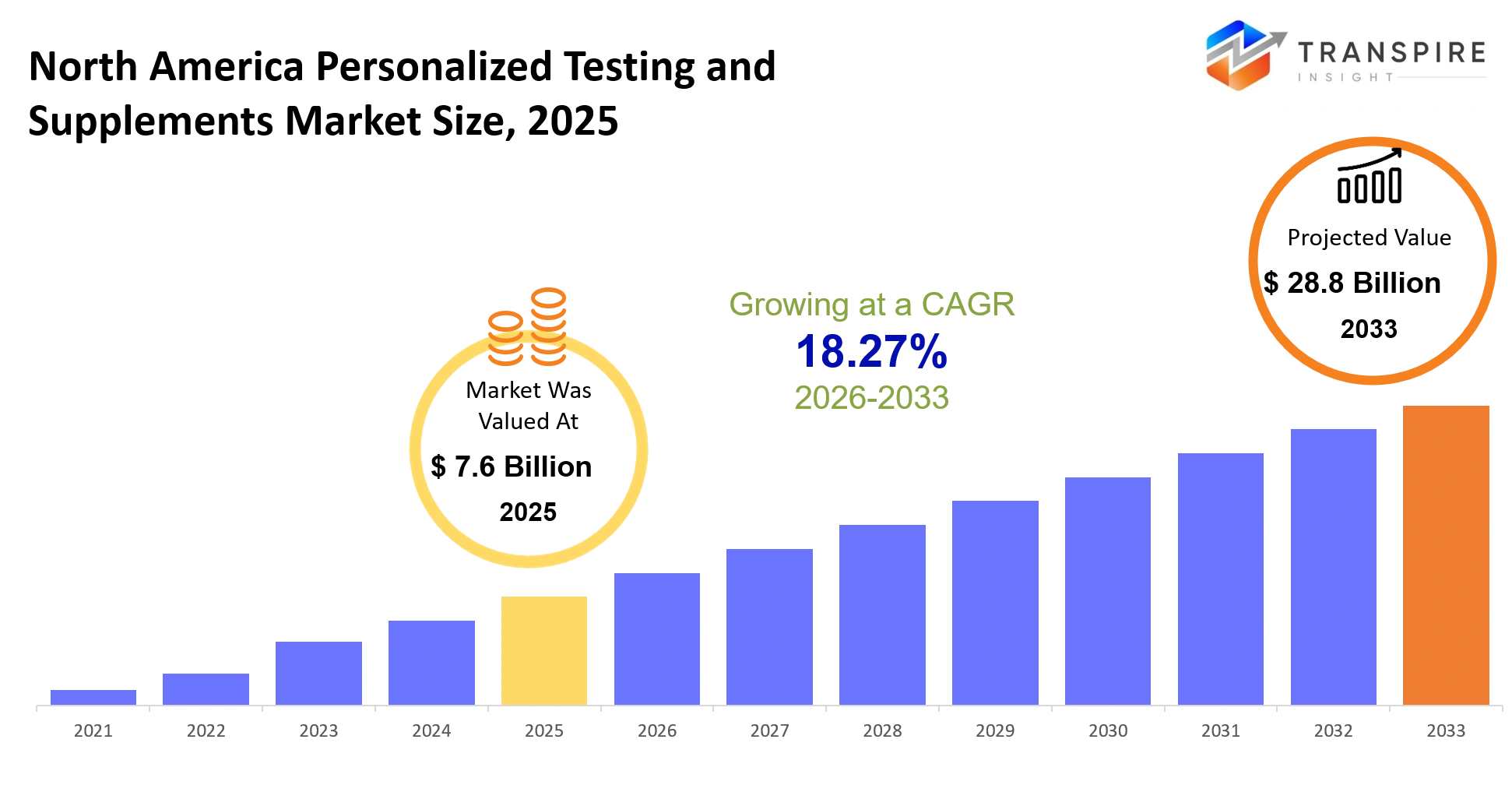
Key Market Insights
- North America still keeps that regional edge around 100% market share in 2025, backed by advanced healthcare infrastructure along with digital health adoption and this ongoing innovation cycle.
- The United States stays the quickest growing regional market through the forecast span, since precision nutrition investments plus preventive healthcare spending keep widening.
- For the product part, personalized supplements kind of take the lead with almost 52% market share in 2025, because subscription based nutrition programs really help keep customers longer and they create steady recurring revenue.
- Personalized diagnostic testing sits in the second slot as the second largest product category, and affordable genetic as well as biomarker screening nudges more holistic integration with digital wellness platforms across healthcare providers.
- AI enabled health assessment platforms are the fastest growing segment from 2025 to 2032, mainly pulled along by continuous technology investment and personalized recommendation engines that keep learning.
- In applications, preventive health management dominates with about 46% market share in 2025, as people increasingly choose long-term wellness monitoring , and that is supported by lab testing.
- Chronic disease risk assessment is expected to grow the fastest through 2032, since precision nutrition supports earlier action and more measurable health results.
- When you look at end users, individual consumers lead the chart with nearly 64% market share in 2025 via direct to consumer testing services and personalized supplement subscriptions.
- Corporate wellness programs are projected as the fastest growing end user category through 2032, as employers weave personalized health solutions into everyday benefits to raise workforce productivity and manage healthcare expenses.
What are the Key Drivers, Restraints, and Opportunities in the North America Personalized Testing and Supplements Market?
The main growth engine seems to be the coming together of affordable biomarker testing, AI-enabled health analytics, and preventive healthcare reimbursement. As sequencing got cheaper and at home collection kits got more common, buying habits shifted across North America, like people just… moved faster. Shoppers now lean toward guidance that is anchored in measurable biological data, not that general wellness talk. Health providers and digital health firms then had to answer, so they started folding personalized nutrition into larger care pathways. Overall this mix helped create more recurring subscription income, improved customer sticking power, and pulled higher margin testing into both clinical use and direct consumer offerings.
The biggest structural brake is still the limited standardization of clinical evidence across personalized nutrition products. The bar for “proof” isn’t the same for biomarkers versus genetic markers, and it’s even messier when microbiome testing methods get involved. Because of that mismatch, regulatory buy-in and payer reimbursement tend to move slower. In practice companies have to fund a lot of longitudinal clinical work before they can comfortably enter regulated healthcare environments. Even product launches are often pushed back when validation steps take longer than expected and when evidence has to be generated in the right way. Also, based on Transpire Insight’s look at regional procurement announcements and launch timelines, supply chain concentration stays the key operational risk. Taken together these issues dampen broad commercial rollout and postpone wider institutional adoption.
The strongest future opportunity seems to be in merging continuous health monitoring with personalized supplementation , kinda like not just guessing and then waiting. Wearables, connected diagnostic devices, and AI powered digital twins will let teams create adaptive nutrition recommendations rather than those static reports we all see. Meanwhile venture investment keeps backing precision health platforms that stitch together lab evidence with real time physiological monitoring, in a more living feedback loop. Also , big employer wellness programs and value based healthcare networks are especially set up to push commercial rollout because measurable health outcomes now more often affect reimbursement decisions.
What Has the Impact of Artificial Intelligence Been on the North America Personalized Testing and Supplements Market?
Artificial intelligence is, honestly, reshaping personalized nutrition by tying together lab findings , wearable device signals, electronic health records, and everyday lifestyle details into recommendations that keep getting updated. With modern platforms, a lot of the heavy work gets automated, like biomarker interpretation, supplement assembly, compliance tracking, and even customer interaction. This cuts down on manual checking across testing workflows, and it also makes lab operations smoother by sorting out which samples get processed first while pushing better quality assurance.
Machine learning then helps in a more “smarts over time” way, by spotting possible nutrient deficits, estimating chronic disease likelihood, projecting supplement needs for each person, and improving inventory choices from purchasing patterns. Companies rely on these models to refine tailored suggestions when fresh biological data arrives, instead of depending on one single snapshot assessment. In practice this tends to boost the accuracy of recommendations and supports better customer retention through adjustable wellness programs.
On the operations side, performance has improved, mainly because report generation is faster, admin tasks feel lighter, and inventory is used more effectively across various personalized health platforms. Automated analytics also make formulation less error prone and keep recommendations more consistent. Still, AI adoption isn’t exactly effortless. Integration can be expensive, because platforms have to merge lab systems, genomic repositories, wearable technologies, and healthcare records, all while following strict privacy rules. Plus limited interoperability and uneven clinical datasets keep holding back algorithm performance, especially across different patient groups.
Key Market Trends
- Since 2022, at-home biomarker testing has been growing really fast, because digital health platforms made sample collection and report delivery a lot easier, and somehow it just took off.
- AI-powered nutrition recommendation engines started looking mainstream around 2023, boosting personalization accuracy by continuously scanning biomarker signals plus folding in behavioral data, kind of like a constant feedback loop.
- Subscription based supplement programs pulled in a bigger customer base during 2024 by improving staying power, mostly through repeat health check-ins and adaptive nutrition plans that keep shifting as users change.
- Clinical partnerships between diagnostic laboratories and nutrition companies expanded across 2023–2025, to push stronger scientific validation , and also to win more physician comfort, not just interest.
- Multi-omics analysis that stacks genetics, microbiome, metabolomics, and blood biomarkers became a major edge over the last three years , yes a real differentiator.
- Wearable health devices are increasingly syncing with personalized nutrition platforms, so instead of once a year health assessments, you can get continuous monitoring, which feels more “always on”.
- Thorne and Viome expanded their AI driven precision health capabilities via ongoing technology investment and product iteration, not by doing one big thing and stopping.
- Companies adjusted manufacturing approaches after recent supply disruptions, by broadening ingredient sourcing and reinforcing regional production resilience, and honestly that helped more than people expected.
- Clinical evidence generation turned into a stronger focus after 2023, since healthcare providers wanted measurable outcomes before recommending individualized supplementation , plain and simple.
- Digital health ecosystems are now combining testing, telehealth consultations, and nutrition planning into one place, which improves long-term customer involvement and creates repeat revenue streams.
North America Personalized Testing and Supplements Market Segmentation
By Product Type :
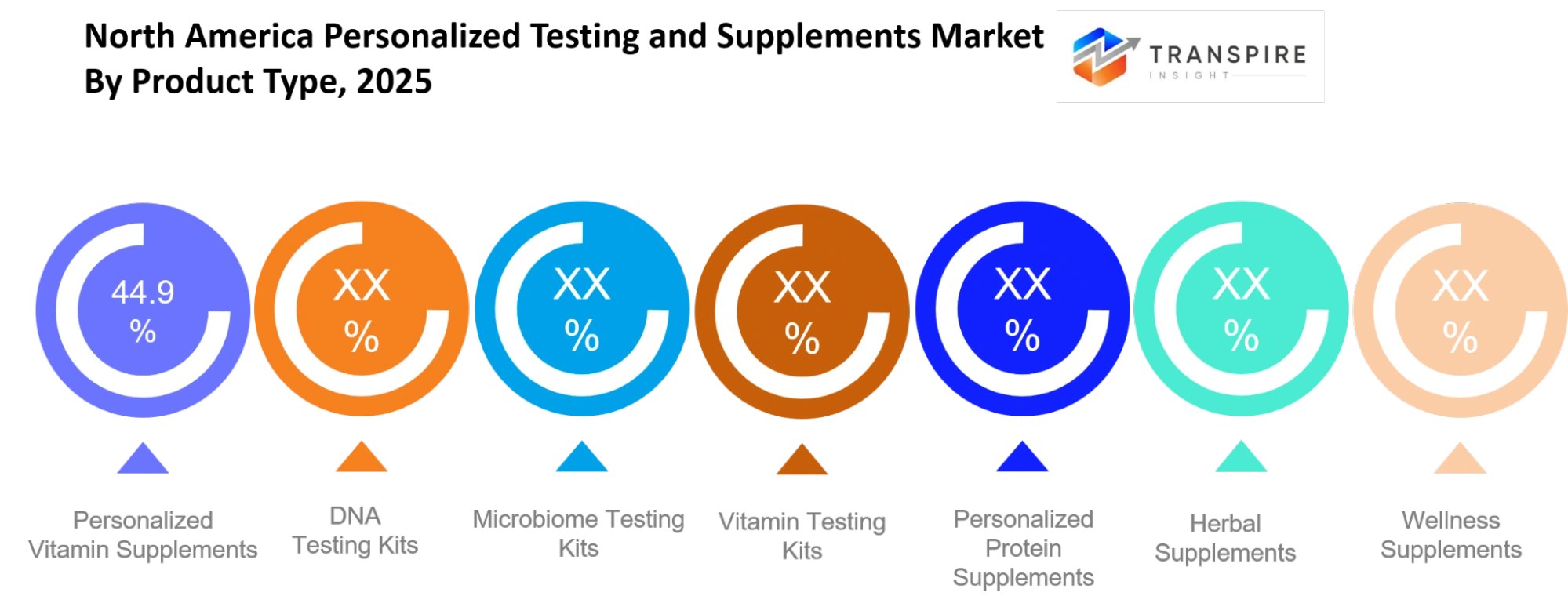
DNA testing kits still help precision nutrition a lot, mostly by picking up genetic traits tied to nutrient metabolism and possible health risks . Microbiome testing kits have also became more widely accepted, because gut health analysis helps build nutrition plans from microbial profiles in a more specific way. Vitamin testing kits give a measurable read on nutrient status, so people can choose supplements with more accuracy rather than relying on generalized recommendations . Personalized vitamin supplements keep the biggest share, since tailored formulations tend to boost customer satisfaction and also support long-term participation in the program.
Personalized protein supplements keep drawing in fitness minded consumers who want nutrition plans that match activity levels and body composition . Herbal supplements stay important too, because plant based wellness solutions feel more natural to many buyers , especially those who prefer formulations from botanical sources. Wellness supplements keep steady sales going through preventive health programs and subscription driven nutrition services. Other specialized products keep growing as newer ideas bring targeted formulations for specific wellbeing goals.
By Application :
Personalized nutrition still looks like the leading use case, partly because lab findings plus daily routine data can back up more tuned dietary advice. Weight management programs are now often mixing biomarker analysis with personalized supplement strategies , so the results are easier to measure and keep improving. Fitness and sports nutrition keeps growing too as athletes and just active people ask for nutrition that matches recovery needs as well as performance targets. Gut health applications are also gaining ground because microbiome analysis can steer both food choices and which supplement options make sense.
On the immune health side, many programs keep folding blood biomarkers into the nutritional planning so people can follow long-term wellness strategies. For healthy aging, the solutions tend to center on preserving strength and mobility while keeping nutritional balance, usually via customized supplementation plans. Preventive healthcare has become a major growth area , since an early health check can support timely nutrition intervention before things get worse or symptoms show up more. And honestly, other applications keep appearing as ongoing research uncovers new connections between nutrition and specific health conditions.
By Distribution Channel :
Online retail still feels like the most powerful distribution channel, mainly because digital platforms make it easier to browse products, pick up a testing kit, and keep up with subscription management. Pharmacies keep pushing product availability higher too, by giving consumers a trusted way to access testing solutions, along with nutritional products that people already look for. Wellness clinics are taking a bigger slice of the market, they blend health consultations with more tailored nutrition guidance. Direct-to-consumer keeps widening as well, through easy at-home testing plus digital delivery of results, which honestly reduces friction.
Health stores also hold onto customer interest by stocking specialized nutrition products, and pairing them with knowledgeable staff who guide decisions. Hospitals are increasingly weaving personalized nutrition into preventive care, and also into programs for chronic disease management. Specialty nutrition stores continue to pull in shoppers who want expert support and premium formulations. Other distribution channels add extra reach via local healthcare providers and wellness partnerships, sometimes with community based promotions.
By End User :
Adults show up as the biggest end-user group, mainly because preventive health planning and individualized nutrition have turned into kind of lifestyle priorities now. Athletes still lean toward customized supplementation, aiming to back recovery, endurance, and their performance aims. Women are choosing more and more personalized health plans that cover nutritional needs across different life stages, while men keep putting money into more specific supplements, geared toward fitness, metabolic health, and overall wellness. \
Older consumers, like the elderly, depend on personalized nutrition to help with healthy aging and a steadier nutritional balance. Children also benefit from carefully designed nutritional programs, but those should be steered by professional guidance and trackable health indicators. Corporate wellness programs keep growing too , since employers want improved workforce health results and at the same time keep healthcare spending under control. Besides that, other end-user groups add extra openings through specialized nutrition requirements and preventive health initiatives.
By Technology :
AI based recommendations help with nutrition planning by looking at someone’s health data, then creating individualized guidance for supplements. DNA analysis is still a core method because genetic information backs long term nutritional choices, and it can keep being useful over time. Microbiome analysis keeps moving forward too, mainly because labs now use better methods, so the results give richer gut wellbeing insights. Blood biomarker analysis also matters , since it produces clinical measurements that make supplement suggestions more grounded, and it helps with ongoing health monitoring.
On the user side, mobile health platforms boost engagement , showing outcomes, reminders and nutrition guidance inside digital apps. Wearable integration makes it possible to collect health information continuously, which supports gradual revisions to nutrition plans. Cloud based analytics improves data handling and allows secure sharing across testing tools and healthcare providers. And there are other technologies as well, they keep strengthening precision nutrition through improved diagnostics, faster data processing and more tailored health recommendations, even when conditions shift.
What are the Key Use Cases Driving the North America Personalized Testing and Supplements Market?
Personalized nutrition still feels like the number one kind of use because clinicians , wellness hubs, and direct-to-consumer apps take the test findings and line them up with supplements that fit specific, measurable health needs. Adults end up doing the most buying too, since those tailored plans back preventive support, steadier long term wellness scheduling, and the “again and again” supplement subscriptions.
At the same time weight management plus fitness apps keep getting bigger with sports nutrition brands, workplace well-being initiatives, and specialist nutrition clinics. Athletes lean on biomarker guided suggestions to speed up recovery, and employers roll out customized wellness programs to trim healthcare expenses and to motivate a more active, healthier workforce involvement.
Then there’s healthy aging, and this also looks like an emerging area with real staying power, especially for preventive risk checks. Hospitals, diagnostic labs, and digital health companies are gradually folding genetic , microbiome and biomarker details into how they plan nutrition. This happens as clinical validation improves, and as precision healthcare expectations continue to get more defined .
|
Report Metrics |
Details |
|
Market size value in 2025 |
USD 7.6 Billion |
|
Market size value in 2026 |
USD 8.9 Billion |
|
Revenue forecast in 2033 |
USD 28.8 Billion |
|
Growth rate |
CAGR of 18.27% from 2026 to 2033 |
|
Base year |
2025 |
|
Historical data |
2021 - 2024 |
|
Forecast period |
2026 - 2033 |
|
Report coverage |
Revenue forecast, competitive landscape, growth factors, and trends |
|
Regional scope |
North America (Canada, The United States, and Mexico) |
|
Key company profiled |
Viome, Thorne HealthTech, Persona Nutrition, Bioniq, Rootine, Care/of, Nestlé Health Science, Herbalife, Amway, DNAfit, 23andMe, GenoPalate, Everlywell, InsideTracker, Nutrigenomix . |
|
Customization scope |
Free report customization (country, regional & segment scope). Avail customized purchase options to meet your exact research needs. |
|
Report Segmentation |
By Product Type (DNA Testing Kits, Microbiome Testing Kits, Vitamin Testing Kits, Personalized Vitamin Supplements, Personalized Protein Supplements, Herbal Supplements, Wellness Supplements, Others); By Application (Personalized Nutrition, Weight Management, Fitness & Sports Nutrition, Gut Health, Immune Health, Healthy Aging, Preventive Healthcare, Others); By Distribution Channel (Online Retail, Pharmacies, Wellness Clinics, Direct-to-Consumer, Health Stores, Hospitals, Specialty Nutrition Stores, Others); By End User (Adults, Athletes, Women, Men, Elderly Consumers, Children, Corporate Wellness Programs, Others); By Technology (AI-Based Recommendations, DNA Analysis, Microbiome Analysis, Blood Biomarker Analysis, Mobile Health Platforms, Wearable Integration, Cloud-Based Analytics, Others) |
Which Regions are Driving the North America Personalized Testing and Supplements Market Growth?
The United States really dominates the regional revenue picture, with around 88% of the market share. A lot comes from strict healthcare regulations , wider access to diagnostic laboratories , and solid digital health infrastructure that helps adoption happen at scale, especially for personalized testing and nutrition offerings. There’s also this mature network of biotechnology companies , precision health startups, clinical labs and supplement manufacturers. All that mix makes product development easier and it supports commercial expansion. On top of that, ongoing funding for artificial intelligence, preventive care , and consumer health technologies should keep the U.S. in the lead for the whole forecast stretch.
Canada comes in as the second-largest regional market, mainly because healthcare delivery tends to follow a structured, evidence-driven approach. That framework supports slower but steady uptake of personalized nutrition. With consistent regulatory control and fairly stable healthcare funding, companies keep investing in genetic testing, biomarker analysis , and preventive wellness services. Meanwhile, research centers and healthcare organizations keep partnering with biotechnology players. The aim is to improve clinical validation and overall product quality. Then there’s reliable consumer spending plus growing digital healthcare services , which together keep Canada a dependable source for long-term regional revenue.
Mexico is expected to log the most rapid growth from 2026–2033 as digital healthcare infrastructure keeps expanding and preventive health initiatives get noticeably more public plus private funding. Over the last few years, the wider availability of diagnostic laboratories and online health platforms have made it easier for people to get personalized testing, and yes, even nutritional coaching. At the same time, global healthcare firms are widening regional collaborations and distribution channels, so they can reach a wider audience of consumers. This build up of momentum should open up appealing chances for new players and backers who want early involvement in an expanding precision health ecosystem.
Who are the Key Players in the North America Personalized Testing and Supplements Market and How Do They Compete?
Competition still looks sort of moderately fragmented, since biotechnology companies, nutrition specialists, diagnostic labs, and digital health firms each touch separate slices of the personalized health chain, kinda in their own way. New technology ideas plus integrated service setups tend to give the most solid competitive edge, whereas clinical proof and data quality are starting to matter more, especially when people are actually buying. Larger, already-established players keep doubling down on subscription platforms and their diagnostic power, but newer companies push artificial intelligence , microbiome research, and direct-to-consumer models that slowly change what customers expect.
Viome stands out with artificial intelligence paired with microbiome analysis, which then produces individualized nutrition guidance from continuous biological measurements, like an always-on view. Thorne mixes premium nutritional items with health testing services so customers can use testing plus supplementation through one unified wellness system. InsideTracker is centered on blood biomarker interpretation and performance tuning, and it aims at health-minded consumers as well as professional athletes via science-based guidance.
Persona Nutrition leans into customized supplement subscriptions that make long-term participation feel easier, using digital health assessments and automated product shipping. 23andMe moves beyond standard consumer genetic tests by layering in health-relevant insights, so users can plan personalized wellness and also pursue strategic partnerships across healthcare and biotechnology. Product invention, clinical research collaborations, and investments in advanced analytics continue to steer positioning, as precision nutrition adoption grows across North America.
Company List
- Viome
- Thorne HealthTech
- Persona Nutrition
- Bioniq
- Rootine
- Care/of
- Nestlé Health Science
- Herbalife
- Amway
- DNAfit
- 23andMe
- GenoPalate
- Everlywell
- InsideTracker
- Nutrigenomix
Recent Development News
In May 2025, Regeneron Pharmaceuticals entered into an asset purchase agreement to acquire 23andMe for US$256 million through a court-supervised sale. The transaction is intended to preserve 23andMe's consumer genetics services while strengthening genetics-guided research capabilities, reinforcing investment in precision health and personalized testing. Sourcehttps://newsroom.regeneron.com/
In April 2025, Viome Life Sciences launched the AI-powered Full Body Intelligence™ Test, an at-home molecular diagnostics platform that analyzes more than 100 million biomarkers to deliver personalized nutrition recommendations. The launch expanded the commercial use of AI-driven health assessments and strengthened competition in precision testing and supplement personalization. Sourcehttps://www.prnewswire.com/
What Strategic Insights Define the Future of the North America Personalized Testing and Supplements Market?
The North America Personalized Testing and Supplements Market is headed toward integrated precision health ecosystems, where diagnostic testing, steady health monitoring, and tailored nutrition kind of work together as connected offerings, not really as separate things. Over time, more clinical validation, artificial intelligence, and value based healthcare systems will push this shift, mainly by tying measurable health results to customized interventions. At the same time, a quieter kind of risk could show up too: heavy reliance on a small set of specialized lab networks and ingredient suppliers, which could create operational headaches if regulatory requirements get stricter, or if supply disruptions happen. There is also a meaningful opening though, especially with ongoing biomarker observation using wearable technologies and remote diagnostics, so nutrition plans can be tuned in real time, instead of waiting for periodic lab reports. Companies that operate here will likely do better by putting money into clinically validated platforms, building diversified supply relationships, and creating interoperable digital health infrastructure that helps healthcare providers, employers, and consumers through one single connected ecosystem.
North America Personalized Testing and Supplements Market Report Segmentation
By Product Type
- DNA Testing Kits
- Microbiome Testing Kits
- Vitamin Testing Kits
- Personalized Vitamin Supplements
- Personalized Protein Supplements
- Herbal Supplements
- Wellness Supplements
By Application
- Personalized Nutrition\
- Weight Management
- Fitness & Sports Nutrition
- Gut Health
- Immune Health
- Healthy Aging
- Preventive Healthcare
By Distribution Channel
- Online Retail
- Pharmacies
- Wellness Clinics
- Direct-to-Consumer
- Health Stores
- Hospitals
- Specialty Nutrition Stores
By End User
- Adults
- Athletes
- Women
- Men
- Elderly Consumers
- Children
- Corporate Wellness Programs
By Technology
- AI-Based Recommendations
- DNA Analysis
- Microbiome Analysis
- Blood Biomarker Analysis
- Mobile Health Platforms
- Wearable Integration
- Cloud-Based Analytics
Frequently Asked Questions
Find quick answers to common questions.
The expected North America Personalized Testing and Supplements Market size for the market will be USD 28.8 Billion in 2033.
Key segments for the North America Personalized Testing and Supplements Market are By Product Type (DNA Testing Kits, Microbiome Testing Kits, Vitamin Testing Kits, Personalized Vitamin Supplements, Personalized Protein Supplements, Herbal Supplements, Wellness Supplements, Others); By Application (Personalized Nutrition, Weight Management, Fitness & Sports Nutrition, Gut Health, Immune Health, Healthy Aging, Preventive Healthcare, Others); By Distribution Channel (Online Retail, Pharmacies, Wellness Clinics, Direct-to-Consumer, Health Stores, Hospitals, Specialty Nutrition Stores, Others); By End User (Adults, Athletes, Women, Men, Elderly Consumers, Children, Corporate Wellness Programs, Others); By Technology (AI-Based Recommendations, DNA Analysis, Microbiome Analysis, Blood Biomarker Analysis, Mobile Health Platforms, Wearable Integration, Cloud-Based Analytics, Others).
Major North America Personalized Testing and Supplements Market players are Viome, Thorne HealthTech, Persona Nutrition, Bioniq, Rootine, Care/of, Nestlé Health Science, Herbalife, Amway, DNAfit, 23andMe, GenoPalate, Everlywell, InsideTracker, Nutrigenomix.
The North America Personalized Testing and Supplements Market size is USD 7.6 Billion in 2025.
The North America Personalized Testing and Supplements Market CAGR is 18.27% from 2026 to 2033.
- Viome
- Thorne HealthTech
- Persona Nutrition
- Bioniq
- Rootine
- Care/of
- Nestlé Health Science
- Herbalife
- Amway
- DNAfit
- 23andMe
- GenoPalate
- Everlywell
- InsideTracker
- Nutrigenomix
About the Authors

Chetan Dhatrak
I’m Chetan Dhatrak, a Senior Research Analyst at Transpire Insight, specializing in the Consumer Goods, Foods and Beverages industry. I focus on analyzing market trends, consumer behavior, competitive landscapes, and industry developments to deliver accurate, data-driven insights. My research at Transpire Insight is built on credible sources and in-depth analysis, helping businesses and readers better understand market dynamics, emerging opportunities, and evolving consumer preferences. I’m committed to creating reliable, well-researched content that supports informed decision-making and reflects the latest developments in the consumer goods and food & beverage sectors.

Chakradhar Khansole
Chakradhar serves as the Research Director at Transpire Insight, bringing over 8 years of experience in technology, innovation, and strategic market intelligence. He specializes in transforming complex market data into actionable business insights that enable organizations to make informed, growth-oriented decisions. Recognized for his strategic vision and analytical expertise, Chakradhar leads high-impact research initiatives, delivering comprehensive market assessments, competitive intelligence, and forward-looking industry analysis.
Recently Published Reports
-
Apr 2026
Baby Infant Formula Market
Baby Infant Formula Market Size, Share & Analysis Report By ype (Infant Milk, Follow On Milk, Specialty Baby Milk, Growing-Up Milk), By Ingredient (Carbohydrate, Fat, Protein, Minerals, Vitamins, and Others), By Product Form (Powder, Liquid, and Ready-to-feed), By Distribution Channels (Supermarket/Hypermarket, Specialty Store, Pharmacies, Online Retail, and Others), and Geography (North America, Europe, Asia-Pacific, Middle East and Africa, South and Central America), 2021 - 2031
-
Apr 2026
Edible Insects for Animal Feed Market
Edible Insects for Animal Feed Market Size, Share & Analysis Report By Type (Insect Powder, Insect Meal, Insect Bar, Insect Paste, Insect Oil, and Others), By Insect Type (Beetles, Cricket, Caterpillar, Hymenoptera, Orthoptera, Tree Bugs, and Others), By Application (Livestock, Pet Food, and Aquaculture), By Livestock Type (Poultry, Swine, and Others), and Geography (North America, Europe, Asia-Pacific, Middle East and Africa, South and Central America), 2021 - 2031
-
Apr 2026
Food Industry Disinfection and Bacterial Control Market
Food Industry Disinfection and Bacterial Control Market Size, Share & Analysis Report By Type (Chemical Disinfectants, Physical Disinfectants, and Biocides and Antimicrobials), By Application (Food Processing Equipment Surface Disinfection, Food Preparation Areas Surface Disinfection, Storage Areas Surface Disinfection, Anti-microbial Coatings Food Preservation, and Preservative Solutions Food Preservation), By End User (Meat and Poultry Processing, Dairy Processing, Seafood Processing, Bakery and Confectionery, Restaurants and Commercial Kitchens, and Food Service Providers), By Sales Channel (Online, Offline), and Geography (North America, Europe, Asia-Pacific, Middle East and Africa, South and Central America), 2021 - 2031
-
May 2026
Freeze Dried Food Market
Freeze Dried Food Market Size, Share & Analysis Report By Product Type (Fruits, Vegetables, Freeze-Dried Dairy Products, Freeze-Dried Meat and Seafood, Freeze-Dried Pet Food, and Prepared Meal), By Nature (Organic, and Conventional), By Form (Powdered, Granules, and Diced), By End Use (Breakfast Cereals, Dairy Products, Bakery & Confectionery, Nutritional Bars & Supplements, Powdered Beverages, Snacks, and Retail (Household)), and Geography (North America, Europe, Asia-Pacific, Middle East and Africa, South and Central America), 2021 - 2031