
North America Animal Genetics Market Size & Forecast:
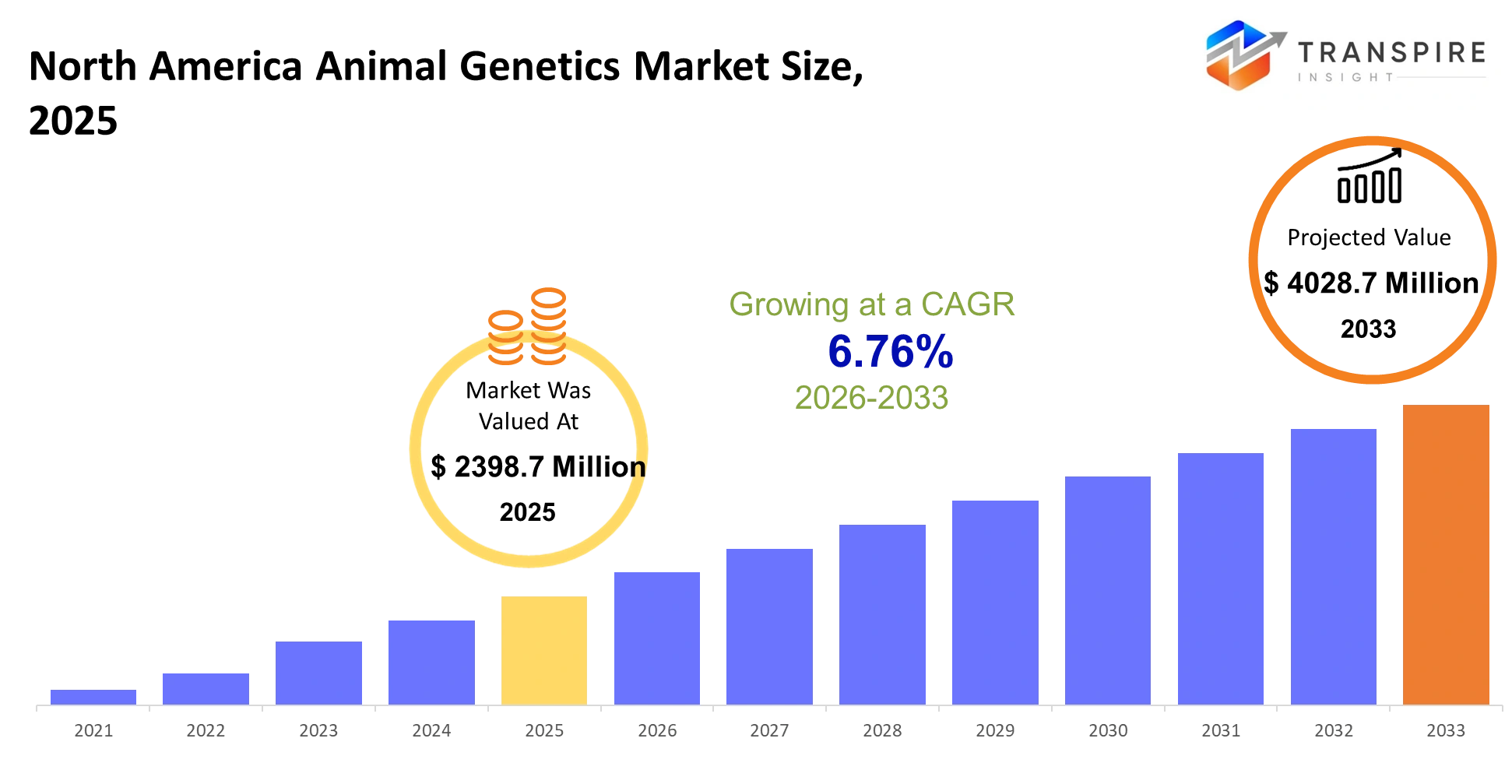
- North America Animal Genetics Market Size 2025: USD 2398.7 Million
- North America Animal Genetics Market Size 2033: USD 4028.7 Million
- North America Animal Genetics Market CAGR: 6.76%
- North America Animal Genetics Market Segments: By Product (Genetic Material, Live Animals), By Application (Breeding, Testing), By End-User (Farmers)
To learn more about this report,  Download Free Sample Report
North America Animal Genetics Market Summary:
The North America Animal Genetics Market size is estimated at USD 2398.7 Million in 2025 and is anticipated to reach USD 4028.7 Million by 2033, growing at a CAGR of 6.76% from 2026 to 2033. The animal genetics market in North America which includes Canada, the United States and Mexico will undergo changes because precision breeding is becoming a commercially successful practice. Farmers will require traceable animal breeds that provide high performance and meet sustainability as well as animal welfare standards. The development of genomic sequencing and data analytics together with gene editing technologies will enable breeders to make better breeding choices because they will be able to select animals more rapidly. The United States and Canada and Mexico will establish new regulatory systems which will enable them to protect ethical standards while fostering greater innovation. The demand from consumers for disease-resistant protein sources which provide high quality will determine breeding priorities because companies will need to develop better data-driven genetic solutions.
Key Market Trends & Insights:
Breeders will be able to make faster and better decisions when genomic tools transition from specialized laboratories to standard farm operations. DNA-based selection will become the primary method for producers in the United States and Canada to enhance their breeding programs for improved fertility and feed efficiency and disease resistance. The adoption of these methods in Mexico will progress at a steady pace because costs will decrease over time. Breeding programs will experience reduced uncertainty which will result in new methods for assessing livestock value throughout integrated supply chains.
Producers will need to establish transparent operations while using ethically sourced materials because consumer expectations about these matters are now increasing. Buyers will seek meat and dairy products linked to responsible breeding practices which include reduced antibiotic use and improved animal welfare standards. Retailers and food brands will respond by demanding genetic traceability from suppliers. The pressure from this situation will lead farms throughout the region to develop sustainable breeding programs because genetic selection will become essential for product differentiation.
Technological integration will extend today into digital farm ecosystems which will include genomics research. The system will use artificial intelligence together with cloud computing to analyze genetic information and health data and performance assessment. Farmers will gain improved ability to forecast results through enhanced cattle management capabilities which this technology provides. Canadian and American and Mexican research institutions will create cross-border partnerships that enhance innovation pipelines to expedite the market launch of new breeding methods.
Gene-editing technology will continue to evolve because researchers increasingly study this area. Regulatory agencies will face increased demands to describe their methods of managing emerging technologies which include CRISPR while they evaluate both safety standards and technological advancements. The United States will have a regulatory framework that will be flexible, whereas Canada and Mexico will revise theirs. The new rules will affect how investors make choices and which genetic technologies will be developed for commercial use in livestock.
North America Animal Genetics Market Segmentation
By Product
Genetic Material- Producers will use genetic material as their primary tool for developing breeding methods which will enable them to achieve measurable and consistent advancements in livestock performance. The process will use semen and embryos together with DNA-based solutions to create specific traits which include increased productivity and disease resistance and climate adaptability. The new preservation and distribution techniques will enable more people to access improved genetics through mid-sized farms which no longer need to keep extensive breeding stock or make big infrastructure investments.
Live Animals- Commercial farms which seek immediate productivity improvements will increase their demand for live animals that possess verified genetic profiles. Breeding companies will supply high-value animals that carry proven traits which will decrease the time needed to develop efficient herds. The United States, Canada, and Mexico will use cross-border trade, but this trade will need health certifications and traceability systems to ensure biosecurity and meet current regulatory requirements.
By Application
Breeding- The future breeding applications will depend on predictive tools which use genetic information together with performance data. Producers will select animals based on visible traits together with feed conversion rates and reproductive success which serve as long-term efficiency indicators. The method will create shorter breeding cycles which will deliver better consistency across herds. Research institutions and private companies will establish collaborative programs to develop breeding techniques which will produce results that meet market needs while protecting the environment.
Testing- Testing will transform into an essential component of livestock management which no longer requires specialized services. Genetic testing will identify hereditary condition carriers while establishing family relationships and guiding breeding selection. The testing costs will decrease which will lead to increased testing use by farms during their daily work. Laboratories and service providers will develop new testing capacities which will enable them to deliver quicker results while providing farmers comprehensive data to help them make better choices.

To learn more about this report, Download Free Sample Report
By End-User
Farmers- The main people who will adopt genetic advancements in agriculture will stay as the primary users of these advancements to enhance their farm productivity while remaining competitive in the challenging agricultural market. Farmers will apply data-based information for their breeding operations and livestock health management and herd productivity control. The combination of accessible technology and advisory services will enable farmers to adopt advanced genetic strategies without needing extensive technical knowledge while they achieve sustainable business operations that meet changing consumer demands.
Regional Insights
The United States will lead regional adoption of advanced breeding technologies which receive support from its strong research infrastructure and commercial partnerships. Large-scale livestock operations will use genomic tools as part of their standard herd management procedures which will help them achieve better productivity and disease resilience. Private investment will sustain innovation development while federal guidelines will determine the implementation methods for new genetic techniques. Producers will increasingly select breeding options that meet market demands for high-quality products which customers can trace back to their origins and which producers use sustainable methods.
Canada will focus on balanced development which needs scientific progress and regulatory compliance. The country’s livestock sector will prioritize sustainability because breeding programs will develop efficient methods that decrease environmental effects. University and industry partnerships will boost innovation while government policies will protect ethical research standards. Canadian producers will gradually adopt genetic data for their operations because they want to achieve better long-term herd results instead of making quick and extensive breeding changes.
The livestock sector in Mexico will modernize at a steady pace because local markets and international markets create new business opportunities. Local producers will start using genetic technologies more because people will become more aware of those technologies and costs will decrease. United States and Canadian businesses will establish partnerships to create knowledge transfer programs and provide access to advanced breeding materials. The regulatory system will undergo continuous development which seeks to achieve two objectives: promote innovative solutions and safeguard traditional farming methods.
The future development of animal genetics in North America will depend on cross-border partnerships between different countries. The trade agreements and common research programs will facilitate the movement of genetic resources and specialized knowledge and advanced technical equipment between countries. Producers will implement standardized quality and safety procedures while they track changes in what consumers want. The regional alignment will establish an interconnected livestock sector that uses genetics as its core element for developing long-term business strategies.
Recent Development News
Canada: Research-Driven Collaboration Strengthens Genetic Innovation
Canada has seen increased collaboration between academic institutions and livestock companies, focusing on precision breeding and sustainability. Recent initiatives have emphasized integrating genomic data with environmental performance indicators, helping producers balance efficiency with ecological responsibility. These efforts will strengthen Canada’s position as a research-led market, where innovation is carefully tested before commercialization. Such collaborations will also support the development of livestock suited to changing climate conditions and evolving export standards.
Mexico: Livestock Health Concerns Trigger Biosecurity and Genetic Focus
In Mexico, recent livestock health alerts have pushed authorities and producers to prioritize stronger biosecurity and genetic resilience. The detection of harmful parasites near key cattle regions has raised concerns about cross-border spread, prompting tighter monitoring and preventive strategies. This situation will encourage investment in genetics that enhance disease resistance, while also strengthening regional cooperation with the United States to protect livestock populations and maintain trade stability.
|
Report Metrics |
Details |
|
Market size value in 2025 |
USD 2398.7 Million |
|
Market size value in 2026 |
USD 2548.5 Million |
|
Revenue forecast in 2033 |
USD 4028.7 Million |
|
Growth rate |
CAGR of 6.76% from 2026 to 2033 |
|
Base year |
2025 |
|
Historical data |
2021 – 2024 |
|
Forecast period |
2026 – 2033 |
|
Report coverage |
Revenue forecast, competitive landscape, growth factors, and trends |
|
Regional scope |
North America (Canada, The United States, and Mexico) |
|
Key company profiled |
Genus, Zoetis, CRV, ABS Global, Hendrix Genetics, Neogen, Topigs, Alta Genetics, EW Group, Select Sires, VikingGenetics, URUS, Semex, Envigo, Trans Ova |
|
Customization scope |
Free report customization (country, regional & segment scope). Avail customized purchase options to meet your exact research needs. |
|
Report Segmentation |
By Product (Genetic Material, Live Animals), By Application (Breeding, Testing), By End-User (Farmers) |
Key North America Animal Genetics Market Company Insights
The main competitors who operate in the North American animal genetics market which includes Canada and the United States and Mexico will drive competition through their development of new products and their international business expansion efforts. The companies Genus plc and ABS Global will develop new breeding methods and create efficient livestock management systems while Neogen Corporation will expand its business through genomic testing and animal safety product development. New companies will finance their development of genetic sequencing technologies and data-driven platforms which will enable farmers to obtain precise genetic information. The partnership between biotechnology companies and livestock farmers will strengthen to create commercial products which meet both performance standards and traceability requirements and current regional regulatory demands.
Company List
- Genus
- Zoetis
- CRV
- ABS Global
- Hendrix Genetics
- Neogen
- Topigs
- Alta Genetics
- EW Group
- Select Sires
- VikingGenetics
- URUS
- Semex
- Envigo
- Trans Ova
North America Animal Genetics Market Report Segmentation
By Product
- Genetic Material
- Live Animals
By Application
- Breeding
- Testing
By End-User
- Farmers
Frequently Asked Questions
Find quick answers to common questions.
The approximate North America Animal Genetics Market size for the market will be USD 4028.7 Million in 2033.
Key segments for the North America Animal Genetics Market By Product (Genetic Material, Live Animals), By Application (Breeding, Testing), By End-User (Farmers).
Major players in the North America Animal Genetics Market are Genus, Zoetis, CRV, ABS Global, Hendrix Genetics, Neogen, Topigs, Alta Genetics, EW Group, Select Sires, VikingGenetics, URUS, Semex, Envigo, Trans Ova.
The North America Animal Genetics Market size is USD 2398.7 Million in 2025.
The North America Animal Genetics Market CAGR is 6.76%.
- Genus
- Zoetis
- CRV
- ABS Global
- Hendrix Genetics
- Neogen
- Topigs
- Alta Genetics
- EW Group
- Select Sires
- VikingGenetics
- URUS
- Semex
- Envigo
- Trans Ova
Recently Published Reports
-
Apr 2026
AI in Diabetic Retinopathy Market
AI in Diabetic Retinopathy Market Size, Share & Analysis Report By Type (Screening AI Systems, Diagnostic AI Systems, and Predictive AI Models), By Application Segment (Hospitals, Ophthalmology Clinics, Diagnostic Centers, and Research and Development), and Geography (North America, Europe, Asia-Pacific, Middle East and Africa, South and Central America), 2021 - 2031
-
Apr 2026
Psychometric Tests Market
Psychometric Tests Market Size, Share & Analysis Report By Type (Personality Tests, Ability/Aptitude Tests, Skill/Knowledge Tests, and Others), By Application (Talent Acquisition and Talent Management), and Geography (North America, Europe, Asia-Pacific, Middle East and Africa, South and Central America), 2021 – 2031
-
Apr 2026
Rare Biological Sample Collection Market
Rare Biological Sample Collection Market Size, Share & Analysis Report By Type (Isolation Kits & Reagent, Blood Collection Tubes, and Others), By Application (Oncology, Transcriptomics, Pharmacogenomics, and Others), and Geography (North America, Europe, Asia-Pacific, Middle East and Africa, South and Central America), 2021 – 2031
-
May 2026
Patient Lift Pendant Market
Patient Lift Pendant Market By Product Type (Wired Pendants, Wireless, Programmable), By Operation Type(Manual, Electric), By End-Users (Healthcare Professionals, Patients), By Application (Hospitals, Homecare, Rehabilitation Centers, Others), By Industry Analysis, Size, Share, Growth, Trends, and Forecasts 2021-2033
Our Clients
.jpg)