
North America Next-generation Sequencing Library Preparation Market Summary
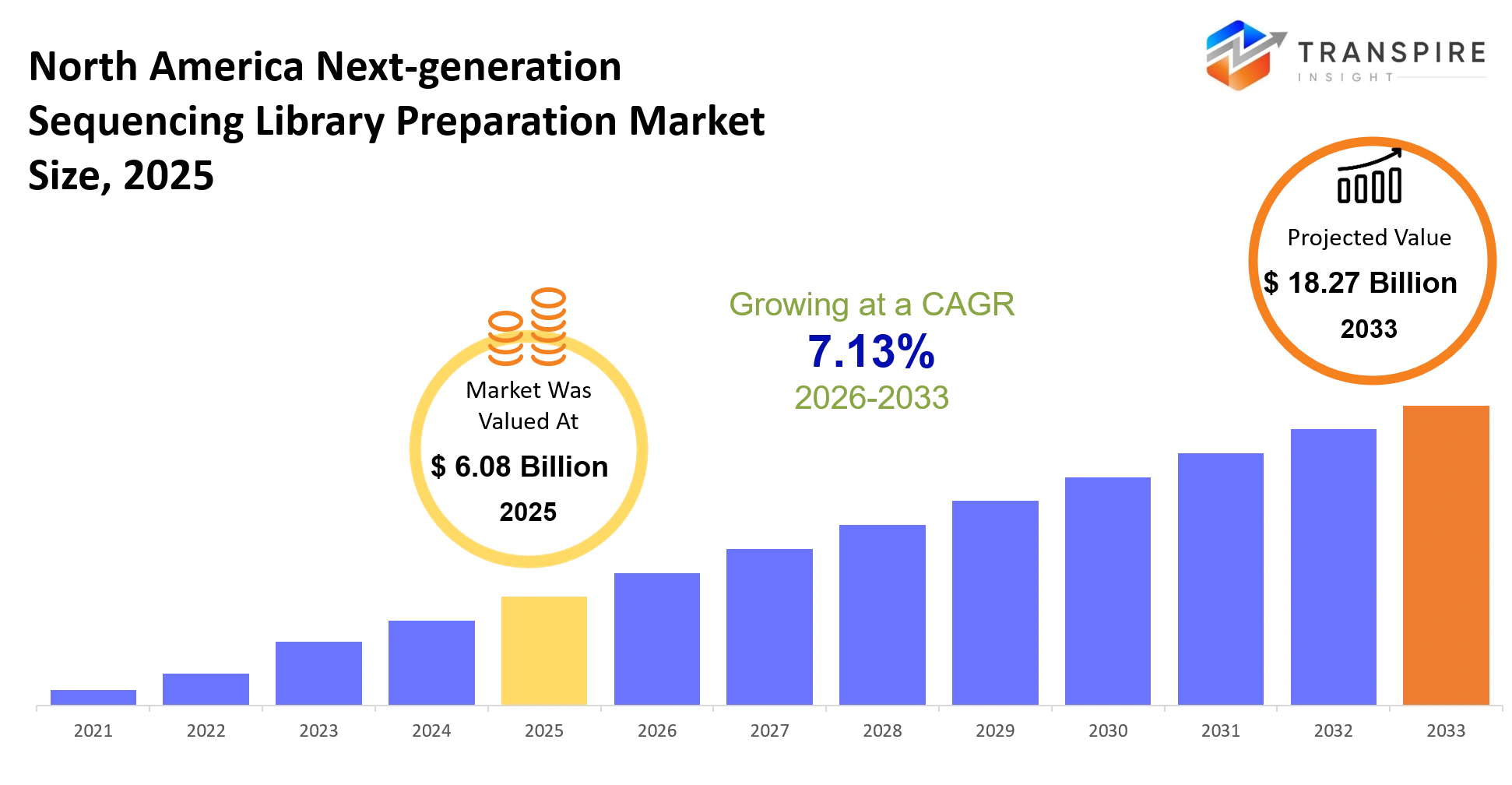
As per Transpire Insight Analysis the North America Next-generation Sequencing Library Preparation Market size is estimated at USD 6.08 Billion in 2025 and is anticipated to reach USD 18.27 Billion by 2033, growing at a CAGR of 14.85% from 2026 to 2033.
The North America next generation sequencing library preparation market basically serves labs, hospitals, pharmaceutical companies , and a mix of research groups, to turn biological samples into sequencing ready libraries, so genomic analysis becomes not only faster but also more dependable. And in this way, things like disease diagnosis, biomarker discovery, precision medicine, drug development, and even public health monitoring all get a boost, because the entire sequencing pipeline stays steadier, and runs more efficiently overall.Over the past five years, the market has kind of drifted away from older, hands-on manual library preparation, and towards automated high-throughput platforms, which is a shift that many teams seem to prefer. These newer systems reduce variability, plus they improve turnaround speed .
The COVID-19 pandemic was a pretty strong nudge too, it helped broaden genomic surveillance infrastructure, and it encouraged quicker investment in sequencing capacity across the region. Today, since more labs manage larger sample volumes and they fold sequencing into daily clinical workflows, the demand for standardized solutions that work smoothly alongside automation keeps strengthening, even with tighter schedules.This shift is opening up extra commercial possibilities for kit manufacturers , reagent suppliers, and also for workflow automation providers, while at the same time keeping market revenue growth more steady.
North America Next-generation Sequencing Library Preparation Market Size & Forecast:
- North America Next-generation Sequencing Library Preparation Market Size 2025: USD 6.08 Billion
- Expected Market Value 2033: USD 18.27 Billion
- Forecast CAGR: 7.13%
- Leading region in 2025: United States
- Fastest Growing region: Canada
- Key Profile: Illumina, Thermo Fisher Scientific, Agilent Technologies, Roche, QIAGEN, New England Biolabs, Takara Bio, Pacific Biosciences, Oxford Nanopore Technologies, Revvity, Bio-Rad Laboratories, Beckman Coulter, Integrated DNA Technologies, Roche Sequencing Solutions, Standard BioTools
Key Market Insights
- North America regional demand keeps mostly piling up in the United States, with about 85% of market share in 2025, largely due to heavy genomic research funding.
- Canada is showing the fastest uptick during the forecast period, because precision medicine investments and national genomics initiatives are still stretching out, and expanding sequencing capacity, pretty steadily.
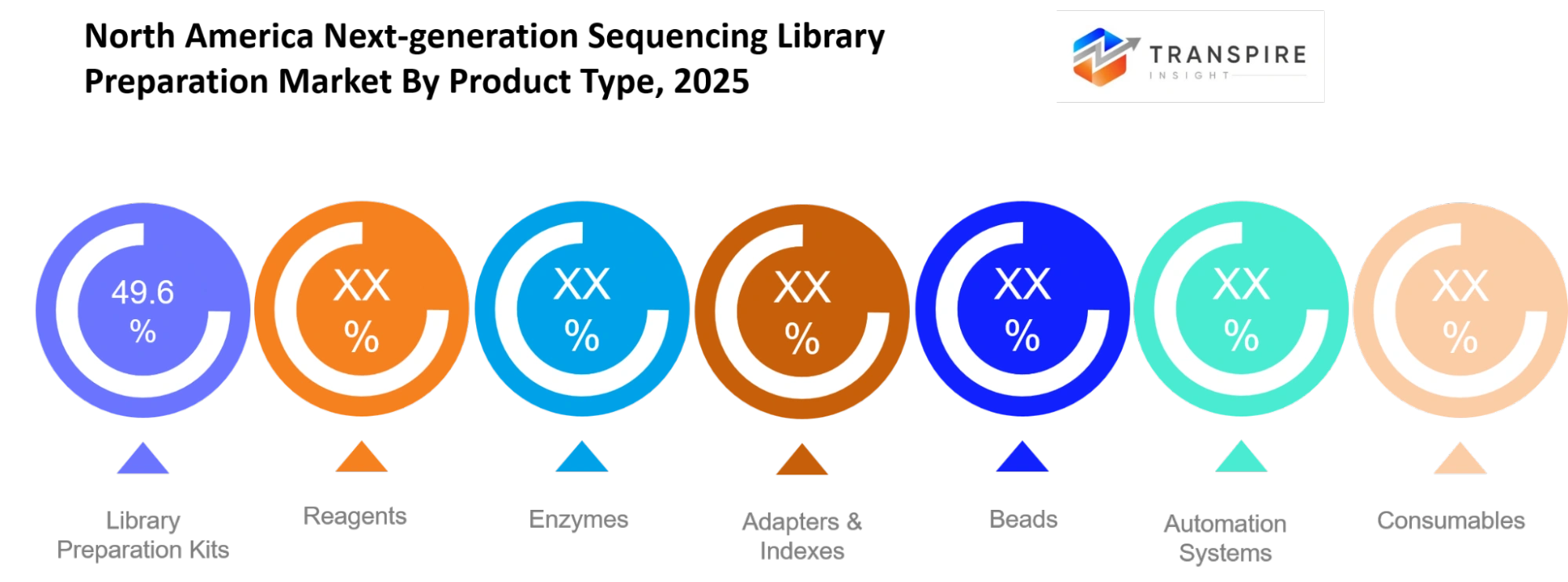
- When it comes to products, library preparation kits pretty much lead the whole landscape, taking nearly 58% market share in 2025 since most laboratories favor validated standardized workflows over those custom protocols.
- Automated library preparation instruments sit in the second-largest slice too, as labs ramp up throughput while also dialing down manual handling errors and day to day operational variability.
- Automation-enabled library preparation consumables are projected to be the quickest moving segment through 2032 , pushed forward by high-volume clinical sequencing adoption.
- On the application side clinical diagnostics leads the demand, around 46% market share, as genomic testing starts getting folded into oncology routines and inherited disease workflows.
- Precision oncology applications are expected to grow the fastest as companion diagnostics are rolled out more widely.
- For end users , pharmaceutical and biotechnology companies remain the top group, holding nearly 42% market share, helped by stronger biomarker discovery efforts and drug development programs.
- Hospitals and clinical laboratories are forecasted to grow the quickest end-user category, because sequencing is shifting into routine diagnostic services across North America.
What are the Key Drivers, Restraints, and Opportunities in the North America Next-generation Sequencing Library Preparation Market?
Artificial intelligence, automation, and the lowering of sequencing costs are still the most powerful forces i n the North America next-generation sequencing library preparation market. Precision medicine initiatives keep expanding, and reimbursement for genomic testing has gotten broader,so labs have been quicker to invest in automated preparation systems. With automation, the workflows need less hand work, they tend to behave more consistently, and laboratory throughput also goes up. When processing capacity expands, labs can finish more sequencing projects without scaling headcount at the same pace. That kind of operating benefit basically helps product adoption, and it also supports recurring reagent income.
Even so, the biggest structural headache is how complicated it is to stitch automated library preparation platforms into what labs already have, plus validation obligations. Clinical laboratories can’t just switch systems overnight, they must meet strict regulatory and quality requirements first. Integration can mean buying more instrumentation, doing software compatibility checks, and training the staff. Per a Transpire Insight review of regional procurement notices and launch timelines, supply chain concentration is still the main practical execution risk. There’s also reliance on specific enzymes, reagents, and other consumables,which can push product availability out and slow or postpone laboratory expansion. In the short term, that ultimately caps revenue realization.
The most compelling long term opportunity sits in multi omics sequencing, stitched together with AI enabled workflow optimization, though it can feel a bit like a moving target. Pharmaceutical companies keep raising spending on biomarker discovery and precision based therapeutics which, overall, means the demand for improved preparation methods stays steady. Automated, miniaturized library prep platforms that can manage low input samples should open up fresh clinical uses that were previously kind of out of reach. On top of that, more funding going into Canadian genomic research centers, plus the spread of more decentralized molecular testing networks, is likely to speed up commercialization chances during the whole forecast period.
What Has the Impact of Artificial Intelligence Been on the North America Next-generation Sequencing Library Preparation Market?
Artificial intelligence is kind of changing how sequencing workflow preparation gets done, mostly by pushing laboratory automation, quality control, and steadier experimental behavior through very complex genomic pipelines. AI software, when it’s powered up, can assess sample quality, then suggest more suitable library preparation procedures. It also spots processing anomalies, and in a way it reduces operator-dependent swings before sequencing even starts. On top of that, digital lab platforms help coordinate robotic prep systems, they schedule instrument usage , and they keep an eye on reagent stock levels in real time, so interruptions become less frequent, or at least smaller.
Then machine learning adds more “sooner than expected” predictive strength. It can forecast reagent usage, estimate expected sequencing throughput, and highlight process deviations before those deviations start to affect sequencing quality. In practice these predictive models let a lab improve instrument utilization, cut down on reagent waste, and improve the whole planning side for larger clinical sequencing programs. Digital analytics also tend to support preventive maintenance by recognizing equipment performance trends ahead of obvious failures , which helps operational uptime, while also keeping maintenance costs lower.
Altogether, these tools raise lab efficiency, speed up turnaround time, increase reproducibility , and reduce operational expenses across genomic testing centers. Still, AI adoption has real obstacles. Integration demands high quality training data sets, it needs compatibility with laboratory information management systems, and it often comes with a big capital outlay. Also performance is not identical across every sequencing protocol and sample variety, so extensive validation is basically required. This way AI-enabled guidance can become part of regulated clinical genomic workflows, without surprises
Key Market Trends
- Since 2022, automated library preparation platforms, kind of like these end-to-end systems, have been replacing the manual workflows across a lot of high-volume labs, which has boosted consistency and frankly productivity at the bench.
- Clinical sequencing also moved fast right after the pandemic, because genomic infrastructure investments kicked in and kept going, so now more oncology , infectious disease and rare disease testing can happen at a broader scale.
- Meanwhile, AI-enabled laboratory software has been getting used more and more to optimize protocol picking, sample tracking, and even workflow scheduling across integrated sequencing facilities, which makes the whole process feel more synchronized.
- Pharmaceutical companies, especially between 2023 and 2025, ramped up their sequencing budgets too , aiming to speed up biomarker discovery and precision drug development programs.
- Robotics adoption reduced the manual preparation errors, and at the same time it supports higher daily sample throughput inside commercial genomic laboratories, so the line keeps moving.
- Multiplex library preparation technologies gained traction as well, mostly because they lower per sample processing costs and improve overall laboratory efficiency, which is a pretty practical win.
- Strategic partnerships between sequencing platform developers and reagent manufacturers have helped integrated workflows become commercialized faster, particularly across North America.
- Low input and single cell sequencing applications are expanding too, and that’s pushing manufacturers to build specialized library preparation kits for those workflows.
- Cloud-connected laboratory information systems are increasingly handling automated compliance documentation, plus workflow monitoring , so quality assurance is easier to maintain in regulated environments.
- And overall, leading companies are still investing in automation, software integration, and scalable sequencing ecosystems, to keep their competitive edge during the forecast period.
North America Next-generation Sequencing Library Preparation Market Segmentation
By Product Type :
Library preparation kits kinda hold the lead mainly because standardized workflows cut down preparation time and help keep sequencing results consistent across research as well as clinical labs. The reagents side keeps bringing in steady revenue from repeated buying cycles, while enzymes are still kind of non negotiable for proper DNA and RNA processing. Adapters paired with indexes back up sample multiplexing, so laboratories can run several samples in one sequencing batch. Beads keep getting more value too, by raising purification efficiency and making library output more dependable overall.
Automation systems are seeing broad adoption because labs are pushing more sample volume through, but with fewer manual steps. Consumables keep demand fairly steady, since every sequencing workflow needs those routine replacement items anyway. Then other supporting products stay useful for specialized sequencing use cases across research institutions, and also for diagnostic centers. Going forward product innovation will likely aim for better efficiency, tighter compatibility, and lower processing variability across the different sequencing platforms.
By Workflow :
DNA library preparation kinda becomes the biggest workflow overall because broad genomic research and also clinical testing still hinge on dependable DNA sequencing methods. RNA library preparation keeps growing too, through transcriptomics efforts, plus those biomarker discovery programs. Whole genome sequencing helps with thorough genetic analysis, while whole exome sequencing is more cost effective for checking protein-coding regions. Targeted sequencing keeps gaining clinical traction, mainly because it can deliver faster results for disease-specific investigations, which matters in practice.
Single cell sequencing is seeing rapid expansion, because people need very fine grained cellular analysis for precision medicine and oncology work. Metagenomics stays useful for infectious disease surveillance, microbiome research , and environmental sample work all at once. Other specialized workflows cover distinctive lab needs across the newer genomic applications. Workflow development will keep moving toward greater automation, improved repeatability, and quicker turnaround times .
By Application :
Clinical diagnostics end up with the largest share, partly because genomic testing increasingly helps with disease identification, sort of supports treatment selection , and improves day to day patient management. Oncology research keeps moving forward through biomarker discovery and the building of personalized cancer therapy programs. Genetic disease research also gets a lift from wider sequencing access for finding inherited disorders, because more samples means more clarity. Drug discovery efforts lean heavily on sequencing data , to pin down therapeutic targets and to review biological pathways.
Precision medicine sees the quickest expansion, as clinicians fold genomic information into clinical choices. Microbiology research then strengthens public health surveillance and antimicrobial resistance tracking with more advanced sequencing tools . Agriculture genomics and other niche uses keep widening the commercial chances, beyond just healthcare. With that kind of app diversity, long term growth should stay steadier across multiple research and diagnostic areas.
By End User :
Clinical laboratories still are the main end user, really because routine genomic testing needs dependable, standardized library prep flows. Hospitals keep rolling out molecular diagnostics, helping personalized treatment pathways and all that. Academic institutes bring in a lot of research momentum via government supported genomic programs plus joint collaborations, so it kind of stacks up over time. On the other side, pharma and biotech outfits are putting more into sequencing spending, to speed up therapeutic creation and biomarker proof.
Contract research organizations also matter, offering specialized sequencing services, which gives pharmaceutical teams more flexibility operationally. Government research organizations push national genomic initiatives and population health efforts through long running funding programs. Then there are other end users, backing specific, smaller scale investigations plus specialized laboratory services around the region. Overall, end user growth should keep happening , as sequencing use cases become more and more embedded in healthcare delivery and life science research.
By Automation Level :
Manual prep keeps showing up, especially for labs dealing with lower testing volume or more specialized research, it feels kinda natural to stick with it. Semi-automated preparation gives a middle ground, so you still get operational flexibility yet you gain better workflow consistency, at least most of the time. Fully automated preparation is getting wider acceptance because automation cuts down on manual errors , and it also boosts how many samples can be run each day. High-throughput systems back large sequencing sites that need to manage thousands of samples without slowing down too much.
AI assisted workflows help with quality monitoring, protocol tuning, and operational planning, all via data driven decision support, not just intuition. Robotic systems then reinforce productivity by taking away repetitive manual chores and by helping with process standardization. Beyond that, other automation routes keep trying to meet niche lab needs and custom sequencing workflows, even when the requirements are a bit awkward. The investment into automation will stay one of the core strategies for pushing efficiency, lowering operating expenses, and enabling larger sequencing volumes overall.
What are the Key Use Cases Driving the North America Next-generation Sequencing Library Preparation Market?
Clinical diagnostics are still the main thing, because hospitals, clinical laboratories, and integrated health systems need steady library preparation for everyday genomic testing. When sample preparation stays consistent it tends to help sequencing results come out right, for oncology, inherited disorders, and infectious disease work. So yeah, this is the biggest reason for purchasing activity.
On another lane, drug discovery and oncology research keep growing, as pharmaceutical companies, biotechnology firms, and contract research organizations ramp up genomic analysis during therapeutic development. Academic institutions also push forward with sequencing programs, often using federally supported research that aims at biomarker discovery and translational medicine, or something like that.
Looking ahead, single-cell sequencing and metagenomics feel like they’re gaining momentum and could have a strong future upside. Public health agencies, government research groups, and precision medicine programs are taking a closer look at these options, to better understand population health studies, improve outbreak surveillance, and support more individualized treatment plans. All of this is happening while sequencing standards keep getting more mature, step by step.
|
Report Metrics |
Details |
|
Market size value in 2025 |
USD 6.08 Billion |
|
Market size value in 2026 |
USD 6.93 Billion |
|
Revenue forecast in 2033 |
USD 18.27 Billion |
|
Growth rate |
CAGR of 14.85%from 2026 to 2033 |
|
Base year |
2025 |
|
Historical data |
2021 - 2024 |
|
Forecast period |
2026 - 2033 |
|
Report coverage |
Revenue forecast, competitive landscape, growth factors, and trends |
|
Regional scope |
North America (Canada, The United States, and Mexico) |
|
Key company profiled |
Illumina, Thermo Fisher Scientific, Agilent Technologies, Roche, QIAGEN, New England Biolabs, Takara Bio, Pacific Biosciences, Oxford Nanopore Technologies, Revvity, Bio-Rad Laboratories, Beckman Coulter, Integrated DNA Technologies, Roche Sequencing Solutions, Standard BioTools . |
|
Customization scope |
Free report customization (country, regional & segment scope). Avail customized purchase options to meet your exact research needs. |
|
Report Segmentation |
By Product Type (Library Preparation Kits, Reagents, Enzymes, Adapters & Indexes, Beads, Automation Systems, Consumables, Others); By Workflow (DNA Library Preparation, RNA Library Preparation, Whole Genome Sequencing, Whole Exome Sequencing, Targeted Sequencing, Single Cell Sequencing, Metagenomics, Others); By Application (Clinical Diagnostics, Oncology Research, Genetic Disease Research, Drug Discovery, Agriculture Genomics, Microbiology Research, Precision Medicine, Others); By End User (Academic Institutes, Pharmaceutical Companies, Biotechnology Companies, Clinical Laboratories, CROs, Hospitals, Government Research Organizations, Others); By Automation Level (Manual Preparation, Semi-Automated Preparation, Fully Automated Preparation, High-Throughput Systems, AI-Assisted Workflows, Robotic Systems, Others) |
Which Regions are Driving the North America Next-generation Sequencing Library Preparation Market Growth?
The United States is basically leading the north america next-generation sequencing library preparation market, with a rough estimate of about 82–85% of the regional income. There’s a lot of pull from federal research funding, plus pretty clear regulatory routes for molecular diagnostics, and then the whole broad genomic research setup helps keep that edge. You can also point to a fairly mature ecosystem—sequencing platform builders, reagent providers, biotech firms, academic medical centers, and contract research organizations all together—which keeps pushing new product ideas, and then getting them commercialized. On top of that, continued backing for precision medicine initiatives, wider clinical sequencing take-up, and steady upgrades in automated library preparation technologies should keep the US in the lead across the forecast window.
Canada ends up being the second-largest regional market, and its growth pattern looks structurally different. It’s more about coordinated public healthcare systems, and national genomics initiatives, not huge private commercialization waves. With consistent regulatory supervision, stable healthcare spending, and long-term research budgets, demand for next-generation sequencing library preparation products stays pretty predictable across hospitals, universities, and research institutes. There’s also strong working together between provincial healthcare bodies, research networks, and biotechnology companies, which helps adoption move along steadily, without the kind of swings you often see in emerging markets. Overall, these built-in strengths make Canada a reliable contributor to regional revenue, while still allowing slow expansion in both clinical diagnostics and life science research.
Mexico is projected to show the quickest growth in the north america next-generation sequencing library preparation market, since fresh investments in molecular diagnostics infrastructure and genomic research know how are improving lab throughput a lot. At the same time, expanding healthcare modernization programs, broader access to advanced sequencing technology, and growing partnerships with international biotech companies are basically pushing market activity forward. Also, the rising need for infectious disease monitoring , oncology testing, and precision medicine use cases is opening up fresh angles for sequencing library preparation providers across both public and private labs. From 2026 through 2033, this speeding uptake should give appealing chances for new market entrants, plus investors who are looking to expand into a more capable, and still underserved genomics ecosystem.
Who are the Key Players in the North America Next-generation Sequencing Library Preparation Market and How Do They Compete?
Competition in the North America next generation sequencing library preparation market is sort of moderately consolidated, you still see established sequencing tech companies competing next to specialized genomics solution providers . On the “who wins” side, it’s mostly about technology innovation, more or less workflow automation, library preparation accuracy, and the whole integrated sequencing story. Meanwhile, incumbents keep tightening and expanding their portfolios, and meanwhile new players come in with more focused chemistries, plus workflow upgrades that sound like they were made for specific pain points. In the end, success usually comes down to shaving down prep time, raising reproducibility, handling low-input samples without drama, and providing scalable solutions for both research groups and clinical labs.
Illumina, Inc. stands out because its sequencing platforms and library preparation kits are built to fit together really cleanly across its sequencing ecosystem . That kind of compatibility helps customers run streamlined workflows, and it tends to deliver high reproducibility as well. The company also keeps pushing forward via new assay development, software integration, and partnerships with healthcare institutions, which in turn widens clinical sequencing use cases. Thermo Fisher Scientific Inc. leans into a different angle by selling end-to-end genomic workflows that bundle together sample preparation, sequencing instruments, reagents, and bioinformatics. So customers can get a full stack from one vendor, more or less. Ongoing portfolio growth through product launches and strategic collaborations further supports its position across research, pharmaceutical, and clinical segments.
QIAGEN N.V. focuses on standard sample prep and molecular diagnostics workflows that try to stay consistent, work well with automation, and look regulation-ready, so its solutions feel useful for translational as well as clinical research. Roche on the other hand expands its competitive footing by stitching sequencing library prep together with molecular diagnostics know-how, plus leveraging hospital lab networks. This supports precision medicine use cases via connected diagnostic platforms. Agilent Technologies, Inc. differentiates mostly through targeted enrichment approaches and high performance library prep reagents for oncology and translational work, and its ongoing spending on specialized genomics products along with research partnerships also helps broaden its customer base across North America.
Company List
- Illumina
- Thermo Fisher Scientific
- Agilent Technologies
- Roche
- QIAGEN
- New England Biolabs
- Takara Bio
- Pacific Biosciences
- Oxford Nanopore Technologies
Revvity - Bio-Rad Laboratories
Beckman Coulter - Integrated DNA Technologies
- Roche Sequencing Solutions
- Standard BioTools
Recent Development News
In April 2025, Watchmaker Genomics partnered with Revvity to automate its complete DNA and RNA next-generation sequencing library preparation portfolio on the Sciclone™ G3 NGSx liquid handling workstation. The collaboration delivered verified automated workflows that reduce hands-on time, improve throughput, and support broader adoption of automated library preparation in research laboratories. Sourcehttps://www.biospace.com/
In May 2025, Roche entered a strategic collaboration with Broad Clinical Labs to develop and pilot applications based on its Sequencing by Expansion (SBX) technology. The partnership is intended to accelerate clinical adoption of advanced sequencing workflows, including library preparation and whole-genome sequencing for newborn genomic testing, strengthening Roche's position in the North American sequencing ecosystem. Sourcehttps://www.roche.com/
What Strategic Insights Define the Future of the North America Next-generation Sequencing Library Preparation Market?
The north america next-generation sequencing library preparation market is expected to kind of move toward more automated, standardized, and clinically linked workflows over the next five to seven years. This shift is pushed by expanding precision medicine initiatives, decentralized molecular testing, and the usual demand for faster genomic analysis, in general.
A quieter kind of risk is that laboratories are starting to rely on a smaller number of sequencing platform providers. That can bring pricing pressure, sudden supply disruptions, and compatibility constraints, especially if procurement options stay concentrated, like too clustered in one place.
On the flip side, there is an emerging opening in library preparation solutions that are tuned for multiomics use cases. In other words, integrated DNA, RNA, and epigenetic readouts for everyday clinical decision-making, even though adoption is still early.
Market players should focus on investing in automation-ready, platform-compatible, and low-input library prep technologies. At the same time, they should build working relationships with hospital networks and reference laboratories, so long-term commercial positioning stays strong as clinical sequencing volumes keep rising.
North America Next-generation Sequencing Library Preparation Market Report Segmentation
By Product Type
- Library Preparation Kits
- Reagents
- Enzymes
- Adapters & Indexes
- Beads
- Automation Systems
- Consumables
By Workflow
- DNA Library Preparation
- RNA Library Preparation
- Whole Genome Sequencing
- Whole Exome Sequencing
- Targeted Sequencing
- Single Cell Sequencing
- Metagenomics
By Application
- Clinical Diagnostics
- Oncology Research
- Genetic Disease Research
- Drug Discovery
- Agriculture Genomics
- Microbiology Research
- Precision Medicine
By End User
- Academic Institutes
- Pharmaceutical Companies
- Biotechnology Companies
- Clinical Laboratories
- CROs
- Hospitals
- Government Research Organizations
By Automation Level
- Manual Preparation
- Semi-Automated Preparation
- Fully Automated Preparation
- High-Throughput Systems
- AI-Assisted Workflows
- Robotic Systems
Frequently Asked Questions
Find quick answers to common questions.
The expected North America Next-generation Sequencing Library Preparation Market size for the market will be USD 18.27 Billion in 2033.
Key segments for the North America Next-generation Sequencing Library Preparation Market are By Product Type (Library Preparation Kits, Reagents, Enzymes, Adapters & Indexes, Beads, Automation Systems, Consumables, Others); By Workflow (DNA Library Preparation, RNA Library Preparation, Whole Genome Sequencing, Whole Exome Sequencing, Targeted Sequencing, Single Cell Sequencing, Metagenomics, Others); By Application (Clinical Diagnostics, Oncology Research, Genetic Disease Research, Drug Discovery, Agriculture Genomics, Microbiology Research, Precision Medicine, Others); By End User (Academic Institutes, Pharmaceutical Companies, Biotechnology Companies, Clinical Laboratories, CROs, Hospitals, Government Research Organizations, Others); By Automation Level (Manual Preparation, Semi-Automated Preparation, Fully Automated Preparation, High-Throughput Systems, AI-Assisted Workflows, Robotic Systems, Others).
Major North America Next-generation Sequencing Library Preparation Market players are Illumina, Thermo Fisher Scientific, Agilent Technologies, Roche, QIAGEN, New England Biolabs, Takara Bio, Pacific Biosciences, Oxford Nanopore Technologies, Revvity, Bio-Rad Laboratories, Beckman Coulter, Integrated DNA Technologies, Roche Sequencing Solutions, Standard BioTools.
The North America Next-generation Sequencing Library Preparation Market size is USD 6.08 Billion in 2025.
The North America Next-generation Sequencing Library Preparation Market CAGR is 14.85%from 2026 to 2033.
- Illumina
- Thermo Fisher Scientific
- Agilent Technologies
- Roche
- QIAGEN
- New England Biolabs
- Takara Bio
- Pacific Biosciences
- Oxford Nanopore Technologies
Revvity - Bio-Rad Laboratories
Beckman Coulter - Integrated DNA Technologies
- Roche Sequencing Solutions
- Standard BioTools
About the Authors

Pankaj Ghogare Patil
I am Pankaj Ghogare Patil, a Senior Research Analyst at Transpire Insight, specializing in the Pharmaceutical, Chemicals & Materials, Healthcare IT, and Biotechnology industry. My expertise lies in conducting comprehensive market research, analyzing industry trends, evaluating competitive landscapes, and translating complex data into actionable insights. At Transpire Insight, I closely follow emerging technologies, regulatory developments, and market innovations to create accurate, well-researched, and informative content that helps businesses and professionals make informed decisions. I am committed to producing credible, evidence-based articles that reflect industry best practices while making technical topics accessible and valuable for a broad audience.

Chakradhar Khansole
Chakradhar serves as the Research Director at Transpire Insight, bringing over 8 years of experience in technology, innovation, and strategic market intelligence. He specializes in transforming complex market data into actionable business insights that enable organizations to make informed, growth-oriented decisions. Recognized for his strategic vision and analytical expertise, Chakradhar leads high-impact research initiatives, delivering comprehensive market assessments, competitive intelligence, and forward-looking industry analysis.
Recently Published Reports
-
Apr 2026
AI in Diabetic Retinopathy Market
AI in Diabetic Retinopathy Market Size, Share & Analysis Report By Type (Screening AI Systems, Diagnostic AI Systems, and Predictive AI Models), By Application Segment (Hospitals, Ophthalmology Clinics, Diagnostic Centers, and Research and Development), and Geography (North America, Europe, Asia-Pacific, Middle East and Africa, South and Central America), 2021 - 2031
-
Apr 2026
Psychometric Tests Market
Psychometric Tests Market Size, Share & Analysis Report By Type (Personality Tests, Ability/Aptitude Tests, Skill/Knowledge Tests, and Others), By Application (Talent Acquisition and Talent Management), and Geography (North America, Europe, Asia-Pacific, Middle East and Africa, South and Central America), 2021 – 2031
-
Apr 2026
Rare Biological Sample Collection Market
Rare Biological Sample Collection Market Size, Share & Analysis Report By Type (Isolation Kits & Reagent, Blood Collection Tubes, and Others), By Application (Oncology, Transcriptomics, Pharmacogenomics, and Others), and Geography (North America, Europe, Asia-Pacific, Middle East and Africa, South and Central America), 2021 – 2031
-
Jul 2026
Diabetic Retinopathy Market
Diabetic Retinopathy Market Size, Share & Analysis Report By Type (Proliferative Diabetic Retinopathy, and Diabetic Macular Edema (DME)), By Treatment Type (Anti VEGF Drug, Steroid Implants, Laser Surgeries, and Vitrectomy), and Geography (North America, Europe, Asia-Pacific, Middle East and Africa, South and Central America), 2021 – 2031
Our Clients







