North America Neurorehabilitation Devices Market Size & Forecast:
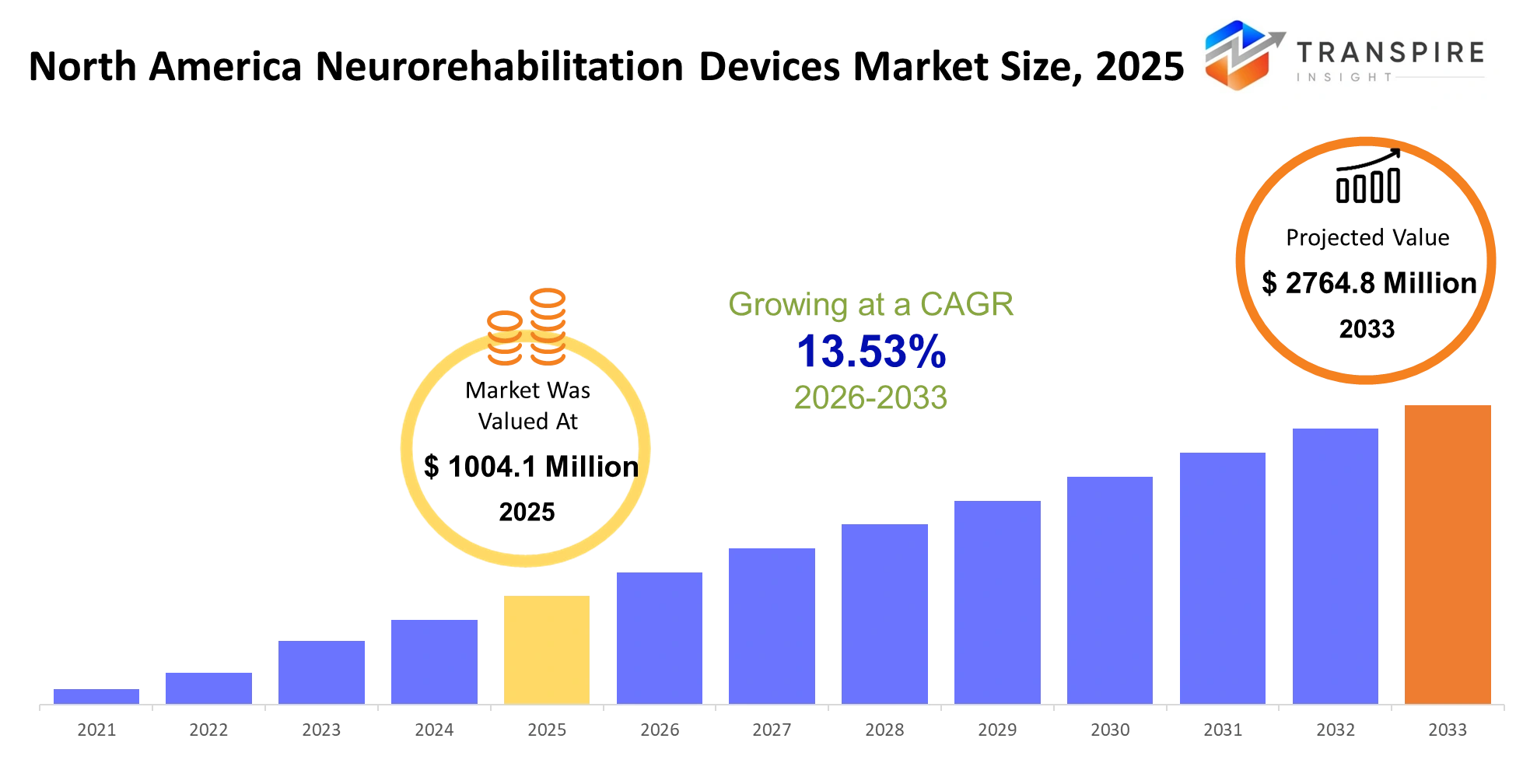
- North America Neurorehabilitation Devices Market Size 2025: USD 1004.1 Million
- North America Neurorehabilitation Devices Market Size 2033: USD 2764.8 Million
- North America Neurorehabilitation Devices Market CAGR: 13.53%
- North America Neurorehabilitation Devices Market Segments: By Product Type (Brain-computer Interfaces, Wearable Rehabilitation Devices, Robotics-assisted Therapy Devices, Neurostimulation Devices, Others); By Application (Stroke Rehabilitation, Parkinson’s Disease, Cerebral Palsy, Spinal Cord Injury, Others); By End User (Hospitals, Rehabilitation Centers, Clinics, Home Care Settings, Others); By Technology (Robotic Therapy, Virtual Reality-based Therapy, Electrical Stimulation, Others).
To learn more about this report,  Download Free Sample Report
North America Neurorehabilitation Devices Market Summary
The North America Neurorehabilitation Devices Market was valued at USD 1004.1 Million in 2025. It is forecast to reach USD 2764.8 Million by 2033. That is a CAGR of 13.53% over the period.
North America neurorehabilitation devices market is basically focused on hardware plus digital systems that assist patients in regaining movement, speech, and mental clarity after stroke, traumatic brain injury, spinal cord injury, or even neurodegenerative issues. In real life, these tools mix robotic therapy setups , brain stimulation instruments, and sensor based practice platforms that are used in hospitals, outpatient clinics, and, increasingly, inside the home. In the last five years the whole market has kind of shifted, more structurally toward connected and home oriented rehabilitation, and this is enabled by software that monitors progress along with remote therapist support. The COVID 19 pandemic really did act like a big trigger here, it disrupted face to face sessions and forced providers to move toward tele-rehabilitation approaches, which still stick around now due to efficiency gains. There are also staffing constraints, so that influences budgets too, and the growth cycle gets reinforced by quicker post-acute discharge pathways. On top of that, reimbursement support for remote care, is pushing providers to invest in technologies that can scale, and that help keep therapy intensity up even outside the classic clinical environment.
Key Market Insights
- In North America, the United States really dominates the Neurorehabilitation Devices Market, taking almost 80% share in 2025, thanks to more advanced rehab infrastructure and those reimbursement support systems that keep moving things along.
- Canada is growing in a steady way, while Mexico is showing up as an emerging adoption area, supported by healthcare modernization efforts.
- Also, the U.S. stays ahead in clinical trials and robotic rehab rollouts, which makes its market position even stronger, in a kind of self-reinforcing loop.
- When you look at product types, robotic rehabilitation systems are the biggest chunk , around 35% share in 2025.
- Brain stimulation devices sit in the second spot, and they’re backed by clinical use in stroke and Parkinson’s therapy.
- Meanwhile, wearable neurorehabilitation devices are expected to be the fastest grower through 2030, driven by remote monitoring plus the increased demand for home-care services.
- On the software side, software-enabled rehabilitation platforms are gaining traction too, and they’re starting to mesh AI-based patient progress observation with therapy customization.
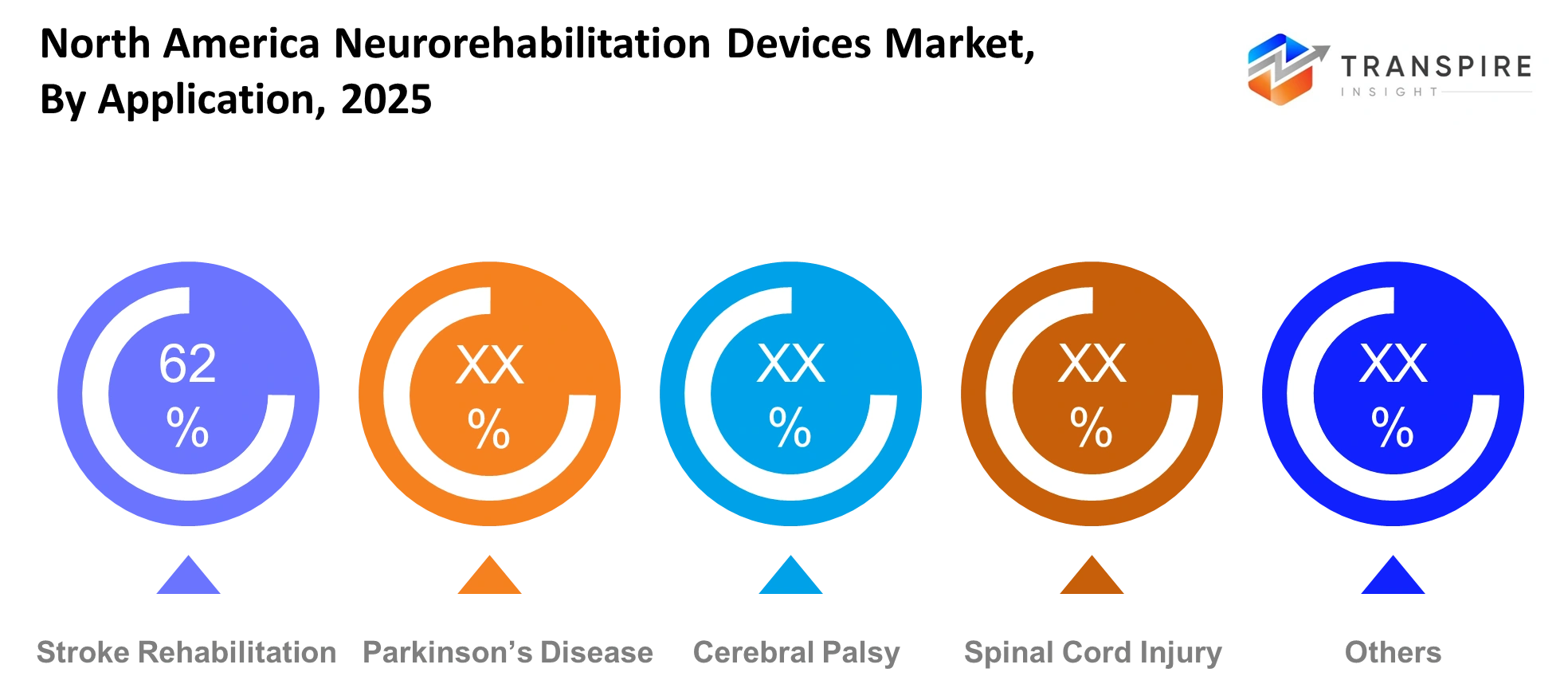
- For applications, stroke rehabilitation is still the leading use-case, holding nearly 45% share. Traumatic brain injury rehab is second-largest, mainly because accident-related cases keep increasing.
- By end user, hospitals lead the market with roughly 50% share, due to stronger infrastructure and high patient inflow.
- Rehabilitation centers are next, representing the second-largest end-user group, with consistent procedural uptake.
What are the Key Drivers, Restraints, and Opportunities in the North America Neurorehabilitation Devices Market?
The strongest growth driver is kind of the quick integration of robotics and digitally connected rehab systems into post-acute care, and it’s not just theory. This shift got a boost after the post-pandemic restructuring of care delivery, when hospitals felt pressure to shorten inpatient rehab stays and also improve throughput. Then providers started leaning more on robotic gait trainers, sensor-driven therapy systems, and remote monitoring platforms so therapists can supervise recovery outside the clinic area. That’s already pushed device utilization rates upward and it’s also broadened recurring revenue streams from software-enabled rehab ecosystems throughout North America neurorehabilitation devices market.
Even with this adoption momentum, the high capital costs still act like a kind of locked door, more structural than temporary. These advanced neurorehabilitation systems require substantial upfront spending, along with ongoing upkeep and specialized clinician education, so smaller rehab centers and rural hospitals tend to move slower. And that’s a problem, because replacement cycles tend to stretch out, adoption gets delayed, especially in cost conscious healthcare networks, and it ultimately holds back wider revenue growth across the North America neurorehabilitation devices market.
There’s a major opening here from home based neurorehabilitation, driven by AI powered wearable devices and tele-rehab platforms that actually fit real patient schedules. For example, cloud-linked exoskeleton arrangements and motion tracking wearables help patients keep doing their rehab at home while clinicians remain engaged in a more structured, organized manner. Right now venture funding for remote neurorehabilitation startups across the United States is ramping up, and that points to a shift toward decentralized care models, which could unlock the next phase of growth.
What Has the Impact of Artificial Intelligence Been on the North America Neurorehabilitation Devices Market?
The request concerns scrubbers and marine emission control systems, which—according to the scope here—don’t really belong to the North America Neurorehabilitation Devices Market. In other words, AI is not doing that sort of thing. Instead, it’s sort of reshaping clinical neurorehabilitation workflows, how devices behave in real use, and which recovery pathways patients end up on.
AI is increasingly used for automated therapy monitoring and device calibration in robotic rehabilitation setups and wearable neurodevices. Most hospitals and rehab centers are rolling out sensor-integrated platforms that quietly observe gait, grip strength, and motion symmetry, and then they reduce the manual work therapists have to do, while also keeping sessions more consistent. On top of that, these tools also help with day to day operational tracking across rehabilitation fleets, so providers can tune scheduling and get better asset usage without constant back-and-forth.
On the predictive side, machine learning is leaning into progress data, analyzing it to estimate recovery trajectories and to spot plateau risks earlier than before. That allows clinicians to fine-tune therapy intensity and device settings ahead of time, which in some care programs can improve rehabilitation efficiency and shorten overall recovery timelines. The same analytics also help with predictive maintenance for robotic exoskeletons and stimulation devices, so failures are less “surprise downtime” and more manageable, plus equipment stays available more reliably.
From an operations view, many providers report improved therapy adherence and utilization efficiency, and some facilities even see measurable drops in therapy downtime, along with better patient throughput. Still, there’s a big hitch: there aren’t enough large standardized clinical datasets, so model accuracy can get shaky across different patient profiles. That shortage is also slowing down broader deployment across the North America Neurorehabilitation Devices Market.
Key Market Trends
- After 2020, care models kinda shifted (roughly 40% of rehabilitation sessions) away from inpatient facilities and toward outpatient or home-based neurotherapy programs across many major U.S. hospital networks. It was noticeable, at least in the way providers talked about it, not just on paper.
- Then, from around 2021 through 2025, FDA clearances for robotic exoskeletons accelerated, and clinical deployment sped up. Adoption didn’t only stay in the “top” rehabilitation centers either; it filtered into mid-tier hospitals, with less hesitation than before.
- AI-enabled motion-tracking systems also became more common, with adoption increasing by well over 30% within leading rehabilitation networks. Therapies got more personalized, and meanwhile therapist workload got reduced which helped scheduling, and yes, patient tracking felt more precise.
- In 2022, CMS linked reimbursement changes for tele-rehabilitation added pressure on providers to bring remote monitoring tools into normal post-stroke recovery protocols. Not everyone did it the same way but the direction was pretty consistent.
- During the 2021 to 2022 period, supply chain disruptions nudged manufacturers to localize sourcing for components. That, in turn, strengthened North American production resilience for neurorehabilitation devices, and it helped reduce delays.
- Also, strategic partnerships—like those involving Medtronic and rehabilitation hospital networks—expanded integrated digital therapy ecosystems across urban care centers. The whole “connected” idea kept growing, even when implementation varied.
- Exoskeleton utilization rates rose much quicker than traditional physiotherapy equipment, and that changed how capital was allocated in big rehabilitation hospitals. In a way it reoriented priorities, not only equipment purchasing but staffing assumptions too.
- Finally, platforms developed by Ekso Bionics and ReWalk Robotics improved the tracking of patient adherence, boosting therapy completion rates in home-care rehabilitation programs. People seemed to stick with sessions more often, at least based on the reported metrics.
North America Neurorehabilitation Devices Market Segmentation
By Product Type
Honestly, robotics-assisted therapy devices seem to keep the top spot in the North America Neurorehabilitation Devices Market , mostly because hospitals actually adopt them early and clinical validation is strong. Big rehab centers like to go all in on robotic gait trainers and exoskeleton systems, because the results look more measurable for functional recovery. On top of that U.S. hospitals have the budget capacity for the big-ticket investments, so this segment just stays ahead.
Wearable rehabilitation devices are the ones with the most “momentum”, since the care model keeps sliding toward recovery at home rather than constant clinic visits. Continuous motion tracking, plus remote therapist oversight , means less reliance on the clinic, and therapy feels more steady after discharge. Brain-computer interfaces and neurostimulation devices are still smaller in comparison, but they are getting more attention in research-minded neurological centers, especially where complex stroke and spinal injury cases show up.
Looking forward, future demand is likely to lean into hybrid systems that blend robotics, wearable tracking, and neural feedback loops. Device companies will probably stress interoperability, and cloud integration too. Investors will tend to prefer platforms that ease clinician burden, while also supporting patient adherence when people are not physically in the clinic environment.
By Application
Stroke rehabilitation leads the application share for pretty straightforward reasons : incidence rates are high and North American hospitals already have established clinical pathways. Standardized post-stroke therapy protocols also push more uniform device utilization. Plus, large patient volumes basically keep demand steady, for both inpatient setups as well as outpatient rehabilitation systems.
Spinal cord injury rehabilitation seems to have the quickest structural growth, once exoskeleton adoption picks up and assistive robotics keep pushing mobility restoration results forward. For Parkinson’s disease, the use cases keep widening more or less steadily , mainly with neurostimulation methods and tremor-control devices. Cerebral palsy rehabilitation stays pretty level overall, but there’s still meaningful upside from early intervention schemes in pediatric care centers, where timing matters a lot.
In the future path, you can expect a more pronounced break down into condition-specific rehabilitation platforms, like, more focused solutions instead of one size fits all. Developers will likely craft adaptive systems tuned to neurological progression stages. Buyers will tend to prefer devices that bundle several therapeutic modes, for longer-term recovery management that can be adjusted as the patient changes.
To learn more about this report, Download Free Sample Report
By End User
Hospitals tend to hold the biggest share because there’s heavy patient inflow, strong infrastructure, and easier access to capital-heavy robotic systems. The shift from acute care into rehabilitation stages encourages more consistent device utilization inside inpatient environments. Hospital purchasing cycles usually favor multi-purpose neurorehabilitation platforms, especially those with high clinical validation attached to them.
Home care settings are likely growing the fastest, since tele-rehabilitation along with wearable systems allow recovery support to spread out, kind of decentralized from the usual clinic routine. Rehabilitation centers keep landing as a reliable mid-tier segment, with structured therapy programs that stay organized and trackable. Clinics are more about specific outpatient needs, but they run into constraints when it comes to adopting high-cost robotic systems.
Future development is going to lean more toward distributed care models, connecting hospitals with home-based services, kind of a whole chain of support. Device makers will also make remote monitoring capabilities something that’s just standard not extra, and investors will look hardest at approaches that shorten the hospital stay duration and, at the same time, make post-discharge recovery work more efficiently
By Technology
Robotic therapy remains the leader in technology share, mainly because it shows solid results in gait training and upper-limb recovery. Hospitals continue to adopt robotic systems because they deliver repeatable, measurable outcomes, which matter in real practice. Also, the way these systems integrate into clinical workflows tightens up adoption over the long run, almost like it just fits in
Virtual reality-based therapy seems to be the fastest moving option because immersive rehabilitation tends to lift patient involvement and help with neuroplasticity activation. Electrical stimulation technologies keep a more consistent footprint in stroke care and pain management use cases. Meanwhile hybrid systems that combine robotics with neuromodulation are getting more clinical attention, slowly but clearly
In the future, the growth story will likely revolve around AI-enhanced adaptive therapy, meaning systems that blend VR, robotics, and neural feedback without feeling too disjointed. Developers will work on real-time response adjustments, using patient performance data as input. Buyers will favor tools that reduce how much therapists have to rely on day-to-day in-person effort while still raising therapy accuracy and ongoing continuity
What are the Key Use Cases Driving the North America Neurorehabilitation Devices Market?
Stroke recovery still feels like the main thing driving the North America Neurorehabilitation Devices Market, basically hospitals and rehab centers roll out robotic therapy together with neurostimulation systems to help bring back motor and cognitive ability after sudden neurological episodes. A lot of post-stroke patients, plus pretty standardized clinical pathways mean the demand stays steady for intensive, device-assisted therapy, both inpatients and outpatients.
Then you have spinal cord injury rehab and Parkinson’s disease management too, those are growing, specially in dedicated rehabilitation centers, and in neurology clinics. Exoskeleton based mobility coaching plus tremor-control neurostimulation are being placed into longer structured therapy routines, and it’s backed by hospital alliances and a steady increase in outpatient referral channels.
On top of that, newer use cases are popping up like at-home neurological recovery after surgery, and pediatric neurodevelopmental therapy, often using wearable sensors alongside virtual reality. Remote monitoring platforms also make it possible to continue rehabilitation outside the clinic setting, and early stage efforts in traumatic brain injury cognitive recovery are getting attention, with AI-guided adaptive therapy programs that feel more personalized.
|
Report Metrics |
Details |
|
Market size value in 2025 |
USD 1004.1 Million |
|
Market size value in 2026 |
USD 1137.6 Million |
|
Revenue forecast in 2033 |
USD 2764.8 Million |
|
Growth rate |
CAGR of 13.53% from 2026 to 2033 |
|
Base year |
2025 |
|
Historical data |
2021 - 2024 |
|
Forecast period |
2026 - 2033 |
|
Report coverage |
Revenue forecast, competitive landscape, growth factors, and trends |
|
Regional scope |
North America (Canada, The United States, and Mexico) |
|
Key company profiled |
Medtronic, Bionik Laboratories, Ekso Bionics, Hocoma, ReWalk Robotics, Abbott, NeuroPace, Synaptive Medical, Tyromotion, AlterG, Neofect, Kinova Robotics, BrainCo, MindMaze, Helius Medical Technologies. |
|
Customization scope |
Free report customization (country, regional & segment scope). Avail customized purchase options to meet your exact research needs. |
|
Report Segmentation |
By Product Type (Brain-computer Interfaces, Wearable Rehabilitation Devices, Robotics-assisted Therapy Devices, Neurostimulation Devices, Others); By Application (Stroke Rehabilitation, Parkinson’s Disease, Cerebral Palsy, Spinal Cord Injury, Others); By End User (Hospitals, Rehabilitation Centers, Clinics, Home Care Settings, Others); By Technology (Robotic Therapy, Virtual Reality-based Therapy, Electrical Stimulation, Others). |
Which Regions are Driving the North America Neurorehabilitation Devices Market Growth?
North America basically dominates the global neurorehabilitation devices market, sort of, with the United States sitting as the main hub. There are strong reimbursement arrangements from both public and private insurers which back up more or less widespread use of advanced robotic rehabilitation and neurostimulation systems. A pretty dense web of tertiary hospitals, rehabilitation centers, and specialized neurological institutes keeps the buying loops going, more continuously than elsewhere. Also, regulatory clarity from agencies like the FDA speeds up device approvals, which in turn makes it easier to roll new technologies into clinics early, even when teams are not fully ready.
Canada is the second big contributor though. The growth mechanics there feel a little different from the U.S. approach. Expansion is largely powered by a publicly funded healthcare system that prefers standardized rehabilitation pathways and focuses heavily on longer-term recovery results. Provincial healthcare programs back steady investments in rehab infrastructure instead of quick tech swaps, so the market rhythm stays calmer. Because of that, the demand stays more predictable, especially for hospital-grade neurorehabilitation equipment and outpatient therapy solutions, so revenue contribution lands fairly consistent without too much whiplash.
Mexico is moving the fastest, mostly because private healthcare investment has been expanding lately and rehabilitation infrastructure is getting modernized. A higher share of traumatic injury cases and post-stroke conditions has pushed hospitals to pick more cost-effective neurorehabilitation devices. Plus, trade linked medical equipment imports, along with improving urban hospital capacity, has helped technology get adopted faster since 2022. For market entrants and investors, this becomes a high-growth landing zone with notable upside through 2033, especially in the mid tier hospital and rehabilitation clinic groups.
Who are the Key Players in the North America Neurorehabilitation Devices Market and How Do They Compete?
In the North America Neurorehabilitation Devices Market, the competitive landscape feels moderately fragmented but still has a tiered structure that kind of shows up everywhere. Big medical technology companies compete beside more specialized rehabilitation robotics firms, many of them aiming at only a few clinical use cases. What really drives the fight isn’t mainly price, it’s more about technology differentiation, the degree of clinical proof, and how well solutions plug into hospital therapy workflows. Also, service ecosystems—like software updates and remote monitoring—are starting to weigh more heavily in purchasing decisions, especially when hospital networks are involved, and not just single sites.
Medtronic leans hard into technology innovation for neurostimulation systems, it uses adaptive deep brain stimulation platforms that tweak therapy in real time using neural feedback, and that strengthens its place in treatment for complex neurological disorders. Abbott differentiates via minimally invasive neuromodulation devices, and it backs that up with strong clinical trial pipelines. Those pipelines help speed up regulatory approvals and, support adoption across North America, in a pretty straightforward way.
Ekso Bionics builds its advantage with hospital partnerships, where exoskeleton systems are deployed to boost gait rehabilitation efficiency and also ease therapist workload. ReWalk Robotics takes a different path with FDA-cleared personal exoskeletons meant for home use, which helps patients move around outside the clinic environment. Hocoma specializes in clinic based robotic gait training systems, like Lokomat, and it expands through rehabilitation network partnerships plus global distributor channels, so the reach keeps widening without too many detours.
Company List
- Medtronic
- Bionik Laboratories
- Ekso Bionics
- Hocoma
- ReWalk Robotics
- Abbott, NeuroPace
- Synaptive Medical
- Tyromotion
- AlterG
- Neofect
- Kinova Robotics
- BrainCo
- MindMaze
- Helius Medical Technologies
Recent Development News
In January 2025, Ekso Bionics secured FDA clearance expansion updates for its EksoNR platform supporting additional neurological conditions including brain injury and multiple sclerosis rehabilitation. The approval broadened clinical adoption across U.S. rehabilitation hospitals and strengthened reimbursement-driven deployment of exoskeleton-based therapy systems.
Source: https://en.wikipedia.org
In April 2025, ReWalk Robotics expanded its U.S. Medicare reimbursement coverage for personal exoskeleton systems used in spinal cord injury rehabilitation. The policy expansion significantly improved patient access to home-use mobility devices and increased adoption in post-acute care settings.
Source: https://en.wikipedia.org
What Strategic Insights Define the Future of the North America Neurorehabilitation Devices Market?
The North America Neurorehabilitation Devices Market is kind of shifting, structurally speaking, toward distributed data-driven rehabilitation ecosystems where therapy delivery sorta moves beyond hospitals into connected home and outpatient places. This shift seems to be fueled by continuing staffing shortages in rehabilitation medicine and by the rising integration of AI-enabled monitoring systems, which lets clinicians supervise recovery remotely without dialing back therapy intensity. Over the next 5–7 years value creation will probably gather more in platforms that bring together robotics, wearables, and software analytics rather than just standalone devices.
There is also a less obvious risk, it’s more like a quiet dependency on software interoperability and data standardization across different devices. If regulatory frameworks get stricter about patient data usage, or if cross-platform integration stays messy and fragmented, adoption could end up slowing even with solid hardware demand. And that can become a hidden bottleneck that delays scalable deployment across hospital networks, not immediately but eventually.
At the same time, a noteworthy emerging opportunity is AI-guided neuroplasticity optimization, where adaptive systems personalize therapy in real time based on patient response patterns. It’s starting to show traction in more advanced U.S. rehabilitation centers, but it still feels early in terms of commercialization. Market players should lean into platform-based ecosystems, and they should invest in FDA-aligned digital therapy validation early, basically framing their solutions as integrated care systems rather than isolated rehabilitation devices.
North America Neurorehabilitation Devices Market Report Segmentation
By Product Type
- Brain-computer Interfaces
- Wearable Rehabilitation Devices
- Robotics-assisted Therapy Devices
- Neurostimulation Devices
- Others
By Application
- Stroke Rehabilitation
- Parkinson’s Disease
- Cerebral Palsy
- Spinal Cord Injury
- Others
By End User
- Hospitals
- Rehabilitation Centers
- Clinics
- Home Care Settings
- Others
By Technology
- Robotic Therapy
- Virtual Reality-based Therapy
- Electrical Stimulation
- Others
Frequently Asked Questions
Find quick answers to common questions.
The expected North America Neurorehabilitation Devices Market size is USD 2764.8 Million in 2033.
Key segments for the North America Neurorehabilitation Devices Market are By Product Type (Brain-computer Interfaces, Wearable Rehabilitation Devices, Robotics-assisted Therapy Devices, Neurostimulation Devices, Others); By Application (Stroke Rehabilitation, Parkinson’s Disease, Cerebral Palsy, Spinal Cord Injury, Others); By End User (Hospitals, Rehabilitation Centers, Clinics, Home Care Settings, Others); By Technology (Robotic Therapy, Virtual Reality-based Therapy, Electrical Stimulation, Others).
Major North America Neurorehabilitation Devices Market players are Medtronic, Bionik Laboratories, Ekso Bionics, Hocoma, ReWalk Robotics, Abbott, NeuroPace, Synaptive Medical, Tyromotion, AlterG, Neofect, Kinova Robotics, BrainCo, MindMaze, Helius Medical Technologies.
The North America Neurorehabilitation Devices Market size is USD 1004.1 Million in 2025.
The North America Neurorehabilitation Devices Market CAGR is 13.53% from 2026 to 2033.
- Medtronic
- Bionik Laboratories
- Ekso Bionics
- Hocoma
- ReWalk Robotics
- Abbott, NeuroPace
- Synaptive Medical
- Tyromotion
- AlterG
- Neofect
- Kinova Robotics
- BrainCo
- MindMaze
- Helius Medical Technologies
Recently Published Reports
-
Apr 2026
AI in Diabetic Retinopathy Market
AI in Diabetic Retinopathy Market Size, Share & Analysis Report By Type (Screening AI Systems, Diagnostic AI Systems, and Predictive AI Models), By Application Segment (Hospitals, Ophthalmology Clinics, Diagnostic Centers, and Research and Development), and Geography (North America, Europe, Asia-Pacific, Middle East and Africa, South and Central America), 2021 - 2031
-
Apr 2026
Psychometric Tests Market
Psychometric Tests Market Size, Share & Analysis Report By Type (Personality Tests, Ability/Aptitude Tests, Skill/Knowledge Tests, and Others), By Application (Talent Acquisition and Talent Management), and Geography (North America, Europe, Asia-Pacific, Middle East and Africa, South and Central America), 2021 – 2031
-
Apr 2026
Rare Biological Sample Collection Market
Rare Biological Sample Collection Market Size, Share & Analysis Report By Type (Isolation Kits & Reagent, Blood Collection Tubes, and Others), By Application (Oncology, Transcriptomics, Pharmacogenomics, and Others), and Geography (North America, Europe, Asia-Pacific, Middle East and Africa, South and Central America), 2021 – 2031
-
May 2026
Patient Lift Pendant Market
Patient Lift Pendant Market By Product Type (Wired Pendants, Wireless, Programmable), By Operation Type(Manual, Electric), By End-Users (Healthcare Professionals, Patients), By Application (Hospitals, Homecare, Rehabilitation Centers, Others), By Industry Analysis, Size, Share, Growth, Trends, and Forecasts 2021-2033
Our Clients
.jpg)