
North America Lab Analytical Instrumentation Market Size & Forecast:
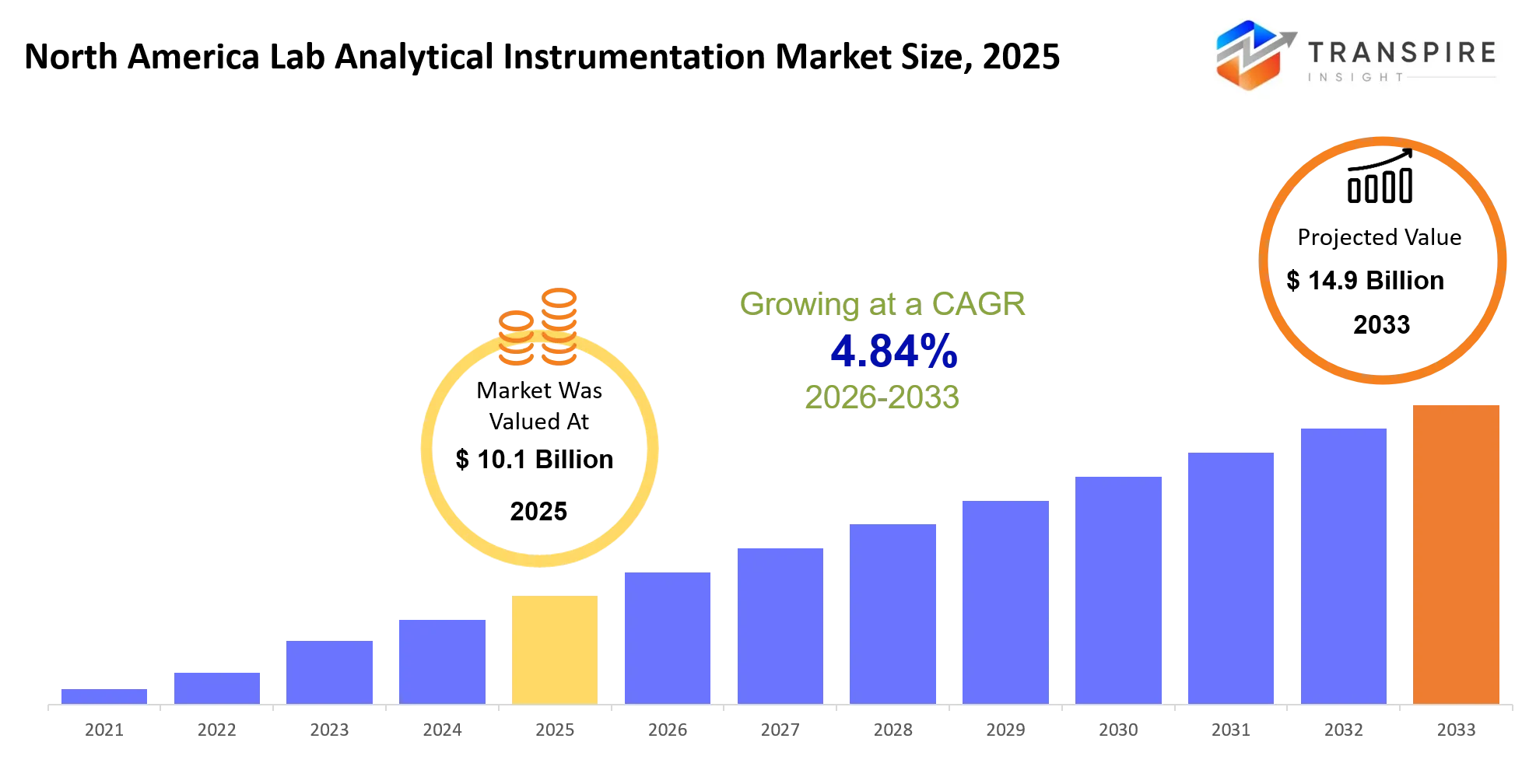
- North America Lab Analytical Instrumentation Market Size 2025: USD 10.1 Billion
- North America Lab Analytical Instrumentation Market Size 2033: USD 14.9 Billion
- North America Lab Analytical Instrumentation Market CAGR: 4.84%
- North America Lab Analytical Instrumentation Market Segments: By Product Type (Spectrometers, Chromatography Systems, Microscopes, PCR Instruments, Others); By Application (Drug Discovery, Clinical Diagnostics, Environmental Testing, Food Testing, Others); By End User (Research Institutes, Pharmaceutical Companies, Diagnostic Laboratories, Others); By Technology (AI-enabled Instruments, Automated Systems, Portable Instruments, Others)
To learn more about this report,  Download Free Sample Report
North America Lab Analytical Instrumentation Market Summary
The North America Lab Analytical Instrumentation Market was valued at USD 10.1 Billion in 2025. It is forecast to reach USD 14.9 Billion by 2033. That is a CAGR of 4.84% over the period.
The North America lab analytical instrumentation market kind of underpins quality control, product development, environmental testing, clinical diagnostics, and also scientific research across a bunch of industries like pharmaceuticals and biotechnology, plus food processing and advanced manufacturing. In practice these instruments churn out very precise chemical, biological, and material data that organizations lean on to validate products, satisfy regulatory requirements, and generally speed up innovation.
Over the last five years the market has shifted in a more structural way, toward automated, digitally connected, and higher throughput analytical platforms, making everything feel more synchronized and in real use, less manual.Laboratories are steadily mixing in artificial intelligence, cloud based data management, and workflow automation to push productivity forward, and to deal with skilled labor shortages that are becoming harder to fill. One big push behind all of this was the COVID-19 pandemic, which kind of revealed the limits in lab capacity, and it also made it clear they needed faster, more scalable testing infrastructure. So, organizations raised spending on modern analytical systems that can handle bigger sample volumes and still keep strong accuracy.
This modernization cycle is not just boosting instrument utilization, it is also lifting software and services revenues, and it’s nudging labs to swap out older legacy equipment with more advanced platforms, step by step.
Key Market Insights
- The North America Lab Analytical Instrumentation Market is expanding steadily, kind of, mainly backed by laboratory automation, digital analytics and increasing investment s into life sciences research.
- It feels like there’s a momentum that doesn’t really slow down, and the market outlook stays positive through 2030, because analytical technologies keep riding on higher testing volumes, tougher regulatory compliance expectations and more advanced research applications.
- Within North America, the United States still dominates, roughly about 82% of regional revenue in 2025, mostly due to the big, established research infrastructure.
- Canada on the other hand, is the fastest-moving regional market through 2030, helped by biotechnology investments, academic research funding and various lab modernization initiatives.
- Also, strong pharmaceutical manufacturing activity, alongside clinical research work, continues to reinforce North America’s major role in the global analytical instrumentation industry, so the baseline share remains strong.
- When you look at segments by product or service, spectroscopy instruments are leading, with an estimated 32% share in 2025, and this is driven by their common use in pharmaceutical analysis and materials evaluation.
- Chromatography systems sit in second place, supported by the expanding range of uses across drug development and environmental testing laboratories.
- Mass spectrometry instruments are projected to keep growing the fastest through 2030, mostly powered by precision diagnostics plus those biomarker discovery initiatives that seem to never slow down.
- At the same time, lab software and integrated data management platforms are picking up momentum too, since many labs are trying to improve workflow efficiency, along with meeting regulatory compliance, and honestly they also want smoother, quieter operations in day to day use.
- As for applications, pharmaceutical and biotechnology research is the main push here, contributing close to 38% of the market revenue in 2025 thanks to intensive analytical testing requirements.
What are the Key Drivers, Restraints, and Opportunities in the North America Lab Analytical Instrumentation Market?
Driver
One of the strongest growth driver in the North America Lab Analytical Instrumentation Market is the rapid expansion of biologics, cell and gene therapies, plus precision medicine programs, sort of all together. Now pharmaceutical companies need much more intricate analytical testing compared with the older small-molecule development approach. Because of this change, investment keeps moving faster into high-resolution mass spectrometry, advanced chromatography, and also automated sample preparation setups. On top of that, regulatory agencies expect broad characterization of biologic products during development and manufacturing, so the number of analytical workflows carried out per drug candidate keeps climbing. So in practice, labs are buying higher-value instrumentation and taking on larger service contracts, and that directly adds to market revenue.
Restraint
The biggest restraint is the high total cost of ownership that comes with advanced analytical platforms. After the initial equipment purchase, laboratories still have to cover specialized facilities, software validation, maintenance agreements, and keep highly trained personnel on hand. This becomes a structural issue because know-how in analytical chemistry, bioinformatics, and instrument operation can’t be built quickly enough. Smaller labs and academic institutions often hold back on upgrades or they lean on outsourcing, which can slow down adoption timelines and reduce market reach. Therefore capital spending gets delayed, and instrument manufacturers miss out on unrealized revenue opportunities.
Opportunity
There is a pretty big opportunity sitting right where artificial intelligence meets laboratory automation. In North America, more labs are rolling out AI enhanced data analysis platforms, which in practice cuts down the interpretation time a lot and helps the workflow move with less friction. Like, automated mass spectrometry together with chromatography setups when they’re tied to machine learning can handle bigger sample volumes while still needing fewer hands-on steps. So as pharmaceutical companies and contract research organizations modernize their digital lab infrastructure, the vendors that bundle instrumentation, software, and analytics into one coherent platform kind of get the better lane for the next wave of growth in the market.
What Has the Impact of Artificial Intelligence Been on the North America Lab Analytical Instrumentation Market?
Artificial intelligence, and advanced digital technologies, are changing laboratory analytical workflows across North America by making instrument use better, data interpretation smoother and day to day operations more efficient. Lately, new analytical platforms are also pairing AI driven software into the routine, it helps with things like sample scheduling, instrument calibration checks, quality control reviews and then the data processing side, basically the more repetitive tasks. In chromatography, mass spectrometry, and spectroscopy labs, these automated flows cut down on manual work and let researchers handle larger sample volumes, without needing to grow staffing in the same proportion.
At the same time, machine learning models are adding stronger predictive power. Instead of waiting for problems, laboratories use these models to spot instrument performance drifts before failures show up, so predictive maintenance becomes realistic and it reduces the surprise downtime. AI algorithms can sift through past operating logs, sensor signals, and environmental conditions, to project component wear and then tune the maintenance timeline. As a result, instrument uptime improves, the equipment life spans tend to extend, and service related expenses can drop. On top of that, advanced analytics platforms speed up peak identification, support anomaly detection, and help with pattern recognition inside complicated datasets, which shortens analysis time and improves what the team decides next.
Overall, these tools help labs reach higher throughput, deliver faster turnaround times, and maintain stronger regulatory compliance, largely because automated audit trails and data integrity monitoring are built in. Still, there is a clear catch: the cost is high, and the integration complexity is real, especially when AI platforms have to connect with older laboratory infrastructure. A lot of facilities run instruments from multiple vendors, and that makes data standardization messy which can slow implementation and also cap the full value of AI-enabled laboratory ecosystems.
Key Market Trends
- Since 2020, labs have been speeding up adoption of automated sample preparation systems, kinda to offset workforce shortages, and also to push higher testing throughput. I mean, it’s been noticeable.
- Pharmaceutical firms started putting more money into high resolution mass spectrometry as biologics and cell therapy pipelines kept expanding across North America, so yeah, that direction became more normal by now.
- AI data analysis tools that were mostly “just pilots” in earlier phases have, between 2022 and 2025, moved into routine lab workflows, cutting down the time spent on manual interpretation, which matters a lot.
- Contract research organizations also increased their instrument investments when outsourcing activity from pharma ramped up a lot, especially after the pandemic era operational shifts.
- Big manufacturers, Thermo Fisher Scientific, Agilent Technologies, and Waters Corporation, have expanded their software collections alongside hardware offerings since 2021, not only the physical stuff.
- Regulatory focus on data integrity pushed labs away from paper based records. People replaced those with cloud connected analytical management platforms, which is… pretty direct.
- Instrument vendors have been bundling maintenance services plus analytics software plus workflow automation, instead of only competing on hardware performance alone, or at least that’s what it looks like.
- Multi omics research programs drove stronger demand for integrated chromatography and mass spectrometry setups rather than the older model of standalone systems, you know.
- During 2021 and 2022, supply chain disruptions made labs diversify their vendor relationships and hold bigger inventories of critical consumables.
- Research institutions are increasingly leaning toward interoperable lab platforms that connect instruments, software, and databases inside unified digital environments, so everything talks to everything else.
North America Lab Analytical Instrumentation Market Segmentation
By Product Type
Spectrometers kind of hold the lead in laboratory analytical instrumentation, mainly because they are adopted widely in pharmaceutical research, environmental monitoring, clinical testing, and materials science. There’s strong demand for molecular characterization, biomarker discovery, and quality assurance which keeps them in a solid slice of the overall industry revenue. Chromatography systems sit in the second spot, they stay popular because labs need accurate compound separation, plus quantification, across research and also manufacturing routines.
But the growth story is not the same everywhere. Spectrometers tend to ride the momentum from biologics development and more advanced analytical needs. Chromatography systems get extra traction from regulatory testing and drug development programs. PCR instruments still bring in capital from molecular diagnostics and genomics use cases. Meanwhile microscopes, they remain useful in cell biology, pathology, and materials analysis.
Over the forecast period, integrated analytical platforms that bring together spectroscopy, chromatography, and stronger software functions are expected to draw more attention and investment. Product developers that focus on automation, digital connectivity, and data analytics probably will improve their competitive position, while buyers more often prefer multifunctional systems that boost lab output and overall productivity.
By Application
Drug discovery is the biggest application segment, mainly because it needs a lot of analytical testing across pharmaceutical research and development. There are huge testing volumes, heavy regulatory paperwork, and complex biologic pipelines too, so spending stays high on advanced instruments. Clinical diagnostics also comes in near the top, supported by the continued rise of molecular testing, plus the push for precision medicine programs.
Each application area has its own kind of growth momentum. Drug discovery relies on steady pharmaceutical innovation and increasing research complexity. Clinical diagnostics gets a boost from wider genomic testing adoption and a more personal healthcare mindset. Environmental testing tends to move forward with tougher contaminant monitoring requirements, and food testing grows as safety rules get stronger, along with tighter supply chain quality oversight.
Looking ahead, future chances should appear through quicker and more automated testing routines. Labs that cut down the analysis time yet keep accuracy steady are likely to see real operational advantages. And instrument manufacturers that adjust their solutions for specific use cases should do better with stronger customer loyalty, and longer term revenue momentum.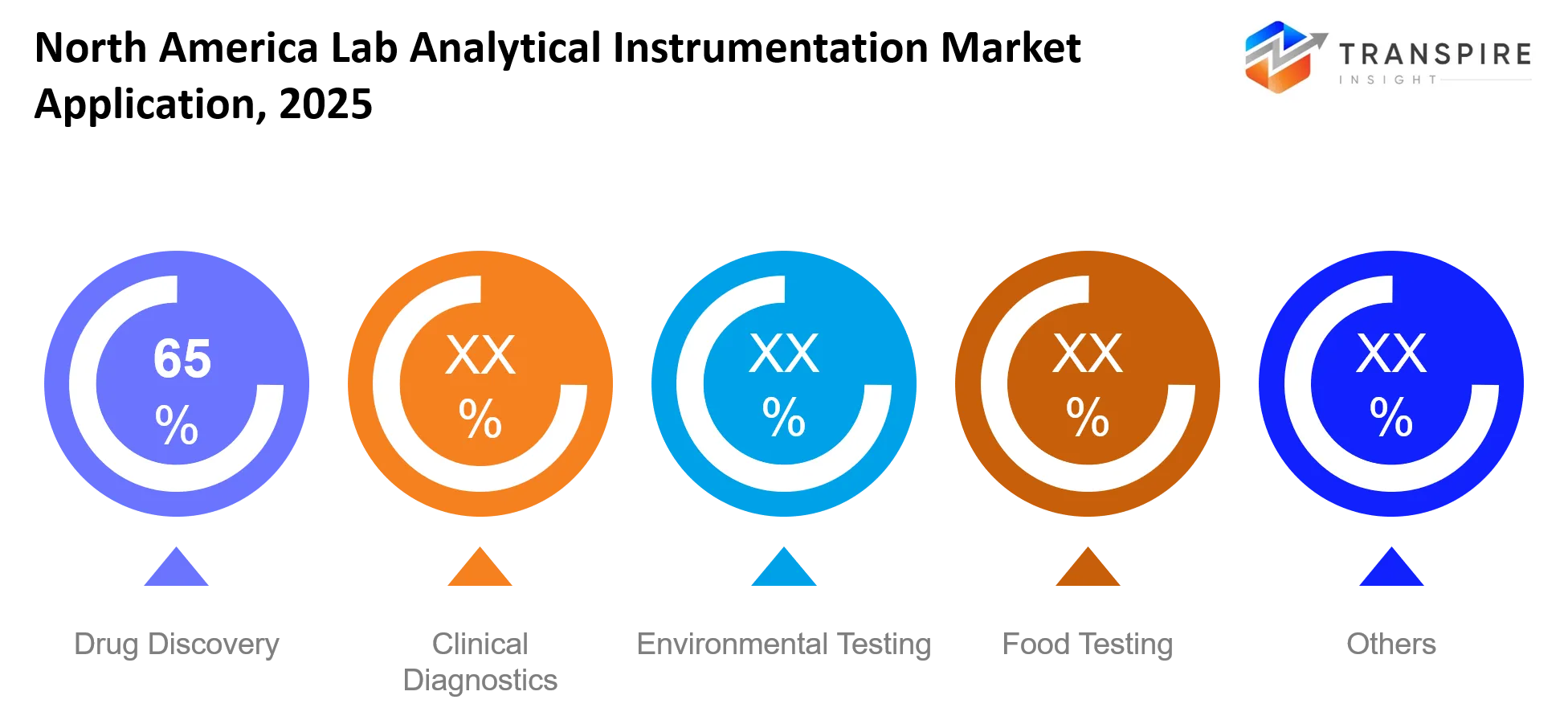
To learn more about this report, Download Free Sample Report
By End User
Pharmaceutical companies take the biggest slice among end users, mostly because drug development, manufacturing validation, and quality assurance tasks demand a lot of analytical testing. Big research budgets plus ongoing spending on newer laboratory technologies help keep this segment in the lead. Research institutes also sit as a noticeable user base, mainly via government backed programs and university led projects.
In practice, each end user category seems to follow its own adoption rhythm. Pharmaceutical organizations go for high-performance setups, those systems help with regulatory compliance and also keep product development on schedule. Diagnostic labs tend to care more about throughput, dependability and day to day operational efficiency. Research institutes typically prefer analytical flexibility, so they can handle varied investigations across several disciplines, without too much friction.
Across the forecast period, contract research work and outsourced laboratory services are likely to steer what buyers choose. Vendors that provide scalable solutions, service coverage, and software integration functions may end up taking a bigger part of the budget pie. Investors, in turn, might spot opportunities with suppliers that serve both commercial labs and academic environments, more or less at the same time.
By Technology
Right now automated systems keep the strongest market position, mainly because labs want more throughput, better reproducibility, and less reliance on hand driven workflows. Automation helps with sample handling, data processing, and quality control across a lot of different testing setups . AI-enabled instruments are still a smaller slice, but they are expanding fast, as laboratories fold advanced analytics into everyday routines.
The growth drivers are pretty different depending on the technology type. Automated systems help with labor shortages and also day to day efficiency problems. AI-enabled instruments make faster sense of data, they help with anomaly detection, plus they enable predictive maintenance. Portable instruments are getting more traction too, especially for field trials, environmental monitoring, and decentralized analytical applications where quick results actually matter for operations.
Looking ahead, technology investment priorities are expected to tilt toward smarter and connected laboratory ecosystems. Instrument manufacturers that combine automation, artificial intelligence, cloud connectivity, and sophisticated software platforms will likely land better future demand. Buyers are increasingly choosing tools that boost productivity, align with compliance duties, and turn complicated analytical data into practical, usable insights.
What are the Key Use Cases Driving the North America Lab Analytical Instrumentation Market?
Pharmaceutical research, and drug discovery still basically dominate as the main use cases for lab analytical instrumentation across North America. Drug developers lean on chromatography spectroscopy, and mass spectrometry systems to pin down compounds, double-check formulations, and satisfy regulatory expectations during clinical development. And that ongoing momentum, from biologics and cell therapy programs, keeps demand pretty solid for newer analytical platforms, yes.
At the same time, clinical diagnostics and environmental testing are getting more attention, and honestly they’re expanding pretty fast. Diagnostic labs are using analytical instruments more often for molecular testing, biomarker assessment, and also precision medicine programs. Meanwhile environmental agencies, and industrial testing facilities use advanced setups to watch contaminants, and to meet tighter federal as well as state regulations that keep showing up.
More emerging use cases are tied to multi-omics research plus AI-assisted laboratory analytics. Research institutes and biotech firms are adopting integrated analytical platforms that help with genomics, proteomics, and metabolomics studies. On top of that, newer digital workflows that mix automation with machine learning are creating extra room for quicker data interpretation and more predictive laboratory operations over the forecast period, too.
|
Report Metrics |
Details |
|
Market size value in 2025 |
USD 10.1 Billion |
|
Market size value in 2026 |
USD 10.7 Billion |
|
Revenue forecast in 2033 |
USD 14.9 Billion |
|
Growth rate |
CAGR of 4.84% from 2026 to 2033 |
|
Base year |
2025 |
|
Historical data |
2021 - 2024 |
|
Forecast period |
2026 - 2033 |
|
Report coverage |
Revenue forecast, competitive landscape, growth factors, and trends |
|
Regional scope |
North America (Canada, The United States, and Mexico) |
|
Key company profiled |
Thermo Fisher Scientific, Agilent Technologies, Waters Corporation, Shimadzu Corporation, Bruker, PerkinElmer, Danaher Corporation, Sartorius AG, Bio-Rad Laboratories, JEOL, Hitachi High-Tech, Mettler Toledo, Anton Paar, Carl Zeiss AG, Oxford Instruments |
|
Customization scope |
Free report customization (country, regional & segment scope). Avail customized purchase options to meet your exact research needs. |
|
Report Segmentation |
By Product Type (Spectrometers, Chromatography Systems, Microscopes, PCR Instruments, Others); By Application (Drug Discovery, Clinical Diagnostics, Environmental Testing, Food Testing, Others); By End User (Research Institutes, Pharmaceutical Companies, Diagnostic Laboratories, Others); By Technology (AI-enabled Instruments, Automated Systems, Portable Instruments, Others) |
Which Regions are Driving the North America Lab Analytical Instrumentation Market Growth?
The United States stays the main market across North America, mostly because of its wide ranging pharmaceutical, biotechnology, clinical diagnostics and academic research ecosystem. Strong federal funding for biomedical research plus the huge concentration of pharmaceutical manufacturers, still keeps instrument adoption rates on the high side. Regulatory oversight from bodies like the U.S. Food and Drug Administration nudges companies to keep investing in more advanced analytical technologies, and data integrity systems. Also, there’s a fairly mature web of research universities, contract research organizations, and lab service providers that just keeps the market leadership steady over the long term.
Canada sits as the second-largest regional market, but the growth comes from a slightly different angle. It is not only about scale, Canada leans on stable public research support, a solid healthcare system, and continuous investments in biotechnology innovation. Government supported research initiatives, along with partnerships between universities and industry participants create a more predictable pull for analytical instrumentation. That kind of steadiness helps Canada contribute reliably to regional revenue even when broader economic conditions feel shaky.
Mexico is currently the fastest-growing market in the region since pharmaceutical production, medical device manufacturing, and industrial testing know how are still expanding. Newer investments tied to nearshoring programs and modern manufacturing facilities have raised the need for quality assurance, and lab testing infrastructure. As more firms join North American supply chains, they’re more motivated to refresh analytical capabilities and match international quality standards. This pace brings favorable opportunities for instrument suppliers, software providers, and service organizations seeking growth between 2026 and 2033.
Who are the Key Players in the North America Lab Analytical Instrumentation Market and How Do They Compete?
Competition in the North America lab analytical instrumentation market is pretty moderately consolidated, with a small group of global manufacturers that control a meaningful share of the revenue across chromatography, spectroscopy, mass spectrometry, and molecular analysis platforms. Technology performance, software integration, regulatory compliance support, and post-sale service capabilities have become the main grounds of competition rather than instrument pricing only, though pricing still matters to some buyers. Established suppliers keep defending their market share with continuous product development, plus digital ecosystem expansion and related partnerships. At the same time, specialized companies aim at less served use cases in genomics, proteomics, and advanced diagnostics. Buyers tend to assess vendors based on workflow efficiency, data management features, and longer-horizon service support.
Thermo Fisher Scientific differentiates itself with a wide set of offerings, basically pairing analytical instruments, laboratory software, consumables, and contract services into one overall platform. That integrated setup can reduce procurement complexity for pharmaceutical and biotechnology customers, and it also simplifies internal validation steps for many teams. The company keeps moving forward by using targeted acquisitions, investing in laboratory informatics, and extending support for biologics as well as cell therapy research workflows. Agilent Technologies emphasizes workflow-first solutions that link chromatography, spectroscopy, and data analytics platforms. Their regulatory compliance tooling, together with laboratory informatics capabilities, gives a practical advantage in tightly regulated pharmaceutical settings where documentation and audit trails are crucial.
Waters Corporation holds a strong footing in liquid chromatography and mass spectrometry applications, especially for pharmaceutical quality control, plus drug development programs. The company continues to invest in high level technology upgrades, and it expands its software and service portfolio to keep customers on modern workflows over time.Continuous investments in high-sensitivity analytical systems and software-driven workflow optimization help the company address complex testing requirements. Danaher Corporation, through businesses such as SCIEX and Beckman Coulter Life Sciences, emphasizes precision analytics, automation, and diagnostic technologies. Strategic investments in automation platforms and digital laboratory solutions allow Danaher to expand adoption across both research and clinical testing environments.
Company List
- Thermo Fisher Scientific
- Agilent Technologies
- Waters Corporation
- Shimadzu Corporation
- Bruker
- PerkinElmer
- Danaher Corporation
- Sartorius AG
- Bio-Rad Laboratories
- JEOL
- Hitachi High-Tech
- Mettler Toledo
- Anton Paar
- Carl Zeiss AG
- Oxford Instruments
Recent Development News
“In May 2026, Thermo Fisher Scientific launched next-generation mass spectrometry innovations at ASMS 2026. The new analytical platforms are designed to accelerate drug discovery and biopharmaceutical research workflows, reinforcing Thermo Fisher’s leadership in advanced laboratory analytical instrumentation. [ https://ir.thermofisher.com
“In March 2026, Agilent Technologies announced acquisition of Biocare Medical in a $950 million all-cash deal. The acquisition enhances Agilent’s pathology and tissue-diagnostics portfolio, broadening its laboratory instrumentation and diagnostics capabilities for cancer and infectious disease testing. [ https://www.reuters.com
What Strategic Insights Define the Future of the North America Lab Analytical Instrumentation Market?
North America lab Analytical Instrumentation Market seems to be shifting, toward these really highly integrated lab ecosystems where the analytical instruments, automation platforms, artificial intelligence, and cloud informatics all kind of work together as one thing. you can see it happening because biologics are getting more complex, cell therapies too, plus precision medicine programs, and just overall data heavy research workflows that really need faster and more scalable analytical capability. In the next five to seven years, the edge that companies have in the market will mostly come down to software intelligence and workflow integration, not only the raw instrument performance.
There is also this less visible kind of risk, like market concentration around a small number of big technology providers. when labs get more dependent on proprietary software environments, and connected platforms, the switching costs can go up. Then purchasing flexibility gets tighter, and that may slow down adoption of new tech at organizations that have tighter budgets.
But at the same time, there is an emerging opportunity too. AI-native analytical platforms that can do autonomous method optimization, predictive quality control, and real time data interpretation are starting to make sense. Market players should probably focus on investments in interoperable software architectures and open data ecosystems, since labs are expected to lean toward vendors that can fit in smoothly with a bunch of different instrument fleets. That also helps reduce operational headaches and those compliance burdens that nobody really wants to deal with, every day.
North America Lab Analytical Instrumentation Market Report Segmentation
By Product Type
- Spectrometers
- Chromatography Systems
- Microscopes
- PCR Instruments
- Others
By Application
- Drug Discovery
- Clinical Diagnostics
- Environmental Testing
- Food Testing
- Others
By End User
- Research Institutes
- Pharmaceutical Companies
- Diagnostic Laboratories
- Others
By Technology
- AI-enabled Instruments
- Automated Systems
- Portable Instruments
- Others
Frequently Asked Questions
Find quick answers to common questions.
The Expected North America Lab Analytical Instrumentation Market size is USD 14.9 Billion in 2033.
Key Segments for the North America Lab Analytical Instrumentation Market are By Product Type (Spectrometers, Chromatography Systems, Microscopes, PCR Instruments, Others); By Application (Drug Discovery, Clinical Diagnostics, Environmental Testing, Food Testing, Others); By End User (Research Institutes, Pharmaceutical Companies, Diagnostic Laboratories, Others); By Technology (AI-enabled Instruments, Automated Systems, Portable Instruments, Others).
Major North America Lab Analytical Instrumentation Market Players are Thermo Fisher Scientific, Agilent Technologies, Waters Corporation, Shimadzu Corporation, Bruker, PerkinElmer, Danaher Corporation, Sartorius AG, Bio-Rad Laboratories, JEOL, Hitachi High-Tech, Mettler Toledo, Anton Paar, Carl Zeiss AG, Oxford Instruments.
The Current North America Lab Analytical Instrumentation Market size is USD 10.1 Billion in 2025.
The North America Lab Analytical Instrumentation Market CAGR is 4.84% from 2026 to 2033.
- Thermo Fisher Scientific
- Agilent Technologies
- Waters Corporation
- Shimadzu Corporation
- Bruker
- PerkinElmer
- Danaher Corporation
- Sartorius AG
- Bio-Rad Laboratories
- JEOL
- Hitachi High-Tech
- Mettler Toledo
- Anton Paar
- Carl Zeiss AG
- Oxford Instruments
About the Authors

Pankaj Ghogare Patil
I am Pankaj Ghogare Patil, a Senior Research Analyst at Transpire Insight, specializing in the Pharmaceutical, Chemicals & Materials, Healthcare IT, and Biotechnology industry. My expertise lies in conducting comprehensive market research, analyzing industry trends, evaluating competitive landscapes, and translating complex data into actionable insights. At Transpire Insight, I closely follow emerging technologies, regulatory developments, and market innovations to create accurate, well-researched, and informative content that helps businesses and professionals make informed decisions. I am committed to producing credible, evidence-based articles that reflect industry best practices while making technical topics accessible and valuable for a broad audience.

Chakradhar Khansole
Chakradhar serves as the Research Director at Transpire Insight, bringing over 8 years of experience in technology, innovation, and strategic market intelligence. He specializes in transforming complex market data into actionable business insights that enable organizations to make informed, growth-oriented decisions. Recognized for his strategic vision and analytical expertise, Chakradhar leads high-impact research initiatives, delivering comprehensive market assessments, competitive intelligence, and forward-looking industry analysis.
Recently Published Reports
-
Apr 2026
Cord Blood Banking Services Market
Cord Blood Banking Services Market Size, Share & Analysis Report By Type of Service (Collection, Processing, Storage), By Bank Type (Private Banks, Public Banks, and Hybrid Banks), By Component (Cord Blood, and Cord Tissue), By End User (Hospitals, Research Institutions, Biotechnology Companies, and Others) and Geography (North America, Europe, Asia-Pacific, Middle East and Africa, South and Central America), 2021 - 2031
-
Apr 2026
ELISA Processors Market
ELISA Processors Market Size, Share & Analysis Report By Type (Optical Filter ELISA Analyzer, and Optical Grating ELISA Analyzers), By Mode (Automated ELISA Analyzers, and Semi-Automated ELISA Analyzers), By Applications (Immunology, Vaccine development, Drug Monitoring, and Others), By End Users (Biotechnology Companies, Pharmaceutical Companies, Contract Research Organization, and Diagnostic Laboratories) and Geography (North America, Europe, Asia-Pacific, Middle East and Africa, South and Central America), 2021 - 2031
-
May 2026
Microscope Slide Scanner Market
Microscope Slide Scanner Market Size, Share & Analysis Report By Type (Portable Microscope Slide Scanner, and Desktop Microscope Slide Scanner), By Application (Biological Research, Medicine, Veterinary, and Other) and Geography (North America, Europe, Asia-Pacific, Middle East and Africa, South and Central America), 2021 - 2031
-
Apr 2026
Microwave Cookware Market
Microwave Cookware Market Size, Share & Analysis Report By Material Type (Plastic, Glass, Ceramic, Silicone, and Metal), By Application (Cooking, Reheating, and Defrosting), By End User (Household, Commercial (Restaurants, Hotels, and Cafes), and Food Service Industry), By Sales Channel (Online Retail, Offline Retail (Supermarkets, Hypermarkets, Specialty Stores), and Direct Sales (Company Outlets)) and Geography (North America, Europe, Asia-Pacific, Middle East and Africa, South and Central America), 2021 - 2031