North America Infant Resuscitators Market Size & Forecast:
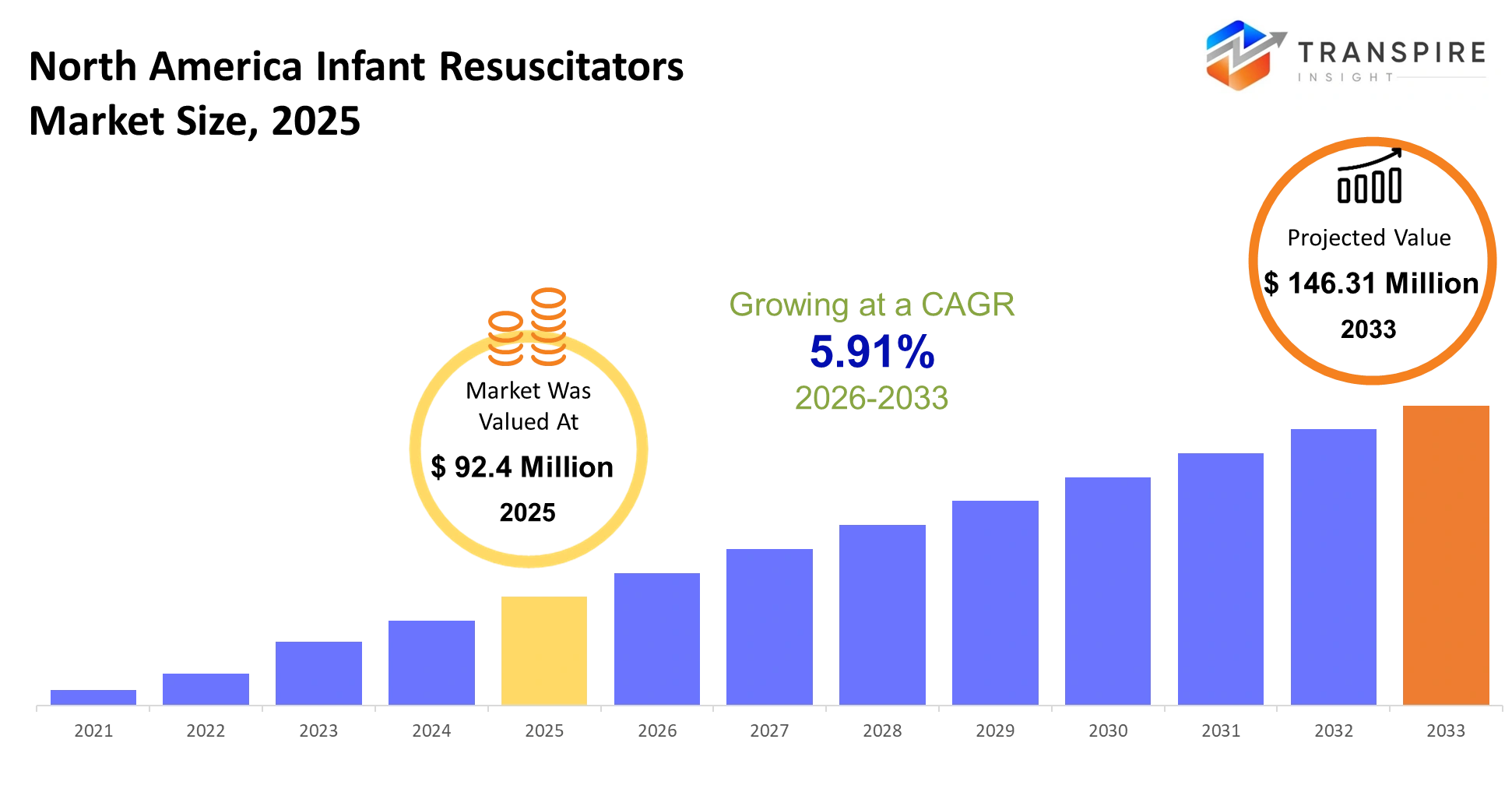
- North America Infant Resuscitators Market Size 2025: USD 92.4 Million
- North America Infant Resuscitators Market Size 2033: USD 146.31 Million
- North America Infant Resuscitators Market CAGR: 5.91%
- North America Infant Resuscitators Market Segments: By Product Type (Manual Resuscitators, T-piece Resuscitators, Flow-inflating Resuscitators, Others); By Application (Neonatal Resuscitation, Emergency Care, NICU Care, Others); By End User (Hospitals, Neonatal Clinics, Ambulatory Care Centers, Others); By Component (Masks, Valves, Bags, Oxygen Reservoirs, Others)
To learn more about this report,  Download Free Sample Report
North America Infant Resuscitators Market Summary
The North America Infant Resuscitators Market was valued at USD 92.4 Million in 2025. It is forecast to reach USD 146.31 Million by 2033. That is a CAGR of 5.91% over the period.
In North American hospitals, infant resuscitators mainly help with immediate breathing support for newborns who can’t really get stable respiration going right after birth, especially in higher-risk deliveries and for premature births. These devices sort of sit right at the center of delivery room response workflows, and it is true, those seconds can decide survival as well as longer-term neuro outcomes.
In the last 3–5 years, day to day care has shifted a bit, from hands-on manual ventilation that depends on the person doing the work, to more controlled-pressure setups like T-piece resuscitators that also include monitoring feedback. That kind of change in structure tracks with newer neonatal resuscitation guidance, which leans into more precise ventilation and lower risk of lung trauma. On top of that, COVID-19 basically became a real-world pressure point by tightening infection prevention rules and speeding up the move away from reusable parts, toward safer standardized replacements in many hospitals.
This market growth has then accelerated, because hospitals now care more about consistent outcomes and regulatory requirements rather than just the initial equipment price. Procurement teams are more and more selecting integrated resuscitation platforms that shrink clinician-to-clinician variation and make documentation easier. So manufacturers that can provide connected, guideline-matched systems tend to win bigger contract value, and also keep replacement cycles going for longer across neonatal care networks.
Key Market Insights
- The North America Infant Resuscitators Market kind of feels like it’s mostly owned by the United States, where it holds almost 78% share in 2025, mostly because the NICU set up is more advanced and the neonatal safety rules are pretty strict.
- Canada shows up as a steadier secondary contributor , with consistent uptake helped along by centralized healthcare purchasing plus provincial neonatal care upgrades, those modernization programs.
- Now for the Latin America-linked cross border demand… that one seems to be moving fastest across 2026–2033, fueled by neonatal infrastructure improvements, and also maternal health funding initiatives that keep expanding.
- When it comes to products, T-piece resuscitators are leading adoption with about 42% share in 2025, this is tied to clinicians leaning toward pressure-controlled ventilation in higher risk neonatal scenarios.
- After that, manual resuscitators stay in second place, largely due to cost effectiveness, and because they’re easy to carry during emergencies across hospital units and ambulance services.
- Looking ahead, flow-inflating resuscitators are projected to grow the quickest through 2033, with support from more consistent clinical training and the need for precise ventilation.
- In terms of application, neonatal resuscitation takes nearly 55% of the share, which lines up with higher preterm birth rates, plus strict delivery room intervention protocols being followed.
- As for the application that’s expanding fastest, NICU care is climbing fastest too, because hospitals are investing in longer-term respiratory stabilization technologies for premature infants.
- On end users, hospitals dominate at close to 70% share, driven by centralized procurement practices and the continual buildout of high acuity neonatal care infrastructure.
- Finally, ambulatory care centers are expanding faster than the rest, supported by decentralized maternal care models and rural healthcare access initiatives that keep pushing into more areas.
What are the Key Drivers, Restraints, and Opportunities in the North America Infant Resuscitators Market?
In North America, the primary driver in the infant resuscitators market feels like it comes down to neonatal resuscitation protocols getting tighter, and hospitals quietly investing in more high-acuity delivery room infrastructure. Newer clinical guidelines stress controlled ventilation pressure, plus faster stabilization for preterm infants, so many centers are moving away from manual-only setups toward T-piece resuscitators and some kind of integrated monitoring devices. And because big hospital groups tend to standardize across maternity wards and NICUs, this move tends to lift procurement volumes— repeat purchases happen sooner, and premium units get picked up more quickly. It kind of snowballs, right.
For restraints, the biggest one is probably the fragmented interoperability, between advanced resuscitation devices and older hospital infrastructure. A lot of community hospitals still use outdated monitoring systems that do not fully “talk” with digitally enabled resuscitators, so clinicians can only use part of the device’s capabilities. That structural mismatch ramps up training difficulty, and it also lowers the return on investment, so full upgrades get delayed. At the same time, it can suppress revenue realization for manufacturers that rely on ecosystem-based value delivery, not just standalone device sales.
A key opportunity that is starting to look more real involves connected neonatal emergency response systems spreading into rural and underserved regions, especially across the United States Midwest and certain areas of Canada. There are public health funding programs that increasingly back portable resuscitation units, which are paired with telemedicine guidance and simulation-driven training platforms. Manufacturers offering compact hardware alongside cloud-enabled clinical decision support may open up new adoption routes in non-tertiary care, in effect creating a second growth wave, after the already strong NICU network momentum.
What Has the Impact of Artificial Intelligence Been on the North America Infant Resuscitators Market?
Artificial intelligence, and advanced digital technologies are kinda reshaping the North American infant resuscitation device segment, by boosting how ready the equipment feels and how clinically reliable it is across neonatal care settings.In hospital environments, AI-enabled asset management platforms automate tracking for infant resuscitators, they even run digital readiness checks and they flag calibration problems, or sometimes missing parts in real time, so the biomedical engineering team spends less time on manual inspections.
Meanwhile, machine learning models look at past usage logs along with sensor readings to anticipate wear in pressure regulators, valves, and battery systems. This leads to predictive maintenance planning, which helps cut down those unexpected device failures during critical neonatal interventions.Overall, these operational upgrades lift device availability in emergency units, support compliance with safety protocols, and they also reduce lifecycle maintenance expenses by dialing back reactive repairs while stretching out equipment service intervals a bit longer.
That said, adoption is still held back by the cost of integration with hospital information systems, the limited supply of standardized training data across different devices , and interoperability hurdles with older neonatal care equipment, which slows down big scale deployment.
Key Market Trends
- Starting in 2020, many North American neonatal units kinda moved away from manual bag-mask ventilation, and toward T-piece resuscitators, which helped with steadier pressure. It also lowered that day to day variability when emergencies happen, at least in the real world settings.
- After 2021, companies like Dräger and GE Healthcare pushed more integrated monitoring resuscitators. This basically matched tighter neonatal safety protocols in both the U.S. and Canada, even when hospitals were still rethinking workflows.
- From 2022 onward, procurement teams started favoring bundled neonatal care contracts rather than buying piece by piece. That shift made it easier to adopt standardized resuscitation systems, plus it reduced some of the vendor fragmentation.
- In 2023 predictive maintenance tools began to show up more often. Hospitals could track valve wear ahead of time, so unexpected device downtime, sort of got reduced in the neonatal units.
- Also, single-use and disposable resuscitator components got more traction after 2021. The reason was pretty tied to infection control concerns. Those concerns intensified during and after the COVID-19 pandemic, and it changed purchasing habits.
- In 2022 regulators tightened neonatal device safety requirements. As a result, manufacturers worked on upgrading pressure control accuracy and improving alarm responsiveness features, not just the basics.
- Training simulation also increased fast since 2021. Many hospitals used digital neonatal resuscitation trainers, and that aimed to improve clinician response times, during high pressure moments.
- Finally, supply chain localization efforts picked up after 2022. Buyers in North America leaned back from relying on Asian imports for critical neonatal resuscitation equipment, in a more deliberate way.
North America Infant Resuscitators Market Segmentation
By Product Type
Manual resuscitators keep a solid installed base across North American neonatal and emergency care, mostly because they’re low cost, easy to carry around , and they work in almost any acute respiratory distress moment. T-piece resuscitators are getting more traction in tertiary NICUs too , since clinicians like the tighter pressure management , and they think the risk of volutrauma goes down especially for premature infants. Flow-inflating resuscitators still feel more restricted to select scenarios, largely because the results can depend on the operator. Then there are the other blended or hybrid designs, they kind of sit in a smaller niche presence instead of taking the lead.
The growth behind advanced resuscitators feels tied to a bigger clinical push toward standardized ventilation approaches and less day to day variability in neonatal results. Many hospitals are swapping out manual setups with T-piece devices, aiming to match newer resuscitation guidance and the way training is being taught. Still, when budgets get tight in smaller facilities, that manual demand doesn’t just disappear it stays around.
Over the forecast window, T-piece systems should keep adding share, particularly as procurement teams start valuing automation and more consistent pressure accuracy. Device makers will likely weave in feedback sensors and digital monitoring features so their products feel different from each other. Buyers will, in general, lean toward systems that cut down operator mistakes and support better neonatal safety outcomes.
By Application
Neonatal resuscitation leads the application mix, mainly due to the high incidence of preterm births and the fact that ventilation is often needed right away during delivery room actions. NICU care comes next, supported by the longer respiratory support timelines for premature and low-weight infants. Emergency care accounts for a smaller, but still stable, share. Other uses exist as well, though they remain narrower in scope.
Growth in neonatal resuscitation seems pushed along by a rise in adoption of standardized delivery room protocols, and there’s also this greater survival emphasis for extremely preterm infants. NICU demand, it keeps strengthening because hospitals keep investing in more advanced respiratory stabilization systems. Meanwhile, emergency care demand still feels held back, largely because multipurpose ventilation equipment gets used across many departments , so neon-specifc adoption is slower there.
For future expansion, the momentum will likely land more heavily in neonatal and NICU segments as hospitals keep expanding their perinatal care infrastructure and put money into specialized respiratory technologies. Product teams will tend to prioritize integrated monitoring features that are tuned for continuous neonatal support settings. Investors may see better returns from NICU-focused innovations, compared to general emergency care devices, where differentiation is harder.

To learn more about this report, Download Free Sample Report
By End User
Hospitals are the dominant end user segment because procurement is centralized , patient volumes are higher, and specialized neonatal intensive care units are more readily available. Neonatal clinics sit in the middle , with a moderate share, mostly handling outpatient follow up and smaller delivery locations. Ambulatory care centers add only limited demand , and the remaining settings look fragmented, plus they stay relatively low volume.
Most of the growth comes from hospital spending on high acuity neonatal care and from staying aligned with updated respiratory safety standards. Neonatal clinics drive additional demand through regionalization of maternal and infant care services. Ambulatory centers get slowed a bit by structural constraints, mainly because their acuity requirements tend to be lower, and access to advanced resuscitation systems is more restricted.
Looking ahead, hospitals should keep consolidating demand via bundled procurement and integrated respiratory care systems. Neonatal clinics, on the other hand, may increasingly choose more portable, and cost efficient devices, so that care can happen even outside the main centers , in a more decentralized way.Manufacturers will, more and more, shape their product lines around institutional procurement timelines and training integration needs, kind of like a slow shift in how everything is scheduled and taught.
By Component
Masks, for instance account for a notable chunk because they’re swapped out often and they’re critical for keeping a proper seal and ventilation efficiency in place. Valves and bags stay on a pretty steady track too, they’re basically essential functional parts across all device categories. Oxygen reservoirs and other accessories take a smaller slice, yet they still have to be there, for the whole system to actually work the way it should.
When component demand climbs, it’s usually tied to stricter infection control rules and the growing inclination toward disposable, or single patient use parts. Hospitals end up replacing reusable components more frequently, just to cut down cross contamination hazards. On top of that, technical improvements in valve precision help ventilation performance, especially in neonatal care settings where the margins are tighter.
Looking ahead, development will likely lean into modular component systems. The idea is to make compatibility easier and keep maintenance less complicated. Companies should invest in antimicrobial materials and better sealing technologies, mainly for masks and valves. Buyers will probably keep pushing for cost effective replacement cycles while still expecting clinical performance to improve, even if the packaging of those priorities feels a bit messy at times.
What are the Key Use Cases Driving the North America Infant Resuscitators Market?
In the delivery room, neonatal resuscitation creates the most urgent need for infant resuscitators, since hospitals really put emphasis on getting the airway stable right away. That’s mostly for preterm and low-birth-weight babies, and it’s happening during the actual birth moment. This scenario basically wins out because quick action lowers the risk of death directly, and it also matches strict neonatal resuscitation rules used in North American maternity hospitals.
Prolonged respiratory support from the NICU, plus pediatric emergency stabilization, is also growing. You see this more often in big health systems, and in specialized neonatal clinics, where they want steadier ventilation across longer time periods. Because of that, many facilities adopt T-piece resuscitators, and they pair them with integrated monitoring systems. The goal is to keep things consistent, while lowering downstream complications that can show up later.
Newer use cases are starting to show up too, like high-risk prenatal transport and remote maternity care, especially in rural hospitals. In those places portable resuscitation systems help cover emergency delivery situations that can’t wait. There’s also more interest in telemedicine assisted neonatal response protocols, where specialists can guide the resuscitation steps remotely in places that don’t have enough on-site support.
|
Report Metrics |
Details |
|
Market size value in 2025 |
USD 92.4 Million |
|
Market size value in 2026 |
USD 97.86 Million |
|
Revenue forecast in 2033 |
USD 146.31 Million |
|
Growth rate |
CAGR of 5.91% from 2026 to 2033 |
|
Base year |
2025 |
|
Historical data |
2021 - 2024 |
|
Forecast period |
2026 - 2033 |
|
Report coverage |
Revenue forecast, competitive landscape, growth factors, and trends |
|
Regional scope |
North America (Canada, The United States, and Mexico) |
|
Key company profiled |
Fisher & Paykel Healthcare, Medtronic, Dräger, GE HealthCare, Ambu, Vyaire Medical, ResMed, Philips Healthcare, Laerdal Medical, Smiths Medical, Teleflex, Allied Healthcare Products, Atom Medical, Neotech Products, Mercury Medical |
|
Customization scope |
Free report customization (country, regional & segment scope). Avail customized purchase options to meet your exact research needs. |
|
Report Segmentation |
By Product Type (Manual Resuscitators, T-piece Resuscitators, Flow-inflating Resuscitators, Others); By Application (Neonatal Resuscitation, Emergency Care, NICU Care, Others); By End User (Hospitals, Neonatal Clinics, Ambulatory Care Centers, Others); By Component (Masks, Valves, Bags, Oxygen Reservoirs, Others) |
Which Regions are Driving the North America Infant Resuscitators Market Growth?
North America seems to be the front runner, mostly because of the United States, where advanced perinatal care build outs and strict neonatal safety rules push very consistent adoption of infant resuscitators, not that it’s one factor but it feels like the whole system. Big hospital networks, plus Level III and IV NICUs, keep creating these long procurement rhythms for high-precision resuscitation devices. Then the regulatory side, with the FDA and similar bodies, keeps nudging (or more like insisting) on quick swaps of older ventilation gear, so compliant systems replace them faster. On top of that, there’s a mature biomedical ecosystem and well established distribution routes, and honestly that just makes the regional lead easier to keep.
Canada lands as a stable secondary region, and it’s backed by universal healthcare coverage along with more centralized procurement inside provincial health systems. Compared with the United States, the demand pattern here tends to move more steadily, and it’s shaped less by separate private hospital purchasing. Instead, standardized national clinical protocols seem to guide a lot of what hospitals buy. Also, there’s ongoing investment in maternal health programs in places like Ontario and British Columbia, which sustains a regular pickup of neonatal resuscitation equipment. With predictable reimbursement rules and coordinated hospital planning, the market grows gradually, but it stays reliable.
Latin America, though, shows the fastest growth momentum, and it’s tied to newer investments in neonatal intensive care infrastructure, plus international health funding programs that keep coming in. Brazil and Mexico in particular have expanded public hospital capacity and upgraded delivery room equipment, partly after maternal mortality reduction initiatives, and sometimes through equipment renewal cycles. More training programs for neonatal emergency response also help boost device adoption in city hospitals. All of this acceleration makes strong entry opportunities for manufacturers, especially those focused on cost-sensitive high-volume procurement markets, through 2026–2033, with a clear chance to scale in multiple countries.
Who are the Key Players in the North America Infant Resuscitators Market and How Do They Compete?
Competition in the North America infant resuscitators space is still fairly consolidated, sort of, with a tight cluster of multinational medtech firms holding onto most high-acuity hospital agreements while smaller specialized manufacturers go after more particular neonatal processes. The current players tend to defend their positions through regulatory compliance, built-in monitoring capabilities and longer service arrangements tied to hospital networks. New companies keep running into issues, mainly certification hurdles and procurement lock in arrangements, so it’s not easy. Lately the rivalry feels less about price alone and more about device exactness, digital readiness tracking and whether the hardware fits cleanly into NICU workflows, that kind of thing.
Dräger concentrates on T-piece resuscitators, featuring high-pressure control precision, plus hospital-grade service contracts that sort of stick in long-term NICU deployments across U.S. networks. GE HealthCare rolls neonatal resuscitation equipment into wider patient monitoring systems, and they lean on connected ICU infrastructure partnerships to drive adoption. Philips instead highlights respiratory care ecosystems and training-enabled devices, then pushes expansion through simulation-led clinical education initiatives and hospital alliances.
Ambu focuses on single-use resuscitators, and is seeing momentum because infection-control oriented purchasing is shifting in emergency and inpatient environments, plus it helps that they expand distribution partnerships across North American acute care facilities. Laerdal Medical differentiates via resuscitation training systems that are integrated with the device workflow, and they reinforce uptake through simulation-based programs, working together with neonatal care education centers.
Company List
- Fisher & Paykel Healthcare
- Medtronic
- Dräger
- GE HealthCare
- Ambu
- Vyaire Medical
- ResMed
- Philips Healthcare
- Laerdal Medical
- Smiths Medical
- Teleflex
- Allied Healthcare Products
- Atom Medical
- Neotech Products
- Mercury Medical
Recent Development News
In [April 2024], Dräger announced enhancements to its neonatal ventilation and T-piece resuscitation systems, focusing on improved pressure stability and integrated monitoring for NICU environments. The update strengthened adoption in U.S. hospitals upgrading delivery room protocols.https://www.draeger.com
In [2024], GE HealthCare expanded its patient monitoring integration ecosystem for neonatal and pediatric critical care devices, improving interoperability between respiratory support tools and ICU monitoring platforms. The initiative supported broader hospital adoption of connected resuscitation workflows.https://www.gehealthcare.com
What Strategic Insights Define the Future of the North America Infant Resuscitators Market?
North America infant resuscitators market is kind of moving, toward more tightly integrated and digitally supported neonatal airway management systems, mostly pushed by hospital consolidation, plus stricter neonatal safety protocols. In the next five to seven years, purchasing decisions will more and more lean toward devices that bundle precise pressure control with connectivity into broader ICU monitoring platforms, because health systems want stronger outcome consistency and, frankly, less risk during the delivery room moments.
There is also a less obvious danger, the kinda stuff that doesn’t show up in headlines: rising concentration inside hospital purchasing networks could reduce supplier variety and raise pricing pressure on mid-tier manufacturers, especially those without bundled service ecosystems. Then another limitation might appear from interoperability gaps between newer resuscitation devices and older neonatal infrastructure, which could slow full digital rollouts even if regulatory bodies are encouraging adoption.
At the same time, there’s a real opportunity: portable, simulation-linked resuscitation systems are gaining traction for rural maternity centers and emergency transport crews. This is happening more as states push maternal health equity programs. Companies that match their devices to training ecosystems and include tele-guided neonatal support can win early adoption in those underserved areas. Market players should really focus on interoperable, service-backed product ecosystems, not just standalone devices, so they can hold onto long-term institutional contracts.
North America Infant Resuscitators Market Report Segmentation
By Product Type
- Manual Resuscitators
- T-piece Resuscitators
- Flow-inflating Resuscitators
- Others
By Application
- Neonatal Resuscitation
- Emergency Care
- NICU Care
- Others
By End User
- Hospitals
- Neonatal Clinics
- Ambulatory Care Centers
- Others
By Component
- Masks
- Valves
- Bags
- Oxygen Reservoirs
- Others
Frequently Asked Questions
Find quick answers to common questions.
The North America Infant Resuscitators Market size is USD 146.31 Million in 2033.
Key segments for the North America Infant Resuscitators Market are By Product Type (Manual Resuscitators, T-piece Resuscitators, Flow-inflating Resuscitators, Others); By Application (Neonatal Resuscitation, Emergency Care, NICU Care, Others); By End User (Hospitals, Neonatal Clinics, Ambulatory Care Centers, Others); By Component (Masks, Valves, Bags, Oxygen Reservoirs, Others)
Major North America Infant Resuscitators Market players are Fisher & Paykel Healthcare, Medtronic, Dräger, GE HealthCare, Ambu, Vyaire Medical, ResMed, Philips Healthcare, Laerdal Medical, Smiths Medical, Teleflex, Allied Healthcare Products, Atom Medical, Neotech Products, Mercury Medical
The North America Infant Resuscitators Market size is USD 92.4 Million in 2025.
The North America Infant Resuscitators Market CAGR is 5.91% from 2026 to 2033.
- Fisher & Paykel Healthcare
- Medtronic
- Dräger
- GE HealthCare
- Ambu
- Vyaire Medical
- ResMed
- Philips Healthcare
- Laerdal Medical
- Smiths Medical
- Teleflex
- Allied Healthcare Products
- Atom Medical
- Neotech Products
- Mercury Medical
Recently Published Reports
-
Apr 2026
AI in Diabetic Retinopathy Market
AI in Diabetic Retinopathy Market Size, Share & Analysis Report By Type (Screening AI Systems, Diagnostic AI Systems, and Predictive AI Models), By Application Segment (Hospitals, Ophthalmology Clinics, Diagnostic Centers, and Research and Development), and Geography (North America, Europe, Asia-Pacific, Middle East and Africa, South and Central America), 2021 - 2031
-
Apr 2026
Psychometric Tests Market
Psychometric Tests Market Size, Share & Analysis Report By Type (Personality Tests, Ability/Aptitude Tests, Skill/Knowledge Tests, and Others), By Application (Talent Acquisition and Talent Management), and Geography (North America, Europe, Asia-Pacific, Middle East and Africa, South and Central America), 2021 – 2031
-
Apr 2026
Rare Biological Sample Collection Market
Rare Biological Sample Collection Market Size, Share & Analysis Report By Type (Isolation Kits & Reagent, Blood Collection Tubes, and Others), By Application (Oncology, Transcriptomics, Pharmacogenomics, and Others), and Geography (North America, Europe, Asia-Pacific, Middle East and Africa, South and Central America), 2021 – 2031
-
May 2026
Patient Lift Pendant Market
Patient Lift Pendant Market By Product Type (Wired Pendants, Wireless, Programmable), By Operation Type(Manual, Electric), By End-Users (Healthcare Professionals, Patients), By Application (Hospitals, Homecare, Rehabilitation Centers, Others), By Industry Analysis, Size, Share, Growth, Trends, and Forecasts 2021-2033
Our Clients
.jpg)