
North America Genitourinary Syndrome of Menopause (GSM) Market Size & Forecast:
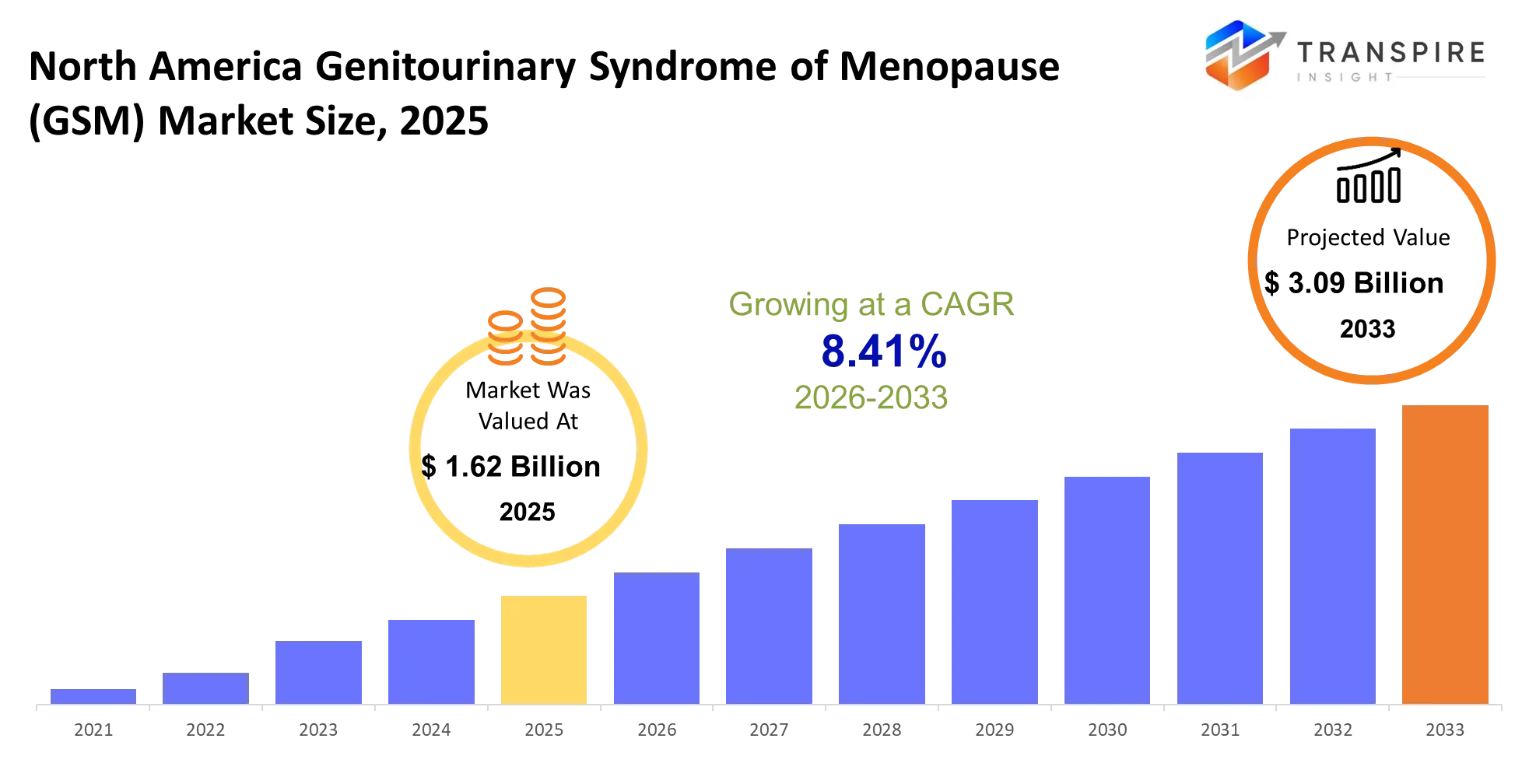
- North America Genitourinary Syndrome of Menopause (GSM) Market Size 2025: USD 1.62 Billion
- North America Genitourinary Syndrome of Menopause (GSM) Market Size 2033: USD 3.09 Billion
- North America Genitourinary Syndrome of Menopause (GSM) Market CAGR: 8.41%
- North America Genitourinary Syndrome of Menopause (GSM) Market Segments: By Type (Hormonal Therapy, Non-hormonal Therapy, Laser Therapy, Moisturizers, Others); By Application (Vaginal Dryness, Dyspareunia, Urinary Symptoms, Others); By End-User (Hospitals, Clinics, Homecare, Others); By Distribution (Hospital Pharmacy, Retail, Online, Others)
To learn more about this report,  Download Free Sample Report
North America Genitourinary Syndrome of Menopause (GSM) Market Summary
The North America Genitourinary Syndrome of Menopause (GSM) Market was valued at USD 1.62 Billion in 2025. It is forecast to reach USD 3.09 Billion by 2033. That is a CAGR of 8.41% over the period.
In North America, the GSM market helps people manage menopausal urogenital symptoms kind of practically like vaginal dryness, that uncomfortable feeling during intimacy, and recurrent urinary infections that really can mess with everyday life plus the clinical routines and pathways. Providers and brands are paying attention to getting urogenital tissue health back on track, and they try to boost patient adherence with a combination of prescription options, over-the-counter moisturizers, and even procedural choices you can usually get in outpatient settings, sometimes in a more convenient way.
Over the last 3 to 5 years, care has gradually moved away from the broad systemic hormone replacement idea toward localized vaginal estrogen, plus non-hormonal alternatives, along with extra scrutiny of energy-based devices. A big acceleration happened during the COVID-19 pandemic, when postponed gynecological visits caused patients to lean more into telehealth consultations and pharmacy-based self-care. That mix has widened access routes and supports earlier intervention. Because of this, revenue growth is not only about awareness anymore; it is more tied to how easily treatment can be reached and how much product diversification is being offered.
Key Market Insights
- United States kind of dominates the North America Genitourinary Syndrome of Menopause (GSM) Market with almost 80% share in 2025, mainly because it has more advanced gynecology infrastructure.
- Canada looks like the fastest moving sub-region through 2030, backed by better access to menopause care and reimbursement policies that actually work.
- Urban healthcare centers are taking the lead in adoption ,while rural areas also show new demand lately, pushed by telemedicine penetration that keeps growing.
- Vaginal estrogen therapy is still out in front, holding about 45% of the North America Genitourinary Syndrome of Menopause (GSM) Market in 2025.
- Non-hormonal moisturizers and lubricants sit next as the second largest segment, largely due to OTC availability and the way patients prefer to start there.
- Energy-based vaginal rejuvenation therapies are the fastest growing slice from 2024–2030, even though they face regulatory scrutiny and extra review.
- Vaginal dryness treatment is the main application use case, with roughly 40% across clinical settings in 2025.
- Dyspareunia management is growing quickest as more post-menopausal care consultations keep coming in.
- Recurrent urinary tract infection management is also expanding steadily, being treated more as an integrated care focus area within the North America Genitourinary Syndrome of Menopause (GSM) Market.
- Hospitals and gynecology clinics lead overall, with nearly 55% share, thanks to structured treatment pathways and prescription-based options that are easier to standardize.
What are the Key Drivers, Restraints, and Opportunities in the North America Genitourinary Syndrome of Menopause (GSM) Market?
North America Genitourinary Syndrome of Menopause (GSM) Market growth is mostly driven by a clinical push toward localized, low dose hormonal solutions, but also by non hormonal alternatives, kind of a both ways deal. This shift really started after years of safety concerns about systemic hormone replacement therapy, and then it was further reinforced by updated prescribing guidelines plus routine post market safety reviews. Now as more physicians lean into targeted vaginal estrogen and selective estrogen receptor modulators, patient adherence usually improves, so prescription volume ticks upward and that ends up backing speciality pharmacy income across the North America Genitourinary Syndrome of Menopause (GSM) Market. Also telehealth platforms are kind of speeding up the “from symptoms to treatment” route by trimming appointment delays, which means earlier symptom relief can actually take place sooner.
Still, one major restraint is the uneven way GSM is diagnosed and managed across primary care and gynaecology. A lot of clinicians under recognize symptoms or they frame them as just normal ageing, so care arrives late, and pharmaceutical demand doesn’t grow as it should. The problem is not simple to fix either, because it’s tied to training differences and screening routines that don’t match up, not because short-term budgets are missing. That means revenue chances slip, and patient journeys can end up scattered or disconnected.
Meanwhile, an emerging opportunity looks like digitally connected women’s health ecosystems that blend tele-gynecology, pharmacy fulfillment, and symptom-tracking applications, all in one flow. Players putting money into AI symptom triage, plus remote prescribing setups are starting to raise early intervention rates , and that could reshape how quickly treatment begins.Pilot programs inside U.S. outpatient networks shows that digitally guided care pathways can really expand the patient pools they can reach, in the North America Genitourinary Syndrome of Menopause (GSM) Market, even if it’s only a start.
What Has the Impact of Artificial Intelligence Been on the North America Genitourinary Syndrome of Menopause (GSM) Market?
Artificial intelligence is kinda reshaping scrubber performance systems and the wider marine emissions control tech, by taking what used to be mostly manual compliance stuff and turning it into continuously optimized digital operations. In North America, maritime fleets are using AI enabled monitoring platforms that sort of automate exhaust gas cleaning system diagnostics , by chewing through sensor readings for SOx concentration washwater quality and pressure differentials, all in real time. The upside is less need for those periodic manual checks and better regulatory reporting accuracy for both IMO and EPA compliance tracking, which, in practice, matters a lot.
Then there’s machine learning, that’s being used more and more for predictive maintenance. Basically, historical vibration records, flow rate trends, and corrosion signals help forecast how scrubber components might degrade before actual failures show up. Operators use these forecasts to line up maintenance tasks during planned port stays, and it can lift vessel uptime something like 5–12% in fleets that are already digitally equipped. On top of that, AI based emissions forecasting supports how fuel and scrubbers get paired, and that can translate into around 3–7% fuel efficiency gains when the load conditions swing around.
Day-to-day, these systems make compliance documentation flow more easily, reduce unplanned downtime, and help control lifecycle costs across exhaust gas cleaning technology networks. Still, adoption is not fully smooth, because there are limited high quality maritime training datasets , and also inconsistent sensor connectivity issues out at sea. Intermittent satellite links plus harsh operating environments often break the continuity of the data, so model accuracy can drop , and that slows the move to full scale deployment across older vessels in the North America scrubber performance systems market.
Key Market Trends
- Since the 2021 guidelines kicked in, clinical prescribing kind of shifted, not exactly overnight but systemically, because systemic hormone therapy use got reduced—so localized vaginal estrogen started getting adopted more across North America, you know.
- After 2020, telehealth consultations expanded, and that altered diagnosis patterns a bit, plus it seemed to let clinicians step in earlier with GSM related urogenital symptom management pathways, kind of sooner than before.
- Between 2022 and 2025, over-the-counter moisturisers gained market share from prescription options, mainly because self care purchasing behavior climbed. People just seemed more willing to try it first.
- Also, energy based devices got more scrutiny after regulatory reviews in 2023 , which slowed procedural uptake across outpatient gynecology clinics. It’s like everyone paused to read the fine print more.
- Training programs for physicians improved GSM recognition rates after 2022, so historically missed cases in primary care settings became less common, at least in comparison to earlier years.
- Pharma companies—like Bayer and Pfizer—put more attention on low dose localized therapies between 2022 and 2025. It’s not that they stopped doing other things, but this direction got louder.
- In distribution, pharmacy operations moved toward hybrid digital models, and that improved prescription fulfillment speed, along with adherence tracking across urban regions, which clinicians liked.
- Patient preference also moved away from systemic hormone replacement and toward non hormonal lubricants, largely due to changing long term safety perceptions after studies released after 2020.
- And finally, clinical trial pipelines for selective estrogen receptor modulators expanded after 2023, signalling innovation in targeted GSM therapies.
North America Genitourinary Syndrome of Menopause (GSM) Market Segmentation
By Type
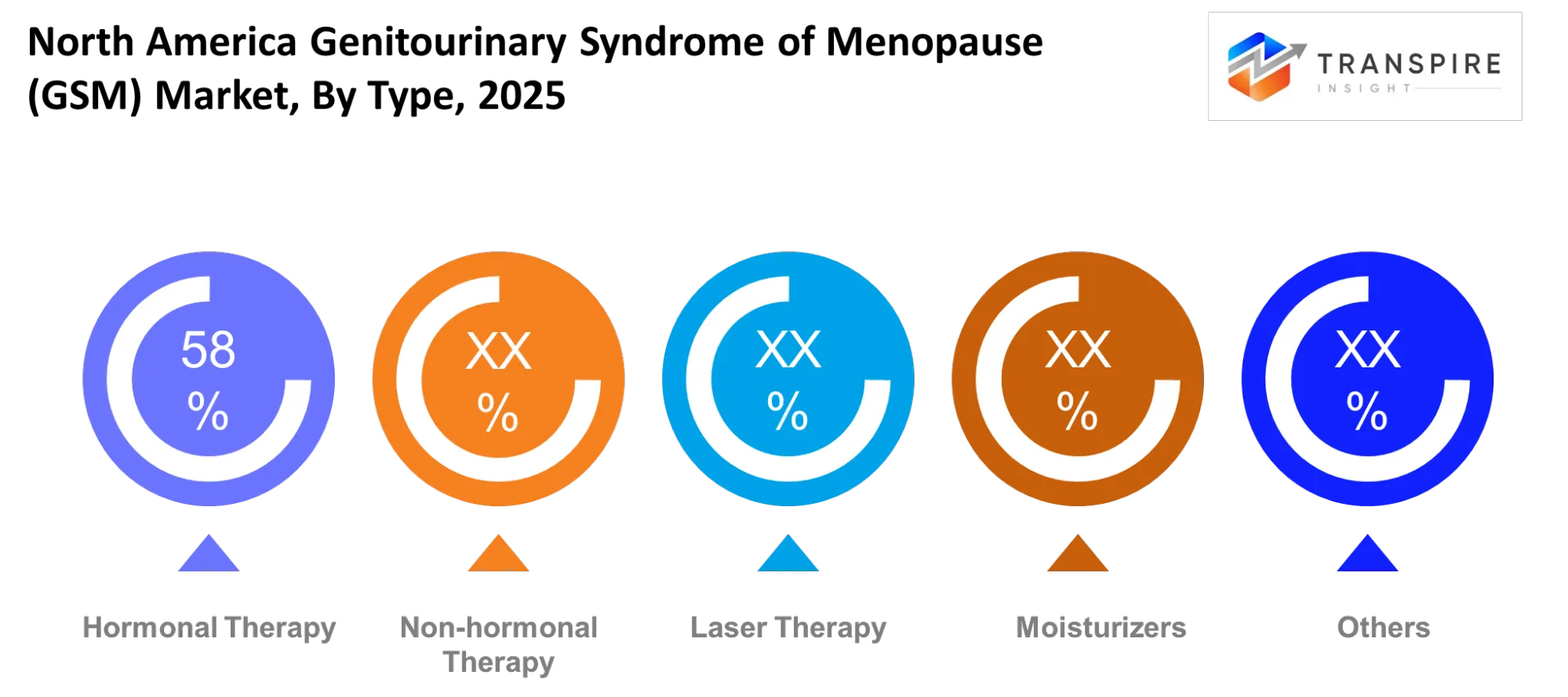
Hormonal therapy still holds the leading position in the North America Genitourinary Syndrome of Menopause (GSM) Market, mainly because it has strong clinical validation and long standing prescribing routines within gynecology care. Vaginal estrogen products keep steady demand since many clinicians prefer localized delivery , rather than broader systemic exposure, particularly after the latest safety clarifications. Non-hormonal options, such as lubricants and moisturizers, have been taking more share too, because people increasingly pick OTC solutions when symptoms are mild to moderate. Laser therapy stays smaller though, but it is still noticeable, largely due to procedure pricing sensitivity and a cautious regulatory environment in the United States.
This segment’s expansion comes from a fairly obvious structural drift away from systemic hormone replacement toward targeted vaginal care and more drug free approaches. Pharmaceutical groups like Bayer and Pfizer have reshaped portfolios to emphasize low-dose and focused vaginal treatments, which in turn supports prescription stability. Moisturizer uptake is also climbing as self-care habits strengthen in outpatient routines, not just in specialty clinics.
Over the forecast horizon, non-hormonal and localized hormonal treatments should become equally important, in a practical sense. Investors are likely to concentrate on combined assortments , meaning hybrid portfolios that mix prescription medicines with OTC formulations, so they can track multiple demand behaviors at once.
To learn more about this report, Download Free Sample Report
By Application
Vaginal dryness is the largest application segment in the North American Genitourinary Syndrome of Menopause (GSM) Market because it is very common among postmenopausal women and directly affects quality of life on a daily basis. Dyspareunia comes next, quite closely, backed by stronger clinical awareness and growing patient comfort with starting therapy sooner.Urinary symptoms, including recurrent infections and urgency, keep getting more attention as integrated urogynecology care models roll out and sort of expand everywhere.
The main growth catalyst feels tied to better symptom classification in real-life clinical practice, so diagnosis now reaches beyond sexual wellness complaints and more into urinary plus pelvic wellbeing categories. Clinicians are spotting overlapping symptom clusters much more often, which pushes combined treatment pathways rather than those single, isolated moves.
What comes next for growth is multimodal treatment strategies, meaning they’ll aim to address vaginal and urinary symptoms simultaneously. That change should make developers build therapies aimed at multiple GSM-related results, not just one symptom at a time.
By End-User
Hospitals and specialty gynecology clinics dominate the North America Genitourinary Syndrome of Menopause GSM Market, mainly because treatment protocols are structured and prescription-based options are easier to access. Clinics maintain strong patient throughput through repeated consultations and established screening practices. At-home care is also climbing because OTC products and telehealth are cutting down the need for in-person visits.
This segment is growing from the decentralization of women’s health services, where care delivery moves away from the hospital centered setups and toward outpatient care and remote- managed models. Digital prescribing platforms along with pharmacy integrations help continuity continue outside the clinic environment, and patients benefit from fewer gaps, even when they aren’t physically there.
Over time, homecare will turn into a sort of critical growth motor, backed by self-administered therapies and remote monitoring mechanisms. Investors will likely look first at service platforms that link clinical diagnosis to home-based treatment compliance, even if it’s a bit indirect at first.
By Distribution
Hospital pharmacies currently keep the largest share in the North America Genitourinary Syndrome of Menopause (GSM) Market, mainly because they’re directly linked with physician prescribing routines, and post-consultation dispensing. Retail pharmacies stay solid too, partly because OTC lubricant and moisturizer items are easy to reach and grab. Online channels, though, are growing fast as digital health adoption speeds up and prescription fulfilment becomes more streamlined.
The main growth driver is the move toward hybrid distribution models, mixing in-person pharmacies with digital ordering systems. Players like Viatris and AbbVie have leaned harder into omnichannel approaches to make access easier, and to keep better visibility for adherence monitoring.
Looking ahead, expansion should tilt toward online distribution, especially for non-hormonal therapies and repeat prescriptions. That kind of direction will nudge manufacturers to fund digital pharmacy partnerships and build more unified patient engagement ecosystems.
What are the Key Use Cases Driving the North America Genitourinary Syndrome of Menopause (GSM) Market?
Vaginal dryness management is still the main use case in the North America Genitourinary Syndrome of Menopause (GSM) Market, it really hits daily comfort, intimacy, and yes even clinical consultation frequency. So gynecology clinics and hospitals usually push localized estrogen therapies along with moisturizers, because symptom relief tends to bring fast, measurable patient outcomes which is what they want, basically.
Dyspareunia treatment together with urinary symptom management are also growing, especially across outpatient clinics and home care settings where telehealth consultations have helped people stick with follow up a lot more. In ambulatory care, providers are more often mixing lubricants with prescription therapies to handle overlapping symptom patterns and to cut down repeat visits.
And then there are the newer use cases, like preventive urogenital health programs within corporate wellness and early-intervention screening across primary care networks. Digital symptom-tracking tools are becoming more popular, too, helping clinicians spot GSM progression earlier and supporting a more proactive start of treatment during the forecast period.
|
Report Metrics |
Details |
|
Market size value in 2025 |
USD 1.62 Billion |
|
Market size value in 2026 |
USD 1.756 Billion |
|
Revenue forecast in 2033 |
USD 3.09 Billion |
|
Growth rate |
CAGR of 8.41% from 2026 to 2033 |
|
Base year |
2025 |
|
Historical data |
2021 - 2024 |
|
Forecast period |
2026 - 2033 |
|
Report coverage |
Revenue forecast, competitive landscape, growth factors, and trends |
|
Regional scope |
North America (Canada, The United States, and Mexico) |
|
Key company profiled |
Pfizer, Novo Nordisk, AbbVie, Bayer, Teva, Mylan, Lupin, Sun Pharma, Cipla, Amneal, Endo, TherapeuticsMD, Duchesnay, Ferring, Allergan |
|
Customization scope |
Free report customization (country, regional & segment scope). Avail customized purchase options to meet your exact research needs. |
|
Report Segmentation |
By Type (Hormonal Therapy, Non-hormonal Therapy, Laser Therapy, Moisturizers, Others); By Application (Vaginal Dryness, Dyspareunia, Urinary Symptoms, Others); By End-User (Hospitals, Clinics, Homecare, Others); By Distribution (Hospital Pharmacy, Retail, Online, Others) |
Which Regions are Driving the North America Genitourinary Syndrome of Menopause (GSM) Market Growth?
North America really leads the Genitourinary Syndrome of Menopause (GSM) Market, mainly because the United States drives it, where more advanced gynaecology infrastructure and a solid pool of specialists help treatment adoption actually stick. A lot of clinics follow clinical guidelines consistently, so you tend to see early diagnosis and then a steady use of localized hormonal plus non-hormonal therapies. On top of that, integrated hospital networks and outpatient gynaecology clinics keep patient management going, even as populations spread across urban, and suburban areas. And yes, strong reimbursement rules, along with established pharmaceutical distribution systems, basically keep demand supported across the whole region over time.
Canada looks more stable than the U.S. market, with growth rooted in steady public healthcare access and a gradual uptake of guidelines, not an aggressive push toward procedural expansion. Provincial healthcare systems focus on standardized women’s health protocols, which help prescriptions roll in fairly consistently across both hospitals and community clinics. You also get predictable physician involvement and more formal referral routes, but the adoption pace can be slower, since approvals tend to be centralized. So overall it becomes a dependable but measured revenue situation, supported by long-term care continuity.
Meanwhile, the fastest growth is evident in Mexico and a few selected Latin American cross-border care corridors. This is supported by expanding private healthcare investment, plus better access to specialist gynecology services. More recent hospital infrastructure upgrades , and also rising medical tourism inflows, have improved availability of menopause-related treatments. With private clinics getting more involved, adoption of non-hormonal therapies seems to accelerate, and diagnostic screening programs are also being taken up more often.For investors and market entrants, this region offers strong upside through 2026–2033, especially in low-cost outpatient care models and pharmacy-led distribution network
Who are the Key Players in the North America Genitourinary Syndrome of Menopause (GSM) Market and How Do They Compete?
The North American Genitourinary Syndrome of Menopause (GSM) Market shows a moderately consolidated competitive landscape, where big pharmaceutical names often control prescription options, while consumer health brands are increasingly entering through OTC routes. It’s not like the fight is only about new molecules anymore, it’s more about delivery format , how well patients stick with the plan, and how easily the therapy flows into telehealth prescribing setups. Older players hold their ground via lifecycle management of vaginal estrogen products, newer entrants push non-hormonal moisturizers and digitally enabled care pathways, reducing that whole clinic dependency thing.
Pfizer leans hard on clinically validated hormonal options and keeps an edge by building strong physician trust, plus using wide distribution across hospital and specialty pharmacy channels. Bayer stands out through a hybrid women’s health range that mixes OTC with prescription access, with lubricants and localized therapies that feel more direct-to-consumer. AbbVie boosts its presence by taking existing women’s health knowhow and extending it into adjunct, supportive therapies for symptom clusters tied to GSM. Overall, these companies stretch their influence through payer arrangements and digital prescription integration, so adherence keeps improving over time.
TherapeuticsMD competes with low-dose, more patient-friendly estrogen formulations, aiming for better tolerability and longer continued use. Viatris, for its part, builds momentum using cost-efficient generic vaginal estrogen products, which helps expand affordability across both retail and online pharmacies. The competitive intensity keeps rising as firms pour resources into tele-gynecology collaborations and direct pharmacy fulfillment networks, and that in turn reshapes how treatment accessibility ends up driving share.
Company List
- Pfizer
- Novo Nordisk
- AbbVie
- Bayer
- Teva
- Mylan
- Lupin
- Sun Pharma
- Cipla
- Amneal
- Endo
- TherapeuticsMD
- Duchesnay
- Ferring
- Allergan
Recent Development News
In October 2025, Bayer announced U.S. Food and Drug Administration approval of Lynkuet (elinzanetant) for the treatment of moderate to severe vasomotor symptoms associated with menopause. Although primarily targeting hot flashes rather than GSM directly, the hormone-free neurokinin receptor antagonist expands non-hormonal menopause therapy options in the North American market and strengthens Bayer’s menopause portfolio.https://www.bayer.com/media/en-us/bayers-lynkuet-elinzanetant-approved-in-the-us-for-treatment-of-moderate-to-severe-vasomotor-symptoms-due-to-menopause/ (Bayer)
“In October 2025, Pfizer announced escalation of its acquisition efforts for Metsera, including an increased bid and legal action to enforce its merger agreement. The move reflects Pfizer’s strategic push to strengthen its position in the metabolic and women’s health-adjacent GLP-1 and menopause-linked therapeutic pipeline, which could indirectly support GSM-related treatment expansion in North America.”https://www.reuters.com/business/healthcare-pharmaceuticals/pfizer-raises-2025-profit-forecast-second-time-row-2025-11-04/ (Reuters)
What Strategic Insights Define the Future of the North America Genitourinary Syndrome of Menopause (GSM) Market?
The North America Genitourinary Syndrome of Menopause (GSM) market is slowly moving toward something more fused and lifecycle driven in women’s health, where GSM is not really handled as a standalone issue, but more like a piece of the bigger postmenopausal metabolic and urogenital care picture. You can see this change getting pulled forward by demand for long-lasting, non hormonal treatments, and also by the way menopause care is blending with digital health supported chronic management routes. There is a kinda less obvious risk too, which is therapeutic substitution pressure: as GLP-1 use and systemic metabolic drugs expand, they may indirectly lower the apparent need for separate GSM solutions. So even if prevalence is going up, prescription volumes could get squeezed, because the market sorta “compresses” in what people feel they have to treat.
On the other hand, an emerging opening is regulatory normalization of localized non estrogen therapies, delivered through newer vaginal drug-delivery systems. That might mean faster approvals, better sticking with therapy, and more momentum especially since FDA endpoints are drifting toward patient-reported outcomes. Strategically, players in the market should lean into combination positioning—meaning they link GSM treatments with broader menopause and sexual wellness portfolios. This helps defend against substitution, and it also lets them catch cross-indication prescribing behavior inside those integrated women’s health platforms, where clinicians and patients want one coordinated pathway rather than many separate ones.
North America Genitourinary Syndrome of Menopause (GSM) Market Report Segmentation
By Type
- Hormonal Therapy
- Non-hormonal Therapy
- Laser Therapy
- Moisturizers
- Others
By Application
- Vaginal Dryness
- Dyspareunia
- Urinary Symptoms
- Other
By End-User
- Hospitals
- Clinics
- Homecare
- Others
By Distribution
- Hospital Pharmacy
- Retail
- Online
- Others
Frequently Asked Questions
Find quick answers to common questions.
The expected North America Genitourinary Syndrome of Menopause (GSM) Market size is USD 3.09 Billion in 2033.
Key segments for the North America Genitourinary Syndrome of Menopause (GSM) Market are By Type (Hormonal Therapy, Non-hormonal Therapy, Laser Therapy, Moisturizers, Others); By Application (Vaginal Dryness, Dyspareunia, Urinary Symptoms, Others); By End-User (Hospitals, Clinics, Homecare, Others); By Distribution (Hospital Pharmacy, Retail, Online, Others).
Major North America Genitourinary Syndrome of Menopause (GSM) Market players are Pfizer, Novo Nordisk, AbbVie, Bayer, Teva, Mylan, Lupin, Sun Pharma, Cipla, Amneal, Endo, TherapeuticsMD, Duchesnay, Ferring, Allergan.
The North America Genitourinary Syndrome of Menopause (GSM) Market size is USD 1.62 Billion in 2025.
The North America Genitourinary Syndrome of Menopause (GSM) Market CAGR is 8.41% from 2026 to 2033.
- Pfizer
- Novo Nordisk
- AbbVie
- Bayer
- Teva
- Mylan
- Lupin
- Sun Pharma
- Cipla
- Amneal
- Endo
- TherapeuticsMD
- Duchesnay
- Ferring
- Allergan
Recently Published Reports
-
Apr 2026
AI in Diabetic Retinopathy Market
AI in Diabetic Retinopathy Market Size, Share & Analysis Report By Type (Screening AI Systems, Diagnostic AI Systems, and Predictive AI Models), By Application Segment (Hospitals, Ophthalmology Clinics, Diagnostic Centers, and Research and Development), and Geography (North America, Europe, Asia-Pacific, Middle East and Africa, South and Central America), 2021 - 2031
-
Apr 2026
Psychometric Tests Market
Psychometric Tests Market Size, Share & Analysis Report By Type (Personality Tests, Ability/Aptitude Tests, Skill/Knowledge Tests, and Others), By Application (Talent Acquisition and Talent Management), and Geography (North America, Europe, Asia-Pacific, Middle East and Africa, South and Central America), 2021 – 2031
-
Apr 2026
Rare Biological Sample Collection Market
Rare Biological Sample Collection Market Size, Share & Analysis Report By Type (Isolation Kits & Reagent, Blood Collection Tubes, and Others), By Application (Oncology, Transcriptomics, Pharmacogenomics, and Others), and Geography (North America, Europe, Asia-Pacific, Middle East and Africa, South and Central America), 2021 – 2031
-
May 2026
Patient Lift Pendant Market
Patient Lift Pendant Market By Product Type (Wired Pendants, Wireless, Programmable), By Operation Type(Manual, Electric), By End-Users (Healthcare Professionals, Patients), By Application (Hospitals, Homecare, Rehabilitation Centers, Others), By Industry Analysis, Size, Share, Growth, Trends, and Forecasts 2021-2033
Our Clients
.jpg)