
North America Flex Fuel Vehicle Market Size & Forecast:
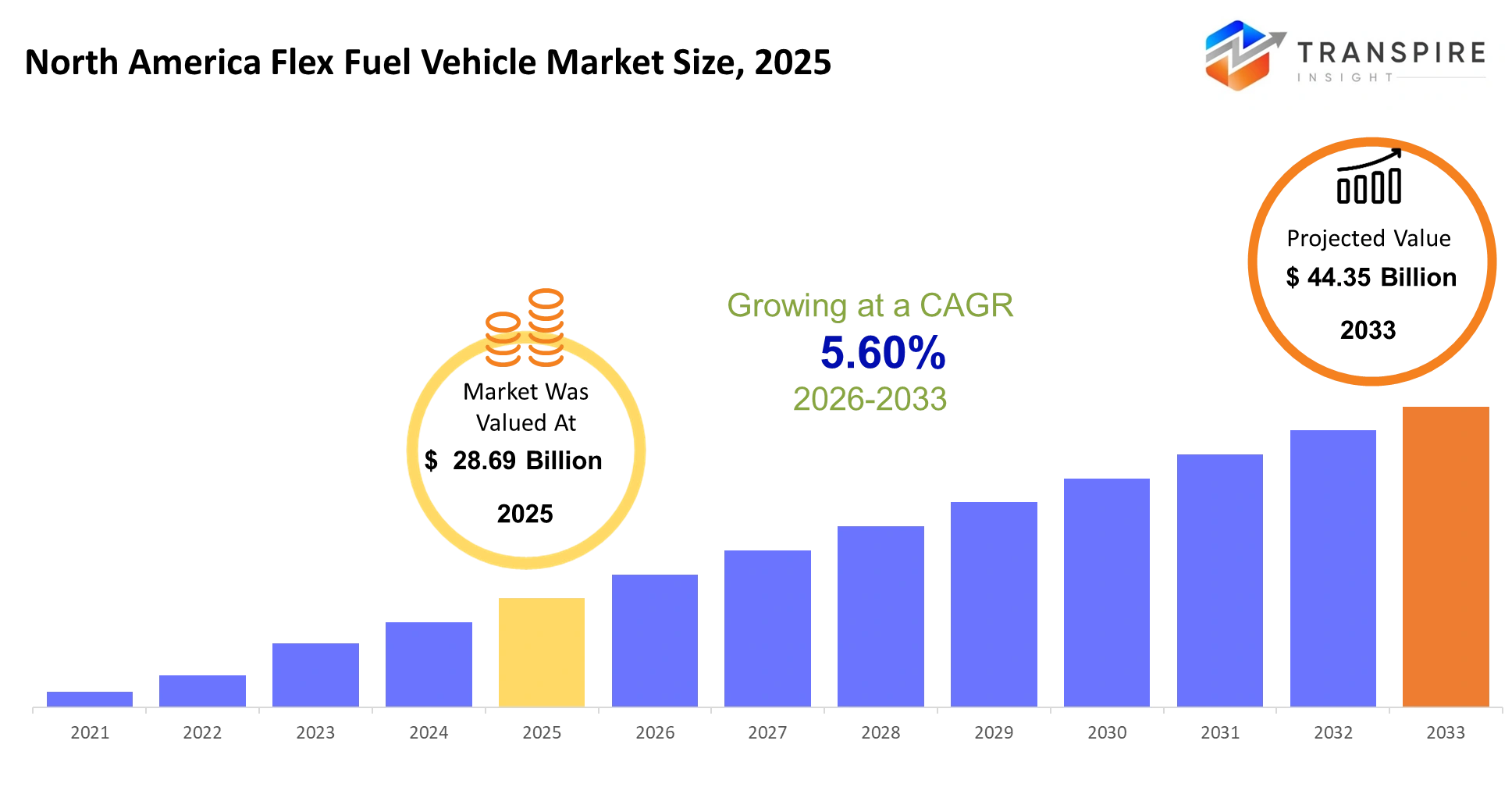
- North America Flex Fuel Vehicle Market Size 2025: USD 28.69 Billion
- North America Flex Fuel Vehicle Market Size 2033: USD 44.35 Billion
- North America Flex Fuel Vehicle Market CAGR: 5.60%
- North America Flex Fuel Vehicle Market Segments: By Fuel Type (E10, E15, E85, Others, Blends, Dual Fuel), By Vehicle Type (Passenger Cars, LCV, HCV, SUVs, Trucks, Others), By Application (Personal, Commercial, Fleet, Logistics, Government, Others), By Component (Engine, Fuel System, Sensors, ECU, Others, Conversion Kits).
To learn more about this report,  Download Free Sample Report
North America Flex Fuel Vehicle Market Summary:
The North America Flex Fuel Vehicle Market size is estimated at USD 28.69 Billion in 2025 and is anticipated to reach USD 44.35 Billion by 2033, growing at a CAGR of 5.60% from 2026 to 2033. The North American Flex Fuel Vehicle Market is experiencing continuous growth because both government bodies and individual customers are adopting environmentally friendly transportation methods.
Fuel flexfuel vehicles (FFVs) run on a mixture of gasoline and ethanol (E85) which Lowers greenhouse gas emissions as well as a lesser consumption of fossil fuels. The United States and Canada provide strong policy backing which together with biofuel usage incentives has motivated automakers to expand their FFV vehicle development. The North America Flex Fuel Vehicle Market experiences growth through the existing changes in regulatory requirements.
The North America Flex Fuel Vehicle Market grows because rising fuel prices become unpredictable and people start to understand environmental issues. Automakers are spending money on new engine technology development to enhance FFV performance and fuel efficiency which will attract more customers to their products. The market expansion receives support from both the growth of ethanol fueling infrastructure and the rising production of biofuels through agricultural methods. The North American Flex Fuel Vehicle Market will keep growing because sustainability has become a main focus for businesses.
What Has the Impact of Artificial Intelligence Been on the North America Flex Fuel Vehicle Market?
The north america flex fuel vehicle market undergoes rapid transformation through artificial intelligence which improves methods for gathering data and conducting analysis and making strategic business decisions. The north america flex fuel vehicle market utilizes artificial intelligence to conduct sophisticated market research through its ability to process current market data which enables stakeholders to track changing market patterns and customer behavior with improved precision.
The industry increasingly uses machine learning models and predictive analytics to forecast flex fuel vehicle demand and develop pricing methods and evaluate regional adoption patterns. The data-driven method enables organizations to make better choices which help them maintain their market position in the evolving energy and transportation industry.
Artificial intelligence improves production efficiency through smart automation in north america flex fuel vehicle manufacturing processes. AI-powered systems optimize business processes by decreasing operational interruptions and boosting quality assurance which results in reduced business expenses. AI-powered supply chain optimization enables businesses to control their stock levels and predict their material needs and protect their operations from possible interruptions which results in uninterrupted production.
Key Market Trends & Insights:
- The United States controls more than 70% of the North American flex fuel vehicle market in 2024 because it has developed a strong ethanol infrastructure.
- The Canadian market exhibits the fastest growth trajectory which will reach a compound annual growth rate above 6% between 2025 and 2030 because of clean fuel regulations and policy incentives.
- The market for passenger vehicles reaches almost 65% because of increased consumer demand and the growing availability of FFV models from major automotive manufacturers.
- Light commercial vehicles hold the second-largest market share because they provide fleets with flexible fuel options and cost-effective operational benefits.
- The heavy-duty vehicle segment represents the most rapidly expanding sector which will achieve substantial growth by 2030 because of the logistics industry's shift towards electric vehicle solutions.
- Personal transportation dominates with over 60% share because consumers prefer transportation that lets them choose their fuel sources and environmental awareness continues to grow.
- The fastest growing sector in commercial fleet applications operates through two main drivers which include cost optimization strategies and regulatory compliance requirements.
- The market operates under the dominance of individual consumers who hold approximately 68% market share while flex fuel vehicle options become more accessible.
- Fleet operators represent the fastest-growing end-user segment, which enables them to achieve both fuel cost reductions and sustainability objectives.
North America Flex Fuel Vehicle Market Segmentation
By Fuel Type
The widespread use of E10 and E15 fuel types exists because drivers can easily find these fuels and their engines support these fuel types. E85 has gained popularity because it contains high ethanol content which results in decreased emissions and improved ecological impacts. Vehicles equipped with blended fuels together with dual fuel systems will achieve operational flexibility through their ability to alternate between different fuel options. The rising production of ethanol will develop into an essential element which helps people accept these fuel types.
The market for advanced fuel blends will expand according to two factors which include technological developments that enhance engine performance and fuel optimisation. Users who want to reduce costs and protect their fuel supply will find practical advantages in dual fuel system technology. The market for ethanol-based fuels will grow according to three factors which include their cost, their market availability and the support they receive from government regulations. The ongoing advancements in fuel standards will create conditions which enable all fuel categories to achieve continuous growth.
To learn more about this report, Download Free Sample Report
By Vehicle Type
The widespread use of flexible fuel systems has made passenger cars a major vehicle category which drivers prefer to operate. Light commercial vehicles support business operations by offering fuel cost savings and operational efficiency. Flex fuel technology is becoming more common among heavy commercial vehicles and trucks because it helps them meet environmental standards. The demand for SUVs is growing because consumers want vehicles that offer multiple driving options.
The expansion of vehicle types depends on two factors which are fuel efficiency advancements and development of supporting infrastructure. The demand for commercial vehicles will remain constant because logistics and transportation operations continue to require them. Passenger vehicles will remain a major contributor due to daily usage and affordability. All vehicle categories will benefit from technological upgrades that enhance engine compatibility.
By Application
Personal use dominates because people now understand that their fuel savings will lead to environmental advantages. The operational expenses of commercial applications decrease because they gain access to multiple fuel options. Flex fuel vehicles enable fleet operators to decrease their fuel costs while achieving their sustainability targets. The logistics and government sectors experience ongoing growth because of their need to comply with regulations and improve their operational efficiency.
The combination of cost benefits and fuel access will drive expansion of application growth. The fleet and logistics industry will experience faster growth because of its requirement for substantial fuel usage. Government initiatives will encourage adoption in public transport and service vehicles. The various applications will create consistent demand across different industry sectors.
By Component
Engine and fuel system components require dual fuel compatibility because they need to function with two different fuel types. The system uses sensors together with ECU systems to control fuel composition while achieving maximum engine efficiency. Flex fuel conversion kits enable existing vehicles to use multiple fuel types which helps expand their market reach. The components will deliver operational efficiency, dependable performance, and full compliance with emission regulations.
Key components will undergo performance and durability improvements through upcoming technological advancements. The system will use sensors together with control systems to enable real-time fuel management adjustments. The conversion kits will deliver economical solutions that enable vehicle enhancements. The continuous development of components will create market stability while enabling business growth.
What are the Main Challenges for the North America Flex Fuel Vehicle Market Growth?
The north america flex fuel vehicle market experiences multiple technical and operational obstacles which prevent its ability to achieve steady development. The engine optimization process for multiple fuel blends results in performance declines and efficiency issues under extreme conditions. The combination of ethanol quality variations and supply chain interruptions creates two simultaneous threats which affect fuel stability and vehicle reliability. The north america flex fuel vehicle market experiences operational challenges which hinder its widespread implementation and create difficulties for sustained operational trust.
The north america flex fuel vehicle market expansion process faces two distinct obstacles which include manufacturing barriers and commercialization restrictions. The production process for vehicle manufacturers becomes more complicated because they must develop unique parts and testing equipment. The development process becomes more expensive and slower because companies must adapt to new emission regulations and fuel specification requirements. The manufacturing process faces two financial challenges because of operational expenses and restricted production capacity which create major obstacles to business growth.
The existing adoption barriers continue to hinder market progress because there are not enough refueling stations to support high-ethanol blends like E85. The absence of refueling stations in multiple areas leads to decreased consumer trust which results in decreased market demand. The market faces limitations because there is insufficient understanding about the product and there is a lack of qualified technicians needed for its upkeep. The north america flex fuel vehicle market remains blocked from achieving full market acceptance because of these elements.
The north america flex fuel vehicle market outlook receives its assessment from two main factors which include current market competition and potential future threats. The electric vehicle industry and hybrid technology sector experience rapid development which results in intense market competition. The price of ethanol experiences fluctuations while regulatory frameworks undergo changes which create unpredictable conditions for organizations to forecast their future operations.
Country Insights
The market for flex fuel vehicles in North America shows strong concentration in the United States because of ethanol distribution throughout the country and the existence of biofuel supportive regulations. The market will experience steady demand because of high vehicle ownership rates and the presence of established fueling infrastructure. Canada shows gradual adoption of flex fuel vehicles which receives backing from its clean energy targets and its regulations which aim to decrease transportation system emissions.
The growth patterns show that people in urban and semi-urban areas display rising interest in flexible fuel systems because these systems help them manage their expenses. The demand patterns in the region will continue to change because of ethanol infrastructure development and government programs. Mexico experiences slow progress which originates from policy reforms and efforts to diversify fuel sources as these elements help establish balanced development across the region.
Recent Development News
In April 2026, U.S. EPA Delays Finalisation of 2026 Biofuel Mandates Impacting Automakers: The U.S. Environmental Protection Agency postponed final biofuel blending rules for 2026–2027, creating uncertainty for automakers and fuel producers. The delay has slowed investment decisions tied to ethanol usage and flex-fuel vehicle production strategies.
Source: hhttps://www.reuters.com
In February 2026, Chevrolet announces new ethanol-compatible hybrid flex-fuel models for U.S.: General Motors, through Chevrolet, revealed new mild-hybrid vehicles capable of running on high ethanol blends, signalling renewed investment in flex-fuel technology. This move highlights a shift toward combining hybrid systems with ethanol compatibility to reduce emissions and fuel costs.
Source: https://carbuzz.com
|
Report Metrics |
Details |
|
Market size value in 2025 |
USD 28.69 Billion |
|
Market size value in 2026 |
USD 30.29 Billion |
|
Revenue forecast in 2033 |
USD 44.35 Billion |
|
Growth rate |
CAGR of 5.60% from 2026 to 2033 |
|
Base year |
2025 |
|
Historical data |
2021 – 2024 |
|
Forecast period |
2026 – 2033 |
|
Report coverage |
Revenue forecast, competitive landscape, growth factors, and trends |
|
Country scope |
North America (Canada, The United States, and Mexico) |
|
Key company profiled |
Ford, General Motors, Stellantis, Toyota, Honda, Nissan, Volkswagen, Hyundai, Kia, BMW, Mercedes-Benz, Tata Motors, Mahindra, Bosch, Delphi |
|
Customization scope |
Free report customization (country, regional & segment scope). Avail customized purchase options to meet your exact research needs. |
|
Report Segmentation |
By Fuel Type (E10, E15, E85, Others, Blends, Dual Fuel), By Vehicle Type (Passenger Cars, LCV, HCV, SUVs, Trucks, Others), By Application (Personal, Commercial, Fleet, Logistics, Government, Others), By Component (Engine, Fuel System, Sensors, ECU, Others, Conversion Kits). |
How Can New Companies Establish a Strong Foothold in the North America Flex Fuel Vehicle Market?
Businesses which start up their operations in North America can succeed in the flex fuel vehicle market by concentrating on particular market segments while fulfilling the specific requirements of their target customers. The company can achieve its initial success through brand creation by serving niche markets which include fleet operators and rural transportation needs.
The company will improve its business entry methods through market growth data and consumer behavior insights. The company will achieve a competitive edge through its clear product positioning which emphasizes cost savings and fuel flexibility.The north american flex fuel vehicle market requires companies to use innovation strategies for establishing their brand presence.
Startups can improve their performance and efficiency through their financial support of advanced engine calibration and ethanol optimization as well as smart fuel management systems. The introduction of digital tools which include IoT-based monitoring and predictive maintenance will solve the operational challenges that arise in the logistics and manufacturing industries. Gevo demonstrates industry leadership by developing ethanol-based products which create a business model for new competitors to follow.
Strategic partnerships will accelerate market entry and expansion in the north america flex fuel vehicle market. Through partnerships with biofuel companies and automotive manufacturers and technology providers the company will achieve better product development and wider distribution capabilities. The company can achieve cost savings and better supply chain access through joint ventures. Through these partnerships new companies will achieve rapid growth while adapting to changes in the market.
Key North America Flex Fuel Vehicle Market Company Insights
The north america flex fuel vehicle market shows intense competition between established automakers and new technology companies who work to develop fuel-efficient vehicles that produce fewer emissions. The companies will spend money to develop better engine systems which will work with ethanol to enhance their product value. The combination of strategic pricing and extensive distribution networks will enable the company to establish its market position while reaching more customers.
Companies will develop their products through continuous upgrades while establishing partnerships with biofuel suppliers to create competitive advantages in different markets. The development of fuel systems together with digital monitoring solutions will enable companies to achieve better performance results and more dependable operations. The company will create new growth prospects by expanding into fleet and commercial markets which will help them achieve consistent development and sustain their position in the market for an extended period.
Company List
- Ford
- General Motors
- Stellantis
- Toyota
- Honda
- Nissan
- Volkswagen
- Hyundai
- Kia
- BMW
- Mercedes-Benz
- Tata Motors
- Mahindra
- Bosch
- Delphi
What are the Key Use-Cases Driving the Growth of the North America Flex Fuel Vehicle Market?
The North America flex fuel vehicle market is expanding due to strong use-cases in personal transportation, where consumers seek cost-effective and fuel-flexible mobility options. Drivers who need to commute every day find E85 ethanol-blend vehicles economical because they reduce fuel costs and emissions. The combination of increasing fuel prices and rising environmental awareness leads to more people adopting these technologies in urban and suburban areas.
It expands because government and public sector use-cases drive its development. Municipal fleets and public transportation systems and service vehicles are adopting ethanol-compatible engines to meet their emission reduction goals. The implementation of supportive regulations together with incentive programs receives state and federal agencies extended deployment support.
The market now includes industrial and agricultural sectors as key market participants. The farming and manufacturing sectors use locally produced biofuels to secure their fuel supply while maintaining consistent fuel costs. The combination of real world applications and ongoing engine technology development will enable the market to achieve sustainable growth throughout time.
North America Flex Fuel Vehicle Market Report Segmentation
By Fuel Type
- E10
- E15
- E85
- Others
- Blends
- Dual Fuel
By Vehicle Type
- Passenger Cars
- LCV
- HCV
- SUVs
- Trucks
- Others
By Application
- Personal
- Commercial
- Fleet
- Logistics
- Government
- Others
By Component
- Engine
- Fuel System
- Sensors
- ECU
- Others
- Conversion Kits
Frequently Asked Questions
Find quick answers to common questions.
The Approximate North America Flex Fuel Vehicle Market size for the market will be USD 44.35 Billion in 2033.
The key Segments of the North America Flex Fuel Vehicle Market are By Fuel Type (E10, E15, E85, Others, Blends, Dual Fuel), By Vehicle Type (Passenger Cars, LCV, HCV, SUVs, Trucks, Others), By Application (Personal, Commercial, Fleet, Logistics, Government, Others), By Component (Engine, Fuel System, Sensors, ECU, Others, Conversion Kits).
Major Players in the North America Flex Fuel Vehicle Market are Ford, General Motors, Stellantis, Toyota, Honda, Nissan, Volkswagen, Hyundai, Kia, BMW, Mercedes-Benz, Tata Motors, Mahindra, Bosch, Delphi.
The Current Market size of the North America Flex Fuel Vehicle Market is USD 28.69 Billion in 2025.
The North America Flex Fuel Vehicle Market CAGR is 5.60%.
- Ford
- General Motors
- Stellantis
- Toyota
- Honda
- Nissan
- Volkswagen
- Hyundai
- Kia
- BMW
- Mercedes-Benz
- Tata Motors
- Mahindra
- Bosch
- Delphi
Recently Published Reports
-
Apr 2026
ATV & UTV Market
ATV & UTV Market Size, Share & Analysis Report By Type (ATV, and UTV), By Variants (Less Than 400 CC, 400 CC To 800 CC, and More Than 800 CC), and Geography (North America, Europe, Asia-Pacific, Middle East and Africa, South and Central America), 2021 - 2031
-
Apr 2026
Automotive Central Gateway Module Market
Automotive Central Gateway Module Market Size, Share & Analysis Report By Type (Ethernet Central Gateway Module, CAN Central Gateway Module, LIN Central Gateway Module, and FlexRay), By Application (Powertrain Control, Body Control, Infotainment System, Advanced Driver Assistance Systems (ADAS), and Others), By End User (Passenger Vehicles, and Commercial Vehicles), and Geography (North America, Europe, Asia-Pacific, Middle East and Africa, South and Central America), 2021 - 2031
-
Apr 2026
Automotive Engine Oil Filter Market
Automotive Engine Oil Filter Market Size, Share & Analysis Report By Filter Type (Fuel Filter, Engine Oil Filter, Hydraulic Oil Filter, and Others), By Filter Media (Cellulose, Synthetic, and Micro), By Sales Channel (OEMs, and Aftermarket), By Vehicle Type (Passenger Cars, Light Commercial Vehicles, Heavy Duty Trucks, Buses and Coaches, and Off-road Vehicles), and Geography (North America, Europe, Asia-Pacific, Middle East and Africa, South and Central America), 2021 - 2031
-
Apr 2026
Automotive Parts Aluminium Die Casting Market
Automotive Parts Aluminium Die Casting Market Size, Share & Analysis Report By Production Process (Pressure Die Casting, Vacuum Die Casting, Squeeze Die Casting, Gravity Die Casting), By Application (Body Parts, Engine Parts, Transmission Parts, Battery And Related Components, Other Application Types), and Geography (North America, Europe, Asia-Pacific, Middle East and Africa, South and Central America), 2021 - 2031
Our Clients