South Korea Wireless Brain Sensors Market Size & Forecast:
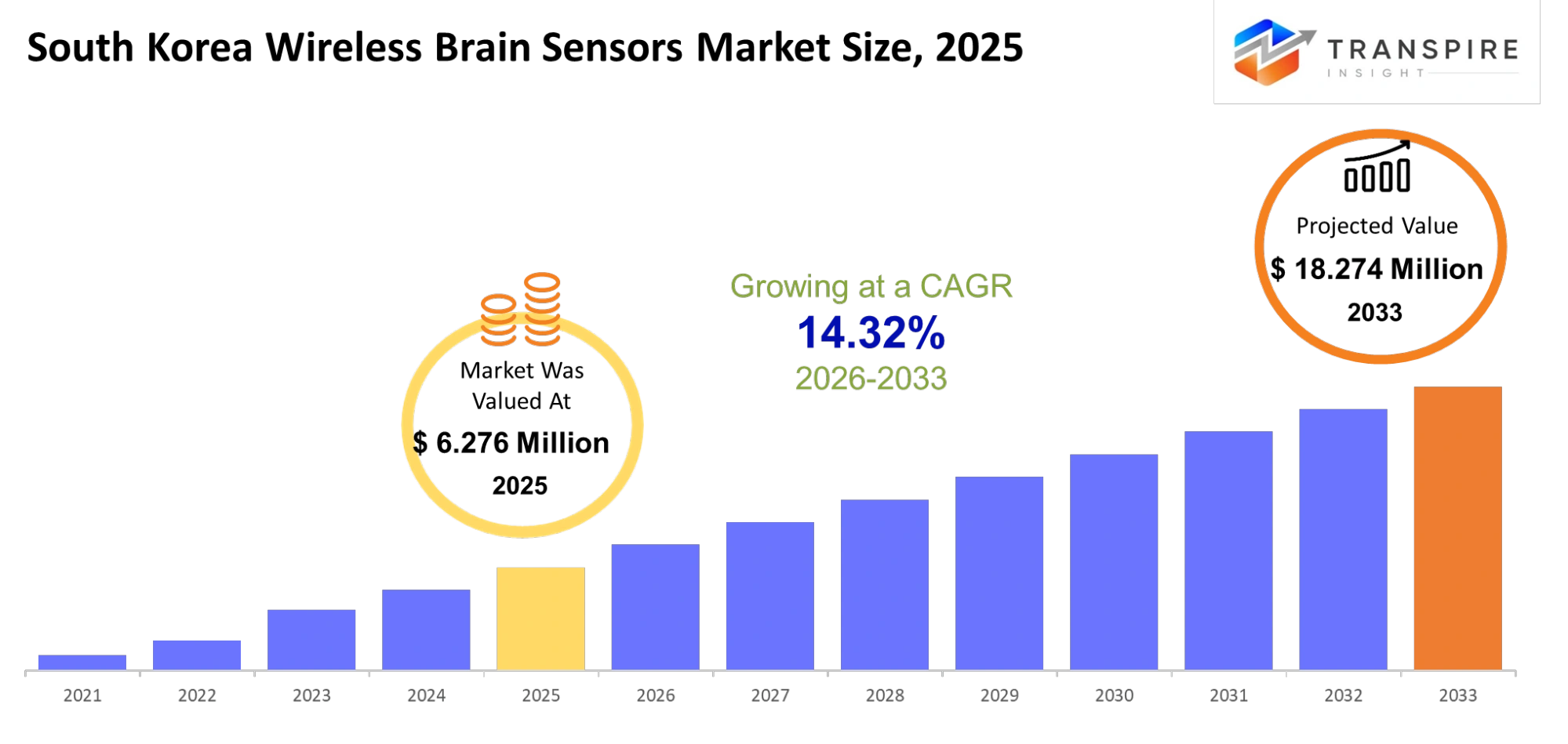
- South Korea Wireless Brain Sensors Market Size 2025: USD 6.276 Million
- South Korea Wireless Brain Sensors Market Size 2033: USD 18.274 Million
- South Korea Wireless Brain Sensors Market CAGR: 14.32%
- South Korea Wireless Brain Sensors Market Segments: By Type (Implantable, Wearable, Non-invasive, Hybrid), By Technology (EEG, fNIRS, MEG, Neural Interfaces), By Application (Neurology, Brain Monitoring, Research, BCI), By End-User (Hospitals, Research Institutes, Labs, Patients), By Component (Sensors, Software, Connectivity, Devices)
To learn more about this report,  Download Free Sample Report
South Korea Wireless Brain Sensors Market Summary:
The South Korea Wireless Brain Sensors Market size is estimated at USD 6.276 Million in 2025 and is anticipated to reach USD 18.274 Million by 2033, growing at a CAGR of 14.32% from 2026 to 2033.
The wireless brain sensors market in South Korea will enable healthcare and neurotechnology industries to track brain activity in real time through non-invasive brain monitoring systems which people can wear. The market will expand in hospitals and research facilities because consumers increasingly demand tools for box testing and mental health assessment and cognitive performance evaluation. The accuracy and user experience of clinical applications will benefit from advancements in EEG-based wearable devices and AI-based signal processing and fast data transmission technologies. South Korean regulatory bodies will create new regulations for digital health products which will allow technology developers to create safer medical devices through controlled experimentation and testing in clinical settings. South Korea will develop its wireless brain sensor market by creating brain monitoring systems which will use mobile health technology and smart hospital networks to expand their application in medical treatment and research.
What Has the Impact of Artificial Intelligence Been on the South Korea Wireless Brain Sensors Market?
The South Korean wireless brain sensors market experiences transformation through artificial intelligence since it enhances neural data collection and interpretation and application processes which serve both clinical settings and research environments. The South Korean wireless brain sensors market solutions combine artificial intelligence with wireless brain sensors to achieve faster signal processing and reduced noise interference and more precise identification of cognitive and neurological patterns. The South Korean wireless brain sensors market platforms use artificial intelligence to enhance market trend analysis because it allows them to assess real-time data from wearable and wireless EEG systems.
The South Korean wireless brain sensors market uses machine learning models which detect early neurological disorder and stress-related condition symptoms with greater accuracy to enhance its predictive analytics capabilities. The process of smart automation improves device calibration and data labeling and continuous monitoring processes which results in fewer operational mistakes and greater operational capacity. The South Korean wireless brain sensors market uses AI-driven forecasting tools which help companies predict demand changes and identify patterns of regional market adoption.
The South Korean wireless brain sensors market uses AI to enhance production efficiency and supply chain management because it helps manufacturers decrease production delays and develop better methods for sourcing components. Predictive analytics supports cost reduction by minimizing device failure rates and improving maintenance cycles. The South Korean wireless brain sensors market systems use artificial intelligence to create personalized experiences which enhance clinical decision-making while giving technology providers operating in this market a competitive edge.
Key Market Trends & Insights:
- The South Korea wireless brain sensors market in 2025 is controlled by Seoul which holds approximately 45% market share through its advanced healthcare facilities and artificial intelligence research centers.
- From 2025 to 2030 Daejeon will become the most rapidly expanding area because of its biotechnology research centers and semiconductor technologies for neuro-sensor development.
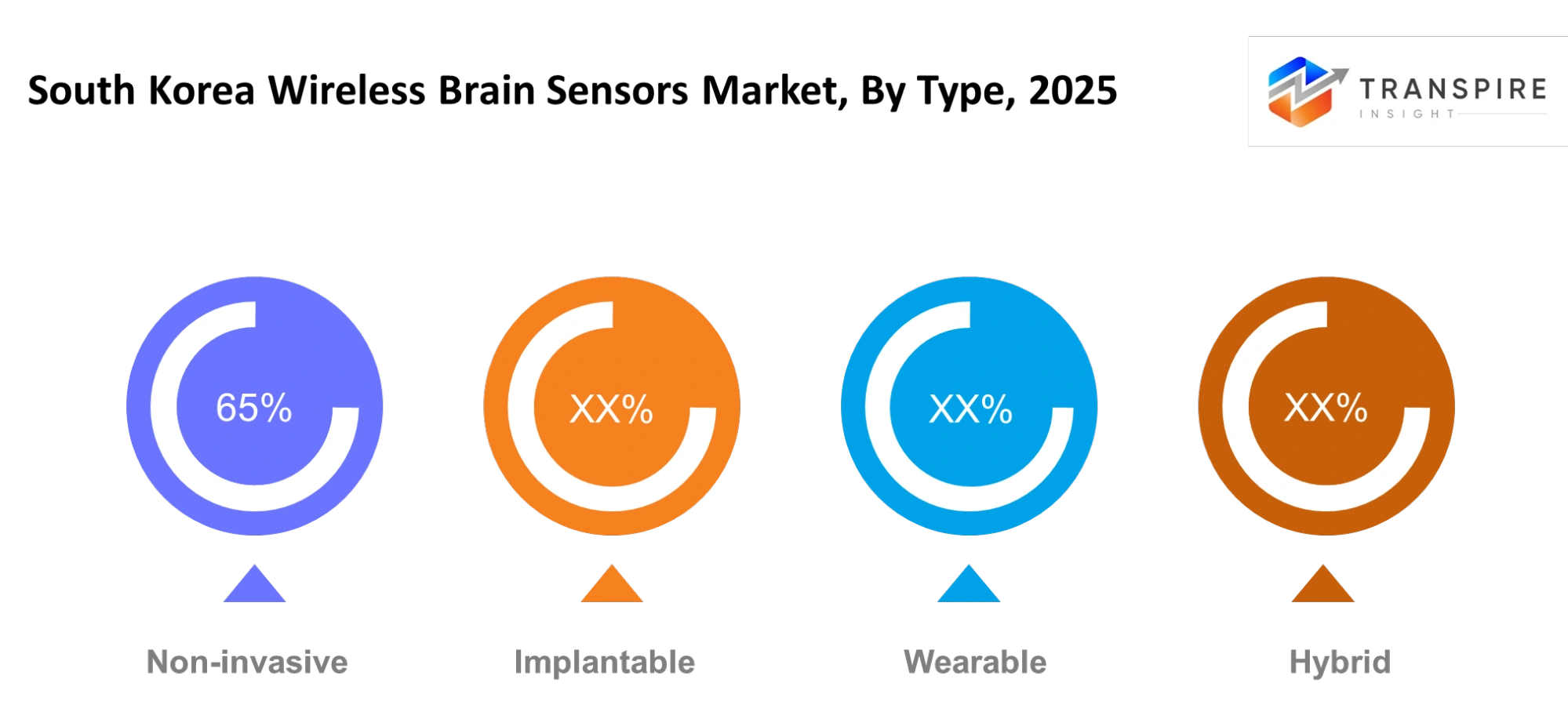
- The South Korea wireless brain sensors market in 2025 is dominated by wearable devices which hold approximately 38% of the market share because people need to monitor their health without harmful effects.
- Non-invasive systems hold the second-largest share driven by hospital-based EEG and sleep disorder diagnostics.
- The hybrid neuro-sensor systems market experiences its most rapid growth between 2025 and 2030 because AI technology improves multi-signal measurement precision.
- The South Korean wireless brain sensors market shows neurology as the leading field which holds about 40% market share because of increasing neurological disorder cases.
- The South Korean wireless brain sensors market is dominated by hospitals which control approximately 50% of the market through their extensive use of medical equipment and testing procedures.
- The main companies in this industry sector consist of Emotiv Inc, Neuroelectrics, Neuralink, Advanced Brain Monitoring, and Brain Products GmbH.
- Companies are funding development of AI-based signal processing and instant neural analytics technologies which will help achieve accurate medical treatments.
- The South Korean wireless brain sensor market receives clinical validation support through strategic alliances that hospitals and universities establish with each other.
South Korea Wireless Brain Sensors Market Segmentation
By Type:
The South Korea Wireless Brain Sensors Market divides into three main segments which include Implantable systems, Wearable systems and Non-invasive systems and Hybrid systems. Implantable devices enable comprehensive brain function assessment through deep neurological monitoring, whereas wearable and non-invasive formats prevail because they provide safe and simple operational features. Hybrid models use multiple detection techniques to achieve better measurement results, which enables their usage in both clinical and research environments across different medical facilities.
To learn more about this report, Download Free Sample Report
By Technology:
The South Korea Wireless Brain Sensors Market divides its segments into EEG and fNIRS and MEG and Neural Interfaces as different technological categories. EEG remains the primary tool for monitoring brain activity throughout the day, while fNIRS tracks oxygen concentration in cortical areas. MEG provides precise brain mapping capabilities, and neural interfaces create direct links between brain signals and outside systems, which researchers use for various complex purposes.
By Application:
The South Korea Wireless Brain Sensors Market divides its segments into four application areas which include Neurology and Brain Monitoring and Research and Brain-Computer Interface applications. Neurology leads usage for disorder diagnosis, while brain monitoring supports continuous patient tracking. Research institutions utilize advanced data models and brain-computer interface applications create new possibilities for developing assistive technologies and cognitive enhancement systems.
By End-User:
The South Korea Wireless Brain Sensors Market divides its end-user market between hospitals research institutes labs and patients. Hospitals handle diagnosis and treatment needs while research institutes conduct their studies through innovation and trial work. Labs provide controlled testing environments which enable direct patient use of wearable devices that monitor neurological conditions from home.
By Component:
The South Korea Wireless Brain Sensors Market establishes its component market through three main components which include sensors software and connectivity modules and devices. Sensors capture neural signals, while software processes and interprets data for clinical use. The system allows wireless transmission through its connectivity components while users can operate their devices as complete systems. The continuous development of all components leads to improved accuracy which results in wider use across different business sectors.
What are the Main Challenges for the South Korea Wireless Brain Sensors Market Growth?
The South Korea wireless brain sensors market encounters severe technical and operational difficulties because of its problems with signal stability and motion artifacts and its inability to sustain long-term battery life of wearable neuro devices. The real-world conditions present a major challenge for maintaining precise EEG data especially during physical activities and when monitoring lasts for extended periods. The South Korea wireless brain sensors market experiences problems that decrease its ability to grow because of various issues which make product optimization more difficult and result in inconsistent performance during clinical and commercial operations.
The South Korea wireless brain sensors market faces expansion restrictions because manufacturing and commercialization processes demand high production costs and need precision engineering and require strict medical device approval standards. The process of gathering safety and quality standards leads to increased market entry time while the limited availability of local components creates difficulties in managing supply chains. The combination of these factors causes delays in widespread adoption while creating pricing problems which make it difficult for smaller businesses to compete within the South Korea wireless brain sensors market.
The South Korea wireless brain sensors market faces adoption problems because of two factors which include limited public knowledge about the technology and the lack of trained neurotechnology professionals beyond major medical centers and research institutions. The advanced wireless brain systems face implementation challenges because smaller healthcare facilities lack essential infrastructure. The South Korea wireless brain sensors market experiences growth limitations because early-stage deployments need funding which remains restricted in non-urban areas that experience low adoption rates.
The South Korean wireless brain sensor market faces rising competitive threats because new neuroimaging methods and affordable wearable products have entered the market. Domestic companies will experience margin declines because international competitors impose price competition and technological advancements progress. The South Korean wireless brain sensor market experiences growth limitations because developing data privacy regulations and changing neural data usage rules create uncertainty in the industry.
Regional Insights
The Wireless Brain Sensors Market in South Korea experiences growth from active research activities in Seoul and Daejeon which provide advanced hospital systems and university research facilities and startup business areas. Medical professionals in Seoul use AI-based neurodiagnostic assessment tests while Daejeon uses its semiconductor technology to develop new wireless brain monitoring sensors.
The Wireless Brain Sensors Market in South Korea expands through Busan and its nearby industrial areas which test smart manufacturing systems and implement programs for cognitive safety in workplaces. The region's healthcare facilities support pilot testing activities that monitor neurological disease progression. The South Korea Wireless Brain Sensors Market will benefit from government-supported innovation zones and smart city initiatives which will enhance product development processes and create better export opportunities.
Recent Development News
In March 2026, Cognito Therapeutics reported a major funding event. The company raised $105 million in a Series C round to advance its non-invasive neurotechnology therapies targeting neurodegenerative diseases, strengthening its position in brain-monitoring and stimulation technologies. https://www.ventureradar.com
In March 2026, Temple (neurodiagnostic & monitoring wearable developer) raised $54 million in a seed funding round to expand development of brain-monitoring technologies, including wearable systems aligned with wireless neuro-sensing applications.https://newmarketpitch.com
|
Report Metrics |
Details |
|
Market size value in 2025 |
USD 6.276 Million |
|
Market size value in 2026 |
USD 7.161 Million |
|
Revenue forecast in 2033 |
USD 18.274 Million |
|
Growth rate |
CAGR of 14.32% from 2026 to 2033 |
|
Base year |
2025 |
|
Historical data |
2021 - 2024 |
|
Forecast period |
2026 - 2033 |
|
Report coverage |
Revenue forecast, competitive landscape, growth factors, and trends |
|
Country scope |
South Korea |
|
Key company profiled |
Neuralink, Blackrock Neurotech, Synchron, Medtronic, Abbott, NeuroPace, BrainCo, Emotiv, OpenBCI, Kernel, Natus Medical, Nihon Kohden, Siemens Healthineers, GE Healthcare, Philips |
|
Customization scope |
Free report customization (country, regional & segment scope). Avail customized purchase options to meet your exact research needs. |
|
Report Segmentation |
By Type (Implantable, Wearable, Non-invasive, Hybrid), By Technology (EEG, fNIRS, MEG, Neural Interfaces), By Application (Neurology, Brain Monitoring, Research, BCI), By End-User (Hospitals, Research Institutes, Labs, Patients), By Component (Sensors, Software, Connectivity, Devices) |
How Can New Companies Establish a Strong Foothold in the South Korea Wireless Brain Sensors Market?
New market entrants who want to enter the South Korea wireless brain sensors market must focus on developing particular clinical and cognitive solutions instead of trying to attract all consumer groups. The South Korea wireless brain sensors market enables companies to succeed through their initial stages when they establish partnerships with hospitals and rehabilitation centers and AI diagnostics companies to confirm their product accuracy and establish reliability.
The South Korea wireless brain sensors market requires companies to establish unique product offerings through their AI-based signal processing technologies and their ability to transmit data with extremely low delays and their development of wearable products which meet the specific needs of Korean medical and industrial settings. Both Neurable and Seoul NeuroTech Labs use EEG-based analytics to develop solutions which help enterprises monitor stress levels and optimize cognitive workload management.
The South Korea wireless brain sensors market needs companies to connect their products with smart city systems and driver-assistance technology and precision healthcare solutions that receive funding through government innovation initiatives. The South Korea wireless brain sensors market enables companies to speed up their product launch process through partnerships with OEMs and data platforms while these alliances help decrease regulatory barriers and enhance customer adoption of their products.
Key South Korea Wireless Brain Sensors Market Company Insights
The new companies entering South Korea Wireless Brain Sensors Market do not seek broad market access. Their business model aims to develop specific clinical monitoring solutions through initial collaborations with hospitals and rehabilitation centers and AI diagnostic companies. The team maintains fundamental dedication to achieving regulatory compliance through initial testing processes and development of Korean-specific product solutions. The business creates value through its proven accuracy and data-based neuro-signal technologies.
The market in South Korea Wireless Brain Sensors Market achieves product differentiation through three main factors which include AI-based signal processing and low-latency wireless architecture and ergonomic wearable design. The two emerging startups Neurable and Seoul NeuroTech Labs provide EEG analytics for cognitive load monitoring and stress assessment. The company builds its market reach through strategic partnerships with original equipment manufacturers and healthcare systems which drive enterprise solution adoption.
Company List
- Neuralink
- Blackrock Neurotec
- Synchron
- Medtronic
- Abbott
- NeuroPace
- BrainCo
- Emotiv
- OpenBC
- Kernel
- Natus Medical
- Nihon Kohden
- Siemens Healthineers
- GE Healthcare
- Philips
What are the Key Use-Cases Driving the Growth of the South Korea Wireless Brain Sensors Market?
The South Korea wireless brain sensors market experiences quick development because advanced healthcare applications which include real-time neuro-monitoring and epilepsy detection and stroke rehabilitation and sleep disorder analysis drive market growth. South Korean hospitals and research institutes now use wireless brain-sensing headsets to monitor patients continuously which enables them to identify unusual patterns before they reach a diagnosis. The healthcare industry demonstrates increasing acceptance of non-invasive AI-driven neurodiagnostic solutions which enhance clinical workflows and result in better patient results for tertiary medical facilities.
The South Korea wireless brain sensors market extends beyond medical applications to support automotive safety systems and industrial worker surveillance. Automotive companies develop brain-computer interface technology to measure driver fatigue and cognitive overload while factories use neuro-sensors to improve worker safety and productivity. The enterprise market demonstrates strong demand for these use cases because organizations can use real-time cognitive analytics to prevent accidents and improve their business results.
The South Korea wireless brain sensors market experiences strong growth through consumer neurotech wearables and immersive gaming and neuroscience research environments. Startups create lightweight EEG devices which enable users to improve their cognitive abilities while monitoring their mental health. The combination of AI with edge computing will enable future growth in smart healthcare systems and defense training programs and personalized neuro-interface technologies which will support businesses for long-term success.
South Korea Wireless Brain Sensors Market Report Segmentation
By Type
- Implantable
- Wearable
- Non-invasive
- Hybrid
By Technology
- EEG
- fNIRS
- MEG
- Neural Interfaces
By Application
- Neurology
- Brain Monitoring
- Research
- BCI
By End-User
- Hospitals
- Research Institutes
- Labs
- Patients
By Component
- Sensors
- Software
- Connectivity
- Devices
Frequently Asked Questions
Find quick answers to common questions.
The approximate South Korea Wireless Brain Sensors Market size for the market will be USD 18.274 Million in 2033.
Key segments for the South Korea Wireless Brain Sensors Market are By Type (Implantable, Wearable, Non-invasive, Hybrid), By Technology (EEG, fNIRS, MEG, Neural Interfaces), By Application (Neurology, Brain Monitoring, Research, BCI), By End-User (Hospitals, Research Institutes, Labs, Patients), By Component (Sensors, Software, Connectivity, Devices).
Major South Korea Wireless Brain Sensors Market players are Neuralink, Blackrock Neurotech, Synchron, Medtronic, Abbott, NeuroPace, BrainCo, Emotiv, OpenBCI, Kernel, Natus Medical, Nihon Kohden, Siemens Healthineers, GE Healthcare, Philips.
The South Korea Wireless Brain Sensors Market size is USD 6.276 Million in 2025.
The South Korea Wireless Brain Sensors Market CAGR is 14.32%.
- Neuralink
- Blackrock Neurotec
- Synchron
- Medtronic
- Abbott
- NeuroPace
- BrainCo
- Emotiv
- OpenBC
- Kernel
- Natus Medical
- Nihon Kohden
- Siemens Healthineers
- GE Healthcare
- Philips
Recently Published Reports
-
Dec 2024
AI in Diabetic Retinopathy Market
AI in Diabetic Retinopathy Market Size, Share & Analysis Report By Type (Screening AI Systems, Diagnostic AI Systems, and Predictive AI Models), By Application Segment (Hospitals, Ophthalmology Clinics, Diagnostic Centers, and Research and Development), and Geography (North America, Europe, Asia-Pacific, Middle East and Africa, South and Central America), 2021 - 2031
-
Feb 2025
Psychometric Tests Market
Psychometric Tests Market Size, Share & Analysis Report By Type (Personality Tests, Ability/Aptitude Tests, Skill/Knowledge Tests, and Others), By Application (Talent Acquisition and Talent Management), and Geography (North America, Europe, Asia-Pacific, Middle East and Africa, South and Central America), 2021 – 2031
-
Feb 2025
Rare Biological Sample Collection Market
Rare Biological Sample Collection Market Size, Share & Analysis Report By Type (Isolation Kits & Reagent, Blood Collection Tubes, and Others), By Application (Oncology, Transcriptomics, Pharmacogenomics, and Others), and Geography (North America, Europe, Asia-Pacific, Middle East and Africa, South and Central America), 2021 – 2031
-
Dec 2025
Patient Lift Pendant Market
Patient Lift Pendant Market By Product Type (Wired Pendants, Wireless, Programmable), By Operation Type(Manual, Electric), By End-Users (Healthcare Professionals, Patients), By Application (Hospitals, Homecare, Rehabilitation Centers, Others), By Industry Analysis, Size, Share, Growth, Trends, and Forecasts 2021-2033
Our Clients
.jpg)