North America Facial Palsy Market Size & Forecast:
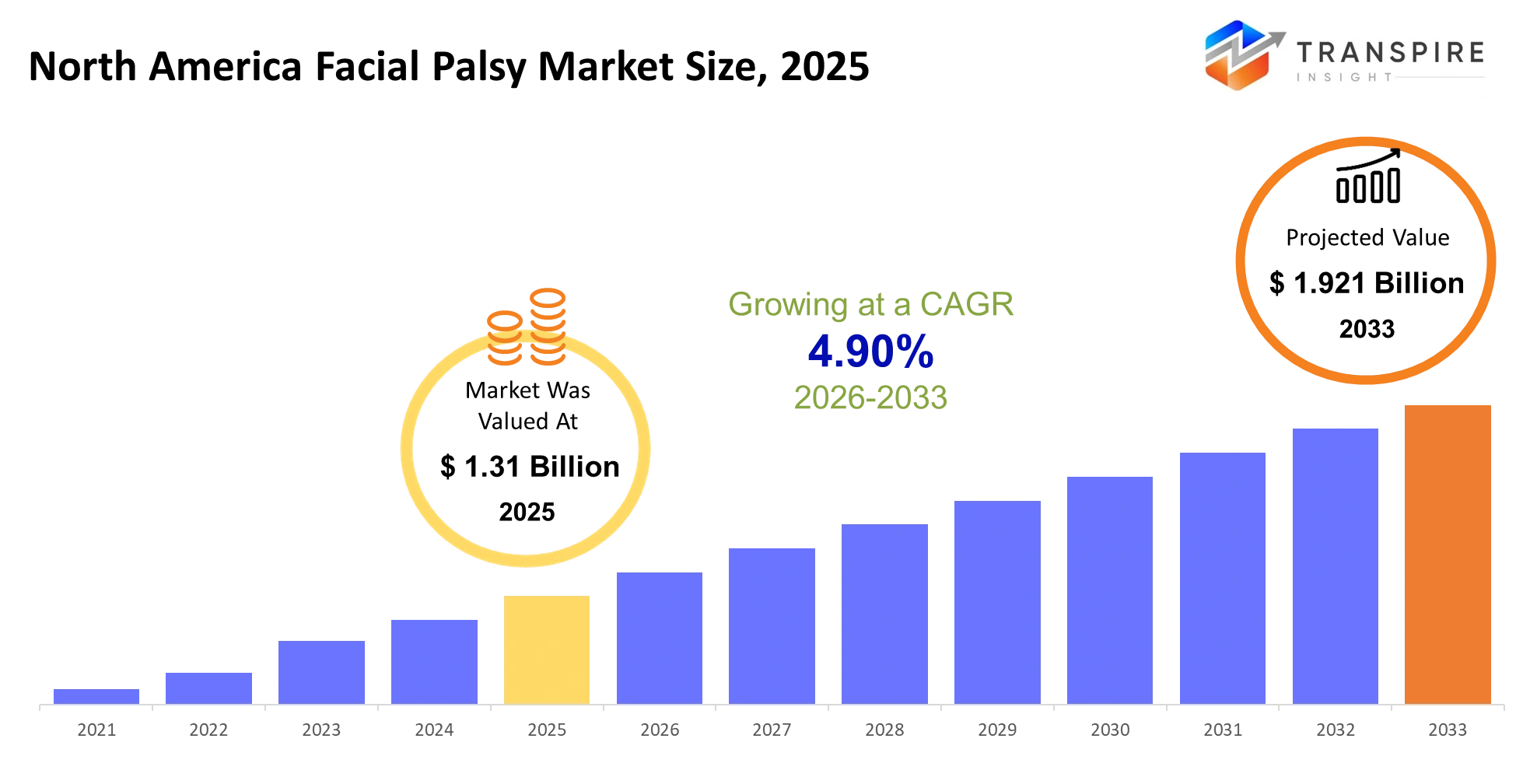
- North America Facial Palsy Market Size 2025: USD 1.31 Billion
- North America Facial Palsy Market Size 2033: USD 1.921 Billion
- North America Facial Palsy Market CAGR: 4.90%
- North America Facial Palsy Market Segments: By Type (Bell’s Palsy, Congenital, Traumatic, Others), By Application (Treatment, Diagnosis, Rehabilitation, Others), By End-User (Hospitals, Clinics, Rehab Centers, Others), By Treatment (Drugs, Surgery, Therapy, Others).
To learn more about this report,  Download Free Sample Report
North America Facial Palsy Market Summary:
The North America Facial Palsy Market size is estimated at USD 1.31 Billion in 2025 and is anticipated to reach USD 1.921 Billion by 2033, growing at a CAGR of 4.90% from 2026 to 2033. The North America Facial Palsy Market is dealing with a condition that gets a lot of attention, and it can be functionally jarring too. It impacts facial motion, speech, eye protection, and also the emotional signaling people rely on. Day to day, the market is basically a mix of surgical restoration, neuromodulation, rehab therapies, injectable options, and even diagnostic tools that help someone move back toward facial balance, and recover ordinary social plus physical functioning. Hospitals, and focused specialty clinics, are treating facial palsy more and more like it’s both a neurological concern and a quality-of-life disruption. so the care pathway is increasingly multi disciplinary, with more than one type of specialist in the loop.
In the last 3–5 years, the direction has been shifting away from delayed corrective intervention and toward earlier, more precise treatment. This is now supported by advanced imaging, nerve monitoring, and reconstructive approaches that are tailored. The COVID-19 pandemic did a lot here as a major catalyst, because it disrupted elective neurological and reconstructive services, which left many patients in a waiting state. Later, that backlog seems to have pushed procedure volumes higher. At the same time, tele-rehabilitation platforms got better at keeping follow up continuous, which helps providers support long term recovery without losing the thread. When you combine earlier recognition, wider therapy reach, and higher sophistication in procedures, treatment adoption rises. That's also expanding the revenue areas across surgical devices, biologics, and rehabilitation services, though in slightly different ways depending on the patient stage.
Key Market Insights
- In 2025, the United States basically dominated the North America Facial Palsy Market, grabbing more than 78% of the market share , mainly because of advanced neurological care infrastructure. And yeah, that setup seems to matter a lot.
- Canada is showing the fastest momentum through 2032, with growth tied to wider rehabilitation access , plus more funding landing in specialty clinic spaces.
- Across North America, major urban medical centers keep ramping up use of less invasive facial nerve reconstruction methods and AI-assisted diagnostics , not just in theory, but in everyday practice.
- When you look at treatment approach, surgical solutions pretty much led the North America Facial Palsy Market, holding about 42% industry share in 2025, kind of the big driver there.
- Injectable therapies , such as botulinum toxin procedures, sat in the second-largest position, supported by repeat dosing needs and the fact that many services are outpatient-friendly.
- Neuromodulation alongside robotic rehabilitation systems are expected to become the fastest-growing segment from 2026 to 2032.
- Also, advanced imaging guided facial nerve monitoring tools are getting noticeable traction across tertiary care hospitals and neurological treatment centers , more and more often.
- For applications, Bell’s palsy treatment took over 46% market share in 2025, mostly due to strong diagnosis rates across North America.
- Meanwhile, post-stroke facial paralysis management is emerging as the fastest-growing application area, helped by rising neurorehabilitation investments.
- And for patient groups, long-term facial reanimation procedures keep climbing in demand among trauma and tumor related paralysis populations.
- On the revenue side, hospitals led the facial palsy treatment market with around 58% share in 2025, largely because multidisciplinary surgical capabilities are concentrated there.
- Finally, specialty neurology and rehabilitation clinics are projected to be the quickest-growing end-user tier across the forecast window.
What are the Key Drivers, Restraints, and Opportunities in the North America Facial Palsy Market?
The strongest force moving the North America Facial Palsy Market is that subtle shift toward earlier stage neurological care, backed up by advanced diagnostic imaging and microsurgical reconstruction approaches. In the last five years, hospitals and specialty neurology centers sort of started folding high resolution nerve mapping, AI-assisted visualization, and minimally invasive facial reanimation methods into the usual care pathways. You can trace this momentum to better reimbursement support for functional reconstructive procedures and post stroke rehabilitation programs across the United States and Canada. Because of that, providers are seeing patients sooner, not waiting for permanent facial nerve breakdown, and that has already boosted procedure counts, increased enrollment in rehab programs and added more repeatable income from follow up therapies.
Still, the market’s largest structural snag stays the lack of highly specialized facial nerve surgeons and multidisciplinary rehabilitation teams. Treating facial palsy typically needs coordinated work across neurology, surgical disciplines, ophthalmic care, and rehabilitation expertise, but many regional hospitals cannot assemble that mix. Also, the preparation cycles for microsurgical facial reconstruction specialists are long, and they require major capital , which slows workforce growth. This limits market penetration in secondary healthcare networks and it makes access slower for patients, especially in rural areas. In the end, that reduces both the potential treatment volumes and the longer term revenue tied to continuing therapy.
There’s a real major growth chance coming up, in digital neurorehabilitation platforms that sort of stitch together wearable muscle sensors, remote physiotherapy, and AI guided facial movement tracking. Venture funding going into tele-neurology infrastructure and home based rehabilitation tools has been accelerating since 2021, especially across outpatient recovery networks in the United States. With this kind of setup, these tools can push treatment continuity way past hospitals, bring down rehab costs, and also boost patient follow-through, sometimes a lot. That overall pattern creates scalable, recurring revenue streams for device manufacturers and rehabilitation providers—like, the kind of revenue you can count on month after month.
What Has the Impact of Artificial Intelligence Been on the North America Facial Palsy Market?
Artificial intelligence and advanced digital technologies are currently reshaping the North America Facial Palsy Market, mostly by boosting diagnostic precision , rehabilitation tracking and even the efficiency of surgical plans. In more practical terms, AI powered facial recognition software now scans muscle imbalance, blink behaviors, and nerve performance using video based checkups, so neurologists can sort out severity levels faster , and also keep treatment choices more consistent. A number of rehabilitation centers in the United States have started combining computer vision systems with telehealth platforms to handle progress monitoring in a more automated way, which cuts down the time spent on manual evaluation and helps therapy stay consistent over time.
At the same time, machine learning is backing predictive treatment optimization. More hospitals are adopting AI assisted imaging along with nerve mapping tools to estimate possible surgical results, and to flag which people might benefit most from facial reanimation procedures. The goal is that clinicians can tune the intervention timing better, that can support stronger functional recovery and also lessen the chance of extra corrective steps. Meanwhile in rehab programs, wearable sensors plus AI analytics observe facial muscle activity in near real time, which lets therapists adjust exercise intensity and recovery timelines in a more tailored manner, not just by general guidelines.
From an operations angle, these digital setups are improving how reliably patients stick to care plans, while also speeding up diagnostic turnaround times and raising procedural throughput in specialty clinics. Still, uptake is somewhat restrained, largely due to costly integration efforts, and because clinical datasets are often fragmented. Facial palsy cases also differ a lot by underlying cause and overall severity so it becomes hard to develop universally reliable AI models across wide patient groups, especially when the data quality is uneven, or when the patient mix changes.
Key Market Trends
- Between 2021 and 2025 , U.S. hospitals started using more AI facial motion analysis tools, kind of to make neurological checkups more consistent and to reduce the differences in how diagnoses get judged.
- Facial reanimation surgeries also moved more toward minimally invasive microsurgical approaches once better nerve mapping showed up, that helped surgeons feel more accurate during the procedure, and it seemed to support faster postoperative recovery results.
- Then tele rehabilitation really ramped up after COVID-19 disruptions, and specialty clinics said patients showed steadier long-term therapy adherence when remote facial exercise monitoring platforms were used .
- Since 2022, outpatient rehabilitation centers have been managing larger treatment volumes, partly because insurers favored lower cost recovery pathways, outside the tertiary hospitals, or at least that’s what many teams reported.
- Companies like Medtronic and Stryker increased their spending on precision neuromodulation and nerve monitoring technologies, aiming them at facial paralysis recovery use cases .
- In Canada, healthcare networks accelerated multidisciplinary facial palsy treatment programs after provincial investments expanded access to neurological rehabilitation infrastructure in 2023 .
- Rehab providers were also getting more into wearable facial muscle sensors between 2022 and 2025, so they could fine tune therapy intensity and follow recovery from a distance, in a more individualized way.
- Biologic grafts and regenerative nerve repair materials gained more confidence in clinics as surgeons looked for options beyond the usual nerve transfer procedures , even when conventional methods were still common.
- During 2021, supply chain disruptions slowed down the arrival of specialized microsurgical instruments, so hospitals ended up diversifying their sourcing agreements with regional device manufacturers .
- Finally, academic medical centers leaned harder into collaborations with AI software developers, hoping to improve predictive modeling for surgical outcomes and for long range planning around facial nerve recovery.
North America Facial Palsy Market Segmentation
By Type
The type segment still gets most of the attention from Bell’s palsy cases, largely due to the high diagnosis frequency and the fact that treatment is pretty accessible across North American healthcare systems. Acute viral nerve inflammation keeps showing up as the biggest chunk of patients entering neurology and rehabilitation pathways, so Bell’s palsy ends up holding a dominant position in the industry. Traumatic facial palsy has also been getting more clinical spotlight, because facial nerve injuries seem to be climbing, tied to sports trauma, vehicle accidents, and complex cranial surgeries.
Congenital facial paralysis is smaller in market share but it stays more niche, since care often means long-term reconstructive support plus pediatric rehabilitation follow-through. Other neurological drivers, like tumor-related paralysis, and stroke-associated facial dysfunction, are also adding momentum for multidisciplinary treatment approaches. Earlier diagnosis through AI assisted facial assessment tools ,and newer advanced imaging technologies is gradually pulling the market toward more precise treatment planning. At the same time, medical device firms and rehabilitation providers are spending more on customized nerve repair services and longer recovery programs that focus on complicated, and chronic facial paralysis conditions.
By Application
The application segment is mostly led by treatment services because surgical correction, drug therapy, and rehabilitation procedures end up pulling in the highest clinical spending, plus they bring recurring patient engagement. Diagnosis applications have been expanding steadily, as healthcare providers start using facial nerve monitoring systems, high resolution imaging, and AI supported movement analysis tools. The idea is to cut assessment delays, though in practice the rollout can be a bit gradual. Rehabilitation applications are showing up as one of the fastest-growing categories too, largely due to a stronger clinical focus on long term muscle retraining and post surgical recovery management. Remote therapy platforms and wearable facial tracking systems are also being used so rehabilitation providers can boost patient adherence, and keep treatment continuity more stable outside hospital settings.
Other applications, like research enablement and cosmetic reconstruction support, still keep getting institutional investment, mainly from academic medical centers and specialty neurological institutes. Overall demand patterns increasingly lean toward integrated care pathways, where diagnosis, surgery, and rehabilitation all operate inside connected treatment ecosystems. This shift is pushing software developers, rehabilitation technology manufacturers, and healthcare providers to expand collaborative treatment infrastructure across outpatient care , and specialty environments as well.
By End-User
Hospitals keep dominating the end-user side, partly because advanced facial nerve reconstruction requires multidisciplinary surgical know-how, solid imaging capacity, and a kind of intense rehabilitation backing. Big tertiary hospitals seem to hold the best market spot, mainly due to their established neurology, plastic surgery, and rehabilitation units, all set up to handle those hard paralysis episodes. Specialty clinics have also been gaining traction. They do this by giving swifter outpatient consultations, practical injectable options, and more focused physiotherapy style services, often with reduced overhead costs.
Meanwhile, rehabilitation centers are seeing faster movement because more people need extended therapy programs , especially those targeting speech coordination, facial muscle re training, and emotional expression restoration. Other end users, like academic institutes and ambulatory surgical facilities, are not standing still either, they are boosting involvement via dedicated neurological treatment pathways. Overall, healthcare delivery models are slowly turning more decentralized, with outpatient recovery support, plus telehealth integration and digital tracking tools. Investors and hospital networks are reacting too, by backing regional rehabilitation expansion efforts, which can ease treatment delays and also strengthen the ability to follow patients over the long run.
By Treatment
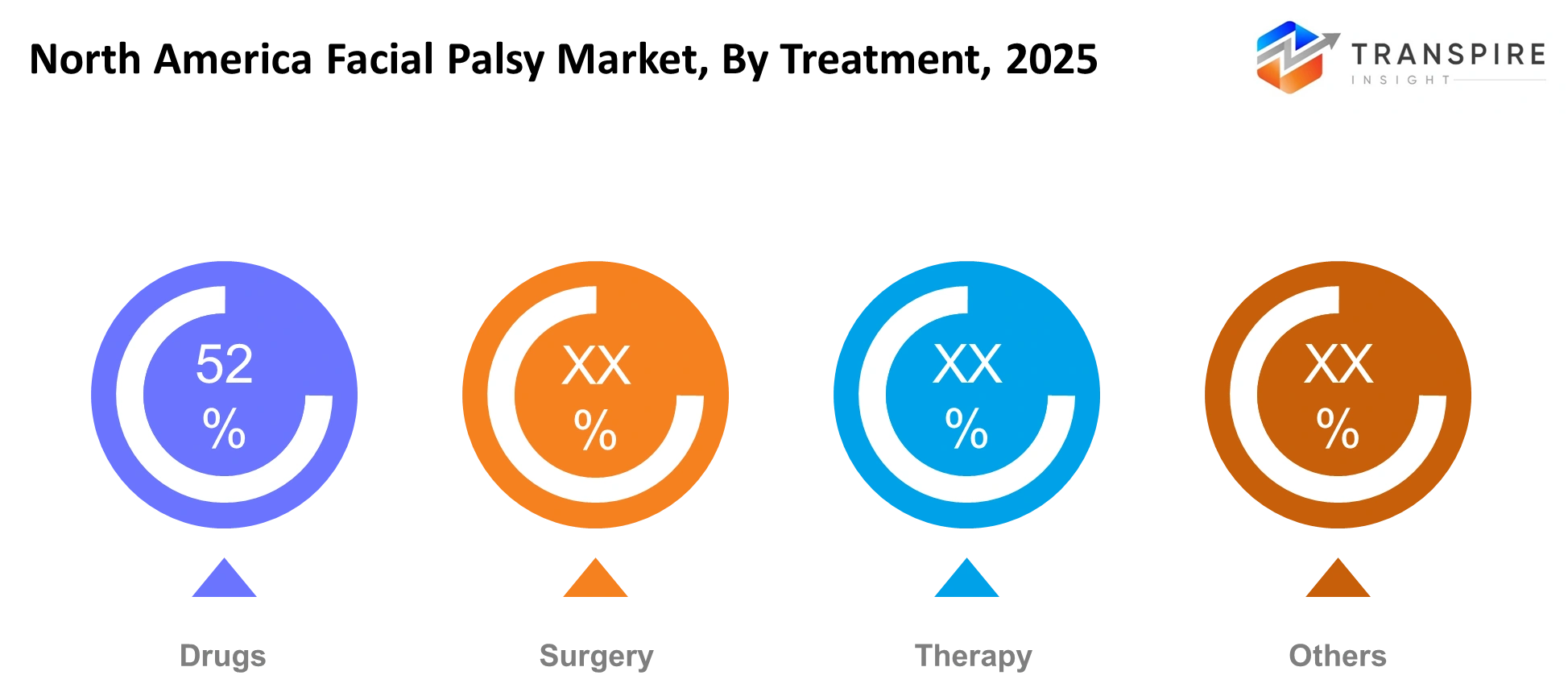
The treatment portion is still basically driven by drug based therapies since corticosteroids, antiviral medications, and injectable neuromodulators stay the first line option for early stage facial paralysis handling. Drug therapies keep a strong market presence because most physicians already know them, you can start them quickly and the short term costs usually sit lower than reconstructive surgery. Surgery itself keeps moving forward step by step as advanced microsurgical nerve repair and facial reanimation methods improve what patients can achieve, especially for severe paralysis situations, where function matters a lot.
Therapy based approaches, like physiotherapy , electrical stimulation, and digital rehabilitation platforms are coming up fast as a notable growth lane, mostly because the conversation has shifted toward long term recovery quality and recurrence prevention, in a more serious way. Other groups, such as regenerative biologics and nerve graft technologies are also getting research budgets from medical technology developers and academic hospitals, even when the evidence is still stacking up. Going forward the market seems to lean toward mixed treatment pathways where pharmaceuticals, surgical care and rehabilitation all run in a coordinated recovery program. This integrated method should support more demand for specialized rehabilitation tools and precision surgical support systems across North America.
To learn more about this report, Download Free Sample Report
What are the Key Use Cases Driving the North America Facial Palsy Market?
The main use case that is really pushing adoption in the North America Facial Palsy Market is early-stage Bell’s palsy care, typically started in hospitals and neurology centers. Rapid corticosteroid therapy, facial nerve monitoring plus rehabilitation sessions all stack together to drive high procedural volumes because acting early tends to improve recovery outcomes a lot, and it also helps cut down ongoing functional impairment over time.
There are also wider applications, like facial rehabilitation after stroke, and trauma tied facial reconstruction being done in specialty clinics and outpatient rehab facilities. With stroke incidence staying elevated, and survival rates rising, the demand grows for longer-term muscle retraining, injectable treatments, and minimally invasive facial reanimation steps. These are often backed by digital rehab platforms, so patients can continue therapy more consistently.
More new ideas are also showing up. For example AI guided at home rehab routines and regenerative nerve repair technologies, these are still under evaluation at academic medical centers. Wearable facial tracking systems, along with bioengineered nerve grafts, look promising for longer horizons. Healthcare providers are basically trying to get more scalable recovery pathways that keep treatment continuity going beyond the usual clinic schedule.
|
Report Metrics |
Details |
|
Market size value in 2025 |
USD 1.31 Billion |
|
Market size value in 2026 |
USD 1.374 Billion |
|
Revenue forecast in 2033 |
USD 1.921 Billion |
|
Growth rate |
CAGR of 4.90% from 2026 to 2033 |
|
Base year |
2025 |
|
Historical data |
2021 - 2024 |
|
Forecast period |
2026 - 2033 |
|
Report coverage |
Revenue forecast, competitive landscape, growth factors, and trends |
|
Country scope |
North America (Canada, The United States, and Mexico) |
|
Key company profiled |
Pfizer, Novartis, Sanofi, Roche, Merck, AbbVie, Johnson & Johnson, AstraZeneca, Teva, Sun Pharma, Cipla, Bausch Health, Endo, Hikma, Amneal. |
|
Customization scope |
Free report customization (country, regional & segment scope). Avail customized purchase options to meet your exact research needs. |
|
Report Segmentation |
By Type (Bell’s Palsy, Congenital, Traumatic, Others), By Application (Treatment, Diagnosis, Rehabilitation, Others), By End-User (Hospitals, Clinics, Rehab Centers, Others), By Treatment (Drugs, Surgery, Therapy, Others). |
Which Regions are Driving the North America Facial Palsy Market Growth?
The United States basically leads the North America Facial Palsy Market, not just one reason but a mix, you know—solid neurological care infrastructure, agreeable reimbursement systems, and wide access to reconstructive surgery know how. Big academic hospitals and specialty neurology centers keep spending on AI assisted diagnostics, facial nerve monitoring, and kind of multidisciplinary rehabilitation programing. Also federal healthcare funding plus private insurance coverage for neurological recovery procedures helps push higher procedural adoption rates across city based healthcare networks. There is this mature setup of medical device manufacturers, rehabilitation technology developers, and research institutions, they keep reinforcing long-term market leadership, yeah all over the country.
Canada lands as the second-largest regional contributor, but the growth rhythm is different from the United States, because provincial healthcare systems usually prefer steady long term rehabilitation access rather than quick procedural expansion. Public healthcare investment has increased outpatient recovery services, especially for stroke related facial paralysis handling and tele rehabilitation programs. Healthcare providers across major provinces have emphasized coordinated neurological recovery pathways, which improves treatment continuity and lowers the hospital burden. So in practice this structured method creates dependable market demand for rehabilitation technologies, digital therapy platforms, and minimally invasive treatment options, even if the overall procedural growth stays slower.
Mexico looks like the fastest-growing region overall, mainly because private healthcare infrastructure is expanding, and there is also more money going into specialized neurological treatment centers. In the last few years , a lot of private hospital groups have been speeding up their use of newer imaging systems, facial reconstruction capabilities, and outpatient rehab services, aimed at medical tourism and urban patients in particular. At the same time, rising healthcare modernization efforts , plus better access to specialty surgical care has helped spread treatment beyond just the biggest metropolitan centers. All that combined momentum makes a really interesting window for device manufacturers, rehabilitation software developers, and investors focused on specialty care, especially for early expansion potential from 2026 to 2033.
Who are the Key Players in the North America Facial Palsy Market and How Do They Compete?
North America Facial Palsy Market competitive landscape is sort of moderately consolidated , with big medical technology players showing up next to smaller specialized neurological rehab providers and reconstructive surgery innovators, even if the overlap is not always obvious. In the last few years, rivalry keeps leaning toward treatment precision, rehab continuity, and how well AI assisted diagnostics gets integrated, not just plain procedural volume. The well established healthcare companies try to keep their share by pushing advanced surgical technologies plus hospital partnerships. Meanwhile newer digital rehabilitation firms are nudging , or maybe disrupting , the old recovery model using remote monitoring platforms and wearable therapy systems. Geography still matters a lot too, mostly because multidisciplinary facial nerve expertise tends to cluster in the bigger urban hospital networks, so access isn’t evenly spread.
Medtronic leans heavily into technology driven neurological intervention, and it tends to separate itself by offering advanced nerve monitoring systems along with minimally invasive surgical support platforms. It also builds strong relationships with tertiary hospitals and neurology centers , so the company can plug facial nerve technologies into wider neurorehabilitation programs. Stryker competes through precision surgical instrumentation and imaging guided reconstruction systems, improving the accuracy during facial reanimation surgeries. Their expansion plans are getting more about partnering with specialty surgical centers, and also investing in AI supported operative planning tools, which is kind of a long game but it seems to help.
AbbVie keeps its competitive edge via injectable neuromodulator therapies that are widely used for managing facial muscle behavior and restoring symmetry after paralysis, sort of. There’s also the thing that physicians already know these options well, plus patients tend to come back for repeat sessions so outpatient revenue keeps coming in across specialty clinics, again and again. Zimmer Biomet, on the other hand, stands out with reconstructive surgical solutions and biomaterial know-how, which supports complicated nerve repair procedures , not just routine cases. And meanwhile Johnson & Johnson keeps stretching its reach by investing in digital surgery platforms, building rehab partnerships, and shaping wider neurological care ecosystems that link diagnostics, surgery, and longer-term therapy oversight in one flow.
Company List
- Pfizer
- Novartis
- Sanofi
- Roche
- Merck
- AbbVie
- Johnson & Johnson
- AstraZeneca
- Teva
- Sun Pharma
- Cipla
- Bausch Health
- Endo
- Hikma
- Amneal
Recent Development News
In April 2026, AbbVie received FDA setback for experimental facial aesthetics treatment: AbbVie announced that the U.S. FDA declined approval of its experimental botulinum toxin treatment, trenibotE, due to manufacturing concerns. The therapy targets facial muscle and wrinkle treatment applications, an area closely tied to facial nerve rehabilitation and facial symmetry restoration markets. The decision may delay commercialization timelines in North America.
Source: https://www.investing.com
In January 2026, Boston Scientific acquired Penumbra in a $14.5 billion neurovascular expansion deal: Boston Scientific agreed to acquire Penumbra for $14.5 billion. The acquisition strengthens Boston Scientific’s neurovascular and neurological treatment portfolio, including technologies relevant to nerve recovery and minimally invasive neurological interventions that can support facial paralysis treatment ecosystems in North America.
Source: https://www.investing.com
What Strategic Insights Define the Future of the North America Facial Palsy Market?
The North America Facial Palsy Market is sort of drifting toward integrated neurorehabilitation ecosystems, that mix AI assisted diagnostics , minimally invasive reconstruction, digital therapy check-ins, and ongoing outpatient recovery management. The real push behind this shift is basically the healthcare system paying more attention to functional recovery results, not just doing one round of surgical intervention and calling it done. In the next five to seven years, the providers who can tie diagnosis, procedure, rehab, and remote monitoring into one unbroken care pathway may pull in a bigger slice of the market , plus more recurring treatment revenue too.
A less obvious risk, is that advanced facial nerve know how is increasingly concentrated in only a handful of urban academic centers. That kind of clustering can create treatment delays , reimbursement strain, and uneven regional access even while the total market grows. At the same time there is an opportunity showing up , wearable neurorehabilitation tech that pairs with home based AI therapy platforms, especially for post stroke recovery management. Market players should lean into collaborations with rehab networks and digital health developers, to lock in long term positioning within more decentralized models for neurological recovery.
North America Facial Palsy Market Report Segmentation
By Type
- Bell’s Palsy
- Congenital
- Traumatic
- Others
By Application
- Treatment
- Diagnosis
- Rehabilitation
- Others
By End-User
- Hospitals
- Clinics
- Rehab Centers
- Others
By Treatment
- Drugs
- Surgery
- Therapy
- Others
Frequently Asked Questions
Find quick answers to common questions.
The approximate North America Facial Palsy Market size for the market will be USD 1.921 Billion in 2033.
The key segments of the North America Facial Palsy Market are By Type (Bell’s Palsy, Congenital, Traumatic, Others), By Application (Treatment, Diagnosis, Rehabilitation, Others), By End-User (Hospitals, Clinics, Rehab Centers, Others), By Treatment (Drugs, Surgery, Therapy, Others).
Major players in the North America Facial Palsy Market are Pfizer, Novartis, Sanofi, Roche, Merck, AbbVie, Johnson & Johnson, AstraZeneca, Teva, Sun Pharma, Cipla, Bausch Health, Endo, Hikma, Amneal.
The current market size of the North America Facial Palsy Market is USD 1.31 Billion in 2025.
The North America Facial Palsy Market CAGR is 4.90%.
- Pfizer
- Novartis
- Sanofi
- Roche
- Merck
- AbbVie
- Johnson & Johnson
- AstraZeneca
- Teva
- Sun Pharma
- Cipla
- Bausch Health
- Endo
- Hikma
- Amneal
Recently Published Reports
-
Apr 2026
AI in Diabetic Retinopathy Market
AI in Diabetic Retinopathy Market Size, Share & Analysis Report By Type (Screening AI Systems, Diagnostic AI Systems, and Predictive AI Models), By Application Segment (Hospitals, Ophthalmology Clinics, Diagnostic Centers, and Research and Development), and Geography (North America, Europe, Asia-Pacific, Middle East and Africa, South and Central America), 2021 - 2031
-
Apr 2026
Psychometric Tests Market
Psychometric Tests Market Size, Share & Analysis Report By Type (Personality Tests, Ability/Aptitude Tests, Skill/Knowledge Tests, and Others), By Application (Talent Acquisition and Talent Management), and Geography (North America, Europe, Asia-Pacific, Middle East and Africa, South and Central America), 2021 – 2031
-
Apr 2026
Rare Biological Sample Collection Market
Rare Biological Sample Collection Market Size, Share & Analysis Report By Type (Isolation Kits & Reagent, Blood Collection Tubes, and Others), By Application (Oncology, Transcriptomics, Pharmacogenomics, and Others), and Geography (North America, Europe, Asia-Pacific, Middle East and Africa, South and Central America), 2021 – 2031
-
May 2026
Patient Lift Pendant Market
Patient Lift Pendant Market By Product Type (Wired Pendants, Wireless, Programmable), By Operation Type(Manual, Electric), By End-Users (Healthcare Professionals, Patients), By Application (Hospitals, Homecare, Rehabilitation Centers, Others), By Industry Analysis, Size, Share, Growth, Trends, and Forecasts 2021-2033
Our Clients
.jpg)