
North America Electric Three-Wheeler Market Size & Forecast:
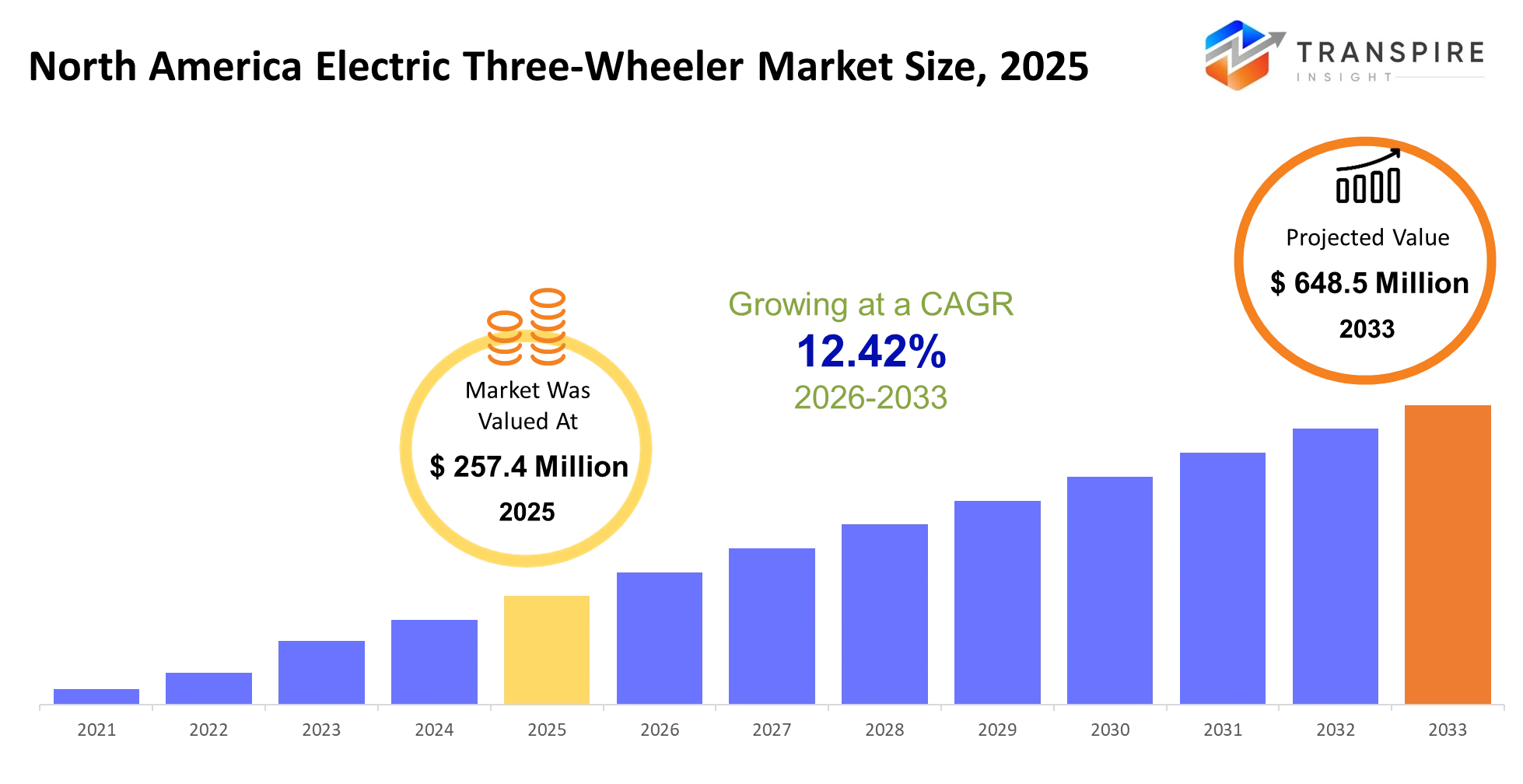
- North America Electric Three-Wheeler Market Size 2025: USD 257.4 Million
- North America Electric Three-Wheeler Market Size 2033: USD 648.5 Million
- North America Electric Three-Wheeler Market CAGR: 12.42%
- North America Electric Three-Wheeler Market Segments: By Type (Passenger Carrier, Cargo Carrier, Others, E-rickshaw, Utility, Hybrid), By Battery (Lithium-ion, Lead-acid, Others, Solid-state, Nickel-based, Hybrid), By Application (Urban Transport, Logistics, Others, Delivery, Personal Use, Commercial), By End-User (Fleet Operators, Individuals, Others, SMEs, Logistics, Govt).
To learn more about this report,  Download Free Sample Report
North America Electric Three-Wheeler Market Summary:
The North America Electric Three-Wheeler Market size is estimated at USD 257.4 Million in 2025 and is anticipated to reach USD 648.5 Million by 2033, growing at a CAGR of 12.42% from 2026 to 2033. The North America Electric Three-Wheeler Market is expanding because cities need cleaner and cheaper transportation solutions. The compact vehicles operate as delivery vehicles and ride-sharing vehicles and short-distance vehicles to travel through busy urban areas.
Companies are using electric three-wheelers to decrease their business expenses and achieve their environmental sustainability objectives while government programs and tougher emission regulations make these vehicles more popular. The market demand for sustainable logistics solutions establishes this market as an essential driver of the region's transition to environmentally friendly transportation.The current electric three-wheeler operations in North America are improved through advances in battery technology and vehicle design and developing charging systems.
Both startups and existing companies are developing new models designed for business and individual customer use. The North America Electric Three-Wheeler Market experiences growth because e-commerce needs delivery methods that produce low emissions while offering high efficiency. The market will continue to grow because people are becoming more aware of environmental issues and both economic conditions and regulatory requirements will influence its development.
What Has the Impact of Artificial Intelligence Been on the North America Electric Three-Wheeler Market?
The North American electric three-wheeler market undergoes rapid transformation through artificial intelligence which enables businesses to make better decisions based on data throughout their entire operational process. North American electric three-wheeler market analysis requires companies to use AI for processing extensive datasets which helps them identify market trends and customer preferences and regional demand patterns with greater precision.
Machine learning algorithms improve demand forecasting and predictive analytics because they help manufacturers and fleet operators identify usage patterns which enables them to manage inventory more effectively. The research on artificial intelligence in North American electric three-wheeler market research helps companies create better strategic plans because it decreases uncertainty and helps them react quickly to changes in urban mobility patterns.
The North American electric three-wheeler market uses artificial intelligence to enhance production efficiency and supply chain efficiency through its market operations. Manufacturing facilities achieve greater operational efficiency through smart automation which minimizes errors and reduces downtime and decreases operational expenses while AI-based logistics systems optimize delivery fleet route planning and energy consumption.
The North American electric three-wheeler market benefits from AI-powered vehicle developments which include intelligent battery management systems and customized user experience solutions. These advancements create a stronger competitive edge for businesses while they help the market move toward environmentally friendly technology-based transportation options.
Key Market Trends & Insights:
- The United States controls more than 70 percent of the North American electric three-wheeler market which will reach that threshold in 2025 because of strong e-commerce demand.
- Clean mobility initiatives drive Canada to become the fastest-growing region which will expand at a CAGR that exceeds 9% until 2030.
- Passenger carriers dominate the market because they hold about 55% share in 2025 which ride-sharing and urban mobility solutions drive.
- Delivery vehicles which operate as cargo three-wheelers hold the second-largest market share because delivery fleets shift toward electric operations.
- The cargo segment shows the fastest growth because it will achieve double-digit expansion until 2030 as last-mile delivery requirements increase.
- Last-mile delivery dominates applications because it accounts for more than 60% of total applications which will reach that level in 2025 due to increasing e-commerce and urban logistics optimization.
- Shared mobility services represent the fastest expanding application because urban commuters prefer affordable and environmentally friendly transport options.
- Fleet operators control more than 65 percent of the North American electric three-wheeler market because they benefit from operational efficiency and cost savings.
- Small and medium enterprises (SMEs) represent the fastest-growing end-user segment which adopts electric fleets to achieve sustainable logistics operations.
North America Electric Three-Wheeler Market Segmentation
By Type
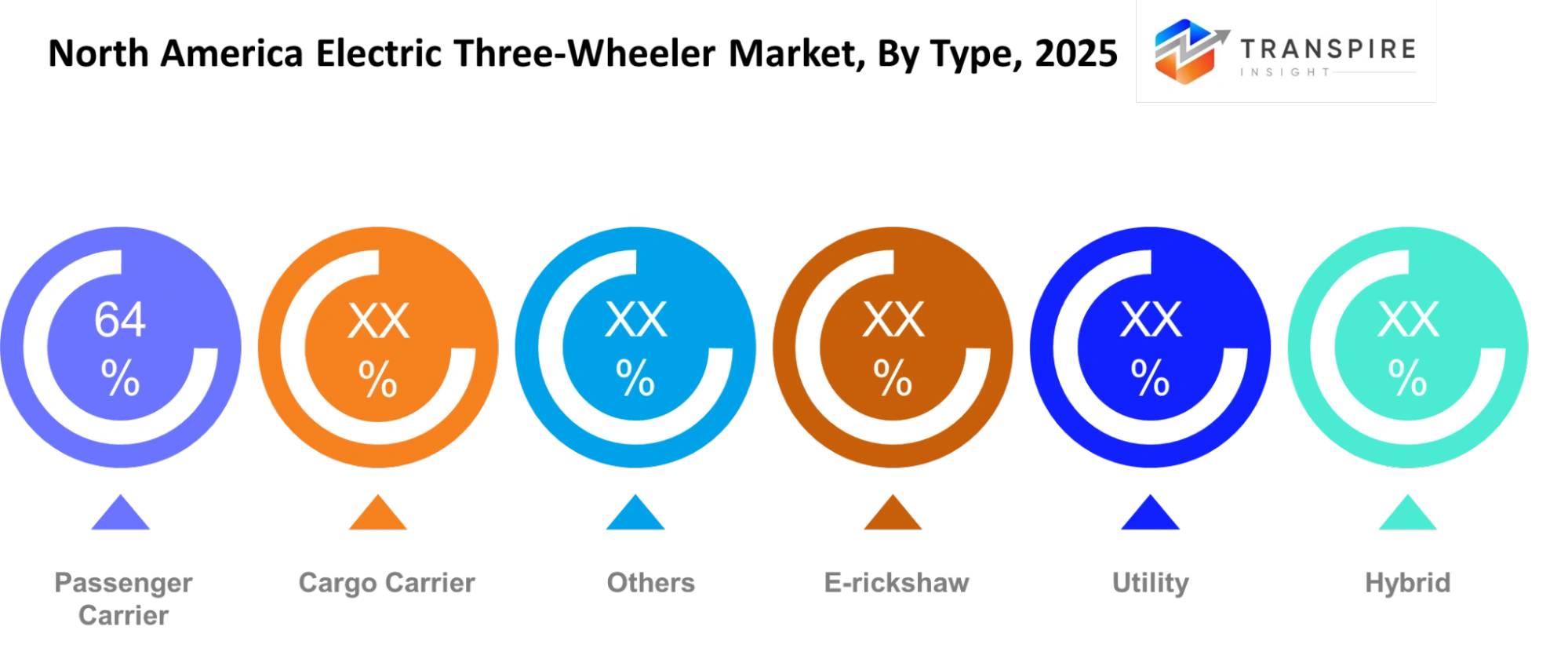
The passenger carrier segment provides strong market presence because people need budget-friendly transportation and shared riding services within urban areas. The ride-sharing market together with short-distance commuting requirements will create consistent business growth. The cargo carrier segment experiences growth because logistics companies develop budget-friendly last-mile delivery systems which produce lower carbon emissions.
E-rickshaw and utility segments are gaining attention as urban infrastructure adapts to compact electric mobility options. People will show interest in hybrid cars because they need to travel between semi-urban areas but their hybrid cars provide them with no electric power. The others category includes specialized functions which will create minor market expansion but enable different business units to achieve their operational targets.
To learn more about this report, Download Free Sample Report
By Battery
The lithium-ion battery segment leads the market because it provides multiple advantages including higher energy density and longer battery life and quick charging capabilities. The combination of ongoing price decreases and technological advancements will boost product usage in both business and personal product categories. The low-cost market segment still uses lead-acid batteries which provide customers affordable options but these batteries have reduced efficiency and shorter operational lifetime.
Solid-state and nickel-based batteries are becoming the main alternatives to solid-state technologies because these batteries provide superior safety features and performance advantages. Hybrid battery systems will support applications which need both long-lasting power and dependable operation. The others segment contains experimental technologies which are currently being developed and these technologies will progressively impact market innovation and competitive market positioning.
By Application
The field of urban transportation systems requires research because cities experience increasing traffic problems and people seek better compact transportation methods. The adoption of sustainable transportation solutions will keep expanding in cities with high population density. The logistics and delivery industry experiences rapid growth because e-commerce expansion creates demand for effective last-mile delivery solutions.
The personal use segment is increasing because more consumers understand how they can save money while protecting the environment. Revenue from commercial operations exceeds all other sectors because delivery and passenger services depend on fleet-based business models. The others category comprises specialized applications which will generate additional demand throughout multiple industry sectors.
By End-User
The demand from fleet operators results from their extensive use of delivery services and shared mobility platforms. The operational cost efficiency together with regulatory support will lead to further growth of this business segment. The adoption of electric three-wheelers by SMEs results in better logistics operations and lower fuel costs which leads to significant business growth.
The market is attracting individual users who become more aware of products while products become easier to access, yet users still adopt products at a slower pace than commercial sectors do. The government together with logistics companies is increasing their operations through policy backing and sustainability programs. The others category includes institutional buyers who will create extra stability in the overall demand patterns.
What are the Main Challenges for the North America Electric Three-Wheeler Market Growth?
The north america electric three-wheeler market expansion process faces ongoing delays because of operational challenges and technical difficulties which occur when electric three-wheelers need more than their current battery range and current charging systems and battery performance levels which exist at different times. Production schedules experience disruptions because supply chains break down for essential parts which include lithium-ion batteries and electronic control systems.
The increase in operational difficulties which results from these limitations decreases manufacturing capabilities for companies who need to produce more products to meet higher demand in urban logistics and mobility services. The north america electric three-wheeler market development process faces two main obstacles which include high production costs and strict regulatory requirements that make it difficult to launch products at mass production.
The development process becomes more time-consuming and expensive because companies must meet safety standards and testing requirements and quality certification standards. The limited ability to produce components locally increases the need to rely on international imports which leads to unstable pricing and creates delays in bringing new products to market.
The north america electric three-wheeler market faces major challenges with adoption because cities lack sufficient charging stations and distribution of electric three-wheelers across urban areas remains unpredictable. The workforce skill gaps which exist in EV servicing and maintenance fields create barriers that prevent fleet operators and small businesses from adopting electric vehicles at higher rates. The lack of funds which exists for early-stage companies creates obstacles that prevent businesses from adopting their products in both commercial areas and semi-urban regions.
Regional Insights
The United States shows strong demand growth because of its logistics and urban transport sectors which support its ongoing economic development while Canada demonstrates continuous expansion through its clean mobility initiatives and governmental support which will drive electric vehicle adoption in major urban areas and key industrial centers.
Urban regions continue to drive most demand as dense population areas require compact and efficient transport options for short-distance travel and delivery services. The development of semi-urban areas will progress at a slow pace because they lack sufficient charging stations and people depend on traditional transportation methods, but future years will see increasing adoption through gradual advancements.
The expansion of cross-regional supply chains together with infrastructure development will create new growth opportunities throughout North America. Manufacturers establish local operations with native business alliances to achieve cost efficiency and better delivery speed. This strategy will create equal market expansion across different regions while establishing market stability for future growth.
Recent Development News
In April 2026, New EV models arrive in 2026 amid shifting electric vehicle market: Major shifts in the U.S. electric vehicle sector in April 2026 are pushing companies to introduce new compact and alternative EV formats, including three-wheeler concepts. This transition is shaping production strategies and accelerating innovation in lightweight electric mobility.
Source: https://abc7.com
In March 2026, Aptera’s solar electric three-wheeler reaches validation production milestone: California-based Aptera has achieved a key manufacturing milestone in 2026 with its solar-assisted electric three-wheeler entering validation-stage production. This marks a significant step toward commercial rollout and highlights renewed investor confidence in efficient, lightweight EV platforms.
Source: https://cleantechnica.com
|
Report Metrics |
Details |
|
Market size value in 2025 |
USD 257.4 Million |
|
Market size value in 2026 |
USD 285.8 Million |
|
Revenue forecast in 2033 |
USD 648.5 Million |
|
Growth rate |
CAGR of 12.42% from 2026 to 2033 |
|
Base year |
2025 |
|
Historical data |
2021 – 2024 |
|
Forecast period |
2026 – 2033 |
|
Report coverage |
Revenue forecast, competitive landscape, growth factors, and trends |
|
Country scope |
North America (Canada, The United States, and Mexico) |
|
Key company profiled |
Mahindra Electric, Piaggio Vehicles, Bajaj Auto, Atul Auto, Terra Motors, Kinetic Green, Euler Motors, Omega Seiki, Hero Electric, TVS Motor, Lohia Auto, YC Electric, Jiangsu Kingbon, Changzhou Yufeng, Saera Electric. |
|
Customization scope |
Free report customization (country, regional & segment scope). Avail customized purchase options to meet your exact research needs. |
|
Report Segmentation |
By Type (Passenger Carrier, Cargo Carrier, Others, E-rickshaw, Utility, Hybrid), By Battery (Lithium-ion, Lead-acid, Others, Solid-state, Nickel-based, Hybrid), By Application (Urban Transport, Logistics, Others, Delivery, Personal Use, Commercial), By End-User (Fleet Operators, Individuals, Others, SMEs, Logistics, Govt). |
How Can New Companies Establish a Strong Foothold in the North America Electric Three-Wheeler Market?
New entrants can gain traction in the north america electric three-wheeler market by focusing on niche segments where demand is rising but competition remains limited. Companies can achieve market success through their delivery services which operate in last-mile areas and through their urban logistics services and smart city mobility solutions. Startups that design vehicles tailored for specific use cases, such as cold-chain delivery or campus mobility, will create clear differentiation.
The dedicated positioning enables new companies to solve their genuine operational challenges while establishing initial customer relationships.The North American electric three-wheeler market will experience growth through innovation strategies which target improved battery performance and reduced vehicle weight and development of smart vehicle systems. The total ownership expenses of fleet operators will decrease when companies use IoT and predictive maintenance and energy optimization technologies.
Startups such as Aptera have developed solar-assisted electric vehicles whereas Arcimoto has created solutions for compact urban mobility. Such approaches highlight how technology differentiation can solve performance and cost-related challenges in this space.The North America electric three-wheeler market will achieve long-term success through strategic partnerships and business models which can scale.
The industry will experience rapid growth through partnerships between logistics companies and municipalities and charging infrastructure providers. Small businesses can achieve higher adoption rates through flexible financing options and leasing models which lower financial obstacles. The combination of innovation with partnerships and focused expansion enables new companies to create a sustainable competitive edge in this market environment.
Key North America Electric Three-Wheeler Market Company Insights
The market competition demonstrates ongoing growth because both existing companies and new market entrants concentrate on developing innovative products and reducing operational expenses. The companies Polaris, Arcimoto, and ElectraMeccanica make ongoing investments in their product development efforts which will enable them to enhance performance while reaching more customers through their electric mobility solutions.
The competitive landscape will be shaped through strategic partnerships and business expansion into new areas which companies will establish through collaborations with logistics companies and technology partners. Companies will improve their market presence through their efforts to enhance battery performance and develop intelligent product features and establish effective pricing models while their ongoing product enhancements and ability to grow will enable them to achieve sustainable development.
Company List
- Mahindra Electric
- Piaggio Vehicles
- Bajaj Auto
- Atul Auto
- Terra Motors
- Kinetic Green
- Euler Motors
- Omega Seiki
- Hero Electric
- TVS Motor
- Lohia Auto
- YC Electric
- Jiangsu Kingbon
- Changzhou Yufeng
- Saera Electric
What are the Key Use-Cases Driving the Growth of the North America Electric Three-Wheeler Market?
The North American electric three-wheeler market experiences rapid growth because of high demand which exists for last-mile delivery services and urban logistics operations. E-commerce companies use these vehicles to lower fuel expenses while achieving their sustainability targets, which they need to fulfill in busy urban areas. The compact size of the vehicle together with its small operational expenses make it suitable for multiple short trips that occur throughout the day. The particular application creates ongoing market expansion which results in increased fleet usage.
The north america electric three-wheeler market uses shared mobility and urban transport services as its primary application. Electric three-wheelers provide budget-friendly sustainable transportation solutions which ride-sharing services and city transit systems use for their operations. The vehicles exist as essential resources for areas with dense populations because they provide efficient space usage and flexible driving capabilities. This trend supports both emission reduction targets and improved urban mobility access.
The north america electric three-wheeler market experiences increased demand because healthcare and institutional services generate more requirements. These vehicles serve as internal transport solutions for hospitals and campuses and industrial sites to move their staff members and equipment and materials. The vehicles operate without noise and produce no emissions, which makes them appropriate for use in controlled spaces. The real-world application demonstrates that different industries are starting to explore various paths of development beyond their usual transportation systems.
The use of electric three-wheelers enables small businesses and service providers to conduct their mobile retail and maintenance operations and deliver goods within their local area. The flexible work model enables organizations to explore fresh income streams while maintaining economical business operations. The use cases will grow because of ongoing innovation, which will result in better adoption and scalability throughout the region.
North America Electric Three-Wheeler Market Report Segmentation
By Type
- Passenger Carrier
- Cargo Carrier
- Others
- E-rickshaw
- Utility
- Hybrid
By Battery
- Lithium-ion
- Lead-acid
- Others
- Solid-state
- Nickel-based
- Hybrid
By Application
- Urban Transport
- Logistics
- Others
- Delivery
- Personal Use
- Commercial
By End-User
- Fleet Operators
- Individuals
- Others
- SMEs
- Logistics
- Govt
Frequently Asked Questions
Find quick answers to common questions.
The approximate North America Electric Three-Wheeler Market size for the market will be USD 648.5 Million in 2033.
The key segments of the North America Electric Three-Wheeler Market are By Type (Passenger Carrier, Cargo Carrier, Others, E-rickshaw, Utility, Hybrid), By Battery (Lithium-ion, Lead-acid, Others, Solid-state, Nickel-based, Hybrid), By Application (Urban Transport, Logistics, Others, Delivery, Personal Use, Commercial), By End-User (Fleet Operators, Individuals, Others, SMEs, Logistics, Govt).
Major players in the North America Electric Three-Wheeler Market are Mahindra Electric, Piaggio Vehicles, Bajaj Auto, Atul Auto, Terra Motors, Kinetic Green, Euler Motors, Omega Seiki, Hero Electric, TVS Motor, Lohia Auto, YC Electric, Jiangsu Kingbon, Changzhou Yufeng, Saera Electric.
The current market size of the North America Electric Three-Wheeler Market is USD 257.4 Million in 2025.
The North America Electric Three-Wheeler Market CAGR is 12.42%.
- Mahindra Electric
- Piaggio Vehicles
- Bajaj Auto
- Atul Auto
- Terra Motors
- Kinetic Green
- Euler Motors
- Omega Seiki
- Hero Electric
- TVS Motor
- Lohia Auto
- YC Electric
- Jiangsu Kingbon
- Changzhou Yufeng
- Saera Electric
Recently Published Reports
-
Apr 2026
ATV & UTV Market
ATV & UTV Market Size, Share & Analysis Report By Type (ATV, and UTV), By Variants (Less Than 400 CC, 400 CC To 800 CC, and More Than 800 CC), and Geography (North America, Europe, Asia-Pacific, Middle East and Africa, South and Central America), 2021 - 2031
-
Apr 2026
Automotive Central Gateway Module Market
Automotive Central Gateway Module Market Size, Share & Analysis Report By Type (Ethernet Central Gateway Module, CAN Central Gateway Module, LIN Central Gateway Module, and FlexRay), By Application (Powertrain Control, Body Control, Infotainment System, Advanced Driver Assistance Systems (ADAS), and Others), By End User (Passenger Vehicles, and Commercial Vehicles), and Geography (North America, Europe, Asia-Pacific, Middle East and Africa, South and Central America), 2021 - 2031
-
Apr 2026
Automotive Engine Oil Filter Market
Automotive Engine Oil Filter Market Size, Share & Analysis Report By Filter Type (Fuel Filter, Engine Oil Filter, Hydraulic Oil Filter, and Others), By Filter Media (Cellulose, Synthetic, and Micro), By Sales Channel (OEMs, and Aftermarket), By Vehicle Type (Passenger Cars, Light Commercial Vehicles, Heavy Duty Trucks, Buses and Coaches, and Off-road Vehicles), and Geography (North America, Europe, Asia-Pacific, Middle East and Africa, South and Central America), 2021 - 2031
-
Apr 2026
Automotive Parts Aluminium Die Casting Market
Automotive Parts Aluminium Die Casting Market Size, Share & Analysis Report By Production Process (Pressure Die Casting, Vacuum Die Casting, Squeeze Die Casting, Gravity Die Casting), By Application (Body Parts, Engine Parts, Transmission Parts, Battery And Related Components, Other Application Types), and Geography (North America, Europe, Asia-Pacific, Middle East and Africa, South and Central America), 2021 - 2031
Our Clients