
North America Dental Acrylic Materials Market Size & Forecast:
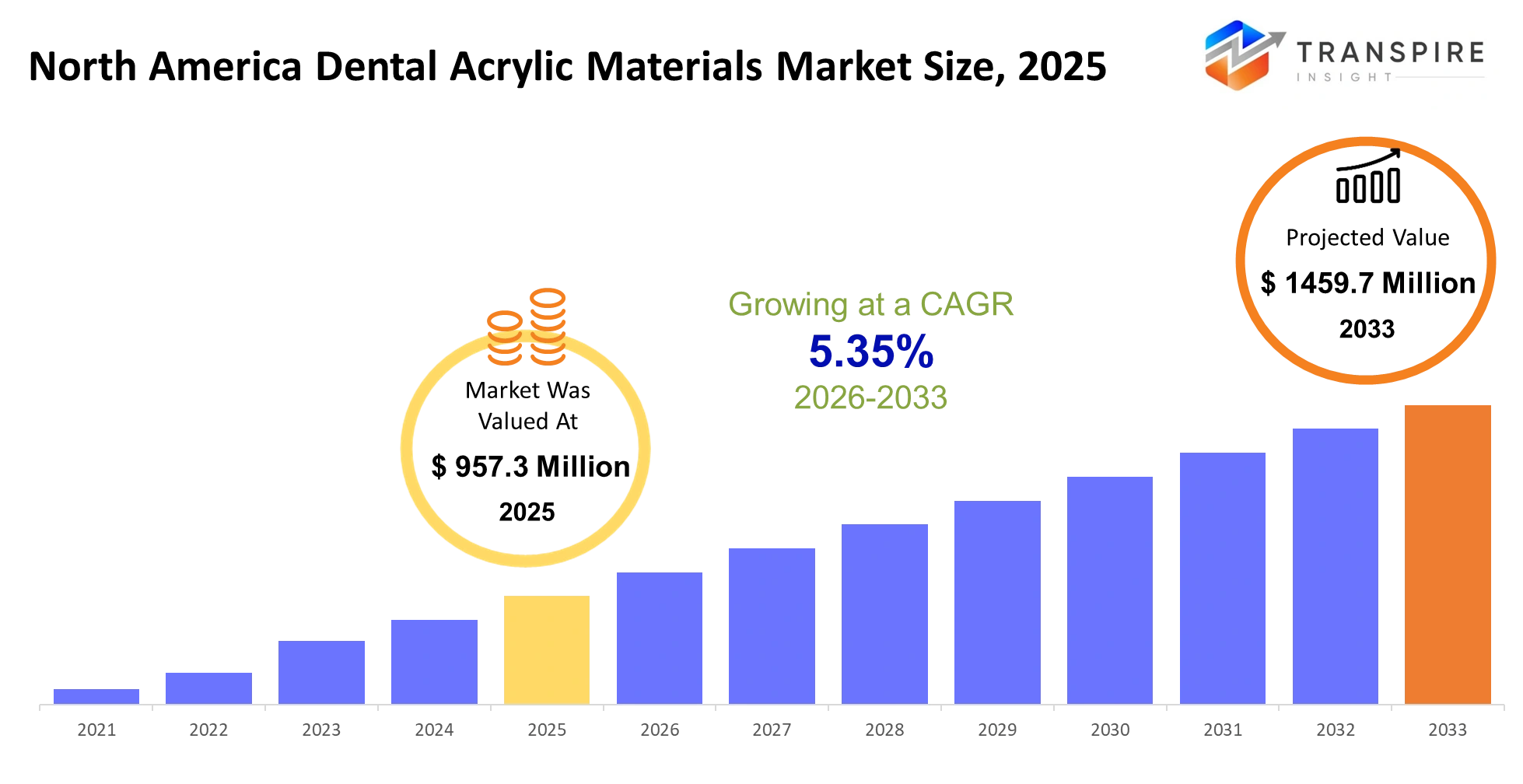
- North America Dental Acrylic Materials Market Size 2025: USD 957.3 Million
- North America Dental Acrylic Materials Market Size 2033: USD 1459.7 Million
- North America Dental Acrylic Materials Market CAGR: 5.35%
- North America Dental Acrylic Materials Market Segments: By Product Type (Heat-cured Acrylics, Self-cured Acrylics, Light-cured Acrylics, CAD/CAM Acrylics, Others); By Application (Dentures, Orthodontics, Crowns & Bridges, Temporary Restorations, Others); By End User (Dental Clinics, Dental Laboratories, Hospitals, Others); By Form (Powder, Liquid, Paste, Others).
To learn more about this report,  Download Free Sample Report
North America Dental Acrylic Materials Market Summary
The North America Dental Acrylic Materials Market was valued at USD 957.3 Million in 2025. It is forecast to reach USD 1459.7 Million by 2033. That is a CAGR of 5.35% over the period.
The North America Dental Acrylic Materials Market is pretty much about enablement of dentures , temporary crowns, orthodontic appliances , and different restorative dental parts that let clinics and labs get back oral function along with that aesthetic look, especially for aging people and those with medically complex conditions. Dental acrylic materials still matter a lot, mainly because they keep a sort of workable balance between durability, moldability ,and cost efficiency, which is useful when you’re running high-volume dental restoration workflows. In the past few years , the market did see a notable structural change, moving more toward digitally made dental prosthetics, and that happened as CAD/CAM systems, plus 3D printing technologies, got more and more embedded inside day to day lab operations.
A big nudge behind that change came from the backlog of elective dental procedures after the COVID-19 pandemic. This basically pressured clinics and laboratories to build things quicker, and to rely more on automated production systems. At the same time, supply chain disruptions made some regional dental laboratories cut down on offshore manufacturing, and instead put effort into localized digital workflows. That whole movement is now boosting the demand for higher-performance acrylic resins, the kind that work well with milling and printing hardware used in more advanced setups. Because of that, manufacturers can often reach better margin revenue streams linked to tailored restorative solutions, plus faster turnaround timelines that everyone keeps asking for.
Key Market Insights
- The United States really dominated the North America Dental Acrylic Materials Market with about 84% share in 2025 , mostly because of advanced dental laboratory infrastructure that kinda keeps improving.
- Canada on the other hand shows the quickest expansion through 2033, largely tied to expanding cosmetic dentistry procedures , plus more investment into digital dental clinics and related tools .
- Across North America , urban dental laboratory networks moved faster toward automated prosthetic manufacturing after the 2021 supply chain disruptions , which basically pushed everyone to streamline.
- In terms of materials, heat-cured acrylic materials took around 46% market share in 2025 because dental laboratories want long lasting denture base performance that holds up.
- Self-cured acrylic materials stayed as the second-largest segment, driven by high usage for temporary crowns and orthodontic appliance fabrication.
- Looking ahead CAD/CAM and 3D printing acrylic resins are expected to become the fastest-growing segment between 2026 and 2033, as more teams switch away from older workflows.
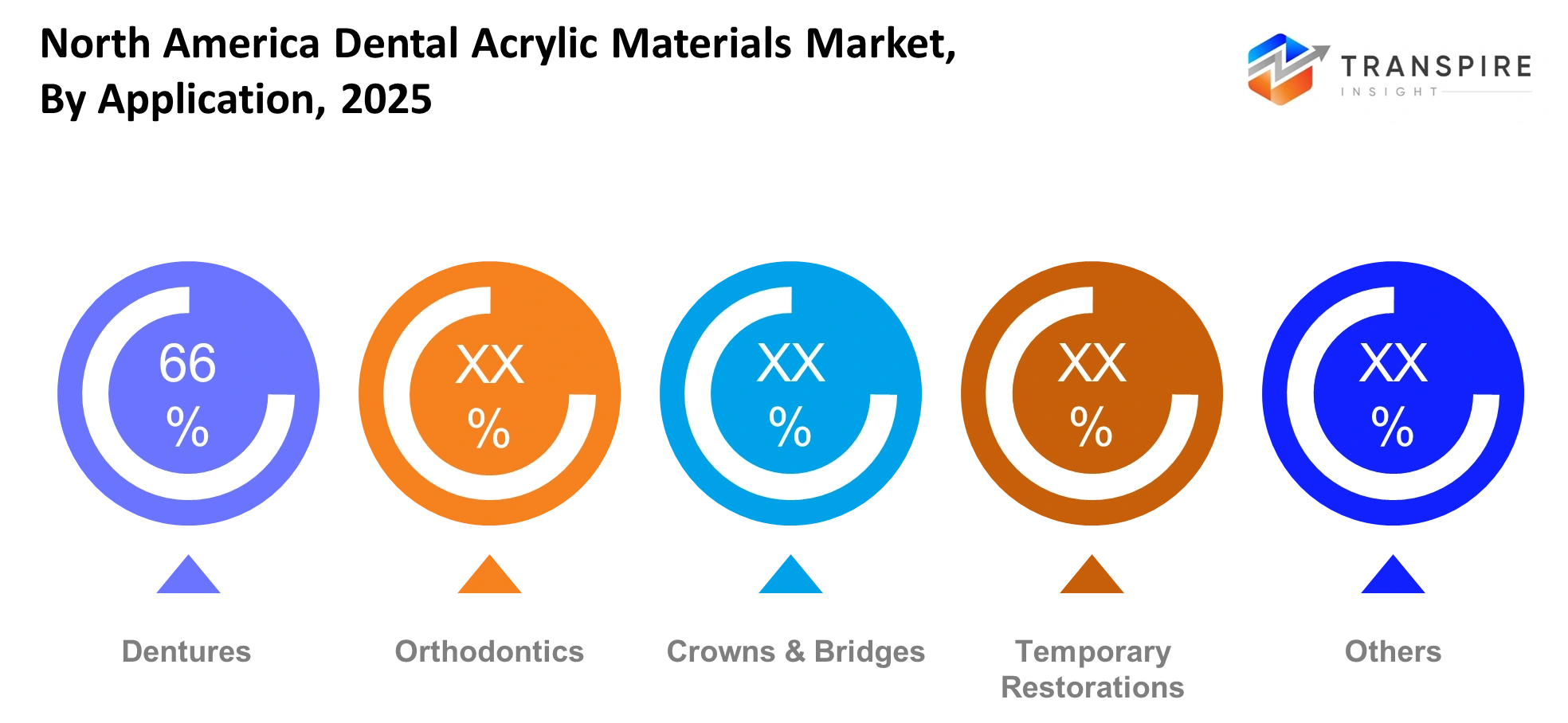
- When it comes to application demand, denture fabrication led overall revenue with nearly 52% share in 2025 , supported by aging patient populations across North America.
- Orthodontic appliance production also emerged as a high-growth area as clear aligner and removable retainer adoption increased sharply after 2022.
- For outpatient settings, temporary crown and bridge restorations keep pushing strong demand for fast-curing acrylic materials.
- And finally dental laboratories held the lead market share in 2025 , since centralized fabrication facilities can process high prosthetic procedure volumes efficiently .
What are the Key Drivers, Restraints, and Opportunities in the North America Dental Acrylic Materials Market?
The main thing pushing the North America Dental Acrylic Materials Market forward is kind of obvious really, the fast move into digital dentistry workflows across labs and even specialty dental clinics. As CAD/CAM systems become more common, plus chairside milling tools , the whole fabrication process for dentures, crowns, and orthodontic appliances got noticeably quicker. That made it easier for providers to see more patients and also cut down on outsourcing costs. Then the COVID-19 elective procedure backlog added more pressure , so many practices had to invest in automated prosthetic manufacturing since they needed faster turnaround to deal with delayed restorative care. In practice this tech shift raised the need for high-performance acrylic resins that work well with 3D printing setups and digitally managed fabrication equipment. So materials makers are seeing better revenue chances, especially higher margin returns.
The biggest limit though is still the heavy capital spending needed to modernize a dental laboratory digitally. Smaller labs and independent clinics often can’t really justify the expense of advanced scanners, milling units, and those specialized resin systems. This is especially true in cost sensitive regional areas where budgets are tight. The issue feels structural, because the replacement cycles for equipment take a long time , and there is also a shortage of skilled digital dental technicians. Because of that, slower digital adoption keeps holding back the uptake of premium acrylic materials in smaller outpatient networks.
A pretty major opportunity seems to be forming, via biocompatible 3D printing acrylic materials, made with long term prosthetic use in mind. In North America, dental laboratories are getting more serious about additive manufacturing systems, they can crank out customized dentures with less material waste ,and also support faster production scaling. At the same time, firms that are building FDA compliant printable acrylic formulations, with better fracture resistance plus improved aesthetics, are in a strong spot to win real commercial momentum by 2033.
What Has the Impact of Artificial Intelligence Been on the North America Dental Acrylic Materials Market?
Artificial intelligence together with more advanced digital tools are quietly changing how dental acrylic materials get made, how prostheses are sketched, and even how laboratory work gets managed across North America. Lately, dental labs are more and more leaning on AI connected CAD/CAM platforms, sort of to auto-run denture modeling, find margins, and tailor prosthetic features—things that used to need a lot of hands on technician time. Instead of mostly manual work, automated systems can look at intraoral scans plus patient bite records, then come up with acrylic restorations that are often very precise, so there are fewer try-ins and fitting corrections. With this kind of shift, production time can drop by as much as 30% in labs that are already digitally set up, while at the same time wasting less material during milling and 3D printing.
Alongside that, machine learning is raising how well digital dentistry pipelines perform overall. AI powered programs review past production records, they can flag possible fracture risks, spot shrinkage tendencies, and notice printing irregularities in acrylic prosthetics before anything gets manufactured. Some dental laboratories are now using predictive analytics to stretch resin yield, strengthen prosthetic longevity, and lower the costs of remaking parts that fail during fitting. On top of that, more advanced imaging tools help with better shade alignment and structural design tuning, all to support long-term restorative performance.
Still, AI adoption is not completely smooth, because the integration costs are high, and the interoperability between scanners, printers, and lab software can be uneven. Smaller dental laboratories, in particular, may not have the technical setup or practical digital workflow knowhow needed to deploy AI driven manufacturing systems at scale, and that’s where the momentum slows down.
Key Market Trends
- Since 2021, a lot of dental laboratories kind of reduced the manual denture fabrication workflows, after CAD/CAM systems got better, and the prosthetic production speed also became more consistent, dimensional consistency yes.
- Dentsply Sirona and Ivoclar also expanded their digital dentistry portfolios between 2023 and 2025, mostly via more advanced printable acrylic resin launches, pretty quickly for a few years there.
- Chairside restoration systems gained stronger adoption not long after outpatient clinics started pushing for faster turnaround times for crowns, bridges and removable prosthetics, it felt urgent.
- In North America, laboratories increased localized acrylic prosthetic manufacturing, especially after pandemic-related supply chain disruptions delayed offshore production deliveries and created that whole back log.
- Automated 3D printing workflows lowered acrylic material waste by nearly 20% compared with the conventional subtractive milling approaches, after 2022 the difference became more noticeable.
- Regulatory focus on biocompatibility standards pushed faster development of low-residual monomer acrylic formulations, these were aimed at long-term intraoral prosthetic use.
- Orthodontic appliance fabrication shifted toward digitally designed acrylic materials as clear aligner treatment volumes rose sharply after 2023, and that seemed pretty tied together.
- Some independent dental clinics increasingly invested in in-house milling equipment, to reduce outsourcing costs and also improve patient scheduling flexibility, less waiting overall.
- AI-integrated dental design software helped improve prosthetic fitting accuracy, and it also reduced remanufacturing rates across high volume laboratory operations, in practice.
- Canadian dental providers accelerated cosmetic restoration spending as aging demographics and elective dental procedure recovery strengthened the demand for premium prosthetics.
North America Dental Acrylic Materials Market Segmentation
By Product Type
Heat-cured acrylics are still sitting in the biggest market position, mainly because dental laboratories keep leaning on strong crack resistance and steady long-term dimensional stability when they’re making dentures. You’ll see high-volume prosthetic production centers gravitate to these materials too, since curing performance stays dependable and there’s usually a lower replacement cadence with removable restorations. Self-cured acrylics stay in a solid secondary slot, since outpatient clinics, plus orthodontic practices, want rapid-setting materials for chairside fixes and short-term applications. Then there are light-cured acrylics, which are slowly but steadily widening their footprint in cosmetic restoration routines, where the improved visual control and faster processing can feel like an operational win.
CAD/CAM acrylics are the quickest-growing group, largely as digital dentistry foundations spread through North American laboratory networks. Automated milling platforms and 3D printing approaches increasingly call for high-performance acrylic blocks and resin blends that print well, while also supporting precision manufacturing. Material developers are pouring resources into low-shrinkage, high-impact acrylic solutions that are compatible with digitally guided fabrication gear. As chairside restoration systems keep expanding and laboratory automation keeps getting more common, that momentum is expected to push premium product uptake forward, and it should open up more revenue opportunities for suppliers who focus on advanced restorative materials.
By Application
Dentures still seem to hold the biggest portion of the market, because the aging patient population keep showing steady demand for removable prosthetic restorations. In many dental labs, they process large volumes of full and partial denture cases, with acrylic materials that hit a kind of sweet spot between affordability, easy customization, and good long-term wear resistance. Meanwhile orthodontic uses keep growing too, mainly since removable retainers and aligner-based care are being more readily accepted across outpatient dental networks. On top of that, temporary restorations bring in notable revenue, partly because more patients prefer same-day style treatment workflows in cosmetic and restorative dentistry.
Crowns and bridges look like a faster moving area, since digital impression systems plus chairside milling tech have basically shortened the restoration turnaround times quite a lot, over the past few years. Acrylic materials that are tuned for temporary crown fabrication are now getting used more in multi-stage implant work and cosmetic procedures, especially when a precise fit and consistent appearance really matter. Product makers are also responding by formulating acrylic blends that are stronger and more resistant to staining, so the temporary restorations can last longer, without losing much in appearance. Looking ahead, continued spending on cosmetic dentistry and implant-supported prosthetics should support demand for restorative materials that work well with digital workflows through 2033.
To learn more about this report, Download Free Sample Report
By End User
Dental laboratories still seem to run the show, mostly because centralized fabrication facilities handle big denture work , crown work, and orthodontic appliance production across wide regional healthcare networks. There are high procedural numbers and a lot of investment going into automated milling systems, so procurement keeps looking pretty strong for advanced acrylic materials. Dental clinics keep adding to market participation too , since chairside restoration technologies are getting easier to access for independent practitioners. Hospitals hold a smaller but pretty steady spot, mainly tied to prosthetic and reconstructive dental procedures related to trauma care and those more complex surgical treatment paths.
Independent dental clinics are probably the fastest-growing end user category. Digital scanning plus in-house milling systems reduce how much they rely on outside laboratories, which is a big deal in practice. Faster completion of treatment and the more flexible appointment scheduling also nudge clinics to buy acrylic-compatible restoration tech directly. At the same time, collaborations between dental laboratories and equipment manufacturers help things move faster, especially with printable acrylic resins tuned for automated production environments. Over the long run, digitally integrated outpatient dentistry is expected to gradually shift purchasing power toward clinics that run high-efficiency restorative workflows.
By Form
Powder-based acrylic material still seems to sit in the leading spot, because laboratories, and clinics keep using powder-liquid systems for denture bases , orthodontic appliances, and repairs. People know these options well clinically, and the material price tends to stay lower, so overall demand remains steady inside the usual restorative routines. Liquid acrylic formulas keep being used too, mainly since they fit customized mixing needs and can support quick chairside repair steps. Paste-based products are slowly picking up more ground in cosmetic, and temporary restorative uses, because the handling is more deliberate and the curing stays controlled, so workflow consistency is easier.
Looking ahead, the strongest growth momentum during the forecast period is expected from advanced printable paste and resin systems, since additive manufacturing keeps spreading through prosthetic fabrication settings. In digital dentistry, workflows are now asking for acrylic formulations that are highly stable , so automated layering works and curing stays precise. Suppliers are focusing on viscosity tuning, color reliability, and less shrinkage behavior, all to help with compatibility for next-generation printing hardware. If digitally manufactured restorations keep expanding, then demand should rise for specialized acrylic forms that are actually designed for automated production environments.
What are the Key Use Cases Driving the North America Dental Acrylic Materials Market?
Denture fabrication is still like the core reason people use acrylic materials across North America , mainly because dental labs keep churning through really large volumes of removable prosthetic restorations for older patients. There’s strong pull for denture bases that are durable yet cost efficient , so heat-cured acrylic stays right in the middle of day to day restorative dentistry work.
Orthodontic appliances plus temporary crown restorations are also getting more noticeable traction among independent dental clinics , especially those leaning on chairside CAD/CAM setups and digital scanning platforms. On top of that, cosmetic dentistry providers more and more lean on updated acrylic formulations, to help them ship work faster and keep a steadier aesthetic look for outpatient restoration routines.
Newer use cases are showing up too, like 3D-printed implant supported prosthetics , and long-term temporary restorations that are digitally customized through automated laboratory workflows. Research focused dental institutes, along with specialty prosthodontic centers are testing biocompatible acrylic materials geared for precision additive manufacturing and high impact wear performance through 2033.
|
Report Metrics |
Details |
|
Market size value in 2025 |
USD 957.3 Million |
|
Market size value in 2026 |
USD 1013.5 Million |
|
Revenue forecast in 2033 |
USD 1459.7 Million |
|
Growth rate |
CAGR of 5.35% from 2026 to 2033 |
|
Base year |
2025 |
|
Historical data |
2021 - 2024 |
|
Forecast period |
2026 - 2033 |
|
Report coverage |
Revenue forecast, competitive landscape, growth factors, and trends |
|
Regional scope |
North America (Canada, The United States, and Mexico) |
|
Key company profiled |
Dentsply Sirona, Ivoclar Vivadent, Kulzer, GC Corporation, Kerr Dental, SHOFU, 3M, Mitsui Chemicals, Tokuyama Dental, Septodont, VITA Zahnfabrik, Ultradent Products, VOCO GmbH, Keystone Industries, Zhermack. |
|
Customization scope |
Free report customization (country, regional & segment scope). Avail customized purchase options to meet your exact research needs. |
|
Report Segmentation |
By Product Type (Heat-cured Acrylics, Self-cured Acrylics, Light-cured Acrylics, CAD/CAM Acrylics, Others); By Application (Dentures, Orthodontics, Crowns & Bridges, Temporary Restorations, Others); By End User (Dental Clinics, Dental Laboratories, Hospitals, Others); By Form (Powder, Liquid, Paste, Others). |
Which Regions are Driving the North America Dental Acrylic Materials Market Growth?
North America still feels like the dominant regional market, mainly because its dental laboratory infrastructure is super developed, plus there’s a wide restorative care network that is tied to insurance coverage, and also because digital dentistry keeps getting rolled in pretty fast. The United States in particular stays ahead on revenue, since big dental service organizations and specialty prosthodontic clinics keep putting money into CAD/CAM systems, automated milling devices, and more chairside restoration workflows. On top of that, there’s strong cooperation between dental materials manufacturers, equipment suppliers, and accredited lab networks, which helps keep product innovation steady and speeds up commercialization for updated acrylic formulations. And yeah, the regulatory focus on biocompatibility standards plus quality-controlled dental manufacturing really helps lock in long-term market stability across the region.
Europe sits as the second-largest regional market, but the growth story is a bit different from North America. Here the demand leans more on predictable reimbursement structures, long-standing dental prosthetic traditions, and a consistent uptake of preventive oral healthcare programs, especially across Germany, France, and the Nordic countries. A lot of European dental laboratories tend to favor long-cycle restorative materials and precision fabrication norms rather than just trying to expand procedural volume quickly. Continued investment in training for vocational dental technology and regulated laboratory certification programs also keeps revenue generation more dependable across both public and private healthcare channels.
Asia-Pacific is kind of emerging as the fastest-growing regional market, because dental infrastructure investment is accelerating, and access to private oral healthcare services is widening across China , India, and Southeast Asia. With rapid urbanization and a larger middle-income patient group, the demand for cosmetic dentistry, orthodontic treatments, and digitally manufactured prosthetics has really kicked up recently. Meanwhile, government healthcare modernization programs are pushing change, and domestic production of CAD/CAM equipment is expanding too, so the adoption barriers for advanced acrylic materials fell across dental networks in the whole region. From 2026 to 2033, all this momentum should produce solid opportunities for international dental materials suppliers , digital equipment makers, and investors that want to focus on high-growth outpatient dental service markets.
Who are the Key Players in the North America Dental Acrylic Materials Market and How Do They Compete?
The competitive landscape of the North America Dental Acrylic Materials Market is still somewhat moderately consolidated, but now competition is more and more tied to digital dentistry integration, plain durability, and workflow efficiency, rather than only price. Most established dental materials manufacturers keep defending their share by pushing CAD/CAM-compatible product lines, and by building alliances with dental laboratory networks, while newer players tend to emphasize printable acrylic resins tuned for additive manufacturing systems. So, differentiation is now kind of driven by biocompatibility performance, color stability, fracture resistance, plus how well the material cooperates with automated milling or 3D printing platforms. Also, geographic service coverage, and hands-on technical training for labs and dental clinics, is playing a bigger role in keeping customers for the long run.
Dentsply Sirona puts a lot of emphasis on technology integration, basically by linking acrylic material development with its own digital scanning, milling, and chairside restoration ecosystems. With this approach, dental clinics can streamline restorative workflows while also cutting down compatibility problems between equipment and materials. Ivoclar, meanwhile, leans into premium aesthetic acrylic formulations meant for deeply customized denture and prosthetic uses, especially within cosmetic and prosthodontic treatment centers. Ongoing spending on digital denture fabrication systems, along with laboratory partnerships, keeps helping strengthen its reach across North America.
Kulzer competes through faster-curing acrylic technologies, aiming to boost laboratory turnaround times and lower remanufacturing rates in large-scale prosthetic production settings.Keystone Industries has been expanding a bit aggressively into 3D printing materials, by developing printable acrylic resins geared for orthodontic needs, and also removable prosthetic uses kind of side by side. Meanwhile, GC America is strengthening its competitive position using high-impact acrylic formulations that are engineered for long-term wear resistance, and lower fracture rates in removable dental restorations too.
Company List
- Dentsply Sirona
- Ivoclar Vivadent
- Kulzer
- GC Corporation
- Kerr Dental
- SHOFU
- 3M
- Mitsui Chemicals
- Tokuyama Dental
- Septodont
- VITA Zahnfabrik
- Ultradent Products
- VOCO GmbH
- Keystone Industries
- Zhermack
Recent Development News
“In March 2026, Ivoclar expanded its partnership with Benco Dental to distribute the complete CAD/CAM block portfolio for the CEREC system. The collaboration improved North American access to digitally compatible restorative materials and strengthened integrated chairside prosthetic manufacturing capabilities.
Source: https://www.benco.com
“In January 2026, Dentsply Sirona entered a strategic partnership expansion with Benco Dental to include connected dental technology solutions. The initiative expanded U.S. market availability for integrated scanning, design, and manufacturing platforms that support digitally fabricated acrylic restorations and prosthetic workflows.
Source: https://pr.comtex.com
What Strategic Insights Define the Future of the North America Dental Acrylic Materials Market?
The North America Dental Acrylic Materials Market is kind of moving , slowly, toward fully digital restorative manufacturing ecosystems where material performance software compatibility and automated production efficiency all end up deciding who is competitive. In the next five to seven years, chairside dentistry expansion and lab automation should shift buying choices away from the usual low-cost acrylics and more toward premium CAD/CAM and printable resin systems that are tuned for precision workflows.
There is also one less obvious hazard here , the growing reliance on proprietary digital platforms that are controlled by only a limited number of equipment manufacturers. If platform concentration keeps increasing, it could limit material interoperability, and then create pricing stress for independent acrylic suppliers who are trying to maintain compatibility certifications. At the same time, an important opportunity is showing up as well, around long-term 3D-printed prosthetics for implant-supported restorations and geriatric dental care. Regulatory movement tied to biocompatible printable materials is expected to speed up adoption across North American prosthodontic centers. So, companies and investors should really emphasize collaborations with digital dentistry software providers and automated laboratory networks, to lock in long-term integration within these next-generation restorative workflows.
North America Dental Acrylic Materials Market Report Segmentation
By Product Type
- Heat-cured Acrylics
- Self-cured Acrylics
- Light-cured Acrylics
- CAD/CAM Acrylics
- Others
By Application
- Dentures
- Orthodontics
- Crowns & Bridges
- Temporary Restorations
- Others
By End User
- Dental Clinics
- Dental Laboratories
- Hospitals
- Others
By Form
- Powder
- Liquid
- Paste
- Others
Frequently Asked Questions
Find quick answers to common questions.
The expected North America Dental Acrylic Materials Market size is USD 1459.7 Million in 2033.
Key segments for the North America Dental Acrylic Materials Market are By Product Type (Heat-cured Acrylics, Self-cured Acrylics, Light-cured Acrylics, CAD/CAM Acrylics, Others); By Application (Dentures, Orthodontics, Crowns & Bridges, Temporary Restorations, Others); By End User (Dental Clinics, Dental Laboratories, Hospitals, Others); By Form (Powder, Liquid, Paste, Others).
Major North America Dental Acrylic Materials Market players are Dentsply Sirona, Ivoclar Vivadent, Kulzer, GC Corporation, Kerr Dental, SHOFU, 3M, Mitsui Chemicals, Tokuyama Dental, Septodont, VITA Zahnfabrik, Ultradent Products, VOCO GmbH, Keystone Industries, Zhermack.
The North America Dental Acrylic Materials Market size is USD 957.3 Million in 2025.
The North America Dental Acrylic Materials Market CAGR is 5.35% from 2026 to 2033.
- Dentsply Sirona
- Ivoclar Vivadent
- Kulzer
- GC Corporation
- Kerr Dental
- SHOFU
- 3M
- Mitsui Chemicals
- Tokuyama Dental
- Septodont
- VITA Zahnfabrik
- Ultradent Products
- VOCO GmbH
- Keystone Industries
- Zhermack
About the Authors

Pankaj Ghogare Patil
I am Pankaj Ghogare Patil, a Senior Research Analyst at Transpire Insight, specializing in the Pharmaceutical, Chemicals & Materials, Healthcare IT, and Biotechnology industry. My expertise lies in conducting comprehensive market research, analyzing industry trends, evaluating competitive landscapes, and translating complex data into actionable insights. At Transpire Insight, I closely follow emerging technologies, regulatory developments, and market innovations to create accurate, well-researched, and informative content that helps businesses and professionals make informed decisions. I am committed to producing credible, evidence-based articles that reflect industry best practices while making technical topics accessible and valuable for a broad audience.

Chakradhar Khansole
Chakradhar serves as the Research Director at Transpire Insight, bringing over 8 years of experience in technology, innovation, and strategic market intelligence. He specializes in transforming complex market data into actionable business insights that enable organizations to make informed, growth-oriented decisions. Recognized for his strategic vision and analytical expertise, Chakradhar leads high-impact research initiatives, delivering comprehensive market assessments, competitive intelligence, and forward-looking industry analysis.
Recently Published Reports
-
Apr 2026
AI in Diabetic Retinopathy Market
AI in Diabetic Retinopathy Market Size, Share & Analysis Report By Type (Screening AI Systems, Diagnostic AI Systems, and Predictive AI Models), By Application Segment (Hospitals, Ophthalmology Clinics, Diagnostic Centers, and Research and Development), and Geography (North America, Europe, Asia-Pacific, Middle East and Africa, South and Central America), 2021 - 2031
-
Apr 2026
Psychometric Tests Market
Psychometric Tests Market Size, Share & Analysis Report By Type (Personality Tests, Ability/Aptitude Tests, Skill/Knowledge Tests, and Others), By Application (Talent Acquisition and Talent Management), and Geography (North America, Europe, Asia-Pacific, Middle East and Africa, South and Central America), 2021 – 2031
-
Apr 2026
Rare Biological Sample Collection Market
Rare Biological Sample Collection Market Size, Share & Analysis Report By Type (Isolation Kits & Reagent, Blood Collection Tubes, and Others), By Application (Oncology, Transcriptomics, Pharmacogenomics, and Others), and Geography (North America, Europe, Asia-Pacific, Middle East and Africa, South and Central America), 2021 – 2031
-
Jul 2026
Diabetic Retinopathy Market
Diabetic Retinopathy Market Size, Share & Analysis Report By Type (Proliferative Diabetic Retinopathy, and Diabetic Macular Edema (DME)), By Treatment Type (Anti VEGF Drug, Steroid Implants, Laser Surgeries, and Vitrectomy), and Geography (North America, Europe, Asia-Pacific, Middle East and Africa, South and Central America), 2021 – 2031
Our Clients







