

North America Cryoballoon Ablation System Market Size & Forecast:
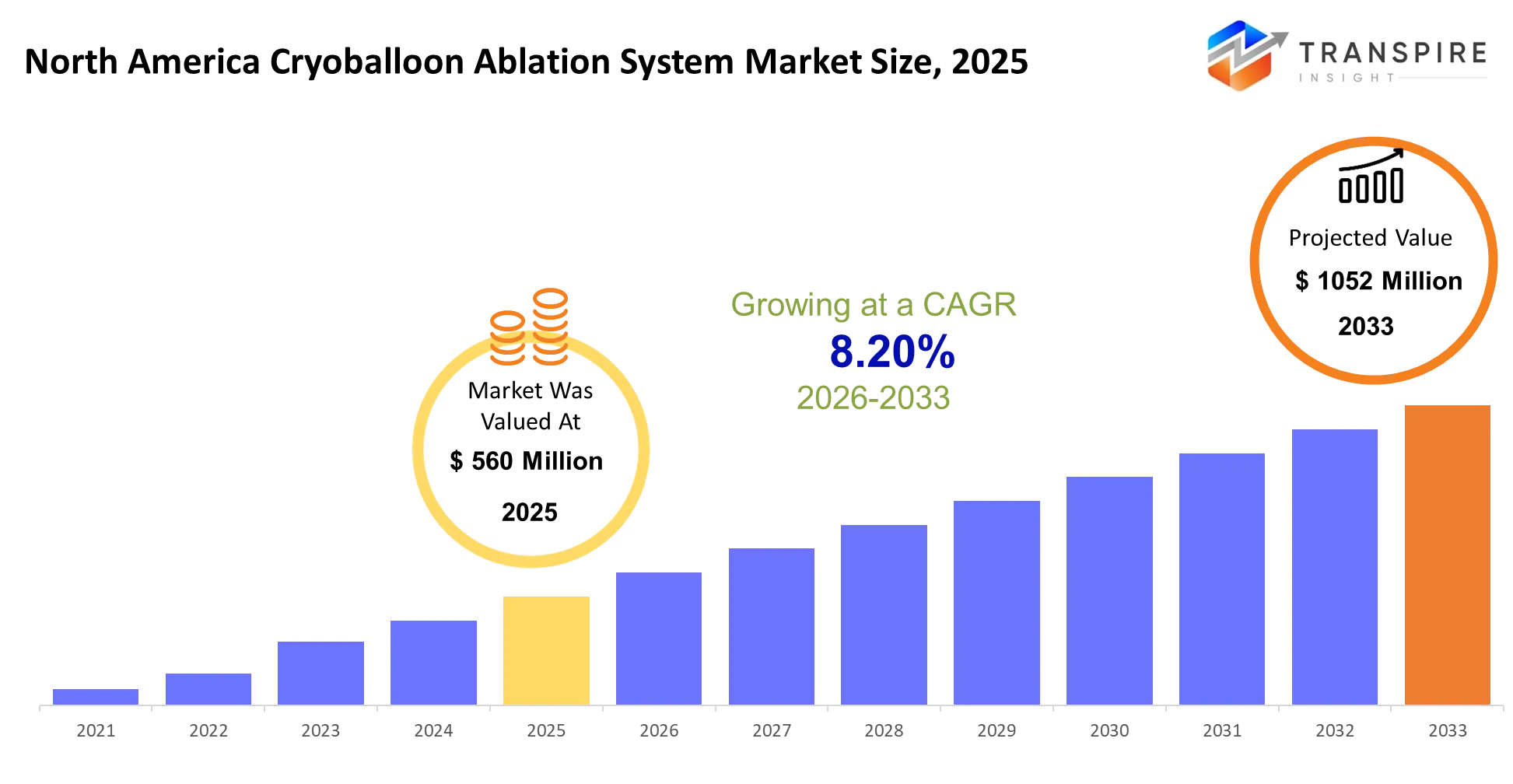
- North America Cryoballoon Ablation System Market Size 2025: USD 560 Million
- North America Cryoballoon Ablation System Market Size 2033: USD 1052 Million
- North America Cryoballoon Ablation System Market CAGR: 8.20%
- North America Cryoballoon Ablation System Market Segments: By Type (Cryoballoon Catheters, Console Systems, Accessories, Others), By Application (Atrial Fibrillation, Arrhythmia, Others), By End-User (Hospitals, Cardiac Centers, Others), By Procedure (Minimally Invasive, Others).
To learn more about this report,  Download Free Sample Report
North America Cryoballoon Ablation System Market Summary:
The North America Cryoballoon Ablation System Market size is estimated at USD 560 Million in 2025 and is anticipated to reach USD 1052 Million by 2033, growing at a CAGR of 8.20% from 2026 to 2033.The North America Cryoballoon Ablation System Market is really about minimally invasive cardiac procedures that help clinicians deal with atrial fibrillation, by freezing and disabling odd electrical pathways in the heart. In practice, these systems seem to reduce procedure complexity, shorten operating time, and help rhythm control outcomes a lot for hospitals handling bigger electrophysiology workloads. Their value became more visible as healthcare providers tried to lower repeat interventions and also cut down long term stroke risk tied to untreated arrhythmias.
Over the past three to five years, the market moved away from the older point-by-point radiofrequency ablation methods toward single-shot cryoballoon platforms. These newer platforms tend to deliver better procedural consistency, and make it easier to standardize workflow across high-volume cardiac centers. That shift picked up speed after pandemic era procedure backlogs showed how much faster and more predictable treatment throughput is needed. Also, reimbursement support for catheter based rhythm management grew more broadly, and clinical evidence for early ablation therapy kept expanding which changed how cardiologists refer patients. Now, as hospitals invest in advanced electrophysiology infrastructure, manufacturers are capturing higher revenue via premium disposable catheters , integrated mapping technologies, and by benefiting from repeat procedural demand.
Key Market Insights
- In 2025 , the United States was basically leading the North America Cryoballoon Ablation System Market with about 78% of the share, mainly because the country has strong cardiac care infrastructure that keeps getting better.
- Canada, meanwhile, shows the quickest momentum through 2032, backed by more electrophysiology labs opening up, plus reimbursement policies that are, generally speaking , quite favorable.
- Also , high prevalence of atrial fibrillation across North America keeps boosting the overall industry scale, the number of procedures done each year, and the longer-range market forecast upside.
- On top of that, more strategic investments in outpatient cardiac centers are speeding up cryoballoon ablation adoption , especially in secondary metro healthcare systems, not only the biggest hubs.
- By 2025 cryoballoon catheters pulled in over 45% of the revenue share , since many hospitals lean toward high precision, disposable ablation systems for consistent performance.
- Capital equipment systems stayed as the second major segment , largely because more high volume electrophysiology centers across North America keep installing new units.
- Meanwhile, the mapping integrated cryoablation platforms are expected to post the fastest growth rate over 2025–2032, since clinicians want workflows that are less chaotic and more accurate.
- Single shot ablation technology is also gaining ground steadily, as providers try to cut down procedural complexity and make better use of operating room time.
- For applications, atrial fibrillation treatment dominated, taking more than 70% market share in 2025 , driven by the rise in cardiac arrhythmia diagnoses across the region.
- Persistent atrial fibrillation management is turning into the fastest growing application segment, because more physicians seem to prefer earlier interventional therapy rather than waiting.
- Key demand drivers include faster recovery, fewer repeat procedures,and better long term rhythm control results for cardiovascular patients.
What are the Key Drivers, Restraints, and Opportunities in the North America Cryoballoon Ablation System Market?
The most powerful driver speeding up the North America Cryoballoon Ablation System Market is kind of the shift toward earlier, sooner interventional treatment for atrial fibrillation. Over the last few years big clinical studies were published, and they basically showed that catheter ablation done earlier in the illness timeline can cut down recurrent hospitalizations and long term cardiovascular troubles compared with sticking to prolonged drug therapy. That data, it also adjusted the referral habits among cardiologists and gave payers more reassurance on reimbursement.
Hospitals then responded by adding more electrophysiology capacity and putting money into cryoballoon platforms, partly because these systems can reduce procedure durations and support a smoother workflow, you know. In practice you end up with higher procedural throughput, more disposable catheter use, and firmer repeating revenue channels for device makers.
The market’s biggest structural pushback though is still the lack of highly trained electrophysiologists and specialized cardiac centers that can carry out advanced ablation processes. Cryoballoon systems need dedicated imaging infrastructure, real procedural know how, and an experienced support team. And all of that comes with multi year investment plans, plus long training cycles too. Smaller hospitals often hesitate to adopt early, because they can’t easily justify the capital spending without enough patient volumes. As a consequence, penetration slows down outside major urban healthcare networks and it also puts a lid on revenue upside across underserved areas.
A really major growth chance is kind of showing up, via the mix of artificial intelligence mapping and navigation tools into cryoballoon workflows. A few companies are building platforms that help lesion evaluation a lot, while also lowering procedural variability, and somehow backing real-time choices during ablation. There’s also investment going into outpatient electrophysiology centers across the United States and Canada, which sets up pretty favorable conditions for these next gen systems. As ambulatory cardiac care keeps expanding, clinicians are leaning more toward solutions that shorten the procedure time without dropping clinical precision, so it opens a new route for premium device adoption, and yeah it feels pretty strong right now.
What Has the Impact of Artificial Intelligence Been on the North America Cryoballoon Ablation System Market?
Artificial intelligence, plus advanced digital technologies, are kind of reshaping the North America Cryoballoon Ablation System Market, in ways that are hard to ignore , especially when it comes to procedural precision workflow automation and post-procedure monitoring across electrophysiology centers. More and more hospitals rely on AI-enabled cardiac mapping platforms to help automate lesion assessment, catheter position evaluation, and even real-time procedural direction during atrial fibrillation ablation. In practice, these platforms assist physicians with lowering manual interpretation slip-ups, and they make outcomes feel more steady, even when the case gets very complex. Also the integrated digital control systems tend to streamline patient records handling, procedural documentation, and operating room scheduling, so that high-volume cardiac centers can effectively boost daily procedure capacity, without as much downtime.
At the same time, machine learning models are being used for predictive patient management, by pulling together cardiac imaging, electroanatomical mapping information, and older arrhythmia history, to spot patients who may face a higher recurrence likelihood after ablation. That sort of foresight supports earlier intervention planning, and it can improve long-term rhythm management results. Meanwhile advanced analytics tools assist in fine-tuning catheter performance and overall procedural efficiency, which often ends up meaning shorter procedure sessions, fewer repeat interventions, and better use of expensive electrophysiology infrastructure.
Still, AI adoption has a major constraint because folding these advanced digital platforms into existing hospital systems needs a lot of capital spending, plus highly specialized training. Many mid-sized healthcare facilities do not have a standardized electrophysiology data environment, so the algorithm reliability drops, and that slowdown makes broad deployment of AI-assisted ablation technologies much harder, than people expect at first.
Key Market Trends
- Since 2021, hospitals have increasingly swapped point by point radiofrequency setups for single shot cryoballoon platforms, in order to shrink procedure durations by about 20–30% (give or take).
- Medtronic also expanded next generation cryoballoon catheter capabilities after electrophysiology centers asked for more procedural consistency, and well, fewer recurrences overall.
- Between 2020 and 2025, outpatient electrophysiology centers moved faster because cardiac procedures were gradually drifting away from the usual inpatient hospital settings, kind of like a steady drift not a flip.
- AI enabled electroanatomical mapping systems started gaining more traction after physicians wanted real time catheter positioning help, plus better lesion assessment accuracy during ablation.
- In Canada, healthcare networks increased investments in electrophysiology labs once pandemic era backlogs made the capacity limits for atrial fibrillation management painfully obvious.
- Since 2022, cardiac centers have leaned harder into integrated digital workflow platforms, that automate procedural reporting, patient tracking, and scheduling coordination , sort of all in one bundle.
- Manufacturers, more and more, are bundling cryoballoon systems with mapping software and service agreements too, to support long term recurring revenue from disposable catheter sales.
- Strategic collaborations between Boston Scientific and hospital systems got stronger as providers pushed for scalable cardiac rhythm management infrastructure, not just one off solutions.
- Referral patterns among physicians changed a lot after big clinical studies showed earlier catheter ablation can lower long term hospitalization risks compared with drug based rhythm control.
- And around 2020 and 2021, supply chain disruptions nudged manufacturers to regionalize catheter component sourcing, while also tightening North American distribution resilience.
North America Cryoballoon Ablation System Market Segmentation
By Type
Cryoballoon catheters are currently in the leading spot for the type segment , mainly because electrophysiology centers lean on disposable catheter systems for pretty much every ablation procedure. When catheter utilization keeps coming back again and again it creates stable income streams for manufacturers. At the same time , console systems take the second-largest share since the upfront installation costs are high and the replacement cycles are long. Accessories and supporting components still see solid demand too, because hospitals need compatible imaging, navigation, and cooling systems, so procedural performance can stay optimal. Also, the growing preference for single-shot ablation technologies is pushing catheter adoption forward in high-volume cardiac facilities.
Healthcare providers are often choosing integrated platforms that bundle cryoballoon devices with mapping software plus workflow automation tools. Manufacturers are meanwhile focusing on improving catheter flexibility , balloon durability, and real-time temperature monitoring, so procedural precision improves rather than slipping. Looking ahead, future growth in this type segment will likely favor firms that can deliver bundled solutions—meaning disposables , consoles, and digital support technologies—tied together under longer-term service agreements.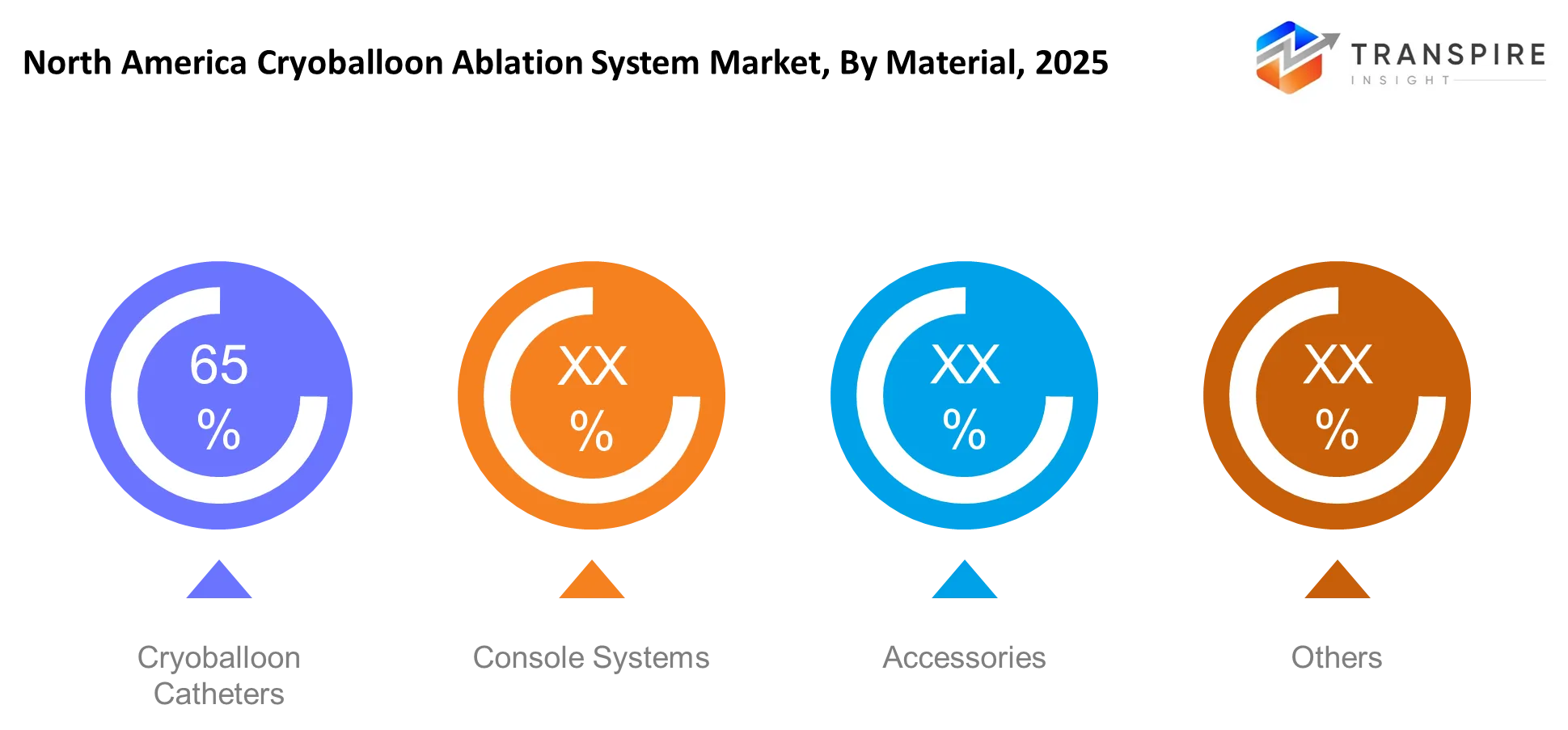
To learn more about this report, Download Free Sample Report
By Application
Atrial fibrillation is still, basically the dominant application segment, because cardiac specialists more and more want catheter based actions instead of prolonged pharmaceutical rhythm management. There is strong clinical evidence for early ablation therapy and this has nudged the treatment pathways toward minimally invasive procedures, particularly for people who carry persistent arrhythmia risk. Treatment for arrhythmias beyond atrial fibrillation keeps expanding slowly, though lower procedural volumes and more complex diagnostic needs make it harder to get wide traction. Hospitals are also leaning toward cryoballoon systems , since shorter procedure durations help patient throughput and lower the operational load inside electrophysiology units.
Demand trends seem tied to physicians feeling more confident about long term rhythm control results, outcomes that are associated with cryogenic ablation technologies. On top of that, improvements in mapping precision and catheter handling are opening up a larger set of patients who could benefit from cardiac rhythm interventions. Going forward, application growth will probably hinge on broader clinical acceptance among moderate risk patient groups, plus reimbursement systems that better match earlier procedural intervention across North American healthcare.
By End-User
Hospitals kind of dominate the end-user side , because big healthcare networks have the infrastructure, imaging systems, and trained electrophysiology teams that are basically needed for the more advanced cardiac ablation procedures. Also, the steady stream of patients and the access to reimbursement-supported cardiovascular programs still sort of pushes hospital leadership forward across the market. Cardiac centers seem to be the fastest growing part of this segment, since many providers are moving some electrophysiology work into more specialized outpatient settings. These outpatient spaces tend to run with lower operating costs and they can schedule faster, with more flexible turnaround times.
Smaller facilities and independent specialty clinics still look somewhat constrained , mostly due to high capital needs and a lack of experienced procedural staff. At the same time , investments in dedicated electrophysiology laboratories have been climbing pretty consistently since pandemic-related treatment delays caused major procedure backlogs throughout cardiac care networks. End-user demand is increasingly leaning toward systems that can blend digital workflow management, real-time imaging support and AI-assisted procedural guidance. Looking ahead, expansion here will likely focus on outpatient cardiac centers that can push high procedural efficiency while still keeping advanced clinical capabilities and strong cost control.
By Procedure
In the procedure segment, minimally invasive procedures take up the larger share because many healthcare providers are leaning more and more toward faster recovery windows, reduced complication exposure, and shorter hospital stays for cardiac rhythm management stuff. Cryoballoon based interventions started getting much more traction after head to head clinical studies showed better procedural efficiency versus older open surgical approaches, and it kind of stuck from there. Also, demand for these less disruptive treatment pathways kept climbing as hospitals tried to ease operating room congestion and make better use of their available resources, especially after pandemic related procedural delays.
That said, alternative procedures still show up for certain patient categories, mainly the complex cardiac cases where hybrid intervention strategies are needed but overall adoption stays relatively limited. Meanwhile, technical upgrades in catheter navigation, imaging integration, and thermal control systems keep reinforcing physician trust in minimally invasive approaches. Manufacturers meanwhile are putting research dollars into reducing procedure variability and supporting long term rhythm steadiness too. Looking ahead, competition in this segment will probably revolve around platforms that can blend speed, precision, and digital procedural intelligence, so they can widen patient eligibility and push outpatient treatment expansion, across more settings.
What are the Key Use Cases Driving the North America Cryoballoon Ablation System Market?
Treatment of atrial fibrillation still stays as the main use case, that is pushing cryoballoon ablation adoption in a lot of North American hospitals and electrophysiology centers. Cardiac specialists now seem to lean toward cryogenic ablation more, because these single-shot approaches basically cut down on operating time , make day-to-day workflow smoother, and help many patients bounce back quicker than the more conventional rhythm management strategies.
Other expansion paths are showing up too, like persistent cardiac arrhythmias handled in outpatient cardiac centers and in specialty electrophysiology clinics. Also, more investment into ambulatory cardiovascular care is helping clinicians use less invasive ablation procedures for moderate-risk patients, who still need durable rhythm stabilization , but would really like less reliance on hospital stays
For what comes next, there are emerging use cases such as AI assisted ablation planning, and early intervention programs geared toward high-risk cardiovascular populations. On top of that, newer mapping technologies and predictive analytics platforms look promising, for making lesion targeting more precise, and for lowering the odds of repeat procedures during the forecast period.
|
Report Metrics |
Details |
|
Market size value in 2025 |
USD 560 Million |
|
Market size value in 2026 |
USD 606 Million |
|
Revenue forecast in 2033 |
USD 1052 Million |
|
Growth rate |
CAGR of 8.20% from 2026 to 2033 |
|
Base year |
2025 |
|
Historical data |
2021 - 2024 |
|
Forecast period |
2026 - 2033 |
|
Report coverage |
Revenue forecast, competitive landscape, growth factors, and trends |
|
Country scope |
North America (Canada, The United States, and Mexico) |
|
Key company profiled |
Medtronic, Boston Scientific, Abbott, Biosense Webster, Siemens Healthineers, GE Healthcare, Philips, Johnson & Johnson, Terumo, MicroPort, Merit Medical, AngioDynamics, Stryker, Olympus, Biotronik |
|
Customization scope |
Free report customization (country, regional & segment scope). Avail customized purchase options to meet your exact research needs. |
|
Report Segmentation |
By Type (Cryoballoon Catheters, Console Systems, Accessories, Others), By Application (Atrial Fibrillation, Arrhythmia, Others), By End-User (Hospitals, Cardiac Centers, Others), By Procedure (Minimally Invasive, Others) |
Which Regions are Driving the North America Cryoballoon Ablation System Market Growth?
The United States is basically in front in the North America Cryoballoon Ablation System Market, mainly because big hospital networks keep growing their electrophysiology capacity and they keep putting money into newer cardiac rhythm technologies. Also the reimbursement routes for catheter ablation procedures look pretty favorable, so clinicians can step in earlier for atrial fibrillation patients across a lot of healthcare systems. Add in strong cooperation between medical device companies academic cardiac centers, and outpatient electrophysiology clinics, and the whole thing speeds up clinical use of next generation cryoballoon platforms. With high procedure numbers, lots of specialists available, plus quick integration of AI-assisted mapping tools, the market keeps its long-term edge across the country.
Canada sits as the second-largest regional contributor, but the market behavior is not the same, it differs a lot from the United States because the healthcare structure is more centralized, and technology rollout happens at a slower, more measured pace. In Canada the provincial healthcare systems put more weight on long-term clinical results and cost-aware procedural planning before they approve broader technology deployment. That creates adoption that’s slower but still more steady for cryoballoon ablation systems, especially inside major metropolitan cardiac centers. Meanwhile consistent public healthcare funding, broader electrophysiology infrastructure, and ongoing physician training programs keep supporting dependable market revenue across Canadian provinces.
Mexico is coming up as the fastest-growing regional market, mostly because private hospital investment is rising and there’s been a modernization of the cardiovascular treatment infrastructure, you know. The spread of specialty cardiac centers along major urban healthcare corridors has made it easier to get minimally invasive arrhythmia treatment over the last few years, in practice. At the same time, international medical device manufacturers have been building more regional partnerships and running physician education programs to support take-up of procedures , and to improve technology familiarity.Overall, growth across Mexico is generating solid opportunities for manufacturers and investors during 2026 to 2033, especially for private healthcare networks that want advanced cardiac intervention capabilities while keeping operating costs competitive.
Who are the Key Players in the North America Cryoballoon Ablation System Market and How Do They Compete?
The competitive landscape of the North America Cryoballoon Ablation System Market is still kinda moderately consolidated, mostly because only a handful of multinational medical technology companies actually steer most of the high-volume electrophysiology installations . Instead of pure price sparring, the fight is usually about procedural efficiency, catheter performance, mapping integration, and how comfortable long-term physicians feel with the workflow over time. Established manufacturers tend to protect their share by bundling cardiac rhythm management ecosystems , where ablation devices, imaging instruments, software platforms and some clinical training support show up together, as one kind of package. New entrants have a harder time because hospitals lean toward validated systems with solid clinical proof, reimbursement alignment, and predictable physician adoption habits.
Medtronic still has a strong edge because it keeps refining the cryoballoon catheter technology , and it also integrates tightly with electrophysiology workflow systems. They stand out with single-shot ablation platforms meant to cut procedure duration and keep results more consistent across busy cardiac centers. Plus , they’ve been investing in physician education programs and digital mapping capabilities, which helped speed up adoption across both hospital networks and outpatient electrophysiology facilities. Medtronic also keeps widening service-based relationships with healthcare providers by delivering integrated procedural support and longer-term equipment management solutions.
Boston Scientific kind of leans pretty hard into advanced cardiac mapping, and this rhythm management integration stuff, to be able to go head to head with the bigger installed cryoballoon ecosystems. They keep setting themselves apart with imaging compatibility that is more sophisticated than usual, plus data driven electrophysiology platforms , that in practice help with better procedural visualization and smoother workflow coordination. Johnson & Johnson on the other hand uses catheter navigation know-how and also those wide cardiovascular device lineups to build and keep physician loyalty inside really involved arrhythmia treatment programs. Abbott Laboratories is still pushing forward too, through digital health integration, and remote cardiac monitoring features that basically help for long term patient management after the ablation procedure, not just during the event.
Company List
- Medtronic
- Boston Scientific
- Abbott
- Biosense Webster
- Siemens Healthineers
- GE Healthcare
- Philips
- Johnson & Johnson
- Terumo
- MicroPort
- Merit Medical
- AngioDynamics
- Stryker
- Olympus
- Biotronik
Recent Development News
In April 2026, Boston Scientific Cuts 2026 Forecast Amid Electrophysiology Segment Pressure: Boston Scientific revised its annual profit and revenue growth outlook after weaker-than-expected performance in its electrophysiology division, a key segment tied to cardiac ablation technologies including cryoablation systems. The update highlighted ongoing pricing and procedural pressures in the North American atrial fibrillation treatment market.
Source: https://www.reuters.com
In May 2026, Boston Scientific Faces Regulatory Scrutiny on Cardiac Devices in the U.S.: the U.S. FDA classified corrective actions involving several Boston Scientific cardiac devices as serious recalls. While not limited exclusively to cryoballoon systems, the development increased industry focus on safety monitoring and regulatory compliance across North America’s electrophysiology and cardiac ablation device sector.
Source: https://www.reuters.com
What Strategic Insights Define the Future of the North America Cryoballoon Ablation System Market?
Over the next five to seven years, the North America Cryoballoon Ablation System Market is sort of moving, structurally, toward earlier stage cardiac intervention supported by outpatient electrophysiology expansion and AI-assisted procedural planning. The strongest underlying force seems to be the healthcare system’s push to lower long-term cardiovascular hospitalization costs through faster, minimally invasive rhythm management. This transition will likely lift demand for integrated ablation ecosystems that blend cryoballoon devices, mapping software, predictive analytics, and remote patient monitoring features all together
There is also a hidden risk tied to technology substitution from next generation pulsed field ablation platforms. These are getting more physician attention lately, mostly because of shorter energy delivery times, and lower tissue damage concerns, yes. If clinical evidence and reimbursement pathways strengthen quickly, some healthcare providers could postpone extra cryoballoon investments. Still at the same time, outpatient cardiac centers across secondary metropolitan markets are becoming an actual opportunity, since infrastructure spending and physician training programs are ramping up outside the typical academic hospitals
Market participants should therefore prioritize hybrid technology partnerships and scalable outpatient-focused service models, so procedural relevance stays on track and long-term adoption stays secured.
North America Cryoballoon Ablation System Market Report Segmentation
By Type
- Cryoballoon Catheters
- Console Systems
- Accessories
- Others
By Application
- Atrial Fibrillation
- Arrhythmia
- Others
By End-User
- Hospitals
- Cardiac Centers
- Others
By Procedure
- Minimally Invasive
- Others
Frequently Asked Questions
Find quick answers to common questions.
The Approximate North America Cryoballoon Ablation System Market size for the Market will be USD 1052 Million in 2033.
The key segments of the North America Cryoballoon Ablation System Market are By Type (Cryoballoon Catheters, Console Systems, Accessories, Others), By Application (Atrial Fibrillation, Arrhythmia, Others), By End-User (Hospitals, Cardiac Centers, Others), By Procedure (Minimally Invasive, Others).
Major Players in the North America Cryoballoon Ablation System Market are Medtronic, Boston Scientific, Abbott, Biosense Webster, Siemens Healthineers, GE Healthcare, Philips, Johnson & Johnson, Terumo, MicroPort, Merit Medical, AngioDynamics, Stryker, Olympus, Biotronik.
The Current Market size of the North America Cryoballoon Ablation System Market is USD 560 Million in 2025.
The North America Cryoballoon Ablation System Market CAGR is 8.20%.
- Medtronic
- Boston Scientific
- Abbott
- Biosense Webster
- Siemens Healthineers
- GE Healthcare
- Philips
- Johnson & Johnson
- Terumo
- MicroPort
- Merit Medical
- AngioDynamics
- Stryker
- Olympus
- Biotronik
Recently Published Reports
-
May 2026
Biosimilars Market
Biosimilars Market By Product Type (Monoclonal Antibodies, Recombinant Hormones, Erythropoietin, G-CSF, Others), By Indication (Oncology, Autoimmune Diseases, Blood Disorders, Diabetes, Others), By Manufacturing Type (In-House Manufacturing, Contract Manufacturing), By Distribution Channel (Hospital Pharmacies, Retail Pharmacies, Online Pharmacies), By Industry Analysis, Size, Share, Growth, Trends, and Forecasts 2021-2033
-
Apr 2026
Gastrointestinal Endoscopy Market
Gastrointestinal Endoscopy Market By Type (Rigid Gastrointestinal Endoscope, Flexible Gastrointestinal Endoscopes, Disposable Gastrointestinal Endoscope), By Procedure Type (Colonoscopy, Gastroscopy, Duodenoscopy, Enteroscopy, Flexible Sigmoidoscopy, Others), By Application (Diagnosis, Treatment), By End-Users (Hospitals, Ambulatory Surgical Centers, Specialty Clinics, Laboratories, Others), By Industry Analysis, Size, Share, Growth, Trends, and Forecasts 2021-2033
-
Apr 2026
Rare Inherited Metabolic Disorder Drug Market
Rare Inherited Metabolic Disorder Drug Market By Drug Class (Enzyme Replacement Drugs, Gene Therapy Drugs, Substrate Reduction Drugs, Small Module Drugs, Protein Drugs), By Route of Administration(Parenteral, Oral, Intrathecal), By Clinical Development (Marketed Drugs, Late Stage Clinical Phase III, Early Stage Clinical Phase I-II, Preclinical Candidates), By Indication (Lysosomal Storage Disorders, Urea Cycle Disorders, Amino Acid Metabolic Disorders, organic Acidemias, Peroximal Disorders), By Industry Analysis, Size, Share, Growth, Trends, and Forecasts 2021-2033
-
Jan 2026
Pharmaceutical Cleanroom Technology Market
Pharmaceutical Cleanroom Technology Market By Product (Equipment, Consumables, Services); By Cleanroom Type (Standard Cleanrooms, Modular Cleanrooms); By End Use (Pharmaceutical Companies, Biotechnology Companies), By Industry Analysis, Size, Share, Growth, Trends, and Forecasts 2021-2033