
North America Automated Machine Learning Market Size & Forecast:
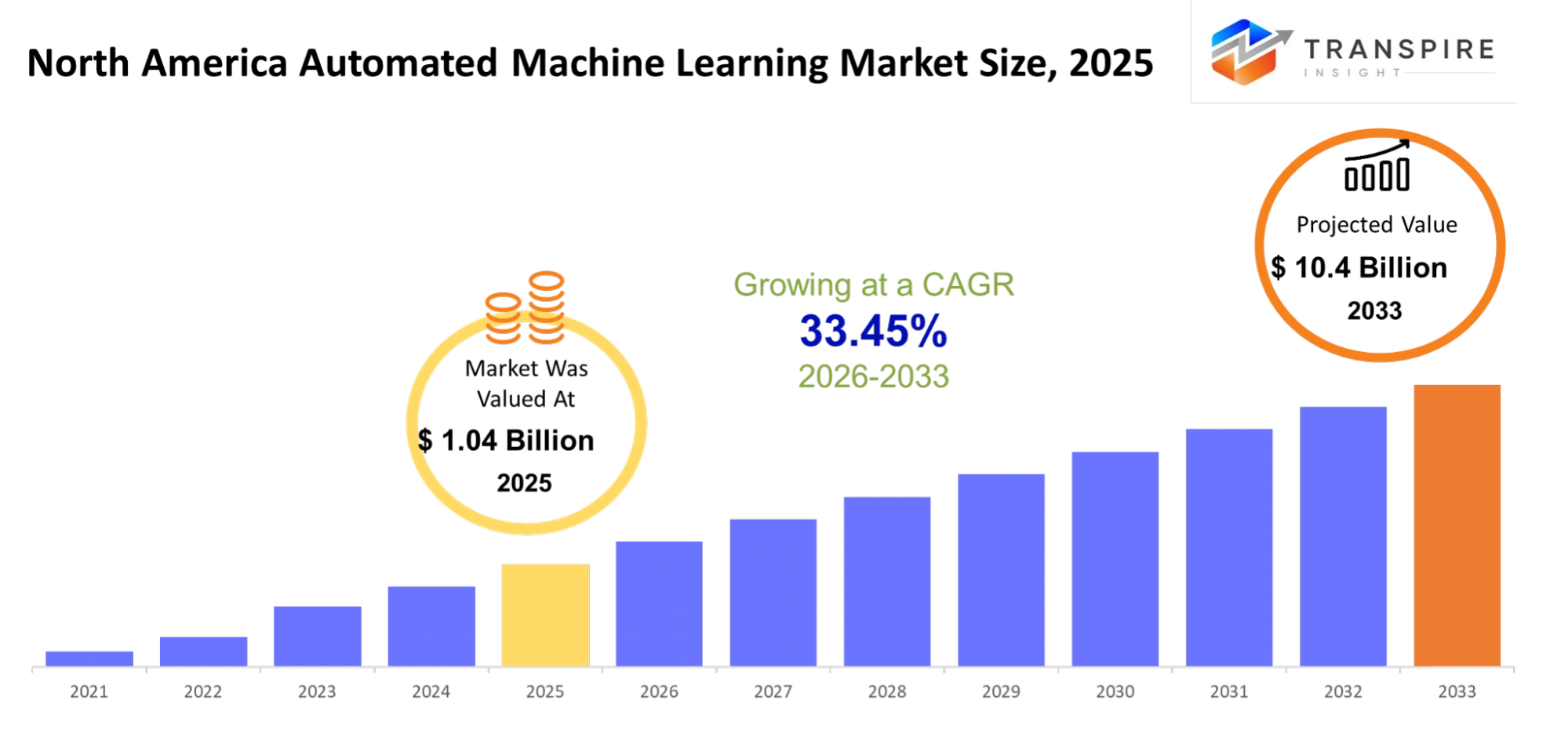
- North America Automated Machine Learning Market Size 2025: USD 1.04 Billion
- North America Automated Machine Learning Market Size 2033: USD 10.4 Billion
- North America Automated Machine Learning Market CAGR: 33.45%
- North America Automated Machine Learning Market Segments: By Component (Software, Services), By Deployment (Cloud, On-Premise), By End-User (BFSI, Healthcare)
North America Automated Machine Learning Market Summary:
The North America Automated Machine Learning Market size is estimated at USD 1.04 Billion in 2025 and is anticipated to reach USD 10.4 Billion by 2033, growing at a CAGR of 33.45% from 2026 to 2033. The Automated Machine Learning Market in North America which includes Canada and the United States and Mexico operates as an accessible solution that connects businesses with complex data science solutions. Organizations will demand faster model deployment with minimal coding, which will force vendors to create user-friendly platforms. Businesses will move towards automated pipelines which decrease their need for expert personnel. Financial and healthcare industries will determine their operational methods based on active data privacy regulations which take precedence in their industry. The demand for real-time insights will drive companies to implement automation as a key element of their analytics approaches which will affect decision-making processes throughout various industries in upcoming years.
Key Market Trends & Insights:
The Automated Machine Learning Market for North America which includes Canada the United States and Mexico will experience a shift toward low-code and no-code platforms because companies want to reduce their time needed for product development without needing specialized technical skills. Decision-makers will select tools which help them construct models through simple processes yet deliver precise results. The operational teams which require direct analytic control will push for this modification because it enables companies to decrease processing times while testing their data-driven approaches throughout different business units.
Enterprises across the region will increasingly adopt automated model monitoring and governance systems to maintain reliability over time. Organizations will spend money on solutions which automatically retrain and validate models because their algorithms become obsolete and their data patterns change. The organization will use this method to deliver steady performance results while meeting all required compliance standards. The banking and healthcare industries will require traceable systems which provide explainable outputs as a mandatory standard rather than an optional component.
The trend of cloud integration will define organizational operations through their continuing process of workload movement toward scalable cloud environments.Machine learning automation systems will be compatible with cloud-native architecture systems, ensuring seamless data ingestion and processing operations. The adoption of hybrid models will increase among firms looking to safeguard their sensitive data.The modern infrastructure enables businesses to maintain critical dataset control while accessing advanced computational capabilities.
Automated tools will show a significant trend toward customized solutions that address specific needs of different industries. The solution vendors will create products that meet the specific data needs of retail and manufacturing and telecommunications industries. Companies will seek platforms that understand domain-specific variables rather than generic frameworks. Providers will need to create pre-built templates and specialized models which help organizations extract insights without using existing resources.
North America Automated Machine Learning Market Segmentation
By Component
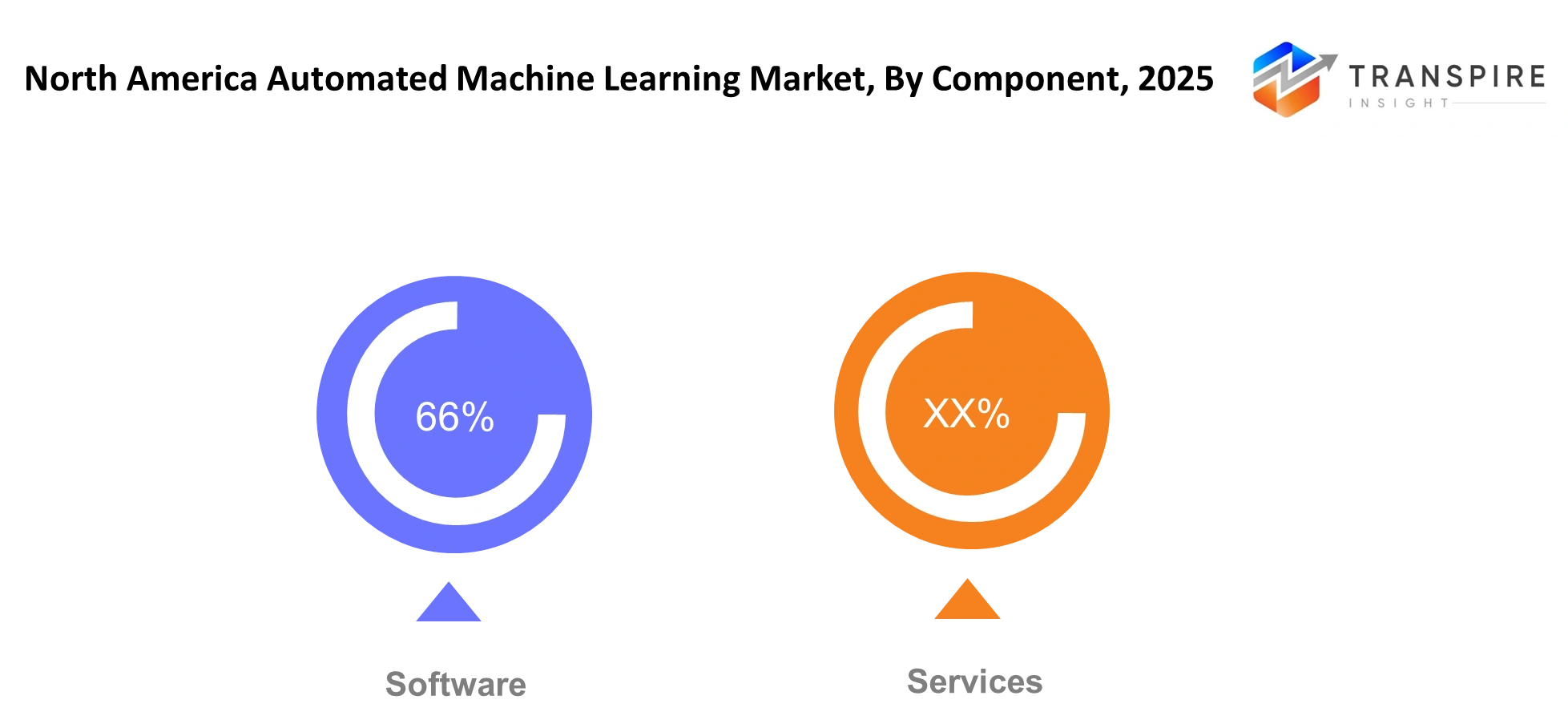
Software- The software market provides solutions which help users simplify model development through all their stages starting from data preparation and ending with deployment. The platforms will develop to provide users with automated feature engineering and model selection and performance tuning through a single interface. Businesses will rely on these tools to reduce manual intervention while maintaining accuracy. Software providers will improve usability for their products to enable non-technical teams to access advanced analytics and work without requiring data scientist assistance.
Services- There is an expected need for organizations to have services that can assist them to achieve success with regard to their automation of machine learning systems. The companies will require consulting and integration services, among others. The demand for managed services will rise as organizations seek to outsource their model monitoring and maintenance tasks. The organization requires training programs which will empower internal teams to use these platforms while they learn about new technological and compliance updates.
By Deployment
Cloud- Organizations that require flexible data management and scalable operations to manage large datasets will choose cloud-based deployment as their primary solution. Remote access to automated tools with automatic updates and affordable infrastructure maintenance will become essential for businesses. Teams that are located in different places will be able to work together more effectively through this method. Cloud environments provide the necessary computational resources for organizations that require quick data processing through model training and deployment because their data volumes continue to grow.
On-Premise- For those organizations who would want absolute control over their data as well as security features for their data, on-premise installation will still be preferred. For companies which deal with sensitive information such as financial information as well as medical records, they would rather install their databases in their own computers or internal network. This will allow them to satisfy all regulatory requirements and at the same time maintain absolute control over their processes.
By End-User
BFSI- The banking, financial services, and insurance sector will implement automated machine learning solutions for their fraud detection, risk assessment, and customer profiling processes. Institutions will use these tools to analyze large volumes of transactional data quickly and identify unusual patterns. Automation will help organizations decrease manual errors while increasing their ability to make decisions more quickly. Financial organizations will require model output transparency because regulatory scrutiny has increased to verify that automated decisions can be explained and audited.
Healthcare- Healthcare providers will use automated machine learning to assist with their diagnostic processes and patient data evaluation and treatment development. Hospitals and research institutions will seek systems that can analyze intricate medical information, which includes patient records and imaging data, without requiring extensive human effort. These tools will assist in detecting hidden patterns, which will result in better patient outcomes. Data privacy regulations will strongly influence adoption, pushing organizations to choose secure and compliant deployment models.
Regional Insights
Organizations across Canada, the United States, and Mexico will adopt automated machine learning in their operational workflows through different methods which will create a unique adoption pattern for North American development. The need for fast business operations in the United States will drive companies to develop scalable solutions because they face strong competition and need to adapt to digital changes. Canadian institutions will establish responsible AI practices that prevent AI technologies from violating ethical standards. Mexico will increase its adoption process through better digital infrastructure and rising demand for data-based business operations.
The United States will continue to provide significant technological support through its established network of technology companies and its history of adopting new technologies. Companies will choose to use platforms that enable them to make decisions faster because they will not need special expertise to operate these platforms. The implementation of new systems will depend on regulatory bodies which will develop their rules through their discussions about algorithm transparency and data protection requirements. Businesses will need tools that show how their models work because they need to meet compliance requirements while running smoothly in the finance and retail and healthcare industries.
The Canadian government will pursue balance between innovation efforts and governance regulations which necessitate organizations to embrace privacy-safe systems. Government-backed initiatives will allow researchers to explore and deploy automated analytical tools in an ethically appropriate manner. Corporations will opt for technology which can give insights about their operations and guarantee their system efficiency, which is essential for businesses operating within high-risk industries. The partnership between public institutions and private companies will drive innovation development while establishing trust, which enables companies to use advanced analytics technologies without risking their confidential information and ethical standards.
Businesses in Mexico will thrive due to digital transformation as they invest in their data infrastructure and automate their processes to increase their efficiency. Firms will be more interested in adopting digital tools that do not need complex technological skills. Organizations will embrace operational tools that increase efficiency and enhance customer insight since digital transformation is gaining popularity. The area will begin using automated analytical solutions in its business activities which will enhance its ability to make decisions using data analytics.
Recent Development News
United States: Policy Push and Commercial Automation Expansion
Recent developments in the United States highlight a strong alignment between policy direction and enterprise adoption. The introduction of a national AI legislative framework in 2026 will guide how automated systems are governed, encouraging innovation while maintaining oversight. At the same time, large technology firms are investing in fully automated solutions, including advertising systems that can independently generate and optimize campaigns, signaling a shift toward hands-free machine learning applications.
Canada: Emphasis on AI Safety and Responsible Deployment
Canada has strengthened its position by focusing on responsible AI practices and safety research. The release of updated international AI safety findings in early 2026, led by Canadian experts, reflects a growing concern around system reliability and control. These developments will influence how automated machine learning tools are designed and deployed, especially in regulated sectors. Canadian institutions will continue prioritizing transparency, ensuring that automation aligns with ethical standards and public trust.
Mexico: Healthcare Innovation Through AI Automation
Mexico has recently demonstrated practical adoption through the use of AI-driven automation in healthcare. In 2025, automated systems were used in fertility treatments, where robotics and machine learning handled complex procedures with minimal human involvement. This advancement signals how automation is moving beyond theoretical use into real-world applications. It will encourage further experimentation across industries, particularly where cost reduction and process consistency are critical priorities.
|
Report Metrics |
Details |
|
Market size value in 2025 |
USD 1.04 Billion |
|
Market size value in 2026 |
USD 1.38 Billion |
|
Revenue forecast in 2033 |
USD 10.4 Billion |
|
Growth rate |
CAGR of 33.45% from 2026 to 2033 |
|
Base year |
2025 |
|
Historical data |
2021 – 2024 |
|
Forecast period |
2026 – 2033 |
|
Report coverage |
Revenue forecast, competitive landscape, growth factors, and trends |
|
Regional scope |
North America (Canada, The United States, and Mexico) |
|
Key company profiled |
Google, Microsoft, IBM, AWS, H2O.ai, DataRobot, SAS, Oracle, Alteryx, RapidMiner, Databricks, Salesforce, TIBCO, SAP, Domino |
|
Customization scope |
Free report customization (country, regional & segment scope). Avail customized purchase options to meet your exact research needs. |
|
Report Segmentation |
By Component (Software, Services), By Deployment (Cloud, On-Premise), By End-User (BFSI, Healthcare) |
Key North America Automated Machine Learning Market Company Insights
The automated machine learning market in North America will be developed by established technology companies and dedicated platform vendors who make model development easier. Companies such as DataRobot, H2O.ai, Google Cloud AutoML, and Databricks will continue enhancing automation across data preparation, training, and deployment stages. Organizations will establish partnerships with new businesses and infrastructure companies to develop their model operations and data processing capabilities. Businesses will prefer vendors who provide simple solutions that include effective control mechanisms for their operational needs.
Company List
- Microsoft
- IBM
- AWS
- H2O.ai
- DataRobot
- SAS
- Oracle
- Alteryx
- RapidMiner
- Databricks
- Salesforce
- TIBCO
- SAP
- Domino
North America Automated Machine Learning Market Report Segmentation
By Component
- Software
- Services
By Deployment
- Cloud
- On-Premise
By End-User
- BFSI
- Healthcare
Frequently Asked Questions
Find quick answers to common questions.
The approximate North America Automated Machine Learning Market size for the market will be USD 10.4 Billion in 2033.
Key segments for the North America Automated Machine Learning Market By Component (Software, Services), By Deployment (Cloud, On-Premise), By End-User (BFSI, Healthcare).
Major players in the North America Automated Machine Learning Market are Google, Microsoft, IBM, AWS, H2O.ai, DataRobot, SAS, Oracle, Alteryx, RapidMiner, Databricks, Salesforce, TIBCO, SAP, Domino.
The North America Automated Machine Learning Market size is USD 1.04 Billion in 2025.
The North America Automated Machine Learning Market CAGR is 33.45%.
- Microsoft
- IBM
- AWS
- H2O.ai
- DataRobot
- SAS
- Oracle
- Alteryx
- RapidMiner
- Databricks
- Salesforce
- TIBCO
- SAP
- Domino
Recently Published Reports
-
Apr 2026
3D Optical Profiler Market
3D Optical Profiler Market Size, Share & Analysis Report By Type (Desktop 3D Optical Profiler, and Portable 3D Optical Profiler), By Technology (Confocal Technology, and White Light Interference), By End-Use Industry (Manufacturing, Research Institutions, Automotive, Aerospace and Defense, Medical Devices, and Other), and Geography (North America, Europe, Asia-Pacific, Middle East and Africa, South and Central America), 2021 - 2031
-
Apr 2026
Depth Sensor Market
Depth Sensor Market Size, Share & Analysis Report By Type (Infrared Depth Sensors, Time-of-Flight (ToF) Sensors, Stereo Vision Sensors, Structured Light Sensors, Ultrasonic Depth Sensors), By Application (Automotive, Robotics, Gaming, Consumer Electronics, Industrial Automation, Healthcare, Security & Surveillance, Others), By End Users (Automotive Manufacturers, Consumer Electronics Companies, Healthcare Providers, Industrial Companies, Security Agencies, Gaming Companies, Robotics Companies, Others), and Geography (North America, Europe, Asia-Pacific, Middle East and Africa, South and Central America), 2021 – 2031
-
Apr 2026
Digital Manufacturing Market
Digital Manufacturing Market Size, Share & Analysis Report By Component (Hardware, Software, and Services), By Technology (Robotics, 3D Printing, Internet of Things (IoT), and Others), By Application (Automotive and Transportation, Aerospace and Defense, Consumer Electronics, Industrial Machinery, and Others), By Process Type (Computer-Based Designing, Computer-Based Simulation, Computer 3D Visualization, Analytics, and Others), and Geography (North America, Europe, Asia-Pacific, Middle East and Africa, South and Central America), 2021 – 2031
-
Apr 2026
Digital Visa Services Market
Digital Visa Services Market Size, Share & Analysis Report By Type (Individual Travelers, Group Travelers), By Application (Tourism, Business Travel, Others), and Geography (North America, Europe, Asia-Pacific, Middle East and Africa, South and Central America), 2021 – 2031