

North America Affinity Chromatography Market Size & Forecast:
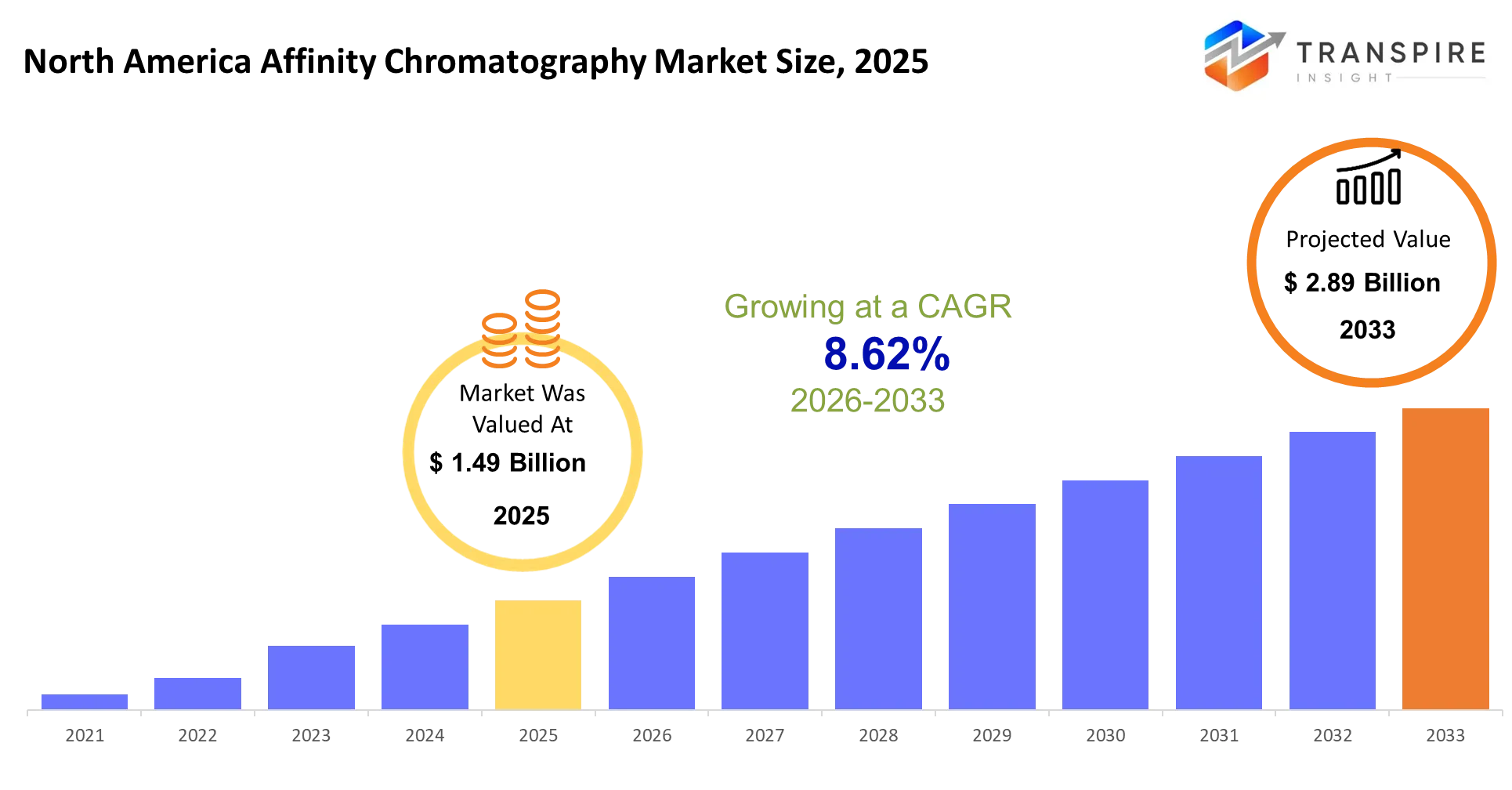
- North America Affinity Chromatography Market Size 2025: USD 1.49 Billion
- North America Affinity Chromatography Market Size 2033: USD 2.89 Billion
- North America Affinity Chromatography Market CAGR: 8.62%
- North America Affinity Chromatography Market Segments: By Type (Protein A, Protein G, IMAC, Dye Ligand, Antibody-based, Others), By Application (Protein Purification, Antibody Production, Drug Development, Diagnostics, Research, Others), By End-User (Pharma, Biotech, Research Institutes, Labs, Others), By Matrix (Agarose, Polymer, Silica, Magnetic Beads, Others).
To learn more about this report,  Download Free Sample Report
North America Affinity Chromatography Market Summary:
The North America Affinity Chromatography Market size is estimated at USD 1.49 Billion in 2025 and is anticipated to reach USD 2.89 Billion by 2033, growing at a CAGR of 8.62% from 2026 to 2033. The North America Affinity Chromatography Market experiences continuous development because biopharmaceutical production now requires better purification methods.
This technique essential for drug development and research enables scientists to separate proteins antibodies and biomolecules with exceptional accuracy. The market expansion receives additional support from rising biotechnology investments and increasing development of biologics. The ongoing development of new technologies leads to better performance and larger operational capacity and lower expenses throughout various uses.
The North America Affinity Chromatography Market receives its main boost because educational institutions and medical research facilities are increasing their research work in genomics and proteomics. Pharmaceutical companies use affinity chromatography more frequently because it helps them produce purer products that satisfy strict regulatory requirements. The healthcare system in the area includes established medical facilities together with major companies which drive both new technologies and their implementation. The growth of personalized medicine will create a higher need for dependable and efficient purification methods which use advanced technologies.
What Has the Impact of Artificial Intelligence Been on the North America Affinity Chromatography Market?
Artificial intelligence is currently transforming the North American affinity chromatography market by delivering precise data solutions to enable research and production and commercial activities. The North American affinity chromatography market uses AI applications to perform advanced data evaluation which enables companies to understand complicated purification data with improved speed and precise results.
Organizations use machine learning with predictive analytics to discover new market patterns while they create experiments and make decisions more quickly. The system enables organizations to conduct better market research, create better demand forecasts, and understand customer needs, which helps them create better strategic plans for the whole North American affinity chromatography industry.
Artificial intelligence now drives North American affinity chromatography market operations to create better production processes and supply chain management systems. Smart automation systems make chromatography processes more efficient by decreasing mistakes which results in higher production rates for biopharmaceutical manufacturing. The machine learning algorithms enable companies to use predictive maintenance which helps them decrease equipment downtime while decreasing their operational expenses.
AI-based supply chain optimization creates better inventory management and resource distribution which leads to fewer resources wasted and higher profit margins. The North American affinity chromatography market maintains its growth through artificial intelligence-based product customization, improved product standards, and advanced competition advantages which result from fast-moving developments in the life sciences sector.
Key Market Trends & Insights:
- The United States dominates the north america affinity chromatography market which it controls with 80% of market share because of its biopharmaceutical infrastructure.
- Canada represents the fastest-growing region, with a projected CAGR above 8% during the 2025–2030 forecast period, driven by expanding research funding.
- Resins dominate the north america affinity chromatography market because they account for almost 45% market share in 2025 through their extensive use in protein purification.
- The second-largest segment of the market belongs to columns which find increasing usage in both large-scale bioprocessing and analytical workflows.
- The demand for ready-to-use solutions drives kits and reagents to become the fastest-growing market section which will experience substantial growth until 2030.
- Antibody purification dominates with over 50% share which results from strong monoclonal antibody production in the north america affinity chromatography market.
- Biomolecule separation has become the fastest-growing application because proteomics and genomics research activities continue to increase.
- Biopharmaceutical companies lead the market with approximately 55% share because they invest in large-scale biologics manufacturing and research development activities.
- The number of academic and research institutes keeps increasing because government funding has become more common and innovation-driven projects receive support.
North America Affinity Chromatography Market Segmentation
By Type
The Protein A and Protein G segments establish themselves as strong purification tools because their binding characteristics enable precise antibody separation processes. The IMAC method experiences increasing popularity because researchers use it for metal ion protein separation during their recombinant protein investigations.
The research community and clinical laboratories use dye ligand and antibody-based purification methods which provide them with multiple options for their purification needs. The ongoing growth of biologics manufacturing will result in increased utilization of all system components across various business sectors. The distinct binding systems present in each type of the product establish better purification performance through increased separation efficiency and operational output.
The field of monoclonal antibody development uses Protein A as its main purification method while IMAC provides an economical solution for cleaning procedures. The laboratories use dye ligand and other formats because they provide multiple options for handling intricate sample processing requirements. The continuous development of ligand design will create better performance capabilities which extend to multiple application areas.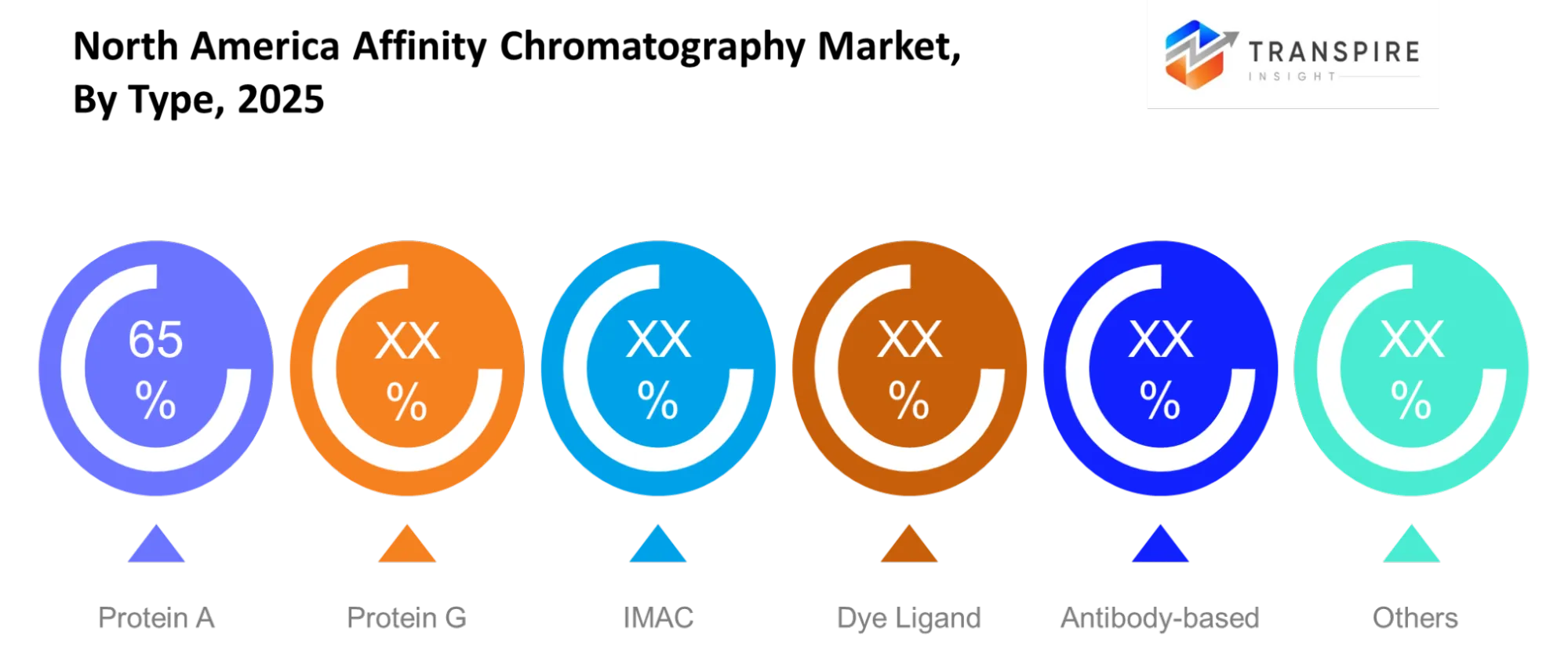
To learn more about this report, Download Free Sample Report
By Application
The demand for protein purification exists because researchers use it extensively in their work with biologics factories and their life science studies. The production of antibodies has progressed rapidly because the number of monoclonal antibody development projects and the development of new therapies have both increased. The purification process remains essential for drug candidate validation therefore the applications for drug development research continue to grow. The market shows stable demand because both diagnostics and research markets keep growing.
The application area needs to achieve better results through high-purity biomolecule separation methods which need proper isolation systems. The process of protein purification establishes product standards for quality control and regulatory requirements in manufacturing facilities. The testing results for drug development and diagnostic procedures improve when researchers use precise separation techniques. The research field will expand because researchers now study genomics and proteomics at greater intensity.
By End-User
Pharmaceutical companies control market demand because they produce biologic products at industrial scales while maintaining high-quality standards. Biotech firms follow with increasing innovation in targeted therapies and biosimilars development. Research institutes and laboratories show steady growth because academic studies and clinical trials drive their operations. Other end-users create specialized needs through their use of particular application areas.
Different end-user groups use chromatography at different levels of operation for different purposes. Pharmaceutical companies develop purification systems that meet both their high-throughput needs and their regulatory requirements. Biotech companies need complete solutions that can adapt to their changing research needs. Research institutes and laboratories will continue to need scientific resources because their scientific projects will keep running and their funding will continue.
By Matrix
The agarose matrix establishes dominance because it shows both high biocompatibility and strong protein binding capacity during protein purification. The polymer-based matrices provide industrial facilities with their ability to sustain chemical stability and operational durability during multiple use cycles. The silica matrices enable analytical processes by delivering exact separation performance. The market for magnetic beads is expanding rapidly because their utilization is simple and they work well with automated systems.
The different matrix types present various benefits which match specific application requirements and different operational capacities. The industry uses agarose because it delivers dependable results while maintaining affordable costs for large-scale purification processes. The laboratory and analytical needs of research facilities can be met through polymer and silica matrix solutions. The use of magnetic beads will increase because organizations develop automated systems which require fast processing capabilities.
What are the Main Challenges for the North America Affinity Chromatography Market Growth?
The north america affinity chromatography market faces multiple technical and operational difficulties which restrict its ability to operate efficiently and expand its operations. Purification processes face consistency problems because resin performance varies and ligand stability problems occur and binding capacity decreases after multiple cycles. Large-scale production operations become more challenging because complex workflows require exact optimization methods to achieve their desired performance goals.
Supply chain disruptions for essential raw materials continue to function as obstacles which prevent the north america affinity chromatography market from developing. The north america affinity chromatography market encounters manufacturing and commercialization challenges because high production costs and strict regulatory requirements serve as obstacles to its growth. Companies must spend substantial resources on validation and quality control and documentation activities to meet Good Manufacturing Practices (GMP) requirements.
The product development process gets delayed because of these requirements which result in extended development periods and postponed market introduction. Small and mid-sized companies face market restrictions because advanced chromatography systems and consumables create financial burdens that affect their operations. The north america affinity chromatography market faces adoption challenges because many facilities lack essential infrastructure and trained personnel.
Advanced chromatography techniques require trained professionals yet there is a gap in technical expertise across several research and production facilities. Smaller organizations face two main obstacles which prevent them from adopting new technologies because they have budget limits and their funding resources are insufficient. Strong demand drivers create market expansion opportunities for the north america affinity chromatography market which faces restrictions from these factors.
Country Insights
The United States maintains its largest market share because of its strong biopharmaceutical manufacturing capabilities and its advanced research facilities and its ongoing investment programs for biologics development. The market experiences steady expansion because of the high demand for monoclonal antibodies and protein-based treatments. The combination of major industry companies and established supply networks will continue to enhance the region's market leadership position.
Canada demonstrates consistent growth because the government increases its funding for life sciences research while biotechnology companies expand their operations. The need for purification technologies increases because academic institutions partner with various innovation centers. The Mexican market demonstrates developing potential because the country establishes better healthcare facilities and research initiatives which will lead to market growth throughout the entire region.
Recent Development News
In April 2026, Thermo Fisher Scientific reports strong Q1 2026 performance driven by bioprocessing demand: Thermo Fisher Scientific posted solid first-quarter 2026 results, supported by continued demand in biopharma services and laboratory products. Growth in biologics-related workflows—especially purification and downstream processing—signals steady investment in chromatography-enabled bioprocessing tools across U.S. pharma labs.
Source: https://www.reuters.com
In April 2026, Thermo Fisher expands bioprocessing portfolio with new instrument rollout: Thermo Fisher Scientific introduced new analytical and bioprocessing instruments aimed at improving efficiency in biologics research workflows. The expansion strengthens its presence in protein purification and downstream processing systems that are closely linked to affinity chromatography applications in U.S. biotech manufacturing.
Source: https://www.labmanager.com
|
Report Metrics |
Details |
|
Market size value in 2025 |
USD 1.49 Billion |
|
Market size value in 2026 |
USD 1.62 Billion |
|
Revenue forecast in 2033 |
USD 2.89 Billion |
|
Growth rate |
CAGR of 8.62% from 2026 to 2033 |
|
Base year |
2025 |
|
Historical data |
2021 – 2024 |
|
Forecast period |
2026 – 2033 |
|
Report coverage |
Revenue forecast, competitive landscape, growth factors, and trends |
|
Country scope |
North America (Canada, The United States, and Mexico) |
|
Key company profiled |
Cytiva, Merck KGaA, Thermo Fisher, Sartorius, Bio-Rad, Agilent, Danaher, GE Healthcare, Repligen, Purolite, Tosoh Bioscience, Kaneka, Sepax Technologies, Orochem, Creative Biolabs |
|
Customization scope |
Free report customization (country, regional & segment scope). Avail customized purchase options to meet your exact research needs. |
|
Report Segmentation |
By Type (Protein A, Protein G, IMAC, Dye Ligand, Antibody-based, Others), By Application (Protein Purification, Antibody Production, Drug Development, Diagnostics, Research, Others), By End-User (Pharma, Biotech, Research Institutes, Labs, Others), By Matrix (Agarose, Polymer, Silica, Magnetic Beads, Others). |
How Can New Companies Establish a Strong Foothold in the North America Affinity Chromatography Market?
New entrants can build a strong position in the north america affinity chromatography market by focusing on niche segments that address unmet needs in biologics purification and research workflows. The company develops distinct market solutions by creating specialized products which meet the demands of high-throughput antibody screening and small-batch personalized therapy applications. The industry needs solutions which improve resin efficiency and binding capacity and reusability through innovative strategies. Early adoption will benefit from a value proposition which demonstrates market growth and demand drivers.
The north america affinity chromatography market depends on technology differentiation to create market momentum. Chromatography systems become more efficient when startups implement smart automation and artificial intelligence and advanced materials. Purolite (Ecolab Life Sciences) has developed high-performance affinity resins while new companies create magnetic bead-based solutions for rapid purification. These approaches address efficiency gaps while creating solutions which match industry trends that need improvements in speed and accuracy.
The north america affinity chromatography market needs well-established strategic partnerships and collaborations to expand its operational capacity. Biopharmaceutical companies and research institutes and contract manufacturing organizations need to work together because their collaboration enables access to specialized knowledge and infrastructure and distribution systems. The organizations use joint development agreements to expedite technology validation and commercial launch. New companies establish credibility through partnerships which help them understand the complicated rules and operational systems of their field.
Key North America Affinity Chromatography Market Company Insights
The market retains intense competition because top companies dedicate their resources to developing better purification methods and creating superior products. Thermo Fisher Scientific Danaher Corporation Merck KGaA and Bio-Rad Laboratories control considerable market share because they continuously develop new products while using their international sales networks. The company will maintain its competitive edge through its research activities and product development initiatives.
The business world uses strategic partnerships together with company acquisitions and geographic growth as its main methods for building market power while gaining better technological capabilities. Established companies will compete with new market entrants through their ability to manage costs and develop unique products and create solutions that can grow with their business. The continuous development of chromatography systems and their associated consumables will create a sustained period of growth which will lead to future competitive advantages.
Company List
- Cytiva
- Merck KGaA
- Thermo Fisher
- Sartorius
- Bio-Rad
- Agilent
- Danaher
- GE Healthcare
- Repligen
- Purolite
- Tosoh Bioscience
- Kaneka
- Sepax Technologies
- Orochem
- Creative Biolabs
What are the Key Use-Cases Driving the Growth of the North America Affinity Chromatography Market?
The north america affinity chromatography market is expanding rapidly because it serves as a fundamental method for protein purification which is essential in biopharmaceutical manufacturing. Monoclonal antibody production remains a primary use-case because high selectivity and purity are essential for therapeutic safety and efficacy.
The growing demand for biologics and biosimilars leads to increased adoption of this product. The business case for this product maintains strong market growth which will continue for an extended period. The north american affinity chromatography market experiences major growth because drug development and clinical research activities. Affinity chromatography enables researchers to separate biomolecules with high accuracy which leads to faster drug discovery processes and better validation results.
Pharmaceutical companies use this method to achieve their regulatory requirements while maintaining product quality control. The segment experiences rising demand because companies increase their research and development spending while developing complex drug products. The north america affinity chromatography market serves important diagnostic applications and personalized medicine solutions.
The technology helps researchers find biomarkers which leads to better disease detection methods that improve diagnostic results. The demand for effective purification methods is growing because precision medicine approaches gain popularity. The current trend creates pathways for new innovations which will enhance existing applications.
North America Affinity Chromatography Market Report Segmentation
By Type
- Protein A
- Protein G
- IMAC
- Dye Ligand
- Antibody-based
- Others
By Application
- Protein Purification
- Antibody Production
- Drug Development
- Diagnostics
- Research
- Others
By End-User
- Pharma
- Biotech
- Research Institutes
- Labs
- Others
By Matrix
- Agarose
- Polymer
- Silica
- Magnetic Beads
- Others
Frequently Asked Questions
Find quick answers to common questions.
The Approximate North America Affinity Chromatography Market size for the Market will be USD 2.89 Billion in 2033.
The key Segments of the North America Affinity Chromatography Market are By Type (Protein A, Protein G, IMAC, Dye Ligand, Antibody-based, Others), By Application (Protein Purification, Antibody Production, Drug Development, Diagnostics, Research, Others), By End-User (Pharma, Biotech, Research Institutes, Labs, Others), By Matrix (Agarose, Polymer, Silica, Magnetic Beads, Others).
Major Players in the North America Affinity Chromatography Market are Cytiva, Merck KGaA, Thermo Fisher, Sartorius, Bio-Rad, Agilent, Danaher, GE Healthcare, Repligen, Purolite, Tosoh Bioscience, Kaneka, Sepax Technologies, Orochem, Creative Biolabs.
The Current Market size of the North America Affinity Chromatography Market is USD 1.49 Billion in 2025.
The North America Affinity Chromatography Market CAGR is 8.62%.
- Cytiva
- Merck KGaA
- Thermo Fisher
- Sartorius
- Bio-Rad
- Agilent
- Danaher
- GE Healthcare
- Repligen
- Purolite
- Tosoh Bioscience
- Kaneka
- Sepax Technologies
- Orochem
- Creative Biolabs
Recently Published Reports
-
Apr 2026
Cord Blood Banking Services Market
Cord Blood Banking Services Market Size, Share & Analysis Report By Type of Service (Collection, Processing, Storage), By Bank Type (Private Banks, Public Banks, and Hybrid Banks), By Component (Cord Blood, and Cord Tissue), By End User (Hospitals, Research Institutions, Biotechnology Companies, and Others) and Geography (North America, Europe, Asia-Pacific, Middle East and Africa, South and Central America), 2021 - 2031
-
Apr 2026
ELISA Processors Market
ELISA Processors Market Size, Share & Analysis Report By Type (Optical Filter ELISA Analyzer, and Optical Grating ELISA Analyzers), By Mode (Automated ELISA Analyzers, and Semi-Automated ELISA Analyzers), By Applications (Immunology, Vaccine development, Drug Monitoring, and Others), By End Users (Biotechnology Companies, Pharmaceutical Companies, Contract Research Organization, and Diagnostic Laboratories) and Geography (North America, Europe, Asia-Pacific, Middle East and Africa, South and Central America), 2021 - 2031
-
Apr 2026
Microscope Slide Scanner Market
Microscope Slide Scanner Market Size, Share & Analysis Report By Type (Portable Microscope Slide Scanner, and Desktop Microscope Slide Scanner), By Application (Biological Research, Medicine, Veterinary, and Other) and Geography (North America, Europe, Asia-Pacific, Middle East and Africa, South and Central America), 2021 - 2031
-
Apr 2026
Microwave Cookware Market
Microwave Cookware Market Size, Share & Analysis Report By Material Type (Plastic, Glass, Ceramic, Silicone, and Metal), By Application (Cooking, Reheating, and Defrosting), By End User (Household, Commercial (Restaurants, Hotels, and Cafes), and Food Service Industry), By Sales Channel (Online Retail, Offline Retail (Supermarkets, Hypermarkets, Specialty Stores), and Direct Sales (Company Outlets)) and Geography (North America, Europe, Asia-Pacific, Middle East and Africa, South and Central America), 2021 - 2031