

Europe Protein Crystallization Market Size & Forecast:
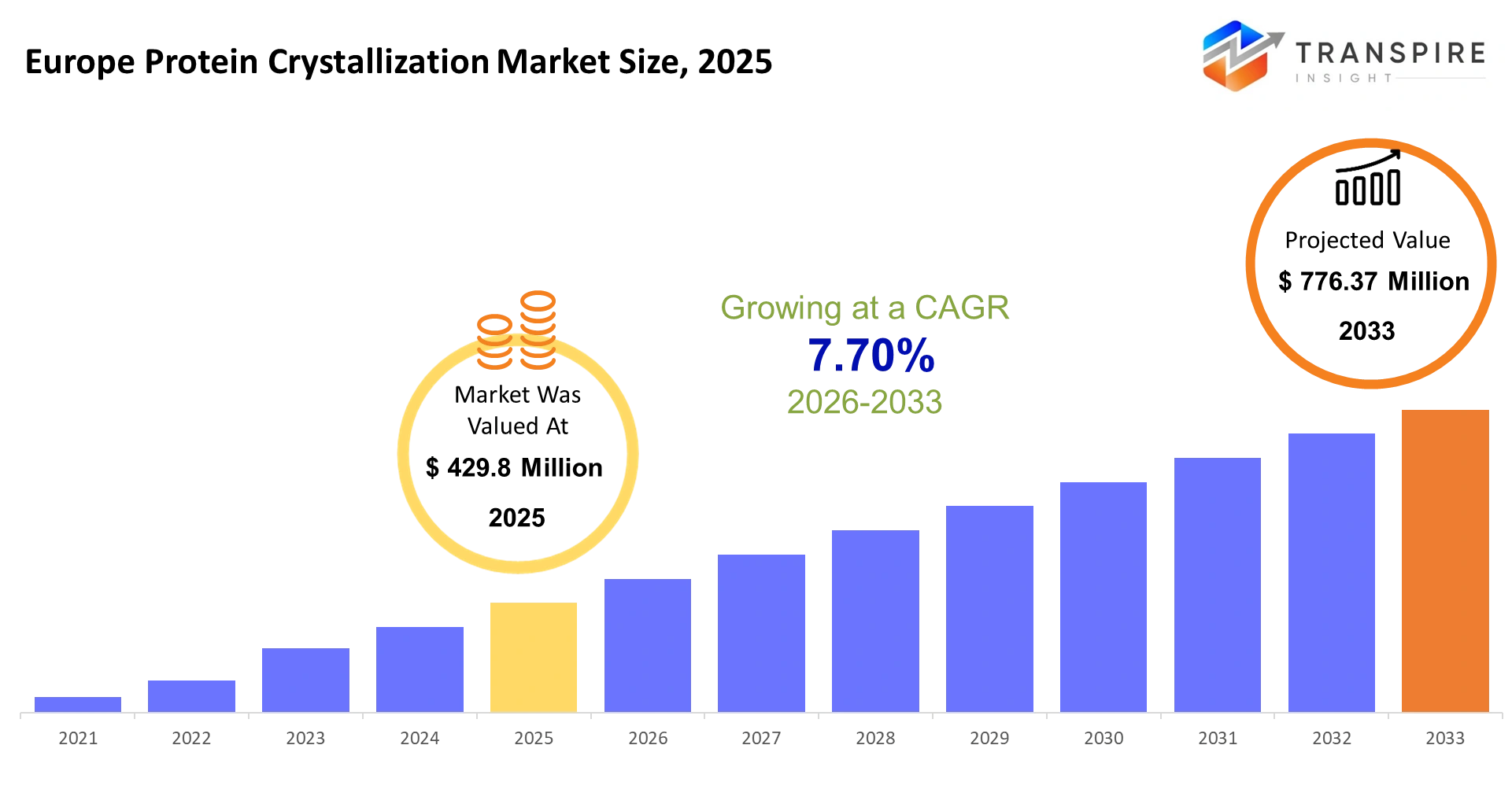
- Europe Protein Crystallization Market Size 2025: USD 429.8 Million
- Europe Protein Crystallization Market Size 2033: USD 776.37 Million
- Europe Protein Crystallization Market CAGR: 7.70%
- Europe Protein Crystallization Market Segments: By Type (Reagents, Instruments, Plates, Kits, Software, Others); By Application (Drug Discovery, Structural Biology, Research, Protein Analysis, Biotech, Others); By End-User (Pharma, Biotech, Research Institutes, Universities, Labs, Others); By Technique (Vapor Diffusion, Microbatch, Dialysis, Free Interface Diffusion, Seeding, Others)
To learn more about this report,  Download Free Sample Report
Europe Protein Crystallization Market Summary:
The Europe Protein Crystallization Market size is estimated at USD 429.8 Million in 2025 and is anticipated to reach USD 776.37 Million by 2033, growing at a CAGR of 7.70% from 2026 to 2033. Protein crystallization in the field of structural biology and biopharmaceutical research in Europe will be instrumental in determining the future of how complex biomolecules can be understood and utilized in novel drugs. It will transition from traditional techniques to automation and miniaturization, where there is minimal loss of samples and increased reproducibility. There will be demand for high-throughput crystallization equipment that can be used on proteins that are rare. The use of machine learning algorithms in imaging and predictions during the process will be common. There will be stringent regulations for reproducibility and accountability in all labs in Europe. However, there will also be a need for affordable, flexible, and convenient equipment since most laboratories have a budget period.
What Has the Impact of Artificial Intelligence Been on the Europe Protein Crystallization Market?
The European protein crystallization market uses artificial intelligence to develop new methods for gathering information which leads to better decision-making processes because data serves as the primary method to achieve accurate results and efficient operations. The European protein crystallization market uses artificial intelligence to develop advanced market research capabilities through its ability to analyze complex crystallization data and imaging results and experimental data at large volumes. Machine learning models enable stakeholders to discover hidden relationships between crystal formation conditions which leads to improved experimental results through better reproducibility and reduced testing uncertainty. The new system enhances predictive analytics because it enables businesses to forecast market developments and research needs and application developments with improved accuracy.
Artificial intelligence in europe protein crystallization market operations is also transforming production environments through smart automation and adaptive systems. The AI-powered platforms create optimal crystallization conditions through real-time optimization which leads to lower material waste and higher laboratory and industrial throughput. Machine learning systems achieve better demand forecasting by combining historical research data with funding cycles and pharmaceutical pipeline information. The combination of AI-driven supply chain optimization and improved inventory planning and resource allocation results in operational cost reductions for businesses. The new technology boosts operational efficiency while creating new opportunities for businesses in the European protein crystallization market to create customized solutions which fasten research processes while sustaining their advantage in data-driven scientific investigation.
Key Market Trends & Insights:
- The Europe protein crystallization market is witnessing an increase in the adoption rate of AI enabled predictive analytics, which boosts protein structure determination by more than 30%.
- Advanced automation systems are cutting down the experimental time by 40%, becoming one of the latest trends among crystallization labs in Europe.
- The factors driving the demand include high biologics development, wherein over 60% of the drugs in the pipeline are protein based.
- Miniaturization technology along with microfluidic crystallization system is gaining momentum, providing efficiency in reducing reagents by up to 50%.
- Europe protein crystallization market in Western Europe region accounted for around 45% of market share in 2025 owing to the presence of robust research ecosystem.
- Northern Europe is considered to be the highest growing regional market and is estimated to grow at more than 9% CAGR through 2030.
- The instruments product segment accounts for major market share owing to increasing adoption of automated crystallization instruments.
- Consumables hold the second leading share due to consistent demand from the research laboratories.
- Software holds the third leading product segment and is estimated to witness highest growth between 2025–2030.
- The discovery of drugs leads with more than 55 percent share because of rising research on biologics and biosimilars.
- The field that is growing fastest in structural genomics because of the need for advanced protein modeling and disease studies.
- The leading end users include pharmaceuticals and biotech firms with approximately 50 percent market share.
Europe Protein Crystallization Market Segmentation
By Type
The reagent is expected to stay as crucial since the chemical environment has an impact on the development and stability of crystals. The instrument will contribute to automation, minimizing the involvement of human labor and enhancing the precision in conducting experiments. The plate and kit will provide a systematic arrangement for conducting the test. It will help in organizing multiple tests.
There will be a growing number of integrated devices that combine both instruments and software to monitor the experiments. There will also be an increasing demand for the kit for conducting the experiment without any hassle of preparation. The high throughput screening plates will allow conducting tests with different conditions simultaneously. There will always be continuous upgrades of the software.
By Application
Crystallization will be important in drug discovery in terms of studying molecular structures and coming up with treatments. Crystallization will be used in structural biology as a means of elucidating structures and furthering scientific knowledge through structural insights gained. Research in general will involve investigations where crystallization will help verify experimental results. Protein research will benefit from crystallization when analyzing proteins for various properties such as stability and structure.
Use of biotech applications is expected to be expanded as a result of emphasis by many firms on protein-based pharmaceuticals and other applications. In this regard, crystallization will help enhance the quality of the products in question. More structural information will be sought in all these applications, thus improving research outcomes.
By End-User
Pharmaceuticals will employ the process of crystallization for developing drugs through their pipelines and designing compounds. Biotechnology companies will utilize such processes for protein engineering and creating specialized products. Research organizations will concentrate more on basic research and use crystallization processes for increasing knowledge. Educational institutions will use crystallization processes for teaching purposes.
Advanced systems will be adopted by laboratories for increasing productivity and workloads. Collaboration between end-users will enhance knowledge exchange and utilization of advanced techniques. Support from funding sources for research and academic organizations will help in improving infrastructure facilities. The need for precision in research activities will fuel the adoption of this technology.
By Technique
The vapor diffusion process will continue to be popular because of the efficiency and dependability involved in a controlled environment. The microbatch procedure will offer an advantage in working underneath oil, allowing experiments to occur without evaporation problems. With dialysis procedures, researchers can make changes to the environment gradually, aiding in the crystallization process.
With seeding processes, the crystals will have a greater chance at growing properly due to the insertion of crystal fragments into the solution. Each procedure will suit certain experiments, giving researchers options. In choosing which process to use, one must consider the protein being used, the quality of crystal needed, and other resources involved.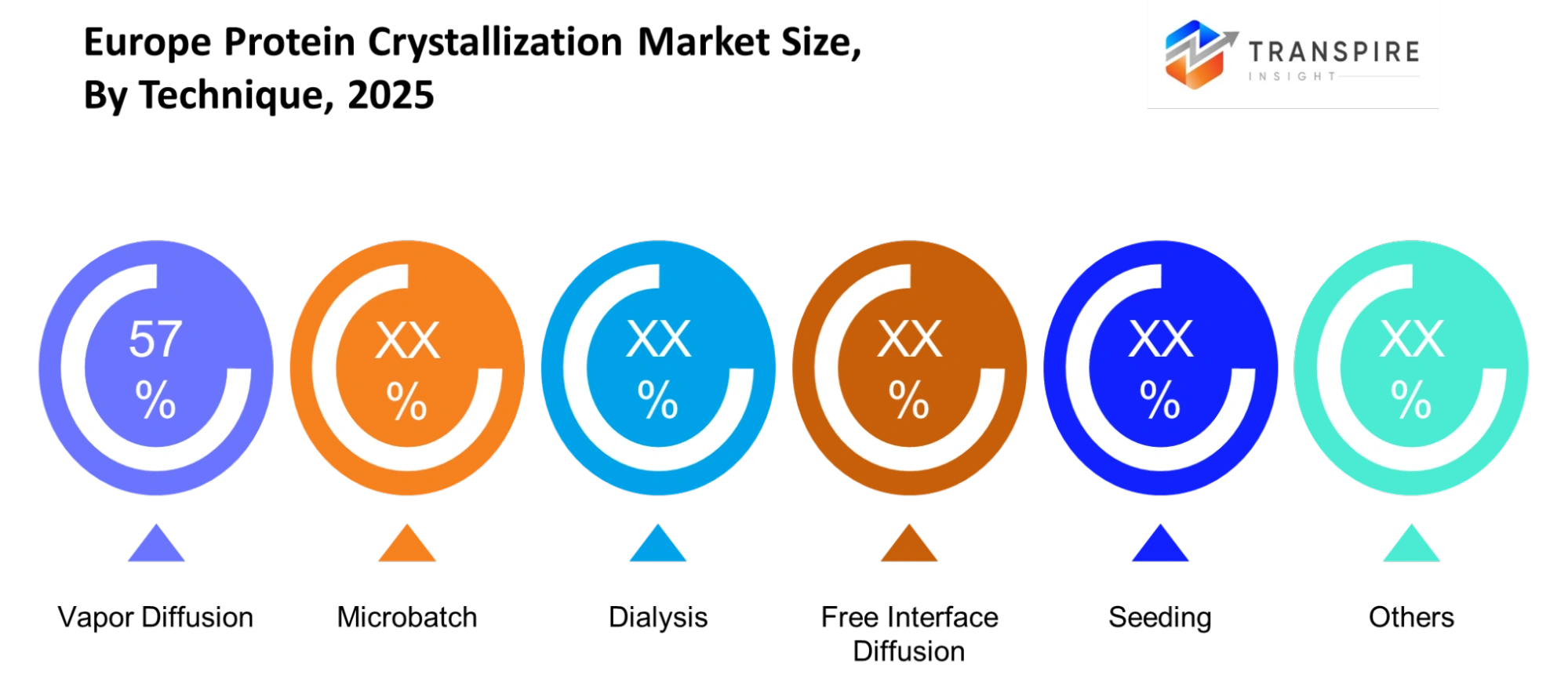
To learn more about this report, Download Free Sample Report
What are the Main Challenges for the Europe Protein Crystallization Market Growth?
Technical and operational challenges continue to shape the performance of the europe protein crystallization market. Scientists find it hard to create stable and reproducible crystal structures. The unpredictable nature of proteins results in different outcomes which requires additional time and funds to conduct experiments. The need for exact environmental conditions together with complicated operational procedures creates obstacles that prevent successful implementation of high-throughput systems. Supply chain disruptions for specialized reagents and instruments create additional challenges which decrease research and commercial operations efficiency and sustain existing problems within europe protein crystallization market activities.
The europe protein crystallization market faces manufacturing and commercialization obstacles which arise from the need to comply with strict regulatory standards that include GMP requirements. The production processes require operators to maintain operational accuracy at high levels because this requirement drives up expenses while making it difficult to implement production systems at full capacity. The technology development pipeline experiences delays because validation and approval processes take too long. The high infrastructure costs combined with insufficient financial returns for small businesses create major obstacles that prevent smaller companies from entering the europe protein crystallization market.
Adoption problems occur due to the lack of proper infrastructure as well as the lack of people who are highly trained in using the method. The laboratories lack any form of automation that would facilitate a faster adoption of the process. Lack of funds is also a challenge. These factors act as obstacles to growth and make it difficult for the europe protein crystallization market to make steady progress.
The emergence of competing solutions like cryo-electron microscopy presents another threat to this market, which provides quick structure determination without the requirement of crystals. The pricing and fast-changing technology trends can pose a problem for existing companies, and changing standards can necessitate constant updates.
Regional Insights
The Europe protein crystallization market functions as a dedicated area between research and drug development that studies protein structures. The pharmaceutical and academic sectors will maintain continuous demand for precise molecular information. The combination of automation and imaging technologies will enhance experimental accuracy by minimizing the need for human personnel.
Laboratory operations will benefit from greater efficiencies and accuracy as a result of technology implementation. Research establishments must collaborate with industry partners since this will provide both parties with the ability to exchange ideas and make good use of their resources. There is a need for research organizations to practice cost management and have standard operating procedures due to the following reasons.
A stable status quo will be retained in Western Europe owing to existing research facilities and steady financial backing. Countries like Germany, France, and the UK will remain dominant adopters of cutting-edge crystallization systems. The presence of many pharma companies will ensure the region's stability.
Continuous development will be experienced in Northern Europe owing to research-oriented centers and biotechnological advancements. Southern and Eastern Europe will witness improvements in adopting new systems with more financial investment. Collaborative efforts among regional players will enhance connectivity, which will facilitate growth in the use of crystallization techniques.
Recent Development News
In April 2026, Merck KGaA announced acquisition. Merck completed the acquisition of JSR Life Sciences’ chromatography business to strengthen Protein A purification capabilities and support scalable biologics manufacturing.https://www.merckgroup.com
In March 2026, Thermo Fisher Scientific announced acquisition. Thermo Fisher Scientific completed the acquisition of Clario Holdings to expand laboratory and biopharma services capabilities within its research and clinical solutions portfolio.https://www.biospace.com
|
Report Metrics |
Details |
|
Market size value in 2025 |
USD 429.8 Million |
|
Market size value in 2026 |
USD 462.05 Million |
|
Revenue forecast in 2033 |
USD 776.37 Million |
|
Growth rate |
CAGR of 7.70% from 2026 to 2033 |
|
Base year |
2025 |
|
Historical data |
2021 - 2024 |
|
Forecast period |
2026 - 2033 |
|
Report coverage |
Revenue forecast, competitive landscape, growth factors, and trends |
|
Regional scope |
Europe (Germany, United Kingdom, France, Italy, Spain, Rest of Europe) |
|
Key company profiled |
Hampton Research, Rigaku, Molecular Dimensions, Jena Bioscience, Thermo Fisher, Danaher, Bruker, Agilent, PerkinElmer, Formulatrix, MiTeGen, TTP Labtech, Bio-Rad, GE Healthcare, Qiagen |
|
Customization scope |
Free report customization (country, regional & segment scope). Avail customized purchase options to meet your exact research needs. |
|
Report Segmentation |
By Type (Reagents, Instruments, Plates, Kits, Software, Others); By Application (Drug Discovery, Structural Biology, Research, Protein Analysis, Biotech, Others); By End-User (Pharma, Biotech, Research Institutes, Universities, Labs, Others); By Technique (Vapor Diffusion, Microbatch, Dialysis, Free Interface Diffusion, Seeding, Others) |
How Can New Companies Establish a Strong Foothold in the Europe Protein Crystallization Market?
Niche specialization in europe protein crystallization market can enable startups to carve out a niche for themselves through innovative approaches that address the shortcomings in difficult-to-crystallize membrane proteins and orphan diseases. As opposed to competing on a broad level, organizations can specialize in their offerings, thereby providing tangible value propositions and increasing success rates. Innovative technology solutions such as microfluidics and AI-based conditions can minimize time cycles and attract early adopters in the europe protein crystallization market.
Technology differentiation can be pivotal in successful market entry. Startups offering innovative technologies that automate the process and provide predictive analysis will help resolve common challenges such as reproducibility and scalability. Firms resembling Formulatrix have already been able to revolutionize processes through imaging, while newer firms such as CrystalSolve BioTech are providing crystallization optimization software based on artificial intelligence in the europe protein crystallization market.
Strategic partnership is going to help position the business further, particularly strategic partnerships with academia and pharmaceutical firms. Through strategic partnerships, it is possible to gain access to resources such as funding, data sets, and testing environments. Companies will have to make sure that they meet the new requirements that are put in place by regulatory agencies. They will also be able to provide modular, cost-effective solutions in order to encourage adoption by smaller and medium sized laboratories.
Key Europe Protein Crystallization Market Company Insights
The protein crystallization market in Europe will experience steady growth which scientists will drive through their research needs in structural biology and their efforts in developing targeted drugs. Laboratories will implement automated systems to improve precision while reducing the need for manual tasks. Research and commercial operations will establish their experimental processes through continuous improvement of efficiency and reproducibility.
Technological integration will support better data tracking and controlled crystallization environments. Academic institutions and industry participants will establish collaborative efforts to enhance knowledge transfer and resource sharing. Scientific applications and pharmaceutical applications will maintain their focus on efficient operations through standardized procedures which support long-term scientific research.
Global companies and local businesses will participate in the market through their innovative systems which enhance operational efficiency. Organizations will direct their funds towards building automated systems and advanced imaging equipment and smooth software connections to boost their success in crystallization processes. Organizations will establish their market position through technological advancements which enhance their ability to produce consistent experimental reslts.
Market expansion and R&D will require cooperation and collaboration among companies. The approach to product development will emphasize usability and scalability of systems for different laboratory requirements. There will be more technological advancements and service improvements, giving organizations who want to remain competitive an advantage.
Company List
- Hampton Research
- Rigaku
- Molecular Dimensions
- Jena Bioscience
- Thermo Fisher
- Danaher
- Bruker
- Agilent
- PerkinElmer
- Formulatrix
- MiTeGen
- TTP Labtech
- Bio-Rad
- GE Healthcare
- Qiagen
What are the Key Use-Cases Driving the Growth of the Europe Protein Crystallization Market?
The europe protein crystallization market continues to be driven by drug discovery, with pharmaceutical firms requiring exact protein structure maps to develop targeted treatments. Crystallization allows for the accurate identification of binding sites that help in the creation of biologics and small molecules. Drug discovery serves as an important factor in the europe protein crystallization market because it boosts lead optimization efforts and decreases clinical failures.
In addition, structural biology investigations serve as important factors in the europe protein crystallization market. Understanding the functions of proteins and the processes involved in illnesses such as cancer and neurological degeneration can be facilitated by crystallography. With increased demand for protein crystallography, more money will go into biological research.
Protein Crystallization Market in Europe is witnessing a growing trend among companies, as biotechnology and industrial uses of protein crystallization are emerging as important aspects in terms of enzyme design and food processing. Protein Crystallization Market in Europe is also seeing the growth in the industrial usage of protein crystals, as companies continue with their innovations in this area.
Europe Protein Crystallization Market Report Segmentation
By Type
- Reagents
- Instruments
- Plates
- Kits
- Software
- Others
By Application
- Drug Discovery
- Structural Biology
- Research
- Protein Analysis
- Biotech
- Others
By End-User
- Pharma
- Biotech
- Research Institutes
- Universities
- Labs
- Others
By Technique
- Vapor Diffusion
- Microbatch
- Dialysis
- Free Interface Diffusion
- Seeding
- Others
Frequently Asked Questions
Find quick answers to common questions.
The Approximate Europe Protein Crystallization Market size for the Market will be USD 776.37 Million in 2033.
Key Segments for the Europe Protein Crystallization Market are By Type (Reagents, Instruments, Plates, Kits, Software, Others); By Application (Drug Discovery, Structural Biology, Research, Protein Analysis, Biotech, Others); By End-User (Pharma, Biotech, Research Institutes, Universities, Labs, Others); By Technique (Vapor Diffusion, Microbatch, Dialysis, Free Interface Diffusion, Seeding, Others).
Major Europe Protein Crystallization Market Players are Hampton Research, Rigaku, Molecular Dimensions, Jena Bioscience, Thermo Fisher, Danaher, Bruker, Agilent, PerkinElmer, Formulatrix, MiTeGen, TTP Labtech, Bio-Rad, GE Healthcare, Qiagen.
The Current Europe Protein Crystallization Market size is USD 429.8 Million in 2025.
The Europe Protein Crystallization Market CAGR is 7.70%.
- Hampton Research
- Rigaku
- Molecular Dimensions
- Jena Bioscience
- Thermo Fisher
- Danaher
- Bruker
- Agilent
- PerkinElmer
- Formulatrix
- MiTeGen
- TTP Labtech
- Bio-Rad
- GE Healthcare
- Qiagen
Recently Published Reports
-
Apr 2026
Cord Blood Banking Services Market
Cord Blood Banking Services Market Size, Share & Analysis Report By Type of Service (Collection, Processing, Storage), By Bank Type (Private Banks, Public Banks, and Hybrid Banks), By Component (Cord Blood, and Cord Tissue), By End User (Hospitals, Research Institutions, Biotechnology Companies, and Others) and Geography (North America, Europe, Asia-Pacific, Middle East and Africa, South and Central America), 2021 - 2031
-
Apr 2026
ELISA Processors Market
ELISA Processors Market Size, Share & Analysis Report By Type (Optical Filter ELISA Analyzer, and Optical Grating ELISA Analyzers), By Mode (Automated ELISA Analyzers, and Semi-Automated ELISA Analyzers), By Applications (Immunology, Vaccine development, Drug Monitoring, and Others), By End Users (Biotechnology Companies, Pharmaceutical Companies, Contract Research Organization, and Diagnostic Laboratories) and Geography (North America, Europe, Asia-Pacific, Middle East and Africa, South and Central America), 2021 - 2031
-
Apr 2026
Microscope Slide Scanner Market
Microscope Slide Scanner Market Size, Share & Analysis Report By Type (Portable Microscope Slide Scanner, and Desktop Microscope Slide Scanner), By Application (Biological Research, Medicine, Veterinary, and Other) and Geography (North America, Europe, Asia-Pacific, Middle East and Africa, South and Central America), 2021 - 2031
-
Apr 2026
Microwave Cookware Market
Microwave Cookware Market Size, Share & Analysis Report By Material Type (Plastic, Glass, Ceramic, Silicone, and Metal), By Application (Cooking, Reheating, and Defrosting), By End User (Household, Commercial (Restaurants, Hotels, and Cafes), and Food Service Industry), By Sales Channel (Online Retail, Offline Retail (Supermarkets, Hypermarkets, Specialty Stores), and Direct Sales (Company Outlets)) and Geography (North America, Europe, Asia-Pacific, Middle East and Africa, South and Central America), 2021 - 2031