

Non-invasive Ventilators Market Summary:
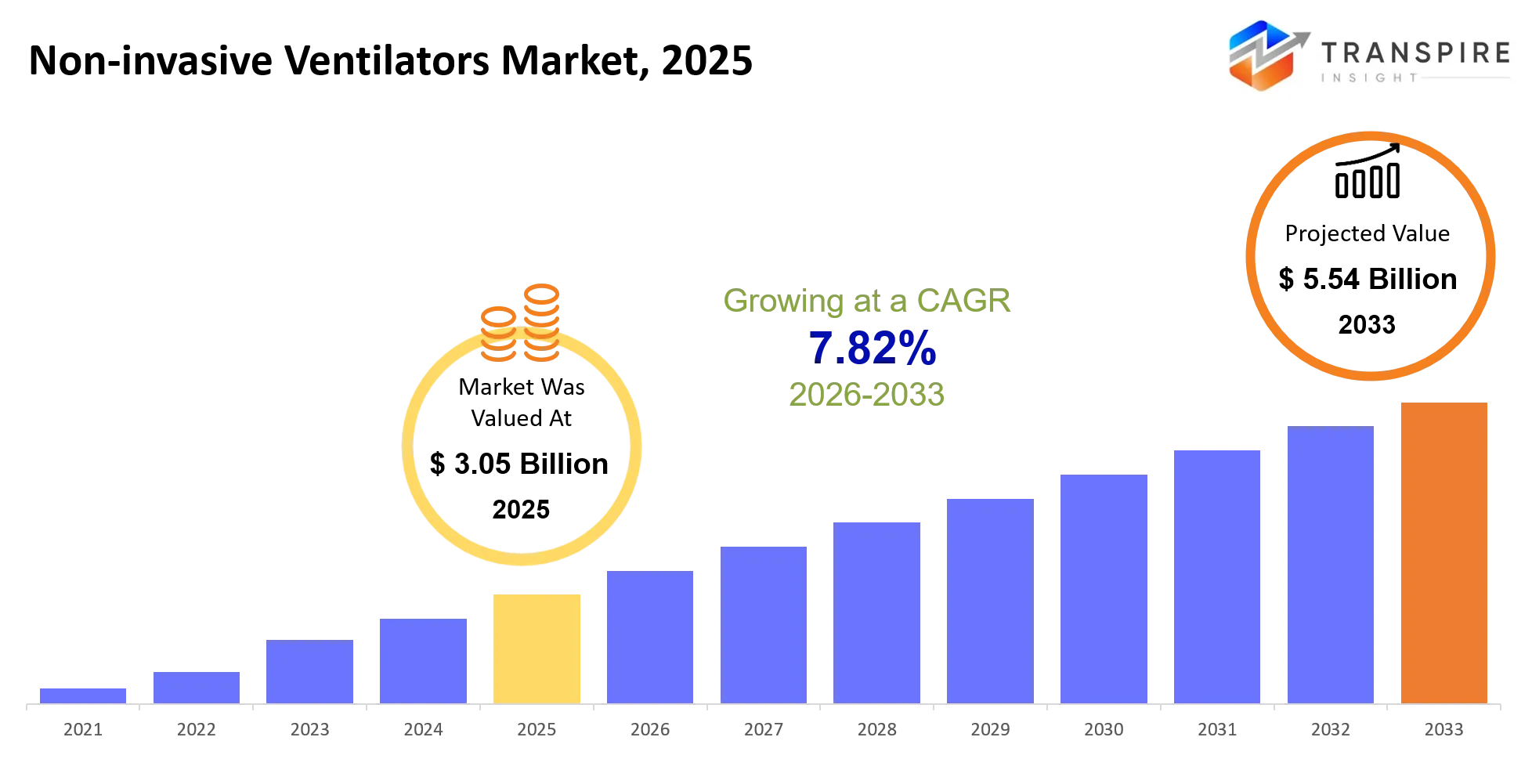
As per Transpire Insight Analysis, the Non-invasive Ventilators Market size is estimated at USD 3.05 billion in 2025 and is anticipated to reach USD 5.54 billion by 2033, growing at a CAGR of 7.82% from 2026 to 2033.
The Non-Invasive Ventilators Market provides ventilator services to patients requiring respiratory assistance without being intubated. The use of these devices is seen in hospitals, clinics, sleep labs, emergency facilities, and even in-home use. In the past three to five years, the market has changed a lot. There is now a focus on connected systems that are easier for patients to use. These systems can track therapy. Help with long-term care outside of hospitals. A big shift has happened from machines that just deliver pressure to more advanced devices. These new devices offer monitoring, automatic adjustments and more personalised ventilation. This progress is helping more people get the care they need. It's also increasing awareness about the importance of support. As a result, healthcare providers are expanding their ventilator capacity. Growth in this market is being driven by the increasing use of BiPAP and other non-invasive treatments. These are now widely used for conditions like COPD, sleep apnea, respiratory failure, and other chronic breathing problems. With home care becoming more practical, manufacturers are making devices that're smaller, more comfortable and easier to set up. They are also adding data connectivity. This helps patients stay engaged with their treatment and makes it easier to use these devices across all care environments.
Non-invasive Ventilators Market Size & Forecast:
- Market Size 2025: USD 3.05 Billion
- Expected Market Value (2033): USD 5.54 Billion
- Forecast CAGR (2026–2033): 7.82%
- Leading Region in 2025: North America
- Fastest Growing Region: Asia Pacific
- Key Company Profiles: ResMed, Philips, Medtronic, Fisher & Paykel Healthcare, Dräger, Getinge, Vyaire Medical, Hamilton Medical, Löwenstein Medical, Air Liquide, ZOLL Medical, BMC Medical, Drive DeVilbiss, Apex Medical, Yuwell
Key Market Insights:
The worldwide market of non-invasive ventilators is moving towards connectivity and personalised respiratory therapy
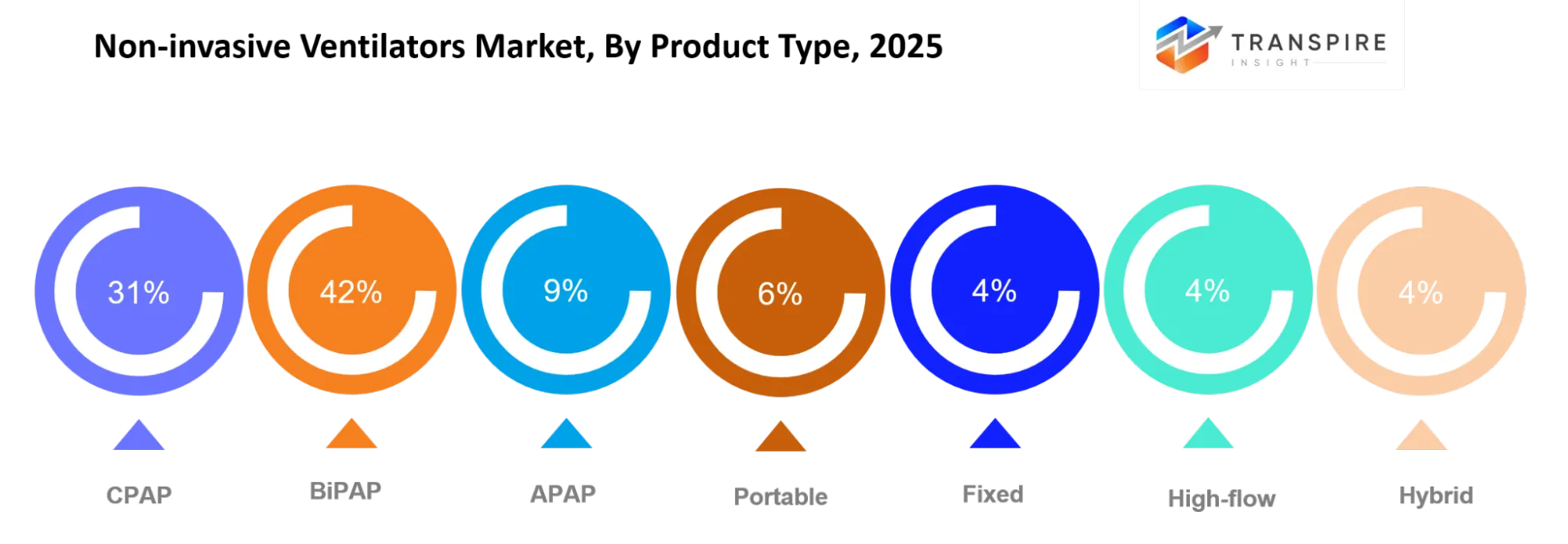
- BiPAP holds a 42% share of the market, whereas companies like ResMed are still developing bilevel ventilators with the support of adaptive technologies and advanced monitoring capabilities.
- CPAP has a 31% share of the market, where companies like ResMed are continuously adding digital connectivity features along with management capabilities.
- APAP constitutes 9% of the market share, as the automated adjustment of pressures is increasingly important for personalised breathing and sleep therapies.
- The portable non-invasive ventilators have a 6% share, where the category is showing a high growth rate of 8.9% CAGR as patients are increasingly seeking treatment outside conventional healthcare facilities.
- The fixed ventilators take 4% of the market share, continuing their position in hospitals and other controlled care facilities where continuous respiratory support is needed.
- The high-flow device has 4% market share, indicating the shift towards less invasive devices and flexible treatment solutions in the industry.
What are the Key Drivers, Restraints, and Opportunities in the Non-invasive Ventilators Market?
Drivers
Growth will be fueled by increasing adoption of non-invasive respiratory devices in cases of COPD, sleep apnea, respiratory failure, and various other chronic diseases. The coronavirus outbreak has sped up hospital spending on respiratory devices as well as raised awareness about non-invasive respiratory care, leading to more familiarity and adoption of non-invasive respiratory care among clinicians. The advancements in monitoring and automated pressure management have made therapy easier to manage.
Restraints
The limitations include the requirement for qualified clinical personnel and proper patient interface. Poor fit, air leaks, discomfort, and therapy intolerance can affect compliance, and expensive technology may increase costs. This remains an issue since efficient ventilation requires the proper combination of the two.
Opportunities
An increase in portability and connectivity of the ventilation systems offers a unique potential for expansion in the marketplace. The devices that use batteries, have remote monitoring, and adaptive ventilation features can be useful for patients who are out of the hospital. Investments in home care facilities, especially in the Asia Pacific region, can help in growing this market.
What Has the Impact of Artificial Intelligence Been on the Non-invasive Ventilators Market?
The use of Artificial intelligence in the field of non-invasive ventilation will enable companies to utilise therapy data better. The connected ventilators can gather data such as breathing patterns, pressure responsiveness, leaks, and others, which will allow for better detection of changes that happen independently of personal visits. There are algorithms enabled with artificial intelligence that help optimise the settings, detect abnormalities, and personalise ventilation. The connected respiratory portfolio of ResMed has already implemented automatic and responsive technologies, while the digital ecosystem of the company illustrates the connection between the device data and software and remote care. At the same time, Philips is cooperating with Respiree to implement wearable sensors and predictive AI to monitor continuous cardio-respiratory. Such tools will facilitate operational efficiency because of their ability to detect patients who require attention and to reduce manual review of vast amounts of monitoring data. The limitation of these tools are their cost, availability of the required data, software integration, and clinical validation. The variability of the conditions of patients and the data itself can also influence the precision of the algorithms.
Instance
In December 2025, ResMed obtained approval from the FDA for Smart Comfort, which is a medical device that incorporates artificial intelligence to recommend individualised therapy comfort settings based on the use of machine learning algorithms and actual sleep data. artificial intelligence and algorithmic technologies have been incorporated in respiratory therapy to achieve personalisation and adherence among patients.
Key Market Trends:
The trend in the market is moving away from traditional equipment used in ventilation to more connected systems for facilitating personalised treatment and remote clinical supervision. The developments in the products being created emphasise portability, adaptability, usability, and data connectivity.
- Treatment of respiration has seen a move towards more homecare applications, thus creating demand for ventilators with remote monitoring capabilities.
- The production of fixed therapy equipment has been supplanted by adaptive devices with the ability to react to respiratory changes.
- Portability is becoming crucial since more people will need respiratory treatment beyond conventional hospital settings.
- Remote monitoring has evolved from an extra function to become one of the most valuable tools in respiratory treatment management.
- Interfaces of equipment have been made easier as a result of the need for easier configuration and monitoring by care providers.
- Connectivity has increased since it helps the transfer of information between devices, clinicians, and digital management tools.
Non-invasive Ventilators Market Segmentation
By product type
BiPAP is the leading segment, accounting for a 42% share, followed by CPAP, which holds 31%, and APAP, which holds 9%. Portable non-invasive ventilators are the third leading segment, accounting for 6% share, whereas fixed non-invasive ventilators and high flow non-invasive ventilators each hold 4%, and hybrid non-invasive ventilators and others each hold 2%. Portable non-invasive ventilators are the fastest-growing segment at a CAGR of 8.9%, as light equipment will facilitate treatment outside hospitals.
By Interface
nasal masks, full-face masks, nasal pillows, oronasal masks, helmets, mouthpieces, total-face masks and others serve diverse needs of patients. Full-face masks and nasal interfaces will continue to be important as comfort, sealing, leakage, and tolerance affect the utilisation of the therapy. In terms of future development, lighter materials, better fitting and pressure points, and more interfaces compatible with smaller portable ventilation equipment will be required.
By Application
COPD, sleep apnea, respiratory failure, asthma, neuromuscular diseases, cardiogenic pulmonary oedema, and post-operation care are the areas where NIV can be used. The range of applications is widening, as NIV is now applied both in acute and chronic respiratory condition management. Devices that are able to adapt to changing clinical conditions are becoming more relevant.
By Age Group
adult and geriatric populations become significant in terms of application, while pediatric, neonatal, adolescent, young-adult and children's segments require special attention. Special interfaces, pressure regulation and monitoring devices are needed for smaller patient population segments. Thus, the development of products for specific age groups may be beneficial for the manufacturer and widen the range of applications.
By End User
hospitals will retain relevance as one of the significant end users. In addition, homecare providers, clinics, sleep centres, EDs, LTCFs, and ambulances will contribute to the widespread acceptance. The increased importance of home care should be noted, as it facilitates reviewing information about therapy using connected devices outside the hospital. It opens possibilities for the providers of portable systems capable of remote management.
By Mode
Spontaneous, CPAP, S/T, auto-adjusting, pressure-controlled, volume-assured, hybrid, and other types of modes create flexibility in managing various respiratory disorders. Auto-adjusting and volume-assured methods receive increasing attention due to their ability to adjust to changes in ventilation needs. The upcoming competitive environment should involve efforts aimed at simplifying the configuration process of sophisticated modes while retaining the reliability of patient-device synchrony.
By Portability
Stationary ventilation solutions will be used to serve fixed care facilities including hospitals, while portable, compact, wearable, travel, battery-powered, and home use ventilators are required to meet growing needs for mobility of patients. The fastest-growing type of ventilators is estimated to be the portable non-invasive ventilation solution, growing at an 8.9% CAGR. The development of the segment reflects the growing demand for flexibility, battery-powered operation, and respiratory assistance for both clinical and home environments
What are the Key Use Cases Driving the Non-invasive Ventilators Market?
Bilevel ventilation continues to be the primary use case, with BiPAP being the designated product segmentation used for patients that require two different pressures for breathing. Some emerging use cases are in the areas of COPD, sleep apnea, respiratory failure, post-operative treatments, and neuromuscular diseases, leading to increased demand in hospitals, clinics, and home care facilities. The additional use cases involve respiratory therapy for patients in home care situations or while travelling, through portable and connected ventilators.
|
Report Metrics |
Details |
|
Market size value in 2025 |
USD 3.05 Billion |
|
Market size value in 2026 |
USD 3.27 Billion |
|
Revenue forecast in 2033 |
USD 5.54 Billion |
|
Growth rate |
CAGR of 7.82% from 2026 to 2033 |
|
Base year |
2025 |
|
Historical data |
2021 - 2024 |
|
Forecast period |
2026 - 2033 |
|
Report coverage |
Revenue forecast, competitive landscape, growth factors, and trends |
|
Regional scope |
United States; Canada; Mexico; United Kingdom; Germany; France; Italy; Spain; Denmark; Sweden; Norway; China; Japan; India; Australia; South Korea; Thailand; Brazil; Argentina; South Africa; Saudi Arabia; United Arab Emirates |
|
Key company profiled |
ResMed, Philips, Medtronic, Fisher & Paykel Healthcare, Dräger, Getinge, Vyaire Medical, Hamilton Medical, Löwenstein Medical, Air Liquide, ZOLL Medical, BMC Medical, Drive DeVilbiss, Apex Medical, Yuwell |
|
Customization scope |
Free report customization (country, regional & segment scope). Avail customized purchase options to meet your exact research needs. |
|
Report Segmentation |
By Product Type (CPAP, BiPAP, APAP, Portable Ventilators, Fixed Ventilators, High-flow Devices, Hybrid Ventilators, Others); By Interface (Nasal Mask, Full-face Mask, Nasal Pillow, Oronasal Mask, Helmet, Mouthpiece, Total-face Mask, Others); By Application (COPD, Sleep Apnea, Asthma, Respiratory Failure, Neuromuscular Disorders, Cardiogenic Pulmonary Edema, Postoperative Care, Others); By Age Group (Adults, Geriatric, Pediatric, Neonates, Adolescents, Young Adults, Children, Others); By End User (Hospitals, Homecare, Clinics, Sleep Centers, Emergency Departments, Long-term Care, Ambulance Services, Others); By Mode (Spontaneous, CPAP, S/T, Auto-adjusting, Pressure-controlled, Volume-assured, Hybrid, Others); By Portability (Stationary, Portable, Compact, Wearable, Travel, Battery-operated, Home-use, Others) |
Which Regions are Driving the Non-invasive Ventilators Market Growth?
North America
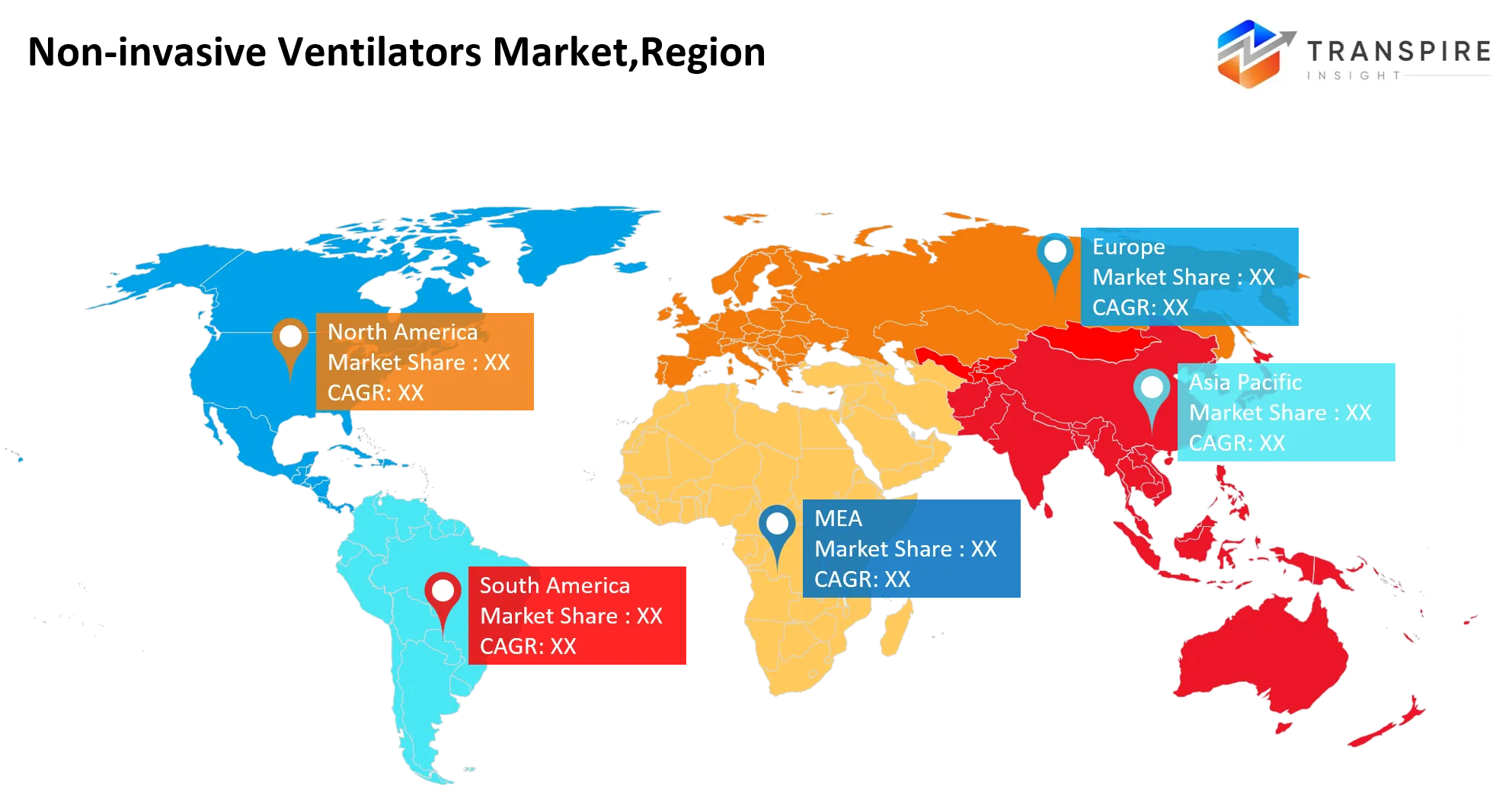
North America represents the dominant regional market, with a 38% market share driven by the presence of an existing infrastructure, services, and greater availability of connected medical devices for respiratory care. Moreover, reimbursement and clinical infrastructure in the region make it possible to provide effective long-term respiratory management. Remote therapy monitoring helps to build connections between hospitals and homecare organisations.
In September 2026, Mindray North America unveiled the SV70 Non-Invasive Ventilator in the US. The ventilator has been designed for NIV and comes with high-flow oxygen therapy, connectivity and monitoring functionalities, offering hospitals a new respiratory care alternative.
Europe
Europe accounts for 29% of the world market and acts as a steady platform due to its well-developed healthcare infrastructure and respiratory care practices. The region is distinguished from North America due to its focus on hospitalisation of respiratory patients and clinical pathways for them. Demand will be driven by the application of NIV in acute and chronic respiratory diseases. Continuous development of patient monitoring and respiratory care will support regional adoption.
In May 2026, ResMed introduced AirConnect Dx in the UK to assist NHS sleep services with technology-led respiratory care pathways. The solution combines referral, screening, home testing, reporting, logistics, and patient services, adding muscle to the region’s technology-led respiratory care capabilities.
Asia Pacific
Asia Pacific accounts for 23% of the market and is the fastest-growing region according to the market data provided. The recent developments in the infrastructure of the healthcare system, coupled with the growing availability of respiratory devices and an increase in home-based models, are generating more demand. In situations where the patient needs treatment from multiple sites, portable solutions might come in handy.
In February 2026, Nihon Kohden Korea unveiled the NKV-440 ventilator, which is a turbine-based ventilator that can be used for non-invasive ventilation and high-flow oxygen therapy.
https://kr.nihonkohden.com/ko/news-and-event/news202602
Who are the Key Players in the non-invasive ventilators market, and how do they compete?
The competition in the international non-invasive ventilators industry revolves around performance, portability, comfort, connectivity, adaptiveness, and integration into workflow. The differentiation strategies of companies in the industry include combining devices that are used to carry out ventilation with monitoring and digital management technologies. For example, ResMed differentiates itself with its connected and personalised ventilation through products like AirCurve, Stellar, and Astral thanks to its adaptive technologies and remote data management capabilities. Philips uses its home and respiratory care solutions and BiPAP-based systems for hospitals and homes as its competitive advantage. The company's wider approach also links its respiratory technologies with monitoring and clinical data platforms. On the other hand, Fisher & Paykel Healthcare offers respiratory interfaces, humidification, and non-invasive respiratory care solutions, thus positioning itself strongly within the supporting equipment ecosystemDräger differentiates itself through its hospital and intensive-care ventilation systems that offer NIV, invasive ventilation, monitoring, automation, and interoperability. Evita portfolio from the company represents a clear focus on clinical flexibility and integration of workflow.
Non-invasive Ventilators Market companies
- ResMed
- Philips
- Medtronic
- Fisher & Paykel Healthcare
- Dräger
- Getinge
- Vyaire Medical
- Hamilton Medical
- Löwenstein Medical
- Air Liquide
- ZOLL Medical
- BMC Medical
- Drive DeVilbiss
- Apex Medical
- Yuwell
Recent Development News
In July 2026, Nihon Kohden released a modified version of the NKV-550 ventilator. With the new model, Nihon Kohden included non-invasive muscle pressure measurement, AVM, and AdaptiveSync™ functions, which provided healthcare providers with more details on the efforts made by a patient during mechanical ventilation.
https://us.nihonkohden.com/nkweb/en/USD/news-and-events
In March 2025, Getinge introduced Neural Pressure Support and Non-Invasive Neural Pressure Support in the Servo-u ventilator line. The new ventilation modes were created to ensure better synchronisation with the breathing of a patient.
What Strategic Insights Define the Future of the Non-invasive Ventilators Market?
The industry is evolving towards connected, personalized, and mobile ventilation compared to stand-alone solutions. The hidden threat could be that advanced devices could increase expenses of purchase, maintenance, training, and integration, restricting implementation in areas with tight healthcare spending or poor digital infrastructure. The new opportunity lies in the growing trend of home respiratory therapy with remote monitoring and adaptive ventilation, especially in countries with less developed healthcare systems. Companies need to develop devices that will ensure portability, user-friendly interfaces, good connectivity, and automated adjustments of treatment, without adding complexity to clinical processes. Cooperation with hospitals, homecare service providers, and digital health platforms will help companies to confirm their solution and expand their market. Expansion should concentrate on regions where the management of respiratory diseases becomes more decentralized. Companies also need to work on interoperability, cybersecurity, and clinical data in order to develop connected ventilation products meeting regulatory requirements and clinical standards. This way companies could create digital services and enhance the continuity of care within hospital, clinic, and homecare environments.
By Product Type
- CPAP
- BiPAP
- APAP
- Portable Ventilators
- Fixed Ventilators
- High-flow Devices
- Hybrid Ventilators
By Interface
- Nasal Mask
- Full-face Mask
- Nasal Pillo
- Oronasal Mask
- Helmet
- Mouthpiece
- Total-face Mask
By Application
- COPD
- Sleep Apnea
- Asthma
- Respiratory Failure
- Neuromuscular Disorders
- Cardiogenic Pulmonary Edema
- Postoperative Care
By Age Group
- Adults
- Geriatric
- Pediatri
- Eonates
- Adolescents
- Young Adults
- Childre
By End User
- Hospitals
- Homecare
- Clinics
- Sleep Centers
- Emergency Departments
- Long-term Care
- Ambulance Services
By Mode
- Spontaneous
- CPAP
- S/T
- Auto-adjusting
- Pressure-controlled
- Volume-assured
- Hybrid
By Portability
- Stationary
- Portable
- Compact
- Wearable
- Travel
- Battery-operated
- Home-use
Frequently Asked Questions
Find quick answers to common questions.
The non-invasive ventilators market size was valued at USD 3.05 billion in 2025 and is poised to reach USD 5.54 billion by 2033, expanding at a 7.82% CAGR.
Key segments for the non-invasive ventilators market are By Product Type (CPAP, BiPAP, APAP, Portable Ventilators, Fixed Ventilators, High-flow Devices, Hybrid Ventilators, Others); By Interface (Nasal Mask, Full-face Mask, Nasal Pillow, Oronasal Mask, Helmet, Mouthpiece, Total-face Mask, Others); By Application (COPD, Sleep Apnea, Asthma, Respiratory Failure, Neuromuscular Disorders, Cardiogenic Pulmonary Edema, Postoperative Care, Others); By Age Group (Adults, Geriatric, Pediatric, Neonates, Adolescents, Young Adults, Children, Others); By End User (Hospitals, Homecare, Clinics, Sleep Centers, Emergency Departments, Long-term Care, Ambulance Services, Others); By Mode (Spontaneous, CPAP, S/T, Auto-adjusting, Pressure-controlled, Volume-assured, Hybrid, Others); By Portability (Stationary, Portable, Compact, Wearable, Travel, Battery-operated, Home-use, Others) a
Growth is primarily driven by Increased cases of respiratory disease, increase in the need for respiratory care at home, ageing populations, and increased use of portable and sophisticated non-invasive respiratory ventilators.
The market is led by major manufacturers including ResMed, Philips, Medtronic, Fisher & Paykel Healthcare, Dräger, Getinge, Vyaire Medical, Hamilton Medical, Löwenstein Medical, Air Liquide, ZOLL Medical, BMC Medical, Drive DeVilbiss, Apex Medical, Yuwell
North America accounts for 38% of the non-invasive ventilator market due to its developed healthcare facilities and high usage of respiratory care equipment. The North American region has well-developed healthcare facilities, increasing cases of respiratory diseases, and the presence of prominent medical device manufacturing companies.
Opportunities in the non-invasive ventilators industry are arising owing to the increasing demand for home care respiratory therapy, portable ventilator equipment, and advanced ventilators that have remote monitoring functionalities. There is also an opportunity for the growth of market presence due to the rising healthcare infrastructure in developing nations and the need for affordable respiratory support solutions.
- ResMed
- Philips
- Medtronic
- Fisher & Paykel Healthcare
- Dräger
- Getinge
- Vyaire Medical
- Hamilton Medical
- Löwenstein Medical
- Air Liquide
- ZOLL Medical
- BMC Medical
- Drive DeVilbiss
- Apex Medical
- Yuwell
About the Authors

Pankaj Ghogare Patil
I am Pankaj Ghogare Patil, a Senior Research Analyst at Transpire Insight, specializing in the Pharmaceutical, Chemicals & Materials, Healthcare IT, and Biotechnology industry. My expertise lies in conducting comprehensive market research, analyzing industry trends, evaluating competitive landscapes, and translating complex data into actionable insights. At Transpire Insight, I closely follow emerging technologies, regulatory developments, and market innovations to create accurate, well-researched, and informative content that helps businesses and professionals make informed decisions. I am committed to producing credible, evidence-based articles that reflect industry best practices while making technical topics accessible and valuable for a broad audience.

Chakradhar Khansole
Chakradhar serves as the Research Director at Transpire Insight, bringing over 8 years of experience in technology, innovation, and strategic market intelligence. He specializes in transforming complex market data into actionable business insights that enable organizations to make informed, growth-oriented decisions. Recognized for his strategic vision and analytical expertise, Chakradhar leads high-impact research initiatives, delivering comprehensive market assessments, competitive intelligence, and forward-looking industry analysis.
Recently Published Reports
-
Apr 2026
AI in Diabetic Retinopathy Market
AI in Diabetic Retinopathy Market Size, Share & Analysis Report By Type (Screening AI Systems, Diagnostic AI Systems, and Predictive AI Models), By Application Segment (Hospitals, Ophthalmology Clinics, Diagnostic Centers, and Research and Development), and Geography (North America, Europe, Asia-Pacific, Middle East and Africa, South and Central America), 2021 - 2031
-
Apr 2026
Psychometric Tests Market
Psychometric Tests Market Size, Share & Analysis Report By Type (Personality Tests, Ability/Aptitude Tests, Skill/Knowledge Tests, and Others), By Application (Talent Acquisition and Talent Management), and Geography (North America, Europe, Asia-Pacific, Middle East and Africa, South and Central America), 2021 – 2031
-
Apr 2026
Rare Biological Sample Collection Market
Rare Biological Sample Collection Market Size, Share & Analysis Report By Type (Isolation Kits & Reagent, Blood Collection Tubes, and Others), By Application (Oncology, Transcriptomics, Pharmacogenomics, and Others), and Geography (North America, Europe, Asia-Pacific, Middle East and Africa, South and Central America), 2021 – 2031
-
Jul 2026
Diabetic Retinopathy Market
Diabetic Retinopathy Market Size, Share & Analysis Report By Type (Proliferative Diabetic Retinopathy, and Diabetic Macular Edema (DME)), By Treatment Type (Anti VEGF Drug, Steroid Implants, Laser Surgeries, and Vitrectomy), and Geography (North America, Europe, Asia-Pacific, Middle East and Africa, South and Central America), 2021 – 2031
Our Clients







