

Non-Dairy Cheese Market Summary:
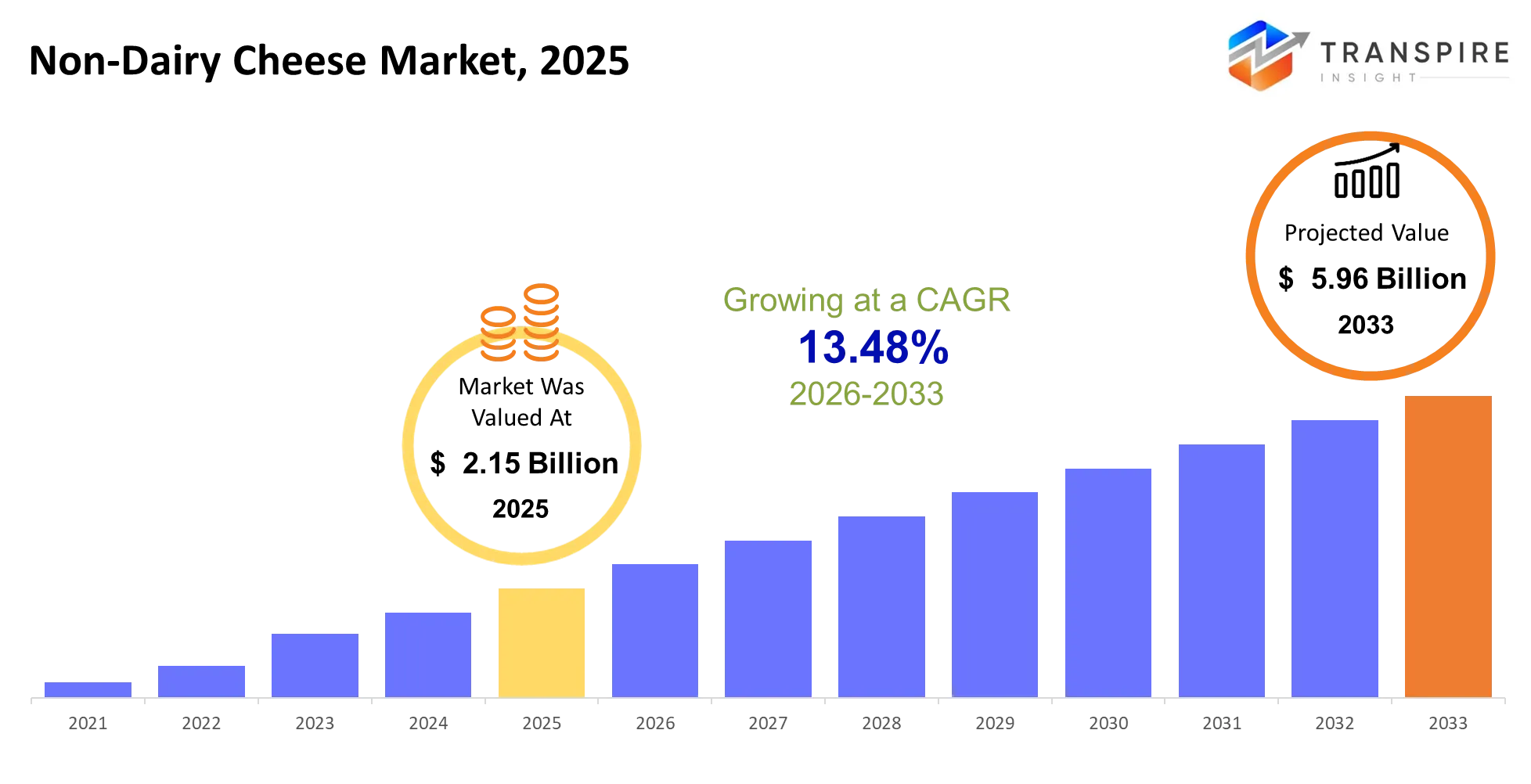
As per the Transpire Insight Analysis, The Non-Dairy Cheese Market size is estimated at USD 2.15 billion in 2025 and is anticipated to reach USD 5.96 billion by 2033, growing at a CAGR of 13.48% from 2026 to 2033.
The non-dairy cheese market supplies dairy-free mozzarella, slices, spreads, shreds and styles for retail, foodservice and pizza use. Over the past 3-5 years, the market has moved from initial coconut oil and starch substitutes towards cultured nut, soy, oat and precision-fermented protein versions that work better to melt, stretch and brown. An important structural change has been fermentation, enzymes, and cutting-edge emulsification to close the sensory gap to dairy cheese. The main 'real-world' driver has been foodservice adoption, because pizza operators need allergen-conscious, vegan options that perform consistently in an oven, not one product that simply claims to be plant-based. This results in better repeat sales and higher menu placement. Market growth happens in a predictable order: improving functionality and cleaner nutrition profiles make products suitable for daily eating occasions; better retail and foodservice distribution then drives household penetration and manufacturer sales. Regulatory explanation is also easing labelling confusion, but requirements remain region-specific.
Non-Dairy Cheese Market Size & Forecast:
- Market Size 2025: USD 2.15 Billion
- Expected Market Value (2033): USD 5.96 Billion
- Forecast CAGR (2026-2033): 13.48%
- Leading Region in 2025: North America
- Fastest Growing Region: Asia-Pacific
- Key Company Profiles: Daiya Foods, Follow Your Heart, Violife, Miyoko's Creamery, Good Planet Foods, Kite Hill, Treeline Cheese, Field Roast, Parmela Creamery, Vevan Foods, Bute Island Foods, Nurishh, Nush Foods, Sheese, Tofutti.
Key Non-Dairy Cheese Market Insights:
Non-dairy cheese is moving beyond “plant-based availability” to repeatable culinary performance, with brands leveraging fermentation, alternative bases and foodservice formats to gain habitual occasions. Solving usage barriers such as melt, stretch, allergen fit, portion control, and flavour is becoming more crucial to growth than simply increasing product numbers.
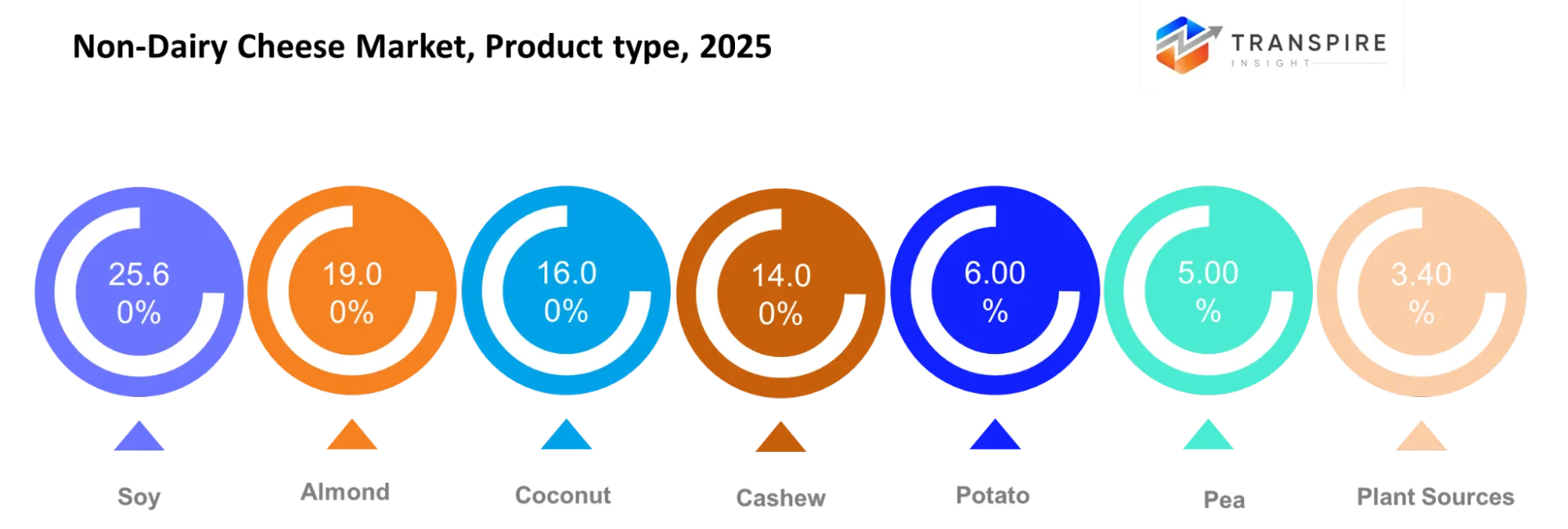
- Soy-based cheese accounts for 25.60%, while Daiya is taking the next step in oat-cream fermentation to make it better for mainstream consumers.
- Almond contributes 19.00%, and Kite Hill uses almond creaminess to compete in premium refrigerated formats.
- With consumers looking at saturated-fat-heavy recipes, coconut is 16.00% of the market, leading formulators to mix fats.
- Cashew is 14.00%, and Miyoko's new cultured cashew spreads in 2025 feature Jalapeño Plant-Milk Cheese.
- The Oat’s growth is boosted by Daiya's Oat Cream reformulation strategy, with 11.00% capture and 13.70% CAGR.
- Potato-based products account for 6.00% and provide neutral taste and lower-cost texture systems for value-oriented launches.
- Pea-based cheese is a source of 5.00% and is being used in protein-driven formulations, with brands looking for soy-free options.
- Other plant sources account for 3.40%, with precision fermentation opening the door to speciality-cheese functionality.
- Foodservice formats are taking front seat: Daiya launched single-serve dairy-free cream-cheese packets for fast, easy breakfast operations.
What are the Key Drivers, Restraints, and Opportunities in the Non-Dairy Cheese Market?
Driver:
Product performance is increasingly driving adoption rather than vegan positioning alone. Consumers and restaurant buyers now expect mozzarella to stretch on pizza, slices to melt in burgers, and shreds to brown without separating into oil. This requirement triggered investment in cultured bases, hydrocolloid systems, enzyme treatment, and precision-fermented proteins. As performance improves, non-dairy cheese can enter high-frequency occasions pizza, sandwiches, pasta and prepared foods rather than remaining a niche speciality purchase. The result is higher repeat buying, larger foodservice contracts and greater shelf productivity.
Restraint:
The category still faces a structural cost-and-formulation challenge. Many products rely on coconut oil, imported nuts, speciality cultures or protein isolates, creating exposure to ingredient-price volatility. Achieving a dairy-like melt while controlling saturated fat, sodium and allergen declarations is technically difficult. In addition, dairy-term restrictions in markets such as the European Union can complicate packaging, consumer recognition and cross-border brand consistency.
Opportunity:
Oat-based and animal-free protein platforms can unlock a broader premium-to-mainstream pathway. Mö Foods’ 2026 funding is directed toward scaling proprietary oat-based cheese technology, while Plantopia’s $9 million financing is supporting production of casein grown in sprouted oats. These investments could enable better melting and stretching without relying on conventional dairy inputs, creating opportunities in mozzarella, foodservice pizza, prepared meals, and private-label products. Distribution partnerships are another adoption catalyst because they reduce the burden of reaching retail. Misha’s Vertage acquisition expanded its shredded and sliced portfolio while connecting the business with Fresh Del Monte’s logistics capabilities, showing how infrastructure can convert innovation into availability.
What Has the Impact of Artificial Intelligence Been on the Non-Dairy Cheese Market?
Integrating AI-enabled formulation support and process control can greatly expedite development and scale-up of non-dairy cheese. Product developers can use machine learning models to test formulas of plant proteins, fats, cultures, starches, and emulsifiers, limiting the number of physical prototypes and iterations required to achieve melting, stretchability, firmness, flavour, and nutrition, particularly when opting for replacement of coconut oil or attempting low-sodium recipes that maintain mouthfeel. On the processing side, sensors and process analytics can monitor fermentation temperature and pH, melt point and stretch, viscosity, moisture content, and batch consistency, providing early warning of deviations that prompt adjustments to culture conditions and limiting costly and time-consuming failed batches and ingredient waste. Demand forecasts can also be used by retailers and foodservice providers to ensure short-shelf-life chilled products are produced where sales are trending. Intelligent solutions cannot eliminate sensory panels, pilot runs and regulatory approval. Data can be spread across recipes, suppliers and equipment; smaller companies may not have the capital and digital infrastructure to connect sensors, laboratory data and factory systems; and fermentation-based ingredients still face regulatory and scale-up challenges.
In September 2026, Crush Dynamics partnered with AI developer Atomic47 Labs to run real-time simulations for creating tailored food fermentation models. This collaboration is projected to reduce energy use by 30% while optimising fermented grape purées and powders used to successfully lower sugar and sodium levels in clean-label food formulations.https://www.foodnavigator.com/Article/2026/09/22/crush-dynamics-uses-ai-to-scale-food-fermentation/
Key Non-Dairy Cheese Market Trends:
The market is changing from “vegan substitute” to “performance” cheese systems that mimic the properties of traditional dairy cheese in the kitchen and factory. The most promising trend isn't just choice; it's the closer convergence of ingredient science, foodservice usability, and manufacturing.
- Oats have shifted from being an ingredient to a technology platform, with Mö Foods investing in scaling up production of oat cheese.
- From simple starch-based products to deeper flavour and texture, culturing and fermentation are changing the face of products.
- Precision fermentation is moving towards commercialisation with functional properties for melt, stretch and browning of casein.
- Retail assortments are expanding from spreads to mozzarella, slices, shreds and speciality formats, providing more substitution occasions.
- Foodservice is turning into a product development testbed, with heat stability and handling impacting repeat purchase.
- More and more, manufacturers are partnering and acquiring formulation expertise, while integrating refrigerated logistics, to lower the barriers to expansion.
- Product innovation is increasingly focused on premium culinary experiences such as cultured, aged, and blue-style profiles for those who appreciate a more complex taste.
- Single-source protein is no longer the only protein being used in ingredients, with research focused on pairing oat and pea proteins and fermentation to enhance nutrition and techno-functionality.
Non-Dairy Cheese Market Segmentation
Source:
Soy-Based Cheese has the largest market share of 25.60% due to its processing proficiency, protein attributes, and formula versatility among cheese alternatives. Almond makes up 19.00% of the market, while coconut holds the third position with a share of 16.00%, followed closely by cashew with 14.00%. The use of nuts remains popular in creamier, premium alternatives. Oat accounts for 11.00% of the market, while potato, pea, and others stand at 6.00%, 5.00%, and 3.40%, respectively. The fastest-growing sector, Oat-Based Cheese, is expected to grow at a CAGR of 13.70%, which can be attributed to advances in texturisation, an increase in processing efficiency, and large-scale investments being made into oat-based production processes.
Product Type:
Mozzarella and Cheddar remain central to high-frequency hot-food applications, where melting, stretch, and browning determine performance. Cream Cheese expands usage across spreads, breakfast and bakery products, while Parmesan and Feta support toppings, salads and premium prepared foods. Slices and Shreds strengthen retail and foodservice standardisation through convenient portioning and handling. Product innovation is increasingly focused on improving flavour, texture and heat stability, helping non-dairy formats perform more consistently in conventional recipes and commercial kitchen environments.
Form:
Slices and Shreds are suited to sandwiches, burgers and pizza because they simplify portioning and preparation. Blocks and Cubes support household cooking, entertaining and speciality-food occasions, allowing consumers greater serving flexibility. Spreads address breakfast, snacks and bakery applications, while Powder offers storage and formulation advantages for processed foods. Sauce formats further support foodservice and industrial applications by providing ready-to-use functionality. Future development is likely to emphasise stability, flavour retention and efficient processing across refrigerated and shelf-stable formats.
Distribution:
Supermarkets & Hypermarkets provide broad refrigerated visibility and support routine household purchases, while Convenience Stores capture immediate consumption occasions. Specialty Stores remain relevant for premium and niche products, particularly differentiated flavours. Online Retail improves product discovery, comparison, and repeat ordering, while Foodservice generates volume through restaurants, hotels, cafes, and catering. Direct Sales enable closer customer relationships, and Other Retail channels provide additional routes for emerging brands. Together, these channels help manufacturers balance mass-market reach with targeted positioning and availability.
End User:
Households provide the recurring consumption base as consumers incorporate non-dairy cheese into everyday meals, snacks, and home cooking. Restaurants and Cafes require dependable melting, handling, and portion consistency for menu execution, while Hotels and Catering emphasize scalable preparation across larger service volumes. Food Manufacturers use standardized ingredients in prepared meals, frozen foods, and packaged products, creating opportunities for longer-term contracts. Institutional Foodservice similarly values predictable specifications, supply continuity and processing efficiency when integrating non-dairy cheese into high-volume meal programs.
Application:
Pizza, Burgers and Sandwiches remain core heat-and-melt uses because they require recognisable cheese functionality during cooking. Pasta expands demand through sauces, toppings and baked dishes, while Salads and Snacks create opportunities for crumbles, cubes and ready-to-eat formats. Bakery applications benefit from spreads, fillings and speciality toppings across sweet and savoury products. Other Foods provide broader formulation opportunities in prepared meals, frozen products and sauces. Future growth will depend on improving application-specific texture, flavour stability and cooking performance across diverse recipes.
What are the Key Use Cases Driving the Non-Dairy Cheese Market?
The main application is in replacing heat-stable cheese in pizza, burgers, and sandwiches, in the formats of Mozzarella and Cheddar (shreds, slices) - applications that require melting, stretching, browning, and consistent portioning, with formulation technology key to success.
Other applications include pasta, bakery, salads, and snacks, where Parmesan, Feta, Cream Cheese, and spreads add flavour and appeal without the specific dairy functionalities. Foodservice is expected to catalyse these applications in multiple segments, with standardised portions for front- and back-of-house.
Further new applications are moving into prepared meals, sauces, and industrial formulations with powder and sauce formats. Powderized casein and better plant-protein combinations may expand applications where alternatives have already encountered texture and cooking issues.
|
Report Metrics |
Details |
|
Market size value in 2025 |
USD 2.15 Billion |
|
Market size value in 2026 |
USD 2.46 Billion |
|
Revenue forecast in 2033 |
USD 5.96 Billion |
|
Growth rate |
CAGR of 13.48% from 2026 to 2033 |
|
Base year |
2025 |
|
Historical data |
2021 - 2024 |
|
Forecast period |
2026 - 2033 |
|
Report coverage |
Revenue forecast, competitive landscape, growth factors, and trends |
|
Regional scope |
United States; Canada; Mexico; United Kingdom; Germany; France; Italy; Spain; Denmark; Sweden; Norway; China; Japan; India; Australia; South Korea; Thailand; Brazil; Argentina; South Africa; Saudi Arabia; United Arab Emirates |
|
Key companies profiled |
Daiya Foods, Follow Your Heart, Violife, Miyoko's Creamery, Good Planet Foods, Kite Hill, Treeline Cheese, Field Roast, Parmela Creamery, Vevan Foods, Bute Island Foods, Nurishh, Nush Foods, Sheese, Tofutti. |
|
Customization scope |
Free report customisation (country, regional & segment scope). Available customised purchase options to meet your exact research needs. |
|
Report Segmentation |
Source (Soy, Almond, Coconut, Cashew, Oat, Potato, Pea, Other Plant Sources); Product Type (Mozzarella, Cheddar, Cream Cheese, Parmesan, Feta, Slices, Shreds, Spreads); Form (Slices, Shreds, Blocks, Cubes, Spreads, Powder, Sauce); Distribution (Supermarkets & Hypermarkets, Convenience Stores, Specialty Stores, Online Retail, Foodservice, Direct Sales, Other Retail); End User (Households, Restaurants, Hotels, Cafes, Catering, Food Manufacturers, Institutional Foodservice); Application (Pizza, Burgers, Sandwiches, Pasta, Salads, Snacks, Bakery, Other Foods) |
Which Regions are driving non-dairy cheese market growth?
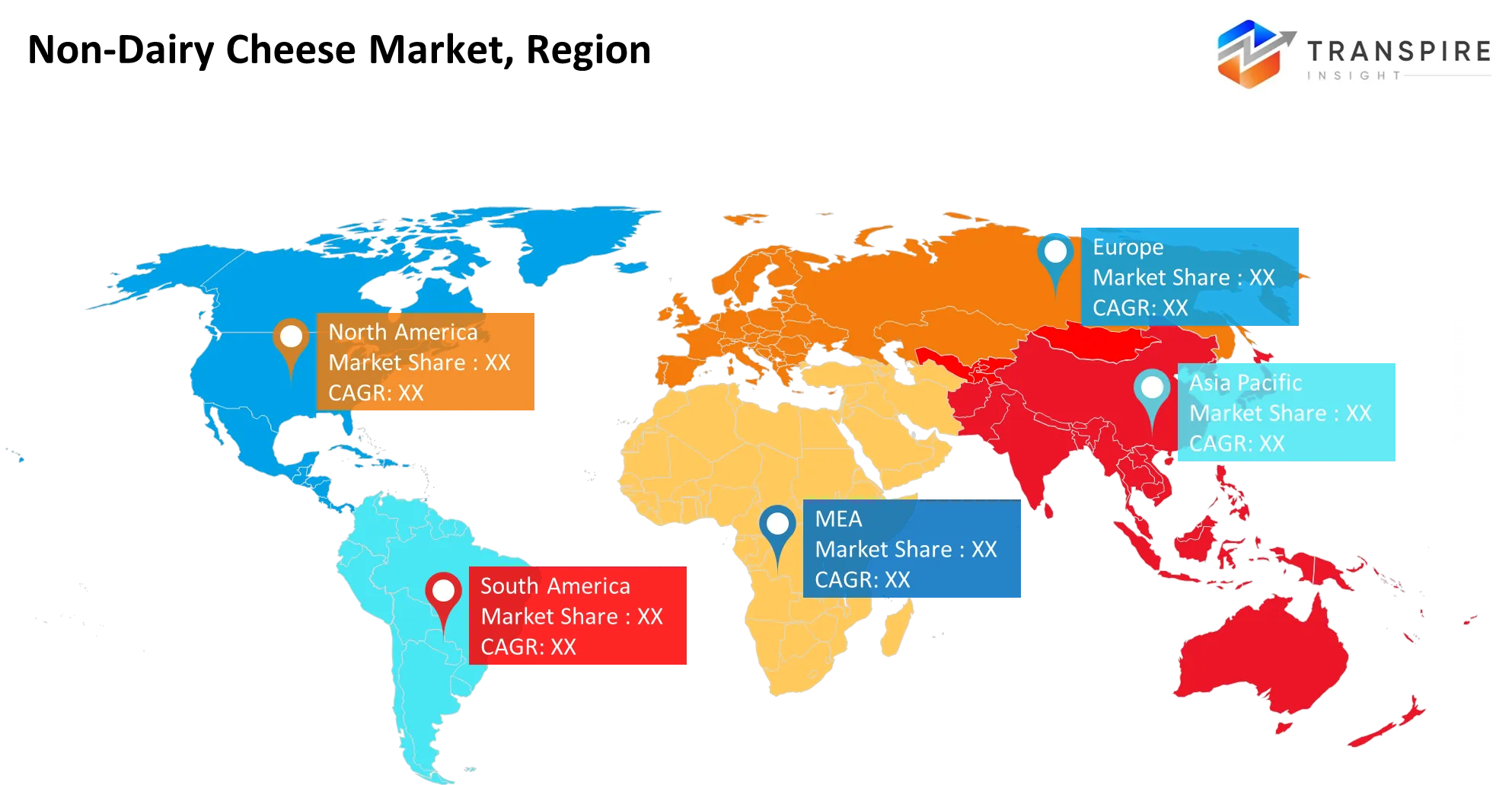
North America is leading the market with a 39.40% share. This is due to a mature supermarket distribution system, and local brands with strong distribution in the dairy-free category, and an established base of flexitarian consumers. There is easy and widespread distribution in chilled, frozen, and shelf-stable channels. Market Innovation in North America centres around the growing US and Canadian consumer base and is focused on improvements to pizza melt, cream-cheese spreadability, and allergen-friendly claims. All of which is typified by the launch of Daiya's foodservice packets and cheese sauce.
In April 2026, Daiya partnered with Canadian pizza chain Panago Pizza to roll out its newly reformulated dairy-free shredded cheese across all locations nationwide. This operational menu solution upgrades the plant-based pizza experience by delivering a creamier texture and richer flavor utilizing a proprietary, naturally cultured oat cream blend without adding extra costs for the consumer.https://vegconomist.com/businesswire/panago-rolls-out-new-daiya-dairy-free-cheese-across-all-locations/
Europe represents 32.00% of our market and is underpinned by a long-standing vegan retail culture, private-label potential and high demand for premium culinary substitutes. The future of Europe has a strong dependence on its convenience and foodservice ethos as well as its artisan and cultured positioning, in addition to its refined flavour profiles. Ongoing European refrigerated supply chains enable distribution of premium offerings of cashew, almond and fermented products, although additional labelling regulation may increase compliance costs and the need for accurate consumer communication.
In September 2026, Revo Foods launched a fermented cottage cheese alternative made from upcycled apricot kernels into prominent German retail chains, EDEKA and REWE. This product launch bypasses traditional thickeners or coconut fats, instead relying entirely on live vegan cultures to create an authentic texture.https://vegconomist.com/category/products-launches/
Asia Pacific accounts for 19.00% of the market and is the fastest-growing region, projected to grow at a 11.90% compound annual growth rate. The Asia Pacific region is growing thanks to changes in urban food delivery, quick-service restaurant chains, and the emergence of plant-based products on online grocery platforms. Unlike mature Western markets, the opportunity in Asia Pacific is in adapting the cheese alternatives to local bakery, snack, pizza, and convenience-food formats. Latin America accounts for 5.00% of the market and the Middle East/Africa 4.60%, both driven by the growth of modern retail and innovation within foodservice.
In August 2026, BioCheese launched a protein-fortified shredded cheddar cheese alternative made with a coconut oil base and 10% pea protein. This introduction marks a first for Australia's plant-based cheese category by providing a functional option that delivers 10g of total protein per 100g, expanding the availability of meltable convenience formats across nationwide retail chains like Coles supermarkets.https://vegconomist.com/category/cheese-alternatives/
Who are the Key Players in the Non-Dairy Cheese Market, and how do they compete?
Dairy milk alternative dairy cheese is simply competing on a different scale, matching the melt, stretch, flavour, and texture of dairy cheese at a price point retail/foodservice operators deem affordable. Daiya Foods is competing on scale and function, leveraging its customised Oat Cream blend and revamped cheese platforms to give better mouthfeel and cooking characteristics. The company's 2025 new offering of single-serve dairy-free cream cheese packets for foodservice breakfast outlets aims to be conveniently portioned and easy to handle.
Vinife features extensive allergen-friendly protocols and is sold ly through Flora Food Group. Its dairy-, nut-, soy-, and gluten-free line enables growth for retail, restaurant, and family-food occasions. Miyoko's Creamery competes in the premium cultured, organic, cashew-milk formats with creamery techniques; Jalapeño Plant-Milk Cheese Spread enhances the company's flavour-driven retail gains. Kite Hill, Treeline Cheese, Parmela Creamery, and Nush Foods focus on premium base, culinary credibility, and speciality retail. Follow Your Heart, Good Planet Foods, Field Roast, Vevan Foods, Bute Island Foods, Nurishh, Sheese, and Tofutti use format, retailer, allergen claims, and regional presence to vie. There is an emerging high-volume/low-margin versus high-margin/artisan chasm.
Key Players are:
- Daiya Foods
- Follow Your Heart
- Violife
- Miyoko's Creamery
- Good Planet Foods
- Kite Hill
- Treeline Cheese
- Field Roast
- Parmela Creamery
- Vevan Foods
- Bute Island Foods
- Nurishh
- Nush Foods
- Sheese
- Tofutti
Recent Development News
- In March 2026, Bel Group accelerated its plant-based strategy by expanding its vegan cheese brand portfolio across Europe and Asia. This initiative aims to deepen market penetration among flexitarian consumers by utilising sustainable dairy alternatives.https://www.groupe-bel.com/en/newsroom/press-releases/bel-confirms-the-strength-of-its-healthier-snacking-model-and-delivers-another-year-of-strong-performance/
- In July 2026, Plantopia raised US$9 million to establish a commercial facility for producing casein proteins through molecular farming in sprouted oats. The investment is intended to move the technology from research toward commercial production of animal-free dairy ingredients for applications including mozzarella and other cheese alternatives.https://www.greenqueen.com.hk/plantopia-molecular-farming-funding-casein-dairy-proteins-oats-sprouts/
- In June 2026, Formo obtained self-affirmed GRAS status in the United States and finalised a commercial manufacturing partnership. This action secures the infrastructure necessary to distribute its precision-fermented casein proteins at a commercial scale, allowing US food manufacturers to formulate plant-based cheeses with traditional melting and stretching characteristics.https://www.greenqueen.com.hk/formo-foods-precision-fermentation-casein-dairy-protein-self-gras-cheese/
What Strategic Insights Define the Future of the Non-Dairy Cheese Market?
It is moving toward a bifurcated future as consumer-friendly, economical formats for pizza, burgers and sandwiches and high-end cultured products priced at a premium to reflect superior taste and origin. The threat isn't only consumer disbelief but the economics of formulation. A reliance on speciality oils, nuts, cultures and imports could keep retail pricing uncompetitive when customers choose a less costly product elsewhere. The most exciting opportunity is functional functionality for foodservice. Fermentation-enabled proteins and enhanced plant-fat systems could provide reliable functionality for non-dairy cheese (mozzarella), sauces and spreads for high-temperature, high-volume operations. Companies should focus on co-development with pizza, QSR and prepared-food operators rather than just shelf-stocking, commodity-style new-to-market retail products. Recipes that meet localised requirements with available ingredients-such as oats, peas, or potatoes-can keep costs down, reduce supply risks, and allergen concerns. Nutrition and labelling claims ready for marketing clearance will be critical to scalable growth.
Key Segmentations are:
Source
- Soy
- Almond
- Coconut
- Cashew
- Oat
- Potato
- Pea
- Other Plant Sources
Product Type
- Mozzarella
- Cheddar
- Cream Cheese
- Parmesan
- Feta
- Slices
- Shreds
- Spreads
Form
- Slices
- Shreds
- Blocks
- Cubes
- Spreads
- Powder
- Sauce
Distribution
- Supermarkets & Hypermarkets
- Convenience Stores
- Speciality Stores
- Online Retail
- Foodservice
- Direct Sales
- Other Retail
End User
- Households
- Restaurants
- Hotels
- Cafes
- Catering
- Food Manufacturers
- Institutional Foodservice
Application
- Pizza
- Burgers
- Sandwiches
- Pasta
- Salads
- Snacks
- Bakery
- Other Foods
By Regional Analysis
North America
- US
- Canada
- Mexico
Europe
- Germany
- UK
- France
- Italy
- Spain
- Russia
- Rest of Europe
Asia Pacific
- China
- Japan
- India
- South Korea
- Australia
- Rest of Asia Pacific
South America
- Brazil
- Argentina
- Rest of South America
Middle East & Africa
- UAE
- Saudi Arabia
- Qatar
- South Africa
- Rest of the Middle East
Frequently Asked Questions
Find quick answers to common questions.
The non-dairy cheese market size was valued at USD 2.15 billion in 2025 and is poised to reach USD 5.96 billion by 2033, expanding at a 13.48% CAGR.
Key segments for the non-dairy cheese market are (Source (Soy, Almond, Coconut, Cashew, Oat, Potato, Pea, Other Plant Sources); Product Type (Mozzarella, Cheddar, Cream Cheese, Parmesan, Feta, Slices, Shreds, Spreads); Form (Slices, Shreds, Blocks, Cubes, Spreads, Powder, Sauce); Distribution (Supermarkets & Hypermarkets, Convenience Stores, Specialty Stores, Online Retail, Foodservice, Direct Sales, Other Retail); End User (Households, Restaurants, Hotels, Cafes, Catering, Food Manufacturers, Institutional Foodservice); Application (Pizza, Burgers, Sandwiches, Pasta, Salads, Snacks, Bakery, Other Foods)
Growth is primarily driven by advances in plant-protein processing, improved meltability and texture, expansion of foodservice applications, wider supermarket and online distribution, investment in oat-based and precision-fermented ingredients, and demand for convenient dairy-free alternatives
The non-dairy cheese market is led by major manufacturers, including Daiya Foods, Follow Your Heart, Violife, Miyoko's Creamery, Good Planet Foods, Kite Hill, Treeline Cheese, Field Roast, Parmela Creamery, Vevan Foods, Bute Island Foods, Nurishh, Nush Foods, Sheese, and Tofutti.
North America holds 39.40% of the market, supported by established refrigerated distribution, mature plant-based foodservice channels, strong retail penetration, product innovation, and consumer familiarity with dairy-free formats
Key opportunities include oat-based cheese, precision-fermented casein, improved melt-and-stretch formulations, foodservice products, premium cultured varieties, and expansion across Asia Pacific.
- Daiya Foods
- Follow Your Heart
- Violife
- Miyoko's Creamery
- Good Planet Foods
- Kite Hill
- Treeline Cheese
- Field Roast
- Parmela Creamery
- Vevan Foods
- Bute Island Foods
- Nurishh
- Nush Foods
- Sheese
- Tofutti
About the Authors

Chetan Dhatrak
I’m Chetan Dhatrak, a Senior Research Analyst at Transpire Insight, specializing in the Consumer Goods, Foods and Beverages industry. I focus on analyzing market trends, consumer behavior, competitive landscapes, and industry developments to deliver accurate, data-driven insights. My research at Transpire Insight is built on credible sources and in-depth analysis, helping businesses and readers better understand market dynamics, emerging opportunities, and evolving consumer preferences. I’m committed to creating reliable, well-researched content that supports informed decision-making and reflects the latest developments in the consumer goods and food & beverage sectors.

Chakradhar Khansole
Chakradhar serves as the Research Director at Transpire Insight, bringing over 8 years of experience in technology, innovation, and strategic market intelligence. He specializes in transforming complex market data into actionable business insights that enable organizations to make informed, growth-oriented decisions. Recognized for his strategic vision and analytical expertise, Chakradhar leads high-impact research initiatives, delivering comprehensive market assessments, competitive intelligence, and forward-looking industry analysis.
Recently Published Reports
-
Apr 2026
Baby Infant Formula Market
Baby Infant Formula Market Size, Share & Analysis Report By ype (Infant Milk, Follow On Milk, Specialty Baby Milk, Growing-Up Milk), By Ingredient (Carbohydrate, Fat, Protein, Minerals, Vitamins, and Others), By Product Form (Powder, Liquid, and Ready-to-feed), By Distribution Channels (Supermarket/Hypermarket, Specialty Store, Pharmacies, Online Retail, and Others), and Geography (North America, Europe, Asia-Pacific, Middle East and Africa, South and Central America), 2021 - 2031
-
Apr 2026
Edible Insects for Animal Feed Market
Edible Insects for Animal Feed Market Size, Share & Analysis Report By Type (Insect Powder, Insect Meal, Insect Bar, Insect Paste, Insect Oil, and Others), By Insect Type (Beetles, Cricket, Caterpillar, Hymenoptera, Orthoptera, Tree Bugs, and Others), By Application (Livestock, Pet Food, and Aquaculture), By Livestock Type (Poultry, Swine, and Others), and Geography (North America, Europe, Asia-Pacific, Middle East and Africa, South and Central America), 2021 - 2031
-
Apr 2026
Food Industry Disinfection and Bacterial Control Market
Food Industry Disinfection and Bacterial Control Market Size, Share & Analysis Report By Type (Chemical Disinfectants, Physical Disinfectants, and Biocides and Antimicrobials), By Application (Food Processing Equipment Surface Disinfection, Food Preparation Areas Surface Disinfection, Storage Areas Surface Disinfection, Anti-microbial Coatings Food Preservation, and Preservative Solutions Food Preservation), By End User (Meat and Poultry Processing, Dairy Processing, Seafood Processing, Bakery and Confectionery, Restaurants and Commercial Kitchens, and Food Service Providers), By Sales Channel (Online, Offline), and Geography (North America, Europe, Asia-Pacific, Middle East and Africa, South and Central America), 2021 - 2031
-
May 2026
Freeze Dried Food Market
Freeze Dried Food Market Size, Share & Analysis Report By Product Type (Fruits, Vegetables, Freeze-Dried Dairy Products, Freeze-Dried Meat and Seafood, Freeze-Dried Pet Food, and Prepared Meal), By Nature (Organic, and Conventional), By Form (Powdered, Granules, and Diced), By End Use (Breakfast Cereals, Dairy Products, Bakery & Confectionery, Nutritional Bars & Supplements, Powdered Beverages, Snacks, and Retail (Household)), and Geography (North America, Europe, Asia-Pacific, Middle East and Africa, South and Central America), 2021 - 2031