

France Cheese Market Size & Forecast:
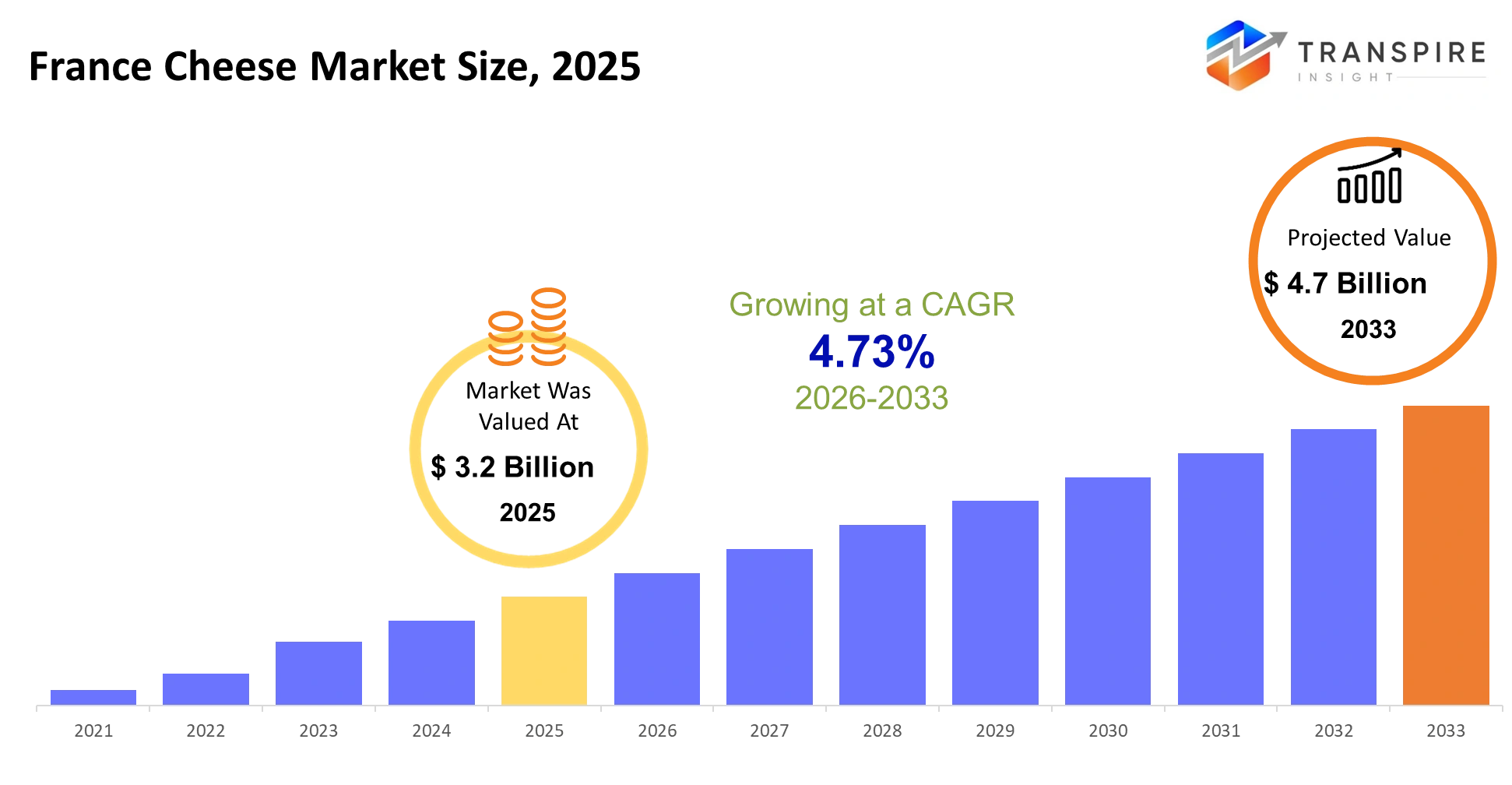
- France Cheese Market Size 2025: USD 3.2 Billion
- France Cheese Market Size 2033: USD 4.7 Billion
- France Cheese Market CAGR: 4.73%
- France Cheese Market Segments: By Type (Natural Cheese, Processed Cheese, Others); By Application (Household, Food Service, Others); By End-User (Consumers, Restaurants, Food Industry, Others); By Distribution (Supermarkets, Online, Specialty Stores, Others)
To learn more about this report,  Download Free Sample Report
France Cheese Market Summary
The France Cheese Market was valued at USD 3.2 Billion in 2025. It is forecast to reach USD 4.7 Billion by 2033. That is a CAGR of 4.73% over the period.
In France, the cheese market kind of sits right in the middle of the whole food manufacturing, retail ,and hospitality ecosystem, because it keeps delivering value-added dairy products for households, restaurants, bakeries, and even more processed food applications. Cheese is not just a staple category, but it also works like a premium culinary ingredient that backs up France’s export economy and its more local gastronomy scene. Over the last five years, things have moved a bit, toward specialty options, organic choices, and cheeses that are certified by specific regions, since shoppers now care more about traceable sourcing and artisanal production, you know. At the same time, the rise of private label premium cheese from supermarket chains has really reshaped competition, not in a small way, it is kinda the big deal.
One big spark for this shift came after dairy supply disruptions, also the energy cost inflation tied to the Russia-Ukraine conflict. Put together, that combo pushed milk processing costs and cold chain expenses higher across Europe so everyone had to re-calibrate. Manufacturers responded with a stronger emphasis on production efficiency, packaging innovation and export diversification, and oddly enough those things worked together. The moves helped secure premium pricing styles and they also strengthened shelf visibility in convenience retail which in turn backs steady revenue growth through both domestic sales and international sales.
Key Market Insights
- Northern France basically held about 38% market share in 2025, mostly because dairy farming there is heavily concentrated and the cheese processing facilities are pretty advanced—so yeah, it adds up.
- Western France is also expected to keep being the fastest-growing regional hub through 2033 with serious investment in export driven dairy plants.
- In the France Cheese Market, hard and semi hard cheese still took the lead, with over 42% share in 2025, largely tied to longer shelf stability, which is a big deal.
- Soft cheese stayed as the second biggest category too, with support coming from premium restaurant demand and those traditional French eating habits that never really quit.
- Between 2026 and 2033, organic plus specialty cheese products look like the quickest movers, as retailers broaden their premium dairy collections and slightly adjust their assortments.
- Retail household consumption made up around 55% of total industry demand in 2025, through supermarkets, hypermarkets, and also online grocery platforms, no surprise there.
- Meanwhile, foodservice applications are expanding fast too, as quick service restaurants keep adding cheese centered items across urban areas in France.
- On the demand side, large dairy processors largely dominate, but artisanal producers are slowly gaining ground in the export focused premium segments.
- And manufacturers are trying to sharpen their edge using AI enabled production monitoring, recyclable packaging, plus strategic expansion into Asian, and Middle Eastern export markets.
What are the Key Drivers, Restraints, and Opportunities in the France Cheese Market?
The main thing driving the France cheese market, is kinda, the premiumization of dairy consumption through retail and foodservice channels. French shoppers are more and more drawn to protected designation cheeses, organic versions, and those high-protein specialty items that are selling at higher retail margins. This momentum really picked up after supermarkets started beefing up premium refrigerated areas, and restaurants also put more cheese at the center of menus once tourism and hospitality activity began recovering after 2021. Since premium products bring stronger profitability per single unit, manufacturers have been expanding aging facilities, updating automated packaging lines, and ramping up export operations , which directly adds to overall market revenue.
The biggest restraint though comes from structural whiplash in dairy input costs along with energy-heavy cold-chain logistics. Cheese production depends a lot on raw milk quality, refrigeration, and aging infrastructure, but all of that became pricier after European energy inflation and feed supply disruptions. Smaller artisan producers are often unable to swallow these extra expenses without increasing their selling prices , and that situation slows scalability and can delay a move into more price-sensitive retail segments. So in practice, this limitation keeps squeezing margins for independent producers.
A noticeable opportunity is tied to functional and plant-blended cheese innovation. More and more French dairy firms are putting money into hybrid cheese concepts , mixing dairy proteins with plant ingredients to match changing dietary preferences while still keeping the taste and texture. Also, export demand from Asia and the Middle East for premium French-branded cheese products is opening up new revenue streams for manufacturers that can scale certified production.
What Has the Impact of Artificial Intelligence Been on the France Cheese Market?
Artificial intelligence , and these advanced digital systems are kinda reshaping the way cheese manufacturing works across France , because they push better production consistency. They also help with inventory forecasting and, somehow, supply-chain efficiency . Nowadays big dairy processors are already leaning on AI enabled monitoring, so they can automate milk quality checks , manage temperature, and control fermentation while the cheese is aging . Then machine-learning models look at humidity levels, track bacterial activity , and watch the storage conditions in real time. That reduces spoilage risk , and it also keeps the flavor more steady from one batch to the next , which is the whole point.
On top of that, predictive analytics tools are making demand swings easier to anticipate across retail and foodservice. Some companies blend AI with warehouse operations , plus cold chain logistics, to improve inventory turnover and cut the waste tied to dairy products that expire. After rolling out automated monitoring platforms, several processing plants have reported a clearer improvement in production uptime, and even lower refrigeration energy use. Digital twins and sensor-driven maintenance setups also support predictive upkeep, especially for packaging and refrigeration equipment, so operational hiccups happen less often.
Still, AI adoption isn’t all smooth , because integration costs can be really high. And the production structures are pretty fragmented, especially among artisanal cheese producers. A lot of smaller facilities don’t have standardized digital infrastructure, and they don’t have enough historical production data either. Because of that, the accuracy and the scalability of advanced predictive systems can stay limited across the wider French dairy network .
Key Market Trends
- Since 2021, supermarket chains have kind of expanded their premium private-label cheese ranges , and that has, you know, reshaped the pricing tug-of-war across both mid tier and artisanal producers, it felt like a change in rhythm.
- French dairy processors started putting more money into automated aging plus packaging systems, partly to counter labor shortages and those higher day to day operational costs, which are not exactly getting smaller.
- After 2022 organic cheese launches really seemed to speed up, because retailers assigned extra refrigerated shelf space to certified dairy products, like it was immediate.
- Export-focused manufacturers also went harder on distribution partnerships in Asia and the Middle East, so they could, basically reduce reliance on European demand cycles that swing around.
- Foodservice operators increased the use of specialty cheeses on gourmet fast-casual menus, especially across urban hospitality markets , after the tourism recovery started to stabilize.
- Recyclable and lightweight cheese packaging adoption grew a lot between 2023 and 2025, mainly because sustainability targets got stricter and more strictly enforced.
- Producers began using AI based quality monitoring tools more often, to improve batch uniformity and cut down spoilage during maturation processes, not just once but repeatedly.
- Regional cheese producers leveraged protected designation certifications to bolster export branding and defend that premium price positioning, even when competition gets noisy.
- Lactose-free and protein-enriched cheese categories got better retail penetration, as health-minded dairy consumption patterns kept evolving over time.
- Consolidation activity also intensified, with large dairy groups acquiring smaller specialty brands, which helped them build wider premium market portfolios , more quickly.
France Cheese Market Segmentation
By Type
Natural Cheese kind of keeps the dominant position in the market, as long standing French consumption habits lean heavily toward artisanal, local, and protected-origin cheese kinds. There is a very clear pull from buyers for genuine taste profiles, better milk sourcing, and the way aging develops quality, and that keeps retail plus foodservice demand quite high both at home and for export. Supermarkets, and also specialty retailers tend to set aside a lot of shelf space for natural cheese because the profit margins feel higher, and brand separation is easier, so it turns into a kind of advantage. Dairy cooperatives and premium makers, meanwhile, get extra leverage thanks to geographic indication certifications, which help maintain stronger pricing power, plus export competitiveness.
Processed Cheese still holds a big market share because large food manufacturers, and quick-service chains want steadiness in every batch, longer shelf life, and easy handling in practice. Industrial uses such as frozen meals, packed snacks, and bakery fillings keep commercial demand stable for processed cheese formats. Then other categories are moving along too, like plant blended options and flavored specialty products, they are growing steadily as producers aim at younger buyers, and also health minded retail segments. In the coming forecast period , product developers are expected to put more money into protein boosted, lactose free, and hybrid cheese ideas, so this should open selective chances for premium and functional dairy brands.

To learn more about this report, Download Free Sample Report
By Application
Household applications, kind of stay in the lead because cheese is still a staple product, across French daily consumption habits and home-based meal prep. People keep buying through supermarkets, convenience shops, and even digital grocery platforms, so the revenue keeps coming back, on both premium and mainstream cheese categories. You can also see higher demand for ready-to-use sliced, shredded, and snack-sized cheese products, which points to shift in urban lifestyles and this convenience-first way of eating. At the same time, premiumization in home use still nudges manufacturers to push organic , artisanal and region-certified product lines.
Food Service stays pretty important too, because restaurants, cafés, bakeries and hospitality operators depend on cheese a lot, in traditional French cuisine and also for fast-casual menus. Pizza chains, gourmet burger spots, and bakery manufacturers increasingly lean on processed and specialty cheese to create better differentiation and operational steadiness. Other use cases, like industrial packaged food production and institutional catering, are also picking up pace as convenience food demand keeps expanding in cities. Over the long run, growth in these segments should motivate dairy processors to work on tailored formulations, aimed at better manufacturing efficiency and commercial kitchen performance.
By End-User
Consumers pretty much dominate the end-user segment, because separate households make up the biggest slice of the recurring cheese buys across retail plus online distribution. Also, there’s this strong cultural tie, like a sort of habitual attachment, to cheese eating in France, so demand stays steady across premium, regional, and even everyday dairy categories. On top of that, the spending level on specialty and organic cheese goods has helped profitability, not only for branded dairy manufacturers but also for artisanal producers. At the same time, the growing interest in protein-centered diets , and that kind of gourmet at-home dining, keeps nudging the same long-term demand pattern forward.
Restaurants still hold a pretty big market position, since cheese stays essential everywhere from French meals to bakery items , and even in international fast-casual food formats. More fine dining places are leaning harder into protected-origin cheese and premium selections, partly to sharpen menu differentiation, and partly to lift the perceived experience value for guests. The food industry segment keeps moving upward too, sort of steadily, as packaged food producers increase how much cheese goes into frozen meals, snack bars, and ready-to-eat lines. Then there are the other end users, like institutional catering providers and hospitality operators, they’re expected to add demand for bulk cheese supply deals, plus customized dairy formulations during the forecast period.
By Distribution
Supermarkets kinda hold the biggest market share, since large retail chains offer a broad product mix, solid cold chain infrastructure, and nationwide consumer reach which is honestly hard to match elsewhere. Hypermarkets and organized grocery retailers still keep leading sales, mostly by pushing promotional pricing tactics, rolling out private-label premium items, and expanding those refrigerated dairy aisles. At the same time, established shop networks also help cement ties with suppliers, including major dairy processors plus regional artisanal producers, which seems to keep things steady. Ongoing spending on premium shelf look and convenience-driven packaging also helps maintain long-term revenue stability across the whole supermarket segment, if you look at it over time.
Online distribution is growing pretty quickly too, as digital grocery platforms make specialty cheese access easier, with subscription based delivery models, and even direct-to-consumer artisanal brands. E-commerce players are also leaning more into personalized recommendations, and they’re using temperature-controlled logistics systems to keep product quality protected, plus to help lock in repeat customers. Specialty Stores keep pulling in premium buyers who want regional cheeses, imported selections, and a bit more knowledgeable guidance that just isn’t really available in most mass-market retail spaces. Other routes, like gourmet food boutiques and hospitality-linked supply networks, should still support selective growth for niche producers and higher-value cheese portfolios, during the forecast period.
What are the Key Use Cases Driving the France Cheese Market?
In the French cheese market the main use case still feels like household and retail consumption, mostly via supermarkets, hypermarkets, and those specialty grocery chains. Hard and semi-hard cheeses keep pulling in a lot of demand because they last longer on the shelf, work well in many culinary situations, and are easier to move around both for domestic coverage and for exports.
But it looks like the way people use cheese is shifting a bit too, especially in foodservice and processed food. Restaurants, bakery brands , and quick-service operators are increasingly relying on premium cheeses for ready-to-eat dishes, gourmet sandwiches, pizzas, and snack items. At the same time, industrial food manufacturers are bringing cheese into frozen meals and convenience food lines too, partly to match the way urban consumers are changing their routines.
You can also spot newer use cases like protein-enriched functional cheese products, and hybrid dairy-plant formulations aimed at health focused shoppers. On top of that, there are export oriented assortments, made for hospitality channels in Asia and the Middle East, and these seem to have solid long term growth potential since international interest in French-origin dairy keeps expanding.
|
Report Metrics |
Details |
|
Market size value in 2025 |
USD 3.2 Billion |
|
Market size value in 2026 |
USD 3.4 Billion |
|
Revenue forecast in 2033 |
USD 4.7 Billion |
|
Growth rate |
CAGR of4.73% from 2026 to 2033 |
|
Base year |
2025 |
|
Historical data |
2021 - 2024 |
|
Forecast period |
2026 - 2033 |
|
Report coverage |
Revenue forecast, competitive landscape, growth factors, and trends |
|
Regional scope |
France |
|
Key company profiled |
Lactalis, Danone, Arla Foods, FrieslandCampina, Savencia, Bel Group, Kraft Heinz, Saputo, Fonterra, Emmi, Muller, Parmalat, Hochland, Granarolo, Président |
|
Customization scope |
Free report customization (country, regional & segment scope). Avail customized purchase options to meet your exact research needs. |
|
Report Segmentation |
By Type (Natural Cheese, Processed Cheese, Others); By Application (Household, Food Service, Others); By End-User (Consumers, Restaurants, Food Industry, Others); By Distribution (Supermarkets, Online, Specialty Stores, Others) |
Which Regions are Driving the France Cheese Market Growth?
Northern France still feels like the main, almost default, region for the France cheese market because it has a dense dairy farming network, solid cold chain infrastructure and a big clustering of large scale processing plants. Areas like Normandy and Hauts-de-France do well, mostly thanks to strong milk collection systems, protected designation cheese production and the fact they are fairly close to export logistics routes that reach beyond the local scope, serving wider Europe. There are also government backed agricultural modernization efforts , plus cooperative dairy ecosystems, that keep pushing output efficiency and better quality cheese making. And frankly the region hosts several big facilities run by Lactalis and Savencia, so it stays the operational center for the national cheese industry, even when demand shifts a bit.
Western France is next, it contributes the second most, but the story here is more about supply resilience and export steadiness than about pure production concentration. Brittany and Pays de la Loire keep growing at a stable pace due to diversified dairy assortments that mix industrial cheese manufacturing with value added specialty products. Compared with Northern France, this part leans more on cooperative farming frameworks and longer term retailer relationships, which gives a bit stronger pricing predictability when milk costs jump around, or get a little wobbly. Ongoing investment in sustainable dairy farming, plus energy efficient processing facilities, has also improved day to day operational certainty for both producers and exporters.
Southern France is starting to pull ahead as the fastest growing regional market , since specialty and premium cheese demand keeps widening across tourism, hospitality, and channels that are more export oriented. More money is going into artisanal cheese production, and protected origin certifications, that type of thing, is spreading too. In practice this means regional brands gain visibility faster and distribution networks get more organized, so the growth looks less like a spike and more like a gradual climb.
Who are the Key Players in the France Cheese Market and How Do They Compete?
Competition in the France cheese market is still kind of moderately consolidated, where big multinational dairy groups hold a lot of the retail distribution. Meanwhile, regional and artisanal makers keep battling it out, using premium positioning and protected-origin products, but honestly it can get a bit nuanced. The main players usually don’t push on pure price all the time. Instead they tend to compete on brand power, product differentiation, how far they can export, and how good their cold-chain efficiency is. Incumbents keep defending their slice of the market through acquisitions, new premium launches, and investments in sustainable dairy sourcing. At the same time the smaller producers lean more on authenticity and regional specialization, even when margins are tight.
Lactalis stands out with global scale, a solid export setup, and a wide lineup of premium cheeses, think Président and Galbani among others. They expanded pretty aggressively into Oceania and Asia after buying Fonterra’s consumer business, which helped tighten international distribution and also boosted production scale. Bel Group is more focused on processed, convenience-style cheese products aimed at retail and snack categories. That gives it decent positioning with younger consumers and urban households. Its innovation approach pushes portion-controlled formats and recyclable packaging, sort of to match the shifting expectations from retailers.
Savencia, on the other hand, competes via specialty and premium cheese know-how, especially in protected designation items and gourmet foodservice channels. Danone draws from its dairy research strengths to move further into health-oriented and protein-enriched cheese categories. And Arla Foods reinforces its presence through cooperative milk sourcing, plus sustainable dairy production standards, which tend to appeal to environmentally minded retailers and export buyers.
Company List
- Lactalis
- Danone
- Arla Foods
- FrieslandCampina
- Savencia
- Bel Group
- Kraft Heinz
- Saputo
- Fonterra
- Emmi
- Muller
- Parmalat
- Hochland
- Granarolo
- Président
Recent Development News
In August 2025, Lactalis announced an agreement to acquire Fonterra’s consumer dairy brands including Mainland and Anchor. The acquisition expanded Lactalis’ international cheese portfolio and increased its strategic presence in Asia-Pacific dairy markets.http://www.reuters.com
In January 2026, Lactalis launched a multi-million-pound investment campaign for its Président cheese brand in the UK and Ireland. The initiative strengthened premium French cheese positioning in international retail channels and supported category expansion in European markets.http://www.lactalis.co.uk
What Strategic Insights Define the Future of the France Cheese Market?
In France, the cheese market is kind of structurally shifting toward premiumization, export diversification, and technology-assisted dairy processing over the next five to seven years, more or less. The main undercurrent behind this transition is that profitability spread keeps widening between commodity cheese output and higher value specialty items, especially organic lines, and protected-origin products. In practice, manufacturers who can manage brand identity, traceability, and cold chain logistics—without cutting corners—will usually end up with stronger margins as retail and foodservice buyers start leaning more on quality differentiation rather than just volume growth.
There’s also a hidden risk that doesn’t get talked about enough: raw milk supply is concentrated, and dairy farming is aging in several key producing areas. If younger farmers keep leaving the sector, milk availability can get tighter, and that could translate into longer term pricing instability for processors. Meanwhile hybrid dairy products are beginning to show up as a real opening, you know, where classic cheese is combined with plant-based proteins. This seems especially promising in export markets that are actively looking for “healthier” and lower emission food alternatives.
For market participants, the obvious play is to put money into automated aging systems, AI-driven quality monitoring, and export partnerships spread across geographies. The goal is to lessen exposure to European supply volatility and, at the same time, reinforce longer term pricing power.
France Cheese Market Report Segmentation
By Type
- Natural Cheese
- Processed Cheese
- Others
By Application
- Household
- Food Service
- Others
By End-User
- Consumers
- Restaurants
- Food Industry
- Others
By Distribution
- Supermarkets
- Online
- Specialty Stores
- Others
Frequently Asked Questions
Find quick answers to common questions.
The approximate France Cheese Market size for the market will be USD 4.7 Billion in 2033.
Key segments for the France Cheese Market are By Type (Natural Cheese, Processed Cheese, Others); By Application (Household, Food Service, Others); By End-User (Consumers, Restaurants, Food Industry, Others); By Distribution (Supermarkets, Online, Specialty Stores, Others).
Major France Cheese Market players are Lactalis, Danone, Arla Foods, FrieslandCampina, Savencia, Bel Group, Kraft Heinz, Saputo, Fonterra, Emmi, Muller, Parmalat, Hochland, Granarolo, Président.
The France Cheese Market size is USD 3.2 Billion in 2025.
The France Cheese Market CAGR is 4.73% from 2026 to 2033.
- Lactalis
- Danone
- Arla Foods
- FrieslandCampina
- Savencia
- Bel Group
- Kraft Heinz
- Saputo
- Fonterra
- Emmi
- Muller
- Parmalat
- Hochland
- Granarolo
- Président
Recently Published Reports
-
Apr 2026
Baby Infant Formula Market
Baby Infant Formula Market Size, Share & Analysis Report By ype (Infant Milk, Follow On Milk, Specialty Baby Milk, Growing-Up Milk), By Ingredient (Carbohydrate, Fat, Protein, Minerals, Vitamins, and Others), By Product Form (Powder, Liquid, and Ready-to-feed), By Distribution Channels (Supermarket/Hypermarket, Specialty Store, Pharmacies, Online Retail, and Others), and Geography (North America, Europe, Asia-Pacific, Middle East and Africa, South and Central America), 2021 - 2031
-
Apr 2026
Edible Insects for Animal Feed Market
Edible Insects for Animal Feed Market Size, Share & Analysis Report By Type (Insect Powder, Insect Meal, Insect Bar, Insect Paste, Insect Oil, and Others), By Insect Type (Beetles, Cricket, Caterpillar, Hymenoptera, Orthoptera, Tree Bugs, and Others), By Application (Livestock, Pet Food, and Aquaculture), By Livestock Type (Poultry, Swine, and Others), and Geography (North America, Europe, Asia-Pacific, Middle East and Africa, South and Central America), 2021 - 2031
-
Apr 2026
Food Industry Disinfection and Bacterial Control Market
Food Industry Disinfection and Bacterial Control Market Size, Share & Analysis Report By Type (Chemical Disinfectants, Physical Disinfectants, and Biocides and Antimicrobials), By Application (Food Processing Equipment Surface Disinfection, Food Preparation Areas Surface Disinfection, Storage Areas Surface Disinfection, Anti-microbial Coatings Food Preservation, and Preservative Solutions Food Preservation), By End User (Meat and Poultry Processing, Dairy Processing, Seafood Processing, Bakery and Confectionery, Restaurants and Commercial Kitchens, and Food Service Providers), By Sales Channel (Online, Offline), and Geography (North America, Europe, Asia-Pacific, Middle East and Africa, South and Central America), 2021 - 2031
-
Apr 2026
Freeze Dried Food Market
Freeze Dried Food Market Size, Share & Analysis Report By Product Type (Fruits, Vegetables, Freeze-Dried Dairy Products, Freeze-Dried Meat and Seafood, Freeze-Dried Pet Food, and Prepared Meal), By Nature (Organic, and Conventional), By Form (Powdered, Granules, and Diced), By End Use (Breakfast Cereals, Dairy Products, Bakery & Confectionery, Nutritional Bars & Supplements, Powdered Beverages, Snacks, and Retail (Household)), and Geography (North America, Europe, Asia-Pacific, Middle East and Africa, South and Central America), 2021 - 2031