

NIAS Migration Testing Market Summary:
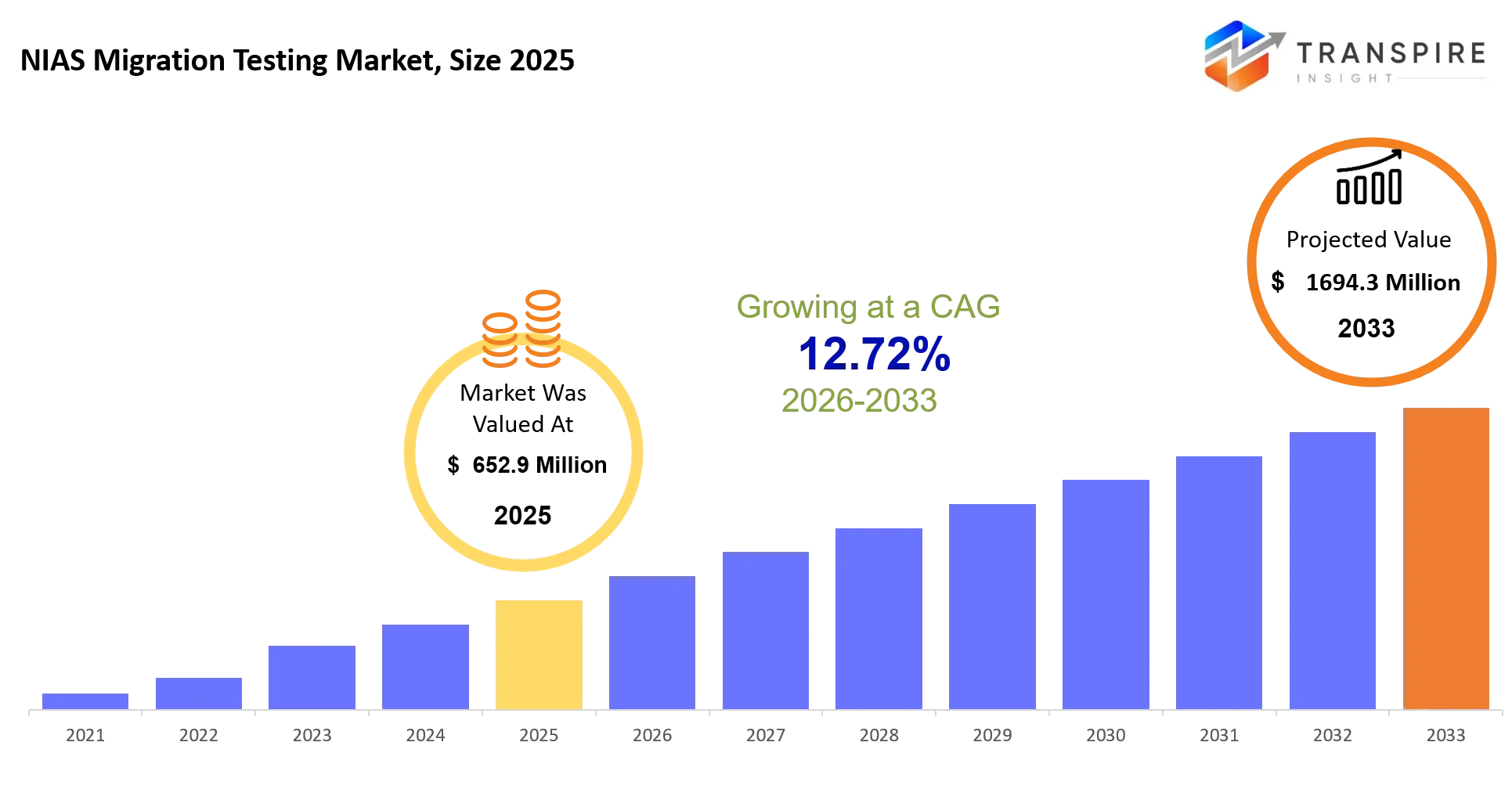
As per the Transpire Insight Analysis, the NIAS Migration Testing Marketsize is estimated at USD 652.9 million in 2025 and is anticipated to reach USD 1694.3 million by 2033, growing at a CAGR of 12.72% from 2026 to 2033.
The NIAS migration testing market allows packaging manufacturers to proactively detect and assess the presence of unknown chemical decomposition products that migrate from materials into foods and beverages. In recent times, the sector has evolved from basic compliance checklists to detailed, non-targeted analytical screening techniques. A structural change has been the more recent compulsory implementation of EC/EU Regulation, which demands that all producers of food contact materials demonstrate that no harmful components, known or unknown, migrate into foodstuffs. A practical trigger for this has been the EC-wide recall of printed paperboard packaging contaminated with photo-initiator (PI) NIAS, revealing deficiencies in conventional targeted testing. Hence, the market drive to increase testing as the hindrance limits will push packaging converters to the leap of advanced high-resolution mass spectrometry (HRMS) and comprehensive two-dimensional gas chromatography (GC*GC) to determine unknown chemical intermediates and turn compliance testing to continuous risk management.
NIAS Migration Testing Market Size & Forecast:
- Global Market Size 2025: USD 652.9 Million
- Expected Market Value (2033): USD 1694.3 Million
- Forecast CAGR (2026–2033): 12.72%
- Leading Region in 2025: Europe
- Fastest Growing Region: Asia Pacific
- Key Company Profiles: Eurofins Scientific, SGS SA, Intertek Group, Bureau Veritas, TÜV SÜD, ALS Limited, NSF International, Mérieux NutriSciences, UL Solutions, Campden BRI, AsureQuality, QIMA, TÜV Rheinland, Element Materials Technology, Smithers
Key NIAS Migration Testing Market Insights:
The market has shifted from compliance-driven routine testing to premium non-targeted screening, and NIAS Risk Assessment has been growing by 17.2 %, as the uptake of HRMS continues to increase.
- Europe accounts for 41 % of the market, and Eurofins and SGS are increasing HRMS capacity to satisfy EU 1935/2004 requirements for recycled content testing.
- North America accounts for 27 % due to FDA Food Contact Substance notifications and state-level PFAS bans leading to premium screening services by Intertek and UL.
- Asia-Pacific accounts for 25 % volume, with a growth rate of 18.1% CAGR, as China's GB 4806 enforcement will require TÜV SÜD and QIMA to invest in appropriate GC×GC instrumentation.
- Overall Migration Testing makes up 38 % of the total, though Specific Migration Testing at 23 % and NIAS Risk Assessment at 9 % grow at a higher rate.
- Plastic Packaging is a market leader in material testing, and Recycled Materials become a high-growth market with unique NIAS requirements for the circular economy.
- Testing Laboratories and Certification Bodies continue to provide Food Packaging Manufacturers with premium-margin NIAS identification services.
- Direct Sales and Laboratory Service Providers are the primary distributors, while Online B2B Platforms are catching up for regular test orders with 3–5-day turnaround transparency.
- The labour saving in toxicological assessment is 40-60 % with the cost of integration at over USD 500,000, which is only achievable in the highest quality laboratories.
- Latin America & Africa account for 7 % of the market, supported by EU and U.S. food export compliance regulations, which demand strict migration documentation.
What are the Key Drivers, Restraints, and Opportunities in the NIAS Migration Testing Market?
Driver:
Enhanced strict application of EU and US food-contact rules is advancing NIAS migration testing by forcing food packaging, additives, and ingredient processors to prove that risky unknowns are not migrating into the food chain. This has spurred outsourcing of sophisticated analytical screening to accredited third-party laboratories, predominantly to fast-track checks on recycled and bio-based pack types, as the food pack/ingredient industry adopts compliance from one-off checks into ongoing risk management.
Restraint:
A shortage of trained analysts in analytical chemistry and toxicological assessment acts as a cap on laboratory throughput, particularly for the interpretation of NIAS risks. The supply of certified personnel worldwide is currently less than 70% of advertised demand, leading to bottlenecks and constraining capacity expansion in the face of increasing demand volumes.
Opportunity:
Bio-based and recycled packaging materials-especially paper, bioplastics, and multi-material laminates-are key growth areas for NIAS screening given the unique NIAS profiles exhibited and the need for comprehensive screening. Upcoming contract lab investments in HRMS instrument platform upgrades and automated data interpretation in Asia Pacific place the region well to take advantage of the premium-margin NIAS screening opportunities that will accompany circular economy mandates and export compliance mandates adopted by food packaging supply chains.
What Has the Impact of Artificial Intelligence Been on the NIAS Migration Testing Market?
Artificial intelligence is more rapidly enabling NIAS migration testing through analysis of the complex, information-rich data obtained from chromatography and high-resolution mass spectrometry. AI, by quickly identifying unknown chemical signatures, ranking compounds based on toxicological importance, and referencing expanding regulatory and scientific toxin databases, lessens the staffing and time burden of chemical analysis. Machine learning predicts migration behaviour based on temperature, storage duration, polymer composition, and food matrix before physical testing occurs, saving laboratory time and enabling more strategic experimental design. Automated laboratory information management streamlines scheduling of experiments, sample queue prioritization, reporting, and quality control measures, increasing throughput while lowering operational expense.
AI-based predictive toxicology enables researchers to speculate about migration and toxicological properties of compounds for which significant experimental safety data does not exist, providing manufacturers with more rapid confirmation of compliance. Despite these benefits, limited or inconsistent reference data, high software cost, and the need for expert validation before regulatory acceptance restrict implementation. Presently, AI complements, not replaces, NIAS chemical analysis by supporting better, faster, more reliable decision-making.
In January 2026, AINIA published updated compliance guidelines and risk assessment frameworks to address strict EU Regulation (EU) 2025/351 mandates requiring enhanced purity data and mandatory NIAS documentation in Declarations of Compliance. This update helps commercial laboratories integrate advanced screening tools and computational models.
Key NIAS Migration Testing Market Trends:
As packaging regulations shift to a more risk-based approach along global supply chains, comprehensive chemical intelligence is taking the place of traditional compliance testing. The market is maturing to become an integrated analytical, toxicological, and digital assessment platform to aid in expediting regulatory approval and commercializing recycled materials.
- Laboratories are changing the approach from chemical analysis to non-target screening to identify unknown contaminants, using high-resolution mass spectrometry.
- The demand for evidence for NIAS safety before commercialization of recycled food-contact packaging has led to a growing number of testing requirements.
- Digital toxicology platforms are becoming more and more important to supplement laboratory testing, focusing on chemical hazards via predictive modelling.
- The packaging manufacturers are delegating complicated migration studies to accredited laboratories that possess multidisciplinary analytical abilities.
- Laboratory automation and robotics have reduced turnaround time and increased testing consistency.
- The regulatory authorities are increasingly favouring chemical characterization, rather than using pre-defined lists of substances.
- Multinational laboratories, regulators, and packaging manufacturers are better connected with the help of cloud-based analytical databases.
- Sustainability efforts are driving the ongoing monitoring of recycled polymers during product manufacturing, not just at the end.
NIAS Migration Testing Market Segmentation
By Test Type:
Overall Migration Testing remains the leading segment with 38% market share because it serves as the first regulatory screening step before advanced chemical investigations. Specific Migration Testing, accounting for 23%, continues gaining relevance for regulated substances requiring precise quantification, while Chemical Characterization, with 15%, is expanding as manufacturers seek a deeper understanding of unknown contaminants. Compliance Testing contributes 10% by supporting certification requirements across regulated industries. NIAS Risk Assessment is projected to grow at the fastest 17.2% CAGR, reflecting the industry's transition toward science-based evaluation. Toxicological Assessment represents 3%, while Others account for 2%, supporting comprehensive product safety and regulatory compliance.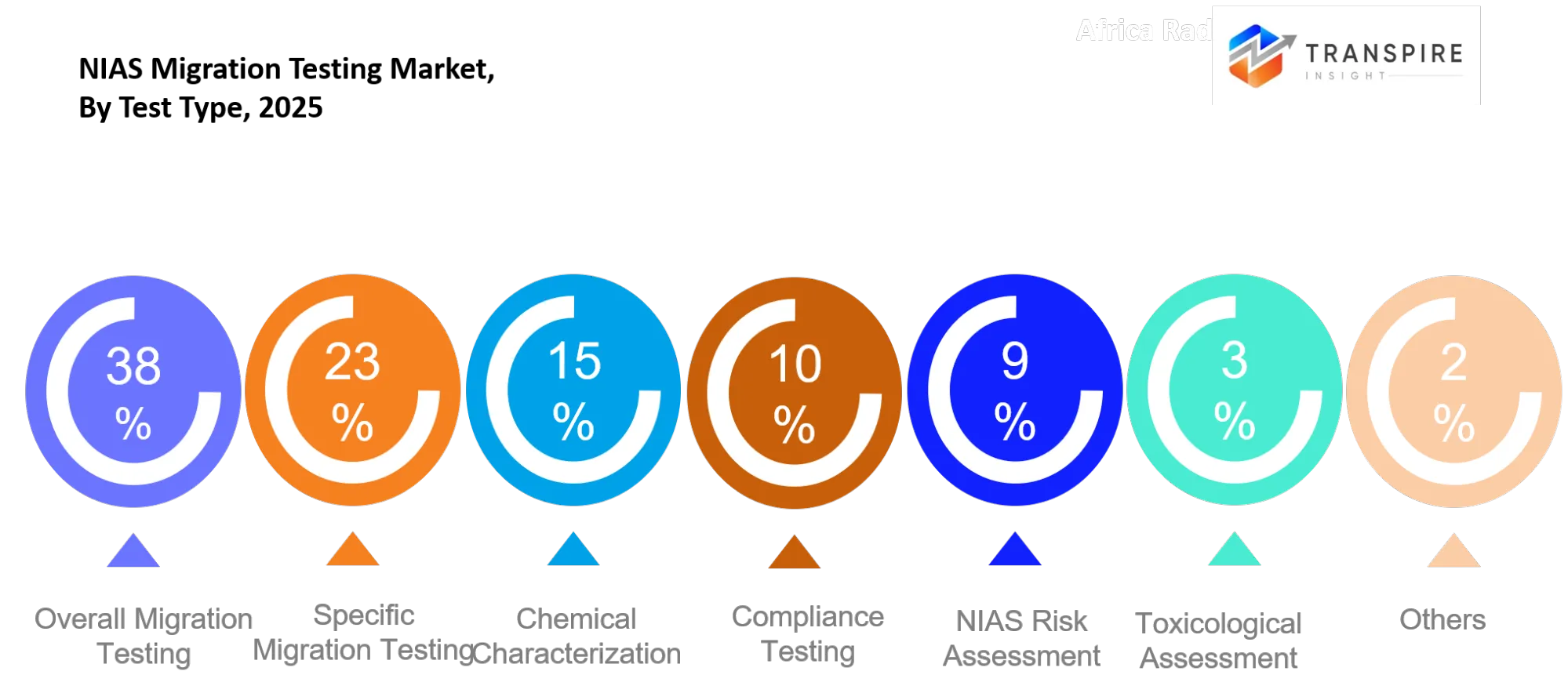
By Material:
Plastic packaging leads the testing demand because of complex additive chemistry as well as extensive food contact utilization. Recycled packaging materials are the fastest changing segment as regulation of the Circular Economy gets closer examination of unknown contaminants. Analytical demands on paper packaging are increasing with printing chemicals; metal, glass, composite packaging, and others are requiring analyses of targeted migration for speciality applications.
By End User:
Food packaging producers account for the lion's share of testing activity as regulatory compliance underpins product sales. The pharmaceutical industry is progressively demanding migration testing for drug packaging integrity, while testing laboratories are broadening their range of specialist services. Consumer goods producers, chemical producers, regulatory authorities and other industrial users are progressively using the NIAS assessments to improve their product stewardship.
By Application:
The demand for food contact materials is the greatest due to tight consumer safety standards. Beverage, pharma, cosmetic, industrial, recycled packaging, and other segments will require more complete migration investigations as sustainability initiatives are placing ever more complex chemical compositions in the packaging.
By Distribution Channel:
Over the long term, direct sales will lead the way in laboratory partnerships, while laboratory service providers will open the doors to increasingly complex testing. Certification units will serve to reinforce regulatory acceptance, online B2B channels will make services easier to buy, and other channels will meet local compliance needs.
What are the Key Use Cases Driving the NIAS Migration Testing Market?
The major application is confirming the safety of food-contact packaging, where OMT(38%) is the first assurance of compliance before entering regulated markets. Manufacturers employ such studies to substantiate packaging formulations and minimize approval delays.
Demand is growing in pharmaceutical packaging, beverage bottles, cosmetics products, and reusing packaging systems, where sophisticated analytical analyses can detect unanticipated impurities added during processing, printing, or recycling.
Future applications such as perpetual monitoring of recycled polymers, AI-assisted chemical risk assessment, and supplier qualification initiatives are emerging. A growing number of companies apply NIAS testing in the framework of sustainable packaging innovation to accommodate circular materials into the food safety framework without any loss of functionality.
|
Report Metrics |
Details |
|
Market size value in 2025 |
USD 652.9 Million |
|
Market size value in 2026 |
USD 732.7 Million |
|
Revenue forecast in 2033 |
USD 1694.3 Million |
|
Growth rate |
CAGR of 12.72% from 2026 to 2033 |
|
Base year |
2025 |
|
Historical data |
2021 - 2024 |
|
Forecast period |
2026 - 2033 |
|
Report coverage |
Revenue forecast, competitive landscape, growth factors, and trends |
|
Regional scope |
United States; Canada; Mexico; United Kingdom; Germany; France; Italy; Spain; Denmark; Sweden; Norway; China; Japan; India; Australia; South Korea; Thailand; Brazil; Argentina; South Africa; Saudi Arabia; United Arab Emirates |
|
Key companies profiled |
Eurofins Scientific, SGS SA, Intertek Group, Bureau Veritas, TÜV SÜD, ALS Limited, NSF International, Mérieux NutriSciences, UL Solutions, Campden BRI, AsureQuality, QIMA, TÜV Rheinland, Element Materials Technology, Smithers |
|
Customization scope |
Free report customization (country, regional & segment scope). Avail customized purchase options to meet your exact research needs. |
|
Report Segmentation |
By Test Type (Overall Migration Testing, Specific Migration Testing, NIAS Risk Assessment, Chemical Characterization, Toxicological Assessment, Compliance Testing, Analytical Screening, Others); By Material (Plastic Packaging, Paper Packaging, Metal Packaging, Glass Packaging, Composite Packaging, Recycled Materials, Others); By End User (Food Packaging Manufacturers, Pharmaceutical Companies, Testing Laboratories, Consumer Goods Companies, Chemical Manufacturers, Regulatory Agencies, Others); By Application (Food Contact Materials, Beverage Packaging, Pharmaceutical Packaging, Cosmetic Packaging, Industrial Packaging, Recycled Packaging, Others); By Distribution Channel (Direct Sales, Laboratory Service Providers, Certification Bodies, Online B2B Platforms, Others) |
Which Regions are Driving the NIAS Migration Testing Market Growth?
Europe represents 41% of the world market, driven by some of the world's toughest food contact legislations and a fast track for circular packaging policies. Stringent legislation such as the EU Packaging and Packaging Waste Regulation has increased mandatory NIAS assessment for all recycled materials. Countries in Europe are well equipped with accredited laboratories, sophisticated analytical infrastructure and collaborative relations between regulators, research institutes and packaging manufacturers to fast-track commercialization while meeting all chemical safety standards.
North America makes up 27% of the market, differentiated by FDA Food Contact Substance Notification programs and state-level PFAS bans rather than broad EU-style restrictions. The focus in the American market is generating revenue-per-test premium NIAS and PFAS analysis services, with Intertek, UL Solutions and NSF International spearheading innovation in this area. Contributing stability factors are well-established food-contact regulatory infrastructure and stable state enforcement by FDA and state environmental agencies. In July 2026, NSF achieved European accreditation for its food-contact and drinking water certification programs, allowing for enhanced, seamless cross-border validation for manufacturers. This expansion strengthens global testing infrastructure to navigate dual U.S. and international packaging mandates.
Asia Pacific accounts for 25% of the market and will experience the fastest growth, with a CAGR of 18.1%. Increases in food export markets, recycled packaging and manufacturing elsewhere in the world have driven up the cost of compliance testing. Countries worldwide are introducing stricter regulation of food-contacting materials while leading multinational companies are setting up regional analytical laboratories. Asia Pacific therefore presents the strongest long-term growth opportunity for advanced NIAS migration testing.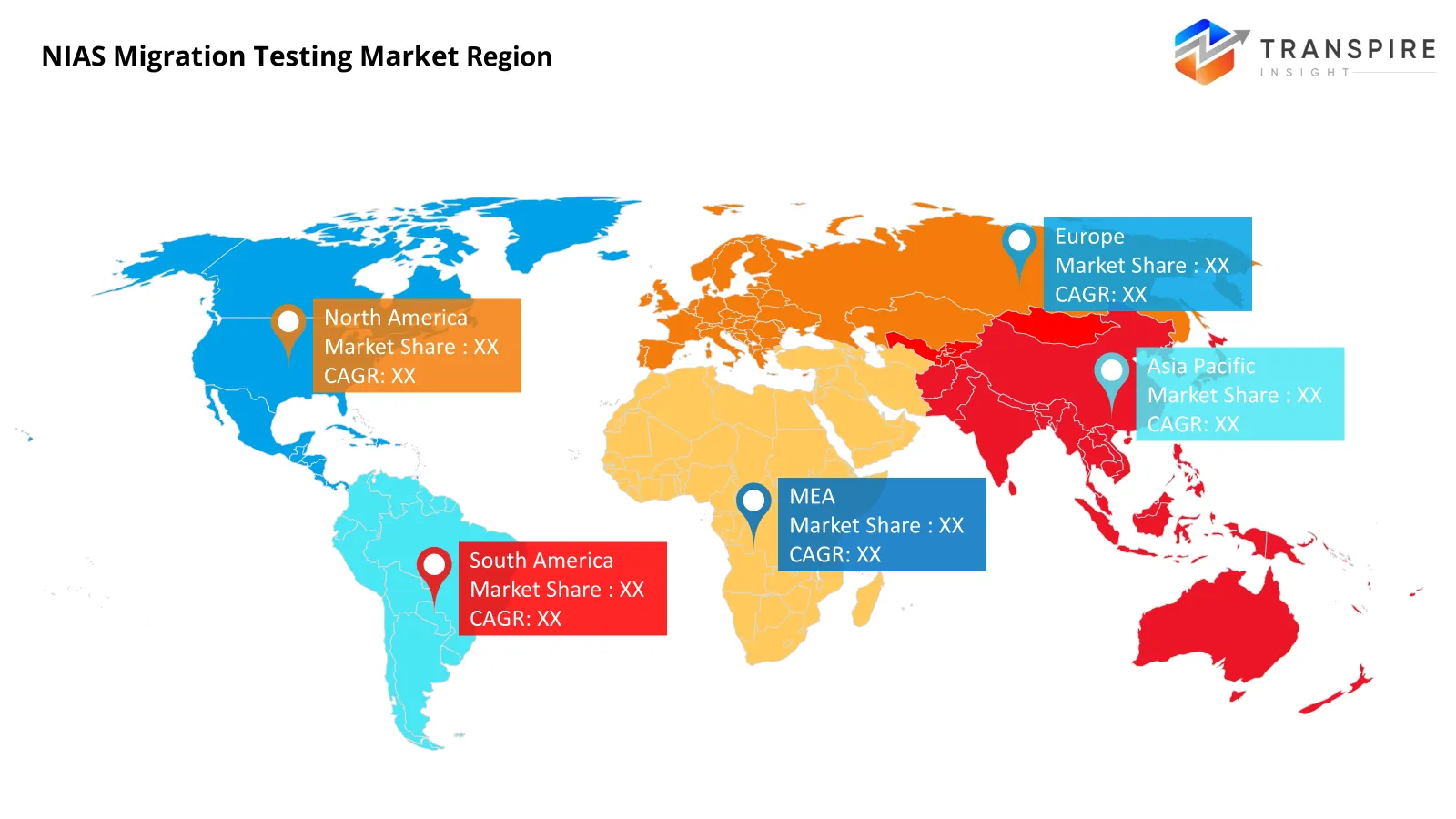
Who are the Key Players in the NIAS Migration Testing Market, and how do they Compete?
The NIAS migration testing arena exhibits keen competition among worldwide certification/laboratory groups, with the five dominant suppliers of Eurofins, SGS, Intertek, Bureau Veritas and TV SD holding more than 60% of the premium NIAS screening margin.
Eurofins Scientific and SGS SA are 'intrinsically innovative' in their business models, investing in AI-enabled spectral interpretation and automated data management solutions to cut down time-to-result in toxicological risk assessments. Both focus on the higher-margin NIAS Risk Assessment service lines. Eurofins builds scale in Asia-Pacific by acquiring regional laboratories to deepen HRMS provision. Intertek Group and Bureau Veritas focus on niche testing modalities like PFAS and recycled content analysis. Regulatory divergence allows them to charge 50-100% rush service premiums. TV SD and UL Solutions provide put-to-glass certification and testing combinations which streamline compliance across the whole supply chain for exporters of food-contact packaging. ALS Limited, NSF International and Mérieux NutriSciences focus on cost-competitive routine Overall and Specific Migration Testing for high-volume clients, while Campden BRI and AsureQuality concentrate on packaging provisions for regional food-packaging manufacturers in Oceania and Europe. New entrants such as QIMA and Element Materials Technology focus on digital-first distribution through Online B2B portals, for better ordering clarity and less purchasing friction for repeat customers.
Key Players are:
- Eurofins Scientific
- SGS SA
- Intertek Group
- Bureau Veritas
- TÜV SÜD
- ALS Limited
- NSF International
- Mérieux NutriSciences
- UL Solutions
- Campden BRI
- AsureQuality
- QIMA
- TÜV Rheinland
- Element Materials Technology
- Smithers
Recent Development News
- In April 2026, Eurofins Consumer Product Testing launched an upgraded compliance framework featuring specialized NIAS screening protocols. This deployment integrates advanced headspace analysis and predictive toxicology tools like the Threshold of Toxicological Concern (TTC) model to accelerate safety validations for complex polymer matrices and sustainable food packaging solutions.
- In March 2026, SGS Group launched customized compliance analytical screening programs following draft food contact material amendments from regulatory authorities like the FSSAI. This deployment integrates specialized migration testing frameworks and non-targeted chemical analysis to isolate unknown plastic impurities, enabling brands to clear strict global safety audits before bringing packaging to market.
What Strategic Insights Define the Future of the NIAS Migration Testing Market?
The NIAS migration testing market is moving toward elite non-targeted screening services; routine Overall Migration Testing is declining in share to the two-tiered NIAS Risk Assessment process and PFAS analysis at double-digit growth rates. An unreported danger is global scarcity of accredited analytical chemists and toxicologists, limiting lab throughput and supporting market concentration at the elite providers.
There is an opportunity emerging for automated spectral interpretation and predictive NIAS formation modelling utilising AI automation, allowing 40-60% less manual assessment requirements for laboratories and a faster turnaround to 3-5 days. Mid-tier laboratories should consider investing in HRMS instrumentation upgrades, AI software integrations, and regional partnerships with certification bodies to take advantage of the growing premium margin NIAS screening business in Asia-Pacific and Latin America, where regulation enforcement and export compliance needs are leading the charge.
Key Segmentations are:
By Test Type
- Overall Migration Testing
- Specific Migration Testing
- NIAS Risk Assessment
- Chemical Characterization
- Toxicological Assessment
- Compliance Testing
- Analytical Screening
- Others
By Material
- Plastic Packaging
- Paper Packaging
- Metal Packaging
- Glass Packaging
- Composite Packaging
- Recycled Materials
- Others
By End User
- Food Packaging Manufacturers
- Pharmaceutical Companies
- Testing Laboratories
- Consumer Goods Companies
- Chemical Manufacturers
- Regulatory Agencies
- Others
By Application
- Food Contact Materials
- Beverage Packaging
- Pharmaceutical Packaging
- Cosmetic Packaging
- Industrial Packaging
- Recycled Packaging
- Others
By Distribution Channel
- Direct Sales
- Laboratory Service Providers
- Certification Bodies
- Online B2B Platforms
- Others
Regional Outlook
North America
- US
- Canada
- Mexico
- US
- Canada
Europe
- Germany
- UK
- France
- Italy
- Spain
- Rest of Europe
Asia Pacific
- China
- Japan
- India
- South Korea
- Australia
- Rest of Asia Pacific
South America
- Brazil
- Argentina
- Rest of South America
Middle East & Africa
- UAE
- Saudi Arabia
- Qatar
- South Africa
- Rest of the Middle East & Africa
Frequently Asked Questions
Find quick answers to common questions.
The NIAS Migration Testing Market size was valued at USD 652.9 million in 2025 and is poised to reach USD 1694.3 million by 2033, expanding at a 12.72% CAGR.
Key segments for the NIAS Migration Testing Market are By Test Type (Overall Migration Testing, Specific Migration Testing, NIAS Risk Assessment, Chemical Characterization, Toxicological Assessment, Compliance Testing, Analytical Screening, Others); By Material (Plastic Packaging, Paper Packaging, Metal Packaging, Glass Packaging, Composite Packaging, Recycled Materials, Others); By End User (Food Packaging Manufacturers, Pharmaceutical Companies, Testing Laboratories, Consumer Goods Companies, Chemical Manufacturers, Regulatory Agencies, Others); By Application (Food Contact Materials, Beverage Packaging, Pharmaceutical Packaging, Cosmetic Packaging, Industrial Packaging, Recycled Packaging, Others); By Distribution Channel (Direct Sales, Laboratory Service Providers, Certification Bodies, Online B2B Platforms, Others).
Growth is primarily driven by stricter global food-contact safety regulations, rising use of recycled and sustainable packaging materials, advancements in high-resolution analytical technologies, and increasing manufacturer investments in comprehensive NIAS risk assessment to ensure regulatory compliance and consumer safety.
The NIAS Migration Testing Market is led by major manufacturers including Eurofins Scientific, SGS SA, Intertek Group, Bureau Veritas, TÜV SÜD, ALS Limited, NSF International, Mérieux NutriSciences, UL Solutions, Campden BRI, AsureQuality, QIMA, TÜV Rheinland, Element Materials Technology, Smithers.
Europe holds 41% of the market, driven by strict EU food-contact regulations, advanced contract laboratory infrastructure, and strong adoption of high-resolution NIAS testing for recycled packaging.
Commercial opportunities include premium-margin NIAS Risk Assessment services growing 17.2% annually, AI-driven spectral interpretation cutting toxicological workload 40–60%, and bio-based/recycled packaging NIAS profiling as circular economy mandates expand in Asia-Pacific and Europe.
- Eurofins Scientific
- SGS SA
- Intertek Group
- Bureau Veritas
- TÜV SÜD
- ALS Limited
- NSF International
- Mérieux NutriSciences
- UL Solutions
- Campden BRI
- AsureQuality
- QIMA
- TÜV Rheinland
- Element Materials Technology
- Smithers
About the Authors

Pankaj Ghogare Patil
I am Pankaj Ghogare Patil, a Senior Research Analyst at Transpire Insight, specializing in the Pharmaceutical, Chemicals & Materials, Healthcare IT, and Biotechnology industry. My expertise lies in conducting comprehensive market research, analyzing industry trends, evaluating competitive landscapes, and translating complex data into actionable insights. At Transpire Insight, I closely follow emerging technologies, regulatory developments, and market innovations to create accurate, well-researched, and informative content that helps businesses and professionals make informed decisions. I am committed to producing credible, evidence-based articles that reflect industry best practices while making technical topics accessible and valuable for a broad audience.

Chakradhar Khansole
Chakradhar serves as the Research Director at Transpire Insight, bringing over 8 years of experience in technology, innovation, and strategic market intelligence. He specializes in transforming complex market data into actionable business insights that enable organizations to make informed, growth-oriented decisions. Recognized for his strategic vision and analytical expertise, Chakradhar leads high-impact research initiatives, delivering comprehensive market assessments, competitive intelligence, and forward-looking industry analysis.
Recently Published Reports
-
May 2026
Healthcare Polymer Packaging Market
Healthcare Polymer Packaging Market Size, Share & Analysis Report By Packaging Type (Syringes, IV Bottles and Pouches, Clamshells, Blisters, Bottles & Jars, Containers, Tubes, IV Parental Packaging, Others), By Type (Regulated, Non-regulated), By Polymer Type (LDPE (Low-Density Polyethylene), HDPE (High-Density Polyethylene), Homo-polymer (Homo), Random Copolymer (Random), Block Copolymer (Block), PET, Polystyrene, Polyvinyl Chloride, Polyamide/EVOH, Others), and Geography (North America, Europe, Asia-Pacific, Middle East and Africa, South and Central America), 2021 - 2031
-
Apr 2026
Hydrophilic Tape (Waterstop) Market
Hydrophilic Tape (Waterstop) Market Size, Share & Analysis Report By Type (Bentonite-Based Hydrophilic Tape, Rubber-Based Hydrophilic Tape), By Application (Residential Buildings, Commercial Buildings, Infrastructure Projects), and Geography (North America, Europe, Asia-Pacific, Middle East and Africa, South and Central America), 2021 - 2031
-
Apr 2026
Metalens Market
Metalens Market Size, Share & Analysis Report By Type (Visible Light Metalens, and Infrared Metalens), By Application (Consumer Electronics, Automotive Electronics, Industrial, Medical, and Others), and Geography (North America, Europe, Asia-Pacific, Middle East and Africa, South and Central America), 2021 - 2031
-
Apr 2026
PBT Resin Market
PBT Resin Market Size, Share & Analysis Report By Type (Reinforced PBT Resin, Unreinforced PBT Resin), By Processing Method (Injection Molding, Extrusion, Blow Molding, Others), By End-User (Automotive, Electrical & Electronics, Consumer Appliances, Industrial Machinery, Medical Devices, Packaging, Others), and Geography (North America, Europe, Asia-Pacific, Middle East and Africa, South and Central America), 2021 - 2031