
Asia Pacific Application Modernization Services Market Summary
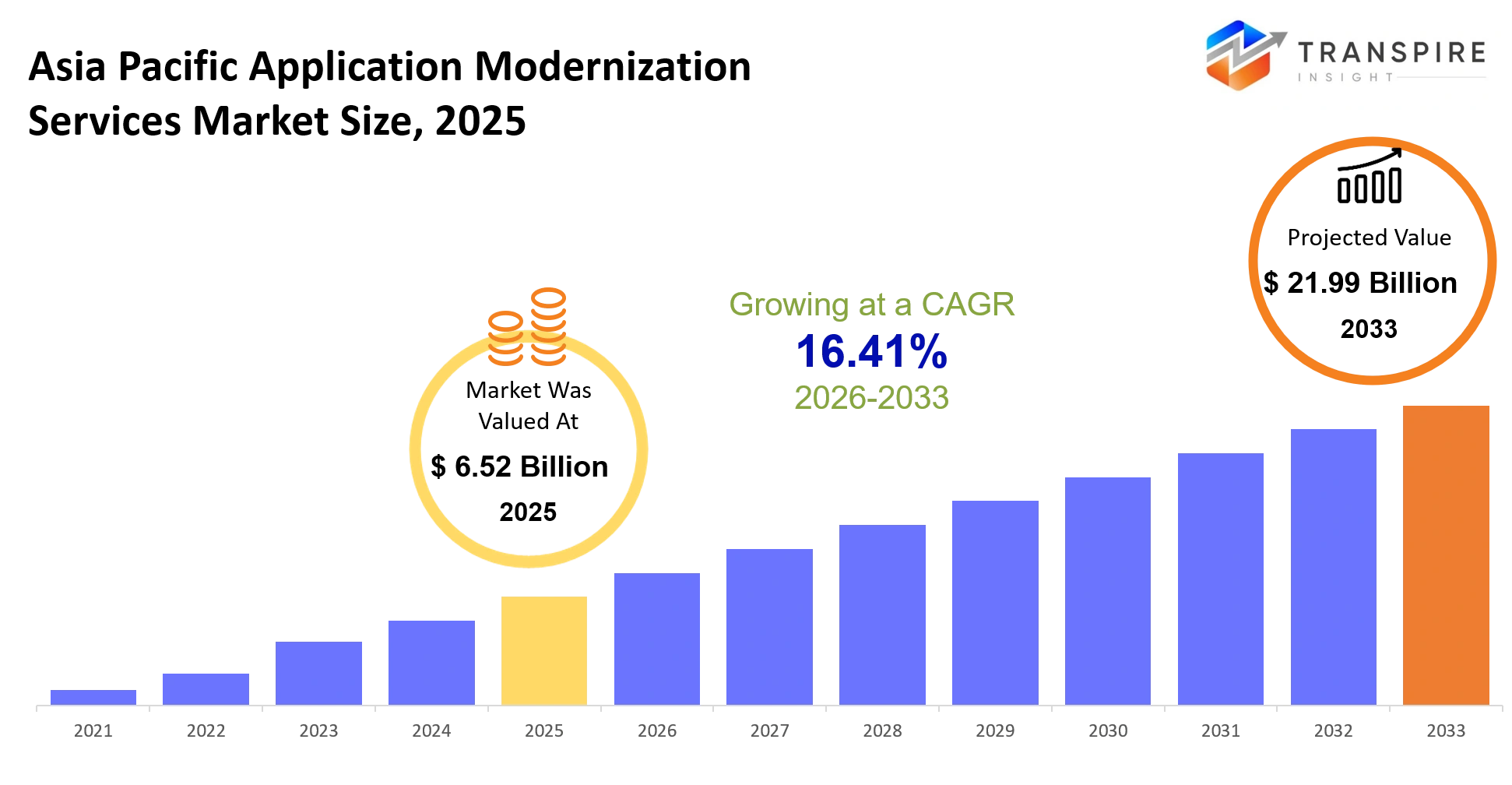
As per Transpire Insight Analysis the Asia Pacific Application Modernization Services Market size is estimated at USD 6.52 Billion in 2025 and is anticipated to reach USD 21.99 Billion by 2033, growing at a CAGR of 16.41% from 2026 to 2033.
Asia Pacific Application Modernization Services Market helps enterprises replace those older software setups that, honestly, slow everything down, make it harder to connect systems, and also open up security gaps. The service providers typically redesign the legacy apps, move workloads onto cloud platforms, and enable more modern architectures so businesses can react quicker to digital operations, evolving data needs ,and customer expectations. In the past 3–5 years the whole market moved away from just routine application maintenance, it’s more like cloud-native transformation now, with API-driven integration and modernization that’s guided by automation. A big push came from the COVID-19 pandemic disruption, it forced many organizations to speed up remote operations and build better digital resilience. Since companies now run a mix of complex legacy systems along with newer platforms, modernization services seem less like a straightforward IT upgrade and more like a strategic investment, or something close to that. It kinda changes the whole conversation. This shift helps adoption across banking , manufacturing, healthcare, and government too, because organizations are trying to create scalable yet protected application environments that can actually expand with their needs over time and not just stay fixed.
Asia Pacific Application Modernization Services Market Size & Forecast:
- Asia Pacific Application Modernization Services Market Size 2025: USD 6.52 Billion
- Expected Market Value 2033: USD 21.99 Billion
- Forecast CAGR: 16.41%
- Leading region in 2025: East Asia
- Fastest Growing region: Southeast Asia
- Key Profile: Accenture, IBM, Tata Consultancy Services, Infosys, Wipro, Cognizant, Capgemini, HCLTech, Fujitsu, NTT DATA, DXC Technology, Microsoft, Oracle, AWS, Google Cloud
Key Market Insights
- East Asia kind of leads the market around 45% share in 2025, mostly because of advanced cloud infrastructure, and enterprise modernization programs. It’s like the momentum there is stronger than everywhere else.
- Southeast Asia is the fastest-growing region through 2025–2033, backed by digital transformation spending and an expanding technology ecosystem that keeps getting more connected, and more developed.
- When we talk about services, cloud application modernization takes the front seat with close to 40% share. Enterprises are prioritizing migration strategies that are scalable, plus hybrid environments that fit real operations.
- Application portfolio management sits in the second-largest lane. It helps organizations fine tune older platforms and also cut down on operational complexity, which can be a big deal.
- AI-driven modernization services show the fastest growth from 2025–2033. They support automated code review, testing, and smarter migration workflows, so teams move with less friction, and more consistency.
- On the application side, banking and financial services dominate with roughly 30% share. This is mainly due to replacing legacy systems, and expanding digital banking services.
- Healthcare modernization applications are growing the fastest too, as providers move toward interoperable platforms and secure cloud-based patient management solutions, without compromising compliance.
- For end users, large enterprises hold more than 55% share. They’re driven by complicated infrastructure needs, and modernization budgets that can actually sustain longer programs.
- Meanwhile, the small and medium enterprises seem to be the most rapidly growing part with cloud adoption and SaaS migration, plus managed modernization services. It kind of makes sense, since many of them need some guidance while scaling, you know, like a practical nudge.
What are the Key Drivers, Restraints, and Opportunities in the Asia Pacific Application Modernization Services Market?
Cloud migration and enterprise digital transformation are basically the primary forces that are pushing the Asia Pacific Application Modernization Services Market forward. The movement away from old school infrastructure toward cloud-native architectures , plus microservices and automation platforms has kind of turned modernization from a “maybe later” IT enhancement into more like business continuity that can’t really wait. Along with that, regulatory pressure about cybersecurity, data governance, and operational resilience has nudged organizations to replace legacy systems that are starting to look fragile. So you get this clear adoption cycle where modernization spend tends to improve scalability, trims maintenance expenses, and also opens up fresh service revenue avenues.
Legacy system complexity is still the biggest structural obstacle. A lot of enterprises run mission-critical applications that were built on outdated designs, and those need deep evaluation , heavy tailoring, and lots of integration work before the move can even happen. From Transpire Insight review of regional procurement announcements and launch schedules, supply chain concentration stays the main execution risk. These issues often stretch transformation timelines , raise overall project costs , and can slow modernization adoption for organizations that are more cost-sensitive.
AI-driven modernization is the next growth thread worth watching. Generative AI enabled code transformation, automated testing, and smarter application assessment tools can shorten migration timelines and help boost accuracy . India, Singapore, and Japan in particular are set up to benefit, mainly due to stronger enterprise technology investments and well-established digital service ecosystems.
What Has the Impact of Artificial Intelligence Been on the Asia Pacific Application Modernization Services Market?
Artificial intelligence is a kind of reshaping application modernization, not just one piece but the whole workflow, by automating complicated stuff like code analysis , application discovery, testing, and even system monitoring. AI-powered platforms can spot outdated parts, suggest modernization pathways, and automate the repetitive migration activities that before used to need lots of manual work. Digital technologies , for example cloud computing, machine learning, and automation frameworks, are also pushing enterprises to optimize application performance, while at the same time improving operational control across spread out IT environments. Machine learning models get used more and more to predict application failures, look at how people use things, and tune resource allocation early , so performance problems don’t start hurting business operations. With these abilities, organizations tend to boost system reliability, lower downtime, and manage technology more efficiently overall.
Some enterprises have reported big reductions in testing cycles and in day to day operational load after switching to AI-assisted modernization workflows. Still, AI adoption is not fully everywhere , because the integration costs can be high , legacy system data quality may be inconsistent, and training models across tangled application environments brings real obstacles. Quite a few organizations still need specialized expertise to connect AI tools with older platforms, and that slows down broad deployment across the region, even when the interest is there.
Key Market Trends
- From 2021 through 2026, enterprises kinda drifted away from the whole traditional migration thing, and they started leaning more into cloud-native modernization, with containers, APIs , and microservices kind of in the mix.
- Then from 2024 to 2026, generative AI really started to pick up speed, and it was pushing application transformation forward by enabling automated code reviews and testing routines, plus it also helps with analysis of older legacy systems, you know.
- Since 2022, hybrid cloud strategies have been spreading across Asia Pacific, with organizations trying to balance modernization targets against the need for regulatory data control requirements.
- In 2025, financial institutions bumped up their modernization spending, aiming to swap out core banking systems with scalable digital platforms or something similar, more or less.
- From 2023 to 2026, low-code and automation platforms gained a lot of momentum , mainly because they trimmed application development timelines and made modernization seem less complicated, overall.
- Starting in 2024, cybersecurity requirements began to nudge modernization decisions, as enterprises strengthened fragile legacy apps, and updated outdated infrastructure.
- In 2025, regional IT service providers went further with AI-enabled modernization offerings, in order to capture enterprise transformation projects.
- Between 2022 and 2026, government digitalization programs helped back modernization work across public services, plus critical infrastructure sectors too.
- Since 2023, companies have been adopting managed modernization services more often, partly because there are shortages of skilled cloud and software engineering professionals.
Asia Pacific Application Modernization Services Market Segmentation
By Service Type :
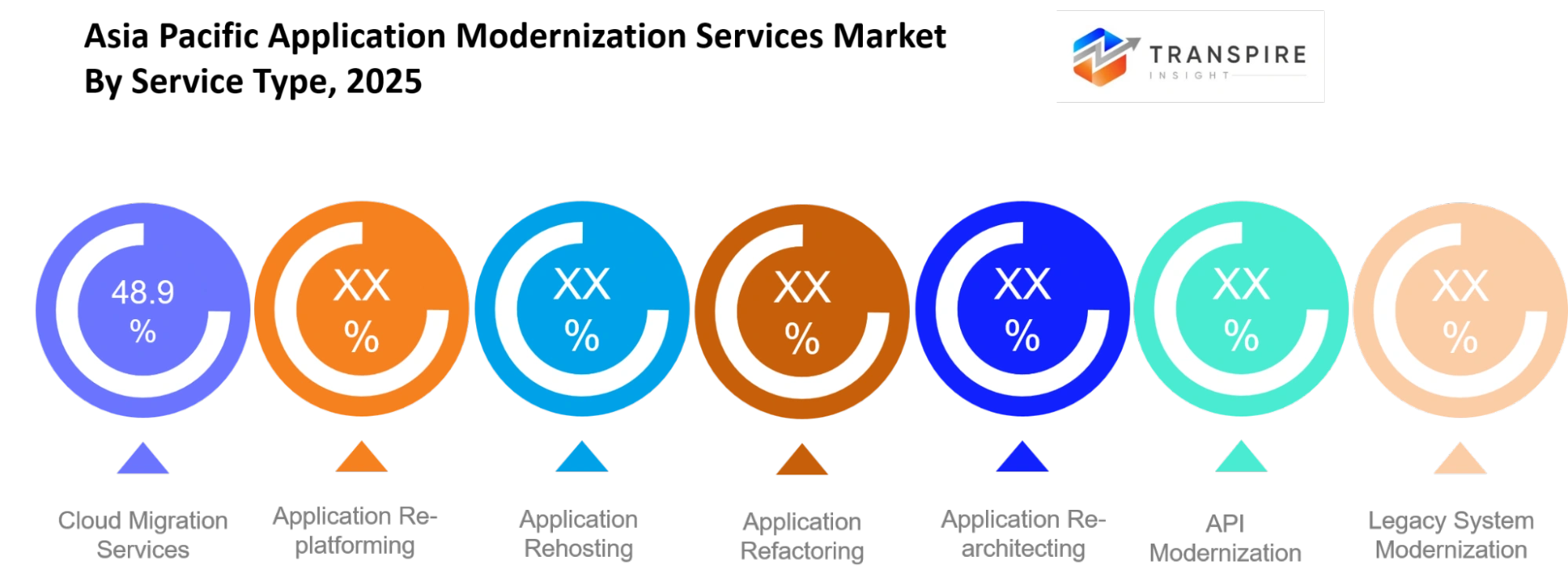
Application re-platforming and cloud migration services help organizations move older software setups, toward more flexible tech structures, kind of slowly but steadily. Application rehosting still stays handy for getting workloads shifted faster with limited code changes, while refactoring goes a step further by boosting application performance via a targeted redesign. API modernization then helps stitch together separate systems and enables smoother information exchange across business functions.
Application re-architecting will get more attention over time as enterprises want scalable software frameworks, and stronger digital capabilities. Legacy system modernization services support teams dealing with outdated applications , especially when security, maintenance, and performance issues start stacking up. Other service categories will keep showing up, because different industries often need specialized transformation work in slightly different ways.
By Deployment :
Public cloud deployment backs quicker application modernization by using flexible infrastructure, cutting upfront costs, and improving scalability. Private cloud adoption is still useful for orgs that need tighter command over sensitive applications , and for regulated data. Hybrid cloud models keep pulling in attention, since they sort of mix cloud flexibility with the infrastructure investments that were already made in-house.
Then multi-cloud strategies will keep growing, as enterprises try to not get cornered by only one provider, and to push operational resilience forward. Even with cloud looking tempting , on-premise environments will keep mattering for industries that hold very strict security requirements.Other deployment approaches will support specific business needs across regional organizations, depending on local rules and existing infrastructure.
By Enterprise Size :
Large enterprises count as a big adoption cluster because their application environments are complicated , they usually have higher tech budgets, and they run big digital transformation programs. Medium enterprises are leaning into modernization services to make operations more efficient, and to stay competitive with those businesses that are already digitally mature. Small enterprises along with SMEs are turning to cloud based modernization solutions , so they can use newer technology without doing heavy infrastructure spending.
Startups will help the next wave of adoption via cloud first development and more modern software architectures . Other enterprise groups will pitch in with focused modernization initiatives. Overall enterprise size will shape what services get chosen, how deployments are done and where the investment priorities land across different industries .
By End User :
BFSI organizations are adopting application modernization to reinforce digital banking platforms , boost customer services, and keep transaction systems secure . IT and telecom firms are still investing in modernization, mainly to handle intricate networks, and to enable advanced digital offerings. In healthcare, providers are upgrading applications in order to improve data handling, interoperability and operational efficiency .
Manufacturing and retail are pushing modernization to raise automation levels , improve customer engagement, and increase supply chain visibility. Government , energy, and utilities organizations will keep moving toward updated platforms for better service delivery and infrastructure management. Other industries will also contribute, through transformation efforts that match their sector needs.
By Application :
Legacy Application Modernization is still a main application area, for organizations that are dealing with old software systems and operational limitations that keep showing up. Cloud-native development helps teams innovate sooner, thanks to scalable architectures, container technologies, and day to day modern practices that feel a bit more efficient. Enterprise application integration, meanwhile it helps organizations tie together different platforms, so the information flow moves with less resistance.
Digital transformation programs keep pulling funding toward modernization across many industries, mostly by increasing agility and sharpening service delivery. DevOps automation also plays a big role, because it supports faster releases, continuous testing, and that overall improved development efficiency. Other areas will cover more specialized technology needs, depending on the way each enterprise environment is set up, and what it expects from its systems.
What are the Key Use Cases Driving the Asia Pacific Application Modernization Services Market?
Legacy application modernization stays the main use case, mostly pushed by BFSI organizations swapping out old banking platforms and making transaction security much better. In practice large enterprises buy these services to cut ongoing maintenance spend, enable digital channels, and also satisfy tough data governance rules inside their financial operations, all of that.
At the same time cloud-native development plus enterprise application integration is starting to get more attention. IT and telecom teams, along with healthcare providers and manufacturing companies, are looking at it. These setups support quicker software rollout, linked systems , and a more reliable data exchange flow across messy business settings.
Then there is AI-assisted code transformation, automated testing, and modernization for government platforms, which is an emerging set of applications with noticeable upside. Regulatory digitization initiatives and public infrastructure upgrades are likely to bring fresh openings for specialized modernization providers, you know.
|
Report Metrics |
Details |
|
Market size value in 2025 |
USD 6.52 Billion |
|
Market size value in 2026 |
USD 7.59 Billion |
|
Revenue forecast in 2033 |
USD 21.99 Billion |
|
Growth rate |
CAGR of 16.41% from 2026 to 2033 |
|
Base year |
2025 |
|
Historical data |
2021 - 2024 |
|
Forecast period |
2026 - 2033 |
|
Report coverage |
Revenue forecast, competitive landscape, growth factors, and trends |
|
Regional scope |
Asia Pacific (India, China, Japan, Australia, South Korea, Rest of Asia Pacific) |
|
Key company profiled |
Accenture, IBM, Tata Consultancy Services, Infosys, Wipro, Cognizant, Capgemini, HCLTech, Fujitsu, NTT DATA, DXC Technology, Microsoft, Oracle, AWS, Google Cloud . |
|
Customization scope |
Free report customization (country, regional & segment scope). Avail customized purchase options to meet your exact research needs. |
|
Report Segmentation |
By Service Type (Application Re-platforming, Application Rehosting, Application Refactoring, Application Re-architecting, Cloud Migration Services, API Modernization, Legacy System Modernization, Others); By Deployment (Public Cloud, Private Cloud, Hybrid Cloud, Multi-Cloud, On-Premise, Others); By Enterprise Size (Large Enterprises, Medium Enterprises, Small Enterprises, SMEs, Startups, Others); By End User (BFSI, IT & Telecom, Healthcare, Manufacturing, Retail, Government, Energy & Utilities, Others); By Application (Legacy Application Modernization, Cloud-Native Development, Enterprise Application Integration, Digital Transformation, DevOps Automation, Others) |
Which Regions are Driving the Asia Pacific Application Modernization Services Market Growth?
East Asia has the lead in the Asia Pacific Application Modernization Services Market, and in 2025 it’s around 45% share. The reason is pretty straightforward: there is a strong digital infrastructure, along with government driven technology programs ,and also tight cybersecurity rules in places like China ,Japan and South Korea. On top of that there’s a well developed environment with cloud providers, IT service firms, and ongoing enterprise technology spending which helps modernization work move faster. Since companies keep investing in automation, cloud adoption, and replacing legacy systems without stopping, East Asia is likely to stay out front all the way through 2033.
South Asia keeps a steady pace of growth too, mainly because digital services are expanding, technology outsourcing capabilities are getting stronger, and enterprises are continuing modernization spend. India in particular brings a big, skilled software workforce, supportive digital policies, and a solid IT services ecosystem that keeps demand coming from both global organizations and local ones. Also, the region tends to have dependable outsourcing arrangements ,plus cost efficient modernization delivery structures. Together these points help South Asia remain a dependable contributor to regional revenue through the forecast window.
Southeast Asia is moving the quickest, because governments and businesses are speeding up digital infrastructure buildouts and cloud take up. In recent years the investments in fintech platforms, smart cities,and digital public services have basically created fresh modernization needs across different industries. At the same time, more regional data centers are coming online, and enterprises are increasing technology adoption which pulls in more service providers and investors. Between 2026 and 2033, this trajectory should open up opportunities for vendors that focus on specialized cloud migration, automation, and application transformation work.
Who are the Key Players in the Asia Pacific Application Modernization Services Market and How Do They Compete?
Competition in the Asia Pacific Application Modernization Services Market stays pretty moderately fragmented, so you get global tech giants, regional service providers, and smaller specialized consulting teams mixing it up with their technology strengths, delivery methods and industry know-how. Most players try to win customers by pitching AI-enabled modernization tools, cloud partnerships, strong cybersecurity skills , and also cost-efficient implementation services, at least that is the story on the market. The bigger incumbents keep defending enterprise contracts, while the more focused providers, are creating new chances via sharper solutions for particular industries, rather than going broad.
Accenture tends to compete with AI-driven transformation services, along with cloud partner ecosystems and modernization frameworks that lean heavily on industry context. They lean into automated application assessment tooling and their global delivery muscle, which helps with those complicated enterprise migrations. IBM takes a slightly different angle, mainly hybrid cloud modernization and AI integration, and it uses its own cloud platforms plus automation technologies to help organizations refresh legacy setups, so updates can actually stick.
Tata Consultancy Services pushes forward with cost-controlled delivery models and large-scale digital engineering capabilities across multiple Asia Pacific markets. Infosys is expanding through cloud modernization platforms plus generative AI offerings, aiming to speed up application development and operational efficiency. Wipro, meanwhile, differentiates using digital engineering know-how, cybersecurity services, and modernization offerings built for enterprises that manage intricate technology environments.
Company List
- Accenture
- IBM
- Tata Consultancy Services
- Infosys
- Wipro
- Cognizant
- Capgemini
- HCLTech
- Fujitsu
- NTT DATA
- DXC Technology
- Microsoft
- Oracle
- AWS
- Google Cloud
Recent Development News
In April 2026, Tata Consultancy Services expanded its strategic partnership with Google Cloud to help enterprises adopt AI-native operating models. The collaboration introduced AI-focused offerings that support cloud-native modernization, application transformation, and autonomous enterprise capabilities across industries. Source https://www.tcs.com/
In April 2026, Infosys and Harness announced a strategic collaboration to accelerate AI-led software delivery transformation programs. The partnership combines Infosys Topaz, Infosys Cobalt, and Harness AI capabilities to improve application modernization, software engineering productivity, and enterprise transformation outcomes. Source https://www.infosys.com/
What Strategic Insights Define the Future of the Asia Pacific Application Modernization Services Market?
The Asia Pacific Application Modernization Services Market is kinda moving toward AI-supported transformation models where enterprises will put more weight on intelligent automation, cloud native setups, and ongoing application refinement rather than just one time migration efforts. The main driver behind this shift is basically the necessity to handle sprawling digital ecosystems while also dialing down reliance on old software environments. A not so obvious downside is the growing market concentration among a few big cloud and consulting providers, which could squeeze pricing flexibility, and also introduce dependency issues for enterprises .
At the same time, there’s a newer opportunity forming around AI powered legacy code transformation, particularly across Southeast Asian economies where spending on digital infrastructure is ramping up. Market players should reinforce industry tailored modernization frameworks, team up with regional cloud vendors, and put money into AI skills that shorten migration cycles and raise implementation accuracy. If they do that, companies are more likely to lock in long term value, since modernization is turning into a continuous business process rather than a one-off task.
Asia Pacific Application Modernization Services Market Report Segmentation
By Service Type
- Application Re-platforming
- Application Rehosting
- Application Refactoring
- Application Re-architecting
- Cloud Migration Services
- API Modernization
- Legacy System Modernization
By Deployment
- Public Cloud
- Private Cloud
- Hybrid Cloud
- Multi-Cloud
- On-Premise
By Enterprise Size
- Large Enterprises
- Medium Enterprises
- Small Enterprises
- SMEs
- Startups
By End User
- BFSI
- IT & Telecom
- Healthcare
- Manufacturing
- Retail
- Government
- Energy & Utilities
By Application
- Legacy Application Modernization
- Cloud-Native Development
- Enterprise Application Integration
- Digital Transformation
- DevOps Automation
Frequently Asked Questions
Find quick answers to common questions.
The expected Asia Pacific Application Modernization Services Market size for the market will be USD 21.99 Billion in 2033.
Key segments for the Asia Pacific Application Modernization Services Market are By Service Type (Application Re-platforming, Application Rehosting, Application Refactoring, Application Re-architecting, Cloud Migration Services, API Modernization, Legacy System Modernization, Others); By Deployment (Public Cloud, Private Cloud, Hybrid Cloud, Multi-Cloud, On-Premise, Others); By Enterprise Size (Large Enterprises, Medium Enterprises, Small Enterprises, SMEs, Startups, Others); By End User (BFSI, IT & Telecom, Healthcare, Manufacturing, Retail, Government, Energy & Utilities, Others); By Application (Legacy Application Modernization, Cloud-Native Development, Enterprise Application Integration, Digital Transformation, DevOps Automation, Others).
Major Asia Pacific Application Modernization Services Market players are Accenture, IBM, Tata Consultancy Services, Infosys, Wipro, Cognizant, Capgemini, HCLTech, Fujitsu, NTT DATA, DXC Technology, Microsoft, Oracle, AWS, Google Cloud.
The Asia Pacific Application Modernization Services Market size is USD 6.52 Billion in 2025.
The Asia Pacific Application Modernization Services Market CAGR is 16.41% from 2026 to 2033.
- Accenture
- IBM
- Tata Consultancy Services
- Infosys
- Wipro
- Cognizant
- Capgemini
- HCLTech
- Fujitsu
- NTT DATA
- DXC Technology
- Microsoft
- Oracle
- AWS
- Google Cloud
About the Authors

Mayur Shinde
I am Mayur Shinde, a Senior Research Analyst at Transpire Insight, specializing in the Automotive & Transportation and Information & Communication Technology (ICT) Industry. My work focuses on analyzing emerging market trends, technological advancements, competitive landscapes, and industry developments to deliver accurate, data-driven insights. I am passionate about transforming complex market information into clear, actionable content that helps businesses, professionals, and decision-makers stay informed and make confident strategic decisions.

Chakradhar Khansole
Chakradhar serves as the Research Director at Transpire Insight, bringing over 8 years of experience in technology, innovation, and strategic market intelligence. He specializes in transforming complex market data into actionable business insights that enable organizations to make informed, growth-oriented decisions. Recognized for his strategic vision and analytical expertise, Chakradhar leads high-impact research initiatives, delivering comprehensive market assessments, competitive intelligence, and forward-looking industry analysis.
Recently Published Reports
-
Apr 2026
3D Optical Profiler Market
3D Optical Profiler Market Size, Share & Analysis Report By Type (Desktop 3D Optical Profiler, and Portable 3D Optical Profiler), By Technology (Confocal Technology, and White Light Interference), By End-Use Industry (Manufacturing, Research Institutions, Automotive, Aerospace and Defense, Medical Devices, and Other), and Geography (North America, Europe, Asia-Pacific, Middle East and Africa, South and Central America), 2021 - 2031
-
Apr 2026
Depth Sensor Market
Depth Sensor Market Size, Share & Analysis Report By Type (Infrared Depth Sensors, Time-of-Flight (ToF) Sensors, Stereo Vision Sensors, Structured Light Sensors, Ultrasonic Depth Sensors), By Application (Automotive, Robotics, Gaming, Consumer Electronics, Industrial Automation, Healthcare, Security & Surveillance, Others), By End Users (Automotive Manufacturers, Consumer Electronics Companies, Healthcare Providers, Industrial Companies, Security Agencies, Gaming Companies, Robotics Companies, Others), and Geography (North America, Europe, Asia-Pacific, Middle East and Africa, South and Central America), 2021 – 2031
-
Apr 2026
Digital Manufacturing Market
Digital Manufacturing Market Size, Share & Analysis Report By Component (Hardware, Software, and Services), By Technology (Robotics, 3D Printing, Internet of Things (IoT), and Others), By Application (Automotive and Transportation, Aerospace and Defense, Consumer Electronics, Industrial Machinery, and Others), By Process Type (Computer-Based Designing, Computer-Based Simulation, Computer 3D Visualization, Analytics, and Others), and Geography (North America, Europe, Asia-Pacific, Middle East and Africa, South and Central America), 2021 – 2031
-
Apr 2026
Digital Visa Services Market
Digital Visa Services Market Size, Share & Analysis Report By Type (Individual Travelers, Group Travelers), By Application (Tourism, Business Travel, Others), and Geography (North America, Europe, Asia-Pacific, Middle East and Africa, South and Central America), 2021 – 2031