
Next Generation Firewall Market Summary:
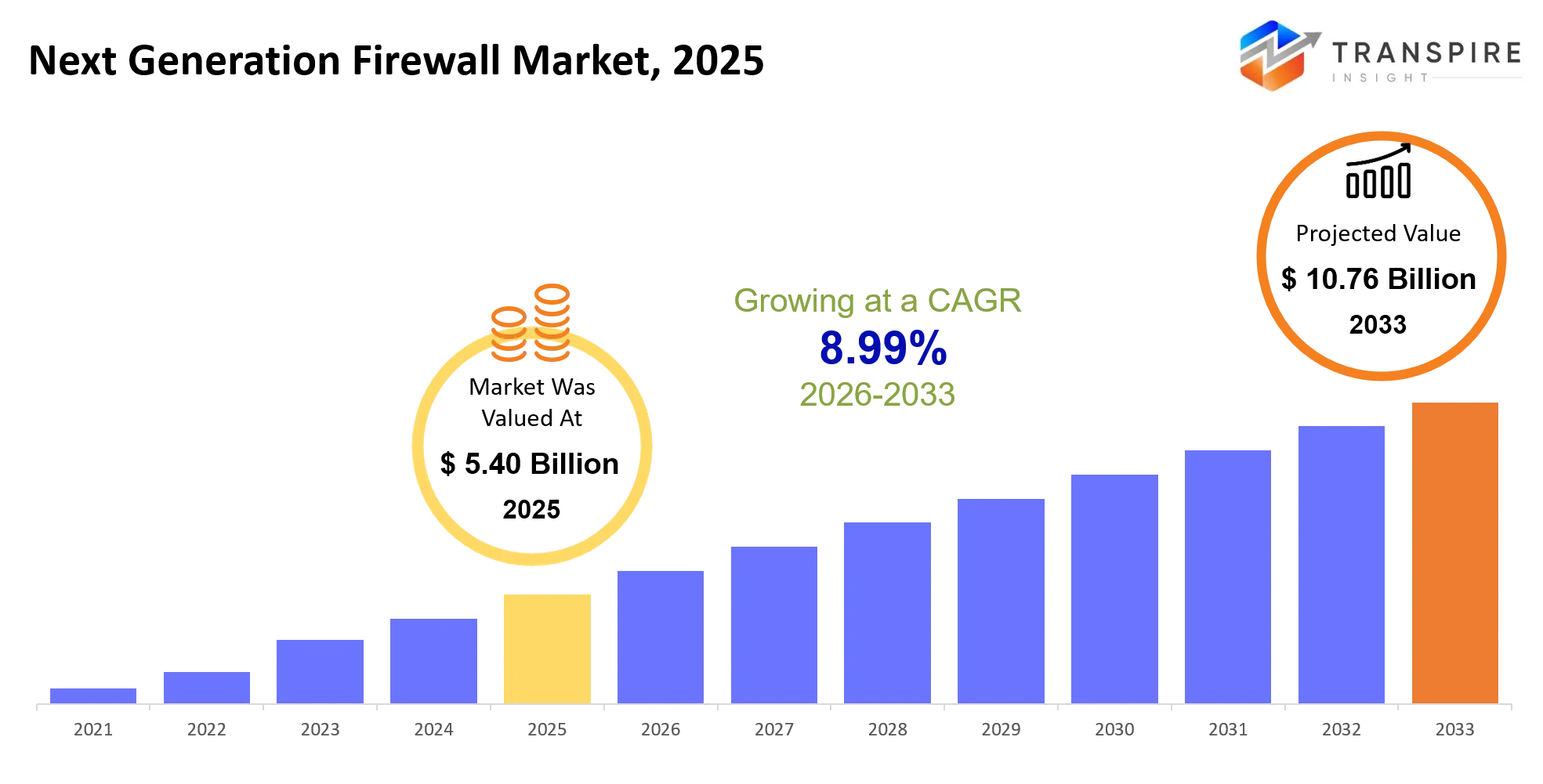
As per Transpire Insight Analysis, the Next Generation Firewall Market size is estimated at USD 5.40 billion in 2025 and is anticipated to reach USD 10.76 billion by 2033, growing at a CAGR of 8.99% from 2026 to 2033.
The next-generation firewall market is changing. It is moving away from old-style perimeter protection. Now the focus is on security platforms that can look inside cloud traffic, encrypted connections, remote users, applications and distributed workloads. In the past three to five years, businesses have stopped relying only on physical appliances. They are now using architectures. These combine firewalls, virtual firewalls and cloud-based security controls. A big shift has happened. Firewall features are no longer separate. They are now part of systems. These include SASE, SD-WAN, zero-trust security, artificial intelligence and threat intelligence.
The growth of cloud applications has made this change necessary. Networks are no longer inside one office. They stretch across locations. This makes consistent security policies important across all environments. Cyber threats are getting worse. Ransomware attacks are more common. Sophisticated phishing campaigns trick people. Encrypted threats hide inside connections. AI-powered attacks are harder to detect. Because of this, companies need real-time inspection. They also need response systems. As network traffic spreads out, visibility is no longer limited to the office firewall. Today organisations need firewalls that work everywhere. The new generation of firewalls supports this. They give visibility and control across all network environments. This makes security more reliable and easier to manage.
Next Generation Firewall Market Size & Forecast:
- Market Size 2025: USD 5.40 Billion
- Expected Market Value (2033): USD 10.76 Billion
- Forecast CAGR (2026–2033): 8.99%
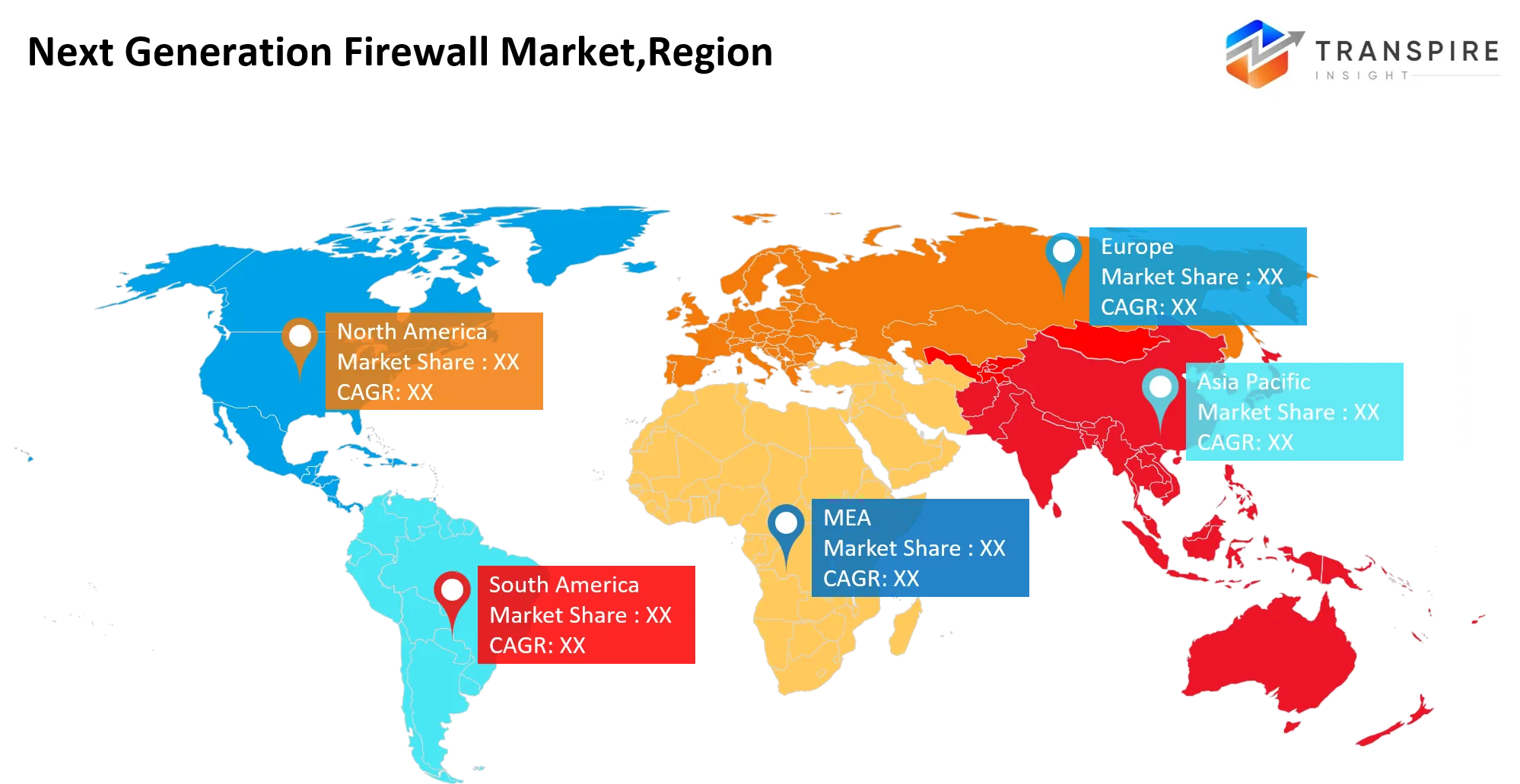
- Leading Region in 2025: North America
- Fastest Growing Region: Asia Pacific
- Key Company Profiles: Palo Alto Networks, Fortinet, Cisco, Check Point, Juniper Networks, Huawei, SonicWall, Forcepoint, WatchGuard, Sophos, Barracuda Networks, Hillstone Networks, Sangfor Technologies, Zscaler, Broadcom
Key Market Insights:
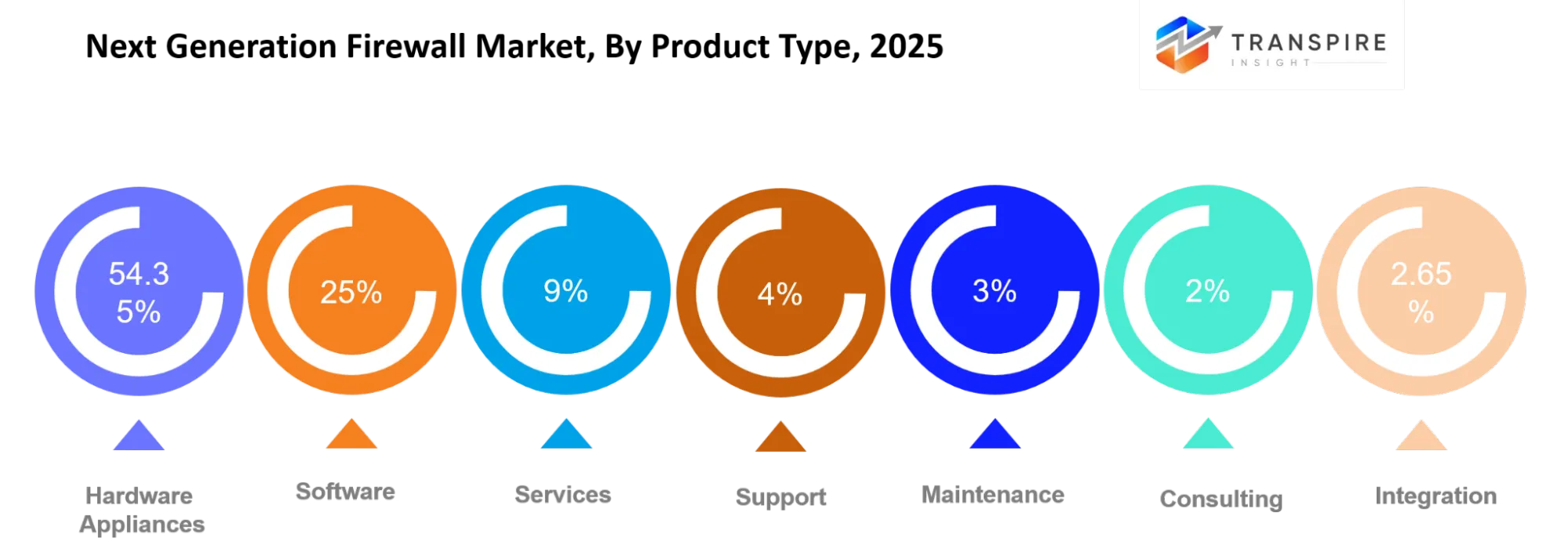
The market is shifting from individual perimeter appliances to integrated security platforms combining networking, threat prevention, cloud security, and automation. The segment based on hardware appliances dominates in terms of market share, whereas there is a growing demand for virtual and cloud firewall appliances among companies.
- Appliances account for 54.35% of the market share, indicating persistent preference for powerful security provided by enterprise networks and data centres.
- The software category is at 25%, revealing a consistent trend towards flexible firewall installation in virtual and software-defined environments.
- The services category holds at 9%, driven by the need for implementation, configuration, monitoring, and security support from the organisation.
- Support accounts for 4%, as the companies require continuous support due to the complexity of the firewall environment.
- Maintenance accounts for 3%, due to continuous needs for updates and upgrades as well as security patching and continuous operations.
- The integration category is at 1.5%, driven by the requirement to integrate firewalls with other security, networking, identity, and monitoring systems.
What are the Key Drivers, Restraints, and Opportunities in the Next Generation Firewall Market?
Drivers
The increasing use of hybrid IT ecosystems has become one of the driving factors for NGFWs' adoption. Modern companies have workloads running on corporate data centres, branch offices, private and public clouds, and even on remote endpoints. At the same time, the increasing amount of encrypted data and attacks on companies' security systems make it necessary to analyse and protect them better.
Restraints
High costs of deployment and operation will affect the adoption process, especially for small firms. Special configuration, monitoring processes, threat intelligence subscriptions, and cybersecurity professionals are required for advanced firewalls. Additionally, integration with the current systems may elongate the deployment process and present some interoperability issues.
Opportunities
The cloud-native security and artificial intelligence-enabled security open up growth opportunities. There is an opportunity to design platforms that offer firewall enforcement, secure access service edge, software-defined wide area network, zero-trust access, and threat detection all within one management platform. Growth in the Asia Pacific region provides an opportunity for expansion.
What Has the Impact of Artificial Intelligence Been on the next-generation firewall market?
AI is revolutionising the ability of next-generation firewalls to detect, prioritise, and react to risks on a network. Rather than relying on pre-set signatures alone, AI and machine learning could analyse traffic patterns, application behaviours, user activities, and odd connections to detect any signs of suspicious behaviour and thus enhance behavioural analysis. Moreover, AI helps security professionals investigate large amounts of incidents without going through each and every one of them. The use of AI also entails automating firewall operations. Modern platforms can help with policy recommendations, threat classification, anomaly detection, configuration analysis and workflows. This eliminates the need for repetitive tasks and enables security professionals to concentrate on the cases that require human decision-making. Predictive features can help detect abnormal traffic patterns even before they lead to security incidents. The implementation of AI also brings its own constraints. More advanced AI-driven security requires extra computing power, high-quality threat intelligence, integration with the current infrastructure and expertise in the field. False positives and lack of contextual information about user behaviours can hinder the accuracy of the system.
Instance
In July 2026, Check Point Software Technologies introduced its AI Network Firewall, combining AI security into current firewall systems to offer visibility, governance, and threat prevention for AI applications and agents.
Key Market Trends
The trend is moving away from perimeter security in favour of end-to-end security for cloud, remote, and hybrid networks. Companies are focusing on automation, centralised management, and threat detection capabilities due to the increasingly distributed nature of network environments.
- The firewall architecture has changed from static to hybrid, which includes clouds, branches, data centres, and remote deployments.
- Cloud security offerings have increased because businesses are deploying applications and workloads outside corporate data centres in the cloud.
- AI has progressed from basic threat identification towards automation, helping with security policy creation and securing workloads using AI.
- The firewall and SASE technology are now merging, where security teams can deploy similar protections across their on-premises and cloud networks.
- Encryption inspection has become more necessary because organisations find it increasingly difficult to detect threats within encrypted traffic.
- Zero Trust is emerging, where the firewall policy is no longer based on network location but on user, application, device, and access context.
Next Generation Firewall MarketSegmentation
By Component
Hardware Appliance constitutes the largest component, accounting for 54.35% of the market share, followed by software with 25% and services with 9%. Support accounts for 4%, maintenance for 3%, consulting for 2%, integration for 1.5% and other components for 1.15%. The hardware component still constitutes a vital part since companies need high-throughput security. The software and service components are gradually becoming more significant in light of flexible firewall architectures.
By Deployment
On-premises firewalls are still providing solutions to those organizations which require to control their own infrastructure, and other deployments such as cloud-based firewalls, virtual firewalls, SaaS-based firewalls, private cloud, and public cloud are increasing as workloads become more decentralised. The hybrid deployment model would be suitable for those enterprises that have legacy infrastructures as well as cloud-based workloads. Virtual and cloud-based firewalls have shown a growth rate of 15.1% CAGR and that means higher demand for scalable security solutions according to changing workloads.
By Enterprise Size
Large enterprises are the dominant adopters because they have huge infrastructures, compliance issues, a large number of users and sensitive data. The adoption in the SMEs segment is growing through managed firewall services and cloud-based firewall services in order to eliminate the requirement of a large security team. In midsize enterprises and start-ups, the subscription-based service models are being adopted which require low infrastructure cost.
By Application
Application visibility and control will continue to be important for organisations because they must identify applications that consume resources and pose security threats. IPS and ATP will assist in detecting and blocking advanced attacks, whereas web filtering and malware protection will help to secure companies against common threats. The use of VPN will still be essential for remote access purposes, while network monitoring will facilitate visibility of the organization's distributed network infrastructure. In the future, there will be integration of the different capabilities.
By Industry
IT and Telecom organisations will be among the most prominent customers due to their complex and interlinked infrastructures. BFSI will need robust security solutions because financial networks are responsible for handling sensitive transactions and regulated information. Retail will have to ensure the security of connected stores and payments, and also protect customer data. Protection of connected clinical and confidential information will be essential for healthcare. Manufacturing organisations will implement firewalls in their production environments.
By Organisation
the businesses make up an important segment since they have sophisticated networks in many different locations. Enterprises need high-throughput firewall solutions to ensure security for heavy traffic flows, whereas cloud service providers need their systems to be virtualised. Managed security providers are becoming increasingly relevant since they offer firewall and monitoring services to companies that do not have big security departments. Firewalls are used by government agencies and educational institutions for securing network access.
By Technology
artificial intelligence and machine learning are becoming increasingly significant with the advent of ruleless detection systems. The technology of deep packet inspection allows for analysing network traffic thoroughly, whereas the technology of behavioural analytics helps detect anomalous activities. Zero trust changes the approach to creating access policies, while threat intelligence helps monitor the status of malicious infrastructure. The technology of SD-WAN security becomes increasingly related to firewalls.
What are the Key Use Cases Driving the Next Generation Firewall Market?
The use case is network and perimeter protection, which has close ties with the leading hardware appliance category. Next-generation firewalls are used by firms to provide application control, packet inspection, blocking of malicious connections, and unauthorised access in their enterprise networks and data centres. Application development has extended into cloud security, virtual private networking, web filtering, intrusion prevention, and network monitoring. This is more common in hybrid networks where the firms integrate their office networks, cloud workloads, remote workers and third-party applications. Some of the new applications for the next-generation firewall are AI workloads, zero trust enforcement, SD-WAN security, behaviour detection, and cloud firewalls. This has necessitated security platforms that are able to track the workloads and users in dynamic networks.
|
Report Metrics |
Details |
|
Market size value in 2025 |
USD 5.40 Billion |
|
Market size value in 2026 |
USD 5.89 Billion |
|
Revenue forecast in 2033 |
USD 10.76 Billion |
|
Growth rate |
CAGR of 8.99% from 2026 to 2033 |
|
Base year |
2025 |
|
Historical data |
2021 - 2024 |
|
Forecast period |
2026 - 2033 |
|
Report coverage |
Revenue forecast, competitive landscape, growth factors, and trends |
|
Regional scope |
United States; Canada; Mexico; United Kingdom; Germany; France; Italy; Spain; Denmark; Sweden; Norway; China; Japan; India; Australia; South Korea; Thailand; Brazil; Argentina; South Africa; Saudi Arabia; United Arab Emirates |
|
Key company profiled |
Palo Alto Networks, Fortinet, Cisco, Check Point, Juniper Networks, Huawei, SonicWall, Forcepoint, WatchGuard, Sophos, Barracuda Networks, Hillstone Networks, Sangfor Technologies, Zscaler, Broadcom |
|
Customization scope |
Free report customization (country, regional & segment scope). Avail customized purchase options to meet your exact research needs. |
|
Report Segmentation |
By Component (Hardware, Software, Services, Support, Maintenance, Consulting, Integration, Others); By Deployment (On-premises, Cloud-based, Hybrid, Virtual, SaaS, Private Cloud, Public Cloud, Others); By Enterprise Size (Large Enterprises, SMEs, Mid-sized Enterprises, Startups, Government, Education, Nonprofits, Others); By Application (Application Visibility & Control, Intrusion Prevention, Advanced Threat Protection, Web Filtering, Malware Protection, VPN, Network Monitoring, Others); By Industry (IT & Telecom, BFSI, Retail, Healthcare, Manufacturing, Government, Energy & Utilities, Others); By Organization Type (Enterprises, Service Providers, Data Centers, Cloud Providers, Managed Security Providers, Government Agencies, Educational Institutions, Others); By Technology (AI-enabled, Machine Learning, Deep Packet Inspection, Behavioral Analytics, Zero Trust, Threat Intelligence, SD-WAN Security, Others) |
Which Regions are Driving the Next Generation Firewall Market Growth?
North America
North America accounts for the leading position within the next-generation firewall market with a 35.60% share. North America is characterised by a well-developed cybersecurity infrastructure, the presence of technology providers, highly developed cloud implementation and significant enterprise expenses on network security. The necessity of compliance with regulations and protection of a high volume of corporate and customer information supports the implementation of the product.
In August 2026, Palo Alto Networks introduced the PA-3500 Series Next-Generation Firewalls as the fifth generation of its NGFW solution powered by ML technology. The product range offers enhanced threat-prevention performance and covers network perimeter, branch office, and data centre environments, as well as North-South and East-West traffic. This event demonstrates continuous advancements in next-generation firewalls in North America.
https://docs.paloaltonetworks.com/ngfw/new-features/by-version/panos/12-2
Europe
Europe accounts for 24% of the market, with steady demand for next-generation firewalls ensured by data protection regulations, enterprise digitalisation, and investments in secure cloud infrastructure. In contrast to North America, Europe has a significant impact of regulations and data governance on its market. Investments in network security are made by financial services, manufacturing, government agencies, and large corporations due to increasing connectivity.
In July 2026, Check Point Software Technologies has unveiled its AI Network Firewall as part of the Check Point R82.20 firewall software update. It brings AI-based security features to the current firewall infrastructure, such as visibility and management of AI applications, agents, and Model Context Protocol communication.
Asia Pacific
The Asia Pacific region holds a 29% market share and is growing at the fastest pace with a CAGR of 15.95%. Cloud adoption, growth in data centre infrastructure, digital transformation, and investment in cybersecurity solutions are shaping the regional market environment. There is also growth in the technology manufacturing ecosystem in various countries in the region that necessitates more network security. There are opportunities for virtual and artificial intelligence firewalls.
In August 2026, VSTECS Singapore was named as an authorised distributor of Sangfor Technologies cybersecurity products for the Singapore market. The distribution agreement includes Athena Next-Generation Firewall (NGFW) by Sangfor, along with SASE and MDR solutions.
https://www.sangfor.com/news-and-press-release/sangfor-appoints-vstecs-singapore-as-distributor
Who are the Key Players in the Next Generation Firewall Marketand how do they compete?
Competition in the next-generation firewall market revolves around performance, threat prevention, cloud capabilities, AI, management simplicity, and flexibility. Companies are increasingly marketing their firewalls as all-encompassing security platforms and not simply hardware network devices. Thus, competition is in physical appliances, virtual firewalls, SASE, SD-WAN, zero trust, threat intelligence, and cloud security solutions. Fortinet leverages high-performance hardware, custom-designed ASICs, FortiOS, and the Security Fabric strategy for competition. It relies on the combination of appliance performance and cloud-enabled security and SASE. Fortinet added 700 G to its FortiGate family and introduced platforms with AI and post-quantum computing capabilities. Palo Alto Networks offers advanced threat prevention, machine learning firewalls, cloud management, and integration with its overall security platform.
Next Generation Firewall Marketcompanies
- Palo Alto Networks
- Fortinet
- Cisco
- Check Point
- Juniper Networks
- Huawei
- SonicWall
- Forcepoint
- WatchGuard
- Sophos
- Barracuda Networks
- Hillstone Networks
- Sangfor Technologies
- Zscaler
- Broadcom
Recent Development News
In May 2025, Check Point announced the introduction of its latest Quantum Force Branch Office Security Gateways, which were equipped with AI threat prevention and SD-WAN functionalities. This helped Check Point increase its offerings of next-generation firewalls in branch offices as well as improve threat-prevention capability among all of its security gateways.
In March 2026, Siemens teamed up with Palo Alto Networks to offer a cybersecurity solution based on a private 5G network integrated with the next-generation firewall by Palo Alto Networks, which is powered by AI.
What Strategic Insights Define the Future of the Next Generation Firewall Market?
The next-gen firewall market is evolving towards a common security approach where firewall protection, SASE, SD-WAN, zero trust, cloud security, and AI security all function through integrated platforms. Traditional appliance solutions will continue to be useful for high-density enterprise and data centre settings, although cloud and virtual solutions are likely to take on additional strategic significance as applications become even more distributed. Another potential concern is the difficulty of management. Integrating new capabilities like AI, cloud security, threat intelligence, SD-WAN, and zero trust will result in increased management complications when the platforms are not effectively integrated. As a result, enterprises might prefer platform integration and management over the mere inclusion of additional security functions. The combination of performance with AI security and flexible deployment will enable vendors to satisfy both traditional network security demands and AI-related workloads. Recent product announcements by Fortinet and Palo Alto Networks are indicative of this trend.
By Component
- Hardware
- Software
- Services
- Support
- Maintenance
- Consulting
- Integration
- Others
By Deployment
- On-premises
- Cloud-based
- Hybrid
- Virtual
- SaaS
- Private Cloud
- Public Cloud
- Others
By Enterprise Size
- Large Enterprises
- SMEs
- Mid-sized Enterprises
- Startups
- Government
- Education
- Nonprofits
- Others
By Application
- Application Visibility & Control
- Intrusion Prevention
- Advanced Threat Protection
- Web Filtering
- Malware Protection
- VPN
- Network Monitoring
- Others
By Industry
- IT & Telecom
- BFSI
- Retail
- Healthcare
- Manufacturing
- Government
- Energy & Utilities
- Others
By Organization Type
- Enterprises
- Service Providers
- Data Centers
- Cloud Providers
- Managed Security Providers
- Government Agencies
- Educational Institutions
- Others
By Technology
- AI-enabled
- Machine Learning
- Deep Packet Inspection
- Behavioral Analytics
- Zero Trust
- Threat Intelligence
- SD-WAN Security
- Others
Frequently Asked Questions
Find quick answers to common questions.
The next generation firewall market size was valued at USD 5.40 billion in 2025 and is poised to reach USD 10.76 billion by 2033, expanding at an 8.99% CAGR
Key segments for the next generation firewall market are By Component (Hardware, Software, Services, Support, Maintenance, Consulting, Integration, Others); By Deployment (On-premises, Cloud-based, Hybrid, Virtual, SaaS, Private Cloud, Public Cloud, Others); By Enterprise Size (Large Enterprises, SMEs, Mid-sized Enterprises, Startups, Government, Education, Nonprofits, Others); By Application (Application Visibility & Control, Intrusion Prevention, Advanced Threat Protection, Web Filtering, Malware Protection, VPN, Network Monitoring, Others); By Industry (IT & Telecom, BFSI, Retail, Healthcare, Manufacturing, Government, Energy & Utilities, Others); By Organization Type (Enterprises, Service Providers, Data Centers, Cloud Providers, Managed Security Providers, Government Agencies, Educational Institutions, Others); By Technology (AI-enabled, Machine Learning, Deep Packet Inspection, Behavioral Analytics, Zero Trust, Threat Intelligence, SD-WAN Security, Others)
Growth is primarily driven by increasing usage of clouds, digital transformation, expanding IoT networks, need for advanced threat protection, and zero trust security frameworks.
The market is led by major manufacturers including Palo Alto Networks, Fortinet, Cisco, Check Point, Juniper Networks, Huawei, SonicWall, Forcepoint, WatchGuard, Sophos, Barracuda Networks, Hillstone Networks, Sangfor Technologies, Zscaler, Broadcom
North America accounts for 35.60% share of the worldwide next-generation firewalls market. Its market supremacy is attributed to its well-developed cybersecurity system, increasing use of state-of-the-art network security systems, increasing cyber attacks, and the presence of key players in the region.
Commercial opportunities would be due to increasing demand for cloud firewalls, artificial intelligence-based threats detection, zero-trust security solutions, managed firewalls, and cybersecurity of SMEs. Opportunities can also emerge from digital transformation and growing attacks on businesses from various hackers.
- Palo Alto Networks
- Fortinet
- Cisco
- Check Point
- Juniper Networks
- Huawei
- SonicWall
- Forcepoint
- WatchGuard
- Sophos
- Barracuda Networks
- Hillstone Networks
- Sangfor Technologies
- Zscaler
- Broadcom
About the Authors

Mayur Shinde
I am Mayur Shinde, a Senior Research Analyst at Transpire Insight, specializing in the Automotive & Transportation and Information & Communication Technology (ICT) Industry. My work focuses on analyzing emerging market trends, technological advancements, competitive landscapes, and industry developments to deliver accurate, data-driven insights. I am passionate about transforming complex market information into clear, actionable content that helps businesses, professionals, and decision-makers stay informed and make confident strategic decisions.

Chakradhar Khansole
Chakradhar serves as the Research Director at Transpire Insight, bringing over 8 years of experience in technology, innovation, and strategic market intelligence. He specializes in transforming complex market data into actionable business insights that enable organizations to make informed, growth-oriented decisions. Recognized for his strategic vision and analytical expertise, Chakradhar leads high-impact research initiatives, delivering comprehensive market assessments, competitive intelligence, and forward-looking industry analysis.
Recently Published Reports
-
Apr 2026
3D Optical Profiler Market
3D Optical Profiler Market Size, Share & Analysis Report By Type (Desktop 3D Optical Profiler, and Portable 3D Optical Profiler), By Technology (Confocal Technology, and White Light Interference), By End-Use Industry (Manufacturing, Research Institutions, Automotive, Aerospace and Defense, Medical Devices, and Other), and Geography (North America, Europe, Asia-Pacific, Middle East and Africa, South and Central America), 2021 - 2031
-
Apr 2026
Depth Sensor Market
Depth Sensor Market Size, Share & Analysis Report By Type (Infrared Depth Sensors, Time-of-Flight (ToF) Sensors, Stereo Vision Sensors, Structured Light Sensors, Ultrasonic Depth Sensors), By Application (Automotive, Robotics, Gaming, Consumer Electronics, Industrial Automation, Healthcare, Security & Surveillance, Others), By End Users (Automotive Manufacturers, Consumer Electronics Companies, Healthcare Providers, Industrial Companies, Security Agencies, Gaming Companies, Robotics Companies, Others), and Geography (North America, Europe, Asia-Pacific, Middle East and Africa, South and Central America), 2021 – 2031
-
Apr 2026
Digital Manufacturing Market
Digital Manufacturing Market Size, Share & Analysis Report By Component (Hardware, Software, and Services), By Technology (Robotics, 3D Printing, Internet of Things (IoT), and Others), By Application (Automotive and Transportation, Aerospace and Defense, Consumer Electronics, Industrial Machinery, and Others), By Process Type (Computer-Based Designing, Computer-Based Simulation, Computer 3D Visualization, Analytics, and Others), and Geography (North America, Europe, Asia-Pacific, Middle East and Africa, South and Central America), 2021 – 2031
-
Apr 2026
Digital Visa Services Market
Digital Visa Services Market Size, Share & Analysis Report By Type (Individual Travelers, Group Travelers), By Application (Tourism, Business Travel, Others), and Geography (North America, Europe, Asia-Pacific, Middle East and Africa, South and Central America), 2021 – 2031