
_Market,_Forecast_to_2033.png)
Market Summary
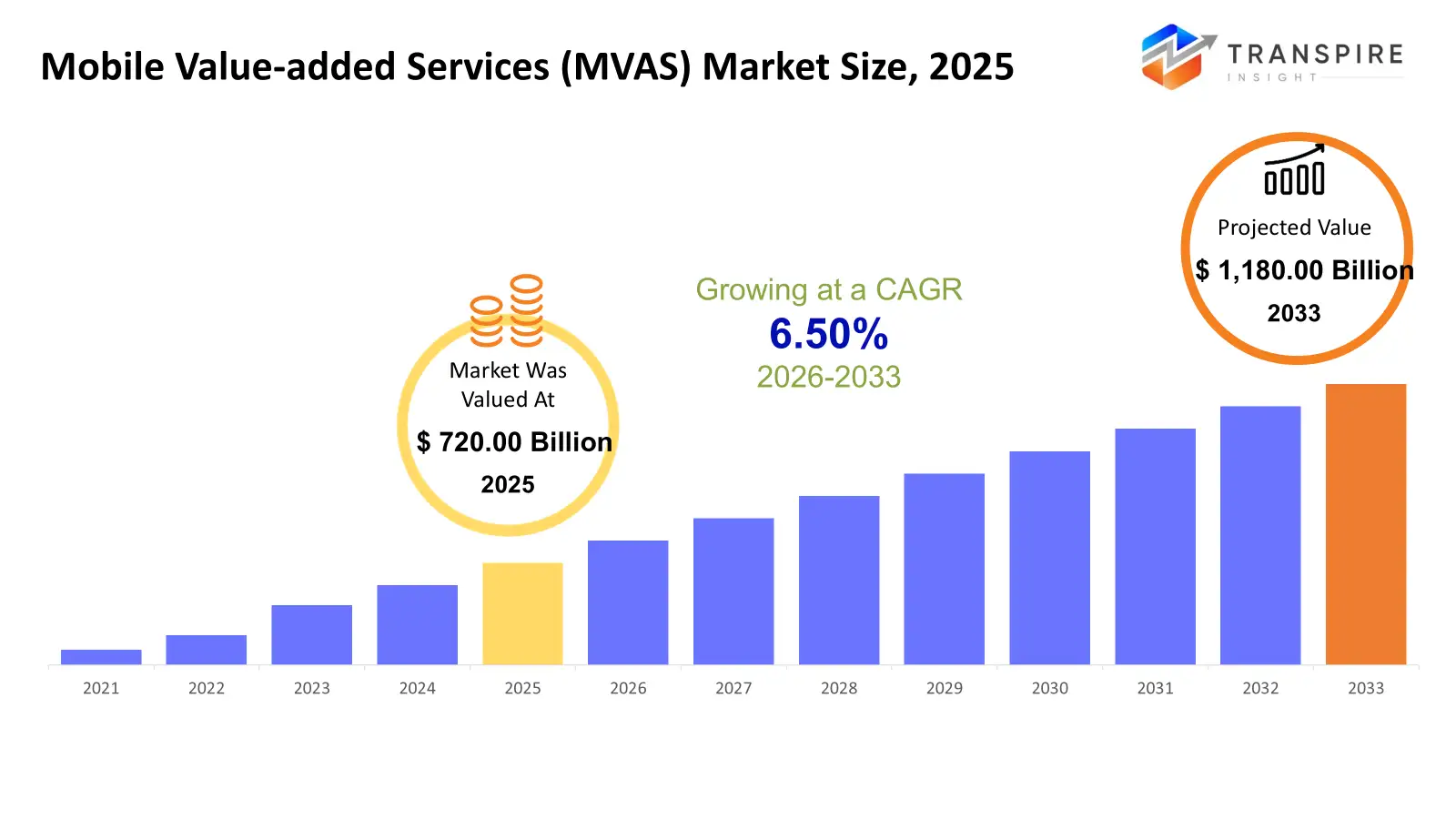
The global Mobile Value-added Services (MVAS) market size was valued at USD 720.00 billion in 2025 and is projected to reach USD 1,180.00 billion by 2033, growing at a CAGR of 6.50% from 2026 to 2033. The growing rate of smartphone subscribers is fueling the growth of mobile internet accessibility, thus launching high demands for multimedia services beyond communication services. Telecom operators and digital service providers are increasingly using MVAS as a tool to hedge revenues, thereby propelling the growth of the MVAS services industry.
Market Size & Forecast
- 2025 Market Size: USD 720.00 Billion
- 2033 Projected Market Size: USD 1,180.00 Billion
- CAGR (2026-2033): 6.50%
- North America: Largest Market in 2026
- Asia Pacific: Fastest Growing Market
To learn more about this report,  Download Free Sample Report
Key Market Trends Analysis
- North America represents a strong adoption rate for Mobile Value-added Services, driven by advanced telecom infrastructure, a strong base of smartphones, and an evolved state of the digital ecosystem, which spells continued growth for the messaging segment, mobile financial services, and advertising platforms due to the phenomenon of enterprise digitization and high consumer data usage.
- The U.S. maintains the leadership position in regional technology innovations, characterized by the earliest commercialization of 5G networks, continued OTT ecosystem development, and artificial intelligence-based personalizations, fueling the need for infotainment, social communication solutions, and mobile advertising services in the entertainment and retail sectors.
- Asia Pacific indicates a strong development in the growth of accelerated MVAS services, driven by high mobile subscriber bases, the growth of digital payment services, and mobile entertainment trends, including the development of mobile financial services, content services, and location-based services through growing 4G and 5G connectivity
- Content and infotainment services comprise a major segment, given the trend of increasing video streaming, mobile gaming, and OTT that is expected to influence consumer engagement patterns, with telecom operators emphasizing bundled services in the realm of digital entertainment.
- Mobile financial services are strengthening their foothold as digital wallets, mobile banking, and contactless payment systems spread their presence throughout the world, driven by the encouragement of such services from the government as well as the growing acceptance of mobile-based transactions among users in the fields of retail, BFSI, and e-commerce.
- 4G LTE or the impending 5G networks shape the MVAS evolution landscape as a whole, enhancing the speed of data transmission, the quality of service, or the latency figures to facilitate the consumption of immersive content, the provision of communicative services, or the development of location-based offerings.
- Entertainment and media services are likely to remain major influencers of mobile service adoption, owing to the increasing dependence of consumers on mobile technology for services such as streaming, gaming, and social interaction services.
So, Mobile Value-added Services market refer to services that are provided through mobile networks, which go beyond communication, such as messaging, entertainment, mobile payments, advertising, and location-based services. They improve the overall customer service experience while enabling telecommunication providers to reap additional revenue through data-based services and subscriptions. The market is affected by factors such as the rise in smartphone usage, rise in mobile internet penetration, and increase in customer preference for digital content and mobile-based transactions. Enterprises are adopting MVAS in their customer engagement strategy, thus allowing real-time communications and personalization of marketing, as well as accessibility of customer service across various industries. The technology scene, especially through advances in 4G and 5G technology, is also supporting the delivery of advanced MVAS applications and services like high-definition streaming services, interactive communications, and mobile commerce services. The market is also dynamic as telecom operators are partnering with other operators and technology firms to offer diversified services.
Mobile Value-added Services (MVAS) Market Segmentation
By Type
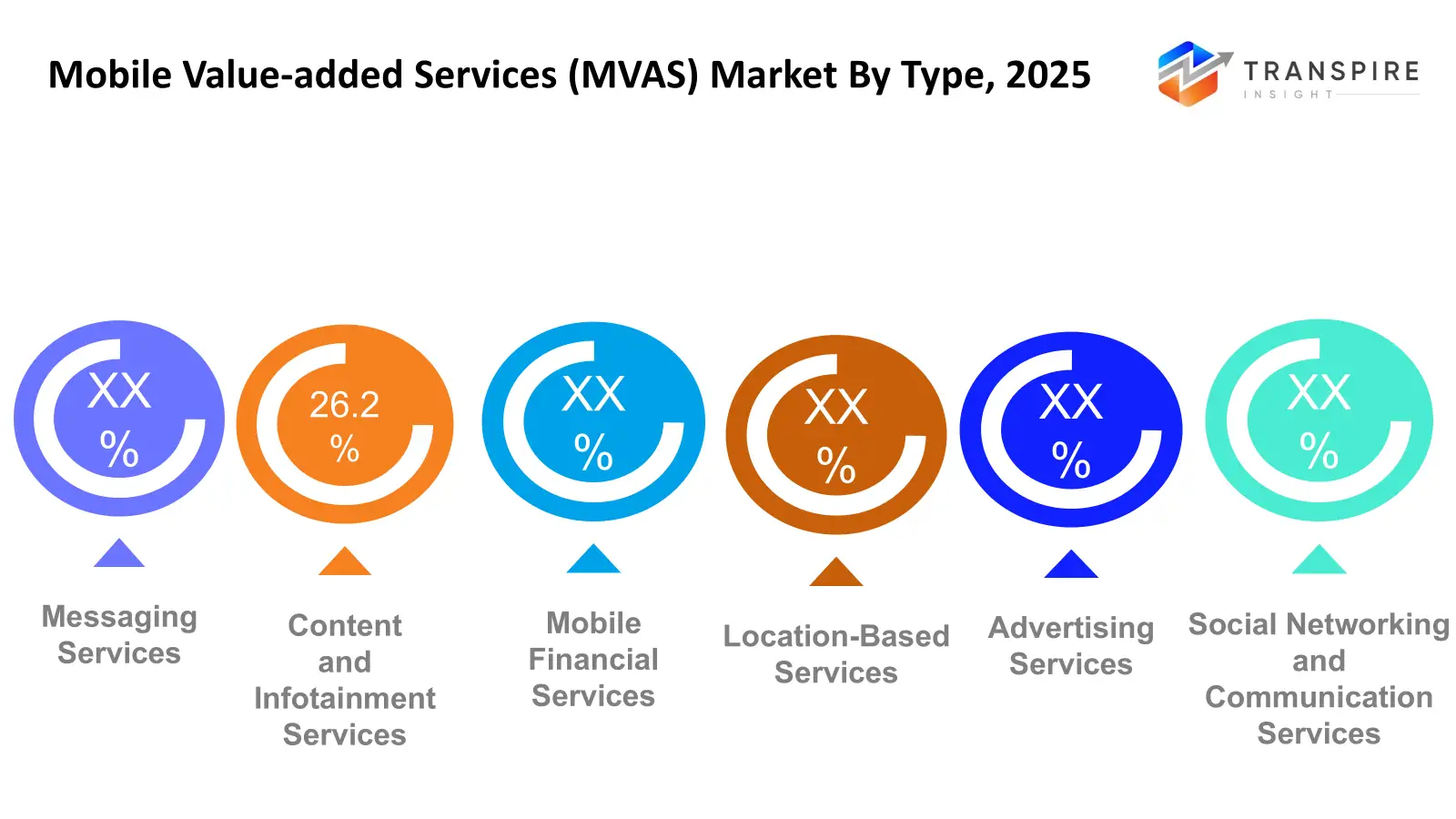
- Messaging Services
The messaging services remain a core segment of MVAS services owing to the rising acceptance of SMS, instant messaging, etc. The messaging services segment is supported by the inherent acceptance of these services among feature as well as smartphone users, thus providing a steady flow of customers from emerging as well as mature markets.
- Content and Infotainment Services
Content and infotainment services are growing as a result of increased consumption of mobile video services, music streaming services, and gaming. As smartphone penetration continues to rise and more affordable data plans become available, access to content services is also gaining traction.
- Mobile Financial Services
The mobile financial services market has been growing with the emergence of digital payments, mobile banking, and wallets. It is been driven by initiatives such as financial inclusion and the shift in consumer behavior towards contactless transactions. There is concerted effort among telecom companies and fintech companies to provide secured mobile financial services to consumers.
- Location-Based Services
The growing category of location-based services offers services based on GPS and network data to provide location-related navigation, advertisements, real-time service recommendations, etc. The growth is driven by increasing usage in transport services, retail services, on-demand services, etc. More precise services based on better network technologies are improving their commercial potential.
- Advertising Services
Mobile advertising services are growing as marketing trends increasingly favor mobile-based strategies. Data analysis and tracking of users help design efficient advertising strategies. It is a growing segment due to the inherent high engagement rates of mobile users, especially those of social media and entertainment apps.
- Social Networking and Communication Services
Social networking/communication services represent the highest level of user engagement in the MVAS ecosystem, and this primarily occurs due to real-time communication and content sharing. The use of multimedia features and interaction capabilities further adds to the growth in terms of retaining users. Unending innovation in communication services represents a high growth opportunity, especially in developing countries.
To learn more about this report, Download Free Sample Report
By Network Type
- 2G / 3G
2G and 3G network connections still exist and are also used for providing basic MVAS services, especially in developing regions. Legacy infrastructure is a common sight in such regions. Messaging and infotainment services are major contributors to this segment. This segment is also declining at a slow rate.
- 4G LTE
4G LTE is the dominant network segment for high-speed data services and advanced MVAS services. The ubiquity of the 4G network has witnessed the rapid growth of video streaming services, gaming, and mobile commerce. The reliability of the network and increased bandwidth have ensured the proliferation of consumers.
- 5G
5G networks are facilitating next-generation services for MVAS applications with ultra-low latency capabilities and high data speed. 5G technology is facilitating immersive services, such as augmented reality, gaming, and location-based services. Investments in 5G, which are constantly increasing, are likely to enhance diversification in the services offered.
By Application
- Entertainment
This segment comprises a large market share because of the growing need for mobile gaming, video streaming services, and music contents. The increasing consumption of contents is also building the strength of the revenue base. Network advancements are further leading to a better user experience, which is enhancing user engagement levels.
- Retail and E-commerce
- Applications developed for retail and electronic business using MVAS facilitate payments, support personalization-based promotions, as well as drive customer engagement. Businesses increasingly leverage the potential of mobile platforms to improve retail business convenience, as well as maintain customer loyalty. The sector is driven by the expansion of the mobile commerce ecosystem, as well as the increasing adoption of smartphones.
- Banking, Financial Services, and Insurance (BFSI)
The BFSI sector is utilizing the MVAS services in the form of mobile banking, transactional alerts, authentication, and digital payment services. Emphasis on secure and timely finance services is driving the momentum in the adoption of the MVAS technology. Regulatory support for digital finance is further fueling the growth of the sector.
- Media and Advertising
Applications in media and advertising services deploy MVAS as a tool in targeting mobile users. Hence, data advertising techniques assist in effective advertising and customer reach. This growth is fueled by an increase in mobile media consumption and the preference by advertisers to use measurable channels.
- Healthcare and Wellness
The segment of healthcare/wellness is witnessing increased popularity through mobile health monitoring, appointment management, and health information services. MVAS facilitates better patient engagement and remote healthcare services. The increasing uptake of digital health services is bolstering the healthcare market
- Education and E-learning
Education and e-learning applications use MVAS technology to implement learning platforms, mobile learning content, and interactive communication. The increasing need for more flexibility and a remote education solution is also promoting MVAS technology. Since mobile technology can support a geographically diverse target audience, this also helps the technology gain more traction.
- Travel and Hospitality
The applications in the travel and hospitality sector utilize MVAS for booking, navigation, travel announcements, and personal recommendations. Mobile applications enhance the experience of customers by providing timely and convenient access to information and services. The increase in the uptake of digital travel planning is likely to remain the growth trend in the segment.
- Government and Public Services
Government and public sector-related applications include MVAS for communication with citizens, delivering messages and alerts, digital payments, and the dissemination of public information to the population. The use of mobility is efficient and accessible through digital governance initiatives in various countries
- Others
Other possible uses include enterprise communication, utilities, and specialized services targeting specific sectors. These applications are also continually evolving, mirroring the increasing trend of including mobile platforms in business strategies. The sector, therefore, shows the growth trend in the use of MVAS services for different purposes.
Regional Insights
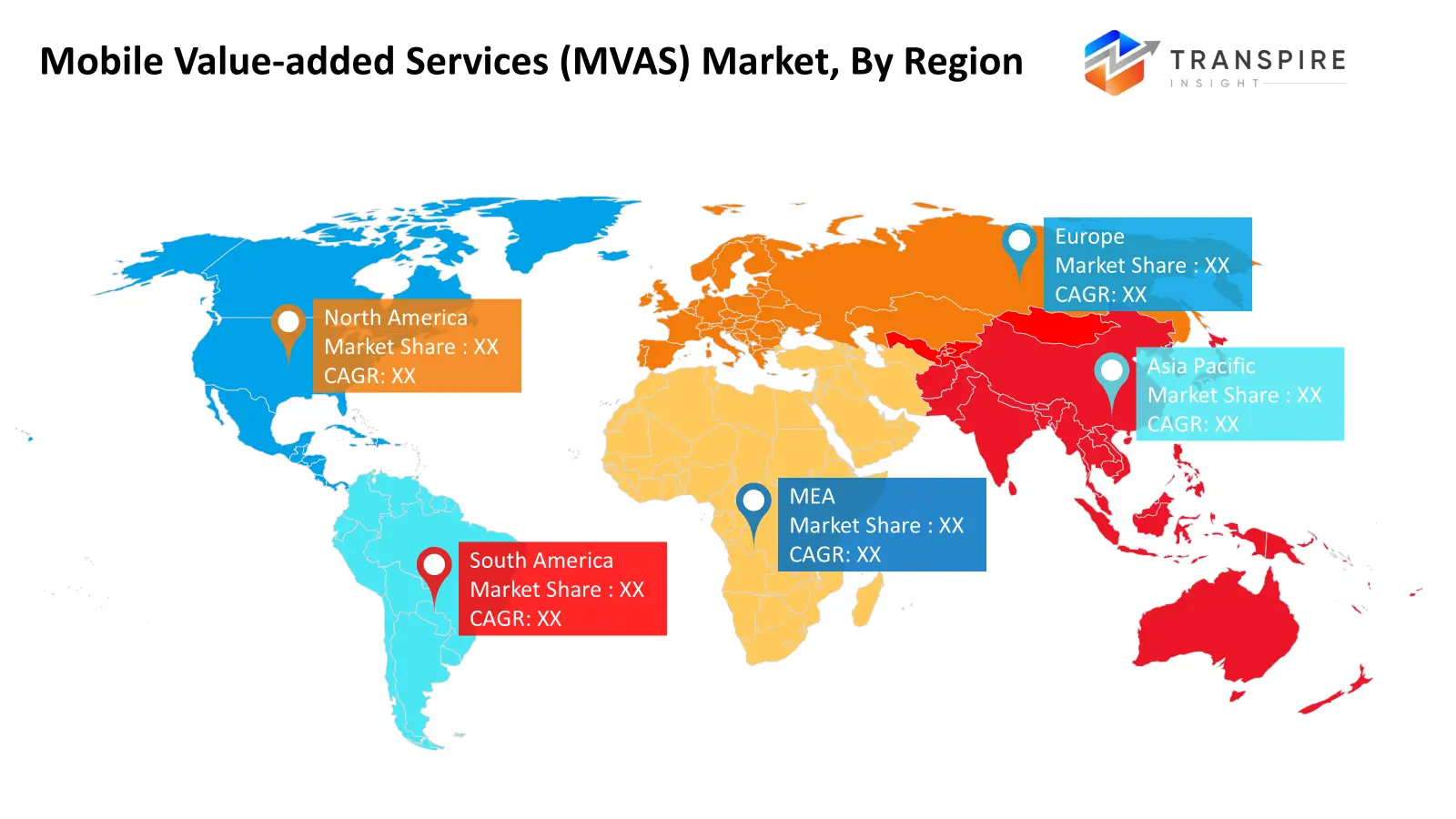
The North American region, which comprises the United States, Canada, and Mexico, forms a developed market for MVAS services, given the presence of a strong telecom infrastructure foundation, a large number of smartphones, and the popularity of digital entertainment services as well as mobile financial services. The US continues to remain a significant contributor to the global market, owing to the growth in mobile advertisements, OTT services, and enterprise services. The region comprising countries such as Europe, which include Germany, the UK, France, Spain, Italy, and others, exhibits a growing market due to robust regulations, a strong culture of digital literacy, and a rise in mobile commerce and/or communication services, along with a rise in 5G networks supporting MVAS capabilities.
The Asia Pacific region, including countries such as Japan, China, Australia, and New Zealand, South Korea, India, and the rest of the Asia Pacific region, represents the quickest growing segment. The region offers vast mobile subscriber bases, along with high rates of digitalization, especially in the countries in the region classified as emerging economies. Driven by Brazil and Argentina, South America is seeing incremental expansion of MVAS, supported by increasing smartphone adoption and rising demand for mobile financial services and digital entertainment. Amongst telecom operators, the thrust is on expanding value-added offerings as a means to better retain customers and diversify revenues.The Middle East and Africa, which includes countries like Saudi Arabia, the United Arab Emirates, South Africa, and the rest, is seeing consistent growth in this sector due to an improved experience in mobile connectivity and government-initiated digital transformation. Mobile banking, messaging services, and communication platforms remain some of the key contributors to the growth of the regional market.
To learn more about this report, Download Free Sample Report
Recent Development News
- February 2025, Ericsson, in association with prominent telecommunication service providers like AT&T, T-Mobile, and Verizon, announced the availability of standardized 5G network APIs, which are intended to help support the creation of sophisticated digital applications by developers and enterprises. The aim of the initiative is to provide secure authentication, fight fraud, and enhance the customer experience, thereby increasing innovation in the enterprise and consumer MVAS sector.
- In June 2024, Ericsson, in association with prominent telecommunication service providers like AT&T, T-Mobile, and Verizon, announced the availability of standardized 5G network APIs, which are intended to help support the creation of sophisticated digital applications by developers and enterprises. The aim of the initiative is to provide secure authentication, fight fraud, and enhance the customer experience, thereby increasing innovation in the enterprise and consumer MVAS sector.
|
Report Metrics |
Details |
|
Market size value in 2025 |
USD 720.00 Billion |
|
Market size value in 2026 |
USD 760.00 Billion |
|
Revenue forecast in 2033 |
USD 1,180.00 Billion |
|
Growth rate |
CAGR of 6.50% from 2026 to 2033 |
|
Base year |
2025 |
|
Historical data |
2021 – 2024 |
|
Forecast period |
2026 – 2033 |
|
Report coverage |
Revenue forecast, competitive landscape, growth factors, and trends |
|
Regional scope |
North America; Europe; Asia Pacific; Latin America; Middle East & Africa |
|
Country scope |
United States; Canada; Mexico; United Kingdom; Germany; France; Italy; Spain; Denmark; Sweden; Norway; China; Japan; India; Australia; South Korea; Thailand; Brazil; Argentina; South Africa; Saudi Arabia; United Arab Emirates |
|
Key company profiled |
Google LLC, Apple Inc., Samsung Electronics Co., Ltd., Huawei Technologies Co., Ltd., Bharti Airtel Limited, Vodafone Group Plc, AT&T Inc., Verizon Communications Inc., China Mobile Limited, Comviva Technologies Limited, OnMobile Global Limited, Mahindra Comviva (Comviva), Amdocs Limited, Syniverse Technologies LLC, and Ericsson AB. |
|
Customization scope |
Free report customization (country, regional & segment scope). Avail customized purchase options to meet your exact research needs. |
|
Report Segmentation |
By Type (Messaging Services, Content and Infotainment Services, Mobile Financial Services, Location-Based Services, Advertising Services, Social Networking and Communication Services), By Network Type (2G / 3G, 4G LTE, 5G) and By Application (Entertainment, Retail and E-commerce, Banking, Financial Services, and Insurance (BFSI), Media and Advertising, Healthcare and Wellness, Education and E-learning, Travel and Hospitality, Government and Public Services, Others) |
Key Mobile Value-added Services (MVAS) Company Insights
The strong position of Google LLC within the Mobile Value-added Services is based on its large ecosystem that comprises mobile applications, cloud-based services, and digital content platforms. This company uses Android OS penetration as an opportunity to embed value-added services like mobile payments, entertainment, location-based services, and cloud storage directly within smartphones. The possibility to monetize services with the help of advertising, subscriptions, and app distribution empowers its revenue diversification potential. Continuous investments in AI-driven personalization and mobile engagement tools enhance user retention and service relevance. In addition, Google’s global developer ecosystem and partnerships with telecom operators contribute to the scalability of the MVAS deployment in developed and emerging markets.
Key Mobile Value-added Services (MVAS) Companies:
- Google LLC
- Apple Inc.
- Samsung Electronics Co., Ltd.
- Huawei Technologies Co., Ltd.
- Bharti Airtel Limited
- Vodafone Group Plc
- AT&T Inc.
- Verizon Communications Inc.
- China Mobile Limited
- Comviva Technologies Limited
- OnMobile Global Limited
- Mahindra Comviva (Comviva)
- Amdocs Limited
- Syniverse Technologies LLC
- Ericsson AB
Global Mobile Value-added Services (MVAS) Market Report Segmentation
By Type
- Messaging Services
- Content and Infotainment Services
- Mobile Financial Services
- Location-Based Services
- Advertising Services
- Social Networking and Communication Services
By Network Type
- 2G / 3G
- 4G LTE
- 5G
By Application
- Entertainment
- Retail and E-commerce
- Banking, Financial Services, and Insurance (BFSI)
- Media and Advertising
- Healthcare and Wellness
- Education and E-learning
- Travel and Hospitality
- Government and Public Services
- Others
Regional Outlook
- North America
- United States
- Canada
- Mexico
- Europe
- Germany
- United Kingdom
- France
- Spain
- Italy
- Rest of Europe
- Asia Pacific
- Japan
- China
- Australia & New Zealand
- South Korea
- India
- Rest of Asia Pacific
- South America
- Brazil
- Argentina
- Rest of South America
- Middle East & Africa
- Saudi Arabia
- United Arab Emirates
- South Africa
- Rest of the Middle East & Africa
Frequently Asked Questions
Find quick answers to common questions.
The approximate Mobile Value-added Services (MVAS) Market size for the market will be USD 1,180.00 billion in 2033.
Key segments for the Mobile Value-added Services (MVAS) Market are By Type (Messaging Services, Content and Infotainment Services, Mobile Financial Services, Location-Based Services, Advertising Services, Social Networking and Communication Services), By Network Type (2G / 3G, 4G LTE, 5G) and By Application (Entertainment, Retail and E-commerce, Banking, Financial Services, and Insurance (BFSI), Media and Advertising, Healthcare and Wellness, Education and E-learning, Travel and Hospitality, Government and Public Services, Others).
Major Mobile Value-added Services (MVAS) Market players are Google LLC, Apple Inc., China Mobile Limited, Bharti Airtel Limited, Amdocs Limited.
The North America region is leading the Mobile Value-added Services (MVAS) Market.
The CAGR of the Mobile Value-added Services (MVAS) Market is 6.50%.
- Google LLC
- Apple Inc.
- Samsung Electronics Co., Ltd.
- Huawei Technologies Co., Ltd.
- Bharti Airtel Limited
- Vodafone Group Plc
- AT&T Inc.
- Verizon Communications Inc.
- China Mobile Limited
- Comviva Technologies Limited
- OnMobile Global Limited
- Mahindra Comviva (Comviva)
- Amdocs Limited
- Syniverse Technologies LLC
- Ericsson AB
Recently Published Reports
-
Apr 2026
3D Optical Profiler Market
3D Optical Profiler Market Size, Share & Analysis Report By Type (Desktop 3D Optical Profiler, and Portable 3D Optical Profiler), By Technology (Confocal Technology, and White Light Interference), By End-Use Industry (Manufacturing, Research Institutions, Automotive, Aerospace and Defense, Medical Devices, and Other), and Geography (North America, Europe, Asia-Pacific, Middle East and Africa, South and Central America), 2021 - 2031
-
Apr 2026
Depth Sensor Market
Depth Sensor Market Size, Share & Analysis Report By Type (Infrared Depth Sensors, Time-of-Flight (ToF) Sensors, Stereo Vision Sensors, Structured Light Sensors, Ultrasonic Depth Sensors), By Application (Automotive, Robotics, Gaming, Consumer Electronics, Industrial Automation, Healthcare, Security & Surveillance, Others), By End Users (Automotive Manufacturers, Consumer Electronics Companies, Healthcare Providers, Industrial Companies, Security Agencies, Gaming Companies, Robotics Companies, Others), and Geography (North America, Europe, Asia-Pacific, Middle East and Africa, South and Central America), 2021 – 2031
-
Apr 2026
Digital Manufacturing Market
Digital Manufacturing Market Size, Share & Analysis Report By Component (Hardware, Software, and Services), By Technology (Robotics, 3D Printing, Internet of Things (IoT), and Others), By Application (Automotive and Transportation, Aerospace and Defense, Consumer Electronics, Industrial Machinery, and Others), By Process Type (Computer-Based Designing, Computer-Based Simulation, Computer 3D Visualization, Analytics, and Others), and Geography (North America, Europe, Asia-Pacific, Middle East and Africa, South and Central America), 2021 – 2031
-
Apr 2026
Digital Visa Services Market
Digital Visa Services Market Size, Share & Analysis Report By Type (Individual Travelers, Group Travelers), By Application (Tourism, Business Travel, Others), and Geography (North America, Europe, Asia-Pacific, Middle East and Africa, South and Central America), 2021 – 2031