

Middle East and Africa Web Performance Market Size & Forecast:
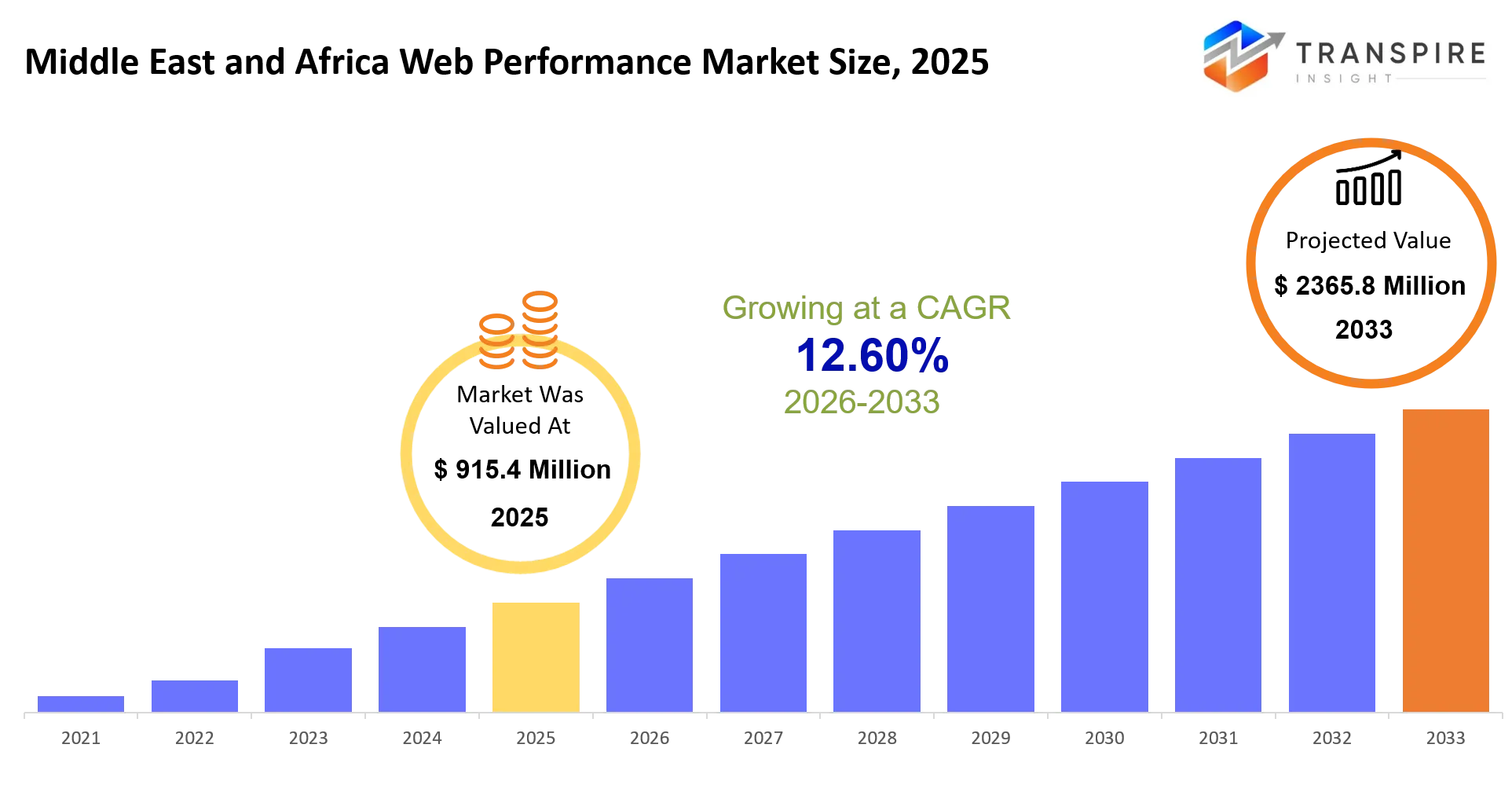
- Middle East and Africa Web Performance Market Size 2025: USD 915.4 Million
- Middle East and Africa Web Performance Market Size 2033: USD 2365.8 Million
- Middle East and Africa Web Performance Market CAGR: 12.60%
- Middle East and Africa Web Performance Market Segments: By Component (Monitoring Solutions, Optimization Solutions, Analytics, Others); By Deployment (Cloud-based, On-premise, Hybrid, Others); By Application (Website Optimization, Mobile Performance, API Monitoring, Others); By End User (E-commerce, Media, BFSI, IT & Telecom, Others)
Middle East and Africa Web Performance Market Summary
The Middle East and Africa Web Performance Market was valued at USD 915.4 Million in 2025. It is forecast to reach USD 2365.8 Million by 2033. That is a CAGR of 12.60% over the period.
The Middle East and Africa Web Performance Market takes on a real important role in making sure websites, mobile apps, APIs, and those digital services load fast , stay up even when traffic suddenly spikes, and keep the user journey feeling smooth across many sectors. Companies lean on web performance solutions so they can cut down page latency, nudge up transaction success, boost customer loyalty, and keep their digital routines running without too much friction. In the last five years, things have kind of moved from simple uptime monitoring toward AI-enabled observability, near real time analytics , and cloud-first performance fine tuning. One big structural shift is that more enterprises are moving workloads into multi-cloud and hybrid setups, which then asks for sharper monitoring and more hands-on optimization tools. Also, the COVID-19 period, with the jump in digital shopping, online banking, remote work, and streaming, sped up interest in performance visibility and reliability, quite noticeably. And since digital payments and web based transactions are more or less tied to revenue now , many organizations are putting more money into web performance platforms—so they can sidestep outages, raise user engagement, and keep business continuity protected. That, in turn, helps create steadier recurring income chances for vendors and solution providers.
Key Market Insights
- The Middle East and Africa Web Performance Market, kinda benefits from enterprise digital transformation programs, with cloud-based monitoring platforms make up nearly 55% of deployments during 2025.
- In general you see Gulf Cooperation Council countries pulling ahead on regional revenue, with an estimated 42% market share, backed by more advanced digital infrastructure spending, and it’s not just surface-level.
- Sub-Saharan Africa is also projected to move the fastest through 2033, mostly because mobile internet penetration keeps rising and fintech adoption is getting traction. When you zoom into components,
- Monitoring Solutions end up leading the pack with around 38% market share, largely because companies need real-time visibility across apps, services and networks.
- Optimization Solutions take the second place too, since enterprises are chasing quicker page loads and better customer conversion metrics, pretty straight forward.
- On the analytics side, analytics platforms are forecast to show the fastest growth through 2033, as organizations lean into AI-driven performance insights plus predictive diagnostics, and that trend keeps building.
- For applications, Website Optimization stays the dominant segment with close to 40% share, which basically highlights how critical customer-facing digital channels are.
- API Monitoring is among the fastest-growing applications as API traffic volumes increase across banking, telecommunications and e-commerce setups.
- And for end users, E-commerce holds the biggest share at about 28%, supported by expanding online retail activity across the Middle East and Africa region.
- Some key players—Akamai Technologies, Cloudflare, Dynatrace, Datadog, and Fastly—also keep strengthening their market positions by focusing on AI-enabled observability, edge computing investments, regional expansion sometimes, and strategic cloud partnerships.
What are the Key Drivers, Restraints, and Opportunities in the Middle East and Africa Web Performance Market?
The strongest force pushing market expansion is this quick sort of shift toward digital-first business models across banking, retail, telecommunications, and public services, sort of like it’s happening everywhere at once. Cloud adoption keeps climbing, mobile commerce is growing faster than before, and API-based application architectures have made digital environments way more layered, in a practical sense. Because of that, organizations can no longer lean on basic monitoring tools—performance problems hit customer retention, transaction completion, and revenue generation directly. So, enterprises are steering bigger IT budgets into observability platforms real-time monitoring solutions, and application optimization technologies, to help prevent downtime and keep service quality steady.
Still, one big structural snag stays in place: the shortage of advanced digital infrastructure and trained observability professionals across several African economies. A lot of organizations are still running legacy systems that need extensive integration work before modern performance management platforms can actually be deployed, properly. And this doesn’t get fixed overnight, since infrastructure modernization, workforce development, and cloud migration programs all need major capital and long implementation cycles. That’s why adoption stays uneven across the region, which then limits the overall revenue upside.
At the same time there’s a real opportunity in AI-powered observability, and also in edge computing deployments. Big investments in regional data centers by hyperscale cloud providers are setting up good conditions for advanced web performance services. Saudi Arabia, the UAE, South Africa, and Kenya are starting to look like particularly interesting markets, where digital infrastructure maturity helps enable more sophisticated monitoring, plus optimization solutions.
What Has the Impact of Artificial Intelligence Been on the Middle East and Africa Web Performance Market?
Artificial intelligence has, kind of, changed web performance management from mostly reactive troubleshooting into a more proactive optimization thing.These days, modern platforms depend on AI algorithms to sort of automatically handle application monitoring, detect weird anomalies, and even perform root-cause analysis across websites, cloud environments, APIs, and the whole digital service map. Rather than keep bouncing back-and-forth with manual investigations, enterprises can catch performance slowdowns in real time, and fix issues before customers even notice that the service is wobbling, or feels briefly disrupted.
Machine learning models are also getting used for predictive maintenance of digital infrastructure, and they take as inputs older traffic rhythms, server behavior, network conditions, and application response times. In practice, these setups forecast capacity needs, anticipate outages, and recommend optimization actions, which overall pushes reliability higher. AI-powered observability solutions also help organizations tune resource allocation, reduce infrastructure spending, and strengthen the customer experience. A lot of enterprises mention clear drops in incident resolution time and improved service availability after adopting AI-enabled monitoring tools, and that line keeps showing up in case studies, time after time.
Meanwhile, advanced analytics platforms make operations seem smoother because they correlate signals across cloud services, APIs, user sessions, and network layers. But, adoption is still not fully effortless, because integration costs stack up, data quality can get messy. Also, finding highly skilled AI and observability specialists is often pretty hard. Organizations that operate across fragmented digital environments commonly run into trouble producing consistent training data, and without that consistency, accurate machine learning outcomes become harder to achieve, which ends up slowing down the full rollout of AI-driven performance optimization.
Key Market Trends
- Cloud-native monitoring adoption kind of jumped, from around 35% in 2020, to something like 55%+ by 2025 across enterprise setups.
- In a lot of orgs, AI-based anomaly detection basically took over manual performance analysis, and that pushed incident investigation times down by more than 30% , which is… pretty notable.
- API monitoring also started feeling more like a strategic priority , especially as API traffic ramped up sharply in financial services and telecommunications.
- After 2023, edge computing deployments sped up a bit, helping cut application latency roughly by 20% to 40% in certain markets.
- Meanwhile, Cloudflare, Akamai, and Fastly rolled out larger regional infrastructure footprints, aiming for better content delivery and improved application responsiveness overall.
- Enterprises also redirected budgets away from standalone monitoring instruments, and toward unified observability platforms that cover infrastructure, applications, and even user experience.
- Real user monitoring became more mainstream as many teams moved past synthetic testing, and started examining actual customer interactions instead.
- Multi-cloud environments got more frequent too, which created extra demand for centralized visibility plus performance management solutions.
- Digital banking platforms increased their focus on application optimization after mobile transactions and online financial services kept growing.
- And finally, regional data center expansion programs improved local hosting capabilities, while reducing reliance on overseas infrastructure resources.
Middle East and Africa Web Performance Market Segmentation
By Component
Monitoring Solutions have this kinda important role in web performance management, mainly because ongoing visibility, kinda lets you spot website slowdowns earlier, along with service interruptions, and even those pesky application issues that sneak in quietly. With real time tracking, businesses can keep their digital operations more steady, and they can also improve customer experience across both websites and applications, not just one side.
Optimization Solutions instead are more about actually making things faster, like improving loading speed, cutting down latency, and boosting the way content gets delivered. When performance is better, you usually get stronger engagement levels and more fluid digital transactions across different industries, you know, the whole journey feels smoother.
Analytics solutions are the part that turns performance data into practical insights so teams can decide better and plan for the long run. Performance trends, user behavior analysis, and operational reporting help organizations spot where adjustments are needed, and then they can route resources more effectively. Other options in the mix include consulting services, managed services, implementation support , and integration solutions that reinforce overall performance management strategies. When you use these components together, you get a more reliable and efficient digital environment for enterprises working across the region.
By Deployment
Cloud based deployment keep getting more attention because scalability, flexibility, and quicker rollouts help match what modern businesses are asking for. With subscription based access, teams can ease the infrastructure burden, yet still get steady updates plus higher level performance functions, it is kind of a win-win. Meanwhile on premise deployment still matters a lot for organizations that want direct oversight of their infrastructure, stronger security guardrails and regulatory alignment. Financial institutions and government agencies usually lean toward it since internal governance requirements can be pretty strict.
Hybrid deployment blends cloud and on premise setups, so you get a more balanced path where flexibility stays high while sensitive workloads remain under control. This approach enables a gradual modernization plan, without breaking older systems or daily operational workflows. Other options also exist, like private hosting arrangements and niche deployment structures aimed for special organizational needs. In the end, these choices help businesses build customized performance management environments, aligned with their own operational objectives, sometimes in ways that plain templates just cant handle.
By Application
Website Optimization counts as a big application area because web speed, and yeah reliability, really drag or lift customer engagement and basically the business results. When pages load faster and the paths feel smoother, user experience gets better, and it also helps raise the chance that customers actually complete a transaction. Mobile Performance is all about keeping digital experiences responsive on smartphones and tablets, where people expect more speed, sooner. Good mobile performance will probably stay really important since mobile internet keeps spreading across regional markets .
API Monitoring has grown more critical too since modern digital services lean on clean communication between connected applications and platforms. Continuous monitoring makes it possible to spot breakdowns, latency problems, and service interruptions ahead of any major operational fallout. Other areas, include network monitoring, digital experience management, cloud infrastructure visibility, and more specialized performance assurance work. The growth showing up in all of these spaces points to wider digital transformation efforts and our increasing dependence on connected digital ecosystems.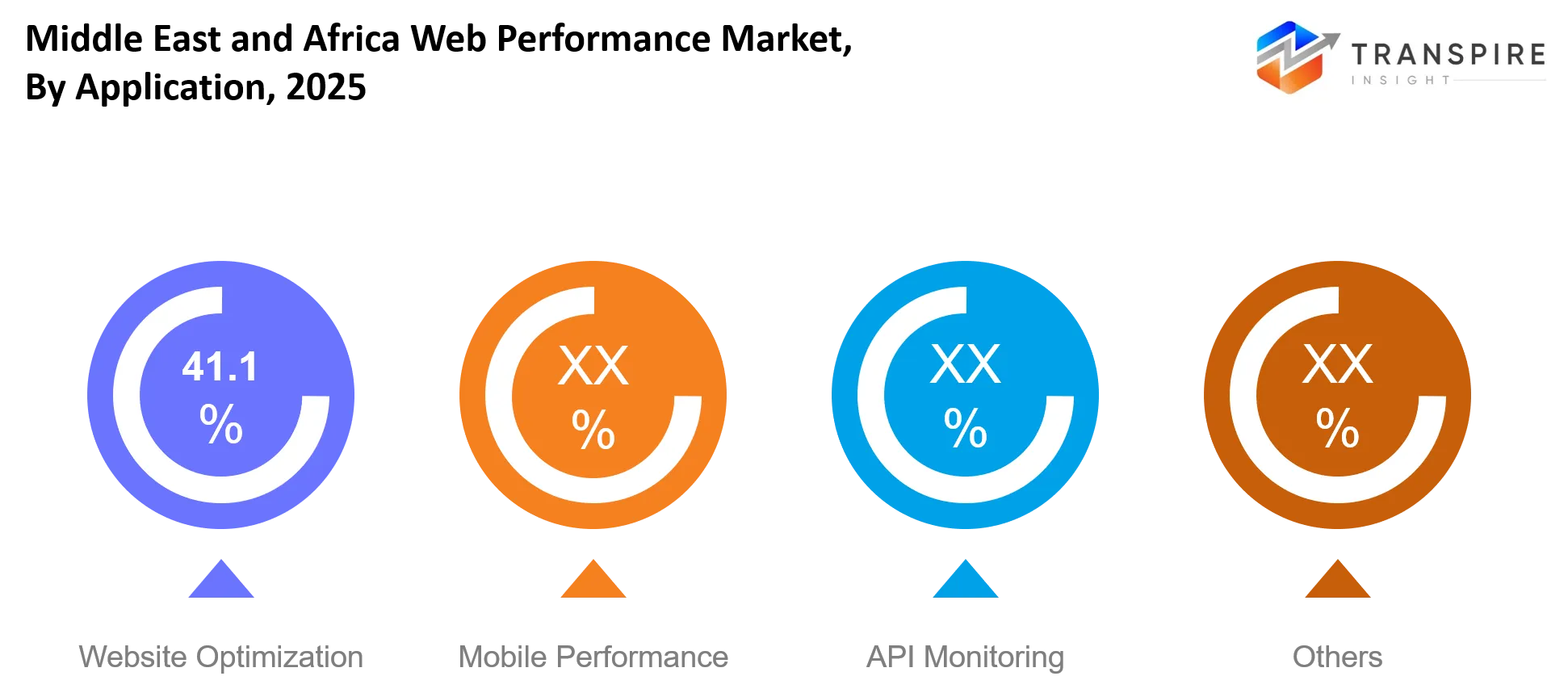
By End User
E-commerce creates big, very real demand for web performance solutions because online deals really rely on fast, dependable , and uninterrupted customer journeys. When a site performs well it actually helps keep customers coming back, it boosts conversion rates , and it drives revenue in the end. Media groups also lean on performance management platforms so content delivery stays steady , support streaming services, and manage huge amounts of digital traffic. When the performance stays steady enough it tends to keep viewers interested and improves ad effectiveness, even when the traffic spikes
For BFSI organizations, stable and secure digital environments are non negotiable for banking apps, payment systems, and customer facing services. Reliability is still a must, because any outage can dent customer confidence and interrupt transaction handling. IT and Telecom firms depend on ongoing observation and continual optimization to steer through complicated digital infrastructure and network services. Other areas , like healthcare, education, manufacturing, government, and transportation, keep expanding their digital offerings, and that kind of growth makes fresh openings for performance management solutions too.
What are the Key Use Cases Driving the Middle East and Africa Web Performance Market?
Website performance optimization is still the main use case, because digital customer interactions kind of end up deciding revenue outcomes more and more. E-commerce sites , online banking portals, and service marketplaces all rely on quick page loading, minimal downtime, and those smooth user experiences that keep people engaged and actually finish transactions.
API monitoring and mobile application performance management are getting more attention, especially across telecommunications, financial services, and cloud software setups. Companies use these tools to keep dependable communication between digital systems, while also trying to hold steady performance across phones and all the connected gadgets.
Newer use cases are showing up too, like AI-driven digital experience management, plus predictive observability. Enterprises are starting to roll out advanced analytics that can hint at performance problems before anything turns into a real service disruption. Also, edge computing optimization and real-time customer journey tracking look like they could grow fast as digital ecosystems become, well, more complicated.
|
Report Metrics |
Details |
|
Market size value in 2025 |
USD 915.4 Million |
|
Market size value in 2026 |
USD 1030.7 Million |
|
Revenue forecast in 2033 |
USD 2365.8 Million |
|
Growth rate |
CAGR of 12.60% from 2026 to 2033 |
|
Base year |
2025 |
|
Historical data |
2021 - 2024 |
|
Forecast period |
2026 - 2033 |
|
Report coverage |
Revenue forecast, competitive landscape, growth factors, and trends |
|
Regional scope |
Middle East and Africa (Saudi Arabia, United Arab Emirates, South Africa, Rest of Middle East and Africa) |
|
Key company profiled |
Akamai, Cloudflare, Dynatrace, New Relic, Datadog, Google, AWS, Microsoft, Pingdom, Catchpoint, Fastly, SolarWinds, Cisco, IBM, Oracle |
|
Customization scope |
Free report customization (country, regional & segment scope). Avail customized purchase options to meet your exact research needs. |
|
Report Segmentation |
By Component (Monitoring Solutions, Optimization Solutions, Analytics, Others); By Deployment (Cloud-based, On-premise, Hybrid, Others); By Application (Website Optimization, Mobile Performance, API Monitoring, Others); By End User (E-commerce, Media, BFSI, IT & Telecom, Others) |
Which Regions are Driving the Middle East and Africa Web Performance Market Growth?
The Gulf region still shows the biggest market revenue traction, mainly because there is strong investment in digital infrastructure, a pretty widespread move to cloud services, and government programs that push digital transformation along. Saudi Arabia and the United Arab Emirates keep on expanding their data center footprint and upgrading advanced connectivity networks, more and more. Meanwhile, enterprise budgets for customer experience optimization seem to stay elevated across banking, retail, and even public sector organizations. There’s also a mature technology ecosystem in place which helps the whole market remain in a leadership position, at least for now.
South Africa comes in as the second-largest contributor, but its growth route looks a bit different. The focus is more on enterprise modernization, and on established technology adoption. Bigger firms keep investing in observability platforms, cloud offerings, and application monitoring solutions without too much interruption. Strong financial services and telecommunications coverage then leads to steadier demand for performance management technologies. Even with the wider market swings, economic diversification helps keep technology spending from dropping.
As for the rest of Sub-Saharan Africa, it’s expected to post the fastest expansion through 2033. Faster mobile connectivity, fintech platforms, and digital commerce growth has basically created fresh needs for dependable web performance infrastructure. More recent moves—like fiber connectivity investments, cloud infrastructure build-outs, and broader digital services—have speeded up deployments. Overall, these changes form solid openings for solution providers, and for investors too, who want longer-term market expansion and related returns.
Who are the Key Players in the Middle East and Africa Web Performance Market and How Do They Compete?
Competition still seems kinda moderately concentrated , with global observability , cloud , and content delivery providers going after customers mainly using technology innovation, platform fit, and also growing their geographic infrastructure a bit. Most market players try to stand out via AI-enabled analytics, edge computing strengths , cloud ecosystem connectivity, and application performance visibility . In practice, competitive advantage is getting more and more tied to providing a sort of unified observability, especially across messy multi-cloud setups.
Akamai Technologies leans into edge delivery infrastructure and application acceleration services , aiming to cut latency and raise the overall digital experience quality. Cloudflare instead differentiates with integrated security plus networking, and performance optimization functions that get delivered through a globally distributed network. Fastly highlights programmable edge computing and real-time content delivery services, which really support modern application architectures.
Dynatrace comes at it with AI-powered observability along with automated root cause analysis , making performance management feel more straightforward . Datadog tries to hold a stronger place in the market through wide-ranging integrations across cloud providers and development ecosystems. Meanwhile, strategic investments in artificial intelligence, cloud relationships , regional infrastructure expansion, and platform consolidation keep shifting the competitive dynamics across the market , even if the overall concentration doesn’t look completely dramatic.
Company List
- Akamai
- Cloudflare
- Dynatrace
- New Relic
- Datadog
- AWS
- Microsoft
- Pingdom
- Catchpoint
- Fastly
- SolarWinds
- Cisco
- IBM
- Oracle
Recent Development News
In October 2025, Cloudflare entered a strategic partnership with ServiceNow to integrate Cloudflare network and security services with enterprise workflow automation. The collaboration improved operational visibility and digital service performance management across enterprise environments.https://www.cloudflare.com/press-releases/ (Cloudflare).
What Strategic Insights Define the Future of the Middle East and Africa Web Performance Market?
The market is kind of moving toward fully integrated observability ecosystems that blend monitoring, optimization, security, analytics, and AI-driven automation inside one operational framework . And this is being pushed by application complexity that keeps rising , plus the really widespread cloud adoption , also the fact that businesses are depending more and more on digital customer interactions. In the future, competitive edge might rely less on standalone monitoring, and more on predictive intelligence, plus automated remediation, you know.
There is also a less obvious risk though, something like market concentration around a limited set of hyperscale cloud and observability providers. If enterprises lean heavily on a small group of tech ecosystems , it could translate into pricing pressure , and it may also reduce enterprise flexibility later on.
On the opportunity side, an interesting opening is showing up with edge-based observability combined with AI powered digital experience management, especially in fast digitizing African economies where infrastructure investments are accelerating. In that case, market participants should focus on collaborations with regional cloud operators, telecommunications providers, and data center developers, while also putting money into AI-enabled analytics capabilities. If you position early in these high-growth digital ecosystems, it should lead to stronger long-term revenue potential, and more clear competitive differentiation.
Middle East and Africa Web Performance Market Report Segmentation
-
By Component
Monitoring Solutions
Optimization Solutions
Analytics
Others -
By Deployment
Cloud-based
On-premise
Hybrid
Others -
By Application
Website Optimization
Mobile Performance
API Monitoring
Others -
By End User
E-commerce
Media
BFSI
IT & Telecom
Others
Frequently Asked Questions
Find quick answers to common questions.
The expected Middle East and Africa Web Performance Market size for the market will be USD 2365.8 Million in 2033.
Key Segments for the Middle East and Africa Web Performance Market are By Component (Monitoring Solutions, Optimization Solutions, Analytics, Others); By Deployment (Cloud-based, On-premise, Hybrid, Others); By Application (Website Optimization, Mobile Performance, API Monitoring, Others); By End User (E-commerce, Media, BFSI, IT & Telecom, Others).
Major Middle East and Africa Web Performance Market players are Akamai, Cloudflare, Dynatrace, New Relic, Datadog, Google, AWS, Microsoft, Pingdom, Catchpoint, Fastly, SolarWinds, Cisco, IBM, Oracle.
The Current Middle East and Africa Web Performance Market size is USD 915.4 Million in 2025.
The Middle East and Africa Web Performance Market CAGR is 12.60% from 2026 to 2033.
- Akamai
- Cloudflare
- Dynatrace
- New Relic
- Datadog
- AWS
- Microsoft
- Pingdom
- Catchpoint
- Fastly
- SolarWinds
- Cisco
- IBM
- Oracle
About the Authors

Mayur Shinde
I am Mayur Shinde, a Senior Research Analyst at Transpire Insight, specializing in the Automotive & Transportation and Information & Communication Technology (ICT) Industry. My work focuses on analyzing emerging market trends, technological advancements, competitive landscapes, and industry developments to deliver accurate, data-driven insights. I am passionate about transforming complex market information into clear, actionable content that helps businesses, professionals, and decision-makers stay informed and make confident strategic decisions.

Chakradhar Khansole
Chakradhar serves as the Research Director at Transpire Insight, bringing over 8 years of experience in technology, innovation, and strategic market intelligence. He specializes in transforming complex market data into actionable business insights that enable organizations to make informed, growth-oriented decisions. Recognized for his strategic vision and analytical expertise, Chakradhar leads high-impact research initiatives, delivering comprehensive market assessments, competitive intelligence, and forward-looking industry analysis.
Recently Published Reports
-
Apr 2026
3D Optical Profiler Market
3D Optical Profiler Market Size, Share & Analysis Report By Type (Desktop 3D Optical Profiler, and Portable 3D Optical Profiler), By Technology (Confocal Technology, and White Light Interference), By End-Use Industry (Manufacturing, Research Institutions, Automotive, Aerospace and Defense, Medical Devices, and Other), and Geography (North America, Europe, Asia-Pacific, Middle East and Africa, South and Central America), 2021 - 2031
-
Apr 2026
Depth Sensor Market
Depth Sensor Market Size, Share & Analysis Report By Type (Infrared Depth Sensors, Time-of-Flight (ToF) Sensors, Stereo Vision Sensors, Structured Light Sensors, Ultrasonic Depth Sensors), By Application (Automotive, Robotics, Gaming, Consumer Electronics, Industrial Automation, Healthcare, Security & Surveillance, Others), By End Users (Automotive Manufacturers, Consumer Electronics Companies, Healthcare Providers, Industrial Companies, Security Agencies, Gaming Companies, Robotics Companies, Others), and Geography (North America, Europe, Asia-Pacific, Middle East and Africa, South and Central America), 2021 – 2031
-
Apr 2026
Digital Manufacturing Market
Digital Manufacturing Market Size, Share & Analysis Report By Component (Hardware, Software, and Services), By Technology (Robotics, 3D Printing, Internet of Things (IoT), and Others), By Application (Automotive and Transportation, Aerospace and Defense, Consumer Electronics, Industrial Machinery, and Others), By Process Type (Computer-Based Designing, Computer-Based Simulation, Computer 3D Visualization, Analytics, and Others), and Geography (North America, Europe, Asia-Pacific, Middle East and Africa, South and Central America), 2021 – 2031
-
Apr 2026
Digital Visa Services Market
Digital Visa Services Market Size, Share & Analysis Report By Type (Individual Travelers, Group Travelers), By Application (Tourism, Business Travel, Others), and Geography (North America, Europe, Asia-Pacific, Middle East and Africa, South and Central America), 2021 – 2031