

Middle East and Africa Virtual Private Network Market Size & Forecast:
- Middle East and Africa Virtual Private Network Market Size 2025: USD 1.17 Billion
- Middle East and Africa Virtual Private Network Market Size 2033: USD 2.774 Billion
- Middle East and Africa Virtual Private Network Market CAGR: 11.40%
- Middle East and Africa Virtual Private Network Market Segments: By Type (Remote Access VPN, Site-to-Site VPN, Mobile VPN, Cloud VPN, SSL VPN, Others); By Deployment (Cloud, On-Premise, Hybrid, Others); By End User (Individuals, SMEs, Large Enterprises, Government, Others); By Application (Security, Remote Work, Streaming, Gaming, Privacy Protection, Others)
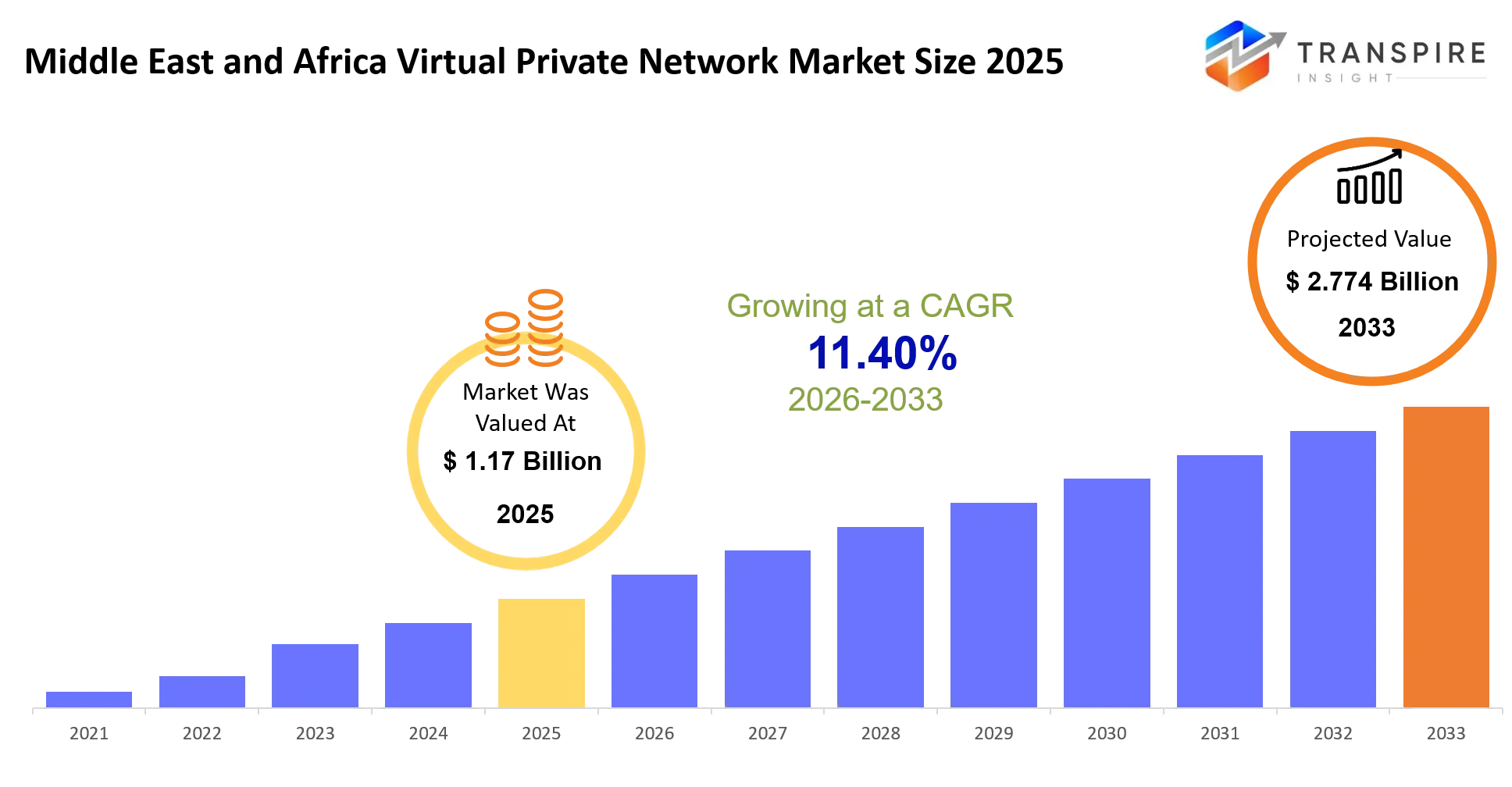
Middle East and Africa Virtual Private Network Market Summary
The Middle East and Africa Virtual Private Network Market was valued at USD 1.17 Billion in 2025. It is forecast to reach USD 2.774 Billion by 2033. That is a CAGR of 11.40% over the period.
In practice, VPN services across the Middle East and Africa are used, kind of, to secure cross-border business communication, guard sensitive financial transactions, and help keep stable access to restricted enterprise systems over fragmented digital infrastructure. They address the everyday problem of unsafe public networks, and also that messy, inconsistent regulatory access between jurisdictions, in particular for multinational firms and remote workforces operating between financial hubs like the UAE and newer African digital economies.
Over the last 3–5 years, there’s been a real structural shift toward cloud-native VPN architectures that, in many cases, replaced the traditional deployments that were heavy on hardware. This has made it easier and quicker to scale for distributed enterprises. At the same time, increased geopolitical tensions, plus stricter data localization rules, have pushed organizations to reroute traffic through encrypted tunnels to stay compliant and maintain operational continuity. Together, cloud migration and regulatory fragmentation have increased enterprise adoption directly, because businesses are prioritizing secure hybrid connectivity, to avoid downtime, reduce data exposure, and handle cross-border access restrictions. In the end this strengthens those recurring revenue streams for solution providers.
Key Market Insights
- Middle East and Africa Virtual Private Network Market size is kind of driven by enterprise cloud migration, and the adoption of secure remote connectivity, yes across BFSI as well as government sectors during 2025–2033, more or less
- Meanwhile market is seeing a noticeable demand shift toward cloud VPNs, with an estimated 35–40% share of deployments in 2025 across big enterprises
- For remote access VPN, it dominates because hybrid work keeps expanding, which pushes it to nearly 45% usage share in enterprise connectivity models, roughly speaking
- Site-to-site VPN stays as the second-largest segment, and it’s widely deployed in multinational orgs and also in regional banking networks
- Mobile VPN is the fastest-growing segment though, climbing above 12% in annual deployment increase, mainly as mobile-first workforce expansion grows in Africa
- On the end-user side, government holds a big chunk above 30% , since national cybersecurity frameworks plus public sector digitization programs keep reinforcing it
- SMEs are the fastest-moving category as well, because subscription-based VPN services lower upfront infrastructure costs, compared to older setups
- Security application leads the Middle East and Africa Virtual Private Network Market with over 50% share , largely tied to rising cyberattack frequency
- Gaming and streaming applications are also starting to gain traction, especially among urban youth populations, plus telecom-led bundled VPN offerings make it easier
- Key players like NordVPN, ExpressVPN, Cisco, Fortinet, and Palo Alto Networks are helping drive innovation in encrypted enterprise connectivity, overall
What are the Key Drivers, Restraints, and Opportunities in the Middle East and Africa Virtual Private Network Market?
The main driver behind the Middle East and Africa Virtual Private Network Market is basically accelerated enterprise digital transformation, backed by cloud migration and a hybrid workforce that keeps growing. Lots of organizations in banking, telecom, and government really have moved core processes into more distributed environments, and because of that they need encrypted access layers, to keep communication stable and secure between branch locations and cloud platforms. Because of this whole shift, subscription demand for VPN services keeps rising again and again , since companies care more about continuous uptime plus regulatory compliance than those older legacy network arrangements.
Now a big restraint is the inconsistent regulatory alignment across different countries. It kind of turns cross-border VPN infrastructure into a deployment puzzle. In fact some governments push strict data localization rules plus encryption controls, so multinational businesses cannot just use the same standardized VPN configurations everywhere. This structural limitation ramps up compliance expenses and makes large-scale rollouts slower, especially for enterprises working across Gulf Cooperation Council markets and different African regulatory zones, where the policy frameworks feel very different.
There’s also an emerging opportunity, and it’s in how VPN systems can be integrated with zero-trust network access architectures, plus AI-driven threat monitoring. Financial services, and even oil and gas operators, are putting more money into adaptive security layers that mix identity verification with encrypted tunneling. That combo gives strong momentum for vendors who can offer integrated security platforms, particularly in high-growth digital economies like the UAE and South Africa, where cloud-first enterprise ecosystems are expanding quite fast.
What Has the Impact of Artificial Intelligence Been on the Middle East and Africa Virtual Private Network Market?
Artificial intelligence is doing a lot of work on VPN infrastructure in the Middle East and Africa, mostly by making automated traffic routing feel less rigid, doing anomaly detection in a more constant way, and then balancing network load across distributed enterprise setups that don’t really agree with each other. Security providers are moving toward machine learning models that keep watching traffic patterns, looking for odd login behavior, or even, signs of intrusion tries. This helps teams respond quicker and contain cyber threats faster, especially in high-risk areas like banking and energy.
On the operational side, AI-driven processes are also squeezing better bandwidth allocation out of the system by steering encrypted traffic through the least congested nodes. That approach tends to cut latency for users who are far away, and the effect is often noticeable in real life not just in reports. Predictive analytics is being used too, to guess network failures before they fully happen, and to adjust server distribution in advance so uptime stays steadier for multinational enterprises that run cross-border operations. In certain enterprise rollouts, these kinds of improvements have been linked with better connection stability and lower downtime, sometimes around 20–25% in hybrid cloud environments.
Still, the take up is limited, largely because real-time training data is not always available, and regional networks are fragmented. Connectivity can also be inconsistent across multiple African infrastructure zones, so the models don’t always learn the same “shape” of traffic. On top of that, many VPN providers hit high integration costs when they try to plug AI modules into older systems, especially when the environment is on premises for enterprise deployments. Even so, AI integration is gradually becoming a key differentiator for newer encrypted connectivity platforms, even if the path to it is a bit uneven at first.
Key Market Trends
- From 2022–2025 cloud VPN adoption rose pretty sharply, sort of replacing hardware-based systems in almost 40% of large enterprises, not in one clean jump though.
- Remote access VPN use also spread across hybrid teams, especially in financial services and telecom, and by 2025 it was noticeable.
- At the same time , government driven cybersecurity mandates pushed a stronger need for encrypted connectivity throughout UAE and Saudi Arabia enterprise ecosystems, this part felt more direct than before.
- Then there’s Mobile VPN traffic which grew a lot, largely because smartphone based business operations became normal across African SME ecosystems over 2024–2026, you could say it kept compounding.
- Meanwhile site-to-site VPN deployments edged down a little in new contracts, but they’re still crucial for legacy banking infrastructure networks, even if budgets moved elsewhere.
- More recently, zero trust integration trends sped up in 2025, as companies paired identity verification and encrypted tunnels together rather than treating them separate.
- Competitive pricing pressure also increased because subscription based VPN models kept expanding across SME customer groups, which made procurement teams a bit more picky.
- Enterprises also started leaning toward multi-cloud VPN compatibility spanning AWS, Azure, and other hybrid environments, rather than one vendor lock in approach.
- On the security side, security first VPN architecture adoption rose, driven by the rising ransomware incidents hitting regional enterprises.
- Finally , Fortinet and Cisco expanded their secure SD-WAN offerings, aimed at tightening enterprise VPN convergence strategies.
Middle East and Africa Virtual Private Network Market Segmentation
By Type
Remote Access VPN kind of dominates enterprise adoption because the hybrid workforce is expanding everywhere, banking IT and government sectors too. It’s like this need for secure employee connectivity across far flung sites keeps the demand steady and predictable. For larger multinational setups, Site-to-site VPN still helps with inter branch communication, especially for those operating across GCC plus parts of African markets. Mobile VPN adoption is also climbing quickly, mostly because the workforce is smartphone based now in logistics and in field services, so the access has to move with them. Then there is Cloud VPN, it’s showing solid growth as enterprises shift their infrastructure toward multi cloud platforms, rather than staying boxed in. Meanwhile SSL VPN stays pretty common for browser based secure access, especially in SMEs. The other VPN types end up serving more niche industrial needs or older legacy infrastructure setups, where the requirements are very specific.
In the Middle East and Africa Virtual Private Network Market by type, the direction keeps shifting toward cloud led and mobile first connectivity patterns. Enterprises are prioritizing scalable VPN systems that cut down on hardware dependency and also improve how fast they can deploy everything. Overall demand for remote access and cloud VPN keeps growing faster than the traditional site-to-site model. SMEs are increasingly going for subscription based VPN services, mainly because the entry cost is lower and the setup feels simpler. Government agencies continue to lean on SSL and secure remote access tools to support public service digitization.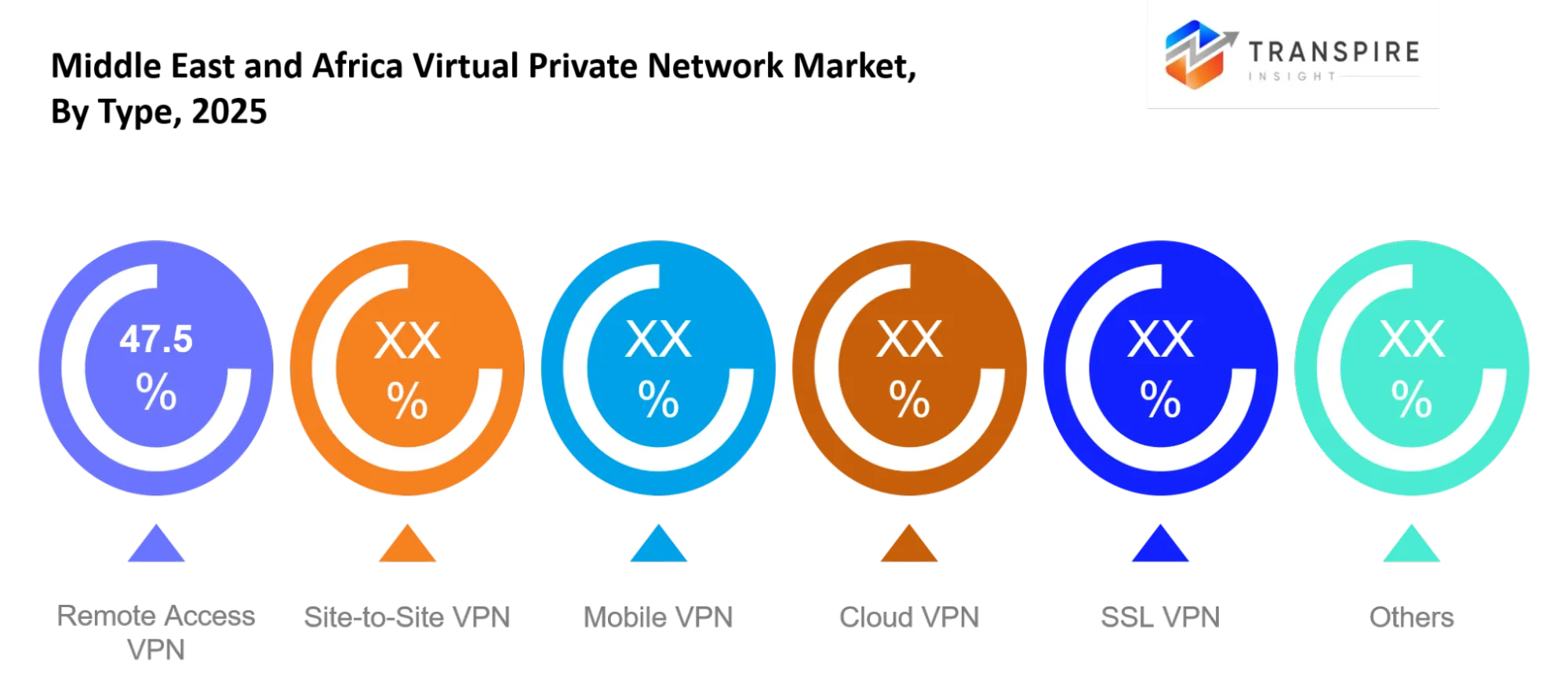
By Deployment
Cloud deployment drives market adoption because enterprises are rushing toward SaaS and, well, the hybrid cloud setup that everyone is talking about. Still, on-premise deployment never fully goes away, especially in defense , banking and other regulated industries where data governance is not optional and needs tight control. Hybrid deployment is getting more love from big companies as they try to keep both security and scalability in place across multiple regions. Some other deployment models also show up, mostly when the infrastructure is specialized and legacy integration is still a real, practical requirement.
In the Middle East and Africa Virtual Private Network Market, deployment trends show a pretty obvious shift toward cloud-first architectures. Organizations are trying to reduce their reliance on physical infrastructure, while at the same time boosting scalability and making remote access less painful. On-premise systems do continue, particularly in government networks where compliance rules are strict ,almost by default. Hybrid approaches also gain traction because enterprises want more operational flexibility, without giving up data sovereignty or oversight.
By End User
Large enterprises dominate the scene, mostly because they run a lot of cross-border activity and therefore need secure encrypted conversation channels. SMEs are still the fastest growing segment, kind of simply because affordable VPN subscriptions make digital transformation feel doable, and not like some huge barrier. Government agencies keep adoption strong too, they’re pushed by cybersecurity frameworks and big national digital infrastructure initiatives. People, on the other hand, typically use VPN services for safer browsing, privacy protection, and a bit of peace of mind. Other end-user groups, like universities and educational institutions, plus managed service providers, also show meaningful usage.
End-user segmentation in the Middle East and Africa Virtual Private Network market points to a rising digital dependency, across different company sizes and roles. Enterprises tend to stress security, regulatory adherence, and governance. SMEs lean toward cost-friendly connectivity, aiming for practicality over complexity. Government demand stays fairly consistent, largely tied to ongoing infrastructure modernization programs. Individual users add steady momentum, driven by mobile internet penetration and privacy worries that don’t seem to fade.
By Application
Security still kind of dominates the application picture , because enterprises keep prioritizing defense against cyber threats and those painful data breaches. At the same time, remote work applications are expanding fast, mostly due to hybrid workforce models that stretch across IT, and also financial services. Meanwhile streaming apps are getting more attention among consumers in city areas . Gaming VPN usage is also climbing in a fairly steady way, largely because people need latency optimization and smoother connections. Privacy protection keeps picking up momentum with individual users too, like it’s becoming a habit. Other types of usage still matter , for example secure cloud access, plus enterprise data transfer and related movement.
In the Middle East and Africa Virtual Private Network Market, the application trends point clearly toward a stronger security-centric, and remote connectivity oriented direction. Enterprises are leaning on VPNs more and more, especially for safe hybrid operations. For consumer demand, streaming and gaming kind of push the numbers upward, bit by bit. At the same time , privacy focused use is growing as digital awareness rises across younger populations, and they seem more intentional about what they share .
What are the Key Use Cases Driving the Middle East and Africa Virtual Private Network Market?
Enterprise secure remote access is still the go-to use case i think, letting staff in banking , energy, and telecom connect in a safe way to internal systems across spread out sites. it keeps pulling the most demand, mostly because the hybrid work setup is growing and cross-border operations keep showing up everywhere too.
For the secondary angle, there is inter-office connectivity for multinational companies and also secure data exchange between cloud platforms in regulated environments. this part is tightly tied to enterprise IT efforts and government digital transformation programs, where encrypted communication basically keeps compliance on track and supports day to day operational continuity, even when things shift.
Then there are the newer, emerging uses: mobile workforce security for people doing field operations and privacy-oriented consumer applications in streaming and gaming. these are getting more momentum as mobile internet keeps expanding, and as latency-sensitive services become more dependent on optimized encrypted routing, which sounds simple but it’s actually a big deal.
|
Report Metrics |
Details |
|
Market size value in 2025 |
USD 1.17 Billion |
|
Market size value in 2026 |
USD 1.303 Billion |
|
Revenue forecast in 2033 |
USD 2.774 Billion |
|
Growth rate |
CAGR of 11.40% from 2026 to 2033 |
|
Base year |
2025 |
|
Historical data |
2021 - 2024 |
|
Forecast period |
2026 - 2033 |
|
Report coverage |
Revenue forecast, competitive landscape, growth factors, and trends |
|
Regional scope |
Middle East and Africa (Saudi Arabia, United Arab Emirates, South Africa, Rest of Middle East and Africa) |
|
Key company profiled |
NordVPN, ExpressVPN, Surfshark, Proton VPN, Cisco, Palo Alto Networks, Fortinet, Check Point, OpenVPN, Perimeter 81, Zscaler, Microsoft, Google, IBM, Oracle |
|
Customization scope |
Free report customization (country, regional & segment scope). Avail customized purchase options to meet your exact research needs. |
|
Report Segmentation |
By Type (Remote Access VPN, Site-to-Site VPN, Mobile VPN, Cloud VPN, SSL VPN, Others); By Deployment (Cloud, On-Premise, Hybrid, Others); By End User (Individuals, SMEs, Large Enterprises, Government, Others); By Application (Security, Remote Work, Streaming, Gaming, Privacy Protection, Others) |
Which Regions are Driving the Middle East and Africa Virtual Private Network Market Growth?
The Middle East leads the Middle East and Africa Virtual Private Network Market, largely because of strong regulatory enforcement , more advanced digital infrastructure, and high enterprise cloud uptake across Gulf economies. In places like the UAE and Saudi Arabia, a lot has been poured into cybersecurity frameworks that back encrypted enterprise messaging. Then add strong telecom backbone plus ongoing data center growth, and yeah , it becomes easier to see why the region stays dominant.
Africa, meanwhile, acts as a steadier yet still changing contributor, with things like incremental upgrades to internet infrastructure, and rising SME digital adoption. Different from the Middle East , growth is pushed more by mobile-first connectivity and budget sensitive subscription based VPN options, not so much by huge enterprise rollouts. Still, economic diversification in places like South Africa and Kenya keeps demand ticking along.
North Africa looks like the fastest-growing region, driven by newer investments in digital infrastructure, widening fintech ecosystems, and more cross border trade digitization. Better undersea cable links, plus government backed digital economy efforts, are speeding up VPN take up. As a result, vendors aiming at emerging enterprise security requirements can find solid entry openings there.
Who are the Key Players in the Middle East and Africa Virtual Private Network Market and How Do They Compete?
Competition in the Middle East and Africa Virtual Private Network market is kinda moderately fragmented, with big cybersecurity brands moving head to head with consumer VPN providers . Most of the differentiation comes from encryption strength, network performance, cloud onboarding ability, and enterprise service tailoring, not just pricing alone.
NordVPN and ExpressVPN mostly pitch consumer privacy and fast, encrypted web navigation, and they lean on broad server coverage to keep latency lower, even when traffic has to cross borders. Cisco, on the other hand, leans into enterprise VPN integration right inside its networking hardware and SD-WAN setups, which supports its standing in big company rollouts. Fortinet differentiates by bundling cybersecurity pieces together , like firewall, VPN, and threat intelligence, into one more unified platform. Palo Alto Networks pushes enterprise adoption using a cloud-first security design, plus zero-trust network access style solutions.
They also tend to grow by building partnerships with telecom operators, cloud providers, and regional enterprises, so market penetration gets boosted rather quickly.
Company List
- NordVPN
- ExpressVPN
- Surfshark
- Proton VPN
- Cisco
- Palo Alto Networks
- Fortinet
- Check Point
- OpenVPN
- Perimeter 81
- Zscaler
- Microsoft
- IBM
- Oracle
Recent Development News
In June 2026, ExpressVPN announced its role as an Official Tournament Supporter of the FIFA World Cup 2026, marking a major strategic partnership focused on securing public Wi-Fi usage and streaming privacy during high-traffic international events. The move strengthens VPN adoption awareness in travel-heavy corridors, including Middle East transit hubs and African streaming markets, where unsecured networks are widely used during large-scale events. The partnership is expected to accelerate consumer VPN penetration by linking cybersecurity protection with live sports engagement and digital broadcasting demand.
https://www.techradar.com
In 2025, NordVPN expanded its cybersecurity stack by deploying post-quantum encryption capabilities and enhancing its Threat Protection Pro suite to counter AI-driven phishing and malware attacks. This upgrade strengthens secure tunneling performance for enterprise and consumer users, particularly relevant in Middle East and Africa markets where financial services and telecom operators face rising encrypted traffic security requirements. The enhancement improves resilience against future cryptographic threats, reinforcing enterprise trust in VPN-based remote access systems.
https://www.techradar.com
In early 2025–2026 rollout phase, ExpressVPN launched a hybrid VPN browser extension and expanded into Meta Quest VR environments, enabling split-mode encrypted browsing and full-device protection for immersive applications. This innovation supports demand for lightweight, application-level VPN usage, which is increasingly relevant in mobile-first African markets and digitally expanding Gulf economies. The feature enhances flexibility in encrypted connectivity, allowing users to switch between proxy-style routing and full VPN protection depending on bandwidth and latency requirements.
https://www.techradar.com
What Strategic Insights Define the Future of the Middle East and Africa Virtual Private Network Market?
The Middle East and Africa Virtual Private Network Market is kind of shifting, more and more, toward cloud integrated zero trust security ecosystems, driven by distributed enterprise operations and tighter data governance frameworks. You can see growth getting anchored in hybrid workforce connectivity, and also in multi cloud enterprise architecture take up across regulated industries, where it really matters.
But there is a quieter risk too, regulatory fragmentation is rising. Different countries enforce different encryption and data residency rules, and that may end up forcing vendors to run several infrastructure variants, which makes operations messier, and it can slow scalability. Meanwhile, a not so obvious opportunity is showing up in the convergence between VPN systems and wider cybersecurity platforms, especially zero trust and AI led threat detection layers that plug directly into enterprise networks.
Market players should put emphasis on unified security architectures, where VPN, identity management, and cloud access controls are brought together rather than kept separate. Also vendors that match up early with telecom operators and cloud hyperscalers will likely be in a stronger spot to win those long term enterprise contracts across the 2026–2033 growth window.
Middle East and Africa Virtual Private Network Market Report Segmentation
-
By Type
Remote Access VPN
Site-to-Site VPN
Mobile VPN
Cloud VPN
SSL VPN
Others -
By Deployment
Cloud
On-Premise
Hybrid
Others -
By End User
Individuals
SMEs
Large Enterprises
Government
Others -
By Application
Security
Remote Work
Streaming
Gaming
Privacy Protection
Others
Frequently Asked Questions
Find quick answers to common questions.
The Expected Middle East and Africa Virtual Private Network Market size for the Market will be USD 2.774 Billion in 2033.
Key Segments for the Middle East and Africa Virtual Private Network Market are By Type (Remote Access VPN, Site-to-Site VPN, Mobile VPN, Cloud VPN, SSL VPN, Others); By Deployment (Cloud, On-Premise, Hybrid, Others); By End User (Individuals, SMEs, Large Enterprises, Government, Others); By Application (Security, Remote Work, Streaming, Gaming, Privacy Protection, Others).
Major Middle East and Africa Virtual Private Network Market Players are NordVPN, ExpressVPN, Surfshark, Proton VPN, Cisco, Palo Alto Networks, Fortinet, Check Point, OpenVPN, Perimeter 81, Zscaler, Microsoft, Google, IBM, Oracle.
The Current Middle East and Africa Virtual Private Network Market size is USD 1.17 Billion in 2025.
The Middle East and Africa Virtual Private Network Market CAGR is 11.40% from 2026 to 2033.
- NordVPN
- ExpressVPN
- Surfshark
- Proton VPN
- Cisco
- Palo Alto Networks
- Fortinet
- Check Point
- OpenVPN
- Perimeter 81
- Zscaler
- Microsoft
- IBM
- Oracle
About the Authors

Mayur Shinde
I am Mayur Shinde, a Senior Research Analyst at Transpire Insight, specializing in the Automotive & Transportation and Information & Communication Technology (ICT) Industry. My work focuses on analyzing emerging market trends, technological advancements, competitive landscapes, and industry developments to deliver accurate, data-driven insights. I am passionate about transforming complex market information into clear, actionable content that helps businesses, professionals, and decision-makers stay informed and make confident strategic decisions.

Chakradhar Khansole
Chakradhar serves as the Research Director at Transpire Insight, bringing over 8 years of experience in technology, innovation, and strategic market intelligence. He specializes in transforming complex market data into actionable business insights that enable organizations to make informed, growth-oriented decisions. Recognized for his strategic vision and analytical expertise, Chakradhar leads high-impact research initiatives, delivering comprehensive market assessments, competitive intelligence, and forward-looking industry analysis.
Recently Published Reports
-
Apr 2026
3D Optical Profiler Market
3D Optical Profiler Market Size, Share & Analysis Report By Type (Desktop 3D Optical Profiler, and Portable 3D Optical Profiler), By Technology (Confocal Technology, and White Light Interference), By End-Use Industry (Manufacturing, Research Institutions, Automotive, Aerospace and Defense, Medical Devices, and Other), and Geography (North America, Europe, Asia-Pacific, Middle East and Africa, South and Central America), 2021 - 2031
-
Apr 2026
Depth Sensor Market
Depth Sensor Market Size, Share & Analysis Report By Type (Infrared Depth Sensors, Time-of-Flight (ToF) Sensors, Stereo Vision Sensors, Structured Light Sensors, Ultrasonic Depth Sensors), By Application (Automotive, Robotics, Gaming, Consumer Electronics, Industrial Automation, Healthcare, Security & Surveillance, Others), By End Users (Automotive Manufacturers, Consumer Electronics Companies, Healthcare Providers, Industrial Companies, Security Agencies, Gaming Companies, Robotics Companies, Others), and Geography (North America, Europe, Asia-Pacific, Middle East and Africa, South and Central America), 2021 – 2031
-
Apr 2026
Digital Manufacturing Market
Digital Manufacturing Market Size, Share & Analysis Report By Component (Hardware, Software, and Services), By Technology (Robotics, 3D Printing, Internet of Things (IoT), and Others), By Application (Automotive and Transportation, Aerospace and Defense, Consumer Electronics, Industrial Machinery, and Others), By Process Type (Computer-Based Designing, Computer-Based Simulation, Computer 3D Visualization, Analytics, and Others), and Geography (North America, Europe, Asia-Pacific, Middle East and Africa, South and Central America), 2021 – 2031
-
Apr 2026
Digital Visa Services Market
Digital Visa Services Market Size, Share & Analysis Report By Type (Individual Travelers, Group Travelers), By Application (Tourism, Business Travel, Others), and Geography (North America, Europe, Asia-Pacific, Middle East and Africa, South and Central America), 2021 – 2031