

Middle East and Africa Travel Insurance Market Size & Forecast:
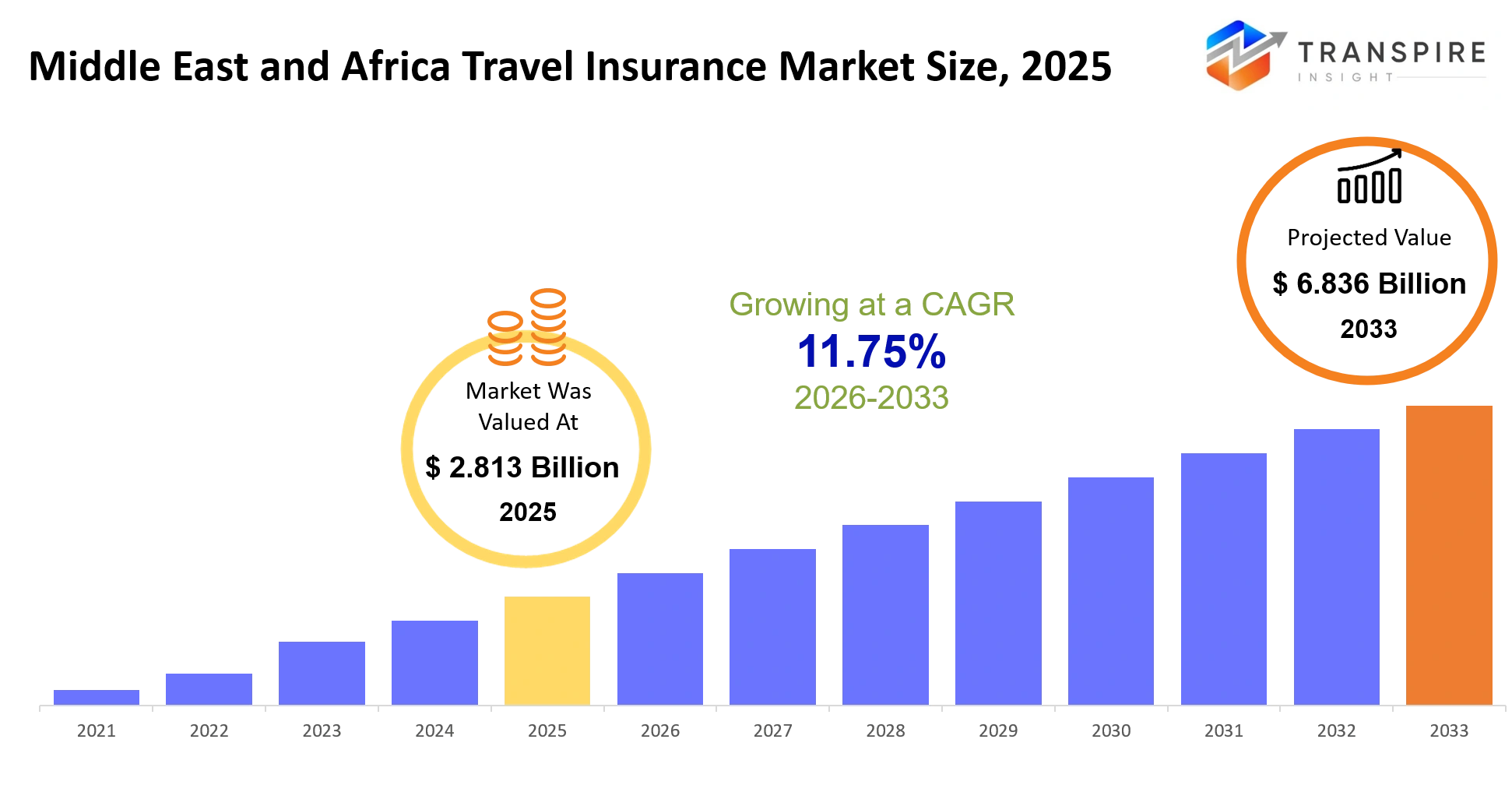
- Middle East and Africa Travel Insurance Market Size 2025: USD 2.813 Billion
- Middle East and Africa Travel Insurance Market Size 2033: USD 6.836 Billion
- Middle East and Africa Travel Insurance Market CAGR: 11.75%
- Middle East and Africa Travel Insurance Market Segments: By Insurance Type (Single Trip, Multi Trip, Medical Travel Insurance, Student Travel Insurance, Others); By Distribution Channel (Online, Insurance Agents, Banks, Others); By End User (Leisure Travelers, Business Travelers, Students, Others).
Middle East and Africa Travel Insurance Market Summary
The Middle East and Africa Travel Insurance Market was valued at USD 2.813 Billion in 2025. It is forecast to reach USD 6.836 Billion by 2033. That is a CAGR of 11.75% over the period.
The Middle East and Africa travel insurance market, helps international and regional travelers stay covered for medical emergencies, trip disruptions , and even evacuation costs that might pop up during cross-border movement, especially when access to care, or the cost structures of healthcare, look different from place to place. In practice it lets travelers insurers and travel operators deal with financial exposure in mobility situations that can feel pretty unpredictable.
Over the last 3–5 years the whole market has been moving in a more structural way toward digital-first distribution, often via airline integrations and mobile based policy issuance, so there is less dependence on old-school sales via travel agents. One big turning point was the COVID-19 pandemic, it really showed where emergency medical coverage had gaps, and it basically pushed insurers to rework policies around wider health protection and stronger cancellation cover. Also the rebound in global travel, plus stricter insurance rules tied to visa processes in a number of Gulf countries, sped up adoption further. Together these forces have boosted embedded insurance, which in turn lifts conversion rates and makes this type of coverage a normal part of travel, rather than just an extra option someone might add later.
Key Market Insights
- The Middle East pretty much dominates the Middle East and Africa Travel Insurance Market, so roughly ~60% share seems right, because outbound tourism is strong and, well , insurance is tied up with visa rules in a bunch of places.
- In the UAE and Saudi Arabia you can see the clearest regional pull , with demand led by people who travel internationally a lot, plus a steady uptick in premium policy adoption.
- Africa is the quickest mover across the forecast, helped by better air connectivity and more middle-class travelers who actually want to move around.
- Single-trip coverage is the main kind across the Middle East and Africa Market, mainly from the volume of leisure getaways and those short run international stays.
- Multi-trip yearly policies come next, still taking the second spot, favored by frequent business travelers and also by corporate mobility initiatives.
- Medical travel insurance is growing the fastest segment, largely because healthcare bills abroad are becoming a bigger worry during international trips.
- Leisure travel stays in the lead as the biggest application, representing the largest slice of policy purchases along the main outbound tourism routes.
- Business travel, however, is the fastest-growing application, backed by corporate travel coming back and risk-reduction requirements.
- For end users, individual travelers are out front, since retail policies get picked up heavily through online booking channels.
- Student travelers are the fastest-growing category, driven by rising international study movement from MEA countries, and honestly it keeps expanding.
What are the Key Drivers, Restraints, and Opportunities in the Middle East and Africa Travel Insurance Market?
Driver:
- The main growth driver seems to be the way travel insurance is getting woven into visa issuance systems and airline booking platforms across the GCC , and also in several key African aviation hubs. In places like the UAE and Saudi Arabia, governments have tightened the insurance requirements for both tourist and business visas, especially after the pandemic where the financial burden of urgent medical care abroad became hard to ignore. So this policy change has sort of increased attachment rates right at the moment someone purchases a ticket, and that turns insurance from a “maybe later” add-on into this default transaction. From there, insurers are seeing better conversion efficiency , and their premium inflows look more stable or at least more predictable.
Restraint:
- A big structural restraint is that insurance penetration still stays low in multiple African economies. It’s tied to informal travel habits and also limited digital payment infrastructure, which basically slows down the uptake of policies. This issue is not just surface level, it is embedded in financial accessibility and distribution limitations, so it’s difficult to fix quickly, or to resolve at once. The outcome is suppressed revenue potential, especially in intra-regional travel segments where risk coverage is underwritten too lightly or sometimes just missing completely.
Opportunity:
- The next phase of growth is starting to form through embedded insurance partnerships with digital travel ecosystems, plus fintech platforms. For instance, airline-led super apps in the Middle East and mobile-first travel booking platforms across Africa are beginning to bundle micro-duration coverage at checkout. The model is supported by real-time API based underwriting , so it should expand micro-policy adoption in a meaningful way. And in turn, it can unlock mass-market travelers that were previously not really reached or still effectively untapped.
What Has the Impact of Artificial Intelligence Been on the Middle East and Africa Travel Insurance Market?
Artificial intelligence along with more advanced digital technologies is quietly reshaping the Middle East and Africa travel insurance market,mostly by making underwriting feel more precise, moving claims handling faster, and supporting real-time risk assessment across travel ecosystems that are becoming more and more digital.
In day to day practice, automation shows up most clearly inside AI based claims management systems and digital underwriting engines,which are used by insurers and travel platforms alike. These systems can verify policy validity by themselves,they also review documentation,then they flag potential fraudulent claims within seconds. Because of that, there’s less manual work, and settlement timelines slip from multiple days down to hours,not in a dramatic way but still noticeably. Customers also feel it at the point of disruption,especially when it comes to flight delays and medical emergency claims, where speed really matters.
At the same time predictive capabilities are being built in through machine learning models that look at past disruption records, weather conditions, and geopolitical risk signals. The models assist insurers in estimating trip cancellation likelihood, in refining pricing approaches,and in adjusting coverage exposure more or less on the fly. For high volume travel corridors across the Middle East, this has helped tighten pricing accuracy and bring down loss ratios,which in turn supports more sustainable premium growth.
Still, adoption is not fully smooth, and it is constrained by uneven data quality plus fragmented digital infrastructure in parts of Africa. When airlines, insurers, and local travel agents don’t integrate well, real time data sharing slows down. On top of that, implementation costs can be high enough that smaller insurers hesitate,so AI deployment tends to concentrate among large global providers, rather than across the whole regional market.
Key Market Trends
- Visa-linked insurance rules across GCC nations pushed up the compulsory policy take-up rates by almost 40% since 2021, and it kinda changed the way people buy while they are still booking. Booking behavior now looks different right at the start, not just later in the trip.
- Meanwhile the old agent-led sales approach kept shrinking, especially as online travel agencies started weaving in real time insurance APIs between 2020 and 2025 across major airline sites. So basically, fewer conversations, more direct checkout flow.
- Allianz Partners together with AXA also widened their embedded insurance deals with airlines, and distribution moved further toward automated checkout style policy issuance systems. It’s like the product shows up while you are paying, then it just becomes a policy.
- After the 2020 pandemic reforms, there was broader medical evacuation coverage, which raised the average policy value a lot across international travel corridors. You could see it as a measurable uptick, not only a wording tweak.
- Digital-first insurers cut claims processing time from several days down to under 24 hours, using AI based document verification systems since 2022. That speed change is pretty significant for travelers who need results fast.
- In African markets, there’s been a slow but steady move away from cash only travel bookings toward mobile payment enabled insurance purchases, via fintech integrated travel platforms. More people can buy instantly, without waiting for a payment desk or something similar.
- Generali and AIG then strengthened their regional presence through airline collaborations, improving penetration in busy Middle East travel hubs. High traffic routes gained better visibility for the coverage options too.
- Machine learning risk scoring started replacing those fixed or static pricing models, so premiums could adjust dynamically based on live travel disruption data. Instead of one price for everyone, it changes with conditions.
- And between 2022 and 2025, travel insurers increasingly shifted from standalone products into bundled offerings inside airline and hotel ecosystems. So the insurance becomes part of a bundle, not this separate item you have to hunt for.
Middle East and Africa Travel Insurance Market Segmentation
By Insurance Type:
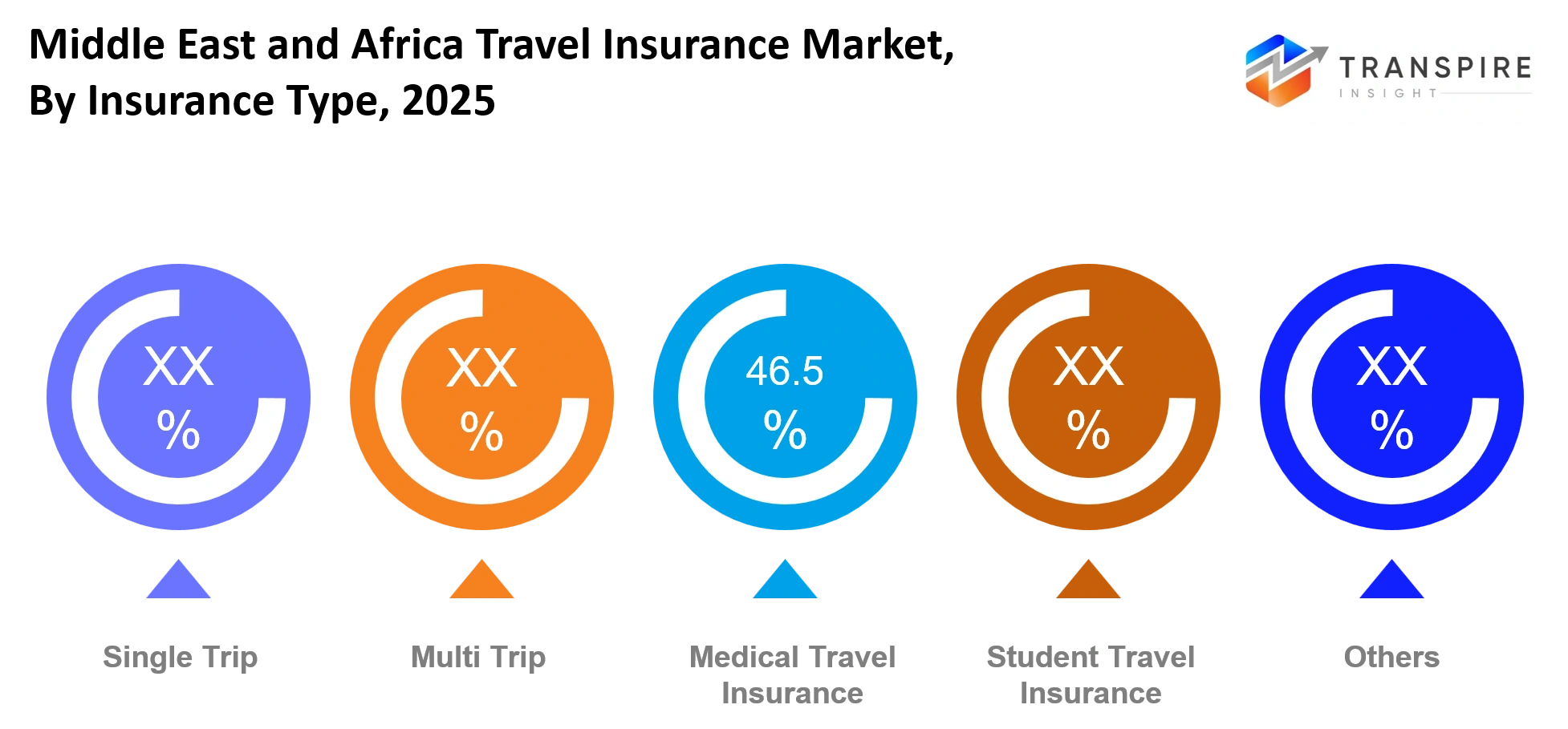
Single Trip insurance still takes the biggest slice, partly because people keep doing lots of short term international trips out of Middle East and Africa areas. The demand looks high for leisure trips and seasonal movement, tied to tourism waves and holiday migrations, so it kinda repeats every year. Multi Trip insurance stays quite steady too, especially for frequent flyers, corporate travelers, and expat workers who travel on a more routine basis. Medical Travel Insurance shows the quickest jump in adoption as overseas healthcare costs keep rising and stronger risk protection feels necessary. Student Travel Insurance is also growing, linked to more international studying flows from Gulf and parts of Africa. Product innovation seems to land on two things, flexible coverage options and quicker digital policy issuance through online booking platforms. Going forward insurers will keep tuning pricing models to reflect travel risk changes and medical cost inflation at major travel corridors.
By Distribution Channel:
Online channels lead distribution, mainly because they plug into airline booking systems and broader travel platforms used across key airports. Now digital checkout systems reduce manual policy issuance, and they also lift conversion rates right when people buy tickets. Insurance agents still matter for customers who prefer a more traditional setup, especially where digital payment uptake is lower. Bank partnerships help a lot as well, with bundled travel insurance linked to credit card travel perks. There’s also a structural shift toward API based embedded insurance models, which has lowered reliance on standalone sales channels since 2020. Technology driven platforms make it easier for customers to compare policies, submit claims, and get approval faster on high traffic routes. Competitive insurers will likely keep pushing for smoother digital integration, to improve customer acquisition efficiency without extra friction.
By end user:
It looks like leisure travelers are still the major customer group, mostly because outbound tourism stays strong and family trips remain in high demand across GCC and also across parts of Africa. Business travelers, meanwhile, seem to keep growing at a steadier pace, helped by corporate travel policies, and some cross border trade activity. Student travelers are expanding faster than most other groups, mainly due to enrollment growth at foreign universities and more education exchange programs that keep showing up.
For insurance adoption, the pattern is moving toward mandatory coverage rules, especially around visa processing across multiple destinations. At the same time digital platforms do the heavy lifting by making policy selection simpler, and they also improve access for first time international travelers, which is kind of a big deal. Demand signals now increasingly connect with risk awareness, like medical emergencies, and also exposure to travel disruption. Going forward, adoption will probably hinge on better affordability, and on wider digital access across these developing travel corridors.
What are the Key Use Cases Driving the Middle East and Africa Travel Insurance Market?
Leisure travel still feels like the main use case, kind of the thing most people anchor on, and it keeps getting a boost from the constant outbound tourism coming out of Gulf countries, plus Africa’s slowly rising international holiday movement. Those short duration trips abroad tend to make demand stay steady for single-trip coverage that basically covers medical emergencies cancellations, and all the usual travel disruption issues that pop up when plans go sideways. Also, in a number of Middle Eastern destinations, visa linked insurance requirements kinda nudge people into buying it, sometimes it’s effectively compulsory at the booking stage, and that helps raise conversion rates across both airline channels and OTA platforms.
On the business side, and also student mobility, things are growing too, mainly because corporate travel policies are being more strict, and enrollment in overseas education programs keeps climbing. Multinational companies more and more ask for coverage for employees moving between GCC trade hubs, while universities, education agencies, and admission teams start folding insurance into visa and acceptance steps. In practice these applications fit well with multi trip options, and the student focused policies, which supports repeat purchasing, and it also helps standardize the policy setup across different institutions.
Then there are the newer angles, like digital nomad travel coverage, plus those short term cross border work assignments that connect back to remote employment trends. Some fintech integrated travel platforms even make micro duration insurance possible for transit passengers and layover protection, especially in big aviation hubs. These use cases are starting to get noticeable attention, since airlines and digital platforms are testing flexible on-demand protection models for travel that’s, honestly, pretty fragmented and hard to predict.
|
Report Metrics |
Details |
|
Market size value in 2025 |
USD 78.2 Billion |
|
Market size value in 2026 |
USD 82.1 Billion |
|
Revenue forecast in 2033 |
USD 110.4 Billion |
|
Growth rate |
CAGR of 4.32% from 2026 to 2033 |
|
Base year |
2025 |
|
Historical data |
2021 - 2024 |
|
Forecast period |
2026 - 2033 |
|
Report coverage |
Revenue forecast, competitive landscape, growth factors, and trends |
|
Regional scope |
Middle East and Africa (Saudi Arabia, United Arab Emirates, South Africa, Rest of Middle East and Africa) |
|
Key company profiled |
Allianz, AXA, Zurich, AIG, Chubb, Generali, MetLife, Tokio Marine, RSA, Bupa, Cigna, Aviva, Prudential, Trawick, Seven Corners. |
|
Customization scope |
Free report customization (country, regional & segment scope). Avail customized purchase options to meet your exact research needs. |
|
Report Segmentation |
By Insurance Type (Single Trip, Multi Trip, Medical Travel Insurance, Student Travel Insurance, Others); By Distribution Channel (Online, Insurance Agents, Banks, Others); By End User (Leisure Travelers, Business Travelers, Students, Others). |
Which Regions are Driving the Middle East and Africa Travel Insurance Market Growth?
The Middle East leads the market due to strong regulatory frameworks tied to visa issuance and mandatory travel coverage across GCC countries. Governments in the UAE, Saudi Arabia, and Qatar enforce structured insurance requirements for inbound travelers, which directly increases policy penetration at the point of entry. A highly developed aviation network, anchored by global hubs such as Dubai and Doha, supports continuous passenger flow and strengthens distribution through airline-linked insurance products. Integrated digital booking systems across major carriers further sustain high adoption rates and ensure consistent premium generation.
Africa represents a stable but structurally different contributor to global revenue, supported by gradual expansion of regional aviation connectivity and cross-border travel within economic blocs such as ECOWAS and the East African Community. Unlike the Middle East, growth here depends less on mandatory insurance policies and more on improving affordability and financial inclusion. Mobile payment ecosystems and partnerships between insurers and fintech platforms improve accessibility in urban centers. This steady but incremental rollout of digital infrastructure supports consistent demand, particularly among leisure and business travelers operating between key African trade corridors.
Sub-Saharan Africa shows the fastest growth momentum due to recent investments in airport modernization and airline fleet expansion across Nigeria, Kenya, and Ethiopia. New bilateral air service agreements and improved regional connectivity have increased outbound travel volumes significantly since 2022. Governments and private operators are also introducing digital visa systems that streamline insurance integration at booking stages. For investors and market entrants, this region offers strong long-term upside as digital adoption and aviation capacity continue to expand through 2026–2033.
Who are the Key Players in the Middle East and Africa Travel Insurance Market and How Do They Compete?
Competition in the Middle East and Africa Travel Insurance Market shows a mixed structure, where a few global insurers hold strong control over high-value travel corridors while many smaller regional players compete in fragmented local segments. Incumbents focus on defending their position through airline integrations and long-term partnerships with travel platforms. At the same time, digital-first entrants disrupt traditional models by offering instant policy issuance and embedded insurance at checkout. The main basis of competition has shifted toward technology integration, speed of claims settlement, and distribution reach rather than pure pricing.
Allianz Partners follows a technology-led strategy by embedding insurance directly into airline and OTA booking flows across GCC carriers. This reduces customer drop-off and strengthens conversion at the point of purchase, giving it an edge in high-volume travel hubs. AXA focuses on product bundling and uses digital API connections to deliver real-time policy customization for medical and cancellation coverage, especially for frequent international travelers.
AIG differentiates through enterprise-grade travel risk solutions, targeting multinational firms that manage employee mobility across borders with structured coverage programs. Zurich Insurance Group strengthens its position through disciplined underwriting and strong penetration in corporate insurance hubs across the Middle East. Generali expands its reach by partnering with regional travel agencies and digital platforms, improving access to mid-tier leisure travelers across emerging African and Gulf travel routes.
Company List
- Allianz
- AXA
- Zurich Insurance Group
- AIG
- Chubb
- Generali
- MetLife
- Tokio Marine
- RSA Insurance Group
- Bupa
- Cigna
- Aviva
- Prudential
- Trawick International
- Seven Corners
Recent Development News
In May 2026, Generali completed strategic acquisition moves within its broader European and LAMEA insurance expansion strategy. The company strengthened cross-border travel and health insurance integration capabilities by consolidating distribution-linked insurance assets tied to travel intermediaries.
Source: https://www.atlas-mag.net
What Strategic Insights Define the Future of the Middle East and Africa Travel Insurance Market?
The Middle East and Africa Travel Insurance Market is moving toward a fully embedded distribution model where insurance becomes an automatic layer within travel booking, visa processing, and fintech ecosystems. This shift is driven by tighter visa-linked insurance enforcement in Gulf economies and the rapid digitization of airline and OTA platforms, which is steadily reducing standalone policy sales.
A less visible risk is rising concentration within a small group of global insurers controlling airline integrations and API infrastructure. This dependency could limit pricing flexibility and expose regional markets to systemic disruption if a few platform partnerships change or consolidate.
An emerging opportunity lies in micro-duration insurance tailored for transit passengers and short-stay travelers enabled by real-time API underwriting and digital visa systems. Select African aviation hubs and GCC airports are already piloting faster integration of insurance at entry points, which could redefine low-value, high-volume coverage models.
Market participants should prioritize building modular, API-first insurance systems that can integrate seamlessly with airlines, fintech apps, and government travel portals to secure long-term distribution relevance.
Middle East and Africa Travel Insurance Market Report Segmentation
By Insurance Type
- Single Trip Insurance
- Multi Trip Insurance
- Medical Travel Insurance
- Student Travel Insurance
- Others
By Distribution Channel
- Online
- Insurance Agents
- Banks
- Others
By End User
- Leisure Travelers
- Business Travelers
- Students
- Others
Frequently Asked Questions
Find quick answers to common questions.
The expected Middle East and Africa Travel Insurance Market size for the market will be USD 6.836 Billion in 2033.
Key segments for the Middle East and Africa Travel Insurance Market are By Insurance Type (Single Trip, Multi Trip, Medical Travel Insurance, Student Travel Insurance, Others); By Distribution Channel (Online, Insurance Agents, Banks, Others); By End User (Leisure Travelers, Business Travelers, Students, Others).
Major Middle East and Africa Travel Insurance Market players are Allianz, AXA, Zurich, AIG, Chubb, Generali, MetLife, Tokio Marine, RSA, Bupa, Cigna, Aviva, Prudential, Trawick, Seven Corners.
The Middle East and Africa Travel Insurance Market size is USD 2.813 Billion in 2025.
The Middle East and Africa Travel Insurance Market CAGR is 11.75% from 2026 to 2033.
- Allianz
- AXA
- Zurich Insurance Group
- AIG
- Chubb
- Generali
- MetLife
- Tokio Marine
- RSA Insurance Group
- Bupa
- Cigna
- Aviva
- Prudential
- Trawick International
- Seven Corners
About the Authors

Mayur Shinde
I am Mayur Shinde, a Senior Research Analyst at Transpire Insight, specializing in the Automotive & Transportation and Information & Communication Technology (ICT) Industry. My work focuses on analyzing emerging market trends, technological advancements, competitive landscapes, and industry developments to deliver accurate, data-driven insights. I am passionate about transforming complex market information into clear, actionable content that helps businesses, professionals, and decision-makers stay informed and make confident strategic decisions.

Chakradhar Khansole
Chakradhar serves as the Research Director at Transpire Insight, bringing over 8 years of experience in technology, innovation, and strategic market intelligence. He specializes in transforming complex market data into actionable business insights that enable organizations to make informed, growth-oriented decisions. Recognized for his strategic vision and analytical expertise, Chakradhar leads high-impact research initiatives, delivering comprehensive market assessments, competitive intelligence, and forward-looking industry analysis.
Recently Published Reports
-
Apr 2026
3D Optical Profiler Market
3D Optical Profiler Market Size, Share & Analysis Report By Type (Desktop 3D Optical Profiler, and Portable 3D Optical Profiler), By Technology (Confocal Technology, and White Light Interference), By End-Use Industry (Manufacturing, Research Institutions, Automotive, Aerospace and Defense, Medical Devices, and Other), and Geography (North America, Europe, Asia-Pacific, Middle East and Africa, South and Central America), 2021 - 2031
-
Apr 2026
Depth Sensor Market
Depth Sensor Market Size, Share & Analysis Report By Type (Infrared Depth Sensors, Time-of-Flight (ToF) Sensors, Stereo Vision Sensors, Structured Light Sensors, Ultrasonic Depth Sensors), By Application (Automotive, Robotics, Gaming, Consumer Electronics, Industrial Automation, Healthcare, Security & Surveillance, Others), By End Users (Automotive Manufacturers, Consumer Electronics Companies, Healthcare Providers, Industrial Companies, Security Agencies, Gaming Companies, Robotics Companies, Others), and Geography (North America, Europe, Asia-Pacific, Middle East and Africa, South and Central America), 2021 – 2031
-
Apr 2026
Digital Manufacturing Market
Digital Manufacturing Market Size, Share & Analysis Report By Component (Hardware, Software, and Services), By Technology (Robotics, 3D Printing, Internet of Things (IoT), and Others), By Application (Automotive and Transportation, Aerospace and Defense, Consumer Electronics, Industrial Machinery, and Others), By Process Type (Computer-Based Designing, Computer-Based Simulation, Computer 3D Visualization, Analytics, and Others), and Geography (North America, Europe, Asia-Pacific, Middle East and Africa, South and Central America), 2021 – 2031
-
Apr 2026
Digital Visa Services Market
Digital Visa Services Market Size, Share & Analysis Report By Type (Individual Travelers, Group Travelers), By Application (Tourism, Business Travel, Others), and Geography (North America, Europe, Asia-Pacific, Middle East and Africa, South and Central America), 2021 – 2031