
Middle East and Africa Tank Mix Adjuvants Market Summary
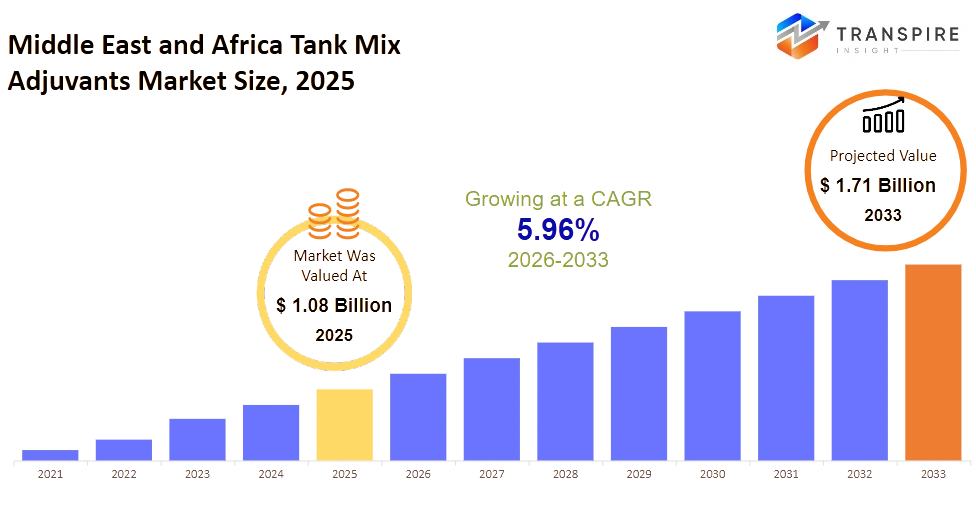
As per Transpire Insight Analysis the Middle East and Africa Tank Mix Adjuvants Market size is estimated at USD 1.08 Billion in 2025 and is anticipated to reach USD 1.71 Billion by 2033, growing at a CAGR of 5.96% from 2026 to 2033.
The Middle East and Africa Tank Mix Adjuvants Market, kinda plays an essential role in making crop protection products work better. It helps pesticides, herbicides, fungicides and foliar nutrients spread more evenly, stick to plant surfaces, and still perform well even when field conditions are rough or unpredictable. Because of this agricultural producers tend to rely on these formulations to cut down spray losses, make sure chemical compatibility is solid, and squeeze more value out of every input, all while keeping production costs under check.
Over the last five years the market has been moving toward precision agriculture practices, plus performance based spray solutions, which basically support higher productivity through optimized agrochemical use. At the same time, stricter regulations around pesticide application, along with supply chain disruptions after the Russia-Ukraine conflict, pushed growers to look at maximizing each and every spray event, rather than simply increasing chemical volumes. That shift really helped adoption of specialized adjuvant formulations speed up, driving steadier demand from commercial farming operations. And yes, it also supports continued revenue expansion.
The Middle East and Africa Tank Mix Adjuvants Market was valued at USD 1.08 Billion in 2025, and is projected to reach USD 1.71 Billion by 2033.
Middle East and Africa Tank Mix Adjuvants Market Size & Forecast:
- Middle East and Africa Tank Mix Adjuvants Market Size 2025: USD 1.08 Billion
- Expected Market Value 2033: USD 1.71 Billion
- Forecast CAGR: 5.96%
- Leading region in 2025:South Africa
- Fastest Growing Region: Saudi Arabia
- Key Profile: Corteva Agriscience, BASF, Bayer CropScience, Syngenta, Nufarm, Croda International, Evonik Industries, Solvay, Helena Agri-Enterprises, Brandt, Wilbur-Ellis, Loveland Products, Innvictis Crop Care, Precision Laboratories, Clariant
Key Market Insights
- The Middle East and Africa Tank Mix Adjuvants Market is growing because, precision agriculture keeps getting better and better, in terms of spray efficiency chemical compatibility, and actual field results across normal commercial farming operations.
- In South Africa, they’re saying it’s the biggest player, with about 31% of the market in 2025. That is backed by commercial agriculture, improved crop protection routines, and modern distribution systems that actually work on the ground.
- Saudi Arabia is expected to show the quickest expansion by 2033, mainly from investments into water-efficient agriculture, plus protected cultivation setups that reduce stress on crops.
- For product types, Activator Adjuvants take the largest slice, around 38%, while Utility Adjuvants stay in second place, mostly due to all the compatibility requirements that keep coming up.
- Surfactants are the fastest-growing product category during the forecast period, since spray coverage gets stronger, and chemical waste tends to drop.
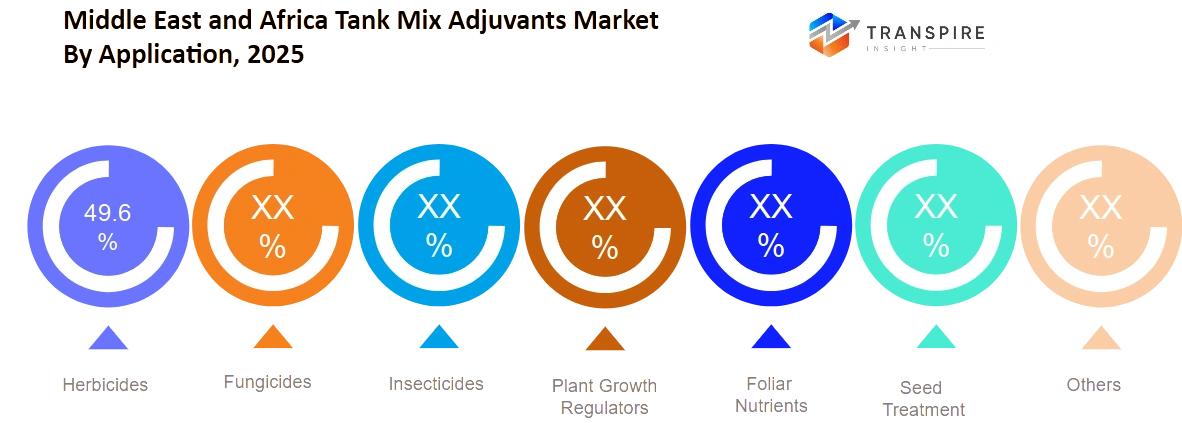
- When it comes to applications, herbicides still lead, holding nearly 44% market share, and this comes from broad use across cereal, grain, and plantation crop production.
- Foliar nutrient use is turning into the fastest-growing application segment too, because growers are trying to optimize micronutrient delivery in water-constrained farming situations, which is not easy.
- Looking at end users, commercial farms are the top segment with more than 55% share, and greenhouse cultivation is where the pace is quickest across Gulf countries.
- Key players such as Corteva Agriscience, BASF, Bayer CropScience, Syngenta, and Croda International are continuing to invest in formulation innovation, precision application technologies, and regional partnerships.
- Strategic expansion lately is also leaning toward low-drift formulations, water conditioning technologies, digital agronomy platforms, and more customized spray solutions that match local, regional climatic conditions.
What are the Key Drivers, Restraints, and Opportunities in the Middle East and Africa Tank Mix Adjuvants Market?
The main thing steering market expansion is the fast adoption of precision crop management within commercial agriculture, more or less. Water scarcity, rising agrochemical costs, and tighter rules on pesticide application have pushed growers to seek better spray effectiveness, not so much to add more chemicals. In that context, tank mix adjuvants help with droplet retention, they also cut down evaporation, and they improve compatibility across several crop protection products being used at once. With these day to day operational tweaks, application expenses tend to drop while treatment consistency gets better ,and steadier. So advanced adjuvants are becoming a more and more important part of modern farming efforts.
Still, the biggest restraint is the fragmented setup of agriculture across many African economies, unfortunately. A lot of smallholder farms do not really have access to agronomic advisory services, precision spraying equipment, or higher grade formulation products. On top of that, limited distribution networks and uneven technical training slow down adoption rates, especially in rural areas where more traditional spraying routines keep happening. Because of those structural barriers, commercial penetration keeps getting delayed even though the performance benefits can be measured.
Meanwhile, a real opportunity is taking shape through greenhouse agriculture and controlled-environment farming across Gulf Cooperation Council countries. Governments are still putting money into food security initiatives, hydroponic systems,and protected cultivation technologies that need very efficient spray handling. Specialized adjuvants, tuned for greenhouse vegetables, high value fruits, and water efficient production setups, are expected to open up solid growth prospects for formulation manufacturers through the next decade.
What Has the Impact of Artificial Intelligence Been on the Middle East and Africa Tank Mix Adjuvants Market?
Artificial intelligence and digital agriculture technologies are, kinda transforming crop spraying jobs by upping the application accuracy and giving more grounded field level choices. Machine learning models look over satellite imagery, drone readings, soil moisture, weather forecasts, and crop health signals to suggest the best moment, dosage, and tank mix setups for each kind of field condition. Precision spraying platforms that come with AI help cut chemical overlap, make droplet placement cleaner , and boost spray coverage while also lowering total input consumption.
On top of that, advanced digital farm management systems back predictive analytics by trying to foresee pest surges, disease pressure, and environmental conditions before a treatment is even due. Those predictive tools let growers tweak adjuvant selection for specific surroundings, so herbicide performance improves, off-target drift gets reduced, and daily operations run more efficiently. Many commercial farms using AI-assisted precision spraying say they see better resource use, less chemical waste, more even crop growth, and a stronger return on their agrochemical spending.
Even with all that though, AI adoption is still held back, mainly by expensive implementation, spotty rural connectivity , and uneven access to solid agronomic datasets across multiple Middle Eastern and African markets. Smaller farming operations often do not have the digital backbone, the technical know how, and the capital outlay needed to fully blend AI driven crop management systems, which ends up slowing wider regional uptake.
Key Market Trends
- Precision agriculture platforms, they’ve helped push the adoption of performance driven adjuvant formulations, that in turn boost spray accuracy while also lowering chemical losses.
- Since 2022, water scarcity across the Gulf countries has made growers lean more toward water conditioning technologies, plus more efficient spray application systems, you know, the whole package.
- Surfactant based formulations keep replacing older conventional additives, mostly because they deliver better droplet spreading, strong retention, and rainfast behavior across commercial crop production.
- At the same time, manufacturers are making more low drift technologies, to back stricter pesticide application rules and to improve environmental compliance overall, not just in theory.
- Digital agronomy platforms are also getting more common, they combine weather forecasting with spray recommendation engines so field level decisions are less guess work and more targeted.
- Commercial farming businesses are increasingly buying multi functional adjuvants, which bundle compatibility enhancement with drift reduction and water conditioning in a single formulation, rather than piecing it together.
- In greenhouse cultivation across Saudi Arabia and the UAE, demand has grown for specialized spray additives that suit protected agriculture systems, because conditions are different there.
- Manufacturers are also investing more in bio based surfactants and renewable raw materials to raise formulation performance, while still meeting the regulatory requirements that keep changing.
- Since 2023, strategic collaborations between agrochemical manufacturers and digital agriculture providers have expanded integrated crop management solutions, so the chemistry and software end up working together.
- Product development is now leaning toward climate resilient farming systems where optimized spray retention, and reduced evaporation, can improve treatment efficiency under arid conditions.
Middle East and Africa Tank Mix Adjuvants Market Segmentation
By Type
Activator Adjuvants seem to take the biggest slice, because enhanced pesticide uptake and overall spray coverage still stay kind of the whole point for commercial crop production. Utility Adjuvants are also in the mix to help with blending stability, to cut down on foaming , and to make field spraying feel more efficient during day to day operations. Surfactants keep getting solid adoption too, mostly by helping droplets spread out better and stick around longer on many crop surfaces. Oil-Based Adjuvants usually give stronger penetration, especially when herbicides are used in tough environmental conditions
Water Conditioners help mute the bad side of hard water minerals and they also help the chemical work as intended while spraying. Drift Control Agents reduce that off-target drift problem and help operators follow the application rules, especially in sensitive farming zones. Compatibility Agents let several crop protection products stay stable together inside one tank mixture, so it takes less time and can lower application costs. The Others grouping is kind of a catchall, and it covers specialized formulations built for niche crops and region specific agricultural needs.
By Formulation
Liquid formulations pretty much win overall because people in the field tend to want stuff that mixes quick, spreads fairly even and kinda makes the big spraying job simpler. Dry formulations still matter a lot though. Mainly because moving the product is more efficient, shelf life stays longer , and storage feels more flexible for a wider range of setups. Emulsifiable Concentrates are often picked since they work very well with oil-based crop protection products, where as suspension concentrates help keep things stable when the active ingredient needs a uniform dispersion, not just a vague mixing.
Water-Soluble Formulations are also continuing to grow in popularity, largely for convenient handling and less residue after use, which operators notice. Granules give controlled mixing traits and fit certain agricultural practices, especially when measured dosing is required and not just approximate spreading. The Others group is basically where customized formulation technologies show up, usually tuned for particular climatic conditions, crop varieties, and even different application equipment. Meanwhile continuous formulation improvements help achieve better field performance, and at the same time, better operational efficiency overall.
By Application
Herbicides take the biggest slice of application share, sorta because good weed management is still essential if you want to guard crop yield and cut down on production losses. Fungicides, then, show up as another major application type, as growers keep tightening disease management plans across cereals, fruits ,and vegetables. Insecticides keep a fairly steady demand too, mainly by boosting pest control efficiency even when climatic conditions keep shifting around. Plant Growth Regulators are also seeing more traction lately, largely from optimized spray coverage that helps with steady crop development
Foliar Nutrients are moving up fast as producers look for more efficient nutrient delivery, especially when farming gets water-limited. Seed Treatment applications keep expanding too, since better coating quality supports early crop establishment and more uniform germination. The “Others” category covers specialty crop protection products that need customized tank mix performance. In the end each application seems to gain from improved compatibility, stronger spray retention, and less variation from one application to the next
By Crop Type
Cereals & Grains basically shows up as the biggest crop segment, mainly because wheat, maize, barley and sorghum are grown on huge cultivation areas through out the region. Oilseeds & Pulses keep a pretty steady demand, since growers are leaning into better crop productivity and pest management efficiency, all that stuff. Fruits & Vegetables need high-performance spray applications, to boost coverage a bit more, and still keep that premium crop quality safe. Plantation Crops keep supporting the market too, largely thanks to specialized crop protection programs that are kinda tailored.
Then you have Turf & Ornamentals, they really depend on accurate application techniques, so the visual quality looks better while chemical waste stays lower. Forage Crops are also moving toward advanced spray additives, to help keep livestock feed production healthier, even when the weather is all over the place. The Others part, well it covers specialty horticultural and regional crops , each with its own agronomic needs. And crop diversification continues to push, wider adoption of specialized adjuvant technologies, which is sort of the main driver.
By End User
Commercial Farms still are, kinda, the biggest end user segment, because big farming operations put a lot of weight on operational efficiency, input optimization, and that steady crop protection work. Contract Sprayers keep growing too, mainly as professional application services spread across regions, especially where mechanized farming is more common. Agricultural Cooperatives help products get adopted by making modern crop protection technologies more reachable, plus adding technical guidance that farmers can actually use. Greenhouses are also leaning more toward specialized spray solutions , aiming for maximum coverage while still keeping those controlled growing environments safe.
Research Institutes play a part as well by testing how formulations perform across different environmental conditions, and by supporting product innovation too. For the Others segment, it usually covers specialty farming businesses and agricultural service providers who run customized spray management practices. With commercial agriculture expanding, along with protected cultivation and precision farming technologies, the long-term demand keeps getting stronger across all end user categories.
What are the Key Use Cases Driving the Middle East and Africa Tank Mix Adjuvants Market?
Herbicide application is still basically the main thing across the region, since big cereal, grain, and oilseed cultivation needs solid weed control to keep crop yields safe. Tank mix adjuvants help with spray coverage sort of in a practical way, they boost herbicide absorption and also cut down chemical drift, so commercial farms can get steadier field results, and maybe even reduce the costs from doing repeat applications too.
But there are other uses that keep growing too, especially in fungicide mixes and foliar nutrient programs, mainly for fruit, vegetable, and plantation production. Commercial greenhouses, and contract sprayers too, are leaning more and more on specialized adjuvants to improve droplet retention , get better nutrient uptake, and hold uniform spray distribution when everything is under controlled growing conditions.
And then there are the newer angles, like precision agriculture systems that pair drone spraying with variable-rate application equipment, plus digital field mapping. With that setup, growers can run more customized spray programs, meaning better application accuracy while wasting less input. That creates some new chances for higher performance adjuvant formulations during the forecast period too.
|
Report Metrics |
Details |
|
Market size value in 2025 |
USD 1.08 Billion |
|
Market size value in 2026 |
USD 1.14 Billion |
|
Revenue forecast in 2033 |
USD 110.4 Billion |
|
Growth rate |
CAGR of 5.96% from 2026 to 2033 |
|
Base year |
2025 |
|
Historical data |
2021 - 2024 |
|
Forecast period |
2026 - 2033 |
|
Report coverage |
Revenue forecast, competitive landscape, growth factors, and trends |
|
Regional scope |
Middle East and Africa (Saudi Arabia, United Arab Emirates, South Africa, Rest of Middle East and Africa) |
|
Key company profiled |
Corteva Agriscience, BASF, Bayer CropScience, Syngenta, Nufarm, Croda International, Evonik Industries, Solvay, Helena Agri-Enterprises, Brandt, Wilbur-Ellis, Loveland Products, Innvictis Crop Care, Precision Laboratories, Clariant |
|
Customization scope |
Free report customization (country, regional & segment scope). Avail customized purchase options to meet your exact research needs. |
|
Report Segmentation |
By Type (Activator Adjuvants, Utility Adjuvants, Surfactants, Oil-Based Adjuvants, Water Conditioners, Drift Control Agents, Compatibility Agents, Others); By Formulation (Liquid, Dry, Emulsifiable Concentrates, Suspension Concentrates, Water-Soluble Formulations, Granules, Others); By Application (Herbicides, Fungicides, Insecticides, Plant Growth Regulators, Foliar Nutrients, Seed Treatment, Others); By Crop Type (Cereals & Grains, Oilseeds & Pulses, Fruits & Vegetables, Plantation Crops, Turf & Ornamentals, Forage Crops, Others); By End User (Commercial Farms, Contract Sprayers, Agricultural Cooperatives, Greenhouses, Research Institutes, Others) |
Which Regions are Driving the Middle East and Africa Tank Mix Adjuvants Market Growth?
South Africa is kind of leading the regional market because commercial agriculture, pretty well-developed agrochemical distribution networks, and a lot of cereal , fruit, plus high-value crop cultivation keep steady demand coming for more advanced spray additives. Also modern farms keep putting money into precision spraying methods , which improves application efficiency and helps lower input costs. With strong regulatory oversight on top encouraging careful and responsible pesticide application, adoption of performance-enhancing formulations is more likely. And then you have an established agricultural supply chain, along with active involvement from global agrochemical manufacturers, that really keeps the country in a leadership position.
Saudi Arabia shows up as the second-largest regional contributor though the market dynamics aren’t exactly the same as South Africa. The government-backed food security programs, protected agriculture projects, and investments in irrigation tech support a stable growth path despite limited arable land. In particular, greenhouse cultivation and controlled-environment farming generate a consistent need for specialized adjuvants , adjuvants that boost spray performance even when water is constrained. Plus the ongoing modernization of agricultural practice helps keep revenue generation fairly reliable across the whole country.
Meanwhile, the Rest of the Middle East and Africa is expected to post the fastest growth, especially over the 2026–2033 window. Places like the United Arab Emirates, Egypt, Kenya, and Morocco continue directing investments toward precision agriculture, digital farming, and upgraded irrigation infrastructure to raise agricultural output. More commercial farming activity, higher uptake of mechanized spraying equipment, and supportive government measures have pushed market opportunities forward across these economies.
Who are the Key Players in the Middle East and Africa Tank Mix Adjuvants Market and How Do They Compete?
Competition stays fairly consolidated, not like total chaos, and the multinational crop protection players still go after growers mostly with things other than raw price. So it’s more about formulation performance, agronomic know-how, hands on technical support, and regional distribution muscle than it is about discounting. They usually carve out separation by tweaking spray retention, checking compatibility, reducing drift, and handling water conditioning better. At the same time, they’re pushing digital agriculture services, trying to lift field performance in a more measurable way. In general, innovation plus localized product development is still the main lever , even as farming routines get more tech driven.
Corteva Agriscience leans hard on integrated crop management, and they do it by combining advanced adjuvant technologies with digital agronomy platforms. The goal is clearer application accuracy, and, well, to maximize crop protection results. BASF puts a lot of weight on formulation science and sustainable chemistry, developing multifunctional adjuvants that improve spray efficiency while also keeping pace with regulatory changes that keep coming. Syngenta meanwhile strengthens its stance through precision agriculture tools, technical advisory services, and pretty broad distribution networks spanning commercial farming areas.
Bayer CropScience differentiates its offerings by linking crop protection products with performance-enhancing spray additives, which is basically aimed at boosting productivity at the field level. Croda International focuses on high-performance surfactant technologies, plus bio-based inputs, trying to answer shifting environmental expectations while still keeping application efficiency solid. Overall these firms keep expanding through product innovation, regional partnerships, technical training programs , and investments in precision agriculture solutions, which should help defend their long-term competitive advantage.
Company List
• Corteva Agriscience
• BASF
• Bayer CropScience
• Syngenta
• Nufarm
• Croda International
• Evonik Industries
• Solvay
• Helena Agri-Enterprises
• Brandt
• Wilbur-Ellis
• Loveland Products
• Innvictis Crop Care
• Precision Laboratories
• Clariant
Recent Development News
In April 2026, BASF launched Limus® Performance Enhancer for advanced nitrogen fertilizer management. The new formulation improves nitrogen use efficiency and complements BASF's broader crop solutions portfolio, strengthening its position in precision agriculture. Source:https://www.basf.com
In October 2025, Clariant expanded its Vita surfactants portfolio with new 100% bio-based surfactant solutions. The development strengthened Clariant's renewable ingredient offering for agricultural and industrial formulations while supporting lower-carbon product development. Source:https://www.clariant.com
What Strategic Insights Define the Future of the Middle East and Africa Tank Mix Adjuvants Market?
The Middle East and Africa Tank Mix Adjuvants Market seems to be drifting toward these high performance, pretty precision driven formulations, that are meant to boost spray efficiency, while also backing digital farming and water frugal agriculture. Honestly, the strongest long term growth engine looks like it is the way adjuvant technologies are being stitched together with precision application systems, AI enabled agronomy dashboards, and climate resilient farming routines.
At the same time there is a risk that’s kinda quieter, more tucked away, tied to how the industry leans on specialty surfactants and petroleum derived inputs, so if supply gets messy or pricing gets wobbly, manufacturer margins can get squeezed, and product timing might slip.
One emerging opening though, is protected agriculture across Gulf nations, because greenhouse growth and hydroponic production really push the need for specialized adjuvant blends, with better compatibility plus low drift characteristics. Firms that choose to invest in bio based ingredients, do localized formulation work, and build alliances with precision agriculture technology partners, will likely be in a stronger position to win future share and hold onto long range profitability.
Middle East and Africa Tank Mix Adjuvants Market Report Segmentation
By Type
• Activator Adjuvants
• Utility Adjuvants
• Surfactants
• Oil-Based Adjuvants
• Water Conditioners
• Drift Control Agents
• Compatibility Agents
• Others
By Formulation
• Liquid
• Dry
• Emulsifiable Concentrates
• Suspension Concentrates
• Water-Soluble Formulations
• Granules
• Others
By Application
• Herbicides
• Fungicides
• Insecticides
• Plant Growth Regulators
• Foliar Nutrients
• Seed Treatment
• Others
By Crop Type
• Cereals & Grains
• Oilseeds & Pulses
• Fruits & Vegetables
• Plantation Crops
• Turf & Ornamentals
• Forage Crops
• Others
By End User
• Commercial Farms
• Contract Sprayers
• Agricultural Cooperatives
• Greenhouses
• Research Institutes
• Others
Frequently Asked Questions
Find quick answers to common questions.
The expected Middle East and Africa Tank Mix Adjuvants Market size for the market will be USD 1.71 Billion in 2033.
Key segments for the Middle East and Africa Tank Mix Adjuvants Market are By Type (Activator Adjuvants, Utility Adjuvants, Surfactants, Oil-Based Adjuvants, Water Conditioners, Drift Control Agents, Compatibility Agents, Others); By Formulation (Liquid, Dry, Emulsifiable Concentrates, Suspension Concentrates, Water-Soluble Formulations, Granules, Others); By Application (Herbicides, Fungicides, Insecticides, Plant Growth Regulators, Foliar Nutrients, Seed Treatment, Others); By Crop Type (Cereals & Grains, Oilseeds & Pulses, Fruits & Vegetables, Plantation Crops, Turf & Ornamentals, Forage Crops, Others); By End User (Commercial Farms, Contract Sprayers, Agricultural Cooperatives, Greenhouses, Research Institutes, Others).
Major Middle East and Africa Tank Mix Adjuvants Market players are Corteva Agriscience, BASF, Bayer CropScience, Syngenta, Nufarm, Croda International, Evonik Industries, Solvay, Helena Agri-Enterprises, Brandt, Wilbur-Ellis, Loveland Products, Innvictis Crop Care, Precision Laboratories, Clariant.
The Middle East and Africa Tank Mix Adjuvants Market size is USD 1.08 Billion in 2025.
The Middle East and Africa Tank Mix Adjuvants Market CAGR is 5.96% from 2026 to 2033.
• Corteva Agriscience
• BASF
• Bayer CropScience
• Syngenta
• Nufarm
• Croda International
• Evonik Industries
• Solvay
• Helena Agri-Enterprises
• Brandt
• Wilbur-Ellis
• Loveland Products
• Innvictis Crop Care
• Precision Laboratories
• Clariant
About the Authors

Pankaj Ghogare Patil
I am Pankaj Ghogare Patil, a Senior Research Analyst at Transpire Insight, specializing in the Pharmaceutical, Chemicals & Materials, Healthcare IT, and Biotechnology industry. My expertise lies in conducting comprehensive market research, analyzing industry trends, evaluating competitive landscapes, and translating complex data into actionable insights. At Transpire Insight, I closely follow emerging technologies, regulatory developments, and market innovations to create accurate, well-researched, and informative content that helps businesses and professionals make informed decisions. I am committed to producing credible, evidence-based articles that reflect industry best practices while making technical topics accessible and valuable for a broad audience.

Chakradhar Khansole
Chakradhar serves as the Research Director at Transpire Insight, bringing over 8 years of experience in technology, innovation, and strategic market intelligence. He specializes in transforming complex market data into actionable business insights that enable organizations to make informed, growth-oriented decisions. Recognized for his strategic vision and analytical expertise, Chakradhar leads high-impact research initiatives, delivering comprehensive market assessments, competitive intelligence, and forward-looking industry analysis.
Recently Published Reports
-
May 2026
Healthcare Polymer Packaging Market
Healthcare Polymer Packaging Market Size, Share & Analysis Report By Packaging Type (Syringes, IV Bottles and Pouches, Clamshells, Blisters, Bottles & Jars, Containers, Tubes, IV Parental Packaging, Others), By Type (Regulated, Non-regulated), By Polymer Type (LDPE (Low-Density Polyethylene), HDPE (High-Density Polyethylene), Homo-polymer (Homo), Random Copolymer (Random), Block Copolymer (Block), PET, Polystyrene, Polyvinyl Chloride, Polyamide/EVOH, Others), and Geography (North America, Europe, Asia-Pacific, Middle East and Africa, South and Central America), 2021 - 2031
-
Apr 2026
Hydrophilic Tape (Waterstop) Market
Hydrophilic Tape (Waterstop) Market Size, Share & Analysis Report By Type (Bentonite-Based Hydrophilic Tape, Rubber-Based Hydrophilic Tape), By Application (Residential Buildings, Commercial Buildings, Infrastructure Projects), and Geography (North America, Europe, Asia-Pacific, Middle East and Africa, South and Central America), 2021 - 2031
-
Apr 2026
Metalens Market
Metalens Market Size, Share & Analysis Report By Type (Visible Light Metalens, and Infrared Metalens), By Application (Consumer Electronics, Automotive Electronics, Industrial, Medical, and Others), and Geography (North America, Europe, Asia-Pacific, Middle East and Africa, South and Central America), 2021 - 2031
-
Apr 2026
PBT Resin Market
PBT Resin Market Size, Share & Analysis Report By Type (Reinforced PBT Resin, Unreinforced PBT Resin), By Processing Method (Injection Molding, Extrusion, Blow Molding, Others), By End-User (Automotive, Electrical & Electronics, Consumer Appliances, Industrial Machinery, Medical Devices, Packaging, Others), and Geography (North America, Europe, Asia-Pacific, Middle East and Africa, South and Central America), 2021 - 2031