
Middle East and Africa Smart Dishwasher Market Size & Forecast:
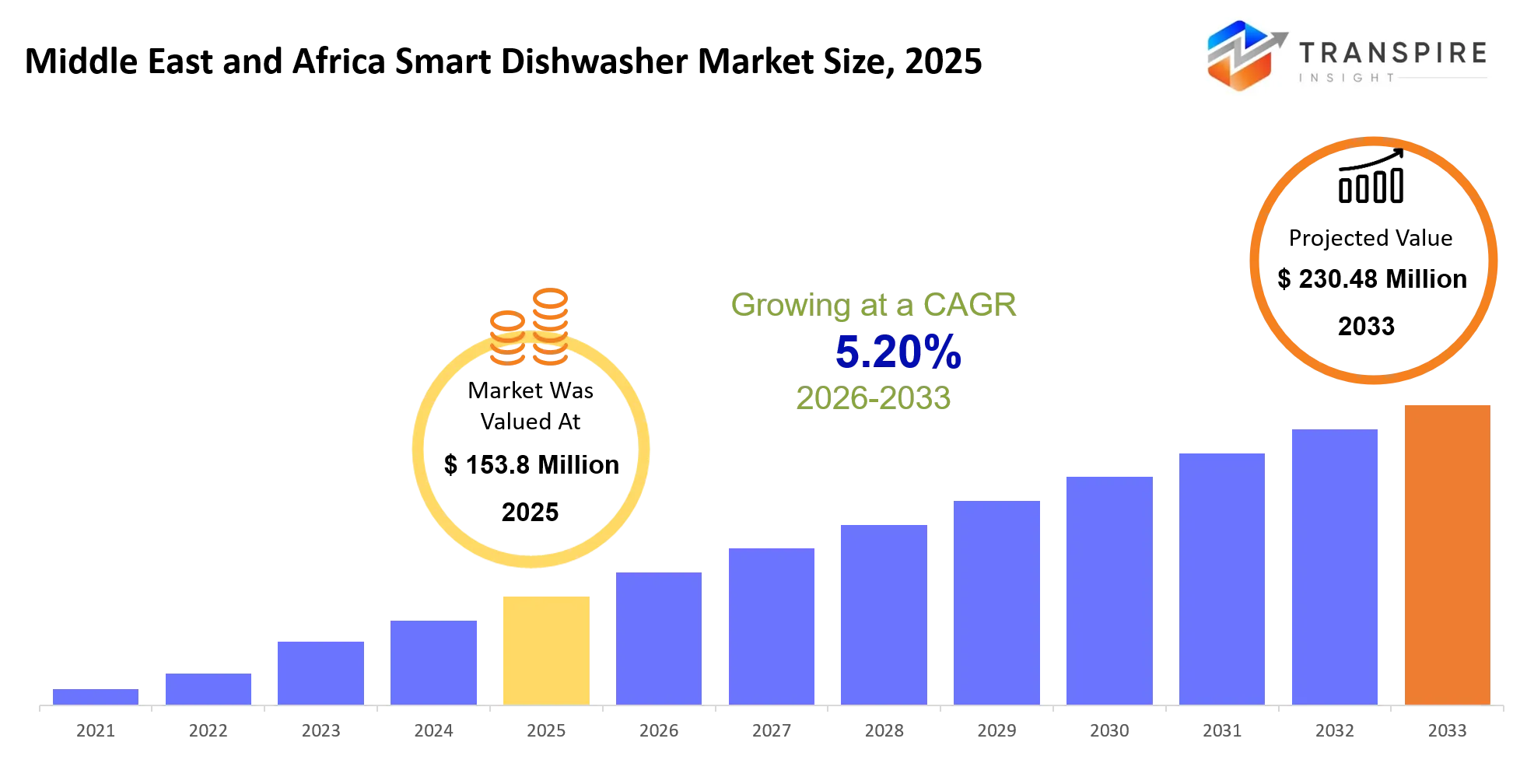
- Middle East and Africa Smart Dishwasher Market Size 2025: USD 153.8 Million
- Middle East and Africa Smart Dishwasher Market Size 2033: USD 230.48 Million
- Middle East and Africa Smart Dishwasher Market CAGR: 5.20%
- Middle East and Africa Smart Dishwasher Market Segments: By Product Type (Built-in Smart Dishwashers, Freestanding Smart Dishwashers, Compact Smart Dishwashers, Drawer Dishwashers, Others); By Connectivity (Wi‑Fi Enabled, Bluetooth Enabled, Voice-Controlled, App-Controlled, Others); By End User (Residential, Commercial Kitchens, Hotels, Restaurants, Others); By Distribution Channel (Online Retail, Specialty Stores, Hypermarkets, Others)
To learn more about this report,  Download Free Sample Report
Middle East and Africa Smart Dishwasher Market Summary
The Middle East and Africa Smart Dishwasher Market was valued at USD 153.8 Million in 2025. It is forecast to reach USD 230.48 Million by 2033. That is a CAGR of 5.20% over the period.
In the Middle East and Africa, the Smart Dishwasher Market basically fills a practical gap for households , hotels, restaurants, and broader commercial kitchens, by automating dish cleaning while also cutting down water use and the amount of manual work needed. It helps reduce operational time too , so in day to day operations it feels faster and more steady. On top of that, the smart versions kind of bring along remote tracking, cycle tuning, and predictive maintenance. so overall kitchen workflows become more efficient and consistent, even when staff changes you know, stuff still runs smoother.
Over the past five years the market has slowly moved away from conventional dishwashers, and toward connected appliances, the type that sync with mobile applications, voice assistants, and broader smart home ecosystems. This shift really picked up speed when more urban households started adopting connected living tech, and hospitality managers kept pushing for better operational efficiency. Then during the post-pandemic recovery there were supply chain headaches, which also made manufacturers rethink sourcing, add alternate inputs, and roll out digitally managed appliance platforms. With electricity and water management now treated as higher priorities across the region, buyers tend to choose machines that can optimize resource usage, and that supports premium product adoption. It also pushes up average selling prices, and opens up fresh recurring revenue routes through software-enabled services plus connected appliance ecosystems.
Key Market Insights
- The Middle East and Africa smart Dishwasher market is kinda moving fast toward Wi‑Fi enabled units, and they’re estimated to be about 40%+ of all connected dishwasher installations.
- Gulf Cooperation Council countries bring in nearly 45% of the regional revenue, mostly because smart home adoption is high, plus people are spending more on premium appliances and such.
- Built-in smart dishwashers still lead overall with around 38% market share, this is helped by newer residential construction ,where these are becoming the norm.
- Compact smart dishwashers are the quickest to grow, growing at roughly 6%+ each year all the way to 2033, you know the smaller footprint is pretty attractive.
- On the demand side, residential users make up more than 55% of the total, since smart kitchens are turning into a main selling point in premium housing projects.
- Hotels and commercial kitchens have bumped up their smart appliance spending by nearly 20% since 2022, aiming for better operational efficiency and labor productivity.
- Also voice-controlled dishwasher installations more than doubled since 2021, mainly because they now fit nicely into smart home ecosystems.
- Online retail channels make up about 30% of appliance sales, and they keep gaining traction, especially with direct to consumer tactics.
- Manufacturers are rolling out AI assisted wash optimization more often, and it can cut water consumption by maybe 15–20% per cycle.
- And, the competitive pressure is rising as companies like Bosch, Samsung, LG Electronics, BSH Home Appliances, Siemens, and Hisense push wider connected appliance portfolios, more features and more attention.
What are the Key Drivers, Restraints, and Opportunities in the Middle East and Africa Smart Dishwasher Market?
The strongest growth driver comes, pretty much from the expansion of connected home eco systems and more premium residential developments across Gulf economies. Smart home platforms, like the ones from Samsung, LG, Bosch and other manufacturers, have made appliance connectivity a bit more practic al and available. When they integrate with mobile applications, voice assistants, and home automation systems, users can run cleaning cycles from a distance while still optimizing water and energy use. This kind of functionality boosts perceived product value and nudges consumers to move on from older, traditional appliances, and it also links directly to higher revenue growth and stronger premium product sales.
High acquisition costs stay the biggest structural obstacle. Smart dishwashers need advanced sensors, connectivity modules, software platforms, and specialized servicing networks. All of that raises the shelf price, which then makes adoption harder in price-sensitive markets across parts of Africa and also in emerging Middle Eastern economies. Add infrastructure issues too, like inconsistent after-sales support and a lower level of smart home penetration, and deployment slows down. Since these constraints are tied to income levels, distribution reach, and digital infrastructure, a quick fix looks unlikely.
A meaningful future chance is in hospitality. Big investments in hotels, tourism projects, and mixed-use developments across Saudi Arabia, the UAE, and selected African tourism hotspots are shaping demand for connected kitchen equipment. Smart dishwashers with remote diagnostics, plus predictive maintenance tools, can reduce downtime and lower labor costs.
What Has the Impact of Artificial Intelligence Been on the Middle East and Africa Smart Dishwasher Market?
Artificial intelligence is,kind of , changing how dishwashers work , by letting the appliance “notice” the load size, the soil levels, the local water situation, and what kind of cycle it should run all in real time. Newer models lean on sensor fed data so they can silently change water amount, detergent dosage, cleaning intensity, and even the drying timeline. The result is more steady cleaning, but also less waste in the use of water and other resources.
On top of that, machine learning is helping with predictive upkeep. Connected units keep watching the motor behavior, the water pressure, pump activity, and the operating temperatures . Then the software flags strange operating signals early before a part fails, so there’s less surprise downtime and the maintenance budget stays smaller. This matters a lot for commercial kitchens and hospitality teams, because if the dishwasher stops, service quality usually drops fast.
Other digital upgrades make daily operations smoother, especially with remote observation and app based control. Managers can check the appliance condition, energy usage, and service timing across multiple sites, all from one central dashboard. In practice, that means lower operating spend and better use of each asset, rather than letting equipment sit around.
Still, AI adoption has a big snag. The integration price stays high, since smart features typically need advanced sensors, software infrastructure, cloud connectivity, and specialized support when something goes wrong. In some African markets, the lack of smart home infrastructure, plus uneven connectivity , can limit how well AI driven functions perform. That, in turn, slows down wider rollouts.
Key Market Trends
- Wi-Fi-enabled dishwasher shipments went up by more than 30% since 2021, kinda as connected appliance ecosystems were expanding.
- Bosch and Siemens put out 2025 product launches with enhanced smart connectivity features, and that helped them lock in a stronger premium image.
- Hospitality operators started adopting faster after 2022, mostly to boost labor productivity and to standardize the cleaning outcome, across properties.
- Between 2021 and 2025 smart home integration with voice assistants grew pretty fast, which really supports those connected kitchen ecosystems.
- AI-powered cycle optimization reportedly cut water usage by around 15–20% versus older dishwasher models, so less waste, basically.
- Online appliance sales channels grabbed roughly 8–10 percentage points of market share since 2020, bit by bit.
- Manufacturers are also leaning more into compact designs, to deal with apartment living and that space limited urban housing reality.
- App-controlled appliances, moved away from “premium only” vibes and more toward a wider mid-range shelf of options.
- New launches keep adding predictive maintenance and remote diagnostics capabilities, even more than before.
- And Matter-enabled smart home compatibility, emerged as a real competitive differentiator among global appliance brands during 2025.
Middle East and Africa Smart Dishwasher Market Segmentation
By Product Type
The product type segment kinda points to the different dishwasher setups that are made for all those different space needs, installation tastes, and day to day operating requirements across both home and office spaces. What people end up choosing usually depends on the kitchen layout, household size, the cleaning capacity, and even smart functionality. Ongoing improvements in connectivity, automation, and energy management keep nudging buying decisions, especially across the region.
Built-in Smart Dishwashers seem to hold a strong position, mostly because they blend in nicely with today’s kitchen designs and those premium residential projects. Freestanding Smart Dishwashers pull in shoppers who want more installation freedom, plus simpler swap outs when something needs replacing. Compact Smart Dishwashers fit the demand coming from apartments and smaller homes, where efficient use of the available space is still a big deal. Drawer Dishwashers offer flexible loading options and separate washing sections which makes everyday convenience better. Others include specialized dishwasher models built for special residential, and commercial requirements where the usual layouts just don’t quite work.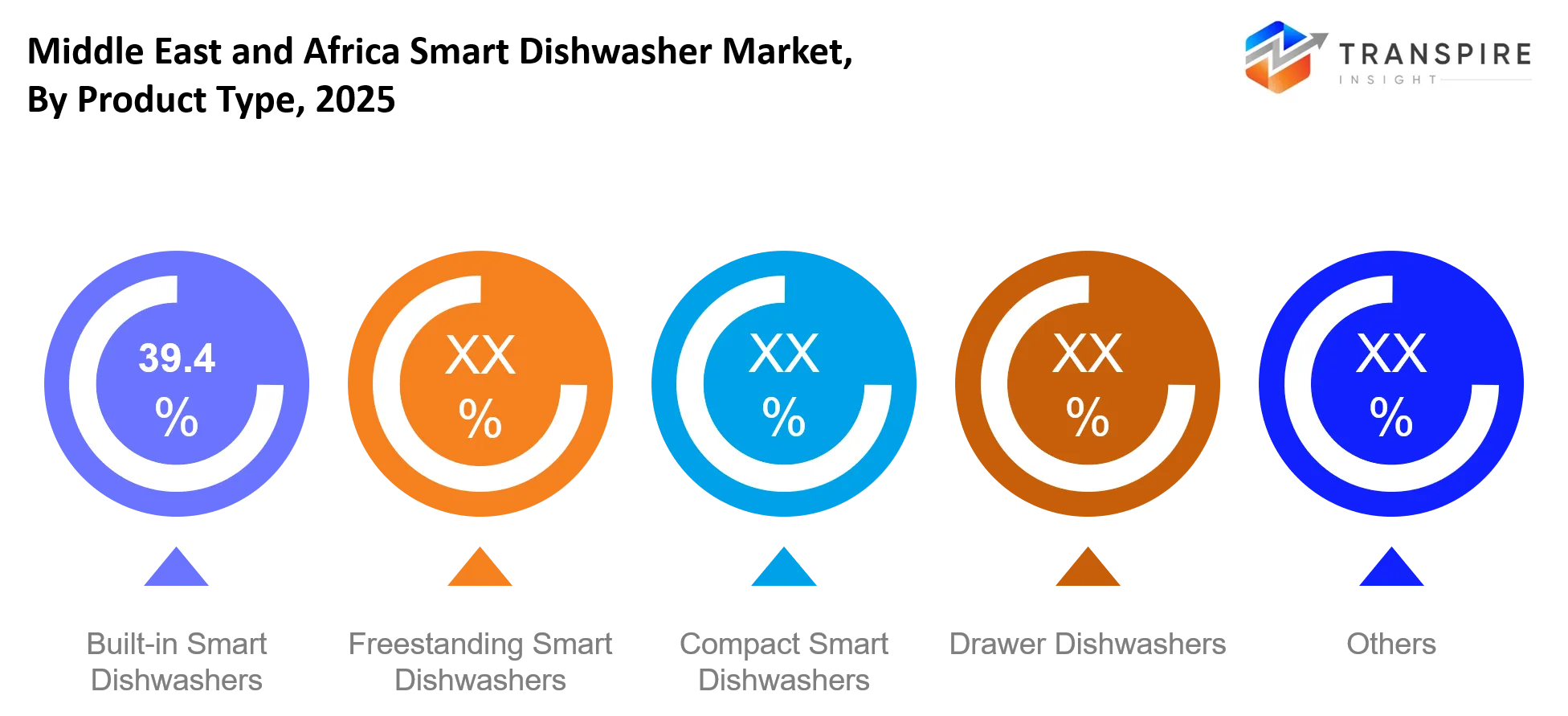
To learn more about this report, Download Free Sample Report
By Connectivity
The connectivity segment kinda shows the technologies that let you do remote monitoring, automation, and also tie everything into bigger smart home ecosystems. Those connectivity features usually boost user convenience, improve operational control and help with appliance performance management in a more steady way. And yeah, the whole ongoing digital transformation still pushes people toward adoption of connected kitchen appliances across different customer groups.
Wi-Fi enabled dishwashers keep a leading position, because remote access, software updates, and smart home compatibility really do support enhanced functionality. Bluetooth enabled models tend to offer localized connectivity, for users who want a simpler way to control things ,without needing constant internet dependence. Voice-controlled dishwashers make it possible to run tasks hands-free, using digital assistants plus connected home platforms. App-controlled models let users keep an eye on cycles, set schedules for operations and even get maintenance notifications straight to their mobile devices. Other options include emerging connectivity solutions ,and some hybrid communication technologies meant to improve appliance interoperability.
By End User
The end user slice shows a few different customer groups using smart dishwashers so they can push operational efficiency, enjoy more ease, and optimize resources kind of overall. How people actually use them changes based on cleaning volume, day to day operational needs, and the overall facility size. Adoption keeps growing in both homes and in commercial spaces which still backs market expansion.
For the residential side, this is a major bucket because smart dishwashers add convenience, lower the manual workload, and fit modern connected home lifestyles. Commercial kitchens tend to lean on advanced dishwashing systems to handle high-volume washing, and also to make workflow run smoother. Hotels use smart appliances mainly to keep hygiene standards up , while also simplifying kitchen operations across bigger properties. Restaurants often go with connected dishwashers to keep cleaning performance steady, and to cut down on operational interruptions. Other buyers include institutions, corporate kitchens, and specialized food preparation sites where the operational requirements are a bit unique, like timing constraints and specific sanitation routines.
By Distribution Channel
The distribution channel segment sort of shows the routes by which smart dishwashers end up with consumers, plus commercial buyers too. In practice, manufacturers don’t rely on only one route; they use several sales channels to boost market reach, raise brand awareness, and make it easier for customers to get what they need. As digital commerce keeps expanding, and as organized retail networks spread out, purchasing patterns across the region keep shifting, more or less.
Online Retail keeps gaining momentum, mainly because e-commerce platforms bring large catalog choices, attractive pricing, and home delivery services. Specialty Stores still pull in shoppers who want precise guidance, in-person product demonstrations, and clear technical information before they actually buy. Hypermarkets help by giving wide access through big retail formats, where multiple appliance brands sit under one roof. Other routes involve distributors, independent retailers, project based sales networks, and alternative channels that target particular market needs and customer requirements.
What are the Key Use Cases Driving the Middle East and Africa Smart Dishwasher Market?
Residential kitchens are mostly where you see it first, because linked dishwashing systems cut down on hands-on work, while also making water and energy management more measured. In the Gulf region, premium housing projects are putting smart appliances in as basically standard kitchen add ons, so the demand stays steady.
Commercial kitchens and hospitality setups come next, but they still matter a lot. Hotels , resorts, catering spaces, and big food service teams lean on connected dishwashers to keep the flow smoother, check equipment health in a simple way, and avoid downtime by using predictive maintenance type of monitoring.
On the newer side, you also get smart facility management platforms, where kitchen equipment is folded into broader building management systems. Luxury serviced apartments, co-living schemes, and high end rental properties are starting to open up too, since landlords and operators want more differentiated tenant experiences, kinda like an overall connected appliance ecosystem that feels intentional.
|
Report Metrics |
Details |
|
Market size value in 2025 |
USD 153.8 Million |
|
Market size value in 2026 |
USD 161.65 Million |
|
Revenue forecast in 2033 |
USD 230.48 Million |
|
Growth rate |
CAGR of 5.20%from 2026 to 2033 |
|
Base year |
2025 |
|
Historical data |
2021 - 2024 |
|
Forecast period |
2026 - 2033 |
|
Report coverage |
Revenue forecast, competitive landscape, growth factors, and trends |
|
Regional scope |
Middle East and Africa (Saudi Arabia, United Arab Emirates, South Africa, Rest of Middle East and Africa) |
|
Key company profiled |
Bosch, Siemens, LG Electronics, Samsung Electronics, Whirlpool, Electrolux, Miele, Haier, Panasonic, Beko, GE Appliances, KitchenAid, Sharp, Hisense, Arcelik |
|
Customization scope |
Free report customization (country, regional & segment scope). Avail customized purchase options to meet your exact research needs. |
|
Report Segmentation |
By Product Type (Built-in Smart Dishwashers, Freestanding Smart Dishwashers, Compact Smart Dishwashers, Drawer Dishwashers, Others); By Connectivity (Wi‑Fi Enabled, Bluetooth Enabled, Voice-Controlled, App-Controlled, Others); By End User (Residential, Commercial Kitchens, Hotels, Restaurants, Others); By Distribution Channel (Online Retail, Specialty Stores, Hypermarkets, Others) |
Which Regions are Driving the Middle East and Africa Smart Dishwasher Market Growth?
The Gulf region is leading the market, mostly because of strong buying power, a big uptake of smart home solutions, and a lot of homebuilding going on. Saudi Arabia, as well as the United Arab Emirates, keeps on putting money into higher-end residential and hospitality projects, so the demand side stays fairly solid. On top of that, advanced retail infrastructure helps keep products easy to find across the main urban hubs. Even better digital connectivity is pushing people toward connected appliances, more or less every time.
South Africa shows up as the second largest regional contributor. Here the market does well thanks to a fairly mature appliance industry and already in place retail distribution routes. The thing is growth depends less on luxury developments and more on replacement cycles, plus slow upgrades to newer technology. When consumers keep spending on household appliances, revenue stays pretty steady.
The quickest growth momentum looks like it’s coming from a handful of North African markets. Urbanization is moving forward, the middle-income population is getting larger, and residential infrastructure modernization makes adoption less complicated. Also investment in smart city programs, plus connected living solutions, is making it easier for demand to build. As a result, these conditions form good entry windows for makers and investors who want to expand steadily between 2026 and 2033, especially in the long run.
Who are the Key Players in the Middle East and Africa Smart Dishwasher Market and How Do They Compete?
Competition still feels moderately concentrated , with global appliance manufacturers holding a pretty big share of those premium and connected dishwasher sales. In practice, the biggest things that decide who wins are technology prowess, smart home linking, energy performance, and also how good the after-sales support is. Lately the race is more about software ecosystems rather than just hardware specs on paper , like, pure mechanical capability.
Bosch stands out thanks to Home Connect integration, more advanced wash automation, and that premium engineering angle. More recent releases pretty much pushed the smart layer further, adding extra connected features and expanded functionality. Samsung Electronics leans hard into AI-enabled smart home integration via SmartThings connectivity, so appliance management feels smoother, more continuous across devices. LG Electronics instead uses AI-driven automation along with connected ecosystem compatibility, aiming to make daily use easier while improving how efficiently the appliance runs.
Siemens keeps a premium posture with intelligent automation, plus advanced connectivity options. Hisense on the other hand is going after value-minded buyers, offering connected appliance lines and AI-enabled functions that do not feel overly complicated. Ongoing strategic investments in software platforms, connectivity standards, and regional distribution networks are also still shaping the competitive advantage across the market, bit by bit, but consistently.
Company List
- Bosch
- Siemens
- LG Electronics
- Samsung Electronics
- Whirlpool
- Electrolux
- Miele
- Haier
- Panasonic
- Beko
- GE Appliances
- KitchenAid
- Sharp
- Hisense
- Arcelik (Arçelik)
Recent Development News
"In August 2025, Bosch Home Appliances launched its all-new 500 Series smart dishwasher line. The launch introduced Zone Wash technology, Home Connect connectivity, and enhanced cleaning performance, strengthening Bosch's position in connected kitchen appliances.https://www.bsh-group.com
"In February 2025, BSH Home Appliances launched a new range of Bosch and Siemens technologically advanced dishwashers. The product range added features such as steam treatment, self-cleaning filters, and enhanced cleaning zones, expanding premium dishwasher adoption opportunities.https://www.bosch-home.in
"In December 2025, LG Electronics unveiled an expanded LG SIGNATURE appliance lineup featuring AI-powered dishwasher technology for CES 2026. The development highlighted growing integration of artificial intelligence and personalized appliance functionality within premium smart kitchen ecosystems.https://www.lg.com
What Strategic Insights Define the Future of the Middle East and Africa Smart Dishwasher Market?
The market is sliding toward software-driven appliance ecosystems where connectivity, analytics, and automation end up delivering the same kind of value as the physical hardware. Smart home expansion, premium residential buildout, and digital facility management uptake will stay the major forces steering this shift during the next five to seven years, honestly.
A less obvious risk shows up as ecosystem fragmentation. Different connectivity platforms and proprietary software environments could end up restricting interoperability , and that can raise customer switching costs, plus it may slow down broader adoption. There is also a separate pressure point from reliance on imported electronic components. That reliance can put manufacturers in a rough spot when supply chains get volatile.
On the upside, there is an opportunity that’s getting more attention, AI-enabled predictive maintenance services aimed at hospitality and commercial food service operators. These solutions are still somewhat underused , but they can produce clear operational wins. Players in the market should focus on open-platform connectivity, local service networks, and software-enabled service packages so they can stand out more and build recurring revenue streams that go beyond appliance sales.
Middle East and Africa Smart Dishwasher Market Report Segmentation
By Product Type
- Built-in Smart Dishwashers
- Freestanding Smart Dishwashers
- Compact Smart Dishwashers
- Drawer Dishwashers
- Others
By Connectivity
- Wi-Fi Enabled
- Bluetooth Enabled
- Voice-Controlled
- App-Controlled
- Others
By End User
- Residential
- Commercial Kitchens
- Hotels
- Restaurants
- Others
By Distribution Channel
- Online Retail
- Specialty Stores
- Hypermarkets
- Others
Frequently Asked Questions
Find quick answers to common questions.
The Expected Middle East and Africa Smart Dishwasher Market size for the Market will be USD 230.48 Million in 2033.
Key Segments for the Middle East and Africa Smart Dishwasher Market are By Product Type (Built-in Smart Dishwashers, Freestanding Smart Dishwashers, Compact Smart Dishwashers, Drawer Dishwashers, Others); By Connectivity (Wi‑Fi Enabled, Bluetooth Enabled, Voice-Controlled, App-Controlled, Others); By End User (Residential, Commercial Kitchens, Hotels, Restaurants, Others); By Distribution Channel (Online Retail, Specialty Stores, Hypermarkets, Others).
Major Middle East and Africa Smart Dishwasher Market Players are Bosch, Siemens, LG Electronics, Samsung Electronics, Whirlpool, Electrolux, Miele, Haier, Panasonic, Beko, GE Appliances, KitchenAid, Sharp, Hisense, Arcelik.
The Current Middle East and Africa Smart Dishwasher Market size is USD 153.8 Million in 2025.
The Middle East and Africa Smart Dishwasher Market CAGR is 5.20% from 2026 to 2033.
- Bosch
- Siemens
- LG Electronics
- Samsung Electronics
- Whirlpool
- Electrolux
- Miele
- Haier
- Panasonic
- Beko
- GE Appliances
- KitchenAid
- Sharp
- Hisense
- Arcelik (Arçelik)
About the Authors

Chetan Dhatrak
I’m Chetan Dhatrak, a Senior Research Analyst at Transpire Insight, specializing in the Consumer Goods, Foods and Beverages industry. I focus on analyzing market trends, consumer behavior, competitive landscapes, and industry developments to deliver accurate, data-driven insights. My research at Transpire Insight is built on credible sources and in-depth analysis, helping businesses and readers better understand market dynamics, emerging opportunities, and evolving consumer preferences. I’m committed to creating reliable, well-researched content that supports informed decision-making and reflects the latest developments in the consumer goods and food & beverage sectors.

Chakradhar Khansole
Chakradhar serves as the Research Director at Transpire Insight, bringing over 8 years of experience in technology, innovation, and strategic market intelligence. He specializes in transforming complex market data into actionable business insights that enable organizations to make informed, growth-oriented decisions. Recognized for his strategic vision and analytical expertise, Chakradhar leads high-impact research initiatives, delivering comprehensive market assessments, competitive intelligence, and forward-looking industry analysis.
Recently Published Reports
-
Apr 2026
Bottled Water Market
Bottled Water Market Size, Share & Analysis Report By Product Type (Still Bottled Water, Carbonated Bottled Water, Functional Bottled Water, and Others), By Packaging (PET, Cans, and Others), By Sales Channel (Supermarkets/Hypermarkets, Convenience Stores/Drug Stores, Grocery Stores/Club Stores, Foodservice, and Others) and Geography (North America, Europe, Asia-Pacific, Middle East and Africa, South and Central America), 2021 - 2032
-
Apr 2026
Color Cosmetic Packaging Market
Color Cosmetic Packaging Market Size, Share & Analysis Report By Application (Mascara Packaging, Liquid Packaging, and Liquid Face), By Type (Tubes & Bottles, Pens & Markers, Compacts & Containers, and Droppers & Pumps), and Geography (North America, Europe, Asia-Pacific, Middle East and Africa, South and Central America), 2021 - 2031
-
Apr 2026
External Microphone For Camera Market
External Microphone For Camera Market Size, Share & Analysis Report By Type (Shotgun Microphone, Lavalier Microphone, and Others), By Application (Digital Camera, Professional Video Camera, and Others), and Geography (North America, Europe, Asia-Pacific, Middle East and Africa, South and Central America), 2021 - 2031
-
Apr 2026
Foot Orthotic Insoles Market
Foot Orthotic Insoles Market Size, Share & Analysis Report By Type (Pre-fabricated, and Custom-made), By Material (Thermoplastic, Composite Carbon Fiber, and Others), By Distribution Channel (Drug Stores, Hospitals & Clinics, and Others), and Geography (North America, Europe, Asia-Pacific, Middle East and Africa, South and Central America), 2021 - 2031