

Global Built-in Kitchen Appliances Market Size & Forecast:
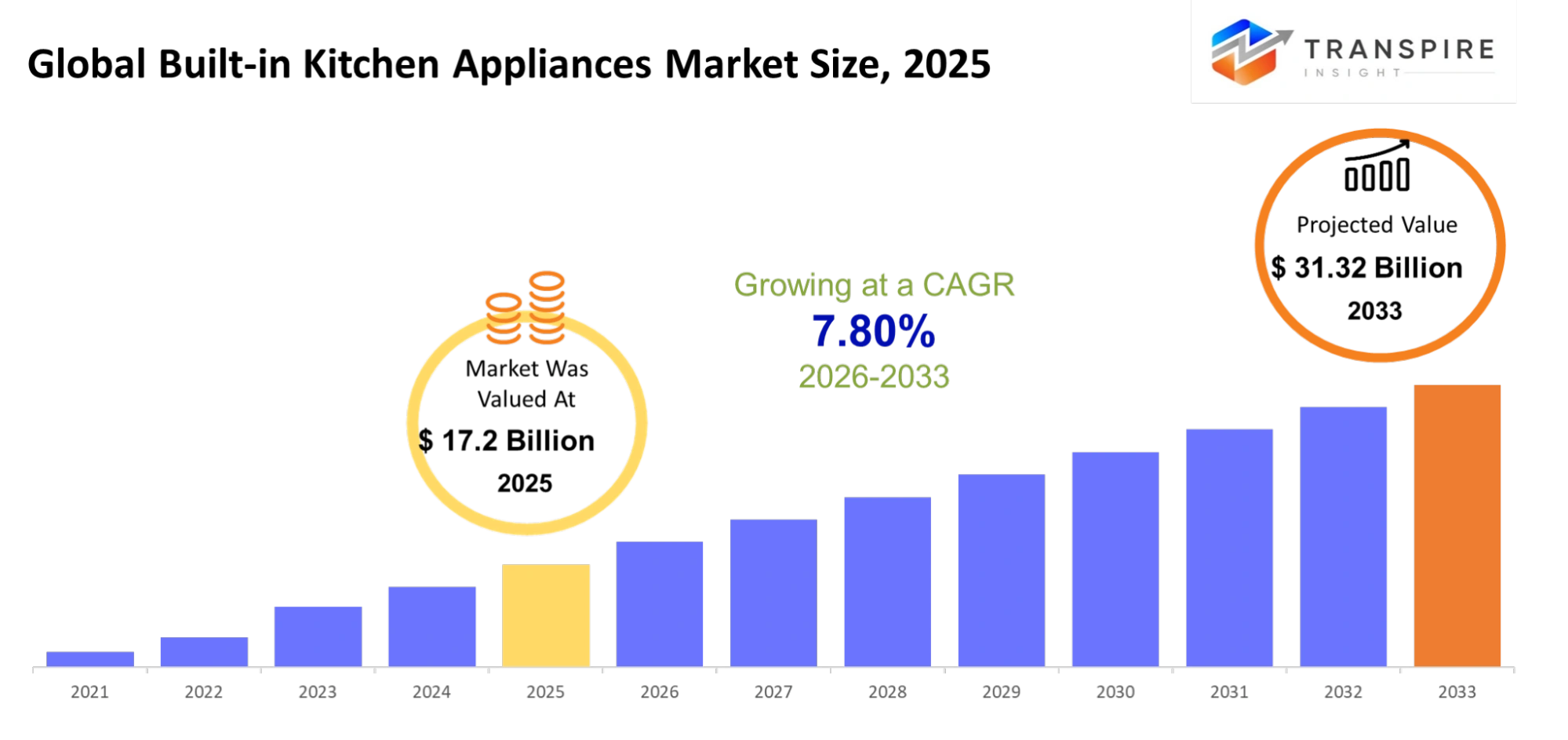
Global Built-in Kitchen Appliances Market Size 2025: USD 17.2 Billion
Global Built-in Kitchen Appliances Market Size 2033: USD 31.32 Billion
Global Built-in Kitchen Appliances Market CAGR: 7.80%
Global Built-in Kitchen Appliances Market Segments: By Product Type (Built-in Ovens, Built-in Cooktops, Built-in Dishwashers, Built-in Refrigerators), By Distribution Channel (Online Retail, Specialty Stores, Supermarkets & Hypermarkets), By End-User (Residential, Commercial).
To learn more about this report,  Download Free Sample Report
Global Built-in Kitchen Appliances Market Summary:
The Global Built-in Kitchen Appliances Market was valued at USD 17.2 billion in 2025 and is forecast to reach USD 31.32 billion by 2033, at a CAGR of 7.80% from 2026 to 2033. Built-in appliances are really integrated right into the kitchen cabinetry or even more closely fitted within the kitchen structure - in contrast to freestanding units that sit quite distinctly on the floor or countertop itself. The defining aspect of the category is quite clearly the installation: a built-in appliance really becomes part of the kitchen architecture rather than just an additional item to it, meaning that the purchase choice is usually made at the kitchen design phase and bears a much higher upfront cost and installation commitment compared to a freestanding equivalent.
Built-in ovens represent our largest product segment and also the price premium that built-in cooking appliances command over freestanding ranges. A built-in single or double oven installed at eye level will cost even more to buy and install than a freestanding range, but it also occupies quite a prominent position in the kitchen design - and is often perceived as a very visible statement of the kitchen's quality level. This dynamic actually plays out well in both the very high-end residential and premium commercial kitchen markets.
The larger market has seen a real lift from the global residential construction and renovation cycle. New apartment developments - especially in Asia and the Middle East - ever so frequently include built-in appliances as standard rather than an optional upgrade. Kitchen renovation in established housing markets in North America and Europe is literally one of the most popular home improvement investments - and replacing a freestanding appliance package with a built-in suite is a very common outcome of those projects themselves.
Commercial buyers really prioritize durability, maintainability - and the easy availability of spare parts quite over the design-driven considerations that influence residential purchases. The two very different end-user groups are supplied by rather overlapping yet not identical sets of manufacturers - and distributors indeed.
Key Market Trends & Insights:
- Induction cooktops have really gained ground on gas in built-in cooktop sales all over European and Asian markets - pushed by the mix of energy efficiency, super-easy surface cleaning, and national policies that have actually forbidden or highly discouraged gas connections in many new residential constructions.
- Online retailers have become much more popular as places to buy, especially when it comes to replacing appliances, since buyers already really know the product category and size required and no longer require the hands-on product experience that they get at specialty stores.
- Luxury and ultra-luxury brands like Miele, Sub-Zero, and SMEG have kept their high prices intact even with wider appliance market pressures, thanks to some very demanding customers - primarily because of high-end residential construction and kitchen renovation projects in the ultra-luxurious sector.
- Smart connectivity - which means appliances that can be monitored and also controlled using a smartphone app or integrated into a home management system - has moved from being a premium point of difference to a standard expectation on middle-range and above built-in products in several major markets.
Global Built-in Kitchen Appliances Market Segmentation
By Product Type
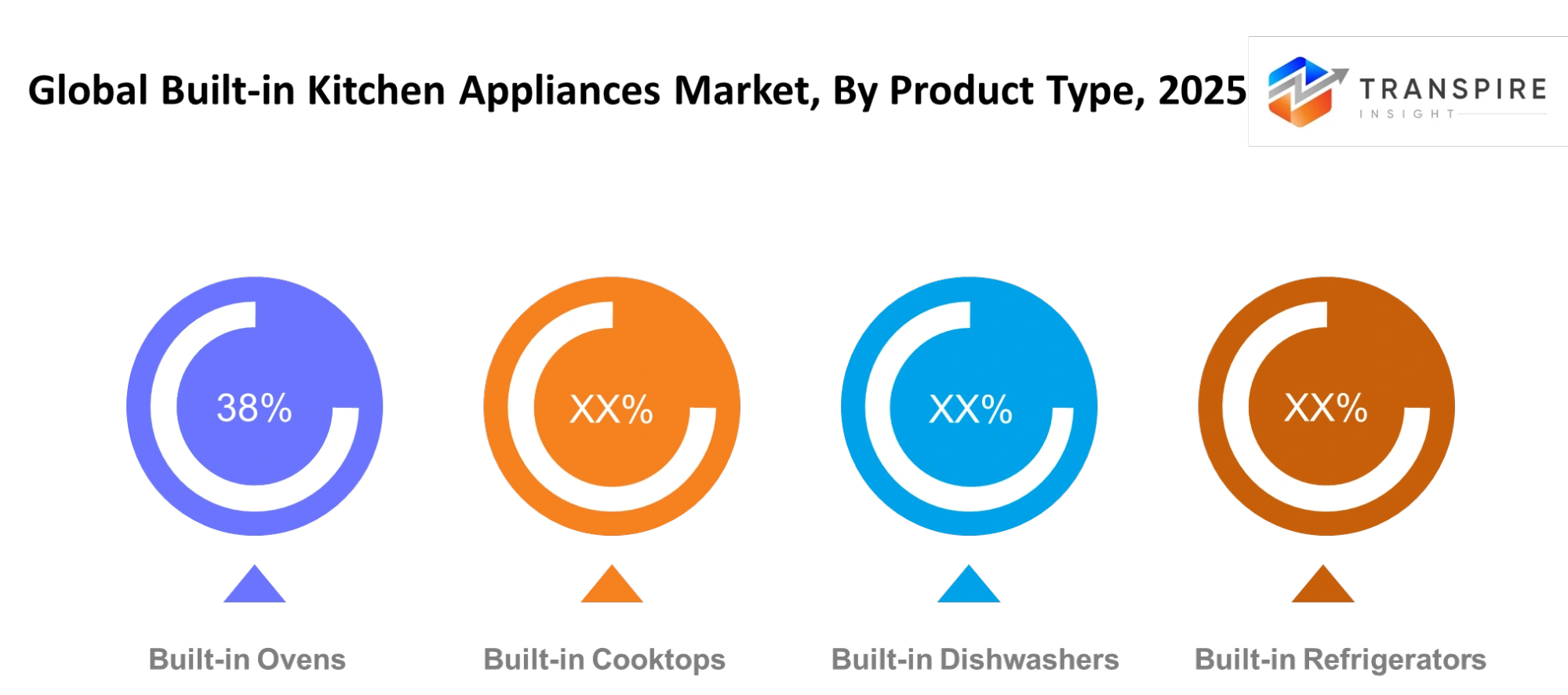
- Built-in Ovens: Built-in ovens represent the biggest product group within the global built-in kitchen appliances market - making up about 38% of overall revenue. The category includes single-wall ovens, double-wall ovens, combination microwave-oven units, and steam ovens - all created so they're mounted inside cabinetry at a determined height rather than contained in a freestanding range. Wall ovens installed near eye level are much simpler to load and unload than a range oven located on the floor - it's a really practical advantage that makes the oven both more visible in the kitchen and sometimes more difficult to use. That higher profile has actually made built-in oven selection a very important consideration in kitchen design projects at the mid-range and higher. Multifunctional ovens with steam injection, pyrolytic self-cleaning, and linked control features have become the central focus in new product development at the luxury tier. The replacement cycle for built-in ovens in domestic settings usually lasts between 8 to 15 years - creating a consistent stream of upgrade and replacement demand in addition to new installation opportunities.
- Built-in Cooktops: Built-in cooktops are installed right into a countertop surface, with the cooking surface showing and the unit itself recessed beneath. The category includes induction cooktops, ceramic glass radiant cooktops, and gas-on-glass or gas-on-stainless formats. Induction has been the fastest-growing cooktop technology in the global built-in kitchen appliances market, especially in Europe - where a combination of energy-efficiency legislation, consumers' desire for easy-to-clean surfaces, and national gas phase-out policies for new construction has really influenced purchasing preferences. Induction cooktops need compatible cookware, which has historically been a real barrier - but as induction-compatible cookware has become much more common in many markets, that issue has largely reduced. Gas cooktops still hold their share in regions where consumers really value the look and feel of an open flame - such as certain parts of the US, the Middle East, and Asia.
- Built-in Dishwashers: Built-in dishwashers are integrated right into the kitchen countertop inside the cabinetry, complete with a door panel - it could match the look of the surrounding cabinets perfectly for a completely integrated style, or it might be finished in stainless steel or a color as a semi-integrated model. The category has really matured in North America and Western Europe, where the number of house holds with a dishwasher is very high indeed and purchasing a new one is usually just replacing an old one instead of buying one to install for the first time. Growth in the built-in dishwasher sector is more concentrated in markets where there are fewer household dishwashers - this is in parts of Asia-Pacific, Eastern Europe, and the Middle East. Water and energy consumption ratings have become far more important factors in purchasing decisions, as utility bills and concern for the environment have increased. Drawer dishwashers - which use a pull-out drawer design instead of a door - have actually found their niche in smaller kitchens and even in larger homes as a secondary dishwasher.
- Built-in Refrigerators: Built-in refrigerators, also referred to as integrated or panel-ready refrigerators, are specially made so that they'll take a door panel that matches the cabinetry. This creates a smooth visual flow between the appliance and its surroundings. They're actually the most expensive product in the built-in kitchen category - and mostly find them at the top-of-the-line and luxurious end of the residential market. Buying one is usually part of designing an entire kitchen project, as opposed to just a replacement on its own - this is because custom panel matching demands communication with the kitchen designer or manufacturer. Column refrigerators and freezers have emerged as a format at the very high end, where one can install two separate refrigeration and freezing columns and match them to the surrounding cabinetry - and this format is replacing traditional combined fridge-freezer units in high-end kitchen designs. The commercial built-in refrigeration sector requires a totally different construction style and is represented by a unique set of manufacturers from the residential category.
To learn more about this report, Download Free Sample Report
By Distribution Channel
- Online Retail: Online retailing has seen steady growth as a channel in the Global Built-in Kitchen Appliances Market, although it functions quite differently for built-in appliances from smaller consumer electronics or household items. The high unit value, the necessity of professional installation, and the critical need for exact dimensional details indicate that many online sales of built-in appliances are either replacements (where the buyer already knows what they want) or orders made after an in-store visit, where the online channel offers better pricing. Direct-to-consumer sales through manufacturer websites have been growing as an online sub-channel, especially for premium brands wanting to control the purchase experience and capture even more margin than the traditional distributor route allows. Kitchen design platforms that enable consumers to plan and order a complete built-in appliance package using an integrated online tool have really added to the channel's share, too.
- Specialty Stores: Specialty stores - covering dedicated kitchen showrooms, appliance retailers, and kitchen design studios - remain the main source of purchase for built-in appliances in most markets still. The consultancy-led nature of the purchase, particularly for new kitchen installations or total renovation projects, really favours a channel where products can be viewed in a functional kitchen display and where staff can offer advice on dimensions, specification compatibility, and installation requirements. Luxury and premium appliance brands invest so much in their specialty retail presence, with in-store display programs, expertly trained sales staff, and exclusive showroom spaces all supporting the sales process for products priced quite high indeed, where the buyer wants extra reassurance before committing. The specialty store channel also looks after the installation planning and after-purchase service relationships that built-in appliance purchases often need.
- Supermarkets & Hypermarkets: Supermarkets and hypermarkets actually carry a pretty limited selection of built-in appliances - mainly at entry and mid-level price points where the product is quite standardized and the buyer is looking for a straightforward replacement purchase. This channel does work for built-in dishwashers and ovens where the dimensions are largely set and the buyer has some knowledge of what they're looking for. It isn't as effective for those with more complex needs or premium products that demand a lot more precise specification matching. The channel actually captures a share of volume in markets where large-format general merchandise and home goods retailers - including warehouse club formats - have a very strong presence in appliance sales indeed.
By End-User
- Residential: The residential end-user sector really holds the majority share in the global built-in kitchen appliances market. Demand comes from two pretty distinct places: new residential development projects and the renovation of existing kitchens. In new construction, built-in appliances are even becoming more commonly specified as a standard item - as opposed to an optional extra feature in mid- to premium apartments and houses, especially in Asia, the Middle East, and Europe. With renovation, the choice to replace a freestanding appliance set with built-in ones is primarily driven by a desire for a much more integrated kitchen style, by the availability of new product features that aren't available in the old appliances, and by that natural replacement cycle when aging appliances finally fail. Residential demand is quite more sensitive to real estate market trends and consumer confidence compared to commercial - yet it's also more geographically diverse across different income levels and housing types all over the world.
- Commercial: The commercial end-user segment is all about hotels, restaurants, catering operations, corporate dining spaces, and many other kinds of food service locations where built-in appliances are part of a professional kitchen setup. Commercial customers focus on specifications quite a bit differently from residential clients: capacity, duty cycle, service-friendly design, parts availability, and whether or not they comply with commercial kitchen hygiene regulations become much more important than that beautiful integrated look that actually drives residential purchases. Commercial built-in ovens and refrigerators really have to meet some even tougher performance and reliability requirements than their residential counterparts, which is why commercial-grade built-in appliances are mainly bought and supplied through a quite separate commercial kitchen equipment channel as opposed to those residential appliance retailers that supply the household market. The commercial segment really sees a faster replacement cycle than residential since equipment operates under a lot higher intensity and undergoes way more stringent hygiene inspections.
Regional Insights
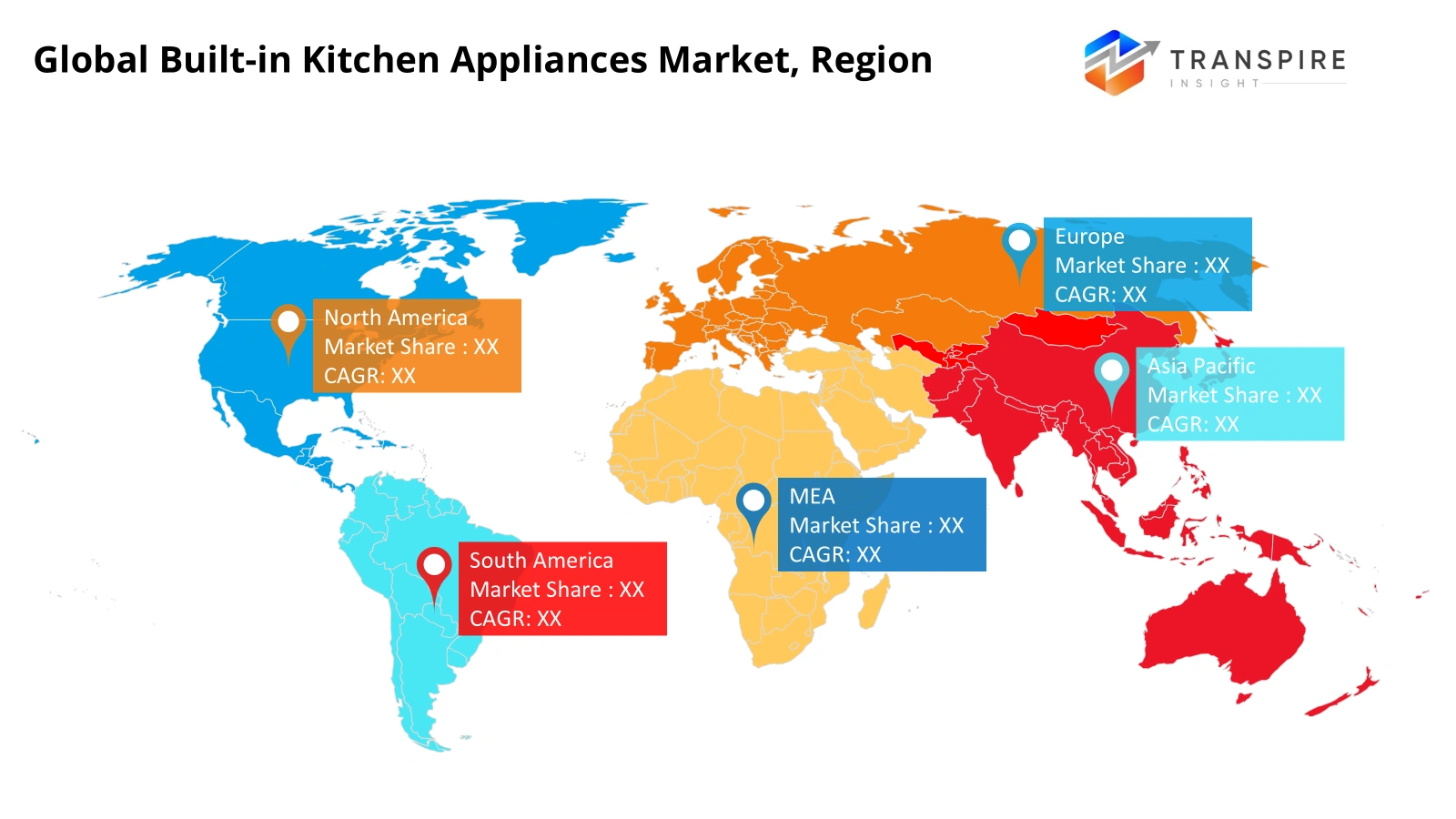
Europe remains the biggest regional market in the Global Built-in Kitchen Appliances Market - with Germany, the UK, France, and Italy among our strongest individual country markets. European consumers' love affair with integrated kitchen designs really drives high built-in appliance penetration all over income brackets - ones who might prefer freestanding appliances in other regions more often. Europe's market holds the highest density of premium and luxury brand demand - with Miele, Bosch, and SMEG holding very powerful positions in super-luxurious residential and commercial sectors. Energy efficiency rules have dramatically influenced product development, and EU energy labeling requirements plus induction policies in some countries really shape the cooktop selection mix.
Asia-Pacific is the speediest-growing regional market. China holds a big and continuously growing middle class - all investing in kitchen renovation and new apartment specifications, and the built-in appliance category is really expanding as aspirations for a more modern kitchen design rise further. South Korea and Japan have very established appliance markets with high penetration of built-in formats - and both countries host key manufacturers that supply globally. India still is in an earlier phase of built-in appliance adoption - yet has huge growth potential, thanks to rapidly developing housing and evolving urban kitchen design preferences.
North America is a quite large market where freestanding stoves and refrigerators had traditionally been the preferred format - though built-in appliances have really grown in the premium residential sector lately. The United States has a strong sub-zero and luxury wall oven culture in higher-income households and many new luxury home constructions. Kitchen renovation is right up there as one of the busiest home improvement areas in the US - and so much of that renovation investment involves upgrading built-in appliances. Canada follows a pretty similar pattern at rather lower per-capita spending levels.
The Middle East, particularly the GCC countries, has seen substantial built-in appliance investment tied to high-end residential and hospitality construction. New hotel and apartment developments in the UAE and Saudi Arabia routinely specify premium European built-in appliances, and the region has become an important market for brands like Miele, Bosch, and SMEG that are established in the European luxury segment.
To learn more about this report, Download Free Sample Report
Recent Development News
Many manufacturers in the Global Built-in Kitchen Appliances Market have actually been adding more items to their intelligent home interfaces so they cover the whole built-in set - making it possible to view everything from one app screen and adjust oven preheating, cooktop controls, the temperature alert settings of fridge, and the cycle status of dishwasher. The real business advantage for manufacturers here is the chance to build stronger, direct relationships with consumers themselves and reduce our reliance on retailers even more for aftercare and service organization.
There's also been a lot of work done on developing new induction cooktop technology at the higher-end models, with zone-less induction plates that can detect and heat any pan placed wherever you like on the surface - rather than on specific predefined heating zones - changing from an extra feature mostly seen only on top-of-the-line products to something available on lower-priced models. The production cost reduction required to bring this feature to a wider range of prices has really been a main area of investment in product engineering at the big European and Korean appliance companies.
Report Metrics
|
Report Metrics |
Details |
|
Market size value in 2025 |
USD 17.2 Billion |
|
Market size value in 2026 |
USD 18.51 Billion |
|
Revenue forecast in 2033 |
USD 31.32 Billion |
|
Growth rate |
CAGR of 7.80% from 2026 to 2033 |
|
Base year |
2025 |
|
Historical data |
2021 - 2024 |
|
Forecast period |
2026 - 2033 |
|
Report coverage |
Revenue forecast, competitive landscape, growth factors, and trends |
|
Regional scope |
Global |
|
Key company profiled |
Whirlpool Corporation, Electrolux AB, Bosch (BSH Hausgeräte GmbH), Samsung Electronics Co. Ltd., LG Electronics Inc., Haier Group Corporation, Miele & Cie. KG, Panasonic Corporation, Fisher & Paykel Appliances Ltd., SMEG S.p.A., Viking Range LLC, Sub-Zero Group Inc., GE Appliances (Haier), Gorenje Group, Arçelik A.Ş. |
|
Customization scope |
Free report customization (country, regional & segment scope). Avail customized purchase options to meet your exact research needs. |
|
Report Segmentation |
By Product Type (Built-in Ovens, Built-in Cooktops, Built-in Dishwashers, Built-in Refrigerators), By Distribution Channel (Online Retail, Specialty Stores, Supermarkets & Hypermarkets), By End-User (Residential, Commercial). |
Key Global Built-in Kitchen Appliances Company Insights
The Global Built-in Kitchen Appliances Market has a tiered competitive structure. The mass-market tier is served by large appliance conglomerates including Whirlpool, Electrolux, Haier (which owns GE Appliances), Samsung, and LG, all of which offer built-in appliance lines alongside their dominant freestanding product ranges. These companies compete primarily on brand recognition in established markets, distribution reach, and product feature density at accessible price points. Their built-in ranges sit below the premium tier in positioning but above basic commodity appliances in specification.
The premium tier is where the competitive dynamics are different. Bosch, through BSH, holds a strong position in the upper mid-range and premium segments, particularly in Europe. Miele competes above Bosch in pricing and build quality, with a reputation for product longevity that it backs with long parts availability commitments. Sub-Zero and Viking hold equivalent positions in the US premium market, where their products are specified by kitchen designers and builders on high-end residential projects rather than purchased through general retail. SMEG competes partly on product aesthetics and Italian design heritage alongside functional performance, which gives it a distinct position in markets where the look of the appliance contributes significantly to the purchase decision. Fisher & Paykel, now part of Haier, has built a position around design-led built-in formats, including its drawer dishwasher, that occupy niches where the mainstream manufacturer platforms do not compete directly.
Company List
- Whirlpool Corporation
- Electrolux AB
- Bosch (BSH Hausgeräte GmbH)
- Samsung Electronics Co. Ltd.
- LG Electronics Inc.
- Haier Group Corporation
- Miele & Cie. KG
- Panasonic Corporation
- Fisher & Paykel Appliances Ltd.
- SMEG S.p.A.
- Viking Range LLC
- Sub-Zero Group Inc.
- GE Appliances (Haier)
- Gorenje Group
- Arçelik A.Ş.
Global Built-in Kitchen Appliances Market Report Segmentation
By Product Type
- Built-in Ovens
- Built-in Cooktops
- Built-in Dishwashers
- Built-in Refrigerators
By Distribution Channel
- Online Retail
- Specialty Stores
- Supermarkets & Hypermarkets
By End-User
- Residential
- Commercial
Frequently Asked Questions
Find quick answers to common questions.
The Global Built-in Kitchen Appliances Market is expected to reach approximately USD 31.32 billion by 2033.
Key segments include Product Type (Built-in Ovens, Built-in Cooktops, Built-in Dishwashers, Built-in Refrigerators), Distribution Channel (Online Retail, Specialty Stores, Supermarkets & Hypermarkets), and End-User (Residential, Commercial).
Major players include Whirlpool Corporation, Electrolux AB, Bosch (BSH Hausgeräte GmbH), Samsung Electronics Co. Ltd., LG Electronics Inc., Haier Group Corporation, Miele & Cie. KG, Panasonic Corporation, Fisher & Paykel Appliances Ltd., SMEG S.p.A., Viking Range LLC, Sub-Zero Group Inc., GE Appliances (Haier), Gorenje Group, and Arçelik A.Ş.
The Global Built-in Kitchen Appliances Market size is approximately USD 17.2 billion in 2025.
The Global Built-in Kitchen Appliances Market is expected to grow at a CAGR of 7.80% from 2026 to 2033.
- Whirlpool Corporation
- Electrolux AB
- Bosch (BSH Hausgeräte GmbH)
- Samsung Electronics Co. Ltd.
- LG Electronics Inc.
- Haier Group Corporation
- Miele & Cie. KG
- Panasonic Corporation
- Fisher & Paykel Appliances Ltd.
- SMEG S.p.A.
- Viking Range LLC
- Sub-Zero Group Inc.
- GE Appliances (Haier)
- Gorenje Group
- Arçelik A.Ş.
Recently Published Reports
-
Apr 2026
Bottled Water Market
Bottled Water Market Size, Share & Analysis Report By Product Type (Still Bottled Water, Carbonated Bottled Water, Functional Bottled Water, and Others), By Packaging (PET, Cans, and Others), By Sales Channel (Supermarkets/Hypermarkets, Convenience Stores/Drug Stores, Grocery Stores/Club Stores, Foodservice, and Others) and Geography (North America, Europe, Asia-Pacific, Middle East and Africa, South and Central America), 2021 - 2032
-
Apr 2026
Color Cosmetic Packaging Market
Color Cosmetic Packaging Market Size, Share & Analysis Report By Application (Mascara Packaging, Liquid Packaging, and Liquid Face), By Type (Tubes & Bottles, Pens & Markers, Compacts & Containers, and Droppers & Pumps), and Geography (North America, Europe, Asia-Pacific, Middle East and Africa, South and Central America), 2021 - 2031
-
Apr 2026
External Microphone For Camera Market
External Microphone For Camera Market Size, Share & Analysis Report By Type (Shotgun Microphone, Lavalier Microphone, and Others), By Application (Digital Camera, Professional Video Camera, and Others), and Geography (North America, Europe, Asia-Pacific, Middle East and Africa, South and Central America), 2021 - 2031
-
Apr 2026
Foot Orthotic Insoles Market
Foot Orthotic Insoles Market Size, Share & Analysis Report By Type (Pre-fabricated, and Custom-made), By Material (Thermoplastic, Composite Carbon Fiber, and Others), By Distribution Channel (Drug Stores, Hospitals & Clinics, and Others), and Geography (North America, Europe, Asia-Pacific, Middle East and Africa, South and Central America), 2021 - 2031