
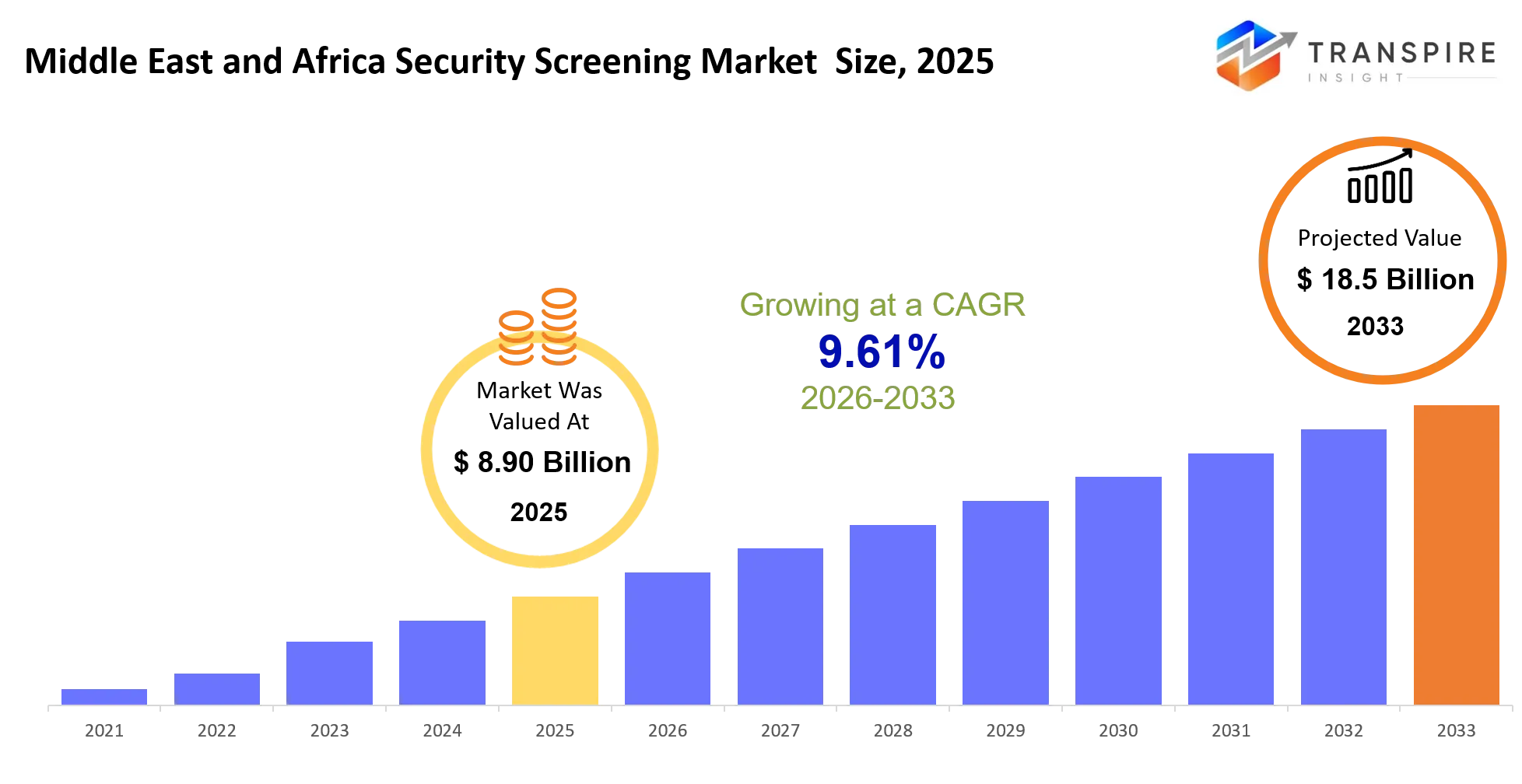
Middle East and Africa Security Screening Market Size & Forecast:
- Middle East and Africa Security Screening Market Size 2025: USD 8.90 Billion
- Middle East and Africa Security Screening Market Size 2033: USD 18.5 Billion
- Middle East and Africa Security Screening Market CAGR: 9.61%
- Middle East and Africa Security Screening Market Segments: By Product Type (X-ray Screening Systems, Metal Detectors, Explosive Detectors, Biometric Systems, Others); By End User (Airports, Government Facilities, Commercial Buildings, Ports, Others); By Application (Passenger Screening, Baggage Screening, Cargo Screening, Others); By Technology (AI-based Screening, Conventional Screening, Others)
To learn more about this report,  Download Free Sample Report
Middle East and Africa Security Screening Market Summary
The Middle East and Africa Security Screening Market was valued at USD 8.90 Billion in 2025. It is forecast to reach USD 18.5 Billion by 2033. That is a CAGR of 9.61% over the period.
In the Middle East and Africa, the Security Screening Market plays a big but kind of quiet role in guarding airports, seaports, border crossings, government facilities, energy infrastructure, and also huge public venues from security risks. In practice, security screening systems let authorities spot weapons, explosives, contraband, and even items that are not allowed, all while still keeping a smooth flow of people, cargo, and vehicles through the transportation routes and commercial networks that matter.
Over the last 5 years, the market has been moving away from the more conventional X-ray and metal detection systems, and toward AI enabled screening platforms, computed tomography (CT) scanners, and software for automated threat recognition. That change has helped detection performance, in other words it gets more accurate, while also cutting down the amount of manual checks staff have to do. A big part of why this shift happened was the stronger focus on border security, and the safeguarding of critical infrastructure, mainly after certain regional geopolitical frictions, along with higher budgets for aviation modernization efforts across the Gulf. When governments keep enlarging airports, logistics hubs, and also smart city programs then security screening becomes a necessary bit of foundational infrastructure, not just a side activity. So this situation creates repeated buying cycles, pushes equipment modernization, and also supports steady long term service income in the area.
Key Market Insights
- The Middle East and Africa Security Screening Market is moving away from old school X ray systems toward AI-assisted detection platforms, and CT based screening technologies too, kind of a big shift right now.
- In the Gulf Cooperation Council area , those countries make up roughly 55% to 60% of regional revenue , helped along by airport expansion plans plus border modernization efforts that keep getting updated.
- When it comes to what’s used the most, airport security screening is still the main application segment, it’s expected to be close to 40% of the market demand in 2025.
- After that, cargo and vehicle inspection systems sit as the second largest group, since governments are tightening customs procedures and cross border security controls.
- AI powered image analysis solutions are projected to grow at more than 12% each year through 2033 , so they are basically the fastest growing technology category in this space.
- Also, critical infrastructure sites, like oil and gas assets, drive more than 25% of screening equipment procurement across the region.
- Saudi Arabia and the UAE keep pushing strategic investments through national development programs, which speeds up the rollout of more advanced screening technologies.
- Smart checkpoint systems have already cut passenger screening time by about 20% to 30% at a number of major international airports since 2022, so that’s been noticeable.
- Government agencies still lead as end users, holding around 45% market share, mostly because of ongoing defense and border protection spending.
- Big suppliers—Smiths Detection, Leidos, Rapiscan Systems, Nuctech, and Thales—are expanding via AI integration, new partnerships, and wider regional service networks.
What are the Key Drivers, Restraints, and Opportunities in the Middle East and Africa Security Screening Market?
The strongest growth driver seems to be the big scale modernization of transportation and boundary infrastructure across Gulf countries plus a few chosen African economies. Governments are putting serious money into new air terminals, marine ports, logistics corridors, and also smart city initiatives, and all of this , really pushes the need for sophisticated screening systems as a kind of mandatory security layer. At the same time national security frameworks and aviation rules are asking for more advanced threat detection features , so operators are more and more inclined to swap older hardware with CT scanners, automated baggage screening setups, and AI oriented image analysis platforms. In practice this shift keeps creating both fresh equipment sales and recurring maintenance revenues, not just one side.
The biggest market restraint is the high upfront capital cost tied to these advanced screening technologies. CT scanners, cargo inspection portals, and integrated command platforms demand substantial spending, including equipment purchase, facility redesign, software integration, and hands on operator training. This is especially tough across many African nations where public infrastructure budgets stay tight. And since the money problem is structural, not really a temporary hiccup, rollout timelines end up stretching across multiple years. That then delays procurement cycles and ends up lowering possible market earnings.
A key future opportunity sits with AI-enabled automated threat detection and remote screening operations. Governments and airport operators are increasingly hunting for solutions that raise detection accuracy while also coping with workforce shortages and rising passenger levels. Saudi Arabia, the UAE, and several emerging African aviation hubs are already channeling investment into digital security ecosystems. These systems blend AI analytics, biometric identification, and cloud based monitoring platforms, more or less end to end.
What Has the Impact of Artificial Intelligence Been on the Middle East and Africa Security Screening Market?
Artificial intelligence has turned into one of the more transformative technologies inside the regional security screening industry, honestly. Today’s screening systems use AI algorithms to look at X-ray and CT images by themselves, so operators can spot weapons, explosives, prohibited items, and odd cargo faster, and with steadier results. In practice, this lowers how much people have to do by hand, and it lets security staff pay more attention to the highest risk alerts.
Machine learning models are also being used to fine tune equipment performance and to anticipate maintenance needs. By watching how scanners get used, how components slowly wear, and the day to day operational signals, operators can notice likely malfunctions ahead of time before they start messing up screening schedules. This kind of early prediction tends to improve uptime, and it helps bring maintenance spending down.
Then there are advanced analytics platforms, they can support passenger flow management and make cargo inspection more efficient too. In several real deployments, people have reported fewer false alarms and quicker screening moments, which helps airports and border crossings move more traffic without dropping standards. Also, AI assisted threat detection solutions that run alongside CT scanners can speed up baggage handling while staying aligned with tough security requirements and compliance expectations.
Still, AI adoption isn’t all smooth sailing. The integration costs are a major hurdle, especially if you’re upgrading older infrastructure. On top of that, AI models need big quantities of high quality training data to keep working accurately across different operational settings. Because of these issues, progress is often slower in markets with tight budgets, even if the long term benefits look very strong.
Key Market Trends
- Since 2021, the adoption of AI assisted threat detection has been growing pretty fast, across a bunch of major Middle Eastern airports and border locations.
- Also, CT based baggage screening deployments went up by 25% plus in big aviation hubs between 2022 and 2025 , like it really took off.
- Governments then started shifting what they buy, away from standalone hardware and more toward integrated, software driven security ecosystems, which sounds obvious but it’s not how it used to be.
- In Saudi Arabia, the whole airport modernization push seems to have sped up the demand for advanced screening technologies across several transportation hubs.
- Meanwhile, cargo inspection investments rose by about 20% since 2023, as customs agencies kept strengthening their border enforcement programs.
- Security vendors also began bundling predictive maintenance plus remote diagnostics services into longer term contracts, so buyers get this “managed” feel rather than just equipment.
- Biometric identity verification is now showing up as a standard requirement in several new airport terminals, it’s kind of becoming non negotiable.
- And during 2025 into 2026, you could see more partnerships forming between AI developers and screening equipment manufacturers.
- On top of that, open architecture platforms are replacing older proprietary systems, which helps with faster software upgrades, and easier third party integration, in a way.
- Finally, buyers are not just looking at the purchase price of a piece of equipment anymore. They’re more focused on total lifecycle performance, and everyday operational efficiency , even if it takes a bit more analysis upfront.
Middle East and Africa Security Screening Market Segmentation
By Product Type
The product type segment kind of points to the broad set of technologies that detect threats, prohibited items, and security risks around transport hubs, public places, and also critical infrastructure sites. X-ray Screening Systems play a big role, mainly because those detailed imaging capabilities help with quick inspection of baggage, parcels, and cargo, while still keeping day to day operations efficient. And then, continuous upgrades to image quality plus automated detection functions make it easier for organizations to adopt them in high traffic zones.
Metal Detectors are still used a lot because they are dependable, fairly straightforward to deploy, and effective at spotting metallic objects during security checks. Explosive Detectors back up more advanced threat identification, by detecting hazardous substances in baggage, cargo, and controlled or restricted areas. Biometric Systems improve identity verification using fingerprint, facial recognition, and iris scanning, which can raise access control accuracy as well as screening performance. Others include specialized screening equipment for particular operational needs and newer security challenges, kind of the less common cases.
By End User
The end user segment shows the mix of facilities and organizations that use screening technologies, to keep things safe and also meet regulatory compliance. Airports grab a big slice of demand, mostly because the passenger flow, baggage processing, and aviation security rules create this constant need for more advanced inspection systems. On top of that, big infrastructure expansion efforts across regional aviation networks, keep pushing deployment the way it’s currently happening.
Government Facilities use screening devices to protect administrative buildings, defense locations and public service centers from potential risks. Commercial Buildings implement screening solutions, to regulate guest entry and to raise workplace safety levels a bit more. Ports lean on inspection systems to keep tabs on cargo movement and to strengthen border control actions. Other segments can include schools, stadium style event venues, healthcare facilities, and transit hubs, all of which still want dependable security screening capabilities, in a pretty similar way.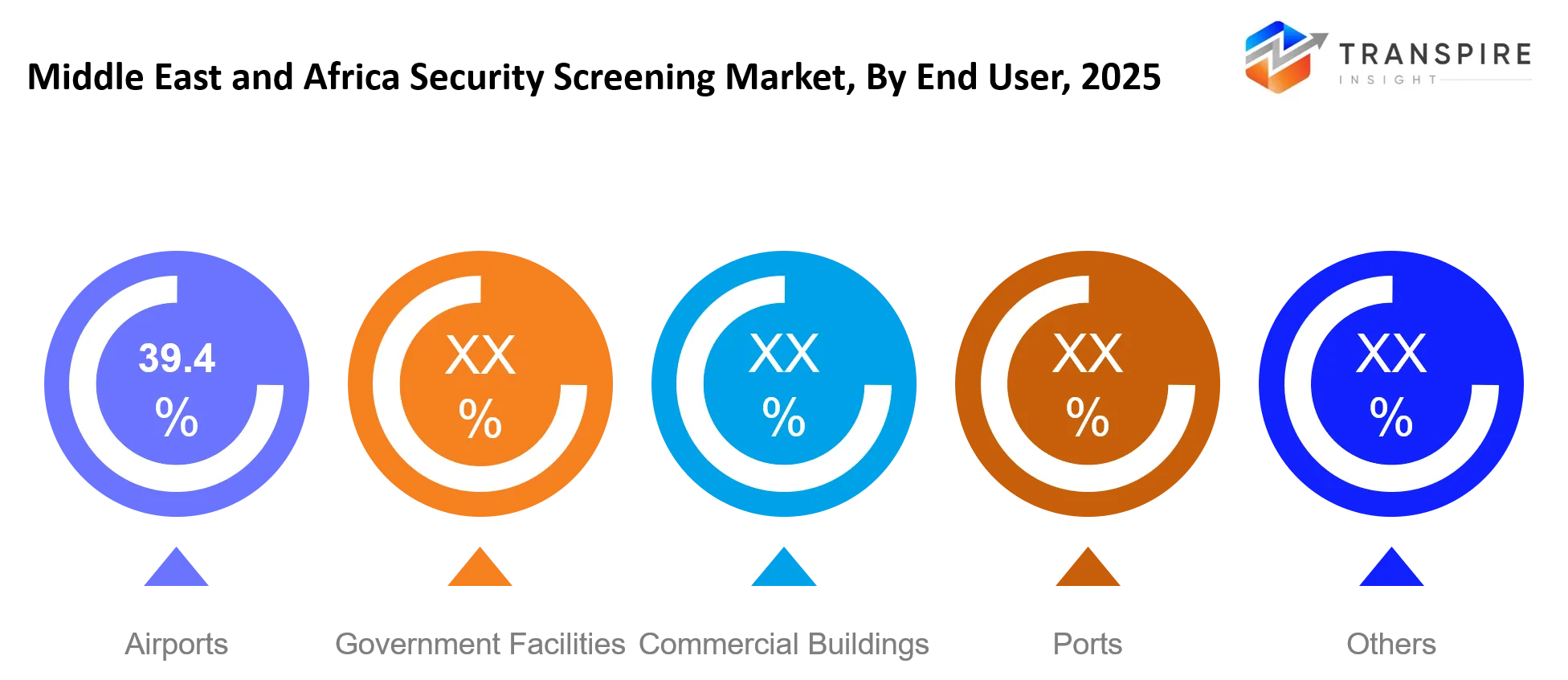
To learn more about this report, Download Free Sample Report
By Application
The application segment kind of shows how screening technologies help with different security tasks across both public and private sides. Passenger Screening creates a lot of demand, since transit hubs and public venues need effective ways to spot possible threats, but also keep the flow of people moving without too much friction. Meanwhile the advanced detection options keep getting better in accuracy, and that also tends to cut down those annoying inspection delays.
Baggage Screening stays important for aviation and transportation security, because it lets operators catch prohibited items before anyone even gets into the secure zones. Cargo Screening backs trade safety by examining shipments and freight containers that move through ports, logistics centers, and border checkpoints. And then there are other efforts too, like vehicle inspection and access control verification, plus niche security operations meant to defend sensitive assets and higher risk locations.
By Technology
The technology segment kind of shows the move toward smarter, also more efficient screening solutions across security operations, you know. AI-based Screening is getting more attention, because automated image analysis, threat recognition, and decision support can boost detection performance and at the same time reduce the manual load. And yeah, ongoing advances in machine learning and data analytics keep improving how well these systems work across complex security environments.
Meanwhile, Conventional Screening still matters a lot, mostly because it has proven reliability, already established operational procedures and broad deployment across many industries, which makes it kind of the steady option when things get messy. A lot of facilities keep using traditional X-ray systems, metal detectors , and inspection equipment as part of their existing security frameworks. Some also move toward hybrid technologies, or even newer digital solutions, that mix multiple detection methods so they can handle changing operational needs , and security objectives as they come.
What are the Key Use Cases Driving the Middle East and Africa Security Screening Market?
Airport passenger and baggage screening still looks like the biggest use case across the region. For international airports, screening never really stops , it has to run continuously for passengers , cabin baggage , checked luggage , and even airport personnel, just to meet aviation security standards. This application kinda gets the highest demand because airports move through huge numbers of travelers every single day.
And it’s not only aviation anymore. Cargo and vehicle inspection systems are also growing in significance at border crossings, seaports , and customs facilities. Governments are more and more turning toward high-energy X-ray scanners and automated inspection tools to spot contraband explosives and other illegal goods, while trying not to mess up trade routes. At the same time, oil and gas sites are using screening solutions to keep critical infrastructure protected and to manage who can access what.
Looking ahead, there are emerging uses too, like smart city security networks and event security for major events. Integrated screening systems, backed by AI analytics and biometric checks, are being trialed in public venues, transportation hubs, and in urban surveillance settings. All of that is expected to open up fresh growth opportunities during the forecast period .
|
Report Metrics |
Details |
|
Market size value in 2025 |
USD 8.90 Billion |
|
Market size value in 2026 |
USD 9.73 Billion |
|
Revenue forecast in 2033 |
USD 18.5 Billion |
|
Growth rate |
CAGR of9.61% from 2026 to 2033 |
|
Base year |
2025 |
|
Historical data |
2021 - 2024 |
|
Forecast period |
2026 - 2033 |
|
Report coverage |
Revenue forecast, competitive landscape, growth factors, and trends |
|
Regional scope |
Middle East and Africa (Saudi Arabia, United Arab Emirates, South Africa, Rest of Middle East and Africa) |
|
Key company profiled |
Smiths Detection, Leidos, Rapiscan Systems, Nuctech, Thales, NEC, Bosch, Honeywell, Teledyne FLIR, Garrett, OSI Systems, Analogic, CEIA, Astrophysics, Rohde & Schwarz |
|
Customization scope |
Free report customization (country, regional & segment scope). Avail customized purchase options to meet your exact research needs. |
|
Report Segmentation |
By Product Type (X-ray Screening Systems, Metal Detectors, Explosive Detectors, Biometric Systems, Others); By End User (Airports, Government Facilities, Commercial Buildings, Ports, Others); By Application (Passenger Screening, Baggage Screening, Cargo Screening, Others); By Technology (AI-based Screening, Conventional Screening, Others) |
Which Regions are Driving the Middle East and Africa Security Screening Market Growth?
The Gulf region sort of dominates the market, largely because of heavy investments in aviation, border safety, and the protection of critical infrastructure—yeah. Countries like Saudi Arabia and the UAE still keep expanding airports, logistics hubs, and smart city initiatives, which in turn demand advanced security systems. Also, tight regulatory oversight along with major public-sector spending helps keep procurement activity steady. On top of that there’s an already mature ecosystem of technology providers, systems integrators, and ongoing maintenance partners, and it just keeps reinforcing the regional leadership.
Meanwhile, the broader Middle East is the second-largest contributor. In that area, growth is not as dependent on huge mega type projects but more on slow modernization programs. Governments continue putting money into border management, government site protection, and transportation security measures. Stable procurement activity and continuing infrastructure upgrades give the market a fairly dependable flow of revenue.
Africa is expected to show the fastest growth through 2033. More recent airport expansion projects, customs modernization pushes, and the rise in international trade have sped up investment in screening infrastructure. Several nations are also tightening border security and replacing older inspection tools, so they can align with international expectations. For vendors and investors, that means meaningful opportunities to establish an early presence in markets that are still less penetrated when you compare them with the Middle East.
Who are the Key Players in the Middle East and Africa Security Screening Market and How Do They Compete?
In the market, competition is sort of moderately consolidated, and the biggest global technology providers tend to compete mostly on detection accuracy, automation capabilitys, regulatory certifications, plus service support . Even though the well established suppliers still keep a big chunk of market share, AI focused partnerships and newer digital screening ideas are starting to change the way everyone competes. Lately, being able to deliver integrated hardware, software, and analytics solutions seems to be one more real differentiator for vendors, right.
Smiths Detection has been leaning hard into open architecture platforms and AI enabled threat detection, which feels like the main theme for them. They’ve also pushed their ecosystem forward via partnerships with AI specialists, so customers can blend advanced analytics with their existing screening infrastructure. Their more recent collaborations with NeuralGuard, Deepnoid , and BigBear.ai show this approach pretty clearly, even if the details aren’t all spelled out in one place.
Leidos stands out with CT screening technology, explosive detection know how, and large scale transportation security deployments. Also, working together with SAFE in Saudi Arabia gives them better regional market access while still supporting localized service capabilities , which matters a lot in practice.
Rapiscan Systems competes by offering a pretty broad portfolio, covering cargo inspection, people screening, and border security use cases. It also benefits from having a wide installed base across more than 170 countries, and they keep moving forward by expanding certified screening technologies. Thales, Nuctech, and Honeywell continue to strengthen their positions through advanced imaging technologies, regional partnerships, and infrastructure oriented deployments that stay focused on the long run.
Company List
- Smiths Detection
- Leidos
- Rapiscan Systems
- Nuctech
- Thales
- NEC
- Bosch
- Honeywell
- Teledyne FLIR
- Garrett
- OSI Systems
- Analogic
- CEIA
- Astrophysics
- Rohde & Schwarz
Recent Development News
In April 2026, Leidos and Analogic announced the formation of a security technology joint venture. The transaction combines security screening and industrial automation assets to accelerate AI-native and 3D imaging innovation across global security markets.https://www.reuters.com
In May 2025, Leidos entered a collaboration agreement with Saudi Arabia's SAFE. The partnership supports modernization of airport and border screening infrastructure across the Kingdom and expands Leidos' regional presence.https://www.leidos.com
In April 2025, Smiths Detection announced a partnership with NeuralGuard to integrate AI-driven threat detection into its screening platforms. The collaboration strengthens automated screening capabilities and supports broader adoption of open architecture security systems.https://www.smiths.com
What Strategic Insights Define the Future of the Middle East and Africa Security Screening Market?
The market is kinda moving, in a structural way, toward intelligent , software-forward security ecosystems instead of standalone inspection hardware. The main thing pushing this shift is the necessity to handle bigger passenger cargo and vehicle volumes without messing up detection accuracy. As governments modernize transport and border infrastructure, purchasing choices will likely start to favor AI enabled analytics, automation and interoperability , more and more.
One sneaky risk is that the advanced technology capabilities are getting more concentrated among a smaller circle of global suppliers. That could open the door to supply chain fragility, and also make the whole system more dependent on a few particular technology platforms. But there is also a real opening showing up, around integrated biometric screening and AI aided remote operations , especially across fast growing Gulf transport hubs and certain African border modernization efforts.
For everyone in the market, the practical route is to put money into open architecture platforms that fuse hardware, software, and data analytics in one blend. Firms that can build scalable ecosystems and also set up solid regional service strengths will probably be in a better place, to grab the long term growth chances between 2026 and 2033.
Middle East and Africa Security Screening Market Report Segmentation
By Product Type
- X-ray Screening Systems
- Metal Detectors
- Explosive Detectors
- Biometric Systems
- Others
By End User
- Airports
- Government Facilities
- Commercial Buildings
- Ports
- Others
By Application
- Passenger Screening
- Baggage Screening
- Cargo Screening
- Others
By Technology
- AI-based Screening
- Conventional Screening
- Others
Frequently Asked Questions
Find quick answers to common questions.
The Expected Middle East and Africa Security Screening Market size for the Market will be USD 18.5 Billion in 2033.
Key Segments for the Middle East and Africa Security Screening Market are By Product Type (X-ray Screening Systems, Metal Detectors, Explosive Detectors, Biometric Systems, Others); By End User (Airports, Government Facilities, Commercial Buildings, Ports, Others); By Application (Passenger Screening, Baggage Screening, Cargo Screening, Others); By Technology (AI-based Screening, Conventional Screening, Others).
Major Middle East and Africa Security Screening Market Players are Smiths Detection, Leidos, Rapiscan Systems, Nuctech, Thales, NEC, Bosch, Honeywell, Teledyne FLIR, Garrett, OSI Systems, Analogic, CEIA, Astrophysics, Rohde & Schwarz.
The Current Middle East and Africa Security Screening Market size is USD 8.90 Billion in 2025.
The Middle East and Africa Security Screening Market CAGR is 9.61% from 2026 to 2033.
- Smiths Detection
- Leidos
- Rapiscan Systems
- Nuctech
- Thales
- NEC
- Bosch
- Honeywell
- Teledyne FLIR
- Garrett
- OSI Systems
- Analogic
- CEIA
- Astrophysics
- Rohde & Schwarz
About the Authors

Avinash Kumar
I’m Avinash Kumar, a Senior Research Analyst at Transpire Insight, with expertise in the Electronics and Semiconductor and Energy & Power industry. My work focuses on analyzing emerging technologies, market trends, industry developments, and innovation across these sectors. I specialize in transforming complex technical and market insights into clear, research-backed content that helps professionals, businesses, and decision-makers stay informed. Through continuous industry research and data-driven analysis, I strive to deliver accurate, reliable, and practical perspectives on the latest advancements shaping the semiconductor and energy landscape.

Chakradhar Khansole
Chakradhar serves as the Research Director at Transpire Insight, bringing over 8 years of experience in technology, innovation, and strategic market intelligence. He specializes in transforming complex market data into actionable business insights that enable organizations to make informed, growth-oriented decisions. Recognized for his strategic vision and analytical expertise, Chakradhar leads high-impact research initiatives, delivering comprehensive market assessments, competitive intelligence, and forward-looking industry analysis.
Recently Published Reports
-
Apr 2026
Fiber Optic Faceplates Market
Fiber Optic Faceplates Market Size, Share & Analysis Report By Type (< 300 mm2, 300-350 mm2, and > 350 mm2, By Application (Night Vision, Holographic Imaging, Medical, and Others), and Geography (North America, Europe, Asia-Pacific, Middle East and Africa, South and Central America), 2021 - 2031
-
Apr 2026
High Temperature Superconductors Market
High Temperature Superconductors Market Size, Share & Analysis Report By Type (1G HTS, and 2G HTS), By Application (Power Cable, Fault Current Limiter, and Transformer), and Geography (North America, Europe, Asia-Pacific, Middle East and Africa, South and Central America), 2021 - 2031
-
Apr 2026
Industrial Plugs and Socket Market
Industrial Plugs and Socket Market Size, Share & Analysis Report By Type (Industrial Plugs, Industrial Sockets), By Current (Up to 32 A, 32 to 125 A, Above 125 A), By Protection (Dustproof and Splash Proof, Waterproof, Explosion Proof), By End User (Heavy Industries, Oil and Gas, Chemicals and Pharmaceuticals, Power Generation, Others), and Geography (North America, Europe, Asia-Pacific, Middle East and Africa, South and Central America), 2021 - 2031
-
Apr 2026
InGaAs Avalanche Photodiodes Market
InGaAs Avalanche Photodiodes Market Size, Share & Analysis Report By Type (1100 - 1700 nm, and 1000 - 1600 nm), By Application (Missile Warning System, Muzzle Flash Detection, Wafer Defect Inspection, Laser Rangefinders, and Others), and Geography (North America, Europe, Asia-Pacific, Middle East and Africa, South and Central America), 2021 - 2031