
Middle East and Africa Rugged Servers Market Size & Forecast:
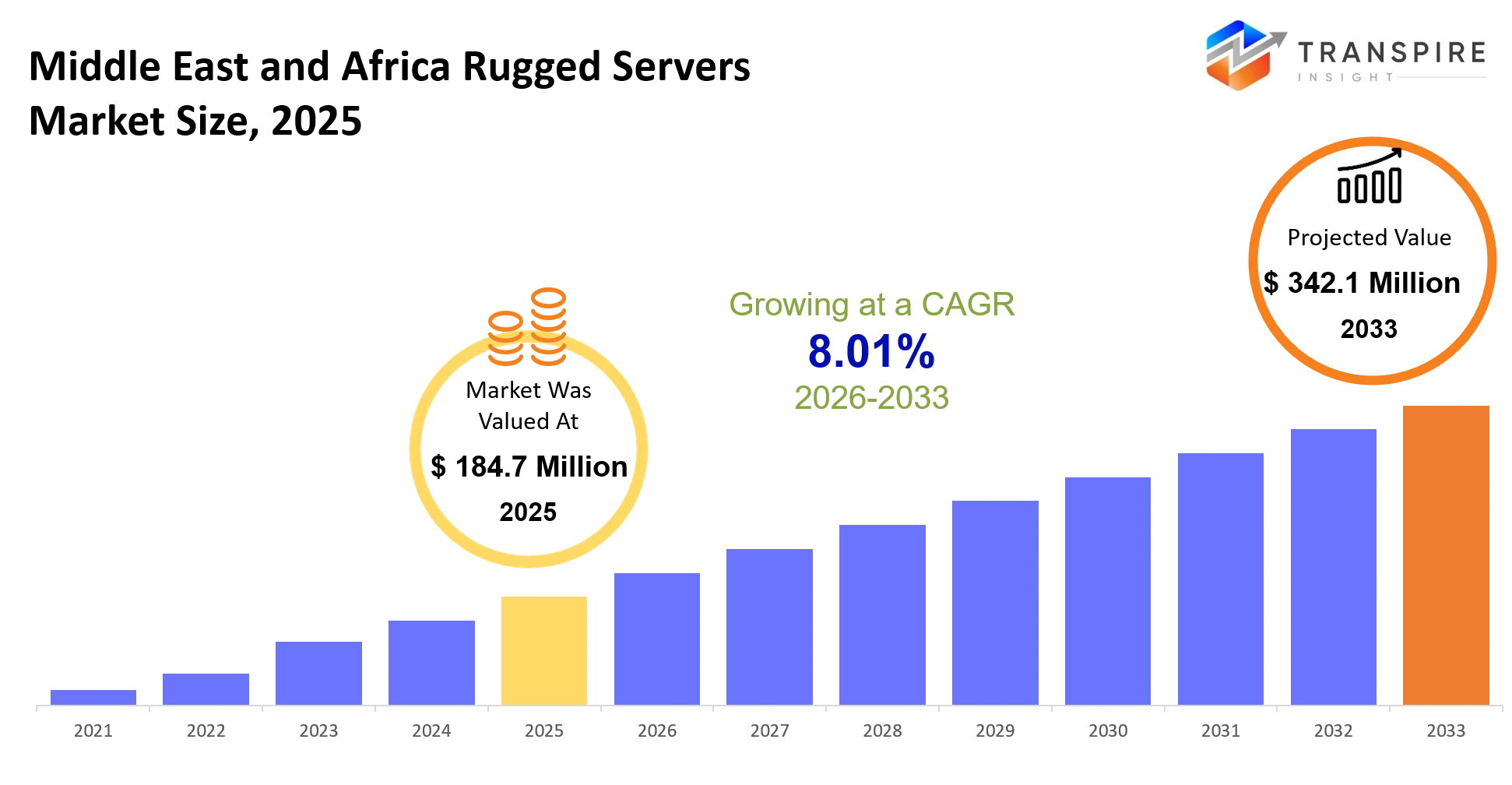
- Middle East and Africa Rugged Servers Market Size 2025: USD 184.7 Million
- Middle East and Africa Rugged Servers Market Size 2033: USD 342.1 Million
- Middle East and Africa Rugged Servers Market CAGR: 8.01%
- Middle East and Africa Rugged Servers Market Segments: By Server Type (Rackmount, Portable, Embedded, Edge, Blade, Military, Industrial, Others); By Application (Defense, Aerospace, Automation, Oil & Gas, Transportation, Telecom, Energy, Others); By Deployment (On-Premise, Edge Computing, Mobile, Cloud Integration, Remote Sites, Others); By End User (Defense, Industrial, Government, Energy, Telecom, Transportation, Others)
Middle East and Africa Rugged Servers Market Summary
The Middle East and Africa Rugged Servers Market was valued at USD 184.7 Million in 2025. It is forecast to reach USD 342.1 Million by 2033. That is a CAGR of 8.01% over the period.
Rugged servers give steadier computing strength in those places where regular IT stuff simply doesn’t hold up. They keep mission-critical workflows running across defense sites, oil and gas facilities, mining areas, transit routes, utilities, and remote industrial locations that deal with heat, dust, vibration, humidity, and that kind of unstable power scenario. With these systems, teams can do real-time data handling , edge computing , surveillance, and day-to-day operational control, even in spots where any downtime turns into big operational trouble ,and also financial pain.
Over roughly the last five years the market kind of swung away from one big centralized compute model and toward scattered edge infrastructure. More companies now place ruggedized computing platforms nearer to the actual operational assets, mainly so latency drops and AI-driven analytics can stay responsive. One big push behind this shift was faster digital transformation after pandemic related disruptions, plus stronger regional security expectations. And as industrial operators start using automation, predictive servicing, and remote monitoring frameworks, the need for dependable computing platforms keeps growing. That movement is raising deployment numbers, boosting aftermarket service income, and pulling funding toward next-generation rugged server designs across the Middle East and Africa.
Key Market Insights
- The Middle East and Africa Rugged Servers Market is seeing quicker adoption of edge computing, with edge deployments going up by more than 30% since 2022 inside industrial sites, and other harsh settings too.
- In 2025, Gulf countries make up roughly 42% of the regional revenue supported by defense modernization, plus smart infrastructure spend that keeps moving.
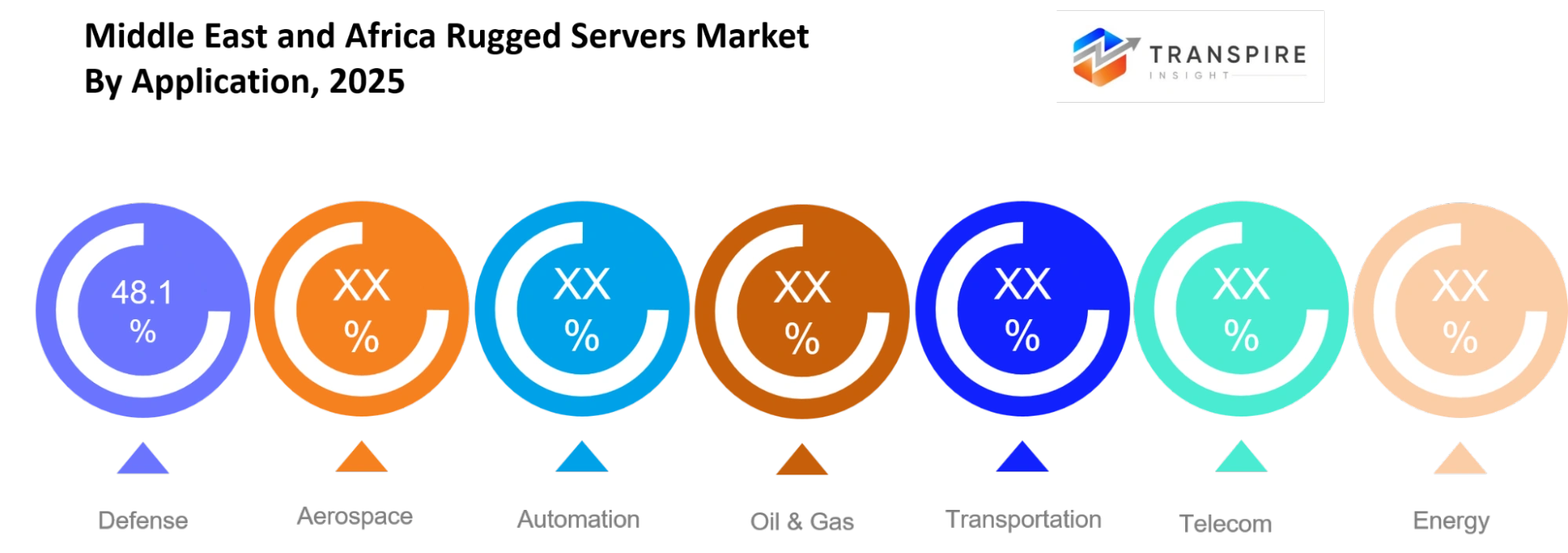
- Defense and security use cases still lead the market, holding nearly 35% share, mainly because surveillance and command systems have to work even when conditions are tough.
- For hardware types, rack-mounted rugged servers are still the top pick, they are around 40% of deployments in 2025, when people need higher capacity and easier scaling.
- Compact fanless rugged servers are the fastest-growing portion through 2033, mostly because they cut down maintenance chores, and they also use less energy.
- Oil and gas companies are rolling out AI-enabled edge infrastructure more and more, with digital field initiatives climbing by over 25% since 2021.
- Saudi Arabia and the UAE keep dominating regional spending, while South Africa is emerging as the quickest growing national opportunity, at a noticeable pace.
- Also, industrial automation deployments rose by about 20% from 2022 to 2025, which in turn is pulling new demand for rugged computing platforms that can handle vibration and dust.
- Dell, HPE, Cisco, Advantech, and Kontron are pushing regional collaborations to improve local support, and response times too.
- Overall, product innovation is leaning hard toward AI acceleration, built-in cybersecurity features, and high-performance edge analytics for essential operations.
What are the Key Drivers, Restraints, and Opportunities in the Middle East and Africa Rugged Servers Market?
The strongest growth driver is probably the quick expansion of industrial digitalization and edge computing infrastructure across energy , defense, mining, transportation, and utility sectors. More and more organizations are needing real time analytics at remote operational locations where cloud connectivity stays kind of patchy or limited. In parallel, the adoption of Industry 4.0 technologies, AI enabled monitoring systems, and autonomous operations has made the market crave computing platforms that can keep working even under harsh environmental conditions. This shift, kind of directly, supports revenue growth by driving deployments across both brand new projects and modernization initiatives.
The biggest restraint still feels like the high acquisition and lifecycle cost of ruggedized hardware. Rugged servers need specialized components, military grade certifications, thermal management systems, and a lot of extensive testing procedures. Because of that, there are structural cost barriers that can’t really be removed fast. Budget constrained organizations often end up delaying infrastructure upgrades or extending equipment replacement cycles, which then slows adoption rates and limits addressable market expansion across several African economies, more than you’d expect.
A major opportunity is also showing up, coming mainly from regional investments in smart energy infrastructure, digital oilfields, autonomous mining operations , and defense modernization programs. Edge AI platforms that can process large volumes of operational data locally are becoming more and more valuable. For instance, large scale industrial developments in Saudi Arabia , the UAE , and South Africa increasingly plug in intelligent monitoring systems that end up needing ruggedized computing architectures, which is why the demand is rising.
What Has the Impact of Artificial Intelligence Been on the Middle East and Africa Rugged Servers Market?
Artificial intelligence is kinda changing rugged server deployments, by helping with advanced analytics, sort of autonomous decision making, and operational optimization even when the environment is really harsh. More and more industrial operators are using AI powered edge computing systems to examine equipment data right on site, which cuts latency down, and helps response times get better. These rugged servers then handle sensor information coming from oil fields, substations, mining machinery, transport networks, and defense applications, without needing to lean too hard on centralized cloud infrastructure all the time.
Machine learning algorithms help with predictive maintenance, in the sense that they catch equipment anomalies before failures actually happen. That reduces unexpected downtime, it can also stretch asset life, and in the end lowers maintenance expenses. In mining and energy settings, AI models continuously review temperature, vibration, pressure, plus general performance data to tune up asset utilization. Meanwhile defense groups use AI enabled rugged computing platforms for surveillance analytics, target recognition, and situational awareness type applications.
The operational perks are usually higher system availability, quicker incident response, less maintenance spending, and better overall operational efficiency. Teams that deploy AI enabled edge infrastructure often mention real numbers improvements, like measurable decreases in downtime and fewer maintenance interventions.
Still, adoption is not all smooth. Integration costs stay high because AI workloads tend to need higher performance processors, specialized accelerators, and upgraded networking infrastructure. Data quality is another snag, especially in remote environments where connectivity can be inconsistent, and operational datasets are fragmented, which can lower model accuracy and slow down implementation schedules.
Key Market Trends
- Since 2021, deployments in edge computing went up by more than thirty percent, a lot of industrial operators started leaning away from centralized cloud infrastructure .
- Defense agencies meanwhile moved toward AI-enabled rugged platforms , which helped surveillance processing and also battlefield data analytics in a more noticeable way.
- Meanwhile industrial automation projects expanded a lot, smart mining and energy sites pushed rugged server deployments up by almost 20% ,or close to that.
- After 2022 regional cybersecurity rules got tighter , so the need for secure computing architectures grew across critical infrastructure sectors, you know like power, transport, and so on.
- Dell HPE and Cisco also increased investment into edge-focused product portfolios to handle industrial AI workloads better.
- Fanless rugged server designs became more popular because maintenance overhead went down and reliability stayed higher in dusty environments, with less fiddling.
- Localized data processing started feeling like the go-to plan, operators wanted lower latency, and better operational resilience too.
- Government-backed digital transformation programs then accelerated procurement activity across transportation, utilities, and public infrastructure networks, all at once it seemed.
- In South Africa, industrial modernization efforts created new opportunities for suppliers focusing on edge computing solutions.
- And partnerships between hardware vendors and industrial software providers actually increased substantially between 2023 and 2025.
Middle East and Africa Rugged Servers Market Segmentation
By Product Type
Copper cables still help with cost effective connectivity across enterprise and industrial sites where near range data transfer stays kind of workable. Fiber optics deliver more bandwidth and reduced signal loss so installing them makes sense in data heavy areas and for those longer distance links. Patch panels sort out network infrastructure a bit better and also make maintenance a lot easier when installations get complicated. Connectors make sure the signal stays steady and that network components can work together in a smooth, compatible way.
Racks give a more organized home for networking and computing gear while still leaving room for future growth. Cable management solutions improve layout, airflow, and day to day upkeep efficiency inside the communication network. Network outlets enable dependable endpoint connections across offices and institutional buildings. Other products cover specialized add ons and supporting infrastructure, made to enhance network efficiency reliability, and deployment flexibility, with less fuss.
By Application
Data centers kinda show up as a big application area because more and more digital infrastructure spending keeps happening, and cloud services are expanding too. LAN deployments are still doing their job for enterprise connectivity needs across different places like multiple offices, educational institutions, and even public facilities. On the telecom side, infrastructure has to come with solid cabling systems, so broadband growth stays on track, mobile networks keep moving, and data transmission can handle the demand without issues. Meanwhile industrial networks lean on dependable connectivity , since automation, monitoring, and operational control systems really need it day after day.
Smart buildings are also getting more “connected”, with devices everywhere, energy management systems in the mix, and intelligent facility operations running in the background. Security systems use modern networking infrastructure to carry surveillance , access control, and monitoring tasks. Healthcare facilities typically need secure, reliable communication systems for patient care, medical records, and all those connected devices. Other applications show up as transportation and utilities, plus more specialized industrial environments where things are less forgiving.
By End User
IT & Telecom is still a big end-user category, mainly because digital connectivity and data transmission needs keep growing across most regional markets. BFSI organizations put money into sturdy network infrastructure, not just for secure transactions but also for data safeguards, plus operational continuity that doesn’t easily get interrupted. In Healthcare, dependable connectivity is essential for medical applications, and for the management of patient information too. Government agencies also keep modernizing their communication networks, and they roll out more digital public services over time
Meanwhile, Manufacturing plants lean on advanced networking infrastructure for automation, industrial monitoring and production efficiency. Educational institutions are also ramping up investments in digital learning spaces, and campus connectivity ends up being part of that upgrade cycle. Retail players deploy network solutions that help omnichannel workflows, and even customer engagement technologies, sometimes in surprisingly complex setups. Other end users run the gamut, like utilities, transport providers, and certain specialized commercial enterprises
By Cable Category
Cat5e is still used a lot in places where budgets matter, and where the bandwidth needs are kinda in the middle. Cat6 can push higher data rates, and it tends to behave better in modern enterprise networks , overall. Cat6A goes even further, it adds more headroom for capacity plus it helps reduce interference when installations get demanding. Cat7 tackles more advanced requirements, mainly by using stronger shielding and keeping signal quality steadier.
Cat8 is starting to show up more often in high-performance setups that need extremely fast connectivity and low delay. Fiber Optics keep expanding because bandwidth-hungry apps are growing, cloud infrastructure keeps getting bigger, and long distance runs still matter. Coaxial solutions, meanwhile, stay relevant in some specific communication and broadcasting situations. Other cable categories exist too, they cover more specialized connectivity needs across different industrial and commercial environments.
What are the Key Use Cases Driving the Middle East and Africa Rugged Servers Market?
The main use case involves mission-critical computing for defense, oil and gas, mining, and utility operations. In those sectors people really need dependable processing power, especially when the surroundings are exposed to dust , vibration, severe temperatures, and also unstable power supply. Rugged servers end up enabling real-time monitoring, operational control , and data processing where a system failure could derail essential activities, you know .
There’s also more adoption coming from transportation infrastructure, industrial automation and the whole smart city push. Manufacturing sites and energy operators increasingly lean on rugged computing platforms to handle predictive maintenance, surveillance setups, and remote asset management.
Then there are emerging scenarios like AI-based edge analytics, autonomous mining equipment management, and more capable border security systems. As investments in digital infrastructure and industrial automation continue to expand , it should open up further deployment opportunities across the entire forecast period.
|
Report Metrics |
Details |
|
Market size value in 2025 |
USD 184.7 Million |
|
Market size value in 2026 |
USD 199.5 Mn |
|
Revenue forecast in 2033 |
USD 342.1 Million |
|
Growth rate |
CAGR of 8.01% from 2026 to 2033 |
|
Base year |
2025 |
|
Historical data |
2021 - 2024 |
|
Forecast period |
2026 - 2033 |
|
Report coverage |
Revenue forecast, competitive landscape, growth factors, and trends |
|
Regional scope |
United States; Canada; Mexico; United Kingdom; Germany; France; Italy; Spain; Denmark; Sweden; Norway; China; Japan; India; Australia; South Korea; Thailand; Brazil; Argentina; South Africa; Saudi Arabia; United Arab Emirates |
|
Key company profiled |
Dell, HPE, Crystal Group, Curtiss-Wright, Mercury Systems, Cisco, Lenovo, Kontron, Advantech, Trenton Systems, Getac, Elma Electronic, Abaco Systems, Dellner, Supermicro |
|
Customization scope |
Free report customization (country, regional & segment scope). Avail customized purchase options to meet your exact research needs. |
|
Report Segmentation |
By Server Type (Rackmount, Portable, Embedded, Edge, Blade, Military, Industrial, Others); By Application (Defense, Aerospace, Automation, Oil & Gas, Transportation, Telecom, Energy, Others); By Deployment (On-Premise, Edge Computing, Mobile, Cloud Integration, Remote Sites, Others); By End User (Defense, Industrial, Government, Energy, Telecom, Transportation, Others) |
Which Regions are Driving the Middle East and Africa Rugged Servers Market Growth?
The Gulf Cooperation Council region seems to be pulling ahead in market growth, largely because of heavy, i mean substantial investments in defense modernization, smart city rollouts, protecting critical infrastructure, and energy sector digitalization too. Saudi Arabia and the UAE are still putting serious money into advanced computing along with operational technology systems. Add strong government backing to the mix, plus fairly sophisticated industrial infrastructure and those big transformation programs, and it sort of keeps the region in the leadership position. On top of that, there is a mature ecosystem of technology providers and system integrators which keeps deployment activity moving along.
South Africa, meanwhile, shows up as the second-largest contributor, but it doesn’t exactly follow the same route. Its growth path leans more toward industrial modernization, mining operations, and upgrades for utility infrastructure. Through economic diversification efforts, more investment is being pushed toward resilient computing setups in key sectors. Steady industrial demand and already established technology adoption routines give a pretty consistent revenue base. And mining firms keep rolling out rugged computing platforms to get better operational visibility, plus tighter equipment management.
Also, the fastest growth is starting to show up across a few developing African markets, where infrastructure modernization programs are ramping up. Since 2023, spending across telecommunications, transportation corridors, digital government initiatives, and energy projects has expanded a lot. With connectivity improving, and industrial development coming into place, the conditions become better for rugged computing uptake. That kind of momentum is basically creating attractive opportunities for vendors looking for long-term expansion between 2026 and 2033.
Who are the Key Players in the Middle East and Africa Rugged Servers Market and How Do They Compete?
Competition stays moderately concentrated, with big technology providers basically going at it on reliability, environmental certifications, raw computing performance, cybersecurity depth, and region based service support, even if it feels a bit more complex in practice. In defense, industrial automation, energy, and transportation, the sectors are asking more and more for customized rugged computing solutions, which opens doors for diversified technology companies and also for more specialized rugged hardware manufacturers that already know the “real world” constraints.
Dell is leaning into scalable edge infrastructure, and it pairs enterprise grade rugged computing systems with broader IT ecosystems, kinda like plug-and-play but not fully. HPE, meanwhile, stands out via hybrid edge-to-cloud architectures that help industrial digital transformation efforts actually get deployed. Cisco leans hard on networking know-how by bundling ruggedized computing platforms with secure communication plus edge networking solutions, so it’s not just computing but the whole path too.
Kontron focuses on industrial-grade embedded computing technologies aimed at transportation, defense, and automation use cases. Advantech emphasizes industrial IoT integration and edge AI, letting customers place analytics nearer to the operational assets, rather than pushing everything back to a distant center. Curtiss-Wright keeps a solid footing in defense and aerospace by leaning on military-grade certifications and mission critical performance capabilities, the type that tends to matter when failure is not an option.
Looking ahead, expansion strategies seem to include regional partnerships and localized service capacity, plus AI enabled product development, and tighter integration with industrial software ecosystems. The players that can blend rugged hardware know how with edge computing, cybersecurity, and AI features are likely positioned to reinforce their competitive differentiation across the whole forecast period, even as requirements keep shifting.
Company List
- Dell
- HPE
- Crystal Group
- Curtiss-Wright
- Mercury Systems
- Cisco
- Lenovo
- Kontron
- Advantech
- Trenton Systems
- Getac
- Elma Electronic
- Abaco Systems
- Dellner
- Supermicro
Recent Development News
In September 2025, Supermicro launched new edge AI server platforms optimized for industrial and telecommunications deployments. The introduction expands high-performance computing options for remote and mission-critical operational environments.https://www.supermicro.com/en/newsroom
What Strategic Insights Define the Future of the Middle East and Africa Rugged Servers Market?
The market seems like it’s sliding toward a future where rugged servers don’t just sit there as plain computing equipment, but kinda act like distributed intelligence platforms instead. The most powerful structural push behind this whole shift is the way edge computing starts to merge with AI analytics , industrial automation, and the modernization of critical infrastructure. More and more organizations want on site processing, so they can make decisions in real time, especially in places where connection isn’t great, latency becomes a problem, or reliability limits how much they can rely on the cloud.
There’s also a risk people might not notice at first, and it’s tied to the rising dependence on specialized semiconductor supply chains. If there are component shortages or geopolitical shocks, production timetables can get disrupted, which then tends to raise deployment expenses. On the other hand, there’s a meaningful opening forming too, because AI enabled edge infrastructure is becoming a big emerging opportunity. You can see it especially across energy, mining, transportation, and defense.
For market participants, it’s probably best to focus on collaborations that blend rugged hardware with AI software, strong cybersecurity functions, and localized service support. Companies that build full integrated edge ecosystems , rather than selling only standalone hardware, should end up in a better position to secure long-term value as industrial digitalization keeps speeding up across the Middle East and Africa.
Middle East and Africa Rugged Servers Market Report Segmentation
-
By Product Type
- Copper Cables
- Fiber Optics
- Patch Panels
- Connectors
- Racks
- Cable Management
- Network Outlets
- Others
-
By Application
- Data Centers
- LAN
- Telecom
- Industrial Networks
- Smart Buildings
- Security Systems
- Healthcare Facilities
- Others
-
By End User
- IT & Telecom
- BFSI
- Healthcare
- Government
- Manufacturing
- Education
- Retail
- Others
-
By Cable Category
- Cat5e
- Cat6
- Cat6A
- Cat7
- Cat8
- Fiber Optics
- Coaxial
- Others
Frequently Asked Questions
Find quick answers to common questions.
The expected Middle East and Africa Rugged Servers Market size for the market will be USD 342.1 Million in 2033.
Key segments for the Middle East and Africa Rugged Servers Market are By Server Type (Rackmount, Portable, Embedded, Edge, Blade, Military, Industrial, Others); By Application (Defense, Aerospace, Automation, Oil & Gas, Transportation, Telecom, Energy, Others); By Deployment (On-Premise, Edge Computing, Mobile, Cloud Integration, Remote Sites, Others); By End User (Defense, Industrial, Government, Energy, Telecom, Transportation, Others).
Major Middle East and Africa Rugged Servers Market players are Dell, HPE, Crystal Group, Curtiss-Wright, Mercury Systems, Cisco, Lenovo, Kontron, Advantech, Trenton Systems, Getac, Elma Electronic, Abaco Systems, Dellner, Supermicro.
The Middle East and Africa Rugged Servers Market size is USD 184.7 Million in 2025.
The Middle East and Africa Rugged Servers Market CAGR is 8.01% from 2026 to 2033.
- Dell
- HPE
- Crystal Group
- Curtiss-Wright
- Mercury Systems
- Cisco
- Lenovo
- Kontron
- Advantech
- Trenton Systems
- Getac
- Elma Electronic
- Abaco Systems
- Dellner
- Supermicro
About the Authors

Chetan Dhatrak
I’m Chetan Dhatrak, a Senior Research Analyst at Transpire Insight, specializing in the Consumer Goods, Foods and Beverages industry. I focus on analyzing market trends, consumer behavior, competitive landscapes, and industry developments to deliver accurate, data-driven insights. My research at Transpire Insight is built on credible sources and in-depth analysis, helping businesses and readers better understand market dynamics, emerging opportunities, and evolving consumer preferences. I’m committed to creating reliable, well-researched content that supports informed decision-making and reflects the latest developments in the consumer goods and food & beverage sectors.

Chakradhar Khansole
Chakradhar serves as the Research Director at Transpire Insight, bringing over 8 years of experience in technology, innovation, and strategic market intelligence. He specializes in transforming complex market data into actionable business insights that enable organizations to make informed, growth-oriented decisions. Recognized for his strategic vision and analytical expertise, Chakradhar leads high-impact research initiatives, delivering comprehensive market assessments, competitive intelligence, and forward-looking industry analysis.
Recently Published Reports
-
Apr 2026
Bottled Water Market
Bottled Water Market Size, Share & Analysis Report By Product Type (Still Bottled Water, Carbonated Bottled Water, Functional Bottled Water, and Others), By Packaging (PET, Cans, and Others), By Sales Channel (Supermarkets/Hypermarkets, Convenience Stores/Drug Stores, Grocery Stores/Club Stores, Foodservice, and Others) and Geography (North America, Europe, Asia-Pacific, Middle East and Africa, South and Central America), 2021 - 2032
-
Apr 2026
Color Cosmetic Packaging Market
Color Cosmetic Packaging Market Size, Share & Analysis Report By Application (Mascara Packaging, Liquid Packaging, and Liquid Face), By Type (Tubes & Bottles, Pens & Markers, Compacts & Containers, and Droppers & Pumps), and Geography (North America, Europe, Asia-Pacific, Middle East and Africa, South and Central America), 2021 - 2031
-
Apr 2026
External Microphone For Camera Market
External Microphone For Camera Market Size, Share & Analysis Report By Type (Shotgun Microphone, Lavalier Microphone, and Others), By Application (Digital Camera, Professional Video Camera, and Others), and Geography (North America, Europe, Asia-Pacific, Middle East and Africa, South and Central America), 2021 - 2031
-
Apr 2026
Foot Orthotic Insoles Market
Foot Orthotic Insoles Market Size, Share & Analysis Report By Type (Pre-fabricated, and Custom-made), By Material (Thermoplastic, Composite Carbon Fiber, and Others), By Distribution Channel (Drug Stores, Hospitals & Clinics, and Others), and Geography (North America, Europe, Asia-Pacific, Middle East and Africa, South and Central America), 2021 - 2031