

Middle East and Africa Printed Circuit Board Market Size & Forecast:
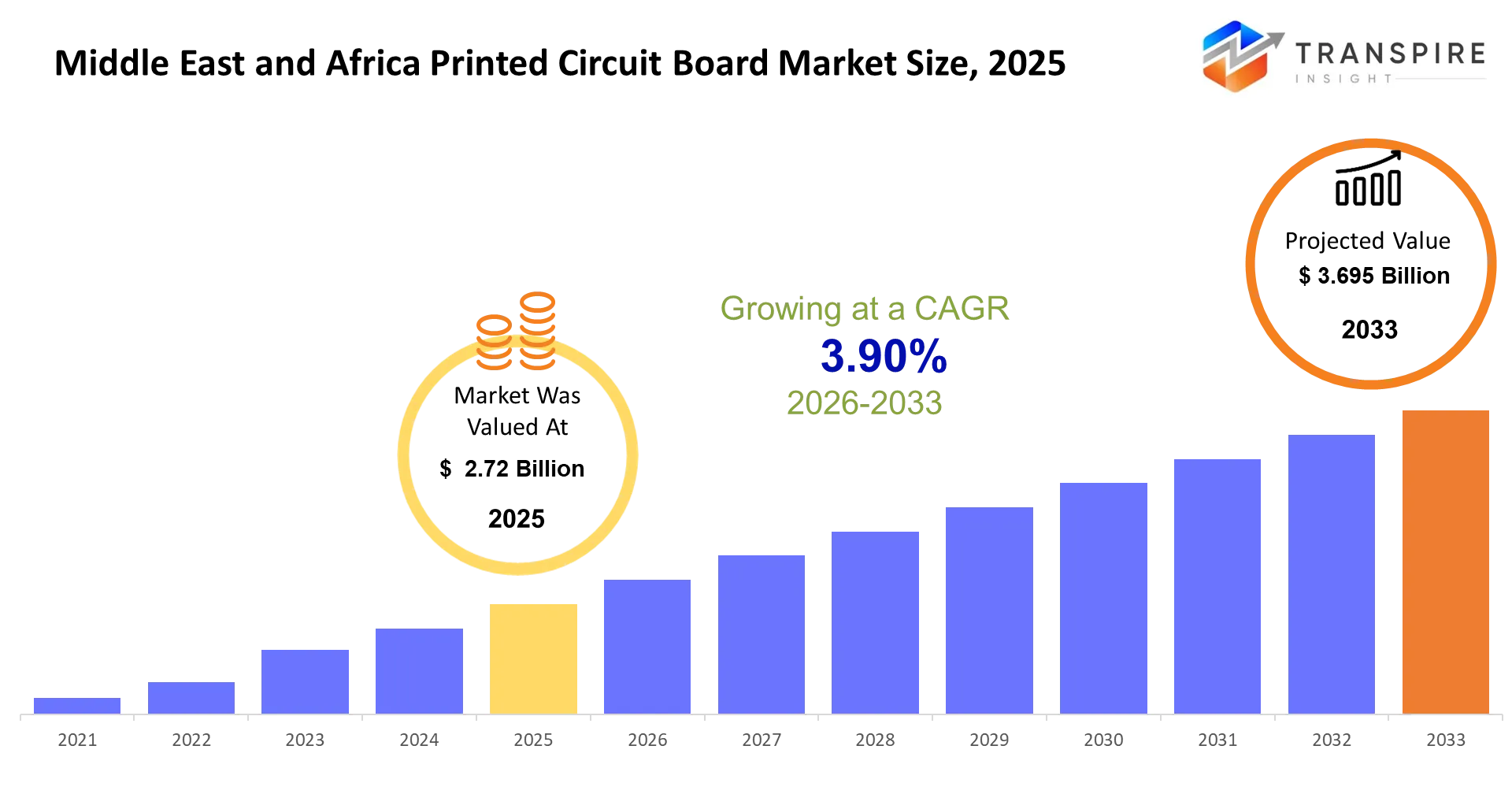
- Middle East and Africa Printed Circuit Board Market Size 2025: USD 2.72 Billion
- Middle East and Africa Printed Circuit Board Market Size 2033: USD 3.695 Billion
- Middle East and Africa Printed Circuit Board Market CAGR: 3.90%
- Middle East and Africa Printed Circuit Board Market Segments: By Type (Single-sided, Double-sided, Multilayer, Flexible PCB, Others); By Application (Consumer Electronics, Automotive, Industrial, Telecom, Healthcare, Others); By End-User (Electronics Manufacturers, Automotive Companies, Industrial Firms, Telecom Operators, Healthcare Sector, Others); By Material (FR4, Polyimide, CEM, Others)
To learn more about this report,  Download Free Sample Report
Middle East and Africa Printed Circuit Board Market Summary
The Middle East and Africa Printed Circuit Board Market was valued at USD 2.72 Billion in 2025. It is forecast to reach USD 3.695 Billion by 2033. That is a CAGR of 3.90% over the period.
The Middle East and Africa printed circuit board market really underpins the backbone of modern electronic systems that power telecom networks, industrial automation, defense platforms and the data infrastructure. In real world use, it helps with signal routing , power distribution and device control, inside equipment stretching from 5G base stations and servers to automotive control units and industrial sensors deployed across the region.
Over the last 3 to 5 years, you can see a structural shift taking shape. It’s moving away from low complexity, cost driven PCB imports, toward boards with more layers, better reliability, and a stronger link to digital infrastructure and defense modernization. This shift got a lot faster after the global supply chain disruptions happening between 2020 and 2022, because that period exposed how dependent many buyers were on concentrated East Asian fabrication hubs. Then GCC economies started to secure diversified sourcing for critical electronics inputs , so basically less risk.
Also, the telecom 5G rollout initiatives plus hyperscale data center expansion in the UAE and Saudi Arabia has added even more weight to this direction. So procurement behavior now tends to prefer long term supplier agreements and more advanced PCB requirements rather than just grabbing spot buys for commodity boards. This has raised revenue concentration in higher value segments, while at the same time it constrains expansion in low margin, single layer applications .
Key Market Insights
- GCC region kinda dominates the Middle East and Africa Printed Circuit Board Market, with almost 48% share in 2025 ,mostly because of telecom infrastructure buildup and hyperscale data center investments, you know the big spend kind.
- Sub-Saharan Africa comes in as the fastest-growing part during 2026–2033, supported by mobile connectivity expansion and the broader rollout of digital infrastructure ,even if it’s uneven across countries.
- Multilayer PCB segment leads overall, holding more than 55% share, it’s clearly tied to high-frequency telecom needs, server systems demand and also defense-grade electronics requirements.
- Flexible PCB segment shows the quickest growth path as wearable electronics keep spreading and compact consumer devices keep popping up across many urban African markets.
- For applications, consumer electronics stays dominant with roughly 40% share ,driven by smartphone imports and networking equipment demand, which is still growing.
- Telecom applications grow the fastest too, because 5G deployment and fiber backhaul expansion are accelerating along GCC and African metro corridors.
- On end-users, electronics manufacturers take the largest share since assembly-driven demand keeps pulling in imported PCB components.
- At the same time, telecom operators are the fastest-growing end-user group, likely due to ongoing infrastructure upgrades and network densification plans, year after year.
- Zhen Ding Tech. Group expands capacity via partnerships on advanced substrates ,this helps to reinforce high-volume PCB supply chains.
- Unimicron Technology meanwhile focuses on IC substrate innovation, supporting the AI and high-performance computing demand that’s entering MEA markets, kind of directly.
What are the Key Drivers, Restraints, and Opportunities in the Middle East and Africa Printed Circuit Board Market?
The main thing driving the Middle East and Africa printed circuit board market seems to be the fast digital buildout that keeps getting kicked off by 5G rollout requirements, plus big money for hyperscale data centers across GCC economies. In Saudi Arabia and the UAE, governments have sped up cloud adoption initiatives and sovereign digital transformation moves, and this kind of directly ups the need for multilayer, high density interconnect boards in servers, networking gear, and telecom base stations. As a result, import volumes for advanced PCBs keep rising, and procurement contracts over the long run are getting tighter with Asian and European vendors.
The biggest drag though is the region’s kind of structural reliance on imported high-end PCB substrates and on the fabrication side too. Right now, local output is mostly limited to low to mid complexity boards, while the really advanced IC substrates and the fine-line multilayer work is still largely located in East Asia. That dependency tends to bring long lead times, makes buyers more exposed to global supply chain swings, and it also limits how much margin can stay inside regional economies. This barrier does not really fade quickly because it’s tied to heavy capex needs, technical know-how gaps, and weak ecosystem linkage rather than some short term policy issue.
One real opportunity is starting to show up through electronics manufacturing zones that are becoming more localized in Saudi Arabia and the UAE, where industrial diversification plans are pulling in PCB assembly and design partnerships. There are joint ventures that global suppliers are doing with regional technology parks, and they are beginning to back early stage production with high reliability, especially for telecom and defense uses. If those ecosystems keep maturing then they could nudge the region away from pure consumption, and toward at least partial participation in the value chain, even if it’s not complete at first.
What Has the Impact of Artificial Intelligence Been on the Middle East and Africa Printed Circuit Board Market?
Artificial intelligence is basically reshaping PCB manufacturing and the electronics supply chain for Middle East and Africa, mostly by making fabrication and assembly a lot more precise, in a way that’s measurable . Advanced machine vision systems are now automating defect detection in multilayer board production and it is kind of replacing manual inspection, which in turn brings down error rates in high-density interconnect lines . On top of that , predictive maintenance models look at vibration, temperature, and throughput signals from drilling and lamination equipment, and they try to guess failures before downtime shows up, so overall equipment effectiveness goes up across fabrication plants supporting telecom and defense projects.
Digital optimization tools also help with yield management and process control, by tweaking etching , plating and exposure parameters in real time. Some manufacturers who use AI-driven process tuning say they get more stable yields and less material wastage, especially when they work with high-spec substrates for data centers and 5G infrastructure. Supply chain planning systems are increasingly applying machine learning too, trying to juggle long-lead imported materials with uneven regional demand , which reduces inventory holding costs and cuts procurement delays.
A key snag though is that the integration cost for AI systems into legacy PCB fabrication lines is still high, especially for smaller regional facilities. Also, limited high-quality production data, along with uneven digital infrastructure across emerging manufacturing hubs, can constrain model accuracy, so wider adoption moves slower even if the efficiency gains are pretty clear.
Key Market Trends
- Telecom operators have been pushing 5G rollout harder since 2023 , and in the background that means multilayer PCB demand also went up, especially for high frequency base station and backhaul systems .
- Meanwhile GCC industrial policies, sort of moved away from pure import dependence and started backing localized electronics clusters , which slowly started pulling in PCB assembly partnerships from Asian suppliers.
- On the defense side , procurement programs expanded after 2024 , and that led to more use of certified, high reliability PCBs , mostly coming from US and Japanese manufacturers.
- Automotive electronics integration also jumped quite a bit in North Africa , you can trace it to 2025 EV pilot programs and to the wider export oriented vehicle assembly expansion .
- Also supply chain diversification really picked up after 2023 , so there was less and less reliance on a single source in China for advanced PCB substrates and components .
- For data centers, construction accelerated in UAE and Saudi Arabia , and with the AI infrastructure buildout the demand is rising for high density interconnect PCB architectures.
- Flexible PCB adoption grew at a steady pace in consumer devices after 2024, mostly because miniaturization trends in smartphones and wearable electronics kept moving forward.
- Material sourcing shifted toward polyimide based substrates for thermal efficiency, in particular across telecom and automotive electronics applications around regional hubs.
- Finally, semiconductor packaging integration increased through 2025 , via partnerships between global PCB firms and substrate suppliers, aimed at the high performance computing demand.
Middle East and Africa Printed Circuit Board Market Segmentation
By Type
Multilayer PCBs are still basically leading in the market, mainly because telecom infrastructure, data centers, and defense electronics are pulling demand across GCC countries. The reason is pretty straightforward, high circuit density, plus signal integrity , needs are so strict that multilayer layouts become the default for modern equipment. Meanwhile, single-sided and double-sided boards stay more stuck in low-cost consumer gear, and basic industrial electronics. For flexible PCBs and other advanced variants, their share looks smaller, not because they are bad, but because production is more expensive and local manufacturing depth is limited.
Adoption momentum for multilayer and flexible PCBs is tied to a few bigger drivers. 5G network rollouts keep rising, EV electronics are growing, and compact medical devices keep expanding. In telecom and automotive, system designs get more intricate over time, so manufacturers push for higher layer counts and smaller, miniaturized layouts, not really the classic board categories people used to rely on. Also, dependence on imported inputs for advanced PCB fabrication adds extra weight to established Asian producers, so that dominance holds.
Across the forecast period, multilayer and flexible PCB demand should grow faster than the conventional categories, especially as digital infrastructure spending accelerates. Product teams will likely focus on thermal efficiency and overall size reduction, while buyers may deal with more procurement complexity, simply due to limited regional fabrication capability.
By Application
Consumer electronics and telecom use cases take the most of the pie, because import volumes of smartphones, networking gear, and broadband infrastructure just keep staying high across most big urban centers. After that comes automotive and industrial, kind of supported by vehicle electronics being integrated more often, plus factory automation upgrades, especially around the North African export hubs. Healthcare and a few other small niche categories stay less visible but they’re still steady, since diagnostic equipment imports continue, and hospital modernization programs keep moving forward.
On the telecom side , expansion and all those digital transformation pushes create their own kind of growth rhythm. High-speed communication networks lean on advanced PCB architectures for base stations , routers, and data transmission systems. Meanwhile, automotive demand seems to rise from electronic control systems in EVs and hybrid vehicles, and industrial adoption grows through predictive maintenance setups and smart manufacturing equipment.
Looking ahead, the future expansion will likely concentrate in telecom and automotive electronics as infrastructure digitization deepens across the GCC and across African economies too. Manufacturers that supply high-reliability boards should end up with better pricing leverage, and at the same time buyers will likely favor longer term contracts , just to lock in steady component availability.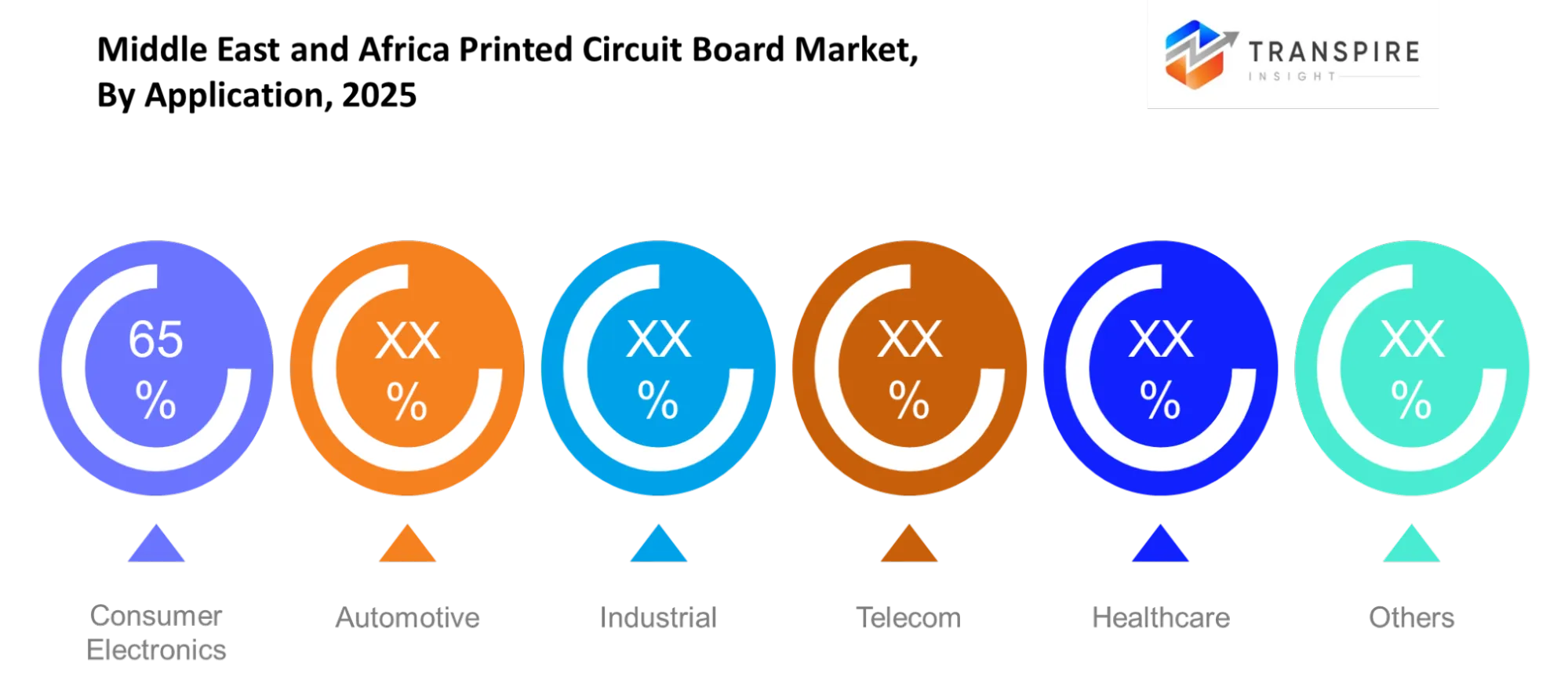
To learn more about this report, Download Free Sample Report
By End-User
Electronics manufacturers really run the consumption side because they assemble and piece together imported PCB components into the final products across telecom, consumer devices, and industrial systems. Telecom operators trail them, mostly because upgrades never stop and 5G infrastructure keeps rolling out across big Middle Eastern cities plus African growth corridors. Automotive companies and industrial firms stay in a moderate band, while healthcare adoption is more niche, and yes it is procurement heavy.
In this segment the demand rhythm is influenced by infrastructure ownership cycles, and also by how intense capex spending is. Telecom operators push bulk buying during expansion phases, while electronics manufacturers keep a steadier baseline going via their assembly operations. Automotive and industrial buyers typically ask for higher dependability thresholds due to safety expectations, and day to day operational constraints.
Looking ahead growth should lean further toward electronics manufacturers and telecom operators as digital infrastructure scaling speeds up. Supply chain integration will matter more too, with end-users trying to coordinate closer with PCB suppliers to shorten lead times, and refine design tailoring.
By Material
FR4 takes the largest share because it’s cost efficient, and it also fits well mainstream consumer electronics, industrial controls, and basic telecom equipment. Polyimide material tends to get more traction for flexible and high temperature uses, especially in automotive electronics, and those compact communication devices. Meanwhile, CEM and some other specialty materials stay kind of niche, mainly since costs run higher and the localized production options are more limited than people expect.
Material selection is guided more by performance needs not just cost alone, and in advanced use cases this difference gets amplified. For example, high frequency telecom systems, plus EV electronics, are pushing demand toward polyimide based substrates, but FR4 is still dominating volume driven manufacturing. Also, supply chain constraints for advanced materials make companies lean harder on global suppliers , so it stays that way for now.
Through the forecast period, polyimide and specialty materials should grow faster than FR4 , largely because electronics design complexity keeps climbing. Buyers will likely focus more on durability plus thermal resistance, and manufacturers that can provide advanced materials will end up with a better position, particularly in those high margin segments.
What are the Key Use Cases Driving the Middle East and Africa Printed Circuit Board Market?
Telecom infrastructure and data center deployments kind of steer the main demand for printed circuit boards across the Middle East and Africa. Operators keep expanding 5G networks and hyperscale facilities, and they end up needing high density interconnect boards for routing, processing, plus thermal management inside really dense electronics systems.
After that, automotive electronics and industrial systems become the next layer of demand, especially in North Africa export manufacturing hubs. PCB usage keeps going up in vehicle control units, factory automation equipment, and even consumer electronics assembly that feeds European and local supply chains.
Some newer applications are starting to show up too, like electric vehicle platforms, smart grid infrastructure, and low earth orbit satellite communications. These applications are still early, yet they slowly gain momentum as governments push energy transition programs and digital connectivity initiatives across African markets that are still, for the most part, underserved.
|
Report Metrics |
Details |
|
Market size value in 2025 |
USD 2.72 Billion |
|
Market size value in 2026 |
USD 2.826 Billion |
|
Revenue forecast in 2033 |
USD 3.695 Billion |
|
Growth rate |
CAGR of 3.90% from 2026 to 2033 |
|
Base year |
2025 |
|
Historical data |
2021 - 2024 |
|
Forecast period |
2026 - 2033 |
|
Report coverage |
Revenue forecast, competitive landscape, growth factors, and trends |
|
Regional scope |
Middle East and Africa (Saudi Arabia, United Arab Emirates, South Africa, Rest of Middle East and Africa) |
|
Key company profiled |
Zhen Ding Tech, Unimicron, TTM Technologies, Nippon Mektron, Ibiden, Samsung Electro-Mechanics, AT&S, Compeq, Shennan Circuits, Tripod Tech, Meiko Electronics, Flexium, LG Innotek, KCE Electronics, Young Poong |
|
Customization scope |
Free report customization (country, regional & segment scope). Avail customized purchase options to meet your exact research needs. |
|
Report Segmentation |
By Type (Single-sided, Double-sided, Multilayer, Flexible PCB, Others); By Application (Consumer Electronics, Automotive, Industrial, Telecom, Healthcare, Others); By End-User (Electronics Manufacturers, Automotive Companies, Industrial Firms, Telecom Operators, Healthcare Sector, Others); By Material (FR4, Polyimide, CEM, Others) |
Which Regions are Driving the Middle East and Africa Printed Circuit Board Market Growth?
The Middle East , especially the GCC stretch steered by Saudi Arabia and the UAE, basically acts as the main regional center for the MEA printed circuit board market, or at least it looks like that in practice. This kind of dominance comes from fairly aggressive industrial diversification programs, strong sovereign backing for electronics ecosystems, and a quick rollout of data center capacity alongside defense electronics buying. On top of that, you have solid logistics setups around ports like Jebel Ali and King Abdullah Port, which makes import and re-export cycles for high value PCB assemblies feel faster and more workable. There’s also this dense layer of free zones and tech clusters that pull in advanced electronics design, system integration, and a bunch of related work, so the area ends up staying the primary demand spot.
North Africa , with Egypt and Morocco at the lead, tends to play a steadier, stability kind of role rather than a high capital, push-the-limits leadership position. Instead of the GCC model, the region leans on consistent export-oriented manufacturing in automotive wiring, consumer electronics assembly, and industrial components. It’s also close to Europe, and the preferential trade arrangements with the EU give a more predictable demand path. That predictability then supports continuous PCB imports and localized assembly operations, even if the pace isn’t as dramatic. Investment behavior stays more gradual and cost sensitive, but the upside is reliable volume continuity, rather than nonstop technological expansion.
Sub Saharan Africa shows up as the fastest mover, mainly because digital infrastructure projects are accelerating and mobile first connectivity keeps spreading. New directions in telecom expansion, local smartphone assembly initiatives , and power infrastructure upgrades are starting to reshape electronics demand down at the base level. Places like Nigeria, Kenya, and Ghana are pushing policy support for local manufacturing, with the goal to lower import dependence and strengthen the supply chain.
Who are the Key Players in the Middle East and Africa Printed Circuit Board Market and How Do They Compete?
Competition in the Middle East and Africa for printed circuit boards still looks pretty structurally fragmented, there’s no true dominant regional manufacturer, and a lot of the higher value boards keep coming in from East Asia and Europe. Most incumbents, like Taiwanese and Japanese producers, are defending their share more with tech differentiation not really on price. Meanwhile demand is getting pulled by telecom, defense, and data infrastructure, so global suppliers keep getting attention. The real “where to win” part is moving toward advanced capability, high density interconnect design, reliability certification, and also just being nearer to end users in the supply chain.
Zhen Ding Tech. Group shows up with cost scale plus vertically integrated mass production, so it can feed high volume electronics and server supply chains in a more efficient way. Unimicron Technology leans into advanced IC substrates and ABF capacity, and they try to stand out by offering high-end semiconductor packaging compatibility, which helps with the AI driven demand flowing into MEA, mostly via data infrastructure imports. AT&S builds its edge around high-end HDI and substrate know how, then expands capacity closer to Asian demand hubs. They also aim premium segments tied to telecom and medical systems, which are relevant to MEA import channels.
Samsung Electro-Mechanics uses its FC-BGA strength and miniaturization capability, so it lines up with high performance computing supply chains that indirectly support MEA data center growth. TTM Technologies differentiates with aerospace and defense certified PCB production, and that positions it for procurement that connects to regional defense modernization programs as well as government backed infrastructure initiatives.
Company List
- Zhen Ding Tech
- Unimicron
- TTM Technologies
- Nippon Mektron
- Ibiden
- Samsung Electro-Mechanics
- AT&S
- Compeq
- Shennan Circuits
- Tripod Tech
- Meiko Electronics
- Flexium
- LG Innotek
- KCE Electronics
- Young Poong
Recent Development News
In December 2025, Zhen Ding Tech. Group announced a strategic cooperation agreement with Topoint Technology. The partnership focuses on advancing high-end PCB drilling technologies, micro-drill innovation, and next-generation substrate capabilities, strengthening advanced manufacturing capacity that supports global supply chains including emerging AI and server demand corridors linked to MEA expansion.https://www.ic-pcb.com
“In March 2026, Zhen Ding Tech. Group entered a strategic partnership with Guangdong Dtech Technology Co., Ltd. The collaboration targets smart manufacturing integration, advanced tooling development, and material optimization for high-end PCB production, reinforcing supply chain resilience for global markets including Middle East electronics infrastructure growth.https://www.ic-pcb.com
What Strategic Insights Define the Future of the Middle East and Africa Printed Circuit Board Market?
Over the next 5–7 years, the Middle East and Africa PCB market is probably going to drift from mostly import dependent consumption into some more selective localized manufacturing clusters, and it feels like this is being pushed by sovereign industrialization plans, defense purchasing, telecom densification , and also the rapid growth of data centers. The whole direction seems to rely less on simple demand growth alone, and more on supply chain “de risking” away from East Asia, toward a regional resilience angle. There is also this quieter risk, like staying dependent on imported high-grade laminates and substrate materials , which could quietly limit how much value local players can actually keep, even if assembly capacity keeps expanding.
At the same time, a not so mainstream opportunity is showing up in Gulf-led advanced electronics zones, where AI infrastructure plus the EV ecosystem could act like a spark for demand around high density interconnect boards and specialized thermal control solutions. So market participants should try to lock in tech transfer partnerships with proven Asian fabricators, but also invest early in recyclable, high reliability PCB capabilities, so margins can grow over the long run.
Middle East and Africa Printed Circuit Board Market Report Segmentation
By Type
- Single-sided
- Double-sided
- Multilayer
- Flexible PCB
- Others
By Application
- Consumer Electronics
- Automotive
- Industrial
- Telecom
- Healthcare
- Others
By End-User
- Electronics Manufacturers
- Automotive Companies
- Industrial Firms
- Telecom Operators
- Healthcare Sector
- Others
By Material
- FR4
- Polyimide
- CEM
- Others
Frequently Asked Questions
Find quick answers to common questions.
The Middle East and Africa Printed Circuit Board Market size is USD 3.695 Billion in 2033.
Key Segments for the Middle East and Africa Printed Circuit Board Market are By Type (Single-sided, Double-sided, Multilayer, Flexible PCB, Others); By Application (Consumer Electronics, Automotive, Industrial, Telecom, Healthcare, Others); By End-User (Electronics Manufacturers, Automotive Companies, Industrial Firms, Telecom Operators, Healthcare Sector, Others); By Material (FR4, Polyimide, CEM, Others).
Major Middle East and Africa Printed Circuit Board Market players are Zhen Ding Tech, Unimicron, TTM Technologies, Nippon Mektron, Ibiden, Samsung Electro-Mechanics, AT&S, Compeq, Shennan Circuits, Tripod Tech, Meiko Electronics, Flexium, LG Innotek, KCE Electronics, Young Poong.
The Current Middle East and Africa Printed Circuit Board Market size is USD 2.72 Billion in 2025.
The Middle East and Africa Printed Circuit Board Market CAGR is 3.90% from 2026 to 2033.
- Zhen Ding Tech
- Unimicron
- TTM Technologies
- Nippon Mektron
- Ibiden
- Samsung Electro-Mechanics
- AT&S
- Compeq
- Shennan Circuits
- Tripod Tech
- Meiko Electronics
- Flexium
- LG Innotek
- KCE Electronics
- Young Poong
Recently Published Reports
-
Apr 2026
Fiber Optic Faceplates Market
Fiber Optic Faceplates Market Size, Share & Analysis Report By Type (< 300 mm2, 300-350 mm2, and > 350 mm2, By Application (Night Vision, Holographic Imaging, Medical, and Others), and Geography (North America, Europe, Asia-Pacific, Middle East and Africa, South and Central America), 2021 - 2031
-
Apr 2026
High Temperature Superconductors Market
High Temperature Superconductors Market Size, Share & Analysis Report By Type (1G HTS, and 2G HTS), By Application (Power Cable, Fault Current Limiter, and Transformer), and Geography (North America, Europe, Asia-Pacific, Middle East and Africa, South and Central America), 2021 - 2031
-
Apr 2026
Industrial Plugs and Socket Market
Industrial Plugs and Socket Market Size, Share & Analysis Report By Type (Industrial Plugs, Industrial Sockets), By Current (Up to 32 A, 32 to 125 A, Above 125 A), By Protection (Dustproof and Splash Proof, Waterproof, Explosion Proof), By End User (Heavy Industries, Oil and Gas, Chemicals and Pharmaceuticals, Power Generation, Others), and Geography (North America, Europe, Asia-Pacific, Middle East and Africa, South and Central America), 2021 - 2031
-
Apr 2026
InGaAs Avalanche Photodiodes Market
InGaAs Avalanche Photodiodes Market Size, Share & Analysis Report By Type (1100 - 1700 nm, and 1000 - 1600 nm), By Application (Missile Warning System, Muzzle Flash Detection, Wafer Defect Inspection, Laser Rangefinders, and Others), and Geography (North America, Europe, Asia-Pacific, Middle East and Africa, South and Central America), 2021 - 2031