

Middle East and Africa Polymeric Adsorbents Market Summary
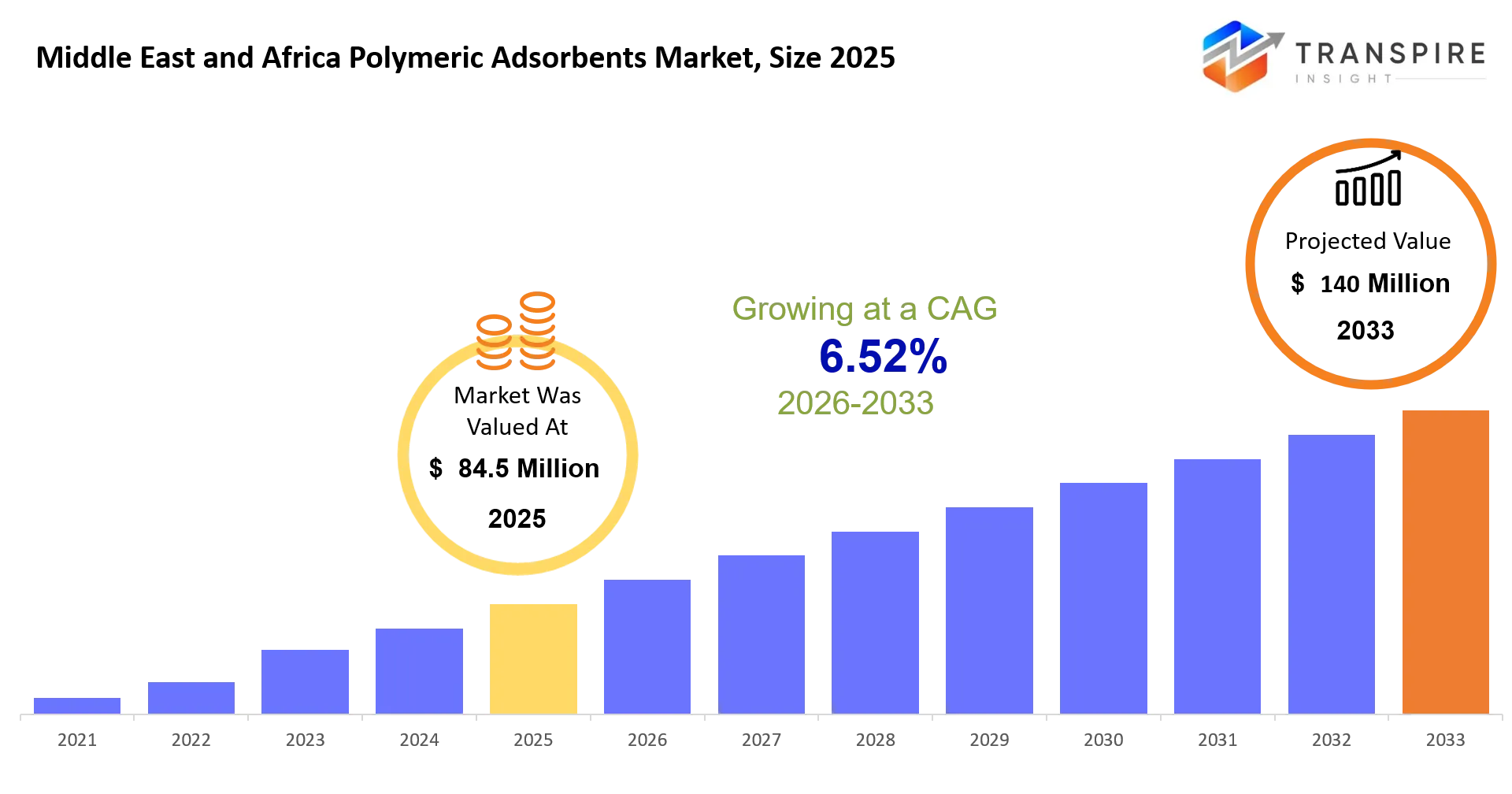
As per Transpire Insight Analysis the Middle East and Africa Polymeric Adsorbents Market size is estimated at USD 84.5 Million in 2025 and is anticipated to reach USD 140 Million by 2033, growing at a CAGR of 6.52% from 2026 to 2033.
Polymeric adsorbents end up doing a pretty practical job in the separation, refinement and recovery of valuable compounds from liquids,as well as gases, across water treatment, pharma making , food processing, and chemical production. In real work they help industries reach better product purity , claw back costly raw materials and also satisfy those tighter environmental discharge rules, all while cutting down on process waste. Over the last five years the market kind of shifted away from the more conventional ion exchange materials toward high-capacity macroporous ones , and also functionalized polymeric adsorbents, which then bring improved selectivity and a longer useful lifetime. At the same time, stricter industrial wastewater regulations, along with a few supply chain hassles after the COVID-19 period, kinda nudged manufacturers to tweak their purification processes a bit and lessen their reliance on throwaway filtration systems. Because of that, companies have been ramping up investment in advanced adsorption technology, in particular across pharmaceutical and chemical operations. That keeps producing these recurring needs for higher performance resins , and it backs continued revenue growth across the Middle East and Africa.
Middle East and Africa Polymeric Adsorbents Market Size & Forecast:
- Middle East and Africa Polymeric Adsorbents Market Size 2025: USD 84.5 Million
- Expected Market Value 2033: USD 140 Million
- Forecast CAGR: 6.52%
- Leading country in 2025: Saudi Arabia
- Fastest-growing country: United Arab Emirates (UAE)
- Key Profile: Purolie, Mitsubishi Chemical, DuPont, LANXESS, Sunresin, Thermax, ResinTech, Samyang Corporation, Evoqua Water Technologies, Kuraray, Bio-Rad Laboratories, Merck KGaA, Dow, BASF, Jacobi Carbons
Key Market Insights
- It looks like the Middle East and Africa Polymeric Adsorbents Market is likely to hit USD 140 million by 2033, and it’s growing around 6.52% CAGR . This is mostly backed by more people wanting high-performance purification methods, i mean technologies that just work really well.
- In the region, the GCC countries seem to dominate , with an estimated 46% market share in 2025. That’s mainly because of big investments in desalination projects, petrochemicals, and industrial wastewater treatment build outs.
- Meanwhile, South Africa is expected to be the fastest moving regional market from 2026 to 2033. The reason is a mix of expanding pharmaceutical manufacturing, mining activities and, environmental compliance push, you know regulations that keep getting stricter.
- When it comes to products, styrene-divinylbenzene adsorbents are leading the chart with roughly 38% market share in 2025. They keep getting picked for their strong thermal stability, solid adsorption capacity and, a pretty wide range of industrial use cases.
- Acrylic polymeric adsorbents sit as the second-largest product segment. After that, functionalized polymeric adsorbents are forecast to grow the quickest through 2033, mainly as biotechnology purification needs keep rising.
- For applications, water treatment stays on top, holding nearly 42% market share in 2025. At the same time, biotechnology and pharmaceutical purification are becoming the fastest-growing application areas during the forecast period, slowly but surely.
- On the end-user side, water utilities remain the biggest slice, at about 35% of market revenue. Pharmaceutical companies are forecast to show the strongest growth through 2033.
- Key players like Purolite, Mitsubishi Chemical, DuPont, LANXESS, Sunresin, and Dow continue to tighten their positions via product upgrades, advanced adsorption resin development, and purification solutions that are clearly technology-driven.
What are the Key Drivers, Restraints, and Opportunities in the Middle East and Africa Polymeric Adsorbents Market?
Industrial water reuse mandates and tighter discharge standards across the Gulf countries have basically become the main nudge, for polymeric adsorbent adoption. Bigger desalination plants, petrochemical hubs, and specialty chemical producers are now looking for adsorption systems that can handle trace organic contaminants. Regular filtration just doesn’t do it efficiently enough, so the push is getting stronger. In parallel, pharmaceutical manufacturing investments in Saudi Arabia, the UAE, and South Africa are also lifting demand for high-purity separation media. In practice, these shifts support sales of specialty adsorption resins too, because replacement cycles get longer and buyers start asking for premium-grade materials with longer operational life.
Still, the market hits a more structural snag, tied to the high up-front capital needed for advanced polymeric adsorption setups. A lot of high-performance adsorbents are still sourced from international manufacturers , so regional buyers deal with exchange-rate swings, longer lead times, and occasional supply chain trouble. On top of that, local manufacturing capacity remains somewhat limited. That means higher procurement expenses and slower technology uptake, especially for medium-sized industrial facilities. Altogether, this dependence tends to curb market penetration and puts investment decisions on hold in more cost-sensitive sectors.
One of the better growth angles comes from biopharmaceutical manufacturing expansion. Governments are putting money into domestic pharmaceutical production in order to reduce import reliance. That, in turn, increases the need for purification resins used during downstream processing, and it becomes a steady demand driver rather than a short term project.
What Has the Impact of Artificial Intelligence Been on the Middle East and Africa Polymeric Adsorbents Market?
Artificial intelligence is getting better and better at improving operational efficiency across polymeric adsorbent manufacturing facilities, and also across industrial purification systems. AI-enabled monitoring platforms continuously check things like adsorption capacity, pressure differentials, contaminant loading, and regeneration cycles, so operators can optimize resin utilization without pausing production, which is honestly huge. Machine learning models then chew through historical operating data to predict resin fouling, estimate replacement schedules and minimize unplanned shutdowns… or at least, reduce how often they happen. A few water treatment operators have said they’re seeing better plant availability and lower maintenance costs thanks to predictive maintenance strategies that are backed by industrial analytics platforms.
At the same time, digital twins along with AI-assisted process control are also helping pharmaceutical manufacturers tune chromatography and adsorption-based purification. Intelligent control systems automatically tweak flow rates, regeneration timing, and other operating conditions, all to maximize separation efficiency while cutting down on chemical consumption. In general, these technologies help raise production consistency and bring down operating expenses across large-scale purification facilities. Manufacturers are increasingly linking IoT sensors with cloud based analytics to watch multiple facilities from a distance , and improve how decisions are made day to day.
Still, AI adoption doesn’t move as fast as some people expect because the implementation costs are high, the industrial data is kind of fragmented, and digital infrastructure is insufficient in several African markets. Many industrial facilities still run legacy purification equipment that can’t easily connect with modern analytics platforms, so widespread deployment of AI-driven adsorption optimization technologies slows down, sometimes quite a lot.
Key Market Trends
- Industrial buyers started swapping conventional activated carbon with polymeric adsorbents, for better selectivity in pharma and special chemical cleanup stuff, more or less.
- After 2023 GCC desalination operators began to extend advanced adsorption approaches, to boost industrial water recovery and also trim operational treatment costs a bit, not fully.
- Manufacturers rolled out functionalized polymeric resins with stronger adsorption capacity, to back biologics production and those more tricky pharmaceutical purification use cases.
- Regional suppliers then leaned harder into strategic partnerships with global resin manufacturers , so product availability improves and import-related delivery delays get less annoying.
- Biotechnology firms increased funding for downstream purification technologies, and that sped up demand for high-performance macroporous adsorption materials.
- Automation platforms are now more often used to keep track of resin regeneration cycles , which helps plant uptime and avoids too much unnecessary replacement of adsorption media.
- Chemical manufacturers also moved toward customized adsorption solutions, aimed at selective contaminant removal instead of relying on standardized separation products.
- Big names like DuPont, Mitsubishi Chemical, Sunresin, and LANXESS expanded technical support plus regional distribution networks, just to strengthen customer ties more directly.
- Mining companies increasingly started using polymeric adsorption technologies, to recover valuable metals while improving wastewater treatment effectiveness.
- Digital process monitoring solutions became more common after 2024, and they help operators tune adsorption performance, and cut lifecycle operating costs.
Middle East and Africa Polymeric Adsorbents Market Segmentation
By Product Type
Styrene-divinylbenzene adsorbents kind of hold a leading position, mostly due to strong adsorption capacity and high chemical stability, even when industrial operations get really demanding. Acrylic adsorbents support purification processes where selective removal of organic compounds matters a lot, and they also keep decent moisture compatibility which helps in practice. Ion exchange resins still remain important for water purification and chemical processing, mainly because their ion removal performance stays reliable, over time. Macroporous adsorbents, on the other hand, provide a higher surface area, so industrial separation and purification can be made more efficient.
Gel-type adsorbents do well in uses that need controlled diffusion and a consistent separation quality, and that’s usually the point. Functionalized adsorbents keep getting more demand through improved selectivity, especially in pharmaceutical and biotechnology production. Mixed polymer adsorbents mix together multiple material properties, in order to improve purification efficiency across different industries. And then there are others, like specialized polymer materials developed for niche industrial separation, plus research applications where you need more particular behavior.
By Application
Water treatment is basically the biggest use case, because industrial plants need to remove dissolved organic compounds and other contaminants pretty fast, before discharge or reuse. Pharmaceutical purification meanwhile, helps make high-grade ingredients, relying on dependable separation together with purification steps that just work. In food and beverage processing, polymeric adsorbents are used to nudge product quality upward by taking out unwanted colors , smells and other impurities. Chemical processing leans on adsorption media as well, so product purity goes up and manufacturing efficiency looks better too.
Biotechnology use keeps growing too, since biological product manufacturing needs accurate purification methods, not guesswork. For environmental remediation, advanced adsorption technology supports fixing contaminated soil and industrial wastewater, which sounds simple but is actually pretty involved. Industrial separation also matters, it boosts the recovery of valuable chemicals while cutting down material losses during production. And then there are the rest, laboratory research, specialty manufacturing, plus tailored purification arrangements depending on the needs.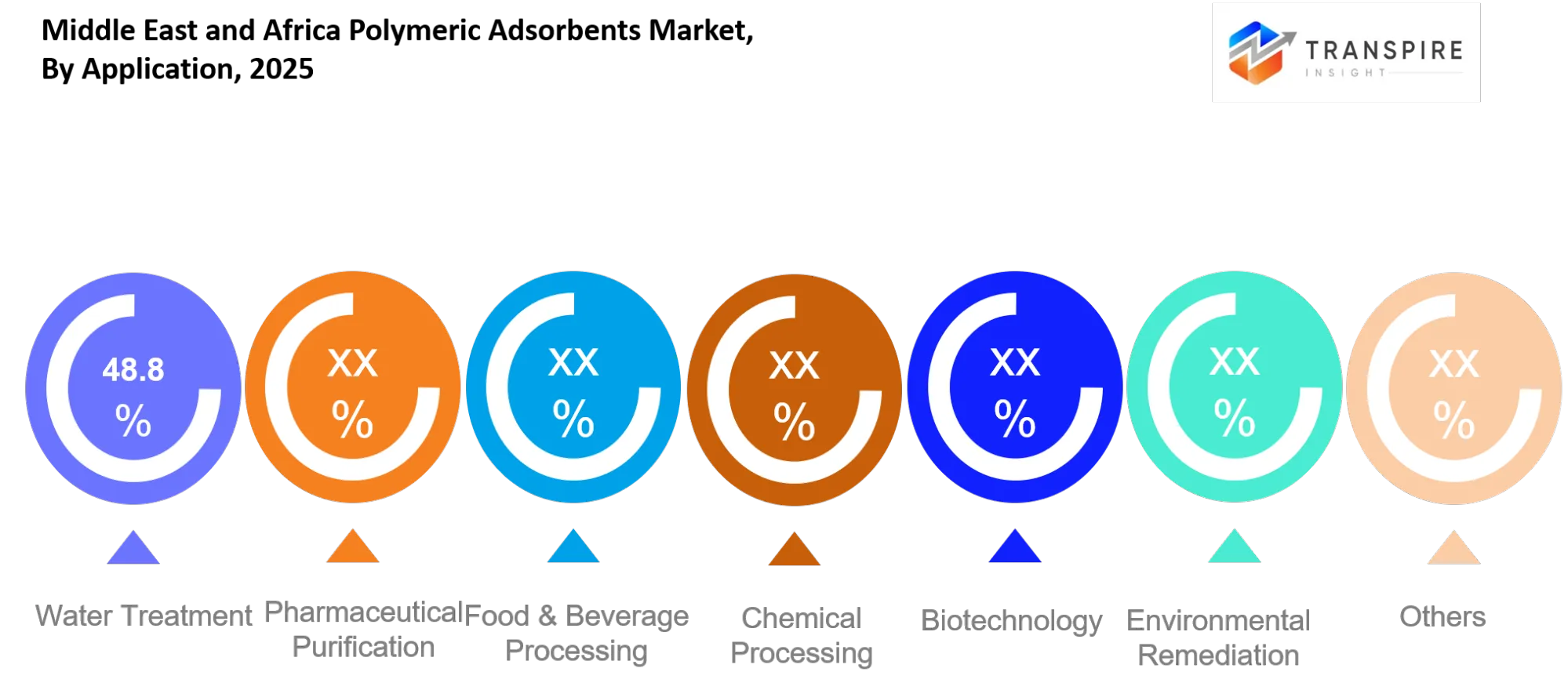
By End User
Water utilities make up the biggest slice, simply because municipal plus industrial treatment sites need dependable purification setups, for consistent clean water output. Pharmaceutical manufacturers lean heavily on advanced adsorption materials, to meet tight purity targets during the production of drugs. Chemical producers often choose polymer based adsorbents to boost separation efficiency and cut down on trace impurities, throughout their various manufacturing steps. Food processing firms use adsorption methods to keep product quality steady, and to comply with food safety rules.
In the biotechnology space, adoption keeps growing as more biologics and specialty therapeutic products get produced. Research institutes back material development and also help with application and testing, for next level adsorption technologies. The oil and gas field uses adsorption materials for purifying process fluids and removing contaminants. The “others” bucket covers mining, electronics manufacturing, plus specialty industrial plants.
By Form
Beads are still the most commonly used choice, mainly because a fairly uniform particle size keeps the flow behavior steady and helps adsorption work efficiently. Granules are more practical to handle, they also fit well with large scale industrial treatment setups where you need high throughput and no drama. Powders tend to adsorb faster, due to the extra surface area, and they’re often picked for batch type processing routines. Membranes mix adsorption with filtration, so purification ends up more effective in advanced industrial plants.
Cartridges make it easier to install and swap out units, which means maintenance becomes simpler for ongoing purification tasks, and that counts in real operations. Packed columns help with high volume industrial separation, they generally hold stable performance and keep processing conditions more controlled. Other options include custom formats made for lab work, plus specialized industrial equipment that’s tuned for specific needs. What you pick usually depends on the processing requirements, the operating conditions, and what the purification goal actually is, because those three decide everything.
By Distribution Channel
Direct sales still feel like the go to distribution channel, mostly because industrial customers need that kind of technical backing, tailored solutions, and, honestly, stable long term supply agreements. Industrial distributors help keep products actually on hand, they do that by holding regional stocks, and by serving a spread of manufacturing industries, not just one. OEM supply, on the other hand, backs equipment manufacturers who fold polymeric adsorbents into full purification systems, end to end kind of stuff. Laboratory suppliers often cover the smaller quantities side of things for research groups, quality testing, and for product design and validation work.
Government procurement backs public build outs, like municipal water treatment projects, plus environmental protection programs. Meanwhile, online industrial platforms keep getting more traction by making it easier to find products, speeding up quotes, and boosting procurement efficiency for industrial buyers. Other options include specialized dealers and regional supply partners who focus on local industrial demand. Distribution plans are still moving forward, pushed by growing industrial demand and the shift toward digital purchasing routines.
What are the Key Use Cases Driving the Middle East and Africa Polymeric Adsorbents Market?
Water purification is still, kinda the main reason people buy this stuff because desalination plants, municipal treatment facilities and industrial recycling setups need dependable removal of dissolved organic contaminants. Also there are strict wastewater discharge rules and water reuse initiatives, so demand doesn’t really drop much, it stays steady across both utilities and industry.
Then there’s the expanding secondary part, mainly in pharmaceutical manufacturing and biotechnology output. Better adsorption materials help clean active pharmaceutical ingredients, biologics and specialty chemicals, and at the same time they support manufacturers in hitting hard production quality requirements. On top of that, food and beverage processing keeps moving toward adsorption methods too, mostly to push product purity and processing efficiency a bit further.
Newer use cases are starting to show up as well, like getting valuable metals out of mining wastewater and then purifying advanced battery materials used for energy storage manufacturing. Research groups and specialty chemical producers are also checking out functionalized adsorption materials for carbon capture, plus next-generation industrial separations, which basically means more chances during the forecast window.
|
Report Metrics |
Details |
|
Market size value in 2025 |
USD 84.5 Million |
|
Market size value in 2026 |
USD 90 Million |
|
Revenue forecast in 2033 |
USD 140 Million |
|
Growth rate |
CAGR of 6.52% from 2026 to 2033 |
|
Base year |
2025 |
|
Historical data |
2021 - 2024 |
|
Forecast period |
2026 - 2033 |
|
Report coverage |
Revenue forecast, competitive landscape, growth factors, and trends |
|
Regional scope |
Middle East and Africa (Saudi Arabia, United Arab Emirates, South Africa, Rest of Middle East and Africa) |
|
Key company profiled |
Purolite, Mitsubishi Chemical, DuPont, LANXESS, Sunresin, Thermax, ResinTech, Samyang Corporation, Evoqua Water Technologies, Kuraray, Bio-Rad Laboratories, Merck KGaA, Dow, BASF, Jacobi Carbons |
|
Customization scope |
Free report customization (country, regional & segment scope). Avail customized purchase options to meet your exact research needs. |
|
Report Segmentation |
By Product Type (Styrene-Divinylbenzene Adsorbents, Acrylic Adsorbents, Ion Exchange Resins, Macroporous Adsorbents, Gel-Type Adsorbents, Functionalized Adsorbents, Mixed Polymer Adsorbents, Others); By Application (Water Treatment, Pharmaceutical Purification, Food & Beverage Processing, Chemical Processing, Biotechnology, Environmental Remediation, Industrial Separation, Others); By End User (Water Utilities, Pharmaceutical Companies, Chemical Manufacturers, Food Processing Companies, Biotechnology Companies, Research Institutes, Oil & Gas Industry, Others); By Form (Beads, Granules, Powders, Membranes, Cartridges, Packed Columns, Others); By Distribution Channel (Direct Sales, Industrial Distributors, OEM Supply, Laboratory Suppliers, Government Procurement, Online Industrial Platforms, Others) |
Which Regions are Driving the Middle East and Africa Polymeric Adsorbents Market Growth?
The Gulf Cooperation Council countries basically count as the biggest regional market because big money keeps flowing into desalination , petrochemical production , and industrial wastewater treatment, so demand keeps climbing for more sophisticated polymeric adsorbents. Saudi Arabia and the United Arab Emirates seem to take advantage of strict goals for reusing industrial water, along with long run national industrial development programs that basically push purification techniques with high performance. There are also strong chemical manufacturing clusters, newer industrial infrastructure, and more pharmaceutical production facilities, which together make consumption stay consistent across several industries. Ongoing spending on water security projects , and industrial diversification as well, helps keep the regional setup stable and it supports that long term market leadership.
Meanwhile, most of the rest of the Middle East brings steady market growth, mainly due to the steady expansion of chemical processing, food manufacturing, and municipal water treatment setups. Qatar, Kuwait, and Oman, for example, don’t exactly match the leading GCC economies since they prefer gradual capacity expansion instead of going all in on major industrial diversification projects. With stable public infrastructure budgets and long horizon industrial investment plans, demand for adsorption materials becomes pretty predictable across essential sectors. That kind of balanced investment climate helps generate revenue consistently while also lowering exposure to quick, short term market swings.
South Africa is expected to show the fastest growth from 2026 to 2033, since industrial modernization and environmental compliance rules are both accelerating adoption of advanced purification technologies.
Who are the Key Players in the Middle East and Africa Polymeric Adsorbents Market and How Do They Compete?
Competition is still moderately consolidated,mostly because only a limited number of international manufacturers deliver high-performance polymeric adsorbents, with specialized technical know how. You can see that technology innovation, product performance, purification efficiency, and even the ability to tailor solutions for specific applications are still the main “cards” in this market, not price by itself. Firms also push forward using regional distribution networks, hands-on technical support services, and longer term supply agreements made with industrial buyers. At the same time, the rise in pharmaceutical production, plus continued water treatment investments, keeps nudging suppliers to grow their regional footprint and deepen customer relationships.
Purolite sets itself apart with advanced specialty resins made for pharmaceutical purification, biotechnology operations, and industrial water treatment. Continuous product improvement, together with technical guidance matched to each application, helps the company handle demanding purification needs across many sectors. Sunresin leans into customized adsorption materials, plus integrated separation solutions that aim to lift operational efficiency for chemical and pharmaceutical manufacturers. By expanding international production capacity and building regional partnerships, it improves market reach and speeds up customer responsiveness.
DuPont highlights high-performance separation materials backed by strong research capabilities, and it also relies on broad industrial know-how. LANXESS, on the other hand, competes with durable ion exchange and adsorption technologies that keep operating performance steady for both municipal and industrial water treatment facilities.
Company List
• Purolite
• Mitsubishi Chemical
• DuPont
• LANXESS
• Sunresin
• Thermax
• ResinTech
• Samyang Corporation
• Evoqua Water Technologies
• Kuraray
• Bio-Rad Laboratories
• Merck KGaA
• Dow
• BASF
• Jacobi Carbons
Recent Development News
In October 2025, LANXESS expanded its Lewatit® ion exchange resin portfolio for industrial water treatment applications. The development strengthens the company's advanced water purification offerings for municipal and industrial users while improving operational efficiency. Source:https://lanxess.com/en/media/press-releases (LANXESS)
What Strategic Insights Define the Future of the Middle East and Africa Polymeric Adsorbents Market?
The market seems to be moving toward higher value adsorption materials, the ones that can give better selectivity, longer service life, and an improved purification outcome for pharma manufacturing , biotech production, and industrial water recycling. And yeah, this sort of structural shift is pretty clearly pushed by stricter industrial water quality rules, the expansion of regional life sciences production, and also the growing money behind advanced separation technologies.
A less obvious risk, though, is still the reliance on imported specialty polymers and raw materials, which can quietly lead to supply disruptions and those unpleasant price swings. Meanwhile, there’s an emerging opportunity in crafting functionalized polymer adsorbents for biologics purification AND for critical mineral recovery from industrial wastewater, especially across South Africa and the Gulf region.
Firms that set up regional manufacturing, boost their technical service strengths, and put resources into product development that’s tuned for specific applications, are likely to be in a better spot for longer term growth. They may also reduce their exposure to broader global supply chain uncertainties, which is not always easy to notice early on but matters later.
Middle East and Africa Polymeric Adsorbents Market Report Segmentation
By Product Type
• Styrene-Divinylbenzene Adsorbents
• Acrylic Adsorbents
• Ion Exchange Resins
• Macroporous Adsorbents
• Gel-Type Adsorbents
• Functionalized Adsorbents
• Mixed Polymer Adsorbents
• Others
By Application
• Water Treatment
• Pharmaceutical Purification
• Food & Beverage Processing
• Chemical Processing
• Biotechnology
• Environmental Remediation
• Industrial Separation
• Others
By End User
• Water Utilities
• Pharmaceutical Companies
• Chemical Manufacturers
• Food Processing Companies
• Biotechnology Companies
• Research Institutes
• Oil & Gas Industry
• Others
By Form
• Beads
• Granules
• Powders
• Membranes
• Cartridges
• Packed Columns
• Others
By Distribution Channel
• Direct Sales
• Industrial Distributors
• OEM Supply
• Laboratory Suppliers
• Government Procurement
• Online Industrial Platforms
• Others
Frequently Asked Questions
Find quick answers to common questions.
The Expected Middle East and Africa Polymeric Adsorbents Market size for the Market will be USD 140 Million in 2033.
Key Segments for the Middle East and Africa Polymeric Adsorbents Market are By Product Type (Styrene-Divinylbenzene Adsorbents, Acrylic Adsorbents, Ion Exchange Resins, Macroporous Adsorbents, Gel-Type Adsorbents, Functionalized Adsorbents, Mixed Polymer Adsorbents, Others); By Application (Water Treatment, Pharmaceutical Purification, Food & Beverage Processing, Chemical Processing, Biotechnology, Environmental Remediation, Industrial Separation, Others); By End User (Water Utilities, Pharmaceutical Companies, Chemical Manufacturers, Food Processing Companies, Biotechnology Companies, Research Institutes, Oil & Gas Industry, Others); By Form (Beads, Granules, Powders, Membranes, Cartridges, Packed Columns, Others); By Distribution Channel (Direct Sales, Industrial Distributors, OEM Supply, Laboratory Suppliers, Government Procurement, Online Industrial Platforms, Others).
Major Middle East and Africa Polymeric Adsorbents Market Players are Purolite, Mitsubishi Chemical, DuPont, LANXESS, Sunresin, Thermax, ResinTech, Samyang Corporation, Evoqua Water Technologies, Kuraray, Bio-Rad Laboratories, Merck KGaA, Dow, BASF, Jacobi Carbons.
The current Middle East and Africa Polymeric Adsorbents Market size is USD 84.5 Million in 2025.
The Middle East and Africa Polymeric Adsorbents Market CAGR is 6.52% from 2026 to 2033.
• Purolite
• Mitsubishi Chemical
• DuPont
• LANXESS
• Sunresin
• Thermax
• ResinTech
• Samyang Corporation
• Evoqua Water Technologies
• Kuraray
• Bio-Rad Laboratories
• Merck KGaA
• Dow
• BASF
• Jacobi Carbons
About the Authors

Pankaj Ghogare Patil
I am Pankaj Ghogare Patil, a Senior Research Analyst at Transpire Insight, specializing in the Pharmaceutical, Chemicals & Materials, Healthcare IT, and Biotechnology industry. My expertise lies in conducting comprehensive market research, analyzing industry trends, evaluating competitive landscapes, and translating complex data into actionable insights. At Transpire Insight, I closely follow emerging technologies, regulatory developments, and market innovations to create accurate, well-researched, and informative content that helps businesses and professionals make informed decisions. I am committed to producing credible, evidence-based articles that reflect industry best practices while making technical topics accessible and valuable for a broad audience.

Chakradhar Khansole
Chakradhar serves as the Research Director at Transpire Insight, bringing over 8 years of experience in technology, innovation, and strategic market intelligence. He specializes in transforming complex market data into actionable business insights that enable organizations to make informed, growth-oriented decisions. Recognized for his strategic vision and analytical expertise, Chakradhar leads high-impact research initiatives, delivering comprehensive market assessments, competitive intelligence, and forward-looking industry analysis.
Recently Published Reports
-
May 2026
Healthcare Polymer Packaging Market
Healthcare Polymer Packaging Market Size, Share & Analysis Report By Packaging Type (Syringes, IV Bottles and Pouches, Clamshells, Blisters, Bottles & Jars, Containers, Tubes, IV Parental Packaging, Others), By Type (Regulated, Non-regulated), By Polymer Type (LDPE (Low-Density Polyethylene), HDPE (High-Density Polyethylene), Homo-polymer (Homo), Random Copolymer (Random), Block Copolymer (Block), PET, Polystyrene, Polyvinyl Chloride, Polyamide/EVOH, Others), and Geography (North America, Europe, Asia-Pacific, Middle East and Africa, South and Central America), 2021 - 2031
-
Apr 2026
Hydrophilic Tape (Waterstop) Market
Hydrophilic Tape (Waterstop) Market Size, Share & Analysis Report By Type (Bentonite-Based Hydrophilic Tape, Rubber-Based Hydrophilic Tape), By Application (Residential Buildings, Commercial Buildings, Infrastructure Projects), and Geography (North America, Europe, Asia-Pacific, Middle East and Africa, South and Central America), 2021 - 2031
-
Apr 2026
Metalens Market
Metalens Market Size, Share & Analysis Report By Type (Visible Light Metalens, and Infrared Metalens), By Application (Consumer Electronics, Automotive Electronics, Industrial, Medical, and Others), and Geography (North America, Europe, Asia-Pacific, Middle East and Africa, South and Central America), 2021 - 2031
-
Apr 2026
PBT Resin Market
PBT Resin Market Size, Share & Analysis Report By Type (Reinforced PBT Resin, Unreinforced PBT Resin), By Processing Method (Injection Molding, Extrusion, Blow Molding, Others), By End-User (Automotive, Electrical & Electronics, Consumer Appliances, Industrial Machinery, Medical Devices, Packaging, Others), and Geography (North America, Europe, Asia-Pacific, Middle East and Africa, South and Central America), 2021 - 2031