
Global Environmental Consulting Services Market Size & Forecast:
- Global Environmental Consulting Services Market Size 2025: USD 39.76 Billion
- Global Environmental Consulting Services Market Size 2033: USD 62.41 Billion
- Global Environmental Consulting Services Market CAGR: 5.8%
- Global Environmental Consulting Services Market Segments: By Service (Impact Assessment, Site Remediation, Waste Management, Water Management, Sustainability Consulting, Compliance Services, Climate Advisory, Others); By End User (Government, Industrial, Energy, Construction, Mining, Others); By Application (Air Quality, Water, Soil, Biodiversity, Others); By Deployment (Onsite, Remote, Hybrid, Others); By Organization Size (Large, Medium, Small, Others)
Global Environmental Consulting Services Market Summary
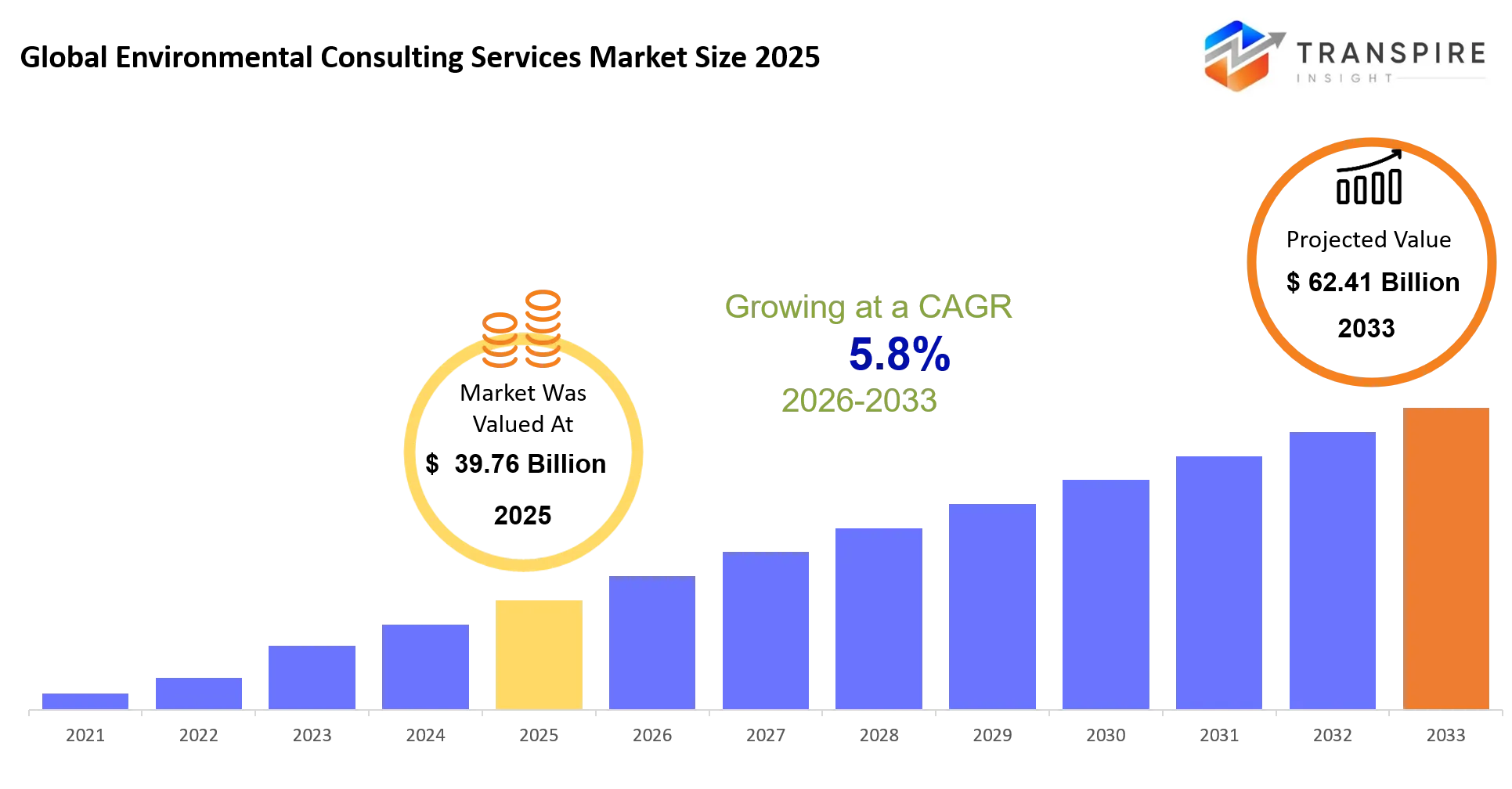
As per Transpire Insight Analysis, the Global Environmental Consulting Services Market size is estimated at USD 39.76 Billion in 2025 and is anticipated to reach USD 62.41 Billion by 2033, growing at a CAGR of 5.8% from 2026 to 2033. This industry provides specialized operational expertise and engineering advisory pipelines, deploying technical teams to handle site remediation, waste management - regulatory compliance audits across major industrial, energy, and government projects. Over the last few years - corporate priorities shifted from treating ecology as a minor, check-the-box legal compliance task to an essential, board-level strategic imperative. This evolution triggered a massive structural shift - as heavy enterprise industries transitioned from reactive pollution containment to data-driven, preventative climate risk modeling and circular economy planning. As tightening international ESG disclosure mandates require organizations to provide verifiable data points on their carbon emissions, water consumption, and land use, corporate and public-sector entities are rapidly hiring specialized consulting firms to audit their resource footprints and build reliable net-zero transition roadmaps, accelerating Market expansion.
Key Market Insights
The environmental consulting services sector - executing a major strategic pivot toward automated, data-driven sustainability modeling and proactive climate risk mitigation to ensure board-level ESG regulatory compliance. Driven by tightening global disclosure frameworks, emerging contaminant mandates, and massive corporate net-zero initiatives, industries are rapidly moving away from old-school, check-the-box legal paper filing. Instead, major project developers and industrial operations are actively utilizing advanced cloud-connected analytics, geographic information system (GIS) tracking, and automated carbon-accounting pipelines to optimize resource efficiency and map physical climate vulnerabilities in real time.
- Sustainability Consulting commands 31% of the Market WSP Global deployed updated ESG tools, standardizing net-zero transition and decarbonization planning pathways for multinational corporate portfolios.
- Compliance Services account for a 22% footprint AECOM expanded multi-view regulatory tracking systems to give infrastructure developers seamless adherence to complex cross-border ecological rules.
- Waste Management locks down 16% of global revenue Tetra Tech integrates advanced recycling analytics and solid waste tracking to minimize long-term environmental liability for industrial clients.
- Site Remediation represents a 12% Market share Jacobs utilizes high-tech chemical sampling and advanced groundwater modeling to accelerate complex, multi-year hazardous cleanup and PFAS remediation operations.
- Climate Advisory accelerates fastest at a 15.7% CAGR Industry innovators embed predictive weather simulators into asset management models to run automated, real-time physical climate risk profiling.
- North America commands the primary regional stake at 35% Spurred by strict federal EPA rules, regional developers establish on-site digital auditing pipelines to eliminate non-compliance risks.
- Europe serves as a major secondary pillar with a 31% slice Consulting networks deploy CSRD-compliant reporting frameworks across heavy industries to enforce standardized carbon accounting and resource circularity.
- The Asia Pacific corridor holds a powerful 23% share. Rapid industrialization prompts enterprise clients to procure high-end impact assessments to balance infrastructure growth with biodiversity preservation.
- The Middle East & Africa accounts for a 6% revenue share Driven by state-backed megaprojects, regional agencies invest heavily in green hydrogen and sustainable smart city consulting.
What Strategic Drivers, Restraints, and Opportunities Define the Future of the Global Environmental Consulting Services Market?
Driver
The aggressive implementation of stringent federal environmental mandates and mandatory corporate ESG disclosure frameworks is heavily accelerating the procurement of consulting services. Because environmental regulatory bodies globally have codified rigid new guidelines for emerging contaminants and carbon accounting over the last few years, major industrial and infrastructure developers face massive non-compliance risks and legal liabilities. This intense regulatory pressure forces enterprise organizations to hire specialized advisory firms to handle multi-tier impact assessments and secure vital operating permits.
Restraint
A severe shortage of licensed technical experts like hydrogeologists, toxicologists, and certified green engineers is creating a major bottleneck for the industry. Cleaning up hazardous sites and mapping complex ecosystems takes specialized university degrees and years of local regulatory know-how. Because there simply aren't enough qualified professionals to go around, consulting firms are stuck in fierce bidding wars for talent, driving up wages and crushing their profit margins.
Opportunity
The best chance for future growth is plugging AI and satellite remote sensing right into traditional field auditing workflows. Pairing live satellite data with automated carbon-accounting software allows consulting firms to map flood risks, track biodiversity, and profile soil pollution instantly. This cuts out slow, expensive groundwork and unlocks massive, high-margin contract opportunities across rapid infrastructure builds in the fast-growing Asia Pacific corridor.
What Has the Impact of Artificial Intelligence Been on the Global Environmental Consulting Services Market?
Artificial intelligence is fundamentally reshaping how environmental consultants handle massive datasets while ensuring strict legal compliance. Instead of relying purely on slow, manual field sampling and traditional paperwork reviews which frequently delay project timelinesfirms now deploy advanced machine learning platforms. These specialized algorithms run automated data ingestion tasks, instantly identifying ecological risks by parsing satellite imagery, historical land-use files, and complex regulatory text in real time.
Beyond speeding up early site assessments, AI introduces sophisticated predictive modeling and major operational improvements to active consulting workflows. Deep learning models run continuous simulation checks, automatically projecting groundwater pollutant travel or tracking corporate carbon footprint data without requiring constant human oversight.
However, a major operational limitation persists regarding the accuracy and legal defensibility gap of AI outputs. Because environmental permits require absolute precision to stand up in court, algorithmic hallucination or flawed historical training data can result in incorrect compliance reporting. This accuracy gap forces engineering teams to maintain a strict "trust, but verify" approach, relying heavily on licensed human experts to cross-check every single AI-generated deliverable.
In February 2026, AI-powered field management platform Fulcrum officially completed the acquisition of Wildnote, a specialized environmental compliance software developer. This strategic platform combination integrates advanced machine learning models directly into structured environmental field-data capture and regulatory reporting systems. By utilizing automated data-grounding tools to sync live field observations with rigid compliance frameworks, the combined software removes manual transcription errors and significantly optimizes project delivery speeds for field consultants.
Key Market Trends
Rather than approaching ecological oversight as a series of disconnected - slow-moving regulatory filings managed by isolated on-site technicians, the environmental consulting ecosystem is shifting toward highly connected, automated compliance and asset risk networks. This fundamental operational evolution transforms how corporate leadership interacts with sustainability guidelines, turning traditional episodic pollution monitoring into fully integrated, high-velocity advisory loops that secure environmental permits and verify ESG data points without stalling active industrial operations.
- Moving past slow manual soil and water sampling Consulting firms deploy autonomous drone fleets and real-time electronic sensors to monitor remote industrial discharge points, completely eliminating historical fieldwork delays.
- Traditional physical paperwork manifests are shifting to digital verification Enterprise operators adopt cloud-based tracking APIs and automated carbon-accounting platforms to instantly verify end-to-end greenhouse gas footprints across complex global supply chains.
- Fragmented site assessment data is yielding to unified software suites Infrastructure developers upgrade to integrated geospatial platforms that link multi-view environmental impact variables and localized permitting workflows onto a single dashboard.
- Manual chain-of-custody waste tracking is being replaced globally Hazardous waste handlers integrate real-time IoT tracking chips and secure data ledgers to streamline cradle-to-grave material management and minimize legal liability.
- Standalone engineering audits are evolving into integrated strategy plans Corporate boards build long-term capital improvement pipelines, blending physical site remediation frameworks directly with board-level net-zero decarbonization goals.
- Passive compliance checking is giving way to active climate risk modeling Modern consulting advisory networks deploy predictive weather simulators and GIS mapping to automatically calculate regional asset vulnerability against severe sea-level rises.
- Reactive environmental management is transitioning to predictive resource profiling. Manufacturing facilities utilize centralized databases to run early life-cycle emission assessments on product materials before factory-level production ever begins.
- Labor-intensive regulatory text review loops are migrating to AI assistant software Overburdened compliance officers adopt automated legal parsing tools to instantly isolate shifts in regional emerging-contaminant thresholds or state-level EPA guidelines.
- Fixed, rigid site inspection schedules are turning agile via remote sensing International mining conglomerates and forestry operators deploy high-resolution satellite arrays to dynamically check real-time biodiversity boundaries and land-use shifts over vast territories.
Global Environmental Consulting Services Market Segmentation
By Service
Sustainability Consulting holds the commanding Market position with an authoritative 31% share, acting as the fundamental baseline strategic entry point for enterprise organizations. Compliance Services follow with a 22% footprint, while Waste Management, Site Remediation, and Water Management lock down 16%, 12%, and 10% shares, respectively, leaving remaining specialized advisory niches at 9%. The unique growth logic behind this service distribution is tied directly to the structural overhaul of corporate compliance. Modern enterprise operations face rigorous, board-level disclosure frameworks that force them to map long-term resource risks before breaking ground on capital projects, driving high-margin sustainability consulting contracts. Conversely, Climate Advisory acts as the fastest-accelerating pocket, tearing ahead at an industry-leading 15.7% CAGR because corporate clients desperately need predictive physical risk modeling to protect coastal and industrial assets from extreme weather. Future Market dynamics will see the boundaries between strategic consulting and legal compliance vanish entirely, forcing advisory firms to build fully unified software ecosystems where real-time carbon-accounting networks automatically verify field data for public audits.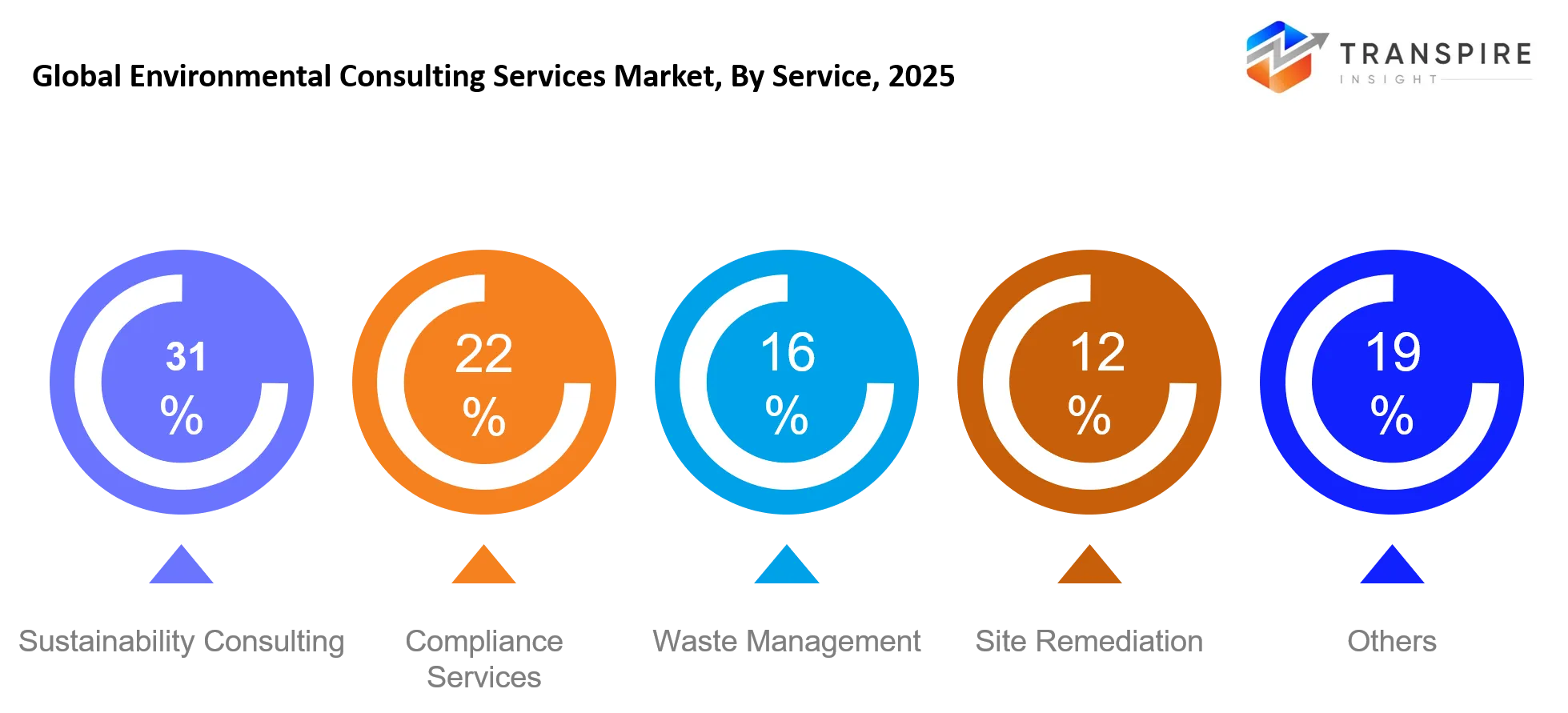
By End User
Industrial operations anchor the Market landscape as the dominant financial driver of multi-tier consulting procurement, while the expanding Energy workflow emerges as the most dynamic operational segment. Government, Construction, and Mining projects make up the remaining client base. The unique growth logic defining this distribution is the sheer environmental footprint and liability exposure of heavy manufacturing, chemical processing, and production lines. Standard industrial clients require continuous on-site monitoring, air quality mapping, and wastewater permitting to avoid severe non-compliance penalties from regional regulatory agencies. Concurrently, the explosive growth in the energy segment is driven by the rapid global transition toward green hydrogen, solar, and wind arrays, forcing a surge in complex cross-border environmental impact assessments. Moving forward, the Market will polarize into distinct service models: legacy industrial and mining accounts will rely heavily on localized, multi-year compliance retainer contracts, whereas the energy and construction sectors will transition toward agile, project-based engineering consultancies optimized for fast-tracked clean infrastructure builds.
By Application
Water application frameworks hold the leading historical position in Market value, functioning as the vital operational baseline for major municipal developments and industrial processing plants. Soil and Air Quality act as highly stable, rigid application segments driven by strict regulatory thresholds, while Biodiversity represents the fastest-growing niche. The unique growth logic comes straight from non-discretionary legal liabilities: while air and soil consulting thrive on routine, localized industrial emissions testing, water applications are surging due to new, non-negotiable federal standards targeting emerging contaminants like PFAS in drinking water. The biggest future implication is a structural shift in application engineering, where consulting firms will completely move away from manual sample collection to deploy autonomous, AI-driven digital twin sensor networks that monitor regional water tables and soil toxicity levels continuously.
By Deployment
Onsite consulting implementations maintain the dominant global volume share due to the physical requirements of environmental sampling, drill-rig oversight, and direct hazardous material handling. However, Hybrid and Remote sensing setups represent the fastest-growing operational deployment segments. The unique growth logic defining this distribution is the intense shortage of technical field specialists and the high operational costs of dispatching engineering teams to distant locations. Utilizing hybrid deployment models allows consulting firms to capture high-fidelity site data using automated drone fleets and satellite imaging, leaving senior engineers to analyze data and draft permits from centralized offices. Looking ahead, consulting providers must prioritize software-enabled hybrid architectures, enabling environmental teams to instantly run complex site characterizations and asset risk reviews without relying on slow, labor-intensive fieldwork.
By Organization Size
Large multinational consultancies hold the commanding historical position in Market value, functioning as the go-to providers for complex, cross-border infrastructure projects and Fortune 500 corporate ESG overhauls. Medium and Small specialized niche boutiques act as highly agile, localized segments. The growth logic is completely split by project scope and liability risk profiles: massive public-sector developments require large, integrated firms that can bundle impact assessments, site remediation, and legal defense into a single contract, while small consultancies thrive on fast, cost-effective permitting for regional construction firms. Future Market dynamics will see a wave of consolidation, forcing tier-one global environmental consulting networks to aggressively acquire small, specialized tech-driven boutique firms to rapidly scale up their proprietary climate-analytics software portfolios.
What are the Key Use Cases Driving the Global Environmental Consulting Services Market?
Corporate entity overhauls drive the primary use cases for strategic planning. Multinationals retain consultancies to build end-to-end net-zero transition pathways and manage double-materiality data points under strict disclosure rules like the EU's CSRD. This application secures board-level compliance and satisfies investor demands for verifiable carbon disclosures.
Industrial and infrastructure developers require extensive permitting and environmental impact assessments during active project phases. Heavy manufacturing, mining, and conventional energy firms deploy consultants to secure vital environmental permits, model localized toxic spill risks, and construct complex wastewater management pipelines before starting any physical expansion.
Emerging use cases target predictive climate adaptation and high-resolution habitat tracking. Financial institutions and urban planners utilize remote satellite sensing and AI-enabled risk software to map future sea-level rise and regional asset vulnerability, while infrastructure teams run automated biological monitoring loops to balance modern land development with biodiversity preservation rules.
|
Report Metrics |
Details |
|
Market size value in 2025 |
USD 39.76 Billion |
|
Market size value in 2026 |
USD 42.06 Billion |
|
Revenue forecast in 2033 |
USD 62.41 Billion |
|
Growth rate |
CAGR of 5.8% from 2026 to 2033 |
|
Base year |
2025 |
|
Historical data |
2021 - 2024 |
|
Forecast period |
2026 - 2033 |
|
Report coverage |
Revenue forecast, competitive landscape, growth factors, and trends |
|
Regional scope |
United States; Canada; Mexico; United Kingdom; Germany; France; Italy; Spain; China; Japan; India; Australia; South Korea; Brazil; Argentina; South Africa; Saudi Arabia; United Arab Emirates |
|
Key company profiled |
AECOM, WSP, Tetra Tech, Stantec, ERM, Jacobs, Ramboll, Arcadis, GHD, SLR Consulting, Wood, Antea Group, Sweco, HDR, NV5 |
|
Customization scope |
Free report customization (country, regional & segment scope). Avail customized purchase options to meet your exact research needs. |
|
Report Segmentation |
By Service (Impact Assessment, Site Remediation, Waste Management, Water Management, Sustainability Consulting, Compliance Services, Climate Advisory, Others); By End User (Government, Industrial, Energy, Construction, Mining, Others); By Application (Air Quality, Water, Soil, Biodiversity, Others); By Deployment (Onsite, Remote, Hybrid, Others); By Organization Size (Large, Medium, Small, Others) |
Which Regions are Driving the Global Environmental Consulting Services Market Growth?
North America maintains a commanding grip on the Global Environmental Consulting Services Market, capturing a dominant 35% of all worldwide industry revenue. This geographic leadership is heavily driven by the rigid enforcement of strict federal and state-level regulatory updates targeting emerging contaminants. The regional ecosystem is structurally supported by the US EPA’s stringent drinking-water standards for toxic compounds and localized corporate carbon reporting policies like California's SB 253 disclosure mandate. Consequently, local industrial operators, real estate developers, and manufacturing facilities must steadily procure high-end site assessments and remediation advisory services to eliminate severe non-compliance liabilities.
In May 2026, leading global professional services firm WSP Global Inc. officially announced a major expansion of its specialized climate and infrastructure resilience advisory services across its international networks. This strategic service rollout integrates advanced GIS-based data analytics and automated predictive risk modeling directly into large-scale capital infrastructure planning workflows. This operational scaling explicitly addresses the surging corporate demand for verifiable, data-driven ESG compliance reporting, allowing major industrial developers to eliminate regulatory bottlenecks and substantially driving regional consulting contract adoption.
Europe serves as a highly stable, predictable secondary pillar for the global Market, locking down an essential 31% share of total industry demand. While North American Market growth is heavily dependent on toxic compound remediation waves and state-level policies, the European theater is anchored by uniform continent-wide transparency laws and the finalized adoption of Corporate Sustainability Reporting Directive (CSRD) frameworks. This regional Market stability is structurally insulated by long-term public infrastructure budgets, massive green energy transitions, and zero-tolerance circular economy guidelines connecting diverse industrial corridors. To maintain seamless alignment with these extensive data-disclosure protocols, European manufacturing giants and public utility sectors steadily invest in long-term strategy retainers with tier-one engineering firms.
The Asia Pacific region has emerged as the fastest-growing territory globally, accelerating at a Market-leading CAGR of 16.8% to capture an expanding 23% slice of global sales. This sudden structural shift is driven by rapid industrial modernization, intense urbanization, and the aggressive implementation of major national decarbonization frameworks across expanding economies like China, Japan, and India. Historically, local infrastructure deployment prioritized fast, high-volume production builds over ecological impacts, but regional governments have now rapidly pivoted toward mandating comprehensive biodiversity protection and multi-criteria environmental impact assessments. Looking ahead, future procurement in this booming corridor relies entirely on deploying scalable, tech-enabled consulting models that leverage satellite remote sensing and AI data tracking within massive capital development networks.
In March 2026, pure-play global sustainability advisory leader ERM officially expanded its primary Singapore operational hub to aggressively accelerate technical project delivery across the expanding Asia Pacific Market. This strategic facility scaling explicitly channels advanced nature-based advisory services and predictive environmental risk mapping tools directly into active renewable energy and infrastructure grids throughout the region. By automating complex regional ecosystem impact reporting and ESG regulatory cross-referencing right at the project site, this localized expansion directly empowers APAC enterprise clients to navigate tightening regional disclosure standards without compromising industrial construction timelines. 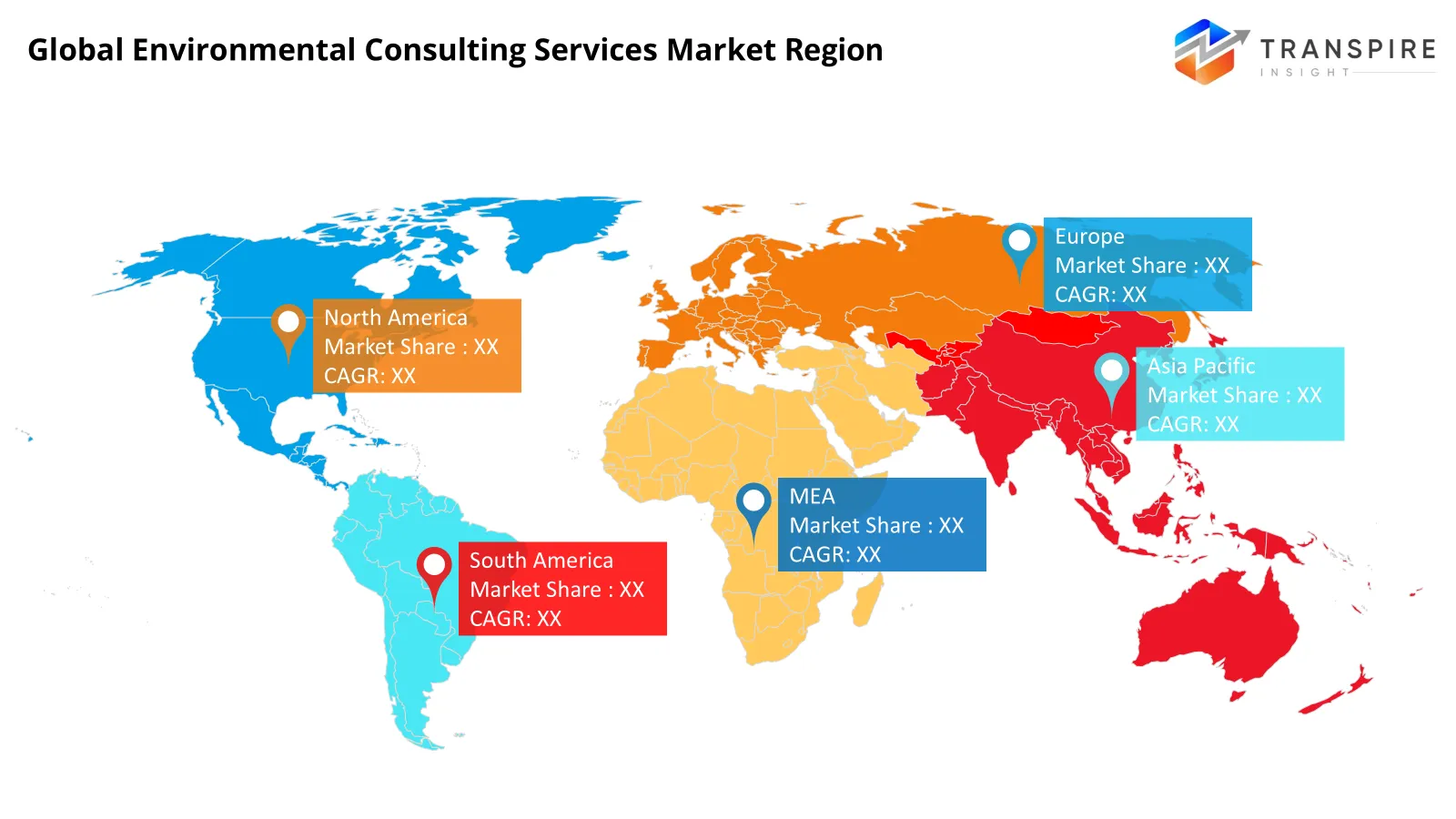
Who are the Key Players in the Global Environmental Consulting Services Market and how do they Compete?
The global Market is a highly competitive mix of massive - multi-disciplinary engineering firms and smaller, pure-play sustainability boutiques. Success in this space depends entirely on how well a firm can navigate changing local laws and turn complex field data into clear, legally bulletproof business strategies. Companies fight for Market share by launching proprietary digital tools, building out custom data analytics software, and buying up local agencies to expand their geographic reach.
WSP Global Inc. relies on an aggressive, scale-driven innovation strategy to stay ahead. The company differentiates itself by combining massive capital infrastructure engineering directly with deep environmental permitting services under one roof. To expand its footprint, WSP regularly absorbs large regional firms, leveraging its massive global workforce to lock down long-term asset management contracts across the energy and utility sectors.
On the other hand, Tetra Tech, Inc. uses a highly focused niche strategy that concentrates strictly on water resources and ecological engineering. Tetra Tech sets itself apart with its technical approach, using advanced computer modeling and digital twins to predict coastal flood risks and map complex water systems. The firm expands its business by focusing heavily on high-value public sector contracts, securing large-scale government and military engineering projects that require specialized scientific expertise. [https://www.tetratech.com/]
Company List
- AECOM
- WSP
- Tetra Tech
- Stantec
- ERM
- Jacobs
- Ramboll
- Arcadis
- GHD
- SLR Consulting
- Wood
- Antea Group
- Sweco
- HDR
- NV5
Recent Development News
In April 2025, pure-play global sustainability consultancy ERM officially completed the acquisition of the Environmental Division of NewFields. This tactical business combination expands ERM's North American footprints by integrating specialized capabilities in environmental forensics, emerging contaminant risk profiling, and complex groundwater modeling directly into its active remediation portfolios. [https://www.erm.com
In November 2025, global engineering and consulting leader Arcadis finalized a five-year global architecture and workspace design collaboration agreement with energy giant Shell Global Solutions International. This cross-border partnership leverages AI-enabled digital processes and multi-disciplinary engineering infrastructure across EMEA, the Americas, and APAC to streamline sustainable workplace replication while minimizing lifecycle environmental impacts across Shell's worldwide real estate assets. [https://www.arcadis.com
What Strategic Insights Define the Future of the Global Environmental Consulting Services Market?
The global Market is rapidly transitioning from a compliance-driven reporting model into an execution-focused operating discipline. Forward-looking corporations are no longer treating environmental consulting as an administrative check-the-box legal task; instead, they are integrating climate mitigation directly into long-term corporate asset allocation, energy infrastructure transitions, and circular supply-chain workflows.
A significant, hidden risk facing the sector is the accelerating commoditization of routine compliance reporting, driven by the widespread enterprise adoption of in-house digital environmental health and safety (EHS) tracking software. Conversely, a highly lucrative emerging opportunity lies in nature-positive accounting frameworks and specialized emerging-contaminant remediation pipelines, such as localized PFAS groundwater cleanup.
To maintain high profit margins, it is a critical strategic recommendation that environmental consultancies aggressively shift their service portfolios away from basic standalone emissions auditing. Instead, they must reposition themselves as advanced digital technology integrators, embedding predictive AI risk modeling and satellite remote sensing directly into heavy industrial engineering projects.
By Service
- Impact Assessment
- Site Remediation
- Waste Management
- Water Management
- Sustainability Consulting
- Compliance Services
- Climate Advisory
- Others
By End User
- Government
- Industrial
- Energy
- Construction
- Mining
- Others
By Application
- Air Quality
- Water
- Soil
- Biodiversity
- Others
By Deployment
- Onsite
- Remote
- Hybrid
- Others
By Organization Size
- Large
- Medium
- Small
- Others
Regional Outlook
North America
- United States
- Canada
- Mexico
Europe
- Germany
- United Kingdom
- France
- Spain
- Italy
- Rest of Europe
Asia Pacific
- Japan
- China
- Australia & New Zealand
- South Korea
- India
- Rest of Asia Pacific
South America
- Brazil
- Argentina
- Rest of South America
Middle East & Africa
- Saudi Arabia
- United Arab Emirates
- South Africa
- Rest of the Middle East & Africa
Frequently Asked Questions
Find quick answers to common questions.
The Global Environmental Consulting Services Market size was valued at USD 39.76 Billion in 2025 and is poised to reach USD 62.41 Billion by 2033, expanding at a 5.8% CAGR.
Key segments for the Global Environmental Consulting Services Market are By Service (Impact Assessment, Site Remediation, Waste Management, Water Management, Sustainability Consulting, Compliance Services, Climate Advisory, Others); By End User (Government, Industrial, Energy, Construction, Mining, Others); By Application (Air Quality, Water, Soil, Biodiversity, Others); By Deployment (Onsite, Remote, Hybrid, Others); By Organization Size (Large, Medium, Small, Others).
Growth is primarily driven by the aggressive implementation of stringent federal environmental regulations, mandatory corporate ESG disclosure frameworks, and intense legal non-compliance risks targeting emerging contaminants like PFAS in industrial water systems.
The global Market is led by major manufacturers including AECOM, WSP, Tetra Tech, Stantec, ERM, Jacobs, Ramboll, Arcadis, GHD, SLR Consulting, Wood, Antea Group, Sweco, HDR, and NV5.
North America commands a dominant 35% share of the worldwide industry revenue. This strong position is heavily influenced by the rigid enforcement of strict federal EPA drinking-water standards and localized corporate carbon reporting laws like California's SB 253 disclosure mandate, forcing industries to steadily invest in high-end auditing and site remediation workflows.
Highly lucrative commercial opportunities lie in nature-positive accounting frameworks, PFAS emerging-contaminant remediation pipelines, and plugging predictive AI or satellite remote sensing software directly into traditional field auditing workflows to replace slow, labor-intensive groundwork.
- AECOM
- WSP
- Tetra Tech
- Stantec
- ERM
- Jacobs
- Ramboll
- Arcadis
- GHD
- SLR Consulting
- Wood
- Antea Group
- Sweco
- HDR
- NV5
About the Authors

Mayur Shinde
I am Mayur Shinde, a Senior Research Analyst at Transpire Insight, specializing in the Automotive & Transportation and Information & Communication Technology (ICT) Industry. My work focuses on analyzing emerging market trends, technological advancements, competitive landscapes, and industry developments to deliver accurate, data-driven insights. I am passionate about transforming complex market information into clear, actionable content that helps businesses, professionals, and decision-makers stay informed and make confident strategic decisions.

Chakradhar Khansole
Chakradhar serves as the Research Director at Transpire Insight, bringing over 8 years of experience in technology, innovation, and strategic market intelligence. He specializes in transforming complex market data into actionable business insights that enable organizations to make informed, growth-oriented decisions. Recognized for his strategic vision and analytical expertise, Chakradhar leads high-impact research initiatives, delivering comprehensive market assessments, competitive intelligence, and forward-looking industry analysis.
Recently Published Reports
-
Apr 2026
3D Optical Profiler Market
3D Optical Profiler Market Size, Share & Analysis Report By Type (Desktop 3D Optical Profiler, and Portable 3D Optical Profiler), By Technology (Confocal Technology, and White Light Interference), By End-Use Industry (Manufacturing, Research Institutions, Automotive, Aerospace and Defense, Medical Devices, and Other), and Geography (North America, Europe, Asia-Pacific, Middle East and Africa, South and Central America), 2021 - 2031
-
Apr 2026
Depth Sensor Market
Depth Sensor Market Size, Share & Analysis Report By Type (Infrared Depth Sensors, Time-of-Flight (ToF) Sensors, Stereo Vision Sensors, Structured Light Sensors, Ultrasonic Depth Sensors), By Application (Automotive, Robotics, Gaming, Consumer Electronics, Industrial Automation, Healthcare, Security & Surveillance, Others), By End Users (Automotive Manufacturers, Consumer Electronics Companies, Healthcare Providers, Industrial Companies, Security Agencies, Gaming Companies, Robotics Companies, Others), and Geography (North America, Europe, Asia-Pacific, Middle East and Africa, South and Central America), 2021 – 2031
-
Apr 2026
Digital Manufacturing Market
Digital Manufacturing Market Size, Share & Analysis Report By Component (Hardware, Software, and Services), By Technology (Robotics, 3D Printing, Internet of Things (IoT), and Others), By Application (Automotive and Transportation, Aerospace and Defense, Consumer Electronics, Industrial Machinery, and Others), By Process Type (Computer-Based Designing, Computer-Based Simulation, Computer 3D Visualization, Analytics, and Others), and Geography (North America, Europe, Asia-Pacific, Middle East and Africa, South and Central America), 2021 – 2031
-
Apr 2026
Digital Visa Services Market
Digital Visa Services Market Size, Share & Analysis Report By Type (Individual Travelers, Group Travelers), By Application (Tourism, Business Travel, Others), and Geography (North America, Europe, Asia-Pacific, Middle East and Africa, South and Central America), 2021 – 2031