
Middle East and Africa Period Panties Market Size & Forecast:
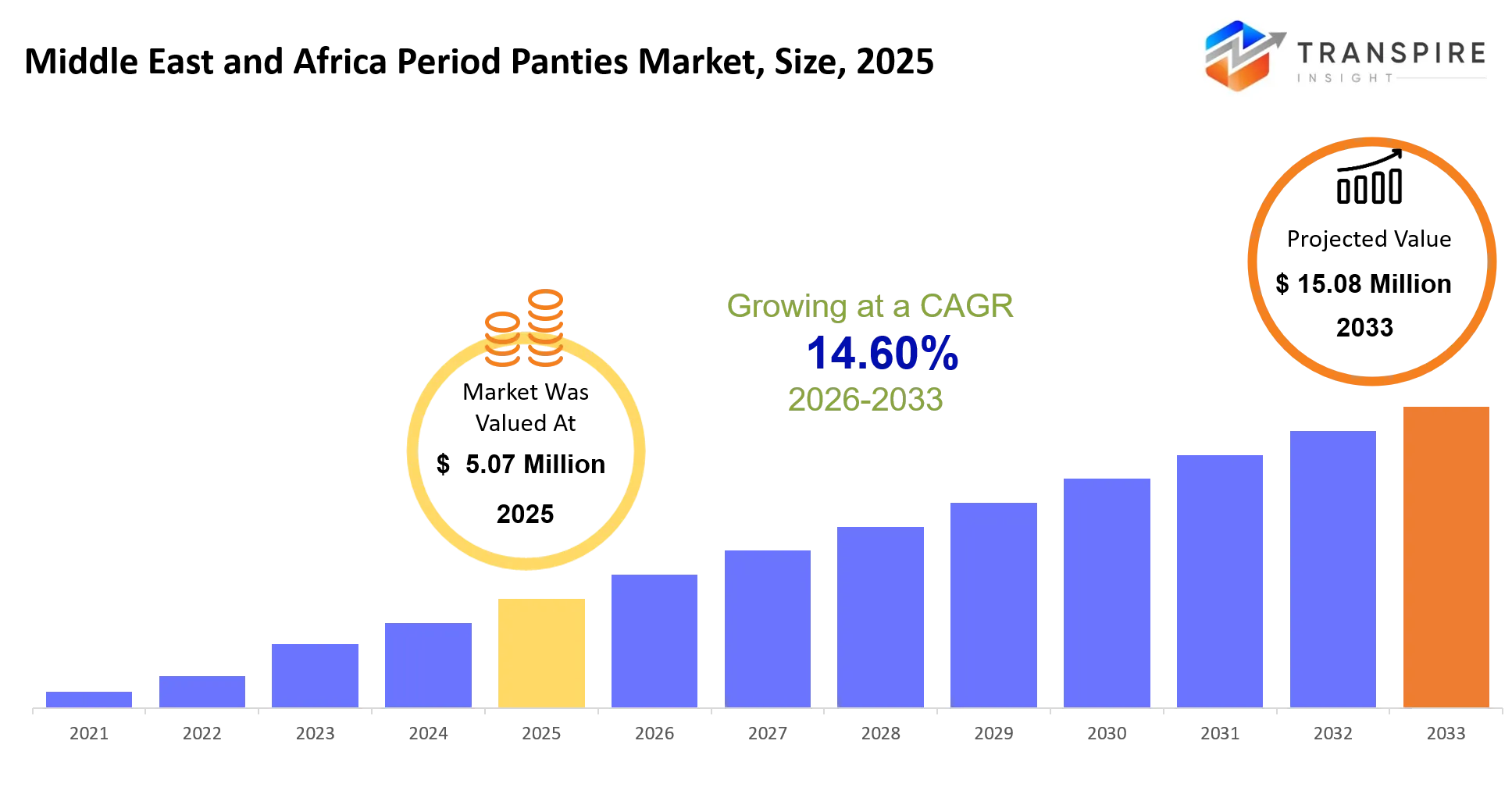
- Middle East and Africa Period Panties Market Size 2025: USD 5.07 Million
- Middle East and Africa Period Panties Market Size 2033: USD 15.08 Million
- Middle East and Africa Period Panties Market CAGR: 14.60%
- Middle East and Africa Period Panties Market Segments:By Product Type (Reusable Period Panties, Disposable Period Panties, High Absorbency, Moderate Absorbency, Others); By Material (Cotton, Bamboo, Nylon, Spandex, Others); By Distribution Channel (Online Retail, Specialty Stores, Supermarkets, Others); By End User (Teenagers, Women, Others)
Middle East and Africa Period Panties Market Summary
The Middle East and Africa Period Panties Market was valued at USD 5.07 Million in 2025. It is forecast to reach USD 15.08 Million by 2033. That is a CAGR of 14.60% over the period.
The Middle East and Africa period panties market kind of answers a real-world need, by offering reusable and disposable menstrual protection that lessens dependence on usual sanitary products while also boosting comfort, discretion, and long-term cost efficiency. Period panties have turned into a meaningful slice within feminine hygiene, especially for shoppers who want leak-proof options that work through everyday routines, travel, sports, and also overnight hours. Over about the last five years, the market kind of shifted from tight, direct to consumer set ups into a more spread out retail presence, which was also nudged by product innovation in absorbency , fabric know how, and chemical free material options.
A major reason for the change, has been the heightened scrutiny of PFAS and other chemicals in menstrual products, it’s like brands got pushed to reformulate things and share clearer specifics on where the materials are coming from. And since performance keeps improving, while retail access keeps widening up, adoption is moving beyond the early adopters and into more mainstream customers. This whole path is affecting repeat buying, widening distribution routes, and basically backing stronger revenue upside for both larger global operators and local regional manufacturers.
Key Market Insights
- South Africa, it kind of clearly leads the regional market with an estimated 32% share in 2025, largely from stronger retail penetration and also that higher premium hygiene product adoption.
- Meanwhile the Gulf Cooperation Council countries seem to be the fastest-growing cluster through 2033, mainly because e-commerce is expanding and people are shifting toward more premium personal care spending.
- Reusable period panties make up about 60% of market revenue in 2025, which happens due to lower lifetime ownership costs and better product durability.
- Disposable period panties stay the second-largest segment, pulling in consumers who want convenience especially during travel or when they need a temporary fit.
- High absorbency products drive nearly 40% of the category revenue, since customers are after overnight protection, plus that extended wear performance.
- Online retail channels contribute more than 45% of sales, so digital commerce becomes the main distribution route across most of the market.
- Teen-focused product ranges are also growing quickly as brands roll out educational campaigns, and first-period product collections.
- PFAS-free product development sped up after 2023, pushing manufacturers toward clearer material sourcing and safety certifications, in a sort of transparent way.
- Companies like Thinx, Knix, Modibodi, WUKA, Saalt, and Bambody compete using absorbency innovation, comfort enhancement, plus direct-to-consumer engagement.
- And strategic expansion into supermarkets as well as pharmacy chains is improving accessibility, which helps category normalization among more mainstream consumers.
What are the Key Drivers, Restraints, and Opportunities in the Middle East and Africa Period Panties Market?
The strongest growth catalyst is, sort of the shift toward reusable menstrual care products, pushed by cost efficiency and improvements in actual product performance. Earlier generations of period underwear had some limits around absorbency durability, and comfort, and you could feel it in day to day use. Now with advances in multilayer fabric engineering, plus moisture-control technologies, performance has jumped quite a lot. So these products can now replace or at least complement the traditional sanitary pads. As a result consumer confidence has risen, and the repeat buying pattern looks stronger too, which helps manufacturers build a more stable revenue base.
The biggest market constraint still stays product affordability. Premium period panties usually come with a higher upfront investment compared to disposable menstrual products. And this is kind of structural, since income disparities across many Middle Eastern and African countries make it harder to access higher-priced personal care solutions. Even when longer term savings are clearly shown, the initial purchase cost can slow adoption and, in practice, suppress market penetration, especially within price-sensitive customer groups.
A major opportunity sits in organized retail expansion together with localized manufacturing. Regional retailers are giving more shelf space to menstrual wellness products, while manufacturers try local sourcing and production partnership models. Countries such as the UAE and Saudi Arabia are building stronger personal care distribution ecosystems, which creates better conditions for regional market entry. When production happens locally it can cut import costs, improve inventory responsiveness, and support wider adoption across underserved consumer segments.
What Has the Impact of Artificial Intelligence Been on the Middle East and Africa Period Panties Market?
Artificial intelligence is starting to seep into the period panties industry a bit, mostly through demand forecasting, inventory optimization, customer analytics, and product development. Manufacturers and retailers are using machine learning models more and more, not just to look at purchasing behavior, but also to catch seasonal demand rhythms and product preferences across digital touchpoints. In practice, these insights make it easier to tune how stock gets allocated and it should lower inventory carrying costs, which is really the whole point.
On top of that, advanced analytics tools help nudge product innovation too, by sifting through customer feedback, tracking return rates, and reviewing product performance info. The AI powered recommendation engines, for instance, boost online conversion by steering shoppers toward absorbency levels, sizes, and styles that align with their personal needs. That kind of personalization tends to lift customer satisfaction and encourage repeat buying, while also easing down return frequencies.
Digital supply chain platforms add another layer of operational efficiency by predicting demand swings and flagging possible inventory shortages before they become an actual problem. With that, product availability improves, and retail performance tends to look stronger overall.
Still, AI adoption isn’t uniform because integration costs can be heavy, and consumer data is kind of fragmented across many regional markets. Smaller manufacturers often don’t have the right digital groundwork needed to assemble reliable datasets, so the accuracy and effectiveness of advanced analytics gets capped. But as data quality keeps improving, AI driven decision making is expected to turn into a more obvious competitive edge.
Key Market Trends
- PFAS-free product development seems to have really taken off after 2023, which in turn made manufacturers sort of, redesign the waterproof barriers , and tweak the material formulations as well, kind of faster than before.
- Between 2022 and 2026 online sales channels grew a lot, now representing more than 45% of category transactions, not a small change at all.
- High-absorbency items also started taking more market share as shoppers moved toward overnight, and extended-wear solutions , basically staying covered longer.
- Knix, in 2026, expanded its more advanced leakproof lineup with higher absorbency, plus better moisture management technologies that handle daily stuff.
- WUKA increased retail reach too, from fewer than 300 stores to more than 1,800 stores throughout 2026, and that jump is pretty noticeable.
- Material transparency became, kind of a must-have competitive angle, since consumers are increasingly checking chemical safety disclosures before buying.
- Teen-focused product lines emerged as brands invested in menstrual education, and also leaned into first-period product positioning , which feels intentional.
- Supermarket and pharmacy distribution kept rising steadily, so brands relied less on direct-to-consumer sales models, which used to be dominant.
- Seamless, and kinda invisible designs gained traction, because comfort and everyday wearability are now the priority for many buyers.
- Partnerships with sports organizations, along with women’s wellness initiatives, grew visibility across the category among younger consumers, and it seems to be working.
Middle East and Africa Period Panties Market Segmentation
By Product Type
Reusable period panties hold a pretty significant place, mainly because of long term cost savings and the fact that you can use them again and again, or at least for a good while. The improvements lately in absorbent fabrics, moisture control layers, and odor management systems have made them more acceptable for regular use. You still see strong demand with people who want dependable protection during daily routines, and also for overnight.
Disposable period panties feel more suited for consumers who prioritize convenience, especially for travel, unexpected situations, or temporary needs. The high absorbency variants tend to be picked by users who want extended coverage and heavy-flow handling, while the moderate absorbency options match typical daily menstrual care needs. There are also other kinds of specialty items, like those intended for postpartum recovery, sports participation, and other lifestyle specific purposes, depending on what someone is dealing with.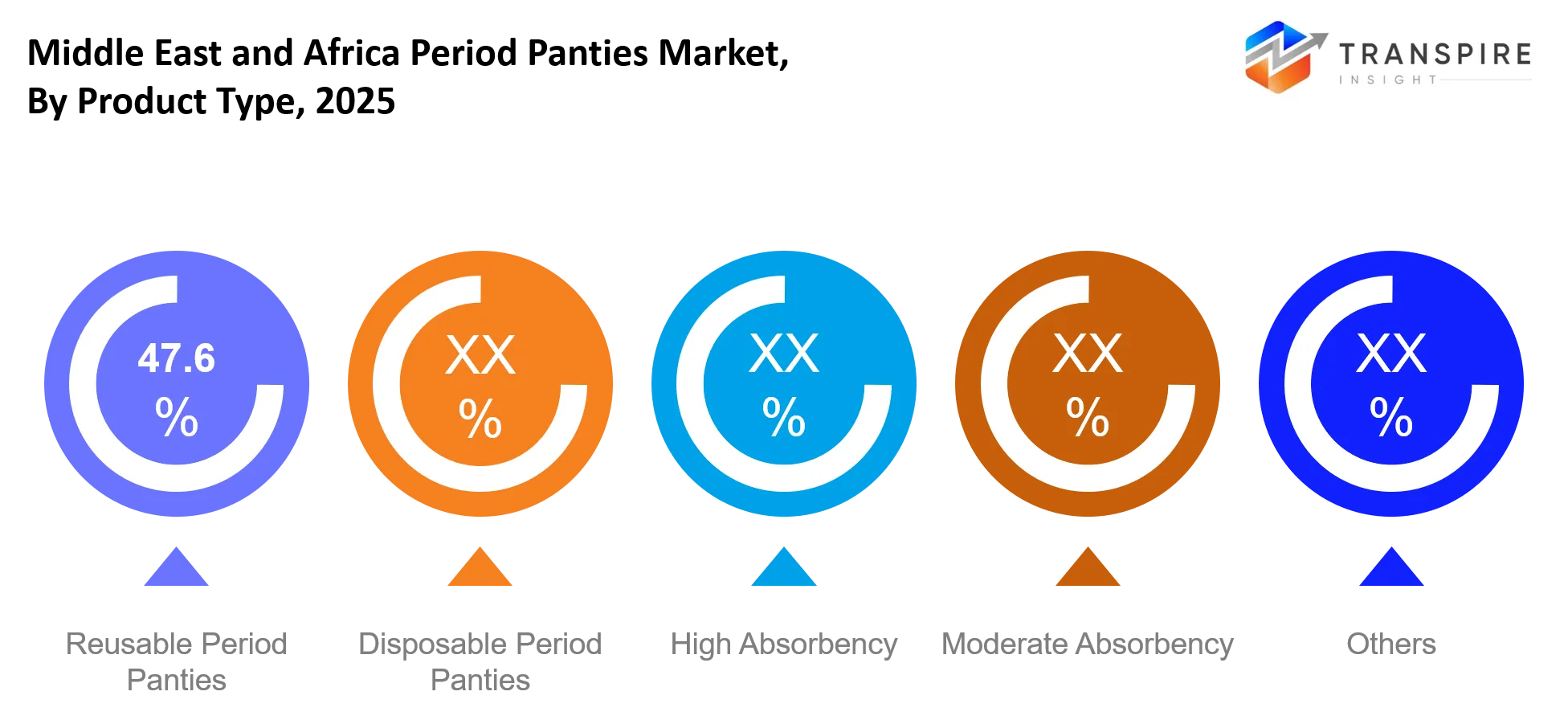
By Material
Cotton kinda stays a go-to choice because it feels soft, it breathes well, and it’s comfy even if you wear it for a long time. Bamboo based fabrics keep getting more attention too, mostly for moisture control and that whole natural fiber appeal. Material innovation has basically pushed manufacturers to mix different fabrics together , so you get better overall performance in the end.
Nylon and Spandex also matter a lot, they add flexibility, stretch, and a kind of body hugging fit. They help support designs that come off as seamless and they tend to boost comfort while you’re moving around. There are also other materials, like advanced synthetic blends that improve absorbency, durability, and moisture transfer abilities, while still holding onto solid comfort standards.
By Distribution Channel
Online Retail is still, pretty much, the main sales channel because product variety, customer reviews, subscription choices, and those discreet buying experiences in general. Digital platforms also come with educational material, which helps first time buyers get a grip on product characteristics and absorbency capabilities, kind of faster.
Meanwhile Specialty Stores keep adding value with tailored product advice and category know-how. Supermarkets are also giving more shelf space to menstrual wellness products, so consumer access gets wider, in a real way. Then there are the other routes too, like pharmacies, department stores, and wellness centered retail outlets that extend the market reach even further.
By End User
Teenagers are a rapidly expanding customer group because of educational campaigns and those first-time product offers. Designs are getting more and more centered on comfort, confidence, and simple integration into school, sports, and everyday routines. At the same time manufacturers keep rolling out age-specific lineups meant for younger users.
Women hold the biggest portion of market revenue, largely due to established spending power and broader awareness of available options. Besides them, other end users include postpartum consumers, and also people looking for leak-proof, almost worry-free protection for particular health situations or lifestyle needs. Overall this product diversification is still helping wider adoption across several demographic groups.
What are the Key Use Cases Driving the Middle East and Africa Period Panties Market?
The main reason people come back to this is basically everyday menstrual protection, specially with reusable items that you can use for regular day time, and also overnight. Now, the high absorbency models make really big demand, since they let you go longer between changes, and they end up lowering how much you rely on disposable hygiene products in the first place.
A second lane of use is starting to grow too, especially with teenagers, athletes, and working professionals who want discreet coverage while they are at school, doing sports, commuting, or handling workplace duties. Also the moderate absorbency options are getting picked more often for lighter flow days, and as backup protection alongside menstrual cups, which honestly makes sense.
Then there are the newer use cases, like postpartum recovery, and more travel oriented menstrual management too. Manufacturers are working on specialized designs for active lifestyles, plus extended duration wear, so there should be more chances for the category to move deeper into the market during the forecast period, overall.
|
Report Metrics |
Details |
|
Market size value in 2025 |
USD 5.07 Million |
|
Market size value in 2026 |
USD 5.81 Million |
|
Revenue forecast in 2033 |
USD 15.08 Million |
|
Growth rate |
CAGR of 14.60% from 2026 to 2033 |
|
Base year |
2025 |
|
Historical data |
2021 - 2024 |
|
Forecast period |
2026 - 2033 |
|
Report coverage |
Revenue forecast, competitive landscape, growth factors, and trends |
|
Regional scope |
Middle East and Africa (Saudi Arabia, United Arab Emirates, South Africa, Rest of Middle East and Africa) |
|
Key company profiled |
Thinx, Knix, Modibodi, Saalt, Bambody, Ruby Love, Rael, Unicharm, Procter & Gamble, Essity, Kimberly-Clark, Bodywise, WUKA, Flux, Dear Kate |
|
Customization scope |
Free report customization (country, regional & segment scope). Avail customized purchase options to meet your exact research needs. |
|
Report Segmentation |
By Product Type (Reusable Period Panties, Disposable Period Panties, High Absorbency, Moderate Absorbency, Others); By Material (Cotton, Bamboo, Nylon, Spandex, Others); By Distribution Channel (Online Retail, Specialty Stores, Supermarkets, Others); By End User (Teenagers, Women, Others) |
Which Regions are Driving the Middle East and Africa Period Panties Market Growth?
South Africa is basically leading the regional market, mostly because of stronger retail setup , more established personal care distribution networks, and frankly higher consumer buy-in for premium menstrual hygiene items. A lot of the major retail chains keep showing wide shelf coverage across the main urban areas. And then, digital commerce platforms also help keep the category reachable, like day to day, for more shoppers. So overall, this mix builds a steady environment that keeps South Africa at the top.
The Gulf Cooperation Council area sits next, as the second-largest contributor. If you compare it to South Africa, the momentum there feels more driven by premium consumer spending and retail formats that lean into wellness rather than just basic shopping. Strong purchasing power then supports quicker uptake of newer, more innovative menstrual care products. E-commerce presence keeps increasing, and that keeps market results moving upward across the UAE and Saudi Arabia.
As for the fastest growth, it’s expected across emerging Middle Eastern economies. There, retail modernization, plus added digital commerce investment, has sped up product accessibility in a way that matters. New distribution agreements and wider awareness efforts have also boosted category visibility. On top of that, more involvement from international brands means more selection, and better competition. Together these changes are turning into real opportunities for investors and new entrants, looking out toward 2033.
Who are the Key Players in the Middle East and Africa Period Panties Market and How Do They Compete?
Competition is still pretty moderately fragmented, with global specialists, and menstrual wellness brands going head to head mostly on product performance, safety credentials, comfort, and also how far their distribution really goes. What’s changing is that differentiation now leans more on absorbency technology, material transparency, and omnichannel retail plays, not just price in itself, or only price.
Thinx keeps steering toward product innovation and category education, and it kind of leans on that solid brand recognition it built during the early period underwear development phase. Knix shows up with thinner absorbent layers, comfort-first engineering, and upgraded leakproof technologies. Modibodi leans hard into absorbency innovation, wider product variety, and performance-driven product development, especially for different flow levels.
WUKA competes with PFAS-free positioning, and then uses an aggressive retail expansion motion that makes access easier for more people. Saalt is all about reusable menstrual wellness solutions, backed by educational engagement, and very specific product ranges. Bambody aims at value-conscious shoppers through affordable offerings, but still tries to hold onto functional performance. Strategic partnerships, retail expansion, and ongoing fabric innovation stay the main levers that companies use to strengthen market positioning, and also keep customers around for longer.
Company List
- Thinx
- Knix
- Modibodi
- Saalt
- Bambody
- Ruby Love
- Rael
- Unicharm
- Procter & Gamble
- Essity
- Kimberly-Clark
- Bodywise
- WUKA
- Flux
- Dear Kate
Recent Development News
In March 2026, WUKA expanded its partnership with Tesco and increased distribution from fewer than 300 stores to more than 1,800 stores. The expansion significantly increased accessibility of reusable period pants through mainstream retail channels.https://www.femtechworld.co.uk/
In February 2026, Knix launched a next-generation leakproof underwear collection featuring enhanced absorbency layers, moisture-wicking fabrics, and odor-control technology. The launch strengthened product performance and expanded the company's reusable menstrual care portfolio.https://www.nextmsc.com/
In August 2025, Modibodi entered a strategic partnership with West Ham United Women as the club's official period-proof underwear partner. The collaboration increased brand visibility and supported broader normalization of period care products in women's sports.https://fashionunited.uk/
What Strategic Insights Define the Future of the Middle East and Africa Period Panties Market?
The market seems to be moving, bit by bit, toward mainstream integration inside the wider menstrual wellness industry. At the same time product performance upgrades, more general retail presence and even greater clarity about what materials are used will shape the way people buy, more and more. The most solid long-term growth driver is likely the shift from “try it once” buying toward routine use by mainstream consumers, not just niche groups.
There’s also a quieter risk that doesn’t get talked about much, market concentration. It can cluster around a smaller set of premium international brands. If prices stay high, and if local manufacturing capacity develops slowly too, then reach among lower income consumer segments may stay limited even when the headline growth signals look good.
On the upside, there’s an emerging opening for localized production, backed by regional textile manufacturing capabilities. When production is closer to home it can bring down costs, reduce the whole supply chain time, and generally make products more affordable across Middle Eastern and African markets.
Market players should focus on retail partnerships, PFAS-free product development, and regional manufacturing approaches. The companies that manage to blend affordability, safety transparency, and dependable distribution networks will probably be in the strongest spot to capture the next stage of market expansion.
Middle East and Africa Period Panties Market Report Segmentation
By Product Type
- Reusable Period Panties
- Disposable Period Panties
- High Absorbency
- Moderate Absorbency
- Others
By Material
- Cotton
- Bamboo
- Nylon
- Spandex
- Others
By Distribution Channel
- Online Retail
- Specialty Stores
- Supermarkets
- Others
By End User
- Teenagers
- Women
- Others
Frequently Asked Questions
Find quick answers to common questions.
The Expected Middle East and Africa Period Panties Market size for the Market will be USD 15.08 Million in 2033.
Key Segments for the Middle East and Africa Period Panties Market are By Product Type (Reusable Period Panties, Disposable Period Panties, High Absorbency, Moderate Absorbency, Others); By Material (Cotton, Bamboo, Nylon, Spandex, Others); By Distribution Channel (Online Retail, Specialty Stores, Supermarkets, Others); By End User (Teenagers, Women, Others).
Major Middle East and Africa Period Panties Market players are Thinx, Knix, Modibodi, Saalt, Bambody, Ruby Love, Rael, Unicharm, Procter & Gamble, Essity, Kimberly-Clark, Bodywise, WUKA, Flux, Dear Kate.
The Current Middle East and Africa Period Panties Market size is USD 5.07 Million in 2025.
The Middle East and Africa Period Panties Market CAGR is 14.60% from 2026 to 2033
- Thinx
- Knix
- Modibodi
- Saalt
- Bambody
- Ruby Love
- Rael
- Unicharm
- Procter & Gamble
- Essity
- Kimberly-Clark
- Bodywise
- WUKA
- Flux
- Dear Kate
About the Authors

Chetan Dhatrak
I’m Chetan Dhatrak, a Senior Research Analyst at Transpire Insight, specializing in the Consumer Goods, Foods and Beverages industry. I focus on analyzing market trends, consumer behavior, competitive landscapes, and industry developments to deliver accurate, data-driven insights. My research at Transpire Insight is built on credible sources and in-depth analysis, helping businesses and readers better understand market dynamics, emerging opportunities, and evolving consumer preferences. I’m committed to creating reliable, well-researched content that supports informed decision-making and reflects the latest developments in the consumer goods and food & beverage sectors.

Chakradhar Khansole
Chakradhar serves as the Research Director at Transpire Insight, bringing over 8 years of experience in technology, innovation, and strategic market intelligence. He specializes in transforming complex market data into actionable business insights that enable organizations to make informed, growth-oriented decisions. Recognized for his strategic vision and analytical expertise, Chakradhar leads high-impact research initiatives, delivering comprehensive market assessments, competitive intelligence, and forward-looking industry analysis.
Recently Published Reports
-
Apr 2026
Bottled Water Market
Bottled Water Market Size, Share & Analysis Report By Product Type (Still Bottled Water, Carbonated Bottled Water, Functional Bottled Water, and Others), By Packaging (PET, Cans, and Others), By Sales Channel (Supermarkets/Hypermarkets, Convenience Stores/Drug Stores, Grocery Stores/Club Stores, Foodservice, and Others) and Geography (North America, Europe, Asia-Pacific, Middle East and Africa, South and Central America), 2021 - 2032
-
Apr 2026
Color Cosmetic Packaging Market
Color Cosmetic Packaging Market Size, Share & Analysis Report By Application (Mascara Packaging, Liquid Packaging, and Liquid Face), By Type (Tubes & Bottles, Pens & Markers, Compacts & Containers, and Droppers & Pumps), and Geography (North America, Europe, Asia-Pacific, Middle East and Africa, South and Central America), 2021 - 2031
-
Apr 2026
External Microphone For Camera Market
External Microphone For Camera Market Size, Share & Analysis Report By Type (Shotgun Microphone, Lavalier Microphone, and Others), By Application (Digital Camera, Professional Video Camera, and Others), and Geography (North America, Europe, Asia-Pacific, Middle East and Africa, South and Central America), 2021 - 2031
-
Apr 2026
Foot Orthotic Insoles Market
Foot Orthotic Insoles Market Size, Share & Analysis Report By Type (Pre-fabricated, and Custom-made), By Material (Thermoplastic, Composite Carbon Fiber, and Others), By Distribution Channel (Drug Stores, Hospitals & Clinics, and Others), and Geography (North America, Europe, Asia-Pacific, Middle East and Africa, South and Central America), 2021 - 2031