

Middle East and Africa Natural Household Cleaners Market Size & Forecast:
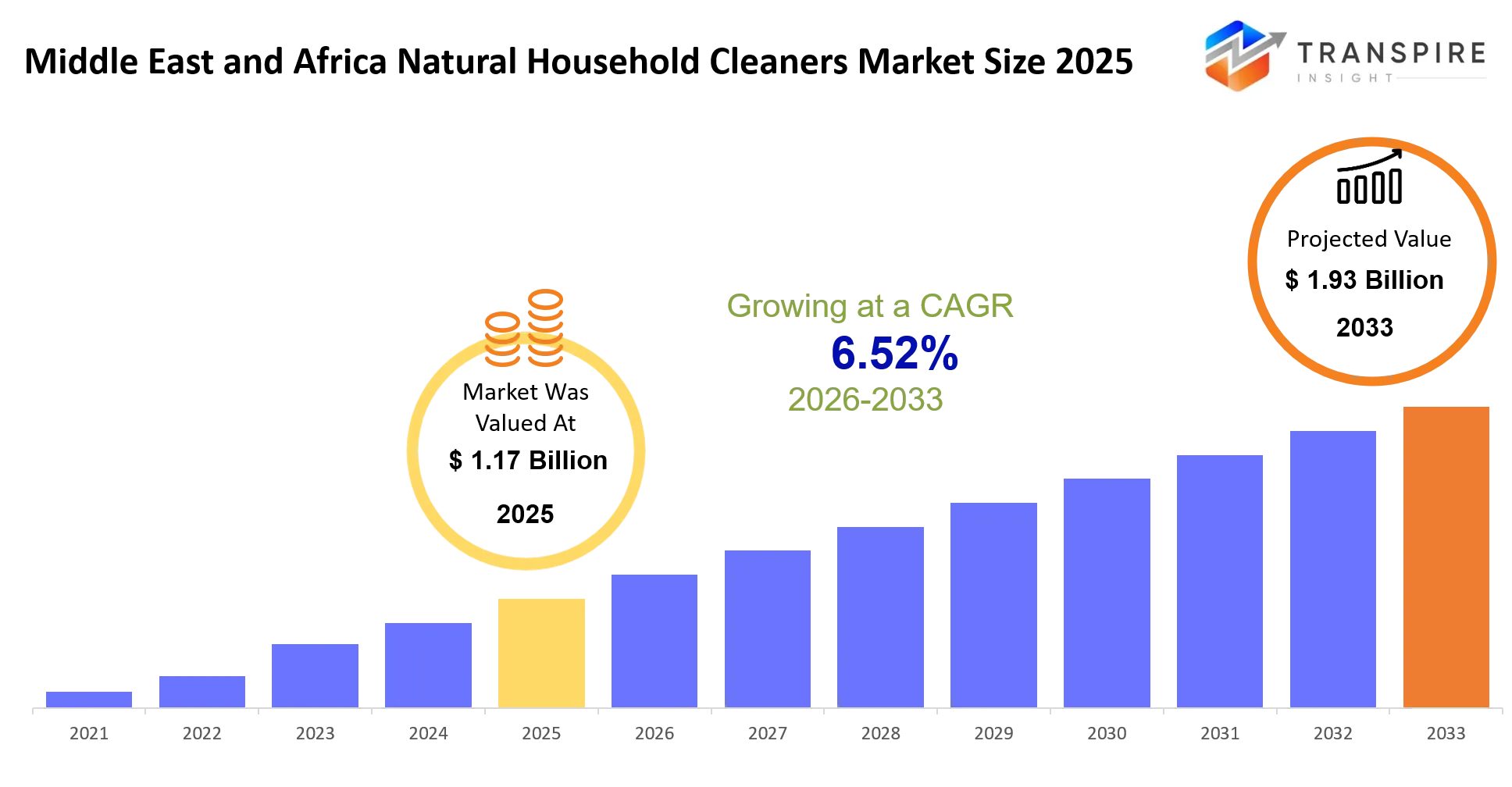
- Middle East and Africa Natural Household Cleaners Market Size 2025: USD 1.17 Billion
- Middle East and Africa Natural Household Cleaners Market Size 2033: USD 1.93 Billion
- Middle East and Africa Natural Household Cleaners Market CAGR: 6.52%
- Middle East and Africa Natural Household Cleaners Market Segments: By Product Type (Surface Cleaners, Dishwashing Cleaners, Laundry Cleaners, Bathroom Cleaners, Multi-Purpose Cleaners, Glass Cleaners, Floor Cleaners, Others); By Ingredient Type (Plant-Based Cleaners, Enzyme-Based Cleaners, Organic Acids, Essential Oils, Citrus Extracts, Herbal Ingredients, Biodegradable Ingredients, Others); By Distribution Channel (Supermarkets, Hypermarkets, Online Retail, Specialty Stores, Convenience Stores, Direct Sales, Department Stores, Others); By End User (Residential, Commercial, Hospitality, Healthcare Facilities, Educational Institutions, Offices, Government Buildings, Others)
Middle East and Africa Natural Household Cleaners Market Summary
The Middle East and Africa Natural Household Cleaners Market was valued at USD 1.17 Billion in 2025. It is forecast to reach USD 1.93 Billion by 2033. That is a CAGR of 6.52% over the period.
Natural household cleaners, honestly do help a lot, households as well as hospitality spaces, healthcare centers, even commercial buildings— they all tend to keep better hygiene, while reducing people’s contact with harsh chemical residues and those volatile compounds. In day to day life these items handle the usual chores, like surface sanitation, laundry care, dishwashing, floor upkeep, and they still try to match tougher sustainability rules, plus a bigger push for ingredient transparency too.
Over the last five years, the market kind of moved away from being only niche eco-labeled stuff and it became more mainstream, like something you can just grab at retail. Big consumer goods manufacturers, they’ve expanded plant-based and biodegradable lines, so natural formulations are now more findable across supermarkets and online channels. During the pandemic, supply chain disruptions also kind of rewired what people buy, and suddenly consumers along with institutions kept asking for product safety, ingredient traceability, and local sourcing— like more proof than before. Retailers are carving out more shelf space for cleaning products that are somehow more environmentally responsible, and meanwhile governments are tightening up their sustainability initiatives. So manufacturers are scaling their production, widening distribution networks, and basically moving quicker, like a bit too fast sometimes. Over all, that shift helps with market penetration, a wider consumer acceptance, and steady revenue growth across the Middle East and Africa.
Key Market Insights
- The Middle East and Africa Natural Household Cleaners Market is projected to hit about USD 1.93 Billion by 2033, starting from roughly USD 1.17 Billion in 2025.
- In 2025, GCC countries bring in nearly 38% of the regional revenue, mainly backed by solid retail setup and a steady shift toward premium product adoption, which honestly feels like it keeps growing.
- South Africa is still a major contributor too with eco-certified options becoming easier to find across modern retail chains and more shelf space over time.
- When it comes to product types, surface cleaners take the lead, holding around 28% market share in 2025, largely because everyday households, plus business cleaning routines, keep creating demand.
- Laundry cleaners sit in the second place, helped by concentrated detergent blends that are plant-origin based and aimed at better performance with less fuss.
- Multi-purpose cleaners are expected to grow the quickest through 2033, since shoppers want convenience-first cleaning answers, and they keep choosing “one for many” categories.
- For use cases, residential applications account for close to 62% of overall demand, propelled by regular household buying and repeat consumption cycles.
- Hospitality facilities are also rising fast, as hotels start leaning into sustainability-focused procurement policies, even when budgets are tight.
- Online retail sales have expanded by more than 20% since 2021, which makes products more reachable across most cities and urban neighborhoods.
- Key players like Unilever, Procter & Gamble, Reckitt, Ecover, and Seventh Generation, continue pushing biodegradable formulations, refill systems, and regional expansion tactics, pretty persistently these days.
What are the Key Drivers, Restraints, and Opportunities in the Middle East and Africa Natural Household Cleaners Market?
The most solid growth trigger comes from tighter product ingredient transparency rules plus sustainability commitments, being leaned into by retailers, hospitality operators, and institutional buyers . Lately, big retail groups are basically moving toward items with biodegradable ingredients, plant-sourced surfactants , and less chemical content overall . This kind of movement has pushed manufacturers to broaden natural cleaning offerings and go after more prominent shelf placement. As product availability keeps getting better and distribution spreads out, the market can benefit through more frequent purchases and a stronger feeling of consumer trust, even if it’s not always said out loud.
Price competitiveness is still the biggest structural hurdle, maybe the one that matters most. Natural formulas typically depend on plant extracts, essential oils, biodegradable compounds and certified sustainable raw materials that often cost more than conventional chemical substitutes. In addition, production volumes stay relatively smaller than those of standard cleaning products across several Middle Eastern and African markets. Put together, this makes affordability harder in price-sensitive economies and it slows adoption among lower-income households. So, penetration tends to arrive later and revenue chances end up limited across multiple emerging economies, in practice.
The clearest future opening is localized manufacturing together with bio-based ingredient sourcing. Putting money into nearby production facilities can help manufacturers reduce their reliance on imports, cut down on transport costs, and get a firmer grip on supply chain disruptions, in a real practical way. Some places, like the United Arab Emirates, Saudi Arabia, and South Africa, are really pushing sustainable manufacturing efforts that back local production and also help the wider industry ecosystem. As local manufacturing capacity keeps growing, businesses often find they can raise supply reliability, adjust faster to shifting market needs, and build a steadier base for long term expansion through out the region.
What Has the Impact of Artificial Intelligence Been on the Middle East and Africa Natural Household Cleaners Market?
Artificial intelligence is slowly, kinda steadily changing the natural household cleaners industry, mainly by making product development a bit smoother, demand forecasting less messy, supply chain handling more predictable, and even pushing manufacturing efficiency up. In practice, more manufacturers are turning to machine learning models to look at how people actually buy stuff, what retailers have on offer in real time, and how certain ingredients perform under different conditions, instead of guessing. From there, the company can fine tune product formulations a bit better and spot newer tastes for certain natural ingredients before they become obvious.
AI driven forecasting tools also help with inventory decisions, because they can predict demand swings across different retail channels, and across geographic markets too. On the production floor, automated systems can watch ingredient usage, packaging effectiveness, and quality checks in real time, so waste goes down, and operating expenses get pushed lower. In addition, advanced analytics platforms let manufacturers judge supplier performance, adjust logistics paths, and strengthen distribution efficiency across the Middle East and Africa, with fewer hiccups.
Then there’s the sustainability angle, which digital tech keeps pushing forward. AI systems can measure carbon footprints, observe how resources are consumed, and flag chances to cut water and energy use during production. Those actions support environmental compliance, while also improving overall operational efficiency, kind of end to end.
Still, AI adoption is not easy, not fully anyway, since integration costs are high and the data quality can be unreliable. A lot of regional manufacturers run on scattered data systems, and the digital infrastructure is limited. When there are no dependable datasets, and when advanced analytics capabilities are missing, it becomes hard to deliver consistent AI driven optimization, especially for small and medium sized producers.
Key Market Trends
- Plant-based cleaning formulations saw a bit more than 15% extra shelf staying power across the biggest retail chains from 2021 through 2025, kind of a steady climb really.
- Refillable packaging programs rolled out further across GCC nations, this cut down on plastic use and also helped with circular economy aims.
- Online retail sales jumped by over 20% since 2021 , which makes products easier to reach even outside the main city hubs.
- In hospitality, many operators started leaning more into biodegradable cleaning products, partly to back sustainability certifications and the like.
- Unilever and Reckitt also pushed out broader natural product lines between 2024 and 2026, trying to catch that premium household cleaning demand that’s growing.
- Ingredient sourcing approaches shifted toward nearby suppliers after supply chain disruptions, especially those that were felt after 2020.
- Multi-purpose natural cleaners, these “all in one” types, got more popular as people consolidated their household cleaning buying into fewer categories.
- Manufacturers have been investing more in enzyme driven formulations that boost how well things clean, while lowering the chemical intensity.
- Retailers meanwhile set aside more shelf space for certified natural brands, improving visibility and turning browsers into buyers more often.
- And in the end, product differentiation is now leaning on ingredient transparency, eco-certifications and recyclable packaging, rather than only competing on price.
Middle East and Africa Natural Household Cleaners Market Segmentation
By Product Type
Surface cleaners take a pretty large slice of the market, mainly because everyday cleaning in homes, offices, hospitality spaces, and healthcare places keeps needing dirt, stains , and microbes removed again and again. That kind of demand basically pushes new ideas, especially plant based formulations that still clean well, but with less chemical content. Dishwashing cleaners keep getting more popular too, mostly due to biodegradable ingredients and those concentrated liquid types that save space and effort. Laundry cleaners stay strong as well, since people use them often at home, and there is also a rising taste for detergents that come from more natural sources.
Bathroom cleaners really fit hygiene needs in both residential and commercial areas, using mixes aimed at hard-water stains and mineral buildup. Multi purpose cleaners pull in customers who want convenience, plus a sense of value because they can handle a wider range of cleaning jobs. Glass cleaners are used for streak free results in houses and workplaces, and floor cleaners remain a go-to for normal upkeep. Beyond that there are other cleaning categories, with specialized solutions created for smaller, more specific household needs , depending on the situation.
By Ingredient Type
Plant based cleaners are kind of a big category too, because the manufacturers more and more lean on renewable raw materials and those naturally derived surfactants, you know. Enzyme based cleaners tend to handle stubborn stains pretty well, and they also help with odor management while cutting back on aggressive chemicals. Organic acids, they support the cleaning work via natural descaling and disinfecting properties, in a way that feels more “clean” to customers. Essential oils add fragrance as well as antibacterial traits, and they make products stand out in the lineup.
Citrus extracts keep getting more traction, since the natural solvent characteristics help with grease breakdown and general surface cleaning uses. Herbal inputs strengthen brand positioning through botanical blends, and that gets tied to gentler cleaning solutions, even when the difference is subtle. Biodegradable ingredients stay central in product development because environmental performance can really affect purchasing decisions. And then there are other ingredient types, like naturally sourced compounds, that are developed to boost cleaning efficiency and improve formulation stability.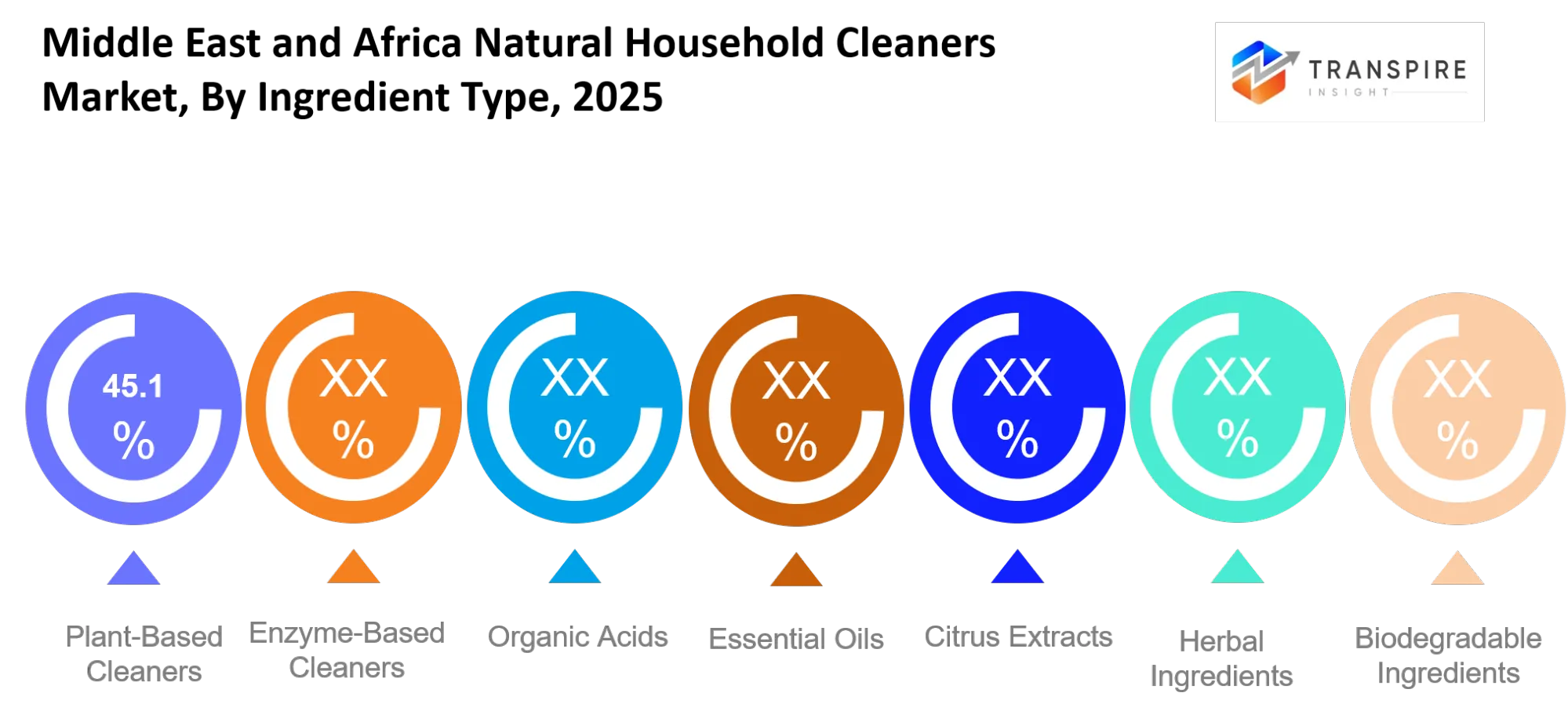
By Distribution Channel
Supermarkets remain the top distribution channel, mostly because people can see the products really well, and they keep visiting often, like, on regular days. Hypermarkets back big volume movement with wide assortments, plus those marketing pushes, promos and such. Online retail keeps growing too, since digital commerce platforms keep getting more convenient, easier to compare items and faster for home delivery services to happen. Specialty stores pull in shoppers who want “certified natural” or more premium cleaning products, kind of a targeted thing.
Convenience stores help with smaller buys and right-now usage needs, especially in dense urban areas. Direct sales are still a good fit for specific brands, mainly when they want close customer engagement and subscription-style purchasing. Department stores also matter, because they give premium visibility and help with brand positioning. Other options include local retailers and independent outlets that serve regional shoppers, in a more familiar type of market, depending on the area.
By End User
Residential users make up the largest share, mostly because household cleaning routines keep buying the same types of products again and again across the year. When people often purchase things for surface care, laundry, dish washing, and floor cleaning , the overall pattern stays pretty steady. Commercial facilities also count as a key customer group, since many companies lean into green purchasing strategies, and run cleaning programs that are more environmentally minded.
In the hospitality sector, more and more properties are swapping in natural cleaning products, partly to meet sustainability targets and partly to match what guests expect. Healthcare facilities, for their part, use carefully chosen natural formulations, but only where safety and hygiene expectations fit the day to day operational needs. Schools and office buildings keep moving toward environmentally responsible cleaning in their maintenance activities. Government buildings and other institutional users add extra volume as well, through procurement drives that emphasize sustainability.
What are the Key Use Cases Driving the Middle East and Africa Natural Household Cleaners Market?
The main use case is mostly about regular home cleaning, you know surface sanitation, laundry care, dishwashing , and keeping floors up to standard. In practice, this is where the biggest chunk of demand comes from, since cleaning products get used often and well they need to reup every so often, pretty much weekly or whatever.
On top of that, there’s additional adoption in hospitality places and commercial buildings. They’re looking for cleaning solutions that match sustainability goals, and also support indoor air quality, not just “clean enough”. So hotels , restaurants, corporate offices, and schools are starting to roll in more natural cleaning solutions as part of how they manage the building day to day.
Then later, newer use cases are showing up in healthcare-support settings, childcare centers, and even high-end residential developments where people care more about ingredient transparency and a lower chemical footprint. Refillable product formats and concentrated cleaning systems also look promising, because more organizations keep pushing for waste minimization and resource efficiency over the whole forecast window.
|
Report Metrics |
Details |
|
Market size value in 2025 |
USD 1.17 Billion |
|
Market size value in 2026 |
USD 1.24 Billion |
|
Revenue forecast in 2033 |
USD 1.93 Billion |
|
Growth rate |
CAGR of 6.52%from 2026 to 2033 |
|
Base year |
2025 |
|
Historical data |
2021 - 2024 |
|
Forecast period |
2026 - 2033 |
|
Report coverage |
Revenue forecast, competitive landscape, growth factors, and trends |
|
Regional scope |
United States; Canada; Mexico; United Kingdom; Germany; France; Italy; Spain; Denmark; Sweden; Norway; China; Japan; India; Australia; South Korea; Thailand; Brazil; Argentina; South Africa; Saudi Arabia; United Arab Emirates |
|
Key company profiled |
Unilever, Procter & Gamble, Reckitt, Seventh Generation, Ecover, Method, Better Life, Bio-D, Dr. Bronner's, Eco-Me, Grove Collaborative, Puracy, Earth Friendly Products, Sonett, Attitude |
|
Customization scope |
Free report customization (country, regional & segment scope). Avail customized purchase options to meet your exact research needs. |
|
Report Segmentation |
By Product Type (Surface Cleaners, Dishwashing Cleaners, Laundry Cleaners, Bathroom Cleaners, Multi-Purpose Cleaners, Glass Cleaners, Floor Cleaners, Others); By Ingredient Type (Plant-Based Cleaners, Enzyme-Based Cleaners, Organic Acids, Essential Oils, Citrus Extracts, Herbal Ingredients, Biodegradable Ingredients, Others); By Distribution Channel (Supermarkets, Hypermarkets, Online Retail, Specialty Stores, Convenience Stores, Direct Sales, Department Stores, Others); By End User (Residential, Commercial, Hospitality, Healthcare Facilities, Educational Institutions, Offices, Government Buildings, Others) |
Which Regions are Driving the Middle East and Africa Natural Household Cleaners Market Growth?
The Gulf Cooperation Council region kinda leads the market because the retail infrastructure is strong, disposable income stays relatively higher, and there are government sustainability initiatives that keep pushing things forward. In practice, countries like Saudi Arabia , and the United Arab Emirates back the shift toward premium household product adoption by using organized retail networks. Also the broad presence of international brands, helps more directly with market penetration. On top of that sustainability-leaning consumer spending seems to add a layer of reinforcement to the regional leadership.
South Africa shows up as the second-largest regional contributor though it doesn’t exactly follow the same growth rhythm. Market stability comes mainly from established retail distribution systems, solid domestic manufacturing capabilities, and a pretty mature consumer goods ecosystem. Retailers are also steadily widening shelf space for natural and biodegradable products. Meanwhile consistent investment from multinational consumer goods companies supports long term market performance without much wobble.
The rest of Africa is expected to post the fastest growth through 2033. A big part is expanding urbanization, better retail penetration, and rising investment in modern consumer goods distribution networks, which together open new opportunities. E-commerce development has helped too, by improving access to products in places that were previously under served. This whole momentum then creates favorable conditions for manufacturers who want geographic expansion and, well, sustained revenue growth over time.
Who are the Key Players in the Middle East and Africa Natural Household Cleaners Market and How Do They Compete?
Competition still looks kind of moderately fragmented, with multinational consumer goods firms going head to head alongside more specialized natural cleaning brands. On the ground, product formulation, ingredient transparency, sustainability certifications, and how far distribution really goes are basically the main competitive points. Larger, established manufacturers get a lot of leverage from large-scale production, but the smaller niche brands manage to stand apart via specialized natural ingredients, plus environmental credentials and some sort of ethos.
Unilever keeps pushing sustainable product development and packaging innovation across household cleaning categories. Their wide retail distribution networks deliver strong visibility, and they also help drive faster regional expansion, which is kinda key. Procter & Gamble leans on research capabilities to craft high-performance cleaning products, aiming to balance effectiveness with sustainability objectives too. Add to that strong brand recognition and supply chain efficiency, and it becomes a real advantage bundle.
Reckitt differentiates with product performance and ongoing innovation inside hygiene-centric formulations. Seventh Generation, meanwhile, highlights plant-derived ingredients, transparency standards, and environmentally responsible sourcing practices that strongly attract sustainability-minded consumers. Ecover keeps expanding using biodegradable formulations and refillable packaging initiatives, meant to lower environmental impact, or at least that’s the intent. Method also holds a position that feels more design-forward, using design-focused products, sustainable packaging, and a more premium consumer appeal.
Overall, these players seem to pursue product innovation, retail partnerships, and regional expansion strategies more and more, trying to reinforce their competitive positioning and capture emerging growth opportunities, even when the market isn’t fully unified.
Company List
- Ecover
- Method
- Better Life
- Bio-D
- Dr. Bronner's
- Eco-Me
- Grove Collaborative
- Puracy
- Earth Friendly Products
- Sonett
- Attitude
Recent Development News
In April 2026, Unilever launched expanded refillable home care solutions across selected international markets. The initiative strengthened packaging waste reduction efforts and supported circular economy objectives within household cleaning categories.https://www.unilever.com/news/ (Unilever)
What Strategic Insights Define the Future of the Middle East and Africa Natural Household Cleaners Market?
The market is sort of leaning toward broader integration of natural formulations into everyday household cleaning categories, instead of staying a premium niche segment. The main driver behind this shift seems to be the combination of ingredient transparency requirements, retailer sustainability commitments, and a wider presence via modern distribution channels. Over the next five to seven years, localized sourcing and regional manufacturing will become more and more of an actual competitive advantage.
A quieter, less obvious risk is raw material availability. Relying on plant-derived ingredients, essential oils, and biodegradable compounds can put manufacturers in a bind if there are agricultural supply disruptions, or if prices start swinging around. In turn, this may pressure margins, and reduce product affordability across price-sensitive markets.
Still, there is a promising opening in concentrated refill systems and low-waste packaging solutions—especially across GCC countries and in organized retail settings. Businesses should put money into regional sourcing partnerships and scalable manufacturing capabilities to boost supply resilience, keep costs steadier, and strengthen long-term market competitiveness.
Middle East and Africa Natural Household Cleaners Market Report Segmentation
-
By Product Type
Surface Cleaners
Dishwashing Cleaners
Laundry Cleaners
Bathroom Cleaners
Multi-Purpose Cleaners
Glass Cleaners
Floor Cleaners
Others -
By Ingredient Type
Plant-Based Cleaners
Enzyme-Based Cleaners
Organic Acids
Essential Oils
Citrus Extracts
Herbal Ingredients
Biodegradable Ingredients
Others -
By Distribution Channel
Supermarkets
Hypermarkets
Online Retail
Specialty Stores
Convenience Stores
Direct Sales
Department Stores
Others -
By End User
Residential
Commercial
Hospitality
Healthcare Facilities
Educational Institutions
Offices
Government Buildings
Others
Frequently Asked Questions
Find quick answers to common questions.
The Expected Middle East and Africa Natural Household Cleaners Market size for the market will be USD 1.93 Billion in 2033.
Key Segments for the Middle East and Africa Natural Household Cleaners Market are By Product Type (Surface Cleaners, Dishwashing Cleaners, Laundry Cleaners, Bathroom Cleaners, Multi-Purpose Cleaners, Glass Cleaners, Floor Cleaners, Others); By Ingredient Type (Plant-Based Cleaners, Enzyme-Based Cleaners, Organic Acids, Essential Oils, Citrus Extracts, Herbal Ingredients, Biodegradable Ingredients, Others); By Distribution Channel (Supermarkets, Hypermarkets, Online Retail, Specialty Stores, Convenience Stores, Direct Sales, Department Stores, Others); By End User (Residential, Commercial, Hospitality, Healthcare Facilities, Educational Institutions, Offices, Government Buildings, Others).
Major Middle East and Africa Natural Household Cleaners Market players are Unilever, Procter & Gamble, Reckitt, Seventh Generation, Ecover, Method, Better Life, Bio-D, Dr. Bronner's, Eco-Me, Grove Collaborative, Puracy, Earth Friendly Products, Sonett, Attitude.
The Current Middle East and Africa Natural Household Cleaners Market size is USD 1.17 Billion in 2025.
The Middle East and Africa Natural Household Cleaners Market CAGR is 6.52% from 2026 to 2033.
- Unilever
- Procter & Gamble
- Reckitt
- Seventh Generation
- Ecover
- Method
- Better Life
- Bio-D
- Dr. Bronner's
- Eco-Me
- Grove Collaborative
- Puracy
- Earth Friendly Products
- Sonett
- Attitude
About the Authors

Chetan Dhatrak
I’m Chetan Dhatrak, a Senior Research Analyst at Transpire Insight, specializing in the Consumer Goods, Foods and Beverages industry. I focus on analyzing market trends, consumer behavior, competitive landscapes, and industry developments to deliver accurate, data-driven insights. My research at Transpire Insight is built on credible sources and in-depth analysis, helping businesses and readers better understand market dynamics, emerging opportunities, and evolving consumer preferences. I’m committed to creating reliable, well-researched content that supports informed decision-making and reflects the latest developments in the consumer goods and food & beverage sectors.

Chakradhar Khansole
Chakradhar serves as the Research Director at Transpire Insight, bringing over 8 years of experience in technology, innovation, and strategic market intelligence. He specializes in transforming complex market data into actionable business insights that enable organizations to make informed, growth-oriented decisions. Recognized for his strategic vision and analytical expertise, Chakradhar leads high-impact research initiatives, delivering comprehensive market assessments, competitive intelligence, and forward-looking industry analysis.
Recently Published Reports
-
Apr 2026
Bottled Water Market
Bottled Water Market Size, Share & Analysis Report By Product Type (Still Bottled Water, Carbonated Bottled Water, Functional Bottled Water, and Others), By Packaging (PET, Cans, and Others), By Sales Channel (Supermarkets/Hypermarkets, Convenience Stores/Drug Stores, Grocery Stores/Club Stores, Foodservice, and Others) and Geography (North America, Europe, Asia-Pacific, Middle East and Africa, South and Central America), 2021 - 2032
-
Apr 2026
Color Cosmetic Packaging Market
Color Cosmetic Packaging Market Size, Share & Analysis Report By Application (Mascara Packaging, Liquid Packaging, and Liquid Face), By Type (Tubes & Bottles, Pens & Markers, Compacts & Containers, and Droppers & Pumps), and Geography (North America, Europe, Asia-Pacific, Middle East and Africa, South and Central America), 2021 - 2031
-
Apr 2026
External Microphone For Camera Market
External Microphone For Camera Market Size, Share & Analysis Report By Type (Shotgun Microphone, Lavalier Microphone, and Others), By Application (Digital Camera, Professional Video Camera, and Others), and Geography (North America, Europe, Asia-Pacific, Middle East and Africa, South and Central America), 2021 - 2031
-
Apr 2026
Foot Orthotic Insoles Market
Foot Orthotic Insoles Market Size, Share & Analysis Report By Type (Pre-fabricated, and Custom-made), By Material (Thermoplastic, Composite Carbon Fiber, and Others), By Distribution Channel (Drug Stores, Hospitals & Clinics, and Others), and Geography (North America, Europe, Asia-Pacific, Middle East and Africa, South and Central America), 2021 - 2031