

Asia Pacific Home Care Market Size & Forecast:
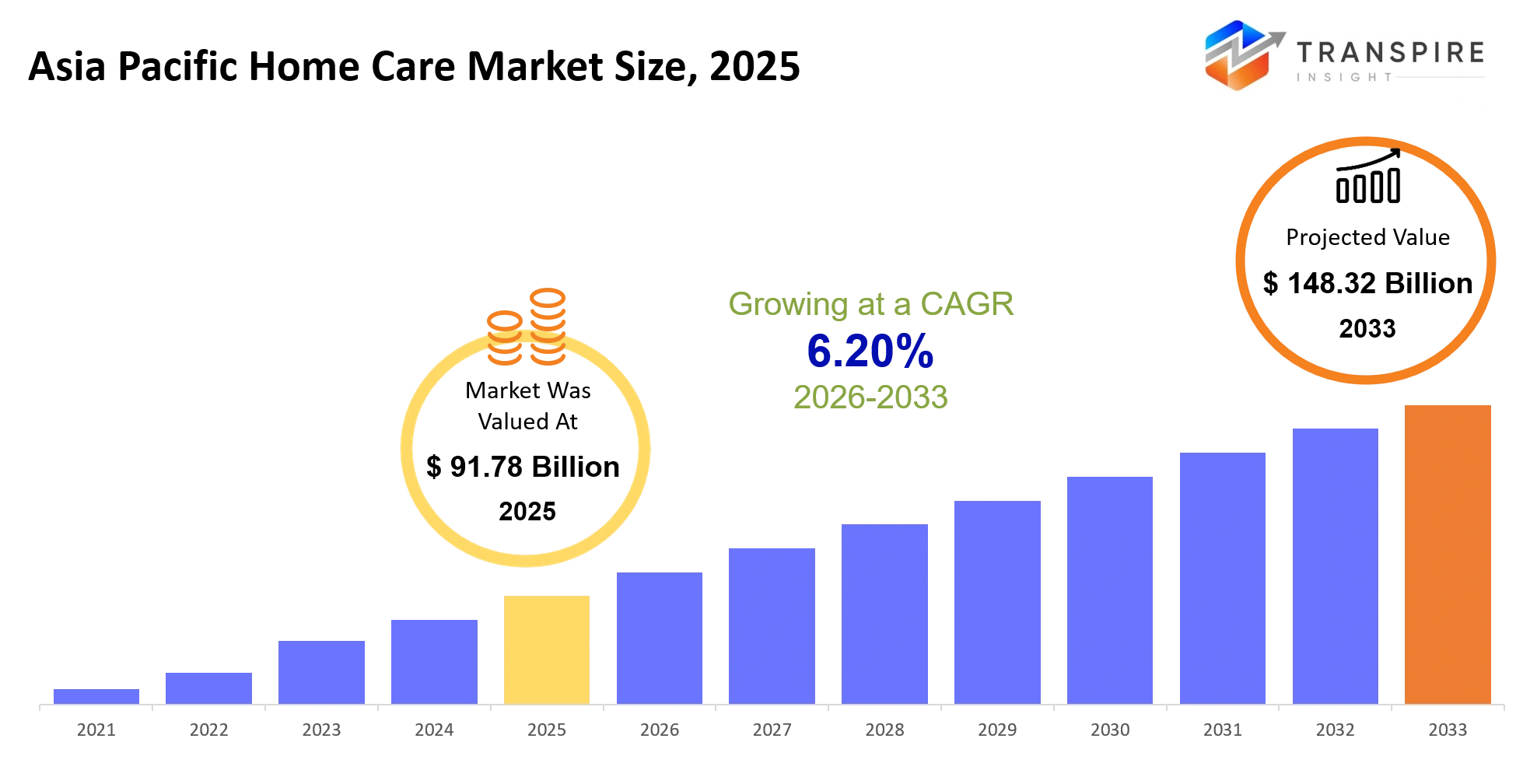
- Asia Pacific Home Care Market Size 2025: USD 91.78 Billion
- Asia Pacific Home Care Market Size 2033: USD 148.32 Billion
- Asia Pacific Home Care Market CAGR: 6.20%
- Asia Pacific Home Care Market Segments: By Product Type (Cleaning Products, Laundry Care, Air Care, Dishwashing Products, Surface Care, Others); By Distribution Channel (Supermarkets, Convenience Stores, Online Retail, Specialty Stores, Others); By End User (Residential, Commercial, Institutional, Others); By Ingredient Type (Chemical-Based, Natural-Based, Eco-Friendly, Others).
To learn more about this report,  Download Free Sample Report
Asia Pacific Home Care Market Summary
The Asia Pacific Home Care Market was valued at USD 91.78 Billion in 2025. It is forecast to reach USD 148.32 Billion by 2033. That is a CAGR of 6.20% over the period.
The Asia Pacific home care market, kind of quietly, helps keep everyday household hygiene going by giving products that clean living spaces, sanitize surfaces, handle laundry, and even make the indoor air feel a little more refreshed. In real life, this supports families in keeping cleanliness routines steady, reducing health risks, and saving time in lifestyles that are becoming more and more urban, and also faster.
Over the last three to five years the market has gone through a noticeable structural shift toward multifunctional, premium, and more environmentally responsible formulations. People are moving past basic cleaning items and looking for solutions that blend convenience with efficacy and sustainability, all in one.One big reason behind this change was the COVID-19 pandemic, which pushed hygiene expectations a bit higher and it sort of changed cleaning routines in a lasting way across homes, schools ,and offices. That shift in behavior motivated manufacturers to grow their disinfecting, antibacterial, and surface-care lines, while also putting money into safer, yet more sustainable ingredients. Consequently , the product value has gone up along with how frequently they are used, which then supports stronger revenue growth via premiumization, innovation, and broader adoption in both major cities and faster-growing consumer groups.
Key Market Insights
- China pretty much dominates the Asia Pacific home care market, taking up around 35%+ of the market share in 2025, backed by its big urban consumer base or whatever, you know.
- India, meanwhile, is the fastest-growing regional market across the forecast window, pushed by the rise of expanding middle-income households and deeper retail penetration.
- In Southeast Asia, a few countries are also seeing strong growth because modern trade channels are getting better and making products more accessible, day by day really.
- Japan and South Korea still keep a pretty solid industry size, mainly from premium household cleaning and fabric care categories that people actually stick with.
- Overall, laundry care leads everything, with about 40%+ market share in 2025, supported by how often households use these products and by product innovation too.
- Surface care is still kinda the second-largest segment , riding on the continuing demand for disinfecting plus multipurpose cleaning products and all that.
- Home fragrance products look like the fastest-growing segment through 2030, mostly because of premiumization and those lifestyle oriented buying patterns people keep doing.
- Concentrated detergents and multifunctional cleaners are getting more notice too , mainly for the convenience angle and the value-per-use perks.
- When it comes to household cleaning applications, they take the biggest market share, pushing past 45% , thanks to the regular consumption cycles that never really stop.
- And surface disinfection is one of the quickest mover applications, enabled by the higher hygiene standards showing up across urban households too.
What are the Key Drivers, Restraints, and Opportunities in the Asia Pacific Home Care Market?
The strongest growth driver in the Asia Pacific Home Care Market is sort of the combo, urbanization and premiumization of everyday household products, not just one thing alone. Over the last decade, rapid expansion of urban middle-income populations in China, India, Indonesia, and Vietnam has tweaked purchasing behavior. People are now leaning more toward convenience oriented items, like concentrated detergents, multifunctional surface cleaners, and specialized fabric care solutions, you know the kind that do more in less time. Then the pandemic kind of institutionalized higher cleaning frequency across households , which pushed the pattern further.As a result, average spending per household went up, not merely product volumes, and that matters. It lets manufacturers earn higher revenue through premium formulations, stronger performance claims, and more differentiated product categories that feel “newer” or more specific to a need.
Still, raw material price volatility is the biggest structural barrier. Key inputs such as surfactants, petrochemical derivatives, fragrances, and packaging materials are vulnerable to swings in energy markets, and also global supply chains. Manufacturers can’t fully swallow these extra costs without squeezing margins, but if they apply frequent price increases, that can reduce purchase frequency among price-sensitive consumers. Since the home care industry relies on globally integrated chemical supply networks, this issue doesn’t get fixed quickly and it keeps suppressing profitability while also delaying category expansion.
The next big chance for growth sits in smart , and sustainable home care solutions made for Asia Pacific consumers. Manufacturers are putting money into refill systems, concentrated formulations, and digitally enabled product ecosystems that cut down packaging waste , while also boosting everyday comfort for users . India and Southeast Asia look especially promising since modern retail infrastructure, e-commerce penetration and higher end household spending keep getting stronger. Firms that manage to blend sustainability with affordability and solid product performance should be able to unlock the next phase of market expansion, and in turn strengthen long term competitive position .
What Has the Impact of Artificial Intelligence Been on the Asia Pacific Home Care Market?
Artificial intelligence is, honestly, increasingly reshaping the Asia Pacific home care industry , mostly by pushing manufacturing efficiency forward, improving demand forecasting , product development and supply chain performance a bit faster than before. In many leading organizations, machine learning algorithms get used to look at purchasing behavior , retail inventory traces, and seasonal consumption rhythms across several countries at the same time. These kinds of systems tend to help tune production schedules, reduce stock shortages, and lift inventory turnover rates , which sounds simple but it is still a big deal in practice.
And then there’s the AI-driven analytics side, it also seems to speed up formulation development in a more direct way. Manufacturers can check thousands of ingredient combinations digitally before any physical testing starts, that shortens the whole product development cycle and it improves formulation accuracy as well. On top of that, computer vision systems running inside production facilities automate quality inspections, spot packaging defects, and quietly trim manufacturing waste. Meanwhile advanced forecasting platforms give more grounded procurement insights, so companies can manage volatile raw material costs and, in turn, protect or even improve operating margins.
There are also digital technologies that make route planning smoother and warehouse operations calmer, lowering distribution costs while raising delivery reliability across wide regional markets. Some producers even mention measurable gains in supply chain responsiveness , plus inventory efficiency, after they implement AI-enabled planning tools . Not perfectly, not overnight, but over time it shows up.
Still, AI adoption doesn’t move freely everywhere. The main roadblocks are high implementation costs, fragmented retail data across emerging economies , and inconsistent data quality. A lot of regional manufacturers simply don’t yet have the digital infrastructure needed to train strong machine learning models , so the scale and overall effectiveness of AI deployment stays limited across the broader home care ecosystem.
Key Market Trends
- Since 2020, households across China, India, and parts of Southeast Asia have been keeping up with higher cleaning rhythms ,and well disinfecting plus surface care items have turned into a kind of everyday habit, not just “occasional” buying.
- Between 2021 and 2025 ,big manufacturers started moving money into concentrated detergents which cuts down on packaging needs ,and that in turn trims transportation expenses ,while also boosting how people perceive value.
- Companies like Unilever and Procter & Gamble widened refill-pack formats , they were basically responding to retailer push plus consumer expectations about cutting plastic waste ,so yeah, it’s been a real shift.
- E-commerce has also reshaped purchasing since 2020, with brands launching products online first, and then only later rolling them out more broadly through conventional retail channels.
- After 2022 ,premium home fragrance and specialty fabric care really started to gather steam, because consumers were steering more of their household budget toward lifestyle oriented purchases, not only functional necessities.
- Manufacturers have been leaning on artificial intelligence for demand forecasting and inventory planning lately ,this helps reduce stock imbalances and makes supply chains feel more responsive, less “reactive” when things change.
- Since 2021, retailers have increased their private label home care lines, which intensifies price pressure on established multinational brands across key Asia Pacific markets, kinda squeezing margins.
- At the same time, regulatory scrutiny around chemical ingredients has grown stronger in several regional areas, encouraging reformulation work and pushing for clearer labeling practices and better transparency.
- And the supply chain disruptions between 2020 and 2023 ,they basically forced faster supplier diversification, so dependence on single-country sourcing models has softened ,at least somewhat.
- Overall differentiation has moved away from basic cleaning capability only, toward multifunction products that blend stain removal, disinfection ,fragrance, and fabric protection all together ,like a 4 in 1 kind of promise.
Asia Pacific Home Care Market Segmentation
By Product Type:
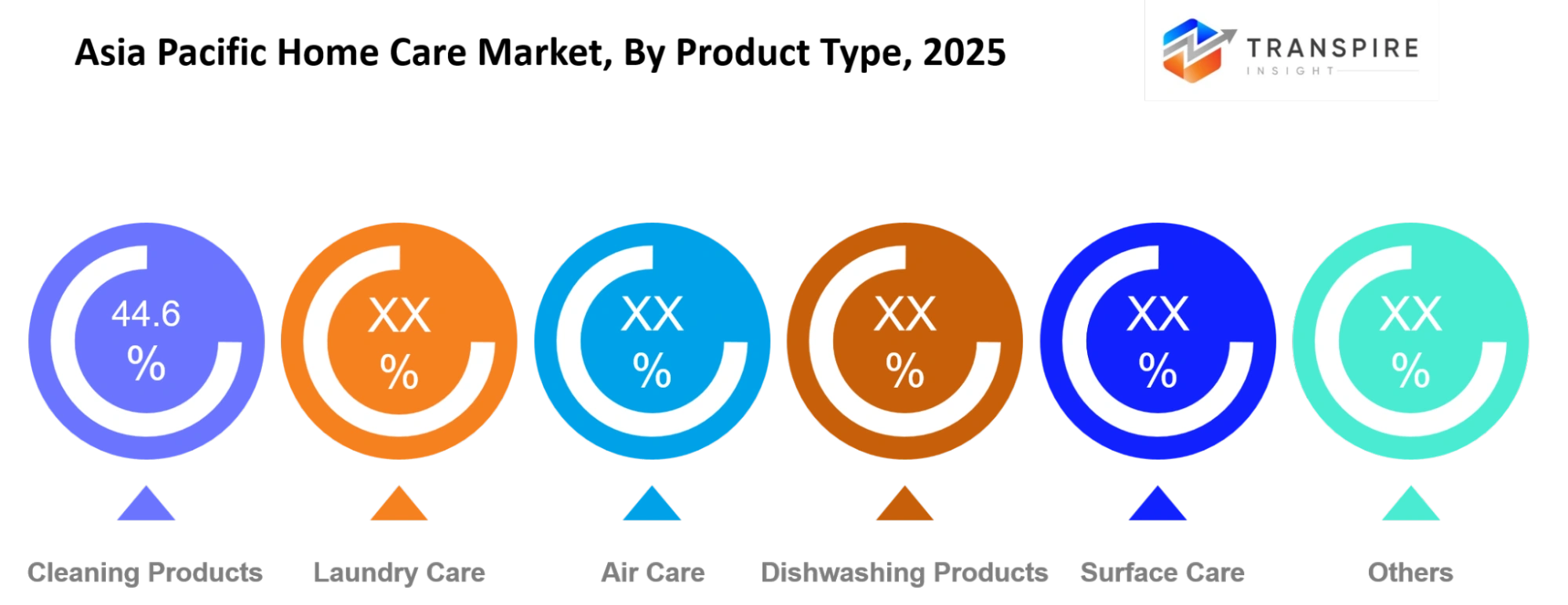
Cleaning Products are basically general household solutions, used to keep hygiene steady across floors, kitchens, bathrooms, and other places in daily life. These items are built to lift dirt, pull off stains, cut through grease, and also deal with germs in different zones of a home, or a wider facility. Ongoing product development has brought in more specialized formulas that take on specific cleaning needs, while at the same time making everything a bit easier to use.
Laundry Care talks about detergents, fabric softeners, stain removers and similar products that help with washing textiles, and keeping them in decent shape. Air Care covers room fresheners, sprays, gels, and odor-control offerings, all aimed at making indoor environments feel more pleasant. Dishwashing Products are used to clean utensils , cookware, and other kitchenware—either in manual ways or through automatic washing cycles.
Surface Care is about products made for countertops , glass, wood, metal, and other home surfaces. The Others category is for more niche home care solutions that handle particular cleaning and maintenance jobs. Taken together these product groups make a fairly broad portfolio that supports day-to-day household hygiene, and general upkeep across the Asia Pacific Home Care Market.
To learn more about this report, Download Free Sample Report
By Distribution Channel:
Supermarkets still remain an important distribution route, largely because they offer those big, broad product assortments so shoppers can kind of compare brands, packaging sizes, and even price choices in one place. Also, high product visibility plus all the promotional activity helps buyers decide faster, or at least feel more certain. Convenience Stores, on the other hand , work for people who want quick and immediate access to essential home care products in locations close by.
Online Retail has turned into a major sales channel because there’s a broader assortment, plus home delivery options, subscription purchases ,and those digital promotions that nudge people along. As internet access expands, and smartphone use keeps increasing, e-commerce keeps getting more strength across both developed and emerging economies in the region.
Specialty Stores lean into specific product categories, and that usually means a more focused shopping experience. And the “Others” bucket is basically independent retailers, wholesale outlets, and alternative sales routes that still add to how easy it is to get the products. In general, each distribution channel fits different consumer preferences, and different buying behaviors too.
By End User:
Residential end users are basically households that regularly grab home care products for things like cleaning, laundry, dishwashing, air care, and that general maintenance routine. Most days, the same kind of household schedule repeats, so the consumption patterns show up pretty consistent across several product categories. Product innovation usually aims at convenience , effectiveness , and also that simple “ easier to apply” feel that works well in home environments, even if people are rushing around.
Commercial end users are more like offices, retail shops, hospitality venues, and other business sites that still need frequent cleaning and maintenance. Then there are institutional end users , such as schools, healthcare facilities, government buildings, and public service settings , where hygiene requirements often push for specialized cleaning solutions and more structured procurement process.
The Others category covers end users with special operating needs that do not quite match standard residential , commercial, or institutional types. In the Asia Pacific Home Care Market, the different end user group influences how much gets purchased , what product specifications are chosen, which packaging formats get used, and what kind of service expectations come along with it.
By Ingredient Type:
Chemical-Based products typically use synthetic ingredients, created for delivering solid cleaning, tackling stains, disinfecting, and odor control kind of results. In practice these kinds of formulations have long made up a large piece of the home care product mix, simply because they tend to give consistent, measurable results across a bunch of different uses, and settings, too.
Natural-Based products include ingredients that come from plant sources, mineral origins, or other materials that are naturally obtained. Product manufacturers are also building these formulations more often these days, since many consumers want clearer ingredient transparency and a different kind of, alternative cleaning solution. Even with that, product performance together with safety concerns keep steering how these products are developed, in this area.
Eco-Friendly products are usually designed with the goal of lowering environmental impact, for example by using biodegradable ingredients, cutting back packaging waste, or using resource efficient production methods. The Others category covers specialized ingredient pairings and newer formulation styles aimed at specific performance needs. Taken together, these ingredient categories show how varied the formulation approaches are across the Asia Pacific home care market.
What are the Key Use Cases Driving the Asia Pacific Home Care Market?
Laundry care is still, pretty much the main thing pushing adoption across the Asia Pacific Home Care Market, yeah. People wash clothing , household textiles, and bedding on a regular basis, and that leads to pretty steady product use in everyday homes. More and more urban households are leaning on specialized detergents and fabric care items, the ones that help with stain removal, fabric protection, and general convenience. So basically this whole laundry segment ends up being the biggest driver of market demand.
Then there’s surface care and dishwashing , those applications are starting to pick up real speed in both residential and commercial spaces. You know, restaurants, hotels, office buildings, and retail sites all need frequent cleaning just to keep hygiene levels up. That kind of pressure supports higher demand for multipurpose cleaners, disinfectants, and dishwashing solutions. Also, the growth of organized hospitality and food service operations really adds fuel to this trend.
Looking ahead, some newer use cases are showing up, like premium home fragrance solutions and smart, refill-based cleaning systems. Consumers are moving toward products that make indoor living feel better, while also cutting down packaging waste. Concentrated cleaning formats and connected dispensing solutions are still early though, but they’re expected to spread more as convenience and sustainability start mattering more in buying decisions across the region.
|
Report Metrics |
Details |
|
Market size value in 2025 |
USD 91.78 Billion |
|
Market size value in 2026 |
USD 97.38 Billion |
|
Revenue forecast in 2033 |
USD 148.32 Billion |
|
Growth rate |
CAGR of 6.20% from 2026 to 2033 |
|
Base year |
2025 |
|
Historical data |
2021 - 2024 |
|
Forecast period |
2026 - 2033 |
|
Report coverage |
Revenue forecast, competitive landscape, growth factors, and trends |
|
Regional scope |
Asia Pacific (India, China, Japan, Australia, South Korea, Rest of Asia Pacific) |
|
Key company profiled |
Procter & Gamble, Unilever, Reckitt, Henkel, Kao, SC Johnson, Church & Dwight, Godrej Consumer, Lion Corporation, Amway, Colgate-Palmolive, LG H&H, Wings Group, Nirma, RSPL. |
|
Customization scope |
Free report customization (country, regional & segment scope). Avail customized purchase options to meet your exact research needs. |
|
Report Segmentation |
By Product Type (Cleaning Products, Laundry Care, Air Care, Dishwashing Products, Surface Care, Others); By Distribution Channel (Supermarkets, Convenience Stores, Online Retail, Specialty Stores, Others); By End User (Residential, Commercial, Institutional, Others); By Ingredient Type (Chemical-Based, Natural-Based, Eco-Friendly, Others). |
Which Regions are Driving the Asia Pacific Home Care Market Growth?
China is still, like, the largest regional market across Asia Pacific and it keeps setting the tone for how the industry moves forward. Strong urbanization plus broad retail networks , big manufacturing capacity and households spending more overall help keep product demand steady across multiple home care categories. There are also government initiatives that lean into consumer spending and domestic production so the whole operating environment looks better for both multinational and local brands. And there’s this pretty mature mix of suppliers, contract manufacturers, logistics providers and e-commerce platforms which lets companies expand distribution smoothly not only in the biggest cities, but also in lower tier markets.
Japan comes in as the second most important contributor, though the market dynamics are quite different from China. The growth story depends less on population expansion and more on people choosing premium product options, adopting new product ideas, and staying consistent with spending for high quality household solutions. Since the economy tends to be stable and brand loyalty is strong, demand is more predictable, which then supports long term revenue. Manufacturers also get to work with a consumer base that cares about performance, ease of use, and more advanced formulations , so it’s easier to justify ongoing research and development investment.
India really stands out as the fastest-growing market in the region, and it is, in a way, opening up new chances for manufacturers plus investors. With more and more people moving into cities, incomes getting higher, e-commerce going deeper, and modern retail channels becoming easier to reach , adoption of home care items has picked up pace in both big metro areas and smaller towns. At the same time, there’s been broader access to premium, specialized products, so customers have been able to choose more things than before, especially over the last few years. If this keeps going , it should lead to pretty compelling expansion opportunities from 2026–2033 , as firms ramp up local production, improve distribution routes, and make their online selling more capable .
Who are the Key Players in the Asia Pacific Home Care Market and How Do They Compete?
In the Asia Pacific Home Care Market the competitive environment kinda blends the sheer scale of global consumer goods companies with a more nimble regional manufacturing mindset. Overall, competition is moderately concentrated across the big product categories, yet the newer segments still feel like a magnet for fresh entrants, who are hunting for openings in premium sustainable and more specialized products. Most players seem to go head to head using product performance , pricing strategies, formulation innovation, brand recognition, and the sheer distribution reach. On top of that, digital commerce plus direct-to-consumer channels have become real competitive levers, so brands can connect with shoppers more effectively, and also pull in real time market insights without waiting around.
Procter & Gamble sets itself apart by keeping investing in advanced laundry and fabric care technologies, aimed at cleaning efficiency and day to day convenience. They tend to grow market presence through product upgrades, localized offerings, and collaborations with major retail as well as e-commerce platforms. Meanwhile, Unilever is more about threading the needle between affordability and innovation, especially via concentrated formulations and packaging improvements that cut material usage while still keeping performance steady. And then there is the broad distribution coverage across a bunch of emerging Asian economies, which acts like an extra advantage in practice.
Reckitt kind of leans hard on hygiene centered products, and it also gets this good momentum from consumers already recognizing them, especially in disinfecting and surface care places. Product innovation plus these targeted promotional pushes really help keep the expansion moving across the urban markets, even when people change their habits a bit. Kao Corporation competes by leaning more into research led product development, plus they keep offering premium household care solutions, adjusted for whatever consumers are asking for these days. Meanwhile Henkel seems to hold a stronger edge through specialized laundry care technologies, and they keep investing in sustainable product development, almost like it’s a steady routine. All in all, these strategy styles let each company carve out differentiation while still responding to shifting purchasing behavior all through the Asia Pacific region.
Company List
- Procter & Gamble
- Unilever
- Reckitt
- Henkel
- Kao
- SC Johnson
- Church & Dwight
- Godrej Consumer
- Lion Corporation
- Amway
- Colgate-Palmolive
- LG H&H
- Wings Group
- Nirma
- RSPL
Recent Development News
In March 2026, Reckitt launched Finish Ultimate Quantum. The new dishwashing detergent introduced an upgraded formula with higher cleaning performance and expanded value positioning, strengthening competition in the premium dishwashing segment and supporting innovation across household cleaning categories.
Source: https://www.reckitt.com/
In February 2026, Reckitt launched Harpic Bathroom Ultra Cleaner. The product represented the brand’s largest bathroom-cleaning innovation in more than a decade, enhancing performance against tough stains and reinforcing premium product development within the regional home care industry.
Source: https://www.business-standard.com
What Strategic Insights Define the Future of the Asia Pacific Home Care Market?
The Asia Pacific Home Care Market is starting to lean more into a value driven setup, where revenue growth will more and more happen through product differentiation rather than just pushing higher consumption volumes. Over the next five to seven years, manufacturers will concentrate on denser formulations, refill systems, digital commerce integration, and performance based product renewal. Honestly, this is all being pushed by how consumers are buying now, higher input costs, and the growing demand to improve resource efficiency across the whole product life cycle.
There’s also a bit of a risk that is not as visible, the industry is tied to a rather concentrated supplier base for key chemical inputs and packaging materials. If feedstock availability stays unstable, or if pricing keeps moving around, margins can get squeezed and the industry may slow down on innovation , especially among smaller manufacturers who do not have strong procurement leverage.
At the same time, an opportunity is quietly showing up, smart dispensing and refill ecosystems in faster growing markets like India and Southeast Asia. As modern retail keeps expanding, and e-commerce keeps getting more capable, market players should invest early in refill platforms that can actually scale , plus localized product experimentation, so they can lock in longer term consumer loyalty and also sharpen their competitive position.
Asia Pacific Home Care Market Report Segmentation
By Product Type
- Cleaning Products
- Laundry Care
- Air Care
- Dishwashing Products
- Surface Care
By Distribution Channel
- Supermarkets
- Convenience Stores
- Online Retail
- Specialty Stores
By End User
- Residential
- Commercial
- Institutional
By Ingredient Type
- Chemical-Based
- Natural-Based
- Eco-Friendly
Frequently Asked Questions
Find quick answers to common questions.
The expected Asia Pacific Home Care Market size is USD 148.32 Billion in 2033.
Key segments for the Asia Pacific Home Care Market are By Product Type (Cleaning Products, Laundry Care, Air Care, Dishwashing Products, Surface Care, Others); By Distribution Channel (Supermarkets, Convenience Stores, Online Retail, Specialty Stores, Others); By End User (Residential, Commercial, Institutional, Others); By Ingredient Type (Chemical-Based, Natural-Based, Eco-Friendly, Others).
Major Asia Pacific Home Care Market players are Procter & Gamble, Unilever, Reckitt, Henkel, Kao, SC Johnson, Church & Dwight, Godrej Consumer, Lion Corporation, Amway, Colgate-Palmolive, LG H&H, Wings Group, Nirma, RSPL.
The Asia Pacific Home Care Market size is USD 91.78 Billion in 2025.
The Asia Pacific Home Care Market CAGR is 6.20% from 2026 to 2033.
- Procter & Gamble
- Unilever
- Reckitt
- Henkel
- Kao
- SC Johnson
- Church & Dwight
- Godrej Consumer
- Lion Corporation
- Amway
- Colgate-Palmolive
- LG H&H
- Wings Group
- Nirma
- RSPL
About the Authors

Chetan Dhatrak
I’m Chetan Dhatrak, a Senior Research Analyst at Transpire Insight, specializing in the Consumer Goods, Foods and Beverages industry. I focus on analyzing market trends, consumer behavior, competitive landscapes, and industry developments to deliver accurate, data-driven insights. My research at Transpire Insight is built on credible sources and in-depth analysis, helping businesses and readers better understand market dynamics, emerging opportunities, and evolving consumer preferences. I’m committed to creating reliable, well-researched content that supports informed decision-making and reflects the latest developments in the consumer goods and food & beverage sectors.

Chakradhar Khansole
Chakradhar serves as the Research Director at Transpire Insight, bringing over 8 years of experience in technology, innovation, and strategic market intelligence. He specializes in transforming complex market data into actionable business insights that enable organizations to make informed, growth-oriented decisions. Recognized for his strategic vision and analytical expertise, Chakradhar leads high-impact research initiatives, delivering comprehensive market assessments, competitive intelligence, and forward-looking industry analysis.
Recently Published Reports
-
Apr 2026
Bottled Water Market
Bottled Water Market Size, Share & Analysis Report By Product Type (Still Bottled Water, Carbonated Bottled Water, Functional Bottled Water, and Others), By Packaging (PET, Cans, and Others), By Sales Channel (Supermarkets/Hypermarkets, Convenience Stores/Drug Stores, Grocery Stores/Club Stores, Foodservice, and Others) and Geography (North America, Europe, Asia-Pacific, Middle East and Africa, South and Central America), 2021 - 2032
-
Apr 2026
Color Cosmetic Packaging Market
Color Cosmetic Packaging Market Size, Share & Analysis Report By Application (Mascara Packaging, Liquid Packaging, and Liquid Face), By Type (Tubes & Bottles, Pens & Markers, Compacts & Containers, and Droppers & Pumps), and Geography (North America, Europe, Asia-Pacific, Middle East and Africa, South and Central America), 2021 - 2031
-
Apr 2026
External Microphone For Camera Market
External Microphone For Camera Market Size, Share & Analysis Report By Type (Shotgun Microphone, Lavalier Microphone, and Others), By Application (Digital Camera, Professional Video Camera, and Others), and Geography (North America, Europe, Asia-Pacific, Middle East and Africa, South and Central America), 2021 - 2031
-
Apr 2026
Foot Orthotic Insoles Market
Foot Orthotic Insoles Market Size, Share & Analysis Report By Type (Pre-fabricated, and Custom-made), By Material (Thermoplastic, Composite Carbon Fiber, and Others), By Distribution Channel (Drug Stores, Hospitals & Clinics, and Others), and Geography (North America, Europe, Asia-Pacific, Middle East and Africa, South and Central America), 2021 - 2031