
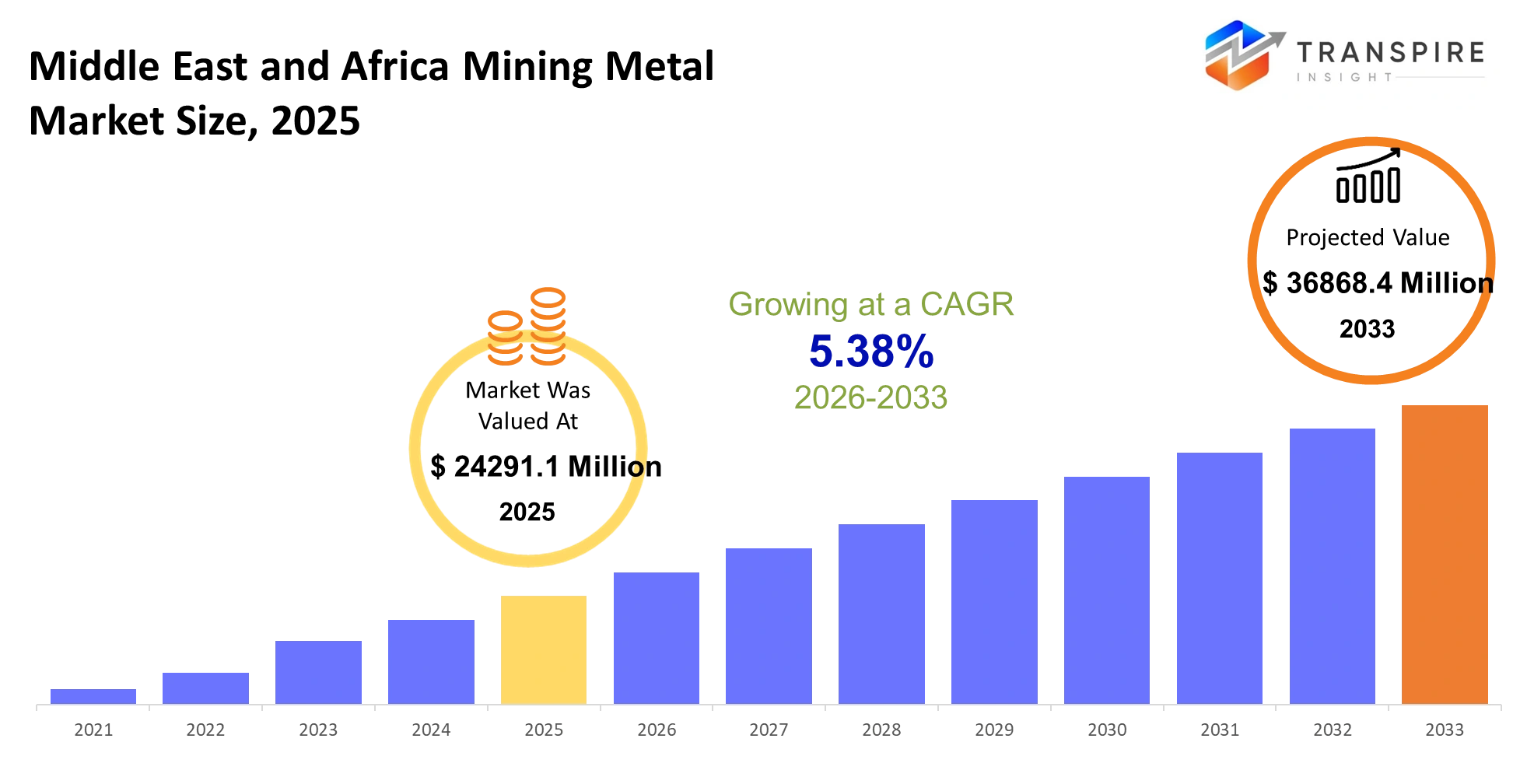
Middle East and Africa Mining Metal Market Size & Forecast:
- Middle East and Africa Mining Metal Market Size 2025: USD 24291.1 Million
- Middle East and Africa Mining Metal Market Size 2033: USD 36868.4 Million
- Middle East and Africa Mining Metal Market CAGR: 5.38%
- Middle East and Africa Mining Metal Market Segments: By Type (Ferrous Metals, Non-Ferrous Metals, Precious Metals, Rare Earth Metals, Others); By Application (Construction, Automotive, Electronics, Energy, Industrial Manufacturing, Others); By End-User (Mining Companies, Construction Firms, Automotive Sector, Electronics Industry, Energy Sector, Others); By Form (Ore, Refined Metal, Alloys, Others)
To learn more about this report,  Download Free Sample Report
Middle East and Africa Mining Metal Market Summary
The Middle East and Africa Mining Metal Market was valued at USD 24291.1 Million in 2025. It is forecast to reach USD 36868.4 Million by 2033. That is a CAGR of 5.38% over the period.
The Middle East and Africa mining metals market , supplies the raw stuff that kind of underpins construction , manufacturing , power generation , transport infrastructure, and industrial processing across emerging plus export-led economies. Copper, iron ore, bauxite, gold , platinum group metals, and industrial minerals back most things , from steel making and automotive assembly to renewable energy equipment and city building projects. Basically, the sector works like a strategic industrial spine that links natural resource removal with downstream manufacturing and the wider global commodity exchange.
Over the past five years, the whole market has been drifting toward higher-value mineral processing, local beneficiation rules ,and more investment in critical minerals connected with battery production and energy transition technologies. Governments in places like Saudi Arabia, South Africa ,and the Democratic Republic of Congo have expanded mining reforms and licensing schemes to pull in outside funds and lessen dependence on raw ore shipments. Then the supply chain hiccups after the Russia-Ukraine conflict, plus pandemic-era logistics constraints, also made manufacturers and commodity buyers rethink where they source from. That diversification has boosted interest in African mining holdings. As a result , exploration work has intensified, infrastructure spend has risen, and regional processing capability has grown, which creates steadier long-term revenue chances across extraction, refining, and export activities.
Key Market Insights
- Africa sort of dominates the Middle East and Africa Mining Metal Market, hitting nearly 68% market share in 2025 because of huge mineral reserves plus ongoing export activity that is hard to ignore.
- South Africa keeps a notable hold thanks to platinum, manganese, and chrome output, and it leans on already built mining infrastructure and logistics networks, which helps quite a bit.
- Saudi Arabia looks like the fastest mover through 2030, largely fueled by Vision 2030, mining sector diversification and also foreign investment incentives that keep coming.
- When it comes to the industry size, base metals are the main force, taking about 42% market share in 2025, mainly from copper, aluminum, and iron ore demand that keeps rolling.
- Precious metals stay the second-strongest segment, since gold and platinum exports bring solid foreign exchange revenue across many African economies.
- Battery minerals are the fastest-growing piece during the forecast, driven by rising lithium, cobalt, and nickel exploration investments and a kind of steady momentum.
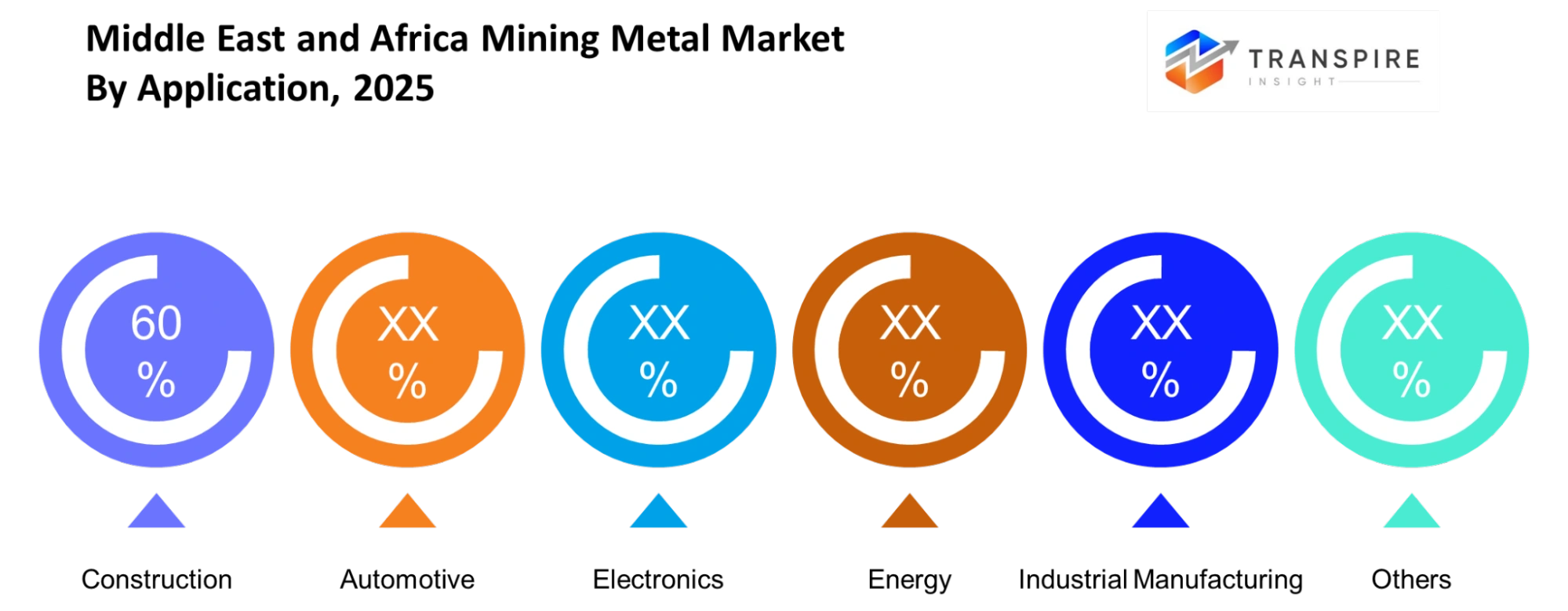
- For applications, construction and infrastructure take more than 38% share of the Middle East and Africa Mining Metal Market, mostly tied to transport upgrades and urban development projects.
- Renewable energy infrastructure is emerging as the fastest-growing application segment too, with copper and aluminum demand climbing for solar plus grid expansion.
- On the end-user side, industrial manufacturing is leading demand, supported by heavy consumption in steel fabrication, machinery production, and industrial heavy equipment manufacturing operations, day after day.
- Energy and utilities also appear as the fastest-growing end-user category through 2030, largely because renewable power and transmission infrastructure investments keep increasing.
What are the Key Drivers, Restraints, and Opportunities in the Middle East and Africa Mining Metal Market?
The strongest force pushing the Middle East and Africa Mining Metal Market is the global shift toward electrification and the energy transition—kind of that bigger reorientation of infrastructure. Electric vehicles, battery storage systems, transmission lines, and renewable energy initiatives need notably higher volumes of copper, cobalt, lithium, manganese, and aluminum compared with typical industrial setups. This transition picked up steam after 2021 , once governments in Europe, China and the Gulf increased clean power spending and also locked in longer term mineral supply understandings. African producers , especially in the Democratic Republic of Congo and Zambia, answered with expanded copper and cobalt efforts, while Saudi Arabia added mining funds under Vision 2030. So the outcome shows up as higher capital inflows, faster exploration work, and improved export earnings linked to critical mineral supply chains, in a more consistent way.
Infrastructure limits are still the most important structural obstacle when it comes to market growth. A lot of mining areas across Sub-Saharan Africa continue dealing with unreliable electricity grids, congested ports , thin rail connections, and not enough local refining capability. As a consequence, transport expenses rise, commissioning schedules get pushed back, and the business case for lower-grade mineral deposits becomes weaker. Unlike those cyclical commodity price swings, these infrastructure gaps demand multi-year public along with private investment programs, and they cannot be settled in a short sprint. This then slows the ramp up of production, and it quietly suppresses downstream industrial development chances.
A big growth opening sits in regional mineral beneficiation and in the processing of battery materials, where more value gets kept rather than being shipped out early.Countries such as Saudi Arabia, South Africa and Namibia are pushing domestic refining via tax incentives, industrial districts, and deals with overseas partners agreement. Meanwhile, new investments in copper smelting , lithium refining, and phosphate processing may slowly turn the region away from raw mineral exporting and toward a higher value manufacturing hub, which can mean better profit margins and more durable industrial income streams.
What Has the Impact of Artificial Intelligence Been on the Middle East and Africa Mining Metal Market?
Artificial intelligence together with advanced digital technologies are, sort of, reshaping mining and metal operations across parts of the Middle East and Africa. The big shift is more than just faster output: it helps extraction efficiency, makes assets more reliable, and also supports environmental compliance in ways that are much easier to document than before. More mining companies are rolling out AI -enabled fleet management systems, which automate haul truck routing, keep an eye on fuel use, and tune drilling precision in big copper, platinum and iron ore sites.
At the same time digital control platforms, now linked with IoT sensors, keep a live watch on conveyors, crushers, and processing units. This makes it easier for operators to cut unplanned downtime and keep ore throughput steadier, even when conditions change. It’s basically a continuous monitoring loop, that reduces surprises and smooths production rhythm.
Machine learning is also showing up in predictive maintenance programs. These models study vibration signatures, temperature shifts, and equipment stress records ahead of mechanical failures, so problems are caught before they turn into breakdowns. In fact, a number of major mining locations in South Africa and Saudi Arabia already use predictive analytics to boost equipment uptime and bring down maintenance expenses across processing plants and heavy machinery fleets.
Then there’s AI-driven ore grade analysis, plus automated mineral sorting solutions. Together they raise recovery outcomes while helping lower energy demand and water usage during processing. In practical terms, these tools strengthen operational performance and help teams respond to stricter emissions rules, and the sustainability reporting requirements that keep getting tighter.
Still, AI adoption isn’t fully smooth everywhere. There are structural limitations in remote mining areas, especially where network quality is weak. Limited digital infrastructure, unstable power, and high integration costs can block large-scale deployment. Smaller mining operations across parts of Africa often struggle most, because real time data collection is not consistent, so the full benefit of AI is harder to realize.
Key Market Trends
- Since 2022, Saudi Arabia expanded mining investment incentives, it sort of pushed foreign participation faster, especially in copper, phosphate, and rare earth exploration projects.
- African copper producers increasingly moved toward long-term supply contracts with electric vehicle battery manufacturers after cobalt price volatility got more intense during 2023 , so yeah the timing mattered.
- Mining operators across South Africa started using AI based predictive maintenance systems, which reduced unplanned equipment downtime , and also bumped processing plant utilization rates in practice.
- Since 2021, regional governments tightened beneficiation policies, so instead of exporting untreated mineral concentrates they encouraged domestic smelting and refining.
- Chinese and Gulf investors raised their stakes in African lithium and cobalt assets between 2022 and 2025 , largely for battery supply chain access , you could say it was a strategic move.
- Renewable energy projects across Namibia and South Africa accelerated the demand for copper, manganese, and aluminum used in transmission systems as well as solar infrastructure.
- Big mining companies , including BHP Group and Rio Tinto Group, expanded automation technologies to improve fuel efficiency and ore recovery performance, without making it too complicated.
- After 2021, port congestion and rail bottlenecks affected exporters , so many mining exporters ended up investing directly in logistics infrastructure and dedicated transport corridors.
- Digital ore sorting technologies gained wider adoption across platinum and gold operations , improving mineral recovery rates while lowering both water and energy consumption.
- Regional competition has shifted , from owning resources toward processing capability, as governments pursued higher-value mineral exports plus broader industrial manufacturing expansion.
Middle East and Africa Mining Metal Market Segmentation
By Type
Ferrous metals take up the largest share across regional mining and metal activities,mostly because steel production stays very strong. That demand comes from infrastructure, transport, and industrial construction projects. Iron ore extraction and steel manufacturing in South Africa, Saudi Arabia, and Algeria still feed the high volume consumption patterns. Big government infrastructure spending and railway expansion programs also made structural steel products more in demand from 2021 to 2025 ,so the momentum did not really slow. Meanwhile non-ferrous metals sit in the second place overall, since copper plus aluminum stay crucial for renewable energy systems, electrical transmission, and the fabrication of industrial machinery.
Precious metals keep bringing in solid export income, especially via gold and platinum mining operations in South Africa and several West African countries. Investment demand looks steady, and central bank gold buying backed production growth even when commodity prices swing. Rare earth metals are, kind of, the fastest-growing segment because battery manufacturing, electric mobility,and advanced electronics production have pushed global sourcing competition higher, than usual. Going ahead future investment activity will probably lean more toward copper, lithium, cobalt, and rare earth extraction projects, plus mining firms and refiners will likely expand regional processing capacity rather than merely exporting untreated ores.
By Application
Construction applications take the leading market stance because, in many places, urban sprawl, transport corridors, port expansions and industrial clusters all push demand for big volumes of steel, aluminum, and copper products. The Gulf’s and parts of Africa’s government supported infrastructure pushes, along with that, made procurement move faster— especially for reinforced steel and the industrial metals that go with it. Industrial manufacturing stays close behind since mechanical equipment production grows, fabrication operations multiply, and more localized processing industries take hold. Electronics and automotive use cases also picked up, not long after global manufacturers changed up their sourcing plans, mainly around copper, cobalt, lithium and nickel supply chains.
Energy applications are projected to expand the quickest through the forecast window, largely because renewable energy buildouts keep lifting regional metal consumption intensity. Solar farms, grid transmission lines, hydrogen initiatives, and battery storage systems tend to need higher amounts of conductive materials as well as corrosion resistant grades compared with older power setups. On the same note, automotive manufacturing adds pressure for greater aluminum volumes and specialty steel demand as regional assembly programs keep rolling forward. In the longer run, growth across energy and advanced manufacturing applications should lead suppliers to emphasize higher grade refined metals and more specialized alloy development.
To learn more about this report, Download Free Sample Report
By end user
Mining companies still stay the largest end user group, mainly because extraction operators directly eat up heavy machinery metals, industrial alloys, drilling gear, and various processing materials throughout their production sites. Big integrated mining groups carry on investing in operational modernization, fleet upgrades, and kind of digital processing technologies, to nudge production efficiency upward. Construction firms are also a major consumption base, especially for large urbanization pushes, commercial property building, and the extension of transportation infrastructure. The energy sector’s demand strengthened too, since pipeline networks , transmission systems, and new renewable installations started pulling more industrial metal procurement.
Automotive and electronics industries show faster long term growth routes, since manufacturers increasingly require battery minerals, conductive metals, and lightweight alloys for advanced production setups. Regional industrial diversification programs helped stimulate downstream manufacturing spending across Gulf economies and a few chosen African industrial centers. Electronics manufacturers keep locking in longer copper and cobalt supply arrangements, to cut down sourcing risks that come from global supply chain disruptions. Looking ahead, market expansion will probably raise collaborations between mining operators, refiners, and industrial manufacturers who are aiming for vertically integrated material supply networks.
By Form
The ore segment still feels like the dominant form section, because a lot of regional economies keep leaning on raw mineral extraction and export related activity. Copper ore, iron ore, bauxite, gold-bearing material and phosphate rock keep bringing meaningful export revenue across African mining jurisdictions. There is limited refining infrastructure, plus very high capital requirements for advanced processing plants , which in practice constrains the broader shift toward producing higher-value metal types. Even so , refined metals are slowly taking a stronger market position as governments more often push domestic beneficiation and industrial processing investments.
Alloys are the fastest-growing form segment, basically because renewable energy systems, transportation groundwork, and industrial machinery call for materials with better resistance to corrosion and wear. The demand for specialized steel alloys, aluminum blends, and high-performance industrial metals has gone up alongside manufacturing expansion and energy infrastructure projects. Processing investments in Saudi Arabia , South Africa, and the United Arab Emirates continue to back more localized refining and alloy production capability. Where the industry seems headed next is toward tighter integration between extraction, refining, and manufacturing operations , so export value improves, and dependence on imported finished metal products goes down.
What are the Key Use Cases Driving the Middle East and Africa Mining Metal Market?
Construction and infrastructure development are still the main use cases driving metal consumption across the region, at least from what everyone keeps saying. In Saudi Arabia, South Africa, and Egypt, steel, iron ore, and aluminum products help power railway expansion, commercial building activity, industrial zones and even port modernization initiatives. The bigger public infrastructure programs keep throwing off steady procurement demand, not just from construction companies but also engineering contractors, almost every quarter.
Over the last three years renewable energy and automotive manufacturing applications really got more traction. Copper plus aluminum demand climbed, mainly tied to solar power deployments, transmission line buildouts, and sites making electric vehicle components. A lot of industrial manufacturers and energy developers are also reaching for battery minerals such as cobalt, lithium, and manganese, for storage systems and grid modernization projects, in a more consistent manner.
There are newer pathways too, like hydrogen infrastructure, advanced battery processing, and localized mineral refining operations. In the Gulf, countries are investing more in downstream processing facilities to back industrial diversification plans and to lessen reliance on imported refined metal products. Meanwhile digital mining techniques and automated ore-sorting systems are showing up more often as well, especially across large scale mining operations where the returns are easier to track.
|
Report Metrics |
Details |
|
Market size value in 2025 |
USD 24291.1 Million |
|
Market size value in 2026 |
USD 25554.3 Million |
|
Revenue forecast in 2033 |
USD 36868.4 Million |
|
Growth rate |
CAGR of 5.38% from 2026 to 2033 |
|
Base year |
2025 |
|
Historical data |
2021 - 2024 |
|
Forecast period |
2026 - 2033 |
|
Report coverage |
Revenue forecast, competitive landscape, growth factors, and trends |
|
Regional scope |
Middle East and Africa (Saudi Arabia, United Arab Emirates, South Africa, Rest of Middle East and Africa) |
|
Key company profiled |
BHP, Rio Tinto, Vale, Glencore, Anglo American, Freeport-McMoRan, ArcelorMittal, Nucor, Tata Steel, POSCO, China Baowu, Vedanta, Teck Resources, Norsk Hydro, Alcoa |
|
Customization scope |
Free report customization (country, regional & segment scope). Avail customized purchase options to meet your exact research needs. |
|
Report Segmentation |
By Type (Ferrous Metals, Non-Ferrous Metals, Precious Metals, Rare Earth Metals, Others); By Application (Construction, Automotive, Electronics, Energy, Industrial Manufacturing, Others); By End-User (Mining Companies, Construction Firms, Automotive Sector, Electronics Industry, Energy Sector, Others); By Form (Ore, Refined Metal, Alloys, Others) |
Which Regions are Driving the Middle East and Africa Mining Metal Market Growth?
Southern Africa kind of leads regional mining and metal activity because its extraction infrastructure is more mature, export logistics are already set, and the mineral production base has been there for a long while. South Africa still feels like the main driver for platinum group metals, manganese, chrome, and gold output, mainly thanks to integrated rail corridors, deepwater ports and processing facilities that are already advanced. Also there are strong institutional mining frameworks and an experienced engineering ecosystem, so large projects can run at scale, and multinational investment groups tend to stick around. On top of that, existing refining capacity and established commodity trading networks help keep export competitiveness strong into European and Asian markets, even when demand shifts.
The Gulf region sits in the second-largest position, more through industrial diversification strategies than by having huge raw mineral reserves. Saudi Arabia and the United Arab Emirates kept expanding mining investment steadily via state-backed financing, industrial zones, and downstream processing incentives that tie into manufacturing growth. Regulatory planning tends to stay stable , and long-term infrastructure funding gives a sort of predictable environment for international mining firms and metal processors. As a result, consistent capital is deployed into phosphate, aluminum, and copper processing activities, which lets Gulf economies keep a steady regional revenue contribution, although their extraction volumes can be lower than what African producers deliver.
Central and West Africa look like the fastest-growing regional markets, mainly because copper, cobalt, lithium, and rare earth development projects are expanding quickly. After 2021, the global battery supply chain started diversifying , and that pulled investment toward the Democratic Republic of Congo, Zambia, Namibia, and Guinea, since manufacturers wanted alternatives to overly concentrated sourcing markets.New rail infrastructure , port modernization programs and cross border mining agreements helped improve export efficiency, and yeah they also reduced logistics constraints across a few emerging mining corridors. The growth momentum that’s building up in these regions creates pretty big openings for refining companies, infrastructure developers, equipment suppliers, and also long term institutional investors. Between 2026 and 2033 there should be a lot of room for collaboration, and for new strategies that stick around.
Who are the Key Players in the Middle East and Africa Mining Metal Market and How Do They Compete?
The Middle East and Africa metal mining sector looks semi consolidated, like a competitive set up where big multinational producers run the high volume extraction sites while regional companies sorta win on localized processing ,and logistics. A lot of the rivalry now hinges on getting hold of critical minerals, squeezing more operational efficiency out of assets, and having downstream refining know how, not just owning reserves. Most established mining groups still guard their slice of the market via automation, longer export arrangements, and supply chains that go in a straight line vertically integrated, sort of. Meanwhile newer players with support from Gulf sovereign funds and battery makers are shifting the playing field, because they’re putting major money into lithium, copper, cobalt, and rare earth projects that connect to electric vehicle and renewable energy supply chains.
In this landscape, Glencore plc competes using integrated commodity trading plus mining operations, which helps it react fast to swings in copper and cobalt demand across battery related networks. Its activities in the Democratic Republic of Congo give more direct access to large scale cobalt resources, which helps industrial customers with supply security. Rio Tinto Group leans on automated mining systems and also low carbon aluminum production that’s powered by renewable energy infrastructure. Its growth approach keeps returning to partnerships around critical minerals and investments in infrastructure that back African export corridors, more and more.
BHP Group keeps its focus on massive copper and potash expansion efforts supported by predictive maintenance systems and newer ore processing techniques, aimed at lowering production costs. Anglo American plc keeps a strong position through specialization in platinum group metals and by using digital mining platforms, so ore recovery improves and operational safety gets better too. Vale S.A. s
Company List
- BHP
- Rio Tinto
- Vale
- Glencore
- Anglo American
- Freeport-McMoRan
- ArcelorMittal
- Nucor
- Tata Steel
- POSCO
- China Baowu
- Vedanta
- Teck Resources
- Norsk Hydro
- Alcoa
Recent Development News
In February 2026, Glencore entered a memorandum of understanding with the Orion Critical Mineral Consortium regarding the potential acquisition of a 40% stake in Glencore’s Democratic Republic of Congo assets, Mutanda Mining and Kamoto Copper Company. The proposed transaction, valued at approximately $9 billion, aims to secure strategic copper and cobalt supply chains for Western markets while expanding investment into African critical mineral assets. https://www.glencore.com
In January 2026, Rio Tinto and Glencore resumed merger discussions involving a proposed mining combination valued at more than $200 billion. The potential merger highlighted increasing consolidation pressure across global mining companies seeking larger copper and critical mineral portfolios linked to energy transition demand. https://www.reuters.com
What Strategic Insights Define the Future of the Middle East and Africa Mining Metal Market?
Competition in mining metals across the Middle East and Africa is still fairly consolidated, kind of in a classic way where multinational producers hold the reins on big extraction, refining, and export infrastructure, while smaller regional operators keep pushing forward in these newer mineral corridors. The competitive squeeze is mostly not about who owns which deposit anymore, it’s more about getting access to critical minerals, having processing know-how, moving material with fewer delays, and achieving low-cost output. Meanwhile, the established mining groups keep trying to protect their footprint by putting money into automation, building vertically integrated supply chains, and signing long horizon commodity agreements with industrial buyers.
At the same time, there’s this growing disruption from Gulf-backed investors and entrants in the battery supply chain, they’re backing lithium, cobalt, and copper initiatives that are connected to electric vehicle manufacturing ,and to renewable energy infrastructure too, it’s like they’re changing the old competitive map.
BHP Group leans hard into copper and potash expansion to get stronger exposure to energy transition demand. They tend to stand out with advanced automation systems, predictive maintenance tools, and large-scale integrated logistics operations that lower operating costs across high volume mines. Rio Tinto Group instead builds its positioning around technology-led mining efficiency and low-carbon aluminum production, supported by processing plants powered by renewables. Their expansion plans are increasingly looking toward critical mineral partnerships and infrastructure bets across African export corridors, with the aim of keeping long term supply reliability.
Glencore plc keeps an edge via integrated commodity trading, tied directly to copper and cobalt production assets located in the Democratic Republic of Congo.This trading network lets you respond quicker to shifts in battery mineral needs, and it also kind of reinforces longer-term supply pledges with manufacturers. Anglo American plc stands out by using premium platinum group metal assets, plus it leans on digital mining platforms that help boost ore recovery rates and keep operational safety more solid. Meanwhile, Vale S.A. is still expanding logistics infrastructure , along with iron ore processing efficiency, to back cost-competitive exports going into Middle Eastern industrial and construction markets.
Middle East and Africa Mining Metal Market Report Segmentation
By Type
- Ferrous Metals
- Non-Ferrous Metals
- Precious Metals
- Rare Earth Metals
- Others
By Application
- Construction
- Automotive
- Electronics
- Energy
- Industrial Manufacturing
- Others
By End-User
- Mining Companies
- Construction Firms
- Automotive Sector
- Electronics Industry
- Energy Sector
- Others
By Form
- Ore
- Refined Metal
- Alloys
- Others
Frequently Asked Questions
Find quick answers to common questions.
The estimated Middle East and Africa Mining Metal Market size will be USD 36868.4 Million in 2033.
Key segments for the Middle East and Africa Mining Metal Market are By Type (Ferrous Metals, Non-Ferrous Metals, Precious Metals, Rare Earth Metals, Others); By Application (Construction, Automotive, Electronics, Energy, Industrial Manufacturing, Others); By End-User (Mining Companies, Construction Firms, Automotive Sector, Electronics Industry, Energy Sector, Others); By Form (Ore, Refined Metal, Alloys, Others).
Major Middle East and Africa Mining Metal Market players are BHP, Rio Tinto, Vale, Glencore, Anglo American, Freeport-McMoRan, ArcelorMittal, Nucor, Tata Steel, POSCO, China Baowu, Vedanta, Teck Resources, Norsk Hydro, Alcoa.
The Middle East and Africa Mining Metal Market size is USD 24291.1 Million in 2025.
The Middle East and Africa Mining Metal Market CAGR is 5.38% from 2026 to 2033.
- BHP
- Rio Tinto
- Vale
- Glencore
- Anglo American
- Freeport-McMoRan
- ArcelorMittal
- Nucor
- Tata Steel
- POSCO
- China Baowu
- Vedanta
- Teck Resources
- Norsk Hydro
- Alcoa
Recently Published Reports
-
Apr 2026
Active Power Filter Market
Active Power Filter Market Size, Share & Analysis Report By Type (Shunt Active Power Filters, Series Active Power Filter, Hybrid Active Power Filter), By Application (Harmonics Mitigation, Reactive Power Compensation, Voltage Regulation, Power Factor Correction), By Phase (Single Phase, Three Phase), By End-User Industry (Manufacturing, Healthcare, Commercial, Automotive, Oil and Gas, Others), and Geography (North America, Europe, Asia-Pacific, Middle East and Africa, South and Central America), 2021 - 2031
-
Apr 2026
Electrical Transformer Market
Electrical Transformer Market Size, Share & Analysis Report By Core (Closed, Shell, and Berry), By Insulation (Gas, Oil, Solid, Air, and Other), By Phase (Single, and Three), By Rating (100 MVA to 500 MVA, 501 MVA to 800 MVA, and 801 MVA to 1200 MVA), and Geography (North America, Europe, Asia-Pacific, Middle East and Africa, South and Central America), 2021 – 2031
-
Apr 2026
Hydraulic Piston Pumps Market
Hydraulic Piston Pumps Market Size, Share & Analysis Report By Type (Axial Piston Pumps, Radial Piston Pumps), By Operating Pressure (Low Pressure, Medium Pressure, High Pressure), By Application (Construction, Mining, Agriculture, Automotive, Oil & Gas, Industrial Machinery, Others), By End-User (OEMs, Aftermarket), and Geography (North America, Europe, Asia-Pacific, Middle East and Africa, South and Central America), 2021 – 2031
-
Apr 2026
Laboratory Gas Generators Market
Laboratory Gas Generators Market Size, Share & Analysis Report By Product (Nitrogen Gas Generator, Hydrogen Gas Generator, Zero Air Gas Generator, Purge Gas Generator, TOC Gas Generators, Others), By Application (Gas Chromatography, Liquid Chromatography-mass Spectrometry (LC-MS), Gas Analyzers, Others), By End-user (Life Science, Chemical & Petrochemical, Food & Beverage, Others), and Geography (North America, Europe, Asia-Pacific, Middle East and Africa, South and Central America), 2021 – 2031